
The verdict
A capable mid-size suv, strong on safety and held back by ownership.
The 2026 Kia EV9 is the most convincing family-first three-row EV you can buy for under $70,000: a genuinely adult-sized third row, 42.8 inches of sliding second-row legroom, an IIHS Top Safety Pick+ award, and running costs around $950 a year on home charging. New for 2026, every EV9 gets a factory NACS port, so Tesla's 21,500-plus Superchargers work without an adapter. The catch is money over time — 283 miles of range on the volume Wind AWD trails the closely related Ioniq 9 by roughly 40 miles, and forecast resale of about 39% at five years is the worst number on this scorecard. Buy it if you plan to keep it and charge at home; lease it or buy it used if you don't.
Jump to scoresStrengths
- Safety credentials with nothing held back for upper trims
- A third row adults will actually sit in
- Cheap to feed compared with any gas three-row
What holds it back
- Depreciation is brutal — the single worst number here
- 283 miles of range is the compromise you sign up for
- Big outside, only average for cargo
Top alternatives
Cars shoppers cross-shop with the Kia EV9 2.95B-
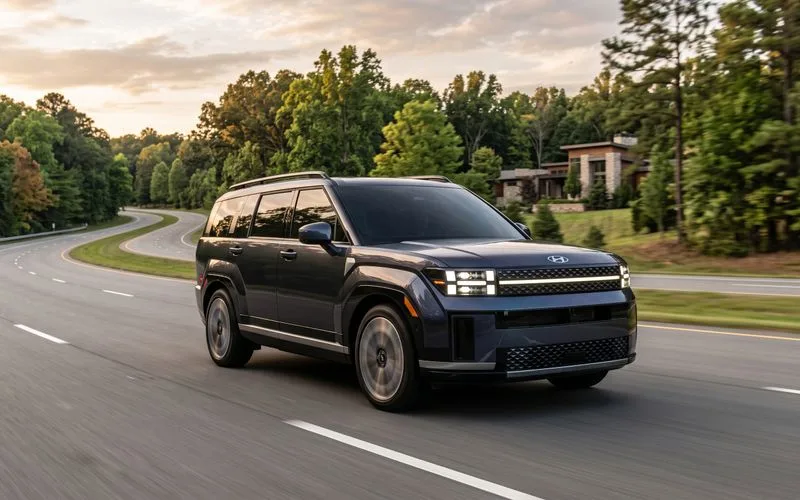 Hyundai Ioniq 9Mid-Size SUVBetter at: Range
Same platform and tow rating with roughly 40 more miles of range from a bigger 110.3-kWh battery, if you'll pay about $4,000 more for it.
Compare 2.79B-
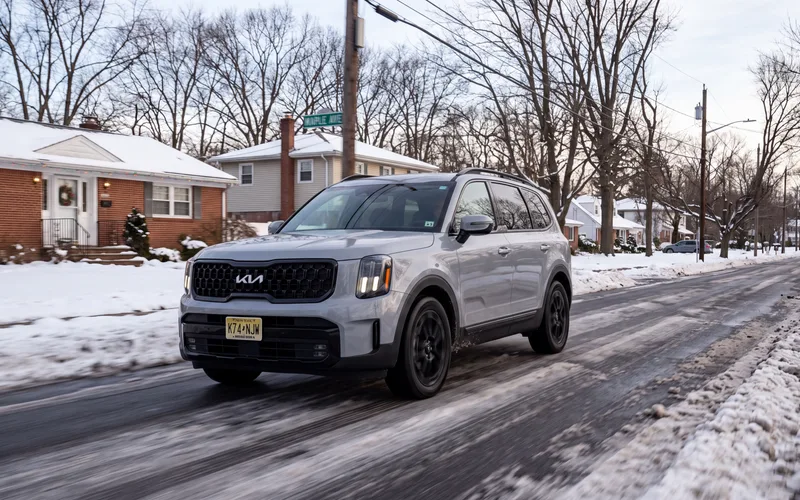 Kia TellurideMid-Size SUVBetter at: Resale value
The same three-row space and warranty for far less money, with none of the charging logistics or the EV9's steep depreciation.
Compare 2.81B-
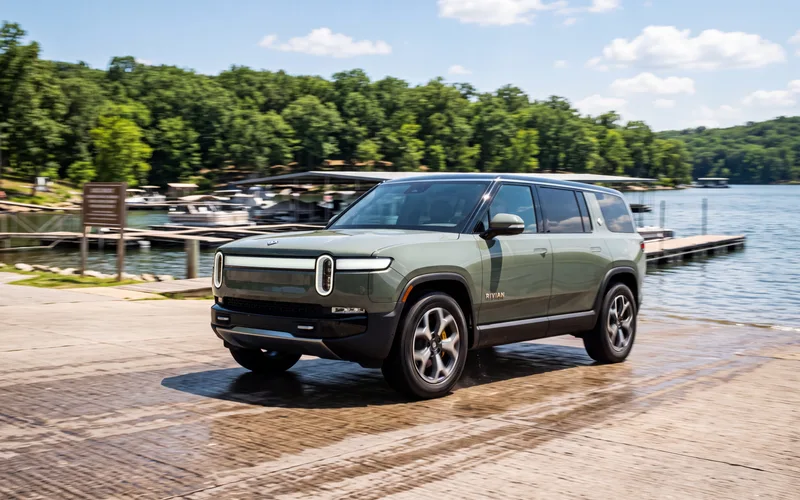 Rivian R1SFull-Size Luxury SUVBetter at: Off-road capability
For buyers who want a three-row EV that can actually leave the pavement and go 400 miles between charges, and can absorb the price jump.
CompareSubject scores by year
Hover or tap a score to see what moved it versus the year before. A corner mark flags a big swing.
| Year | Performance | Efficiency | Safety | Space | Cost | Reliability | Tech | Use-case | Driving | Value |
|---|---|---|---|---|---|---|---|---|---|---|
| 2026 | 66 | 71 | 86 | 76 | 35 | 58 | 82 | 72 | 71 | 79 |
| 2025 | 66 | 70 | 86 | 70 | 34 | 52 | 78 | 70 | 70 | 79 |
| 2024 | 66 | 70 | 84 | 71 | 34 | 50 | 72 | 69 | 70 | 80 |
Compare two years
Best fit & conditions
Higher scores mean a better fit for that use case. Learn more about use-case fit →
Subject profile
Academic Probation · NHTSA safety recalls
Aug 21, 2026Air bags: sensor: occupant classification: front passengerDue to improper routing, the Occupant Detection System (ODS) may not deactivate the air bag when a child or child seat is in the front passenger seat. As such, these vehicles fail to comply with the requirements of Federal Motor Vehicle Safety Standard number 208, "Occupant Crash Protection."
Defect
Kia America, Inc (Kia) is recalling certain 2025-2026 EV9 vehicles. Due to improper routing, the Occupant Detection System (ODS) may not deactivate the air bag when a child or child seat is in the front passenger seat. As such, these vehicles fail to comply with the requirements of Federal Motor Vehicle Safety Standard number 208, "Occupant Crash Protection."
Risk
A child in the front seat may be at a greater risk of injury if the air bag deploys during a crash.
Remedy
Dealers will inspect and replace the ODS mat and bladder tube with a new one and ensure proper routing as necessary, free of charge. Owner notification letters will be mailed beginning October 20, 2026. Owners may contact Kia Customer Service at 1-800-333-4542. Kia's number for this recall is SC379. Vehicle Identification Numbers (VINs) involved in this recall will become searchable on NHTSA.gov on September 4, 2026.
NHTSA campaign 26V545000 ↗Manufacturer no. SC37921,290 vehicles potentially affected (all models in the campaign)Owners notified Oct 9, 2026Filed by Kia America, Inc.Filed as EV9Jan 26, 2026Electrical system: instrument cluster/panelDue to a software error, the instrument panel display may fail. As such, these vehicles fail to comply with the requirements of Federal Motor Vehicle Safety Standard (FMVSS) numbers 101, "Controls and Displays" and 138, "Tire Pressure Monitoring System."
Defect
Kia America, Inc. (Kia) is recalling certain 2025 Kia K4, 2025-2026 Sorento, Sorento Hybrid, Sorento Plug-In Hybrid Electric (PHEV), 2026 Sportage, Sportage Hybrid, Sportage PHEV, K5, EV9, Carnival, and Carnival Hybrid vehicles. Due to a software error, the instrument panel display may fail. As such, these vehicles fail to comply with the requirements of Federal Motor Vehicle Safety Standard (FMVSS) numbers 101, "Controls and Displays" and 138, "Tire Pressure Monitoring System."
Risk
An instrument panel display that fails to show critical safety information, such as the speedometer, tire pressure, or warning lights, increases the risk of a crash.
Remedy
The instrument panel display software will be updated over-the-air (OTA) or by a dealer, free of charge. Owner notification letters are expected to be mailed March 26, 2026. Owners may contact Kia Customer Service at 1-800-333-4542. Kia's number for this recall is SC361. Vehicle Identification Numbers (VINs) involved in this recall will become searchable on NHTSA.gov on February 9, 2026.
NHTSA campaign 26V046000 ↗Manufacturer no. SC36142,677 vehicles potentially affected (all models in the campaign)Owners notified Mar 13, 2026Filed by Kia America, Inc.Filed as EV9
8 recalls on other model years of the EV9 (2024–2025)
Jul 2, 2026Electrical system: propulsion system: traction batteryThe high voltage battery cells may contain misaligned electrodes, which can lead to a fire while parked or driving.
Defect
Kia America, Inc. (Kia) is recalling certain 2022-2024 EV6 and 2024 EV9 vehicles. The high voltage battery cells may contain misaligned electrodes, which can lead to a fire while parked or driving.
Risk
A fire increases the risk of injury.
Remedy
Owners are advised to park outside and away from structures and limit their charge to a maximum of 80% until the recall repair is complete. Dealers will replace the high voltage battery system assembly, free of charge. Owner notification letters are expected to be mailed August 7, 2026. Owners may contact Kia customer service at 1-800-333-4542. Kia's number for this recall is SC375. Vehicle Identification Numbers (VINs) involved in this recall will become searchable on NHTSA.gov beginning July 17, 2026.
NHTSA campaign 26V431000 ↗Manufacturer no. SC3758 vehicles potentially affected (all models in the campaign)Owners notified Aug 7, 2026Filed by Kia America, Inc.Filed as EV9Feb 24, 2025Electrical system: propulsion system · Power train: driveline: driveshaftThe rear gear drive unit (GDU) motor shaft may have been improperly welded and become damaged, causing a loss of drive power.
Defect
Kia America, Inc. (Kia) is recalling certain 2025 EV9 vehicles. The rear gear drive unit (GDU) motor shaft may have been improperly welded and become damaged, causing a loss of drive power.
Risk
A loss of drive power increases the risk of a crash.
Remedy
Dealers will replace the rear GDU, free of charge. Owner notification letters were mailed March 7, 2025. Owners may contact Kia customer service at 800-333-4542. Kia's number for this recall is SC337.
NHTSA campaign 25V115000 ↗Manufacturer no. SC337342 vehicles potentially affected (all models in the campaign)Owners notified Mar 7, 2025Filed by Kia America, Inc.Filed as EV9Dec 20, 2024Seats: critical fastenersThe second- and third-row seat mounting bolts may be missing.
Defect
Kia America, Inc. (Kia) is recalling certain 2024-2025 EV9 vehicles. The second- and third-row seat mounting bolts may be missing.
Risk
Seats without mounting bolts may not properly restrain an occupant, increasing the risk of injury.
Remedy
Dealers will inspect and install mounting bolts as necessary free of charge. Owner notification letters were mailed January 24, 2025. Owners may contact Kia customer service at 1-800-333-4542. Kia's number for this recall is SC329.
NHTSA campaign 24V962000 ↗Manufacturer no. SC32922,883 vehicles potentially affected (all models in the campaign)Owners notified Jan 24, 2025Filed by Kia America, Inc.Filed as EV9Oct 10, 2024Electrical system: instrument cluster/panel · Electrical system: softwareDue to a software error, the instrument panel screen may fail. As such, these vehicles fail to comply with the requirements of Federal Motor Vehicle Safety Standard number 101, "Controls and Displays."
Defect
Kia America, Inc. (Kia) is recalling certain 2024-2025 EV9 vehicles. Due to a software error, the instrument panel screen may fail. As such, these vehicles fail to comply with the requirements of Federal Motor Vehicle Safety Standard number 101, "Controls and Displays."
Risk
An instrument panel screen that fails to display critical safety information, such as the speedometer or warning lights, can increase the risk of a crash.
Remedy
The instrument cluster software will be updated by a dealer or through an over-the-air (OTA) update, free of charge. Owner notification letters were mailed October 25, 2024. Owners may contact Kia Customer Service at 1-800-333-4542. Kia's number for this recall is SC326.
NHTSA campaign 24V757000 ↗Manufacturer no. SC32614,163 vehicles potentially affected (all models in the campaign)Owners notified Oct 25, 2024Filed by Kia America, Inc.Filed as EV9Sep 17, 2024Parking brake: electrical: control module: softwareA software error may cause the remote smart parking assist feature, which allows the operator to remotely move the vehicle, to miscalculate stopping distances.
Defect
Kia America, Inc. (Kia) is recalling certain 2024 EV9 vehicles. A software error may cause the remote smart parking assist feature, which allows the operator to remotely move the vehicle, to miscalculate stopping distances.
Risk
A remote smart parking assist feature that miscalculates stopping distances may increase the risk of a crash.
Remedy
Dealers will update the integrated electronic brake software, free of charge. Owner notification letters were mailed October 4, 2024. Owners may contact Kia customer service at 1-800-333-4542. Kia's number for this recall is SC324.
NHTSA campaign 24V693000 ↗Manufacturer no. SC32412,400 vehicles potentially affected (all models in the campaign)Owners notified Oct 4, 2024Filed by Kia America, Inc.Filed as EV9Jun 4, 2024Structure: interior panels: ceilingThe headliner may not adequately protect passengers from impact in a crash. As such, these vehicles fail to comply with the requirements of Federal Motor Vehicle Safety Standard number 201, "Occupant Protection In Interior Impact."
Defect
Kia America, Inc. (Kia) is recalling certain 2024 EV9 vehicles. The headliner may not adequately protect passengers from impact in a crash. As such, these vehicles fail to comply with the requirements of Federal Motor Vehicle Safety Standard number 201, "Occupant Protection In Interior Impact."
Risk
A headliner with inadequate impact protection increases the risk of injury during a crash.
Remedy
Dealers will replace the impact absorbing plates mounted on the headliner, free of charge. Owner notification letters were mailed July 30, 2024. Owners may contact Kia customer service at 1-800-333-4542. Kia's number for this recall is SC317.
NHTSA campaign 24V400000 ↗Manufacturer no. SC3172,401 vehicles potentially affected (all models in the campaign)Owners notified Jul 30, 2024Filed by Kia America, Inc.Filed as EV9May 14, 2024Seat belts: front: retractorThe front passenger seat belt retractor cover may not be secured properly, which can cause the front passenger seat belt automatic locking retractor (ALR) and emergency locking retractor (ELR) to not operate as intended. As such, these vehicles fail to comply with the requirements of Federal Motor Vehicle Safety Standard numbers 208, "Occupant Crash Protection" and 209, "Seat Belt Assemblies."
Defect
Kia America, Inc. (Kia) is recalling certain 2024 EV9 vehicles. The front passenger seat belt retractor cover may not be secured properly, which can cause the front passenger seat belt automatic locking retractor (ALR) and emergency locking retractor (ELR) to not operate as intended. As such, these vehicles fail to comply with the requirements of Federal Motor Vehicle Safety Standard numbers 208, "Occupant Crash Protection" and 209, "Seat Belt Assemblies."
Risk
A seat belt retractor that does not operate as intended increases the risk of injury in a crash.
Remedy
Dealers will replace the front passenger seat belt assembly, free of charge. Owner notification letters were mailed June 5, 2024. Owners may contact Kia customer service at 1-800-333-4542. Kia's number for this recall is SC312.
NHTSA campaign 24V338000 ↗Manufacturer no. SC3124 vehicles potentially affected (all models in the campaign)Owners notified Jun 5, 2024Filed by Kia America, Inc.Filed as EV9Apr 16, 2024Power train: driveline: differential unitThe differential gear bolts in the gear drive unit may not be tightened properly, which can result in a loss of drive power or cause the differential to lock up.
Defect
Kia America, Inc. (Kia) is recalling certain 2023 Niro EV and 2024 EV9 vehicles. The differential gear bolts in the gear drive unit may not be tightened properly, which can result in a loss of drive power or cause the differential to lock up.
Risk
A loss of drive power or differential lock up can increase the risk of a crash.
Remedy
Dealers will replace the gear drive unit, free of charge. Owner notification letters were mailed May 17, 2024. Owners may contact Kia customer service at 1-800-333-4542. Kia's number for this recall is SC308.
NHTSA campaign 24V271000 ↗Manufacturer no. SC3088 vehicles potentially affected (all models in the campaign)Owners notified May 17, 2024Filed by Kia America, Inc.Filed as EV9
Source: NHTSA Office of Defects Investigation recall database, model years 2024–2026. Recalls are listed by model year as the manufacturer filed them; whether a specific car is affected depends on its VIN — check a VIN at nhtsa.gov ↗. NHTSA model names matched to this page: EV9.
Detailed scoring by subject
1Performance & PowertrainOne of the EV9's weakest categories.2.49C+
The volume configuration is the dual-motor e-AWD Wind/Land with the 99.8 kWh pack, rated 379 hp; new for 2026 the lineup is topped by a 501 hp GT (215 hp front / 362 hp rear motors).
Dual-motor AWD trims make 443 lb-ft standard, rising to 516 lb-ft when the optional Boost function is activated on Wind, Land and GT-Line.
Instrumented testing of the dual-motor Land AWD returned 5.1 s to 60 mph, comfortably quicker than Kia's conservative 5.7 s estimate; the new GT drops that to a claimed 4.3 s.
Instant, lag-free dual-motor delivery on an 800V E-GMP architecture with no combustion or hybrid hand-offs to smooth over; reviewers consistently describe power delivery as effortless and unstrained even fully loaded.
Single-speed direct-drive gearing means no shifts to fumble; regen is paddle-adjustable with well-executed i-Pedal one-pedal driving. Not a perfect score only because the GT's Virtual Gear Shift is a synthetic layer some drivers find gimmicky rather than an improvement.
Dual-motor AWD trims are rated at 5,000 lbs with the tow package, matching the platform-sibling Ioniq 9 and leading most three-row EVs, though well short of body-on-frame gas SUVs.
Dual-motor e-AWD is standard on every trim above the entry Light RWD pair — Wind, Land, GT-Line and the new GT — with Snow/Mud/Sand terrain modes and instant electronic torque split, but no low range or locking differentials.
7.8 in of ground clearance on AWD trims plus electronic terrain modes cover a gravel road or a snowy driveway, but there is no off-road trim, no skid plating, no low range and no underbody protection for the battery pack — this is a pavement-first family EV.
Battery-electric only — no gas, hybrid or PHEV alternative — but the EV9 spreads that single technology across four distinct outputs (201/215 hp RWD, 379 hp AWD, 501 hp GT) and two battery sizes, which is more choice than most single-powertrain vehicles offer.
2Efficiency & RangeGrades above the middle of the scale.2.78B-
The volume Wind AWD rates 84 MPGe combined — roughly 40 kWh/100 mi to move a 5,700-lb three-row SUV, which is honest work but unremarkable against the EV field: the 65–125 MPGe EV band puts it below a third of the way up, and the two-row EVs it shares a showroom with (EV6 at 105+) are in another tier.
City is the EV9's strongest EPA figure — regen reclaims most of what a heavy three-row body throws away in stop-and-go — but 94 MPGe still lands in the lower third of the 70–140 MPGe EV band, because mass, not driving cycle, is the binding constraint here.
Highway falls nearly 20 MPGe below city: the EV9's upright, boxy three-row shape pays a frontal-area penalty at speed that regeneration cannot offset. Against the 60–110 MPGe EV highway band that is a weak result, and it is the figure a road-tripping family will actually live with.
The 99.8-kWh pack carries the dual-motor Wind AWD 283 miles — mid-pack against the 200–400 mi EV SUV band, and about 37 miles short of its own E-GMP sibling the Ioniq 9, which fits a larger 110.3-kWh battery in a near-identical body. Buyers wanting the headline 305 miles have to give up all-wheel drive.
The 800-volt E-GMP architecture accepts a manufacturer-rated 210 kW — genuinely quick, and third-party logging shows the curve holding near 200 kW from roughly 10% to 60% rather than spiking and collapsing. Still, it trails the 240–260 kW its newer Hyundai/Kia siblings (EV6, Ioniq 5, Ioniq 9) now claim, so within the EV field this is good rather than class-leading.
Kia quotes 24 minutes 10–80% on 350 kW hardware for the 99.8-kWh pack and logged sessions land in the 23–25 minute range, so the claim holds up in the field. The caveat that matters for 2026: at the Tesla stalls the new native port unlocks, Kia's own table quotes 34 minutes, because a 400-volt Supercharger cannot feed the 800-volt pack at full rate.
EPA puts the AWD EV9 at $900 a year at 15,000 miles — comfortably under half what a comparable gas three-row SUV burns, and mid-band against other EVs. The figure assumes home charging; a buyer living on public DC fast charging would pay two to three times as much.
No gasoline at any grade, and cheap overnight home charging is the normal case: a 10.9-kW onboard charger fills the big pack in 6h45m–8h45m on 240V, with V2L and a 120/240V cable in the box. The 2026 factory NACS port opens 21,500+ Superchargers without an adapter, and Plug & Charge — not yet working when the car launched — is now available, which is what lifts this a point. Two frictions keep it just under the EV6 (95) and Ioniq 5 (94): Plug & Charge still arrives through a dealer-applied update rather than over the air, and the convenience is not free on speed, since Kia's own table shows a NACS stall taking 34 minutes against 24 on a 350 kW CCS charger, which now needs the adapter instead.
3SafetyThe EV9's best-graded category.3.87A+
NHTSA rates the 2026 EV9 at the maximum 5 stars overall — top of the 3–5 star SUV band — though the component scores are uneven, with 4 stars in both the frontal and rollover tests.
A 2026 IIHS TOP SAFETY PICK+ under the tightened 2026 criteria, with Good ratings in small overlap front, the updated moderate overlap front (which now grades rear-passenger protection) and the updated side test. Just short of a clean sweep because the vehicle-to-vehicle front crash prevention 2.0 result is certified only as 'acceptable or good', and the underlying crash results come from a manufacturer-conducted 2024 test carried across to 2025–26.
Every trim from the base Light up carries the full Kia Drive Wise suite — forward collision-avoidance with pedestrian, cyclist and junction-turning detection, lane departure warning, lane keeping and lane following, blind-spot collision-avoidance, rear cross-traffic alert, driver attention warning, front and rear parking sensors — plus navigation-based smart cruise and Highway Driving Assist 2, a lane-centering highway assist most three-row rivals reserve for upper trims. Only the camera-based conveniences (surround-view, Blind-Spot View Monitor) require stepping up from the base Light.
Clears the stringent 2026 IIHS front crash prevention bar with a Good pedestrian result — stronger than several Hyundai/Kia siblings, which certify only as 'acceptable or good' — while the vehicle-to-vehicle front crash prevention 2.0 test, which adds higher speeds and a motorcycle target, lands at 'acceptable or good' rather than a confirmed Good.
Blind-Spot Collision-Avoidance Assist is standard on every trim and steers/brakes rather than merely warning, with rear cross-traffic alert and Safe Exit Assist also standard; the camera-based Blind-Spot View Monitor that projects the blind zone into the cluster arrives one step up at Light Long Range. No trailer-aware blind-spot coverage is offered.
HDA 2 layers map-aware lane centering over standard lane keeping and lane following and adds signal-initiated assisted lane changes, standard on every trim. Long-term owners report it holds position confidently over hundreds of highway miles, docked for a recurring complaint that the centering occasionally bounces within the lane rather than tracking dead-center.
Full-speed-range stop-and-go Smart Cruise Control with navigation-based speed adjustment, integrated into HDA 2 highway assist and standard on every trim — a genuinely well-integrated package. Held below the top band by owner reports of over-eager behavior in curves, where the system accelerates hard back to set speed once the lead vehicle drifts out of the sensor's view.
No hands-free option in the US market at any price. HDA 2 is a capable Level 2 system but is explicitly hands-on — release the wheel for a few seconds and it escalates to cluster and audible warnings — so it does not compete with Ford BlueCruise, GM Super Cruise or Tesla's supervised systems offered by rivals in this class.
IIHS rates the EV9's headlights Good as standard equipment across the range with no glare violations, and standard High Beam Assist compensates for the low beams' weak spots. Short of a perfect score because IIHS tests two headlight variations and both show Fair visibility on one curve — the sharp left on high beam, the gradual left on low.
The boxy, upright greenhouse gives the EV9 genuinely good natural sightlines and a large glass area — a real advantage over the swoopy three-row EVs it competes with — with only thick rear pillars and chunky A-pillars cutting into the view. Camera compensation is comprehensive from Light Long Range up (360° surround view plus Blind-Spot View Monitor, digital rearview mirror on Land), leaving just the base Light without it.
Strong for a three-row: exposed, easy-to-find lower anchors and top tethers in both the second and third rows, wide door openings and enough second-row legroom that the Cars.com Car Seat Check rated the second row very highly. Docked because the third row's fixed head restraints push a car seat off the seatback and its tight legroom drags the rearmost grades down.
4Space & ComfortGrades above the middle of the scale.3.13B
The 2026 EV9 is a three-row SUV standard with a second-row bench for seven-passenger seating; six-passenger captain's chairs (including the 180-degree swiveling and VIP relaxation variants) are optional on upper trims.
Boxy E-GMP three-row packaging gives near-best-in-segment front headroom; figure is for the non-sunroof configuration.
Front legroom is the EV9's weakest interior dimension — 41.4 in is modest for a 197-in-long SUV because the flat EV floor and long wheelbase are spent on rows two and three rather than the front footwells.
Second-row headroom of 39.8 in sits at the top of the mid-size SUV band thanks to the upright roofline and squared-off greenhouse.
42.8 in of sliding second-row legroom is above the top of the SUV normalization band and rivals a minivan; the 122-in wheelbase and flat floor are the payoff.
Genuinely adult-usable third row — 39.5 in of headroom and 29.9–32.0 in of legroom depending on second-row seat type, with easy walk-in access from a second row that both folds and slides, plus dedicated USB-C ports and cupholders back there.
43.5 cu ft with the third row folded is mid-pack rather than class-leading — the third row eats into the load floor, and 20.2 cu ft behind row three is only average for a three-row SUV.
81.7 cu ft with rows two and three folded is competitive for a mid-size three-row SUV, helped by a flat EV floor, though it trails the biggest gas three-rows and the larger Ioniq 9.
Well above the everyday-competitive bar: sliding center console with under-tray, extendable second-row console with fold-out tables, 180-degree swiveling second-row captain's chairs, underfloor storage, and interior V2L power that runs household devices. The small frunk (1.8 cu ft on AWD trims) is the one real miss.
Eight-way power, heated and ventilated front seats are standard on every trim — unusual at any price — and upper trims add reclining VIP relaxation seats with leg rests and massage in row two. Even the third row draws praise relative to same-size rivals.
The 122-in wheelbase and ~6,000 lb curb weight give a settled, composed highway ride with minimal vertical motion over undulating pavement; for 2026 an electronically controlled suspension arrives (a Kia SUV first) on the new GT. Large wheels on GT-Line trims add some firmness over sharp edges, keeping it just short of the plush-and-controlled top band.
No engine noise, an acoustic windshield and acoustic front side glass standard on every trim, and heavy sound insulation make this one of the quietest cabins in the mid-size three-row class at highway speed.
Rich and mostly standard: tri-zone automatic climate control with a dedicated 5-in HVAC display, heated and ventilated front seats, and six USB ports on every trim, with a heated steering wheel from Wind up, ventilated second row and relaxation seats on Land, second-row window shades, and remote pre-conditioning through the Kia Access app.
5Cost of OwnershipThe EV9's lowest-graded category.0.32F
Entry Light SR RWD opens at $54,900 plus a $1,495 freight charge. That is roughly $4K cheaper to start than the platform-sibling Ioniq 9, but still well up the SUV price band because this is a premium three-row EV rather than a mainstream mid-size SUV.
Wind AWD is the trim reviewers uniformly point buyers to and the configuration that dominates dealer stock — $63,900 plus $1,495 destination. At $65,395 it sits near the top of the SUV volume-price band.
Genuinely cheap to service by three-row standards — no oil, plugs or belts, 8,000-mile/12-month inspection intervals, brake fluid at 4 yr and HV coolant not until ~10 yr — but a 5,700-lb SUV on 19–21-inch rubber eats tires and brakes, and 20/21-inch sets run $1,000–$1,600 installed. Set just above the KBB maintenance line to carry a small repair allowance.
Depreciation is the EV9's worst ownership metric and lands below the bottom of the SUV band. The September 30, 2025 expiry of the $7,500 federal credit reset new-EV transaction prices downward — average new-EV price fell 12.3% in the six months after — and forecast residuals fell with them; large three-row EVs took the hardest hit.
Kia's 5-year/60,000-mile Basic warranty tops the framework band outright and remains best-in-class among mainstream brands alongside Hyundai's.
Kia's 10-year/100,000-mile coverage extends to the full EV system — drive motor, high-voltage battery, EPCU and on-board charger — and carries an explicit 70% capacity guarantee. Maximum-band coverage and a genuine risk reducer on a battery this expensive.
No included scheduled maintenance — Kia has never run a US complimentary-maintenance program, and that is the single reason this isn't an 80+. What surrounds it is strong for 2026: the EV9 switches to a factory NACS port this year with Plug & Charge, so Tesla Supercharger access (21,500+ stalls) works without an app, a CCS1 adapter is included in the box, and 5 yr / 60,000 mi roadside assistance plus a Kia Connect trial come standard.
$65,395 volume-trim price minus its estimated resale value after 5 years (39% retained, or about $25,504) leaves about $39,891 in depreciation. Add the projected $4,600 in 5-year maintenance and repairs, and owning this vehicle for 5 years costs about $44,491 in total.
6Reliability & QualityOne of the EV9's weakest categories.1.88C-
Both major predictors put the EV9 below average: Consumer Reports expects the 2026 EV9 to be less reliable than the average new car, and J.D. Power rates predicted reliability 67/100, inside its "Fair" (below-average) band. Owner-survey trouble spots are electrical and in-car electronics rather than motor or pack failures, which caps the downside but keeps it under the segment mean.
Kia sits solidly mid-pack and trending up rather than top-tier: 9th overall in the 2026 J.D. Power Vehicle Dependability Study at 193 PP100 (up two places year over year) and 13th on the Consumer Reports 2026 Brand Report Card. That is a credible mainstream record but short of the consistently top-5 brands.
This generation has drawn repeated campaigns of real consequence — a 2024 high-voltage battery recall for misaligned cell electrodes with fire risk, a 2025 rear gear drive unit motor-shaft weld defect causing loss of drive power, and a 2026 instrument-cluster software recall (FMVSS 101/138) — plus the platform-wide ICCU service campaign SC327Y. The 2026 build's own exposure is limited to the software fix, which keeps this out of the worst band.
The E-GMP traction motors and 99.8 kWh pack have no broad failure pattern — long-term press fleet EV9s have run tens of thousands of miles without catastrophic failures — but the platform's ICCU is a documented weak point that drains the 12V battery and can trigger no-start or limp mode, and a class action alleges replacement ICCUs share the defect. Mixed history on an otherwise sound powertrain family.
Well above the mainstream three-row norm — plastics are well textured and tightly assembled, the SynTex synthetic leather is standard across trims and convincingly imitates hide, and the recycled/bio-sourced material story is genuine rather than cosmetic. It falls short of class-leading for a Premium price class because lower trims go without metal or faux-metal accents and use a lot of plain black plastic.
Assembly is generally solid for a US-built (Kia Georgia) three-row, and long-term testers report only alignment tweaks over high mileage, but early-build owners report enough loosely mounted driver seats, center-console rattles and misaligned trim or latches — some needing repeat dealer visits — to hold it in the "generally solid with scattered complaints" band.
Coverage is genuinely nationwide — roughly 800–1,000 US Kia franchises — which beats any direct-sales EV rival for physical access. Service satisfaction is the weak half: Kia placed 12th at 835 points in the 2026 J.D. Power CSI, below the 868 industry average, and EV-specific work concentrates on the subset of stores with trained high-voltage technicians.
Routine running costs are ordinary-to-good for the class at roughly $800–900 a year, and Kia's 10-year/100,000-mile powertrain and EV battery warranties absorb the expensive failure modes for most of the ownership window. Against that, high-voltage components like the ICCU and cell monitoring unit are effectively dealer-only with elevated EV labor rates and negligible aftermarket, so out-of-warranty exposure is real.
7Technology & InfotainmentOne of the EV9's strongest categories.3.57A-
US-market 2026 EV9 uses Kia's ccNC 'Triple Panorama Display' — a 12.3-inch center touchscreen paired with a 12.3-inch cluster and a 5-inch climate strip — standard from the base Light RWD trim upward, with no larger screen offered on any trim.
The ccNC system is one of the quicker, better-organized mainstream interfaces — crisp graphics, fast response, logical menu structure, and a real climate strip rather than buried HVAC — and 2026 brings updated software with faster processing. It stops short of the top band because the shortcut row below the screen is a haptic touch panel that reviewers find inconsistent, and the touch volume control is imprecise compared with a knob.
Wireless Apple CarPlay and Android Auto are standard on every 2026 EV9 trim including the base Light RWD, paired with a standard wireless charging pad so projection works without a cable at all.
Native navigation is standard across the line and includes EV-specific charger routing with battery preconditioning, and 2026 software improves voice recognition. But the assistant is command-based rather than a true natural-language agent, and there is no Google built-in / large-language-model assistant of the kind rivals such as the Polestar 3 and Blazer EV ship, so many owners still default to phone projection for search.
Base trims get a competent eight-speaker setup, and a genuine premium option — the 14-speaker Meridian system with subwoofer and external amp — arrives at Land AWD and is standard on GT-Line and GT. Reviewers rate the Meridian system as good rather than best-in-class against Burmester/Bowers & Wilkins offerings in luxury three-rows.
A 12.3-inch fully digital, configurable cluster is standard on every trim from the base Light RWD, sharing the curved panoramic housing with the center screen and rendering EV-specific data (consumption, range, blind-spot camera feed) with sharp graphics.
Kia delivers true whole-vehicle OTA updates on the EV9, not just maps — published release notes cover charging-management, central communication and body-control modules, including an update that enabled Plug & Charge on 2026 cars. It sits below Tesla/Rivian because updates are mostly maintenance and enablement rather than a steady stream of new features, and they require an active Kia Connect account.
The Kia Access app covers remote lock/start/climate, vehicle locate, charge scheduling and charge-limit control, and the EV9 was the first Kia with Digital Key 2 (UWB/NFC/Bluetooth phone-as-key for iPhone, Pixel, Galaxy and Apple Watch, with passive entry). Points come off because Digital Key 2 is trim-restricted rather than line-wide and connected services move to a paid subscription after the complimentary term.
USB-C ports are fitted across all three rows, a wireless charging pad is standard from the base trim, and V2L onboard power supplies up to 1,920 W through an interior outlet and an exterior port at the charge door — enough to run tools or appliances, which few three-row rivals match.
Proximity keyless entry, push-button start and remote start are standard on the base Light RWD, a power liftgate is fitted across the line (hands-free smart liftgate on upper trims), and phone-as-key via Digital Key 2 is available — held back from the top band only because Digital Key 2 is limited to select trims.
The surround-view monitor — upgraded for 2026 to higher resolution with better low-light performance — plus blind-spot view monitor and side parking sensors start at Wind AWD, one step above base, and Land and above add front/side parking collision-avoidance and Remote Smart Parking Assist 2, which parks the vehicle from outside. The base Light RWD makes do with a rear camera and rear sensors, which keeps it out of the top band.
A large 12-inch augmented-reality head-up display is offered, but only on the top GT-Line AWD (and GT) trim — it cannot be optioned on the Light, Wind or Land trims that make up the volume of sales, so most buyers never see it.
8Use-Case FitGrades above the middle of the scale.2.87B-
Boxy body-on-E-GMP packaging gives near-vertical rear door openings, a flat low floor and four complete LATCH sets including two usable third-row positions — among the easiest three-rows in which to install seats. Power-folding second-row seatbacks and available 180-degree rotating captain's chairs help daily loading; only the 20.2 cu ft behind the third row limits stroller-plus-groceries days.
The 2026 EV9 carries IIHS's top award and the base Light trim already includes the ADAS families actually shop for — AEB with pedestrian/cyclist and junction detection, blind-spot collision avoidance, rear cross-traffic alert, Highway Driving Assist 2, rear-occupant alert and front/rear parking sensors. Short of full marks only because surround-view, blind-spot view monitor and rear AEB start at the ~$3k-dearer Wind AWD.
All three rows are genuinely habitable — a six-foot adult fits in row three — and the cabin is quiet with tri-zone climate, plentiful USB-C, available heated/ventilated/massaging second-row captain's chairs and rear sunshades. The catch on a full-house trip is luggage: 20.2 cu ft behind the third row is mid-pack, and seven-up charging stops add planning a Telluride doesn't need.
Instant, silent low-speed torque, paddle-selectable regen with i-Pedal one-pedal mode, a composed ride and standard Highway Driving Assist 2 lane centering make stop-and-go commuting close to effortless, and the front seats draw consistent praise. Only its bulk keeps it from the top of the band in tight traffic.
Home charging runs roughly $0.06–$0.09 per mile with no oil changes and minimal brake wear — well under half what a gas three-row costs to commute in. It falls short of the top band because 82–89 MPGe is unremarkable for an EV, a 5,300–5,900 lb curb weight is hard on tires, and a fast-charge-dependent commuter pays $0.12–$0.18 per mile.
At 197.4 in long, 78.0 in wide and up to 5,873 lb this is a full-size footprint in city parking, and the base Light makes do with parking sensors and a rear camera only. Surround-view, blind-spot view monitor and Remote Smart Parking Assist 2 make it manageable from Wind AWD up, and the square corners aid placement, but it is never easy to thread.
A 5,000 lb ceiling on AWD trims (as little as 2,000 lb on the Standard Range RWD) covers a small trailer, but there is no bed, no meaningful payload headroom on a near-6,000 lb crossover, and hitching anything costs 40–55% of the range — which turns a 280-mile SUV into a 130-mile one. It is a family hauler that can tow occasionally, not a work tool.
Consumer Reports predicts below-average reliability for the 2026 car, and the first two model years drew recalls covering seat mounting hardware, instrument-cluster software, charging logic and rear drive-unit power loss. Combine a first-generation EV powertrain with no fleet track record and soft-trim interior surfaces and this is the wrong pick for hard-use duty, despite Kia's 10-yr/100k powertrain coverage.
The 1,920 W V2L onboard power generator is a real jobsite asset — it will run corded tools or a compressor off the traction battery — and roof rails, a factory hitch, trailering mode and self-leveling rear suspension cover light hauling. But there is no bed, no washable interior, no commercial upfit ecosystem and no spare tire, so it stays mid-band.
Quiet, composed and comfortable in all three rows with standard HDA2 doing most of the highway work, 283–305 miles of EPA range on the volume trims, and a new-for-2026 factory NACS port that opens 21,500+ Tesla Superchargers on top of the CCS network. It sits below the top band because a 10–80% stop is still 24 minutes at best — and closer to 36 minutes on the V3 Supercharger cabinets it will most often meet — and AWD trims fall to roughly 230–260 real highway miles at 70–75 mph.
AWD trims get 7.8 in of clearance and a new-for-2026 terrain mode with Snow/Mud/Sand settings replacing the old 4WD mode, 5,000 lb of tow rating for a boat or camper, and 1,920 W of V2L that makes it a genuine basecamp generator. It handles gravel and trailheads well but is a heavy, low-clearance crossover with no spare tire and no low range — not a Bronco or 4Runner rival off pavement.
81.7 cu ft with both rows down over a low, flat floor and a tall near-square hatch opening makes the EV9 easy to actually pack, and factory flush roof rails have broad Thule/Rhino-Rack support plus a hitch option. Held back from the top band by a token frunk (3.2 cu ft RWD, ~1.8 AWD), an underfloor bin already taken by the tire kit, and second-row relaxation seats that don't fold truly flat.
9Driving ExperienceGrades above the middle of the scale.2.80B-
Secure, well-damped and more composed than its ~6,000 lb curb weight implies, but reviewers consistently note substantial body roll and lean — competent family-SUV dynamics rather than engaging ones.
Well-judged weighting that builds naturally with speed and enough precision to place the car accurately, but heavily filtered with essentially no road feedback.
Regen-to-friction blending is among the better implementations in the class with no detectable handover, and emergency stopping power is rated strong; the mass keeps it short of best-in-class.
E-GMP dual-motor delivery is seamless and instantly responsive with no shift or stop/start interruptions; tip-in calibration and one-pedal modulation are singled out as well sorted in traffic.
Near-silent electric powertrain paired with extensive sound deadening and laminated glass; road and wind noise are well suppressed even on coarse surfaces, with no driveline vibration through the controls.
Long 122-in wheelbase gives the EV9 a wide curb-to-curb circle — poor for the mid-size SUV band and a real constraint in parking structures and tight U-turns.
Commanding, boxy greenhouse with strong sightlines, logically grouped controls and a dedicated physical-feeling climate strip between the displays instead of buried menus; only the thick A-pillars draw complaints.
Quick and satisfying to punt around, and the new 501-hp GT adds genuine pace, but the volume AWD trim is a calm, isolated family hauler that reviewers explicitly call unengaging rather than something you detour for.
10Value & Market PositionOne of the EV9's strongest categories.3.34B+
Every 2026 EV9 gets the CCNC triple-panorama setup (12.3-inch cluster + 5-inch HVAC + 12.3-inch infotainment), the full Kia Drive Wise ADAS suite, and — new for 2026 — a native NACS port and Terrain Mode on all AWD trims; the $54,900 Light SR is the lean one in the range, but volume Wind/Land trims are heavily equipped for the money.
A 379-hp dual-motor three-row EV with ~5,000 lb tow capacity at $63,900 undercuts the Ioniq 9 by roughly $4,000 and everything luxury-badged by far more, and 2026 cut prices on most trims; the offset is that the $7,500 federal credit is gone and resale is soft, so long-run cost lags the sticker advantage.
Five US trims plus the new Nightfall Edition span a $17,000 range, with two battery sizes (76.1/99.8 kWh), RWD and AWD, and 6- or 7-seat layouts including swiveling second-row captain's chairs — unusually wide for an EV. Only gap is the top: the 501-hp GT was delayed indefinitely for the US.
US volume fell about a third in 2025 and the slide steepened after the federal credit lapsed, with January 2026 down 45% year over year — a sharply declining seller even allowing for the broader EV contraction, though it remains one of the better-known nameplates in the small three-row EV niche.
Kia's image has climbed materially on design and award momentum — the brand set US sales records in 2025 — but it is a mainstream badge without luxury pull, and its EV sub-line is the weak spot in an otherwise strong lineup, which limits the halo the EV9 can draw on.
Scored on buyer benefit, this is near the top of the segment: Kia is stacking large customer cash, 0% APR with a financing bonus, and cheap leases to backfill the expired federal credit, so real transaction prices sit far below MSRP even if the discounting itself signals soft demand.
Still the first generation, on sale in the US since late 2023, so it is three model years in — but 2026 is a real update year rather than a carry-over, and the 800V E-GMP hardware plus a factory NACS port keep it current with no redesign imminent.
One of the most decorated SUVs of the decade — World Car of the Year, NACTOY, 10Best, repeat Edmunds Top Rated Electric SUV — and 2026 adds IIHS Top Safety Pick+ and a KBB Best Buy. Held back only slightly by the arrival of the Ioniq 9, which took the Edmunds head-to-head, and by the fact that most of the hardware is 2024 vintage.