
The verdict
A mixed-report mid-size luxury suv, strong on technology and held back by ownership.
The 2026 Volvo EX90 is the quietest, safest-feeling three-row electric SUV you can buy, and 2026 finally fixes its two biggest launch flaws — the switch to an 800-volt architecture brings 350 kW charging (about 155 miles in ten minutes) and a new dual-computer brain replaces the software that made early cars notorious. It is an IIHS Top Safety Pick+ with 5 NHTSA stars, a gorgeous Scandinavian cabin, and $900/year in electricity versus roughly $2,500–3,000 for a gas rival. The catch is money and trust: it starts at $78,090, only goes 298 miles, is projected to keep just ~38% of its value after five years, and Volvo finished 30th of 31 brands in J.D. Power's 2026 dependability study. Buy it for the serenity and the safety, and only if you can absorb the depreciation and a nameplate with a rocky two-year record.
Jump to scoresStrengths
- One of the quietest, most serene cabins at any price
- Top-tier safety with nothing hidden behind option packages
- Google-native tech and audio that outclass the segment
What holds it back
- Depreciation is brutal, and the tax credit is gone
- Volvo's reliability record is the worst it has been in years
- 298 miles of range in a class where 400 is available
Top alternatives
Cars shoppers cross-shop with the Volvo EX90 2.96B-
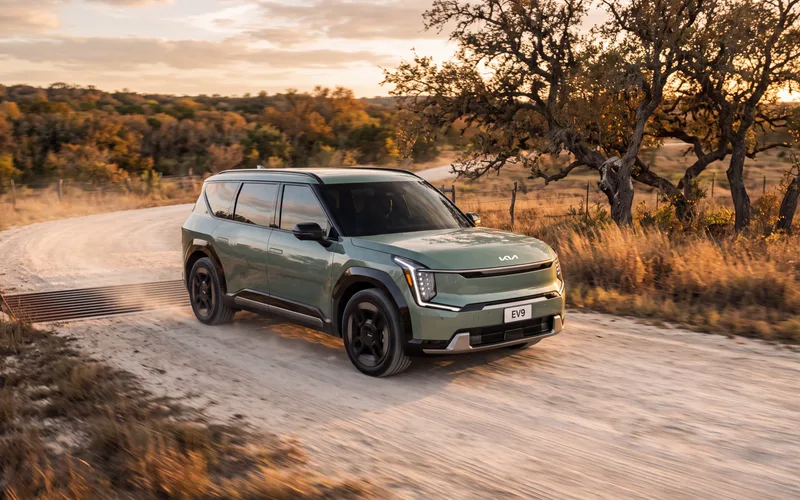 Kia EV9Mid-Size SUVBetter at: Value
Delivers the three-row electric family SUV mission more completely — usable adult third row, more cargo, V2L, better warranty — for around $20,000 less.
Compare 2.81B-
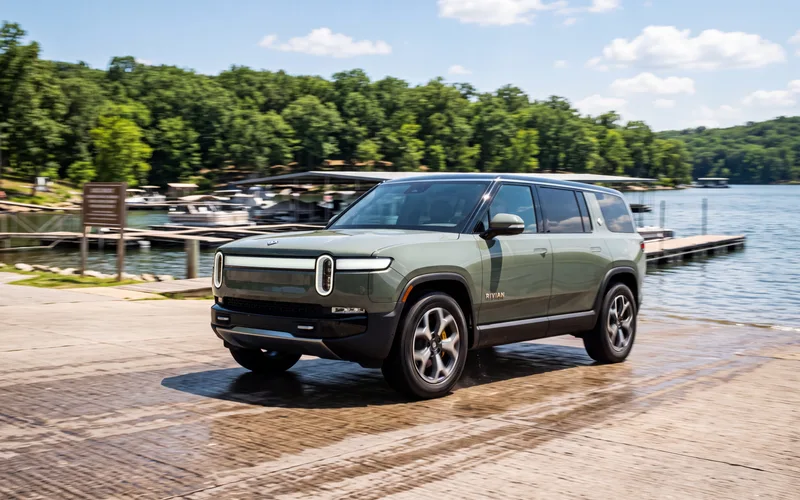 Rivian R1SFull-Size Luxury SUVBetter at: Range and capability
More range, more cargo, real off-road ability and hands-free highway driving for buyers who want an EV that goes beyond the suburbs.
Compare 2.41C+
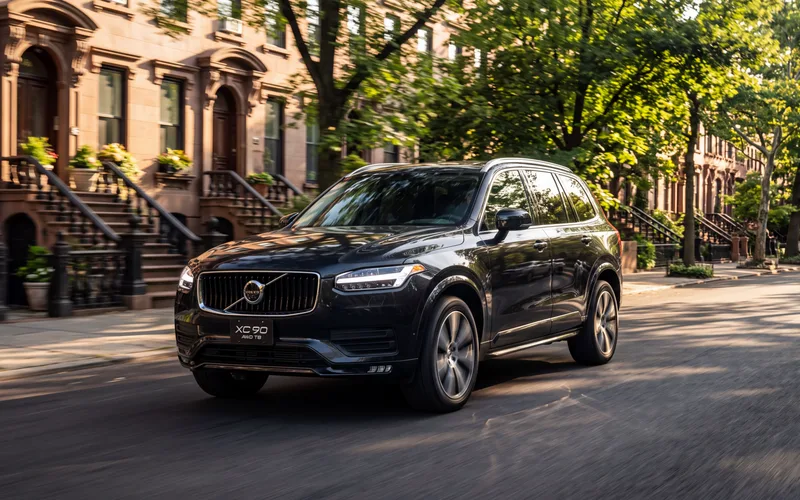 Volvo XC90Mid-Size Luxury SUVBetter at: Resale value
The same Scandinavian seven-seater without the depreciation, charging dependency or first-generation-EV software risk.
CompareSubject scores by year
Hover or tap a score to see what moved it versus the year before. A corner mark flags a big swing.
| Year | Performance | Efficiency | Safety | Space | Cost | Reliability | Tech | Use-case | Driving | Value |
|---|---|---|---|---|---|---|---|---|---|---|
| 2026 | 70 | 78 | 83 | 67 | 18 | 46 | 84 | 70 | 69 | 70 |
| 2025 | 66 | 71 | 81 | 67 | 21 | 44 | 79 | 68 | 68 | 65 |
Compare two years
Best fit & conditions
Higher scores mean a better fit for that use case. Learn more about use-case fit →
Subject profile
Academic Probation · NHTSA safety recalls
No NHTSA safety recall is on record for the 2026 Volvo EX90. Other model years of the EX90 have 3 — listed below.
3 recalls on other model years of the EX90 (2025)
Sep 30, 2025Structure: body: hatchback/liftgate: support device/strutA spindle nut may detach from the Power Operated Tailgate (POT) drive units, causing the tailgate to suddenly drop.
Defect
Volvo Car USA, LLC (Volvo) is recalling certain 2025 EX90 vehicles. A spindle nut may detach from the Power Operated Tailgate (POT) drive units, causing the tailgate to suddenly drop.
Risk
A tailgate that suddenly drops can hit a person, increasing the risk of injury.
Remedy
Owners are advised not to use the POT function until the repair is completed. Dealers will replace both POT drive units. Owner letters were mailed November 24, 2025. Owners may contact Volvo's customer service at 1-800-458-1552. Volvo's number for this recall is R10342. Vehicle Identification Numbers (VINs) involved in this recall will be searchable on NHTSA.gov beginning October 7, 2025.
NHTSA campaign 25V654000 ↗Manufacturer no. R103421,119 vehicles potentially affected (all models in the campaign)Owners notified Nov 17, 2025Filed by Volvo Car USA, LLCFiled as EX90Feb 7, 2025Electrical system: software · Exterior lighting: headlights: concealment devicesDue to a software error in the low power controller (LPC), the headlight shutters may close over the high and low beams while driving.
Defect
Volvo Car USA, LLC (Volvo) is recalling certain 2025 EX90 vehicles. Due to a software error in the low power controller (LPC), the headlight shutters may close over the high and low beams while driving.
Risk
A loss of headlight function while driving can reduce visibility and increase the risk of a crash.
Remedy
The LPC software will be updated manually, free of charge. Owner notification letters were mailed March 12, 2025. Owners may contact Volvo's customer service at 1-800-458-1552. Volvo's number for this recall is R10298.
NHTSA campaign 25V071000 ↗Manufacturer no. R102982,061 vehicles potentially affected (all models in the campaign)Owners notified Mar 12, 2025Filed by Volvo Car USA, LLCFiled as EX90Nov 19, 2024Seats: critical fastenersThe bolts for the second-row free-standing seat may not be tightened properly.
Defect
Volvo Car USA, LLC (Volvo Car) is recalling certain 2025 EX90 vehicles. The bolts for the second-row free-standing seat may not be tightened properly.
Risk
An improperly tightened seat may not adequately restrain the occupant during a crash, increasing their risk of injury.
Remedy
Dealers will inspect and tighten the bolts as necessary, free of charge. Owner notification letters were mailed January 10, 2025. Owners may contact Volvo Car customer service at 1-800-458-1552. Volvo's number for this recall is R10292.
NHTSA campaign 24V869000 ↗Manufacturer no. R1029211 vehicles potentially affected (all models in the campaign)Owners notified Jan 10, 2025Filed by Volvo Car USA, LLCFiled as EX90
Source: NHTSA Office of Defects Investigation recall database, model years 2025–2026. Recalls are listed by model year as the manufacturer filed them; whether a specific car is affected depends on its VIN — check a VIN at nhtsa.gov ↗. NHTSA model names matched to this page: EX90.
Detailed scoring by subject
1Performance & PowertrainGrades above the middle of the scale.2.72B-
2026 is a change year, not a carry-over: Volvo Car USA's 2026 EV lineup announcement moved the EX90 to an 800-volt architecture and raised output across the range. The volume Twin Motor AWD now makes 449 hp, up from the 402 hp (300 kW) figure Wikipedia records for the launch car.
Dual permanent-magnet motors deliver 494 lb-ft from zero rpm, near the top of the SUV normalization band (130–500 lb-ft) — instant-torque EVs routinely max this item out.
5.3 seconds for a ~5,900-lb three-row SUV is genuinely quick, though the Twin Motor Performance's 4.0 s shows how much the volume trim leaves on the table relative to rivals like the BMW iX and Rivian R1S.
Silent, lag-free dual-motor delivery that reviewers single out for smoothness — power builds progressively rather than dumping torque, and the three-mode regen (On/Off/Auto) avoids the grabby one-pedal behavior common to the class. Held short of the 90s because the EX90's early software immaturity shaped its reputation; 2026's new dual NVIDIA DRIVE AGX Orin central computer is the fix but is too new to be treated as proven.
Single-speed reduction gear per axle — no shifts to mistime and no hunting by construction. Scored on the quality of the EV delivery itself: seamless, with selectable regen modes including an Auto setting reviewers preferred over fixed one-pedal.
4,850 lbs braked is mid-pack for a large luxury SUV and typical of the EV three-row set — enough for a small boat or utility trailer, well short of body-on-frame or Rivian R1S territory. The new RWD base trim drops to 3,307 lbs.
Dual-motor AWD on every trim above the new base, with instant electronic front/rear torque distribution and a rear-motor disconnect for efficiency. Kept out of the top band because 2026 made RWD the entry point rather than AWD-standard, and there is no low range or terrain-mode suite.
Pavement-oriented luxury EV. Roughly 8.4 in of ground clearance with an Off Road drive mode that raises the air suspension at low speed is enough for a gravel road or a snowy trailhead, but there are no lockers, no skid plates, no low range, and a ~5,900-lb curb weight on street tires.
One energy type only — the EX90 is a bespoke BEV with no gas, hybrid or PHEV option (buyers wanting those are pointed at the separate XC90). Lifted to the top of the low band because 2026 spans three distinct outputs and two drivetrain layouts on a shared 111 kWh pack.
2Efficiency & RangeOne of the EX90's strongest categories.3.31B+
Graded against other EVs rather than the fleet, 86 MPGe is low-middling: a three-row luxury SUV of this mass consumes 39.2 kWh/100 mi, more than any EV SUV in this class except the Escalade IQ and Rivian R1S. The volume Twin Motor AWD on its standard 20-inch wheels is the conservative pick among the six 2026 EPA entries; wheel choice alone swings it by 2 MPGe. The 2026 switch to 800V lightened the battery and motors but did not move the EPA combined figure.
Regenerative braking makes city the EX90's strongest EPA cycle, as it is for every EV, but 90 MPGe sits well down the 70–140 EV-SUV band — mass tells even in stop-and-go.
Highway is where the EX90 grades best relative to EV rivals: Volvo's 0.29 drag coefficient holds the city-to-highway drop to 8 MPGe, smaller than most SUVs of this size and mass.
The item that holds the category back. The 2026 800V pack is 106 kWh nominal / 102 kWh usable — slightly smaller than the 111/107 kWh pack of the 400V car it replaces — and mass plus frontal area cap EPA range just under 300 miles, mid-pack in the 200–400 mi EV-SUV band and behind the Rivian R1S, Tesla Model X and BMW iX. Counter-intuitively the cheaper Single Motor RWD is rated lower still on its 92 kWh pack, so the volume AWD is not a range compromise.
2026 is a change year, not a carry-over: Volvo replaced the EX90's 400V architecture with an 800V one, lifting peak DC intake from 250 kW to 350 kW and taking it past the top of the 70–320 kW EV-SUV band. Only the 800V Korean EVs, Lucid and the Escalade IQ play at this level, and the upgrade is not retrofittable to 2025 cars.
Volvo's own US specifications page and its MY26 price list both quote 22 minutes 10–80% at 350 kW, an eight-minute improvement on the 2025 car and near the fast end of the 17–45 min EV-SUV band — impressive for a 102 kWh usable pack, since it means holding high power deep into the curve rather than merely peaking high. Confidence raised from MEDIUM to HIGH this run: the figure is now sourced from the manufacturer directly rather than from retailer material, and it applies to all three trims.
Middle of the 500–1,500 $/yr EV-SUV band — cheap against any gas three-row luxury SUV (an XC90, Q7 or GV80 runs $2,500–3,000) but unremarkable among EVs, which is the comparison this item makes. Real-world cost swings hard on home versus public DC pricing, which the EPA figure assumes away.
No fuel grade to worry about, and the 2026 800V switch materially improves the public-charging half of the equation — 350 kW peak, a 22-minute 10–80% stop with standard battery preconditioning, Plug & Charge added during 2026, and a NACS adapter shipping standard for Supercharger access on top of the native CCS1 port. Raised two points this run: Volvo's own spec page puts a full Level 2 charge at 10 hours rather than the 10–11 previously assumed, and Plug & Charge removes the app-and-card friction that is the usual complaint about non-Tesla DC charging. Still short of the mid-90s because the car needs an adapter at the most common fast-charge network and a 240V/48A circuit to charge overnight at all — an owner without one faces a genuinely impractical wait.
3SafetyOne of the EX90's strongest categories.3.66A-
NHTSA has not published a separate 2026 entry yet, but the EX90 is unchanged structurally for 2026 (same first-generation body, 2025-on) so the 2025 result carries: a full 5-star overall with 5 stars in every frontal and side sub-test, including the side pole, and 4 stars for rollover at a 10.9% rollover risk.
A 2026 Top Safety Pick+ with a clean sweep of Good crashworthiness results — small overlap front on both driver and passenger sides, the updated moderate overlap front and the updated side test — plus Good seat belt reminders. Injury measures were unusually low (driver HIC-15 of 118, no hard head contact, ~2 cm of occupant-compartment intrusion), and only the Acceptable headlights keep it from a perfect sheet.
There is no stripped trim to fall through: every 2026 EX90 carries collision avoidance with AEB and pedestrian/cyclist detection, Pilot Assist lane centering, full-range adaptive cruise, BLIS with steer assist, cross-traffic alert, rear automatic braking, run-off-road mitigation, traffic sign recognition and — unlike the XC90, where it starts at Plus — the 360-degree surround-view camera standard. For 2026 Volvo added an unresponsive-driver function that can call emergency services and extended automatic emergency steering to night operation.
IIHS rates the standard system Good in both the tougher vehicle-to-vehicle front crash prevention 2.0 evaluation and the pedestrian evaluation — the pairing that earns TSP+ and that the XC90 misses. The deduction is for false positives rather than misses: EX90 owners have logged phantom-braking events, and Volvo has been tuning the perception stack over the air through the 2026 software releases.
BLIS with steer assist is standard on every trim — active steering intervention rather than alert-only — alongside standard cross-traffic alert, standard rear automatic braking and a door-opening alert that warns occupants about cyclists and traffic approaching from behind. Owner reports of intermittent BLIS dropouts are the only thing holding it below the top of the band.
Pilot Assist is standard and adds assisted lane change on the EX90, which the XC90 does not offer, but the centering itself divides reviewers and owners — praised as smooth on clean, well-marked highway, criticised for ping-ponging and nervous corrections on faded lines or snow-covered lane tracks. The camera-based attention monitor is also unusually quick to nag and disengage.
Full-speed-range adaptive cruise with stop-and-go is standard and integrated into Pilot Assist as one highway-assist mode; reviewers call the pacing and accel/decel among the smoother implementations. It loses ground for the phantom-braking history and for a system that still leans conservative — large following gaps and quick hand-off to the driver when conditions degrade.
No hands-free option exists on the 2026 EX90 at any price. Pilot Assist is explicitly hands-on with a capacitive wheel and camera-based attention monitoring, and Volvo's eyes-off Ride Pilot — the reason the car was sold with a roof lidar — was cancelled outright: lidar is deleted from the 2026 model year after Luminar's bankruptcy, and Volvo is paying compensation to owners who bought into the promised features.
IIHS rates the EX90's LED projector headlights only Acceptable — the single non-Good line on an otherwise perfect ratings sheet — with fair low-beam visibility on both sides of the straightaway and fair performance on curves. High-beam assist is available and the units are the same across the range, so there is no better-lit trim to buy up to.
The upright Volvo glasshouse, low beltline and large mirrors give decent natural sightlines and the surround-view camera with 3D view is standard on every trim, but the EX90's heavily raked rear glass, thick D-pillars and three rows of headrests leave a real over-the-shoulder deficit that the cameras have to cover. Confidence in that camera backstop took a hit from the FMVSS 111 rearview-camera recall.
IIHS calls LATCH ease of use Acceptable, but the underlying hardware is better than the XC90's: four rear positions have complete lower-anchor-plus-tether hardware and a fifth has a tether only, so the third row can actually take a seat rather than just a booster. Second-row lower anchors and the three top tethers are exposed and easy to reach through wide-opening rear doors; the deductions are for tight third-row access and the anchors sitting in the seat-bight.
4Space & ComfortOne of the EX90's weakest categories.2.56C+
The EX90 is a three-row seven-seater as standard across both 2026 trims; the six-seat second-row captain's-chair layout is a low-cost option, so seven is the volume configuration.
The manufacturer-supplied spec feed lists 44.2 in of front headroom — exceptional even allowing for the standard fixed panoramic roof, and consistent with the EX90's tall 68.8-in roofline on a flat-floor EV platform. Either published figure clears the 42-in top of the SUV band.
Front legroom of 40.9 in is modest for a 198.3-in-long three-row SUV — the same figure Volvo quotes for the smaller XC90 — because the EX90 gives most of its length to the second and third rows.
Second-row headroom of 41.6 in is well past the 40-in top of the SUV band; the flat EV floor and upright roofline give the middle row genuinely airy space, which reviewers corroborate qualitatively.
36.5 in of second-row legroom is mid-pack for a three-row SUV — comfortable for adults but short of the 40+ in the Kia EV9 and other EV three-rows offer; the sliding bench trades it against third-row space.
A real, standard third row with its own air vents, USB-C ports, cupholders and standard third-row A/C, and easy one-touch access past the tilting second row — but 35.8 in of headroom and 31.9 in of legroom put it firmly in kid territory, with adults limited to short hops. Better equipped than the XC90's (58) but tighter than the EV9's adult-usable bench (85).
With the third row folded the EX90 offers roughly 37 cu ft — modest for a mid-size three-row and well behind the Rivian R1S (46.7) or Kia EV9 (43.5), a consequence of the sloped tailgate and packaging under the 111-kWh pack. Published figures disagree by measurement basis (Chrome Data's feed lists 35.6 cu ft), so confidence is MEDIUM.
Volvo's own figure of 85.3 cu ft maximum is quoted on the same to-the-roof basis as the XC90's 85.7 cu ft already in this dataset, so it is the comparable number; secondhand outlets measuring differently publish 74.5 cu ft, which is why confidence is MEDIUM.
Competitive but not innovative: a 2.5 cu ft underfloor cargo bin sized for charging cables, a 1.6 cu ft frunk, an open shelf beneath the floating center console for a bag or purse, wireless charging and individually folding backrests — offset by Volvo's minimalist cabin and reviewer complaints that the second-row cupholders are sized for cans, not water bottles.
Volvo's front seats remain a brand high-water mark — firm but deeply supportive, extensively adjustable, with heating standard and ventilation or a ten-point massage available. The reclining second row is flatter but still comfortable; only the cramped third row pulls this back from the high 80s.
With the Ultra's air springs and semi-active dampers the ride is plush and well controlled, but air suspension is not standard — the volume Plus trim rides on steel springs and 20-in wheels, and reviewers report the EX90 getting unsettled and bouncing over larger impacts. Composed most of the time rather than segment-leading.
Reviewers single out isolation as an EX90 strength even against other EVs — no powertrain noise, a 0.29 drag coefficient that limits wind roar, and thicker laminated glass on the Ultra. Among the quietest cabins in the mid-size luxury SUV set.
Unusually rich standard comfort equipment even on the base Plus: quad-zone automatic climate control, third-row air conditioning, a heat pump, heated steering wheel, heated front and rear seats, power-adjustable steering column and head-up display, with ventilation and massage available above that. App-based remote preconditioning comes with the EV powertrain.
5Cost of OwnershipThe EX90's lowest-graded category.0.00F
For 2026 Volvo added a rear-drive Single Motor base model that cut the entry price $3,200 versus 2025, but the EX90 still opens near $78K — above the top of the SUV pricing band and among the most expensive three-row entries in the dataset.
The AWD Twin Motor Plus is the volume configuration — the new single-motor RWD car is a price leader and the Performance/Ultra grades are low-volume. At $81,390 delivered it sits far above the $27K–$68K SUV band, so the item floors out.
The EX90's strongest ownership-cost card: a BEV with no oil, plugs or transmission service and a maintenance schedule of one visit every 2 years/20,000 miles, projected well below the luxury-SUV average. Treat the figure as provisional — the model has only ~2 years of US service history, and its lidar/dual-Orin electronics carry real out-of-warranty repair exposure that a young dataset understates.
The weakest item and the largest single cost of owning this car. Estimates diverge sharply — iSeeCars' listing-derived figure is the harshest, CarEdge's model the kindest — so 38% is set between them, leaning toward observed market data. Expiry of the $7,500 federal credit on 2025-09-30 removed the floor under used luxury-EV pricing, and the EX90's early software reputation is a further drag.
Volvo's standard 4-year/50,000-mile new-vehicle limited warranty — a year longer than the German luxury norm but short of the 5-year coverage Hyundai/Genesis and Kia offer, landing mid-band.
The EV battery gets the federally mandated 8-year/100,000-mile term with a 70% state-of-health guarantee, which is class-standard but not class-leading. Note the electric drive units themselves fall under the 4-year basic warranty rather than a separate longer powertrain term — Volvo has no standalone powertrain warranty.
A genuine step backward for 2026: Volvo cut its Complimentary Factory Scheduled Maintenance program for MY2026–27 EVs from three services over 3 years/36,000 miles down to a single service at 2 years/20,000 miles. What lifts it above a bare-minimum score is the surrounding package — 4 years of unlimited-mileage roadside assistance, a bundled NACS fast-charge adapter, Plug & Charge activated in the US in June 2026 across 35,000+ stalls including Superchargers and IONNA, and Google built-in services. There is no free-charging credit and no multi-year maintenance plan, so it stays in the mid-band, roughly level with Cadillac's and Kia's programs and behind what the gas XC90 offers under the older program.
$81,390 volume-trim price minus its estimated resale value after 5 years (38% retained, or about $30,928) leaves about $50,462 in depreciation. Add the projected $2,634 in 5-year maintenance and repairs, and owning this vehicle for 5 years costs about $53,096 in total.
6Reliability & QualityOne of the EX90's weakest categories.1.03D
Consumer Reports expects the 2026 EX90 to be less reliable than the average new car, and places it at the bottom of Volvo's own lineup — below the 42/100 cluster (XC90, XC60 PHEV, S60, V60, S90, V90) that already sits under the segment norm. The first generation launched with software so unfinished that CR concluded the car should not have been sold, and 2026 layers a new 800V architecture and new core computer on top of a nameplate with only two model years of field history.
Volvo finished next-to-last of 31 brands in the J.D. Power 2026 Vehicle Dependability Study at 296 PP100 against a 204 industry average, and got materially worse year over year (242 PP100 in 2025) — J.D. Power attributes the slide to software/OTA frustration and the brand's shift to PHEV and EV powertrains, which is exactly what the EX90 is. Consumer Reports is kinder at mid-pack for new-car reliability, which keeps this out of the very bottom band but does not offset a near-last dependability finish.
The first model year drew three model-specific NHTSA recalls plus inclusion in a 413,151-vehicle fleet-wide rearview-camera campaign — four in a nameplate's opening year, two of them safety-critical (headlight shutters closing while driving; second-row seat bolts that may not restrain an occupant in a crash). No 2026-MY recall has been filed as of August 2026, and the EX90 was spared the high-voltage battery fire recall that hit the EX30 in January 2026. Against that, the OTA/service-bulletin churn behind the software defects has been systemic rather than incidental.
The mechanical hardware has been the quiet part of the EX90's troubles — the CATL 111 kWh (107 usable) pack shared with the Polestar 3, the twin motors and the crash structure have drawn no durability red flags and no battery recall, unlike the EX30. But durability history is thin and 2026 deliberately resets part of it: the car moves from 400V to 800V, adds a new Single Motor variant, and raises Twin Motor Performance output to 670 hp, so the specific drivetrain being sold now has essentially no field record. Newer powertrain, no red flags, but unproven at the low end of that band.
Materials are the EX90's most convincing quality argument and hold up against Mid-Size Luxury SUV rivals: a plush mix with genuine wood inlays, the Nordico leather substitute and a wool-blend option that both read as upscale rather than as penance, plus a new ventilated Nappa leather choice for 2026. Reviewers dock it only in isolated spots, notably the flimsy plastic slab housing the steering-wheel controls.
Physical assembly is solid — reviewers rate the panel work and cabin execution above three-row EV rivals such as the Kia EV9, and the Charleston-built body has not drawn rattle or misalignment complaints. What drags this down is the other half of the item: initial quality. Delivery-state defects were widespread on early cars, from an airbag warning light that stayed on for a week on Consumer Reports' own test car to cars needing central computer replacements to stabilize, and Volvo's own engineering chief publicly apologized.
Volvo runs a real franchised nationwide network with loaners and established service infrastructure — a structural advantage over EV-only rivals like Rivian and Lucid — but at roughly 280 US retailers it is thin next to BMW or Mercedes-Benz and skews coastal, so rural owners travel. The EX90 has leaned on that network unusually hard: recall work plus dealer-installed core computer replacements and retrofits, on a brand that does not rank near the top of J.D. Power's premium service rankings.
Consumer Reports ranks Volvo 24th of 28 brands for maintenance and repair costs, and the EX90 compounds that with luxury-EV economics: dealer-only parts, effectively no aftermarket, high-voltage handling protocols that make post-crash work expensive, 22-inch tire budgets and roughly $2,600 a year in insurance. The Luminar bankruptcy is the sharpest illustration of supply risk — though a 2026 buyer is insulated from it, since Volvo deleted the lidar from the 2026 EX90 rather than orphaning it. A 4yr/50k basic warranty, 8yr/100k battery coverage and 2yr/20k complimentary maintenance cushion the early years but do not change the out-of-warranty math.
7Technology & InfotainmentThe EX90's best-graded category.3.69A-
The EX90 uses a single 14.5-inch portrait center display on every trim — among the largest in the mid-size luxury SUV class and unchanged for 2026.
The Google built-in stack on Snapdragon hardware is graphically sharp and logically laid out, and 2026 cars ship with the upgraded dual-Nvidia-Orin core computer plus several bug-fix cycles already baked in — but the EX90's software record is the worst-documented of any recent luxury EV, and near-everything including headlights and fog lamps lives in touchscreen menus.
Wireless Apple CarPlay is standard, but Android Auto — although supported — still requires a USB-C cable on Volvo's Google built-in cars, so half the audience gets the tethered experience.
Google built-in gives natural-language Google Assistant and native Google Maps with live traffic and EV route planning that accounts for charge state — the benchmark implementation, and one owners use rather than bypass.
A 14-speaker Bose system is standard and genuinely good, while the optional Bowers & Wilkins setup — 25 speakers, 1,610 W, headrest and ceiling drivers, Dolby Atmos and an Abbey Road Studios mode — is one of the best car audio systems sold at any price.
A crisp full-digital driver display is standard on both trims, but at 9 inches it is deliberately minimalist and noticeably smaller and less configurable than the 12.3-inch clusters standard in most rivals.
The EX90 is Volvo's most software-defined car: whole-vehicle over-the-air releases have added and reworked powertrain, charging, driver-assist and infotainment functions since launch, and Volvo continues to ship feature-adding updates through 2026.
The redesigned Volvo Cars app covers remote lock/unlock, climate preconditioning, location, charge status and scheduling, and digital keys can be shared with family or carried in Apple Wallet and Samsung Wallet — though owners report intermittent digital-key glitches.
USB-C power reaches all three rows — two per row up front and in the second row, one in each third-row side panel — alongside standard wireless phone charging, but there is no household AC outlet and the promised bidirectional V2L capability has been slow to arrive.
Keyless entry and start are standard, the hands-free power tailgate is standard, and phone-as-key is properly implemented with UWB Digital Key Plus plus Apple Wallet and Samsung Wallet support and an NFC smart card key as backup.
A 360-degree camera with 3D view and front/rear parking sensors are standard on every trim, and Park Pilot Assist automates parallel and perpendicular parking including steering, shifting, throttle and braking.
A large 13.2-inch head-up display is fitted from the base Plus trim, which matters more than usual here because the standard driver display is only 9 inches — the HUD carries much of the primary driving information.
8Use-Case FitGrades above the middle of the scale.2.72B-
Genuinely strong family logistics: seven seats standard, wide-opening rear doors onto a flat EV floor, five child-seat positions (four with complete lower-anchor-plus-tether hardware, a fifth tether-only) with the anchors exposed rather than buried, a 40/20/40 second row that folds a section at a time, and a hands-free power tailgate. Held below the Kia EV9 (86) and Ioniq 9 (88) because IIHS rates LATCH ease of use only Acceptable, the Cars.com seat check flagged the fixed head restraints and a heavy second-row seat with a small third-row aperture, and only 13.6 cu ft remains behind the third row for a stroller when all seven seats are in use.
About as good as the paper case gets: a 2026 IIHS Top Safety Pick+ with Good in every crashworthiness test, NHTSA 5 stars overall, and — unusually — nothing meaningful trim-gated, so the cheapest EX90 a family can buy still has AEB with pedestrian and cyclist detection, Pilot Assist, BLIS with steer assist, rear automatic braking, run-off-road mitigation and the 360-degree camera. Two things keep it off the very top: Acceptable headlights are the lone non-Good IIHS line, and the nameplate's first year drew four NHTSA recalls including second-row seat bolts that may not restrain an occupant and a rearview camera that could fail to display.
Rear amenities are the standout — quad-zone climate, third-row air conditioning, heated front AND rear seats, a heat pump and two USB-C ports per row are all standard on the base Plus, in one of the quietest cabins in the class, with a 14-speaker Bose standard and a 25-speaker Bowers & Wilkins available. What holds it to the XC90's level rather than above it is gear capacity with the seats occupied: 13.6 cu ft behind the third row means a seven-up trip needs a roof box, the third row's 35.8 in of headroom limits it to kids on long hauls, and there is no rear-seat entertainment.
The hardware makes an effortless commuter — silent lag-free 449-hp delivery, One Pedal Drive plus a preferred Auto regen setting, standard adaptive cruise and Pilot Assist, standard 360-degree camera, park sensors and Park Pilot Assist, superb seats and a very quiet cabin. The software is what pulls it below the EV9 (89) and iX (88): near-everything including headlights and fog lamps lives in touchscreen menus, and the EX90 has the worst-documented infotainment stability record of any recent luxury EV, with frozen displays and mid-drive reboots reported — annoyances that land squarely in daily use even though 2026 cars ship with the fixed dual-Orin computer.
Energy is genuinely cheap — 86 MPGe combined and 90 MPGe city put EPA's annual fuel bill at $900, roughly a third of what the gas XC90 costs to commute in, with no oil changes and one scheduled service in the first two years. The consumables are where the luxury tax lands: ~$2,651/yr insurance, 20- to 22-inch tires under a ~5,900-lb car, and a brand Consumer Reports ranks 24th of 28 for maintenance and repair costs. Below the EV9 (82) and Ioniq 9 (83) for exactly that reason.
A 198.3-in, ~5,900-lb three-row with a roughly 38.7-ft turning circle is a handful in a city, and the heavily raked rear glass, thick D-pillars and three rows of headrests leave a real over-the-shoulder deficit. It scores above the similarly sized EV9 (58) and Ioniq 9 (55) purely on standard equipment: every trim gets the 360-degree camera with 3D view, front and rear sensors, and Park Pilot Assist, which handles steering, shifting, throttle and braking into parallel and perpendicular spaces.
Not meaningfully a work vehicle. The Twin Motor tows 4,850 lbs braked and the new Single Motor RWD only 3,307, against 7,200–7,700 lbs for the gas BMW X5, Audi Q7 and Mercedes GLE in the same segment; payload is 1,070–1,230 lbs, there is no bed, and towing anything meaningful roughly halves a 298-mile range. Instant torque means it pulls well when it pulls, but the hitch is not even factory equipment — it is a ~$1,880 dealer-installed accessory.
The weakest item in the category and the one where the EX90's reliability record bites hardest. Volvo finished 30th of 31 brands in the J.D. Power 2026 Vehicle Dependability Study, Consumer Reports puts the EX90 at the bottom of Volvo's own lineup for predicted reliability, and the nameplate's opening year produced four recalls plus dealer-installed core computer replacements. The interior is Nordico, wool blend and Nappa leather with no wear-friendly or washable specification, and 2026's switch to an 800V architecture with a new Single Motor variant means the drivetrain being sold now has essentially no field record. Below even the Kia EV9 (38).
Few work-oriented provisions. There is a 12V outlet in the cargo bay, USB-C in all three rows, cargo tie-downs, a 2.5 cu ft underfloor bin and access to Volvo's and Thule's accessory catalogue for dividers, liners and load carriers — but no household AC outlet, no washable interior surfaces and no upfit ecosystem. Critically for 2026, the one distinguishing work card does not apply: Volvo's bidirectional vehicle-to-home capability is exclusive to the 400V 2025 EX90 paired with the dcbel Ara station, and the 2026 car's move to 800V leaves it without a shipping power-export path, unlike the EV9's V2L (55).
Comfort and quiet are close to segment-best — superb long-haul seats with available massage, one of the hushed cabins in the class at a 0.29 drag coefficient, standard head-up display, and standard adaptive cruise with Pilot Assist lane centering. Charging is no longer the weak link either: 2026's 800V architecture brings a 350 kW peak, ~155 miles added in ten minutes, a standard NACS adapter and Plug & Charge live across 35,000+ US stalls. Range is what keeps it below the iX (92) and Ioniq 9 (88) — 298 miles EPA becomes roughly 220–240 at 70–75 mph, so stops come about every three hours, and the volume Plus rides on steel springs rather than the Ultra's air.
A competent trailhead and ski-hill vehicle rather than an adventure enabler: dual-motor AWD on every trim above the new RWD base, about 8.4 in of ground clearance with an Off Road mode that raises the air suspension at low speed, 4,850 lbs of towing for a pair of toys, and standard roof rails rated to 220 lbs dynamic that feed straight into Volvo's and Thule's carrier ecosystem, plus a retractable towbar that takes four bikes. It sits well below the XC90 (79) because AWD is no longer standard across the range, there is no low range, locker or skid plating on ~5,900 lbs of street tires, the 298-mile range and thin DC coverage at trailheads constrain remote trips, and the 2026 car has no external power export for camping.
Flexible in mechanism, merely adequate in volume. The 40/20/40 second row folds a section at a time by lever with an electrically folding third row, everything drops flat onto the EV floor, and there is a 2.5 cu ft underfloor bin for charging cables, a 1.6 cu ft frunk, standard roof rails and an optional retractable hitch. But 37.3 cu ft behind the second row is modest for a three-row — the Rivian R1S offers 46.7 and the EV9 43.5 — and the sloped tailgate limits bulky loads, which is why it trails the XC90 (84) and Ioniq 9 (85).
9Driving ExperienceMid-pack among this car's ten categories.2.64C+
Secure, better-than-expected chassis responses for a ~6,200 lb three-row EV, with good grip and well-controlled body motions on the four-corner air suspension (standard on Ultra, not on the Plus volume trim), but it leans in corners and never disguises its mass. Comfort-first tune, well short of the sportier Polestar 3 that shares its SPA2 platform.
Accurate and easy to place, with well-judged low-speed control, but very light and largely devoid of feedback — typical of Volvo's isolation-first calibration and a step behind BMW iX or Polestar 3.
Stopping power is strong and fade-free with three regen settings (off / auto / one-pedal), but blending is the weak point: testers report a spongy pedal around a standstill where friction-pad engagement is hard to sense, and the full one-pedal mode is aggressive enough to make smooth stops difficult given the vehicle's mass.
Seamless EV delivery with excellent low-speed throttle metering, and 2026 adds power across the range (329 hp Single Motor, 449 hp Twin Motor, 670 hp Twin Motor Performance at 4.0 sec 0–60 claimed). Marked down because the Twin Motor decouples a motor for efficiency by default, leaving throttle response noticeably lazy until 'Constant AWD' is selected from a menu.
One of the quietest cabins at any price — no motor whine, no synthesized sound, and measured isolation that beats the BMW iX and comprehensively beats the Kia EV9. Best-in-segment on this item.
Mid-pack for a 198-inch, 118-inch-wheelbase three-row SUV; the EX90 feels its width in town and there is no rear-axle steering to shrink it.
Excellent seats and a broadly adjustable, commanding position, and unlike the EX30 the EX90 keeps a 9-inch driver display plus available head-up display. Held back by Volvo's screen-first control strategy — mirrors, steering-column adjustment, glovebox and climate all live in the 14.5-inch portrait touchscreen, and drive-mode/suspension settings are menu-buried.
Deliberately calm rather than entertaining — the appeal is silence, serenity and effortless thrust, not engagement. Straight-line speed is genuinely impressive in Performance form, but light steering, 2.8 tonnes and menu-driven dynamic settings mean few drivers will take the long way home.
10Value & Market PositionGrades above the middle of the scale.2.77B-
The base Single Motor Plus at $76,695 ($78,090 with destination) already includes quad-zone climate with third-row A/C, heat pump, heated front and rear seats, heated steering wheel, power liftgate, 20-inch wheels, 14.5-inch Google-native touchscreen with wireless CarPlay, a 14-speaker Bose system and the full standard ADAS suite — content German rivals still bundle into paid packages. It falls short of a top score because upholstery is synthetic leather at Plus, air suspension and the 25-speaker Bowers & Wilkins ($3,200) are extra, and lidar — a signature EX90 feature at launch — is no longer offered for 2026.
For 2026 Volvo cut the entry price $3,200 (to $78,090 delivered) while adding an 800-volt architecture, a dual NVIDIA DRIVE AGX Orin computer with 500 TOPS and more power across the range (329 hp single motor, 449 hp twin, 670 hp Performance) — a rare price-down/content-up model year, and the 670-hp Performance at roughly $86k undercuts comparable German output. Against that, ~305 miles of range trails cheaper three-row EVs, the third row is tight for the money, and the federal $7,500 credit expired 30 Sep 2025, so the out-the-door math got materially worse regardless of MSRP.
Nine configurations spanning $76,695–$89,845: Plus and Ultra trims across three powertrains (Single Motor RWD, Twin Motor, Twin Motor Performance), each in six- or seven-seat layouts. The new-for-2026 single-motor RWD entry adds a rung the lineup previously lacked; the ladder is well spaced, though only two equipment grades means option flexibility comes mostly from packages rather than trims.
The EX90 remains a low-volume flagship and is now moving backwards: 3,913 US sales in 2025 (a +356% gain off a near-zero 2024 launch base) gave way to 702 units in Q1 2026, down 30% year over year against a 32% collapse in Volvo's overall US volume. Segment leaders in three-row luxury move that many units in a month.
Volvo carries a genuinely strong, differentiated image — safety leadership and Scandinavian design that buyers seek out — but sits a tier below Mercedes, BMW and Porsche in aspiration and transaction power. The halo is currently dulled by a 32% US sales slide, the withdrawal of the EX30 from the US market, and well-publicized EX90 software troubles that cut against the brand's engineering-integrity reputation.
Buyers benefit from a slow-selling flagship: an outright $3,200 MSRP cut for 2026, up to $1,000 cash back, Costco member incentives of $1,500–$2,000, a loyalty bonus and real negotiating room on inventory. The ceiling on the score is the post-credit landscape — the $7,500 federal EV credit ended 30 Sep 2025 — and lease payments that still average roughly $1,007/month on a 36-month term.
The EX90 is Volvo's first bespoke EV, in production only since May 2024, and 2026 is a substantive update rather than a carry-over year: new 800-volt electrical architecture, a 102 kWh pack, dual NVIDIA DRIVE AGX Orin core computer, more power across all three motor configurations and new driver-assist functions. Redesign risk for a buyer is essentially nil for several years.
The trophy case is real — 2025 World Luxury Car winner over the Porsche Macan and Panamera, plus AJAC's Best Safety Innovation award — but US road-test verdicts are middling rather than class-winning: Edmunds rates it 6.9/10 and U.S. News ranks it #20 among luxury electric SUVs at 8.2/10. Reviewers consistently praise the cabin, quietness and ride while faulting the cramped third row, merely adequate range and, most damagingly, erratic infotainment software that Consumer Reports catalogued in detail.