

The verdict
A mixed-report mid-size sedan, strong on ownership and held back by performance.
The 2026 Kia K5 is the mid-size sedan you buy for the sticker and the paperwork: roughly $27,800 to get in the door, about $30,200 for the volume GT-Line, twin 12.3-inch screens and the full Kia Drive Wise safety suite standard on every trim, and a 10-year/100,000-mile powertrain warranty nobody else in the class matches. What you give up is the powertrain — the 191-hp 2.5L four is slow (about 7.7 seconds to 60 mph), coarse when pushed, and returns just 31 MPG combined in a segment where the Camry is hybrid-only at more than 50. Add 35.2 inches of rear legroom, a fastback roofline that pinches both headroom and the view out, and roughly 48% resale after five years, and much of the upfront savings comes back out over an ownership cycle. Buy it if you sit up front, keep cars a long time, and want a lot of equipment per dollar; skip it if fuel bills, back-seat space, or resale drive your decision.
Jump to scoresStrengths
- Class-best warranty and cheap-to-fix hardware
- Safety gear that isn't paywalled
- Priced well below the obvious rivals
What holds it back
- No hybrid anywhere in the lineup
- The volume engine is slow and coarse
- The back seat pays for the styling
Top alternatives
Cars shoppers cross-shop with the Kia K5 2.56C+
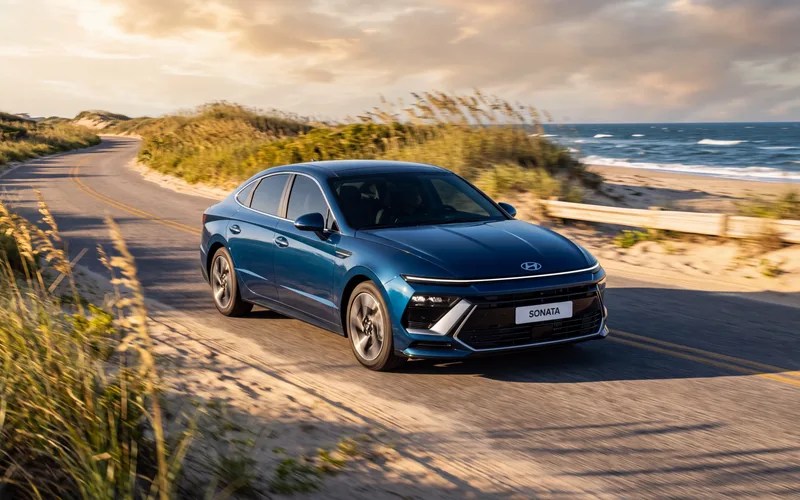 Hyundai SonataMid-Size SedanBetter at: Hybrid option
Same engine, transmission and trunk as the K5, but adds the hybrid the K5 doesn't have plus three years of free scheduled maintenance and a no-fee connected-services app.
Compare 2.84B-
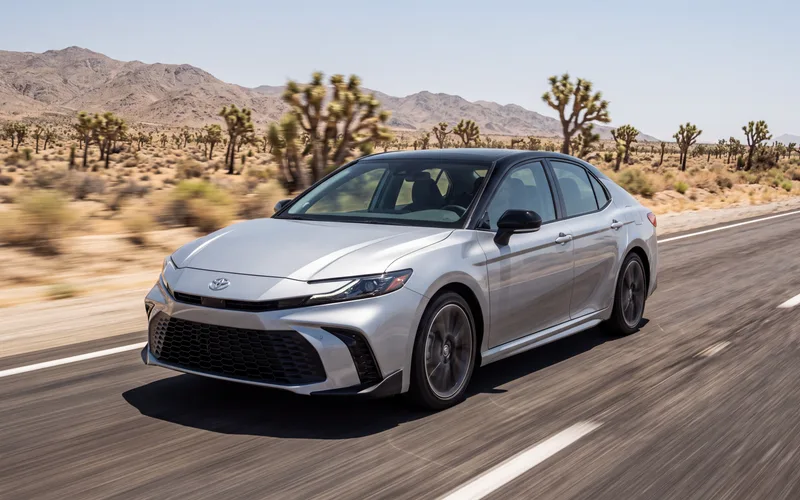 Toyota CamryMid-Size SedanBetter at: Efficiency and resale
Costs about $2,400 more up front but returns roughly 51 MPG combined and retains around 57% of its value at five years against the K5's 48%.
Compare 2.89B-
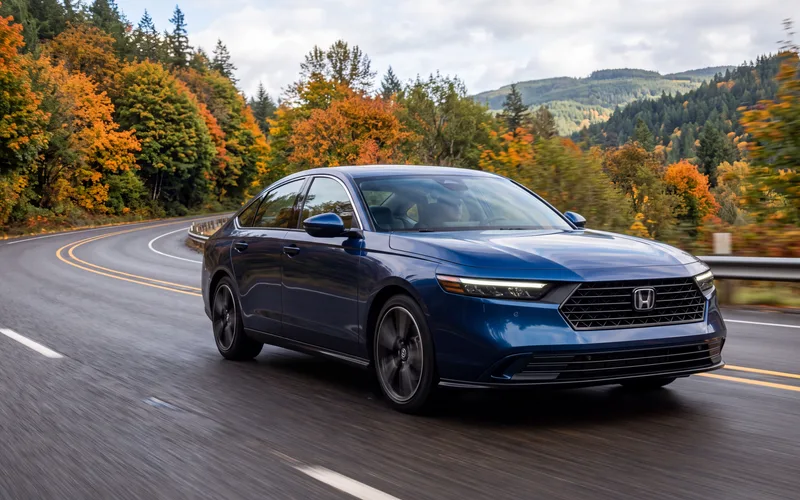 Honda AccordMid-Size SedanBetter at: Rear-seat space
The pick if people actually ride in back — 40.8 inches of rear legroom, a 16.7 cu ft trunk and the class's best ride-and-handling balance.
CompareHow it's evolved
6 scored model years · 2021–2026
Subject scores by year
Hover or tap a score to see what moved it versus the year before. A corner mark flags a big swing.
| Year | Performance | Efficiency | Safety | Space | Cost | Reliability | Tech | Use-case | Driving | Value |
|---|---|---|---|---|---|---|---|---|---|---|
| 2026 | 39 | 61 | 73 | 68 | 75 | 72 | 68 | 54 | 67 | 71 |
| 2025 | 36 | 49 | 70 | 70 | 77 | 74 | 67 | 54 | 66 | 73 |
| 2024 | 39 | 57 | 63 | 71 | 80 | 71 | 52 | 50 | 67 | 67 |
| 2023 | 39 | 57 | 73 | 70 | 80 | 68 | 60 | 53 | 65 | 72 |
| 2022 | 39 | 57 | 71 | 69 | 81 | 66 | 59 | 53 | 65 | 73 |
| 2021 | 39 | 57 | 71 | 69 | 83 | 65 | 54 | 52 | 65 | 75 |
Compare two years
Best fit & conditions
Higher scores mean a better fit for that use case. Learn more about use-case fit →
Subject profile
Trims & configurations
4 trimsScores above reflect the volume trim. Per-trim specs and scores are rolling out — the full lineup:
Academic Probation · NHTSA safety recalls
Jan 26, 2026Electrical system: instrument cluster/panelDue to a software error, the instrument panel display may fail. As such, these vehicles fail to comply with the requirements of Federal Motor Vehicle Safety Standard (FMVSS) numbers 101, "Controls and Displays" and 138, "Tire Pressure Monitoring System."
Defect
Kia America, Inc. (Kia) is recalling certain 2025 Kia K4, 2025-2026 Sorento, Sorento Hybrid, Sorento Plug-In Hybrid Electric (PHEV), 2026 Sportage, Sportage Hybrid, Sportage PHEV, K5, EV9, Carnival, and Carnival Hybrid vehicles. Due to a software error, the instrument panel display may fail. As such, these vehicles fail to comply with the requirements of Federal Motor Vehicle Safety Standard (FMVSS) numbers 101, "Controls and Displays" and 138, "Tire Pressure Monitoring System."
Risk
An instrument panel display that fails to show critical safety information, such as the speedometer, tire pressure, or warning lights, increases the risk of a crash.
Remedy
The instrument panel display software will be updated over-the-air (OTA) or by a dealer, free of charge. Owner notification letters are expected to be mailed March 26, 2026. Owners may contact Kia Customer Service at 1-800-333-4542. Kia's number for this recall is SC361. Vehicle Identification Numbers (VINs) involved in this recall will become searchable on NHTSA.gov on February 9, 2026.
NHTSA campaign 26V046000 ↗Manufacturer no. SC36142,677 vehicles potentially affected (all models in the campaign)Owners notified Mar 13, 2026Filed by Kia America, Inc.Filed as K5
8 recalls on other model years of the K5 (2021–2025)
Nov 17, 2025Fuel system, gasolineA damaged check valve can allow air to enter the fuel tank, causing it to expand and contact hot exhaust components, melting the tank.
Defect
Kia America, Inc. (Kia) is recalling certain 2021-2024 K5 vehicles. A damaged check valve can allow air to enter the fuel tank, causing it to expand and contact hot exhaust components, melting the tank.
Risk
A melted fuel tank can leak, increasing the risk of a fire.
Remedy
Dealers will replace the check valve. The fuel tank will be inspected for damage and replaced as necessary. All repairs will be performed free of charge. Owner notification letters were mailed January 16, 2026. Owners may contact Kia customer service at 800-333-4542. Kia's number for this recall is SC356. Vehicle Identification Numbers (VINs) involved in this recall will be searchable on NHTSA.gov beginning December 1, 2025.
NHTSA campaign 25V794000 ↗Manufacturer no. SC356250,547 vehicles potentially affected (all models in the campaign)Owners notified Jan 16, 2026Filed by Kia America, Inc.Filed as K5Jul 28, 2025Structure: body: roof and pillars · Structure: exterior trimThe left and right rear window trim pieces may loosen and detach.
Defect
Kia America, Inc. (Kia) is recalling certain 2023-2025 K5 vehicles. The left and right rear window trim pieces may loosen and detach.
Risk
Detached trim pieces can create a road hazard for other vehicles, increasing the risk of a crash.
Remedy
Dealers will inspect and replace the C-pillar trim assemblies, as necessary, free of charge. Owner notification letters were mailed November 19, 2025. Owners may contact Kia customer service at 800-333-4542. Kia's number for this recall is SC346.
NHTSA campaign 25V493000 ↗Manufacturer no. SC346100,063 vehicles potentially affected (all models in the campaign)Owners notified Nov 21, 2025Filed by Kia America, Inc.Filed as K5May 27, 2025Exterior lighting: lighting control module: softwareA software error in the Power-net Domain Controller (PDC) may cause the parking lights to flicker. As such, these vehicles fail to comply with the requirements of Federal Motor Vehicle Safety Standard (FMVSS) 108, "Lamps, Reflective Devices, and Associated Equipment."
Defect
Kia America, Inc. (Kia) is recalling certain 2025 K5 vehicles. A software error in the Power-net Domain Controller (PDC) may cause the parking lights to flicker. As such, these vehicles fail to comply with the requirements of Federal Motor Vehicle Safety Standard (FMVSS) 108, "Lamps, Reflective Devices, and Associated Equipment."
Risk
Parking lights that fail to illuminate properly can reduce visibility, increasing the risk of a crash.
Remedy
The PDC software will be updated by a dealer or through an over-the-air (OTA) update, free of charge. Owner notification letters were mailed June 24, 2025. Owners may contact Kia customer service at 1-800-333-4542. Kia's number for this recall is SC341.
NHTSA campaign 25V351000 ↗Manufacturer no. SC34182,281 vehicles potentially affected (all models in the campaign)Owners notified Jun 24, 2025Filed by Kia America, Inc.Filed as K5Mar 7, 2023Air bags: side/window: curtainThe side curtain air bags may have been installed incorrectly, causing them not to deploy properly in the event of a crash.
Defect
Kia America, Inc. (Kia) is recalling certain 2021-2023 K5 vehicles. The side curtain air bags may have been installed incorrectly, causing them not to deploy properly in the event of a crash.
Risk
Air bags that do not deploy as intended can increase the risk of injury in a crash.
Remedy
Dealers will inspect and reinstall the side curtain air bags, as necessary, free of charge. Owner notification letters were mailed April 7, 2023. Owners may contact Kia customer service at 1-800-333-4542. Kia's number for this recall is SC263.
NHTSA campaign 23V149000 ↗Manufacturer no. SC263188,912 vehicles potentially affected (all models in the campaign)Owners notified Apr 7, 2023Filed by Kia America, Inc.Filed as K5Oct 11, 2022Power train: automatic transmissionThe vehicle's "fail-safe" limited-mobility drive mode may be impaired, when prompted by a transmission oil pump malfunction, which can result in a complete loss of drive power.
Defect
Kia Motors, Inc. (Kia) is recalling certain 2021-2022 Sorento and 2021-2023 K5 vehicles. The vehicle's "fail-safe" limited-mobility drive mode may be impaired, when prompted by a transmission oil pump malfunction, which can result in a complete loss of drive power.
Risk
Loss of drive power increases the risk of a crash.
Remedy
Dealers will inspect and replace the transmission, as necessary. Dealers will also update the transmission control unit software. All repairs will be performed free of charge. Owner notification letters were mailed December 9, 2022. Owners may contact Kia customer service at 1-800-333-4542. Kia's number for this recall is SC250.
NHTSA campaign 22V760000 ↗Manufacturer no. SC25069,038 vehicles potentially affected (all models in the campaign)Owners notified Dec 9, 2022Filed by Kia America, Inc.Filed as K5Jul 8, 2021Fuel system, gasoline: delivery: hoses, lines/piping, and fittingsFuel may leak at the pipe connection between the high-pressure fuel pump and fuel rail.
Defect
Kia Motor America (Kia) is recalling certain 2021 Sorento and 2021-2022 K5 vehicles equipped with 2.5L turbocharged engines. Fuel may leak at the pipe connection between the high-pressure fuel pump and fuel rail.
Risk
A fuel leak increases the risk of a fire.
Remedy
Dealers will inspect and tighten, or replace the fuel pipe as necessary, free of charge. Owner notification letters were mailed July 21, 2021. Owners may contact Kia customer service at 1-800-333-4542. Kia's number for this recall is SC214.
NHTSA campaign 21V519000 ↗Manufacturer no. SC21421,575 vehicles potentially affected (all models in the campaign)Owners notified Jul 21, 2021Filed by Kia Motors AmericaFiled as K5Jun 14, 2021Lane departure: lane keep: steering assist · SteeringThe Rack-Mounted Motor Driven Power Steering (R-MDPS) system lacks the ability to diagnose communication faults. If a communication fault occurs while driving around a curve with Lane Following Assist (LFA) engaged, the steering assist level may not adjust properly, causing a sudden increase in the steering effort required.
Defect
Kia Motors America (Kia) is recalling certain 2021-2022 K5 vehicles equipped with 2.5L T-GDI engines. The Rack-Mounted Motor Driven Power Steering (R-MDPS) system lacks the ability to diagnose communication faults. If a communication fault occurs while driving around a curve with Lane Following Assist (LFA) engaged, the steering assist level may not adjust properly, causing a sudden increase in the steering effort required.
Risk
A sudden increase in steering effort can increase the risk of a crash.
Remedy
Dealers will update the R-MDPS software, free of charge. Owner notification letters are were mailed June 24, 2021. Owner may contact Kia customer service at 1-800-333-4542. Kia's number for this recall is SC213.
NHTSA campaign 21V447000 ↗Manufacturer no. SC213846 vehicles potentially affected (all models in the campaign)Owners notified Jun 24, 2021Filed by Kia Motors AmericaFiled as K5Mar 11, 2021Air bags: air bag/restraint control module · Air bags: sensor: occupant classification: front passengerThe Occupant Classification and Detection System (OCS/ODS) unit may not detect the presence of a child restraint system in the front passenger seat. As such, these vehicles fail to comply with the requirements of Federal Motor Vehicle Safety Standard (FMVSS) number 208, "Occupant Crash Protection."
Defect
Kia Motors America (Kia) is recalling certain 2021 Telluride, K5, and Forte vehicles. The Occupant Classification and Detection System (OCS/ODS) unit may not detect the presence of a child restraint system in the front passenger seat. As such, these vehicles fail to comply with the requirements of Federal Motor Vehicle Safety Standard (FMVSS) number 208, "Occupant Crash Protection."
Risk
In the event of a crash, deployment of the front passenger air bag, with a child in that seat, can increase the risk of injury to the child.
Remedy
Kia will notify owners, and dealers will replace the OCS/ODS unit, free of charge. The recall began March 18, 2021. Owners may contact Kia customer service at 1-800-333-4542. Kia's number for this recall is SC207.
NHTSA campaign 21V164000 ↗Manufacturer no. SC207142 vehicles potentially affected (all models in the campaign)Owners notified Mar 18, 2021Filed by Kia Motors AmericaFiled as K5
Source: NHTSA Office of Defects Investigation recall database, model years 2021–2026. Recalls are listed by model year as the manufacturer filed them; whether a specific car is affected depends on its VIN — check a VIN at nhtsa.gov ↗. NHTSA model names matched to this page: K5.
Detailed scoring by subject
1Performance & PowertrainThe K5's lowest-graded category.0.61F
The volume trims (LXS/GT-Line/EX) run the naturally aspirated 2.5L Smartstream GDI four rated 191 hp, which replaced the pre-facelift 1.6L turbo (180 hp) when the third-generation K5 was refreshed for MY2025 — the same swap Hyundai made on the mechanically identical Sonata. Replaces an invented placeholder value of 269.1 hp, which matched no K5 powertrain.
The 2.5L GDI peaks at 181 lb-ft @ 4,000 rpm. That is less low-end pull than the 195 lb-ft turbo it replaced and well short of the torque-rich hybrid and turbo rivals, so it normalizes near the bottom of the sedan band. The old placeholder claimed 355.8 lb-ft — more than even the GT's 2.5T.
Kia publishes no 0–60 claim. The 191-hp 2.5L/8-speed automatic combination has run roughly 7.5–7.9 s in instrumented testing across Hyundai-Kia mid-size applications, so 7.7 s is taken as the representative volume-trim figure — mid-pack, behind the hybrid Camry and Accord. The GT's 2.5T is a genuinely quick outlier at roughly 5.2 s.
The naturally aspirated 2.5L is lag-free and linear at part throttle but short on low-end torque and audibly coarse when worked hard — the standard criticism of this engine, and the reason the switch away from the 1.6T was a mixed result for drivability. Scored at parity with the mechanically identical Sonata (64): below the Accord's seamless two-motor hybrid (80) and just under the Camry's THS 5 (68). The GT's 2.5T adds real thrust but draws torque-steer complaints.
The 2.5L pairs with a conventional 8-speed torque-converter automatic that shifts smoothly and decisively and avoids the CVT drone afflicting the Accord's 1.5T and the Altima — a real advantage in this segment, and a clear step up from the IVT in Kia's own K4 (55). Held below 80 because it can be unhurried to kick down, and the GT's 8-speed wet DCT is hesitant at low speeds.
All-wheel drive is optional on the three 2.5L trims (LXS, GT-Line, EX) and unavailable on the front-drive-only GT — broader coverage than the Sonata's (55), where the hybrid and N Line are also excluded, but short of the Camry's availability on every trim (72). The system itself is a basic slip-triggered setup with no low range, locking modes, or terrain settings. Comfortably ahead of the FWD-only Accord (15) and K4 (12).
Two gas powertrains only — the 191-hp 2.5L and the 290-hp 2.5T GT — with no hybrid, PHEV, or EV anywhere in the range. The spread between them is wide enough to beat the K4's two-engine gas lineup (52) by a hair, but the absence of any electrified option keeps the K5 below the Accord (60) and well below its own Sonata twin (78), which adds a hybrid. Note the risk flagged in evidence: if the GT has been dropped for 2026, this item should fall to roughly 35.
2Efficiency & RangeOne of the K5's weakest categories.2.11C
The 2026 K5 carries over the 2025 facelift powertrain lineup: a 2.5L naturally aspirated four (191 hp) with an 8-speed automatic on LX/LXS/GT-Line, rating roughly 31 MPG combined in FWD form. That is mid-pack for a mid-size sedan and well behind the hybrid rivals.
City economy is the K5's weakest figure — a conventional direct-injected 2.5L with no electric assist gives up a large margin to the hybrid mid-size sedans that dominate stop-and-go driving.
Highway is the K5's best fuel-economy result, helped by the tall top gears of the 8-speed automatic and the sedan's low frontal area, but it still trails the hybrid mid-size field.
A 15.8-gallon tank and 31 MPG combined give roughly 490 miles of mixed-driving range — respectable for the segment and enough for a long interstate leg, but short of the 550-600+ miles hybrid mid-size sedans deliver.
About 484 gallons of regular a year at the EPA's 15,000-mile assumption puts running cost in the middle of the mid-size field — cheaper than a thirsty AWD sedan, but roughly $400-650/yr more than a hybrid Camry or Accord.
The volume 2.5L naturally aspirated engine runs on 87-octane regular with no premium requirement — the cheapest and simplest energy story a gas car can offer. Only the GT's 2.5L turbo recommends premium to reach its full 290 hp, and it still runs safely on regular.
3SafetyOne of the K5's strongest categories.2.95B-
The third-generation (DL3) K5 has carried a 5-star NHTSA overall rating since its 2021 US launch, and the 2025 facelift was a styling, interior and powertrain-lineup change rather than a structural one, so the generation-level result carries into 2026.
The DL3 K5 grades Good across the legacy IIHS crashworthiness battery and was a Top Safety Pick early in the generation, but no current award could be confirmed for 2026, and the tightened updated moderate-overlap (rear-passenger) and updated side tests have stripped awards from most mid-size sedans on this vintage of structure. Placed in the 'mostly Good, no confirmed current award' band rather than credited with an award I could not verify.
Kia Drive Wise is deep as standard equipment on the refreshed K5: forward collision-avoidance with pedestrian, cyclist and junction-turning detection, lane keeping, Lane Following Assist lane centering, driver attention warning, high beam assist, rear occupant alert and stop-and-go smart cruise, with blind-spot and rear cross-traffic avoidance on the volume trims. Held just below the top band because the entry LX is the trim most likely to go without blind-spot coverage, so the full five-feature benchmark set is not provably standard on every trim.
Forward Collision-Avoidance Assist covers vehicles, pedestrians and cyclists and adds junction-turning intervention, which is ahead of the mid-size baseline, but the K5 has no confirmed result in the harder 2024-onward IIHS front crash prevention protocol where higher closing speeds and nighttime pedestrian scenarios now separate the class. Scored as adequate daytime capability with unproven night performance.
From LXS up the K5 gets avoidance-grade blind-spot and rear cross-traffic systems that brake or steer rather than only warn, plus Safe Exit Warning, and the EX adds the Blind-Spot View Monitor camera feed in the cluster — genuinely useful given the fastback's over-shoulder blind zones. Docked because the entry trim likely goes without and the camera monitor is locked to the top trim.
Lane Following Assist — true lane centering rather than bounce-off-the-line correction — is standard on every K5 trim, ahead of much of the mid-size class. Reviewers rate Kia's current implementation competent on well-marked highway but note it wanders on faded markings and hands back early in tighter curves, and the base LKA's steering nudges are abrupter than the blended HDA behavior on upper trims.
Smart Cruise Control with Stop & Go is full-speed-range, works to a standstill and resumes cleanly, and is among the smoother mainstream systems for spacing; upper trims combine it with Highway Driving Assist for integrated centering-plus-following with navigation-based speed adjustment. Short of the top band because HDA is not standard across the range and the integration is a step behind the luxury benchmarks.
No hands-free highway system is offered on the K5 at any trim. Kia's Highway Driving Assist is a hands-on-wheel system that enforces wheel contact via torque sensing, so there is no BlueCruise, Super Cruise or supervised-FSD equivalent. The prior placeholder score of 84 was simply wrong about the vehicle.
The 2025 facelift put LED projector headlights with the vertical 'star map' signature and standard High Beam Assist across the whole range, so no trim is stuck with halogens, but IIHS headlight grades for the DL3 have historically split by trim with the volume trims falling short of the Good earned by the top of the range, and the 2026 grades are unconfirmed.
The K5's low, fastback roofline, high beltline and thick rear pillars are the styling signature of the car and the direct cost is a pinched rearward and over-shoulder view — the usual trade for this body style. Forward sightlines over the low cowl are good, but camera compensation only gets comprehensive on the EX, which adds the Surround View Monitor and Blind-Spot View Monitor; volume trims make do with a plain rearview camera.
The K5 has two sets of outboard lower anchors plus three top tethers, and its roughly 35.2 inches of rear legroom with wide rear door openings make loading a seat easier than in any compact. The anchors sit buried in the seat bight rather than on exposed hardware, and the sloping roofline complicates lifting a rear-facing seat through the opening — workable rather than a standout, and three-across with bulky seats is a squeeze.
4Space & ComfortMid-pack among this car's ten categories.2.58C+
The 2026 K5 is a conventional five-passenger mid-size sedan — front buckets plus a three-across rear bench — on every trim and on both FWD and AWD versions of the 2.5L. Corrects the placeholder value of 4.7 seats.
At 37.8 in the K5 sits below the mid-point of the sedan band (36–40 in) and trails every mainstream mid-size rival here — Accord 39.5, Altima 39.2, Camry 38.3 — a direct consequence of the DL3's low, fastback-style roofline. Notably tighter than its own compact K4 sibling (38.6 in).
46.1 in is the largest published front legroom figure in the mainstream mid-size class — identical to its N3-platform cousin the Sonata, and well clear of the Accord (42.3 in) and Camry (42.1 in) — so it tops out the 40–44 in sedan band. As with the Sonata, part of that margin is Hyundai/Kia's generous measurement convention rather than usable room. Corrects the placeholder 41.4 in.
37.8 in of second-row headroom scores comfortably inside the sedan band (35–39 in) and on paper beats the Camry (37.6), Accord (37.3) and Altima (37.5). The sloping fastback roof is the practical constraint — the number flatters rear space more than tall adults sitting back there would agree.
35.2 in is the K5's clearest packaging weakness — 2.8 in behind the Camry (38.0 in) and 5.6 in behind the class-leading Accord (40.8 in), landing near the bottom of the 32–42 in sedan band and tied with the Altima. Like the Sonata (34.8 in), the K5 trades second-row space for its outsized front row and low roofline. Corrects the placeholder 37.0 in, which materially overstated rear space.
A 16.0 cu ft trunk is mid-pack-plus for the segment: behind the Accord (16.7) but ahead of the Camry (15.1) and Altima (15.4), and level with the Sonata. Because the US K5 is gas-only there is no electrified variant whose battery eats into the hold, so the figure holds across the whole range, and a 60/40 split-folding rear seat extends it for long items. Corrects the placeholder 13.7 cu ft.
Competent, conventional everyday storage with no standout innovation. The console offers a covered bin, a pair of cupholders and a wireless charging pad on GT-Line and up, with usefully deep door pockets and a decent glovebox; the 2025 facelift's move to a curved dual-panoramic display tidied the dash but did not add the floating-console pass-through shelf that lifts the Sonata to 70 here. Scored level with its K4 sibling (64) and just above the Camry and Accord (both 62).
Front seats are a K5 strength — well-bolstered and supportive over long stints, with power adjustment and heating from GT-Line up and sport seats with synthetic-leather trim on GT-Line and GT. What holds it below the Camry and Accord (both 78) is the back seat: at 35.2 in of legroom with a low cushion and a roofline that intrudes on entry, adults are noticeably less comfortable there on long trips. Lands alongside the Sonata (72) and Altima (73). Corrects an unjustifiably high placeholder of 83.
Kia tunes the K5 firmer than the comfort-first Sonata (73) — MacPherson strut front, multi-link rear, with tidy body control and a ride that stays composed on the highway but gets busy over broken pavement, especially on the GT-Line's 18-in wheels and the GT's 19s. Better damped than the shorter-wheelbase K4 (66), but short of the Camry (74) and well short of the Accord's (84) class-leading ride/handling balance.
Average for the class. Acoustic front glass and added sound deadening keep the highway cruise reasonably hushed, and the K5 is clearly quieter than the smaller K4 (55) and the Altima (55), but the 2.5L naturally aspirated four is coarse and vocal under hard acceleration and the larger wheel fitments let in tire roar on coarse pavement. That keeps it below the Camry and Accord (both 70) and the Sonata (68). Corrects an unjustifiably high placeholder of 81.
Comfort equipment is a K5 strong suit and typical Kia feature-per-dollar: dual-zone automatic climate control with rear vents, heated front seats and a heated steering wheel all arrive by the volume GT-Line trim, EX adds ventilated front seats, and remote start with climate pre-conditioning is available through Kia Connect. Scored above the Camry and Accord (both 72) for reaching heated-wheel and dual-zone content at lower trim levels, just below the Sonata (76), whose Limited also adds heated rear seats.
5Cost of OwnershipThe K5's best-graded category.3.08B
The K5 LX opens in the high-$27,000s delivered, undercutting its own mechanical twin the Sonata SE by roughly $1,300 and a 2026 Camry LE by about $2,400, because Kia still sells a plain naturally-aspirated four where Toyota forces every mid-size buyer into a hybrid. That places it in the lower third of the mid-size sedan band and makes price the K5's strongest ownership argument. Estimated from the MY2025 facelift price ladder plus a normal single-digit model-year increase — not a live 2026 lookup.
GT-Line is the K5's volume trim and has been since the DL3 launched — it is the appearance-and-equipment sweet spot, adding the sportier body treatment, larger dual-screen setup and heated front seats over LX/LXS for a modest step up, and it lands near $30,200 delivered. Only the 290-hp GT 2.5T pushes into the mid-$36,000s, so even the top of the ladder stays inside the low half of the segment band.
Running costs sit a little below mid-size norms — the 2.5L GDI four and 8-speed automatic are high-volume, cheap-to-service hardware with a dense dealer network behind them. The K5 lands about $200 above the mechanically identical Sonata for one structural reason: Kia includes no complimentary scheduled maintenance in the US, so the K5 owner pays for every oil change and rotation from day one while the Sonata's first three years are absorbed.
Depreciation is the K5's clear ownership weakness and, at weight 3, the single biggest drag on this category — it costs the car roughly nine points of retention against a Camry. Heavy rental and fleet volume in the mid-size class, large retail incentives on Kia sedans, and a segment in structural decline all push residuals down. Kia brand residuals have climbed markedly over the last decade and now sit level with Hyundai's, which is why the K5 lands on the same figure as its Sonata twin rather than below it.
Kia's 5-year/60,000-mile basic coverage tops the segment band outright and is worth two full years more than the 3/36 terms at Toyota, Honda, Nissan and Mazda. The term is brand-wide, stable across the DL3 generation, and applies to every K5 trim including the GT.
The 10-year/100,000-mile powertrain term is the ceiling of the segment band and double what Toyota and Honda offer on a comparable mid-size sedan. It covers the original owner only — a real caveat for a short hold or a used purchase, where it drops to 5 yr/60,000 mi — but for the first buyer it is best-in-class coverage on both the 2.5L and the GT's 2.5T.
This is where Kia hands back much of its warranty advantage: unlike Hyundai's 3 yr/36,000 mi plan on the otherwise identical Sonata, or ToyotaCare's 2 yr/25,000 mi on the Camry, Kia includes no complimentary scheduled maintenance in the US, so the K5 owner pays for the first oil change. What is included is solid but conventional — 5 years/60,000 miles of roadside assistance plus a multi-year Kia Connect trial covering remote start, vehicle status and safety services — which is squarely the 'basic roadside only' band. Scored level with the K4 because this is a brand-level program, not a model-level one.
$30,200 volume-trim price minus its estimated resale value after 5 years (48% retained, or about $14,496) leaves about $15,704 in depreciation. Add the projected $4,600 in 5-year maintenance and repairs, and owning this vehicle for 5 years costs about $20,304 in total.
6Reliability & QualityOne of the K5's strongest categories.2.90B-
The 2026 K5 is the sixth model year of the third-generation DL3 and the second year after the 2025 facelift, so the body, platform and electrical architecture all have accumulated owner mileage behind them and no late-generation defect wave has surfaced. Its structural advantage over Kia's compact cars is the drivetrain: the volume 2.5L drives through a conventional torque-converter 8-speed rather than the K4's IVT, which historically predicts better at high mileage. That places it at the upper end of the mainstream Korean norm but well short of the Camry/Accord tier that anchors this segment.
Kia is the strongest of the mainstream Korean badges on quality measures — it has repeatedly finished at or near the top of the mass-market field in J.D. Power's Initial Quality Study and sits at or above industry average in three-year dependability, a better showing than Hyundai's. Consumer Reports places the brand mid-pack rather than top-five, and Kia still carries reputational drag from the Theta II engine campaigns and the no-immobilizer theft wave on older cars, which is what keeps this solidly mid-band instead of in the 80+ top-five tier.
The DL3's record is busier than the segment norm and includes powertrain-severity exposure: early Hyundai-Kia 2.5L Smartstream GDI engines were recalled over connecting-rod bearing damage traced to manufacturing debris, a defect class that ends in engine replacement rather than a software flash, and the K5 runs that engine family on its volume trims. Layered on top is Kia's high brand-level recall volume, including the corporate-wide seat-belt pretensioner and engine-compartment fire-risk campaigns that swept multiple nameplates. None of that attaches to a 2026 build — the debris issue was a production-window defect long since corrected — but the generation's cumulative record is not a clean one, and the 2025 facelift's new display and electrical content adds a fresh, unproven surface.
The volume combination is one of the more durable in the Hyundai-Kia lineup: the naturally aspirated 2.5L Smartstream GDI four is a low-stress design unrelated to the Theta II family, and it drives through a conventional 8-speed torque-converter automatic rather than a CVT or dual-clutch — a meaningful high-mileage advantage over the K4's IVT and the Altima's CVT. The 2025 facelift actually improved this item by retiring the 1.6L turbo in favor of the larger naturally aspirated four. What holds it below the Toyota and Honda benchmarks is the 2.5's early rod-bearing campaign, the intake-valve carbon deposits inherent to direct injection, and the GT's 2.5L turbo with its 8-speed wet dual-clutch — the one durability outlier in the range, though not the volume configuration.
The 2025 facelift is what makes the cabin competitive rather than dated: it brought the curved dual-panoramic display housing, a reworked dash and console, and better switchgear to a design that had been on sale since 2021, and the K5's sportier, driver-angled layout presents well against the mainstream mid-size norm. Padded upper-dash and door-top surfaces appear on the trims most buyers order. What keeps it a couple of points under the Sonata is that the underlying architecture is older and the base LXS gives away the price with cloth, urethane touch points and hard plastic across the lower console and rear door cards.
Assembly quality is a genuine Kia strength — the brand consistently outperforms its long-term dependability standing in initial-quality measures — and by 2026 the K5 is six model years into the DL3 with no widespread rattle, squeak or panel-alignment theme attached to it. The 2025 facelift reset a small part of that maturity by introducing a new dash structure and display housing, which is the usual place early-build variation shows up, so this sits above the middle rather than in the top band.
Kia's roughly 775-800 US franchised dealers give solid metro and suburban coverage but a thinner rural footprint than Toyota, Honda, Ford or Chevrolet, and service satisfaction runs around the mainstream average. The industry-leading 10-year/100,000-mile powertrain warranty materially lowers the cost of using that network, but Kia does not include complimentary scheduled maintenance in the US — a small but real ownership-cost difference against its closest corporate sibling, and the reason this lands under the Sonata.
The K5 is cheap to keep by mid-size sedan standards: its engine, 8-speed automatic and most hard parts are shared with the Hyundai Sonata and the wider Smartstream family, so OEM mechanical parts are inexpensive and widely stocked and independent shops already know the hardware. Six model years on the road give the nameplate a real salvage and aftermarket pool for body and trim pieces, and the 10-year/100,000-mile powertrain warranty absorbs a meaningful share of early-ownership risk. It falls short of the Camry's parts ecosystem, and the facelift's curved display and the GT's turbo-plus-DCT hardware are the expensive outliers once out of warranty.
7Technology & InfotainmentMid-pack among this car's ten categories.2.63C+
The MY2025 facelift replaced the old 8-in/10.25-in split with a single panoramic curved display carrying a 12.3-in center touchscreen, carried unchanged into 2026 — a bigger standard screen than the Camry's volume-trim 8 in and level with the platform-adjacent Sonata and the K4. Placeholder value of 10.5 in was low.
Kia's current-generation head unit is consistently credited for quick response, a legible home-card layout and retained physical volume/tune knobs, but the K5 carries the dual-mode capacitive strip that toggles one row of controls between climate and audio — the most common reviewer complaint about this generation. Solidly upper-middle band, a shade under the K4's 79 because the K5's console strip is more touch-dependent.
Wireless Apple CarPlay and Android Auto are understood to be standard on the facelifted K5's 12.3-in head unit, matching the treatment on the K4 and the facelifted Sonata; because there is no smaller wired-only alternative head unit in the range, projection availability is uniform across trims.
Embedded navigation with Kia Connect live traffic ships on the 12.3-in unit and cloud-assisted voice recognition handles climate, media and destination entry, but it is a command-driven assistant rather than a natural-language one and most owners default to CarPlay maps. Mid-band, level with the Sonata.
A six-speaker system covers the lower trims with Bose premium audio available on the upper trims — a real branded upgrade but a modest one by the standards of the top of this class, and the base system draws no particular praise. Level with the K4's Harman Kardon arrangement and slightly ahead of the Sonata's 63.
The facelift's headline interior change is a 12.3-in full-digital instrument cluster fused with the touchscreen under one curved panoramic panel, standard rather than an upper-trim item — one of the strongest cluster fitments in the mainstream mid-size class and the K5's clearest tech advantage over the Camry and Accord.
Kia Connect supports over-the-air navigation-map and infotainment software updates on the current head unit, but there is no evidence of routine feature-adding whole-vehicle OTA across control modules on a mainstream ICE sedan. Squarely the middle band, level with the K4 and Sonata.
Kia Access with Kia Connect covers the core set — remote start with climate, remote lock/unlock, find-my-car, vehicle status and alerts — but it runs on a complimentary trial that converts to a paid subscription, and no phone-as-key option is catalogued for the K5. That subscription wall is the whole gap to the Sonata, whose Bluelink+ is free for the life of the car. Placeholder score of 82 was well above what a paid, digital-key-less app supports.
USB-C charging for front and rear occupants with a wireless charging pad on the mid and upper trims, but no household AC outlet — an adequate rather than generous provision, and typical of the class. Placeholder score of 76 overstated it.
Smart key with proximity entry and push-button start covers the volume trims, with remote start available both from the fob and through the Kia Access app; the base trim is expected to use a conventional fob and no phone-as-key is offered, which keeps this below the Sonata's 82. Placeholder score of 56 was too harsh for a car whose volume trims all have proximity entry.
A rearview camera is standard and parking distance warning is widely fitted, with Surround View Monitor and the camera-based Blind-Spot View Monitor confined to the top EX trim — 360-degree coverage exists but most buyers will not get it. It matters more than usual here because the fastback roofline and high rear deck restrict over-the-shoulder visibility.
No head-up display appears in the US K5 equipment list on any trim — Kia reserves HUD for the Telluride, Sorento, Carnival, Sportage and EV6 rather than fitting it to the K5. That is a straightforward gap against the platform-adjacent Sonata, which offers one on Limited. Placeholder score of 61 implied an option that is not believed to exist.
8Use-Case FitOne of the K5's weakest categories.1.63D
The basics are covered — wide rear door openings, two sets of outboard lower LATCH anchors with three top tethers, and a 16.0 cu ft trunk that takes a full-size stroller with room beside it. What caps the K5 near the bottom of the mainstream mid-size group is second-row space: 35.2 in of rear legroom is 2.8 in behind the Camry and 5.6 in behind the Accord, which turns a rear-facing convertible seat behind a tall driver into a real negotiation rather than a minor squeeze. The low fastback roofline adds a duck-and-lift to every seat installation, and the anchors are buried in the seat bight rather than exposed on hardware.
A strong family-safety argument at the price. The DL3 K5 carries a 5-star NHTSA overall rating, and Kia Drive Wise is unusually complete as standard equipment rather than paywalled: forward collision-avoidance with pedestrian, cyclist and junction-turning detection, Lane Keeping Assist, Lane Following Assist lane centering, Driver Attention Warning, High Beam Assist, Rear Occupant Alert and Smart Cruise Control with Stop & Go all ship line-wide, with avoidance-grade blind-spot and rear cross-traffic systems plus Safe Exit Warning from LXS up. It sits just below the Sonata and well below the Camry because no current IIHS award could be confirmed for 2026, the entry LX is the trim most likely to go without blind-spot coverage, and the better camera hardware — Surround View and Blind-Spot View Monitor — is locked to the EX.
Equipment is respectable for the money — dual-zone automatic climate with second-row vents, heated front seats and a heated steering wheel all arrive by the volume GT-Line, rear USB-C ports keep devices alive, and the 16.0 cu ft trunk holds a family's luggage with all five seats occupied. Space and refinement are what hold it down over a multi-hour trip: 35.2 in of rear legroom runs out well before patience does, there are no heated rear seats at any trim, no rear sunshades and no rear-seat entertainment, and Kia's firmer chassis tune plus a coarse 2.5L make the K5 a slightly noisier, busier place than the Sonata on a long haul.
Commuting is one of the K5's better arguments. The 2.5L pairs with a conventional 8-speed torque-converter automatic instead of a CVT, so there is no drone in stop-and-go traffic — a real advantage over the Altima and the gas Accord, and a clear step up from the IVT in Kia's own K4. Smart Cruise Control with Stop & Go and Lane Following Assist lane centering are standard on every trim, which is ahead of most of the class for traffic-jam fatigue. Light steering, good forward sightlines over a low cowl and a quick 12.3-in head unit that kept real volume and tune knobs reduce daily friction. It lands under the Sonata because the chassis is tuned firmer and gets busy on broken city pavement, the console's dual-mode capacitive strip that toggles one row between climate and audio is the most common reviewer complaint about this generation, and remote start sits behind a Kia Connect subscription once the trial lapses.
Middling per-mile costs, and a step behind the mechanically identical Sonata for one structural reason. The volume GT-Line returns 31 MPG combined — roughly $1,600 a year at 15,000 miles on 87-octane regular — which is mid-pack for a gas mid-size sedan and roughly $400-650/yr more than a hybrid Camry or Accord now that the Camry is hybrid-only. Service parts are cheap and high-volume, but Kia includes no complimentary scheduled maintenance in the US, so the K5 owner pays for every oil change and rotation from day one while a Sonata buyer's first three years are absorbed; insurance also runs about $100 above a Camry on same-source comparisons. Choosing AWD drops the K5 to roughly 28 MPG and pushes annual fuel toward $1,750.
Manageable with camera help rather than genuinely easy. At roughly 193 in long and 73 in wide the K5 is a full-size-footprint mid-size sedan, but it sits low, its front corners are easy to place over the low cowl, and the turning circle is unremarkable for the class. The limitation is rearward vision: the low fastback roofline, high beltline and thick rear pillars are the car's styling signature and they pinch the over-the-shoulder view. Volume trims compensate with only a plain rearview camera and parking distance warning — the hardware that would actually solve it, the Surround View Monitor and Blind-Spot View Monitor, is confined to the top EX.
Not meaningfully work-capable — the honest reading for a mid-size sedan rather than a criticism of this one. Kia publishes no US tow rating for the K5, so trailering is off the table entirely; there is no bed, and payload is effectively passengers plus whatever fits in a sealed 16.0 cu ft trunk. The 60/40 folding rear seatback passes long, thin items through a narrow aperture, and the 191-hp naturally aspirated four has no torque reserve for hauling. It earns its few points as a competent sales-and-service car — a secure locked trunk and a comfortable seat for a day spent driving between calls — not for work capacity.
The hardware underneath is the K5's most work-credible feature: the Smartstream 2.5L GDI and the 8-speed torque-converter automatic are high-volume, mechanically conventional units shared across the Hyundai/Kia range, and a torque-converter automatic is a more durable choice under repeated load than the CVT/IVT fitted to the Altima and the K4. The mid-size sedan class sees enough rental and fleet duty that tolerance for indifferent treatment is a known quantity, cloth upholstery on the LXS is the wear-friendly option, and 5-year/60,000-mile basic with 10-year/100,000-mile powertrain coverage gives a high-mileage owner unusual cover. It sits mid-band rather than higher because Kia's direct-injection fours lack Toyota's out-of-warranty record, Kia includes no maintenance plan to keep service on schedule, and a low-clearance unibody sedan is simply not built for rough-surface abuse.
Almost no work-oriented provisions. There is no 110V household outlet or high-output onboard power at any trim, no factory roof rails to carry a rack or ladders, no factory hitch, and no washable or rubberized cargo surfaces — the trunk is carpeted, with token tie-down points and no upfit ecosystem behind it. The credit it does earn is narrow but real: the trunk is fully enclosed, locked and weathertight, which beats an open bed for keeping tools and samples dry and out of sight, and standard front and rear USB-C ports will keep a tablet or scanner alive on a route.
A capable tourer with clear limits at both ends of the cabin. The 15.8-gallon tank and 31 MPG combined give roughly 490 miles between stops — closer to 585 at the highway rating — and the front row is the K5's best space, with a class-leading 46.1 in of legroom, well-bolstered seats, heated fronts from GT-Line and ventilated fronts on EX. What keeps it out of the top band is the back half of the experience: 35.2 in of rear legroom is punishing over several hundred miles, the coarse 2.5L and 18-in wheels make the cabin noisier at speed than the Camry, Accord or even the Sonata, the firmer chassis tune trades absorbency for body control, and Highway Driving Assist is an upper-trim item with no hands-free system offered at any price.
Pavement-bound with a slightly better gravel-road allowance than most of its rivals. Optional all-wheel drive on the three 2.5L trims — LXS, GT-Line and EX — is a genuine advantage over the front-drive-only Accord and K4 and marginally broader coverage than the Sonata's, since the K5 has no hybrid or N Line variant to exclude; it covers trailhead gravel, snow and wet launches. But it is a basic slip-triggered system with no low range, locking modes or terrain settings, it is unavailable on the GT, and it cannot overcome roughly 5 in of ground clearance on street tires. With no tow rating for a small trailer or teardrop, no roof rails for a box or kayak, and no onboard AC power for camping, the realistic ceiling is a maintained forest road with a trunk-mounted bike rack.
Fits normal luggage well; bulky gear is where it stops. The 16.0 cu ft trunk is one of the larger holds in the mainstream mid-size class — ahead of the Camry's 15.1 and the Altima's 15.4, level with the Sonata, behind only the Accord — and because the US K5 is gas-only there is no hybrid battery eating into the hold on any trim, so the figure holds across the entire range. A 60/40 split-folding rear seatback with a pass-through handles skis or lumber. The constraints are structural to the body style: a sedan trunk aperture rather than a liftgate, no fold-flat load floor, no roof rails for a cargo box or bikes, no hitch for a rack, and no underfloor storage beyond the spare well.
9Driving ExperienceMid-pack among this car's ten categories.2.54C+
The DL3 K5 is the sportier-tuned half of the Sonata/K5 pair: a firmer spring and damper calibration, a long 112.2-in wheelbase and a low-slung fastback body give it noticeably better body control and a more planted feel through corners than its Hyundai sibling, and the GT-Line's 18-inch wheels add useful lateral grip. It remains a front-drive family sedan tuned for security over engagement — grip on all-season rubber is moderate and it will not chase an Accord down a good road — so it lands in the upper half of the 'secure but unremarkable' band rather than the top tier.
Accurate and easy to place, with a quicker rack than the Sonata's and more heft available in Sport mode, but the electric assist is heavily isolated and delivers effectively no road feedback — weight builds artificially with speed rather than with cornering load. This is the K5's clearest dynamic shortfall and a consistent Hyundai/Kia family trait, though it is tuned with slightly more substance than the Sonata or K4.
Ventilated front discs give the volume 1.6T trims stopping power and fade resistance that are adequate for the class with no concerns in normal use, but the pedal is on the soft side with long initial travel that blunts confidence in hard stops. The GT's larger front rotors improve matters meaningfully, but the volume trim is what is scored here.
The volume 1.6-liter turbo four (180 hp) paired to a conventional 8-speed torque-converter automatic suits daily driving well — real low-end torque from around 1,500 rpm, crisp and well-spaced shifts, and none of the rubber-band CVT drone that afflicts several rivals. It gives back ground to the Sonata's naturally aspirated 2.5 on outright calibration: there is a perceptible beat of turbo lag on initial tip-in from rest, and the auto stop/start restart is among the more noticeable in the class.
Quiet and well isolated at a steady cruise, and the turbocharged 1.6 is meaningfully less strained than a naturally aspirated four under load because it makes its torque low and never needs to be revved out to merge. It is inoffensive rather than pleasant — the engine note is anonymous and turns thrummy when extended, with mild vibration through the wheel at high load.
Better than the mid-size sedan midpoint and easy to place in parking structures, though the K5's 112.2-in wheelbase makes it a touch wider-turning than the platform-sharing Sonata (35.4 ft) and far tighter than the Camry (37.4 ft) or Accord (38.1 ft).
A genuine strength: the K5 seats the driver low in a properly sporting position with a wide range of seat and tilt/telescoping wheel adjustment, and the 2025 facelift's dual-panel curved display retained a physical switchable control bar and a real volume knob rather than burying climate in the touchscreen. Marked below the Camry (84) and Accord (82) because the fastback roofline pinches headroom for taller drivers, thick rear pillars and a high decklid compromise the over-shoulder and rearward view, and ingress/egress asks more of the driver than a conventional three-box sedan.
In volume 1.6T form the K5 is a pleasant, competent, quiet sedan whose main appeal is that it looks far more interesting than it drives — the styling and low seating position lend it a sense of occasion the Sonata lacks, but numb steering, an anonymous engine note and comfort-biased limits give an enthusiast little reason to take the long way home. The 290-hp GT is genuinely quick and would rate substantially higher, but it is a low-volume halo trim, not the configuration scored.
10Value & Market PositionGrades above the middle of the scale.2.81B-
The MY2025 facelift carried into 2026 made the twin 12.3-inch panoramic curved display (touchscreen plus digital cluster), LED projector headlights with High Beam Assist, and the full Kia Drive Wise suite including true Lane Following Assist standard on every trim including the base LX — content rivals still gate behind mid or top grades. Held just under the mechanically identical Sonata because Kia gives no complimentary maintenance plan and offers no head-up display at any price.
On sticker the K5 is one of the segment's better buys — roughly $27,800 delivered for an LX undercuts a Sonata SE by about $1,300 and a Camry LE by about $2,400, with dual 12.3-inch screens, full ADAS and the class-best warranty already included. What pulls it back to fair-rather-than-standout is what happens after the sale: a gas-only 191-hp 2.5L returning 31 MPG combined against the hybrid Camry's 51, and roughly 48% five-year retention, together give back most of the upfront saving over an ownership cycle.
Five trims spanning roughly $27,800 to $36,500 (LX, LXS, GT-Line, EX, GT), two engines, and AWD available on the 2.5L trims is a reasonably well-spaced ladder with a genuine performance halo at the top. The gap is electrification: with no hybrid or PHEV anywhere in the range, the K5 cannot match the Sonata's three-powertrain lineup or serve the buyer for whom fuel economy is the deciding variable.
The K5 remains a real-volume nameplate rather than a niche leftover, but the trajectory across the DL3 generation has been steadily downward from its 2021 launch peak, and it sits well behind the Camry, Accord and Altima in the mid-size order. It is a modest, declining seller in a shrinking segment — the low end of mid-pack rather than an outright slow seller.
Kia has moved decisively out of value-brand territory on the strength of design and repeat strong finishes in initial-quality studies, and the K5 is one of the nameplates buyers cite as evidence of that shift — it is bought for how it looks. The ceiling is resale: the brand still does not command the residual or the automatic cross-shop consideration that Toyota and Honda get in this exact segment.
Scored for buyer benefit: a mid-size sedan selling below its own launch volume in a contracting segment is exactly the car that carries standing subvented APR and lease support, and the K5 has been consistently discountable rather than a transact-at-MSRP product. The soft sales picture that costs it points in 10.2.1 is what makes it a good car to negotiate on.
2026 is the sixth model year of the third-generation (DL3) K5 and the second year of the MY2025 facelift, which was substantial — new vertical LED lighting signatures, revised bumpers, a new ccNC dual-screen interior — so the car presents as current even though the platform underneath is not. Mid-cycle rather than fresh, with the added buyer risk that a shrinking sedan segment makes the timing and even the existence of a fourth generation genuinely uncertain.
The K5 reviews as a likeable, well-equipped, sharply styled sedan that lands mid-pack in mid-size rankings — consistently recommended on value and warranty, consistently not the pick of the class. The recurring criticisms are structural rather than nitpicks: the facelift's replacement of the base turbo with a naturally aspirated 2.5L was widely read as a step backward in refinement and pace, there is no hybrid answer to the Camry, and the fastback roofline costs rear-seat space and rearward visibility.