

The verdict
A mixed-report mid-size suv, strong on safety and held back by ownership.
The CX-90 is the three-row SUV for people who still care about driving. A 280-hp turbocharged inline-six, standard rear-biased all-wheel drive and a genuinely luxurious cabin come for $40,830 to start — near-luxury hardware at mainstream-plus money — and it backs that with a 2026 IIHS TOP SAFETY PICK+ that the Highlander and Pilot both missed. The costs are real, though: Consumer Reports predicts below-average reliability and put the CX-90 on its least-reliable list for 2026, the wet-clutch eight-speed still jerks in stop-and-go traffic, 25 MPG combined trails every hybrid rival by ten, and just 14.9 cu ft behind the third row is among the smallest in the class. Buy it if the drive and the interior matter more to you than cargo capacity and a worry-free ownership record.
Jump to scoresStrengths
- Best-driving three-row SUV you can buy
- Class-leading safety credentials
- An interior that punches above its price
What holds it back
- A worrying reliability record
- The transmission still misbehaves in traffic
- Thirsty by 2026 three-row standards
Top alternatives
Cars shoppers cross-shop with the Mazda CX-90 2.79B-
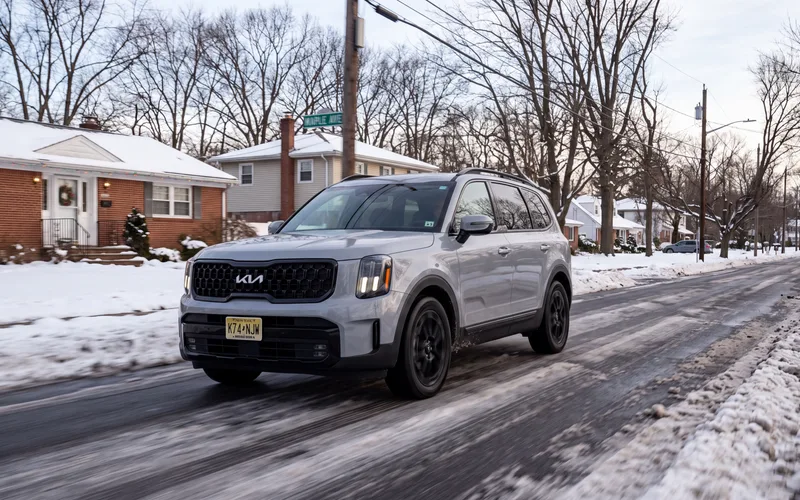 Kia TellurideMid-Size SUVBetter at: Family practicality
It gives you the usable third row, the cargo space behind it and the 10-year powertrain warranty that the CX-90 can't match, for similar money.
Compare 2.88B-
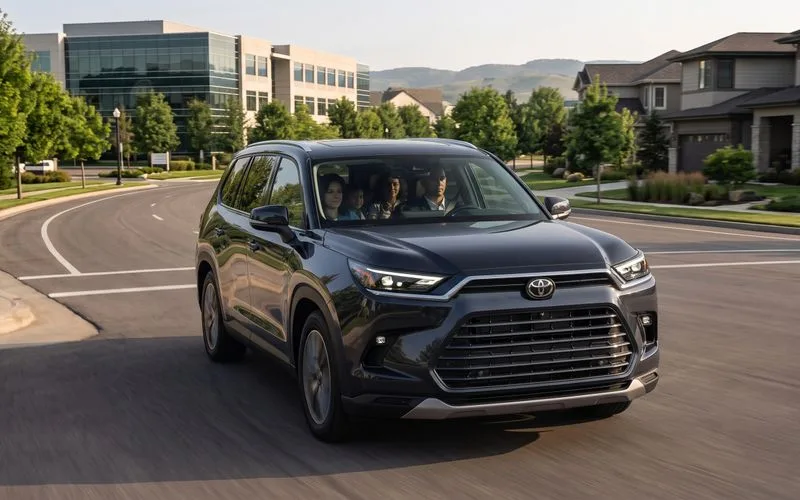 Toyota Grand HighlanderMid-Size SUVBetter at: Efficiency
Hybrid versions run roughly ten MPG better and come with Toyota's reliability record and included maintenance, which is exactly where the CX-90 is weakest.
Compare 2.43C+
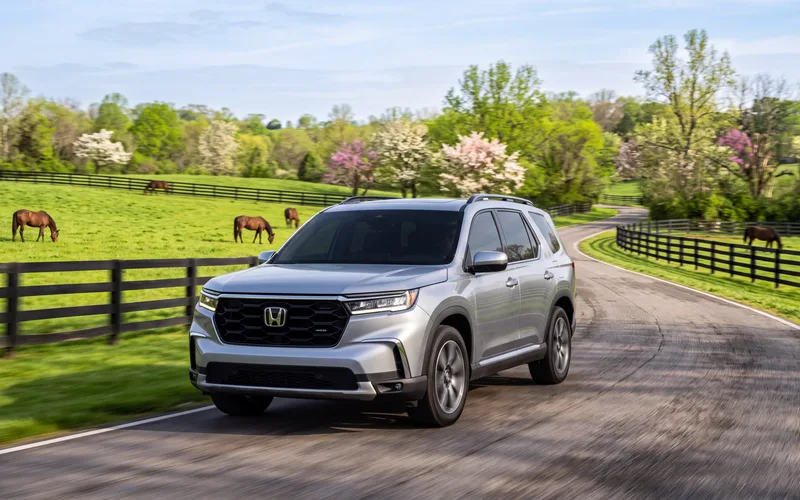 Honda PilotMid-Size SUVBetter at: Cargo space
A larger, more sensible three-row with cheaper long-term running costs for buyers who don't care that the CX-90 is more fun to drive.
CompareSubject scores by year
Hover or tap a score to see what moved it versus the year before. A corner mark flags a big swing.
| Year | Performance | Efficiency | Safety | Space | Cost | Reliability | Tech | Use-case | Driving | Value |
|---|---|---|---|---|---|---|---|---|---|---|
| 2026 | 54 | 59 | 81 | 67 | 50 | 51 | 67 | 67 | 75 | 73 |
| 2025 | 54 | 57 | 83 | 65 | 59 | 52 | 69 | 67 | 71 | 82 |
| 2024 | 56 | 62 | 84 | 64 | 53 | 50 | 56 | 66 | 69 | 83 |
Compare two years
Best fit & conditions
Higher scores mean a better fit for that use case. Learn more about use-case fit →
Subject profile
Academic Probation · NHTSA safety recalls
No NHTSA safety recall is on record for the 2026 Mazda CX-90. Other model years of the CX-90 have 11 — listed below.
11 recalls on other model years of the CX-90 (2024–2025)
Sep 2, 2025Electrical system: body control module: software · Electrical system: instrument panel: fuel gauge: fuel level float/sensor/sending unitThe fuel gauge in the instrument cluster may display an inaccurate fuel reading.
Defect
Mazda North American Operations (Mazda) is recalling certain 2024-2025 CX-90 and 2025 CX-70 mild hybrid electric vehicles (MHEV). The fuel gauge in the instrument cluster may display an inaccurate fuel reading.
Risk
An inaccurate fuel gauge may result in the vehicle unexpectedly running out of fuel and stalling, increasing the risk of a crash.
Remedy
Dealers will update the body control module (BCM) software, free of charge. Owner notification letters were mailed October 24, 2025. Owners may contact Mazda customer service at 1-800-222-5500 Option 6. The manufacturer's number for this recall is 78251. The information in your report suggests that Mazda may have been aware of this issue more than five business days before filing a report with NHTSA. Please be reminded that under Federal law, this agency is to be notified of all safety defect and/or noncompliance decisions within five business days. 49 CFR 573.6 Significant civil penalties can be assessed for this violation.
NHTSA campaign 25V568000 ↗Manufacturer no. 7825I104,854 vehicles potentially affected (all models in the campaign)Owners notified Oct 24, 2025Filed by Mazda North American OperationsFiled as CX-90Oct 31, 2024Electrical system: propulsion system: inverter · Electrical system: softwareImproper inverter software may cause the malfunction indicator lights to illuminate, and a loss of drive power may occur while in electric vehicle (EV) mode.
Defect
Mazda North American Operations (Mazda) is recalling certain 2024 CX-90 and 2025 CX-70 plug-in hybrid electric vehicles. Improper inverter software may cause the malfunction indicator lights to illuminate, and a loss of drive power may occur while in electric vehicle (EV) mode.
Risk
Loss of drive power increases the risk of a crash.
Remedy
Dealers will install improved inverter software, free of charge. Owner notification letters were mailed December 19, 2024. Owners may contact Mazda customer service at 1-800-222-5500 Option 6. Mazda's number for this recall is 7024J.
NHTSA campaign 24V817000 ↗Manufacturer no. 7024J14,902 vehicles potentially affected (all models in the campaign)Owners notified Dec 19, 2024Filed by Mazda North American OperationsFiled as CX-90Oct 31, 2024Electrical system: propulsion system: traction battery: management system/energy control module (bms/becm): software · Power train: automatic transmission: control module (tcm/pcm/tecm)The engine may not restart after the idling stop feature (i-stop) turns off the engine due to a software issue.
Defect
Mazda North American Operations (Mazda) is recalling certain 2024 CX-90 vehicles. The engine may not restart after the idling stop feature (i-stop) turns off the engine due to a software issue.
Risk
An engine that fails to restart increases the risk of a crash.
Remedy
Dealers will reprogram the powertrain control module (PCM) and the battery energy control module (BECM) software, free of charge. Owner notification letters were mailed December 19, 2024. Owners may contact Mazda customer service at 1-800-222-5500 Option 6. Mazda's number for this recall is 7024J.
NHTSA campaign 24V816000 ↗Manufacturer no. 7024J38,926 vehicles potentially affected (all models in the campaign)Owners notified Dec 19, 2024Filed by Mazda North American OperationsFiled as CX-90Oct 31, 2024Engine and engine cooling: engine: engine control module (ecu/ecm) · Power train: automatic transmission: control module (tcm/pcm/tecm)The powertrain control module (PCM) and engine control modules (ECM) software may cause malfunction indicator lights to illuminate and a loss of drive power.
Defect
Mazda North American Operations (Mazda) is recalling certain 2024 CX-90 and 2025 CX-70 vehicles. The powertrain control module (PCM) and engine control modules (ECM) software may cause malfunction indicator lights to illuminate and a loss of drive power.
Risk
Loss of drive power increases the risk of a crash.
Remedy
Dealers will reprogram the PCM and ECM software, free of charge. Owner notification letters were mailed December 19, 2024. Owners may contact Mazda customer service at 1-800-222-5500 Option 6. Mazda's number for this recall is 7024J.
NHTSA campaign 24V815000 ↗Manufacturer no. 7024J31,488 vehicles potentially affected (all models in the campaign)Owners notified Dec 19, 2024Filed by Mazda North American OperationsFiled as CX-90Oct 31, 2024Electrical system: software · Structure: interior panels: dashboardDuring vehicle startup, the defroster, seat belt warning, 360° view monitor functions, and the PHEV high-voltage battery cooling system may not function properly.
Defect
Mazda North American Operations (Mazda) is recalling certain 2024-2025 CX-90 and 2025 CX-70 vehicles equipped with a Dash Electrical Supply Unit (ESU). During vehicle startup, the defroster, seat belt warning, 360° view monitor functions, and the PHEV high-voltage battery cooling system may not function properly.
Risk
An ESU that does not function properly, increases the risk of a crash.
Remedy
Dealers will reprogram the Dash ESU with improved software, free of charge. Owner notification letters were mailed December 18, 2024. Owners may contact Mazda customer service at 1-800-222-5500 Option 6. Mazda's number for this recall is 7124J.
NHTSA campaign 24V814000 ↗Manufacturer no. 7124J80,915 vehicles potentially affected (all models in the campaign)Owners notified Dec 18, 2024Filed by Mazda North American OperationsFiled as CX-90May 16, 2024Forward collision avoidance: automatic emergency brakingThe brakes may activate suddenly due to the automatic braking system falsely detecting certain objects while driving.
Defect
Mazda North American Operations (Mazda) is recalling certain 2024 CX-90 vehicles. The brakes may activate suddenly due to the automatic braking system falsely detecting certain objects while driving.
Risk
Unexpected braking increases the risk of a crash.
Remedy
Dealers will reprogram the vehicle control module (VCM) with updated software, free of charge. Owner notification letters were mailed July 12, 2024. Owners may contact Mazda customer service at 1-800-222-5500 Option 6. Mazda's number for this recall is 6724E.
NHTSA campaign 24V349000 ↗Manufacturer no. 6724E9,914 vehicles potentially affected (all models in the campaign)Owners notified Jul 12, 2024Filed by Mazda North American OperationsFiled as CX-90Jan 18, 2024SteeringAn assembly issue with the worm gear in the steering system may result in a sudden loss of power steering assist.
Defect
Mazda North America Operations (Mazda) is recalling certain 2024 CX-90 vehicles. An assembly issue with the worm gear in the steering system may result in a sudden loss of power steering assist.
Risk
Loss of power steering assist while driving increases the risk of a crash.
Remedy
Dealers will replace the spring engaging the worm gear and reapply grease to the gear teeth, free of charge. Owner notification letters were mailed March 6, 2024. Owners may contact Mazda customer service at 1-800-222-5500 Option 6. Mazda's number for this recall is 6524A.
NHTSA campaign 24V022000 ↗Manufacturer no. 6524A43,454 vehicles potentially affected (all models in the campaign)Owners notified Mar 6, 2024Filed by Mazda North American OperationsFiled as CX-90Oct 26, 2023Power train: automatic transmission: control module: softwareDue to a software error, the engine and electric motor may shut down unexpectedly, which can result in a loss of drive power.
Defect
Mazda North American Operations (Mazda) is recalling certain 2024 CX-90 plug-in hybrid electric (PHEV) vehicles. Due to a software error, the engine and electric motor may shut down unexpectedly, which can result in a loss of drive power.
Risk
A loss of drive power can increase the risk of a crash.
Remedy
Dealers will update the powertrain control module and engine control module software, free of charge. Owner notification letters were mailed December 20, 2023. Owners may contact Mazda customer service at 1-800-222-5500 Option 6. Mazda's number for this recall is 6323J.
NHTSA campaign 23V719000 ↗Manufacturer no. 6323J4,252 vehicles potentially affected (all models in the campaign)Owners notified Dec 20, 2023Filed by Mazda North American OperationsFiled as CX-90Oct 26, 2023Back over prevention: sensing system: camera · Forward collision avoidance: sensing system: camera · Lane departure: sensing system: cameraDue to a software error, the rearview, front, and/or side camera images may not appear on the display. As such, these vehicles fail to comply with the requirements of Federal Motor Vehicle Safety Standard number 111, "Rear Visibility."
Defect
Mazda North American Operations (Mazda) is recalling certain 2024 CX-90 and MAZDA3 vehicles. Due to a software error, the rearview, front, and/or side camera images may not appear on the display. As such, these vehicles fail to comply with the requirements of Federal Motor Vehicle Safety Standard number 111, "Rear Visibility."
Risk
A camera that does not display an image can reduce the driver's view, increasing the risk of a crash or injury.
Remedy
Dealers will update the view monitor control module software, free of charge. Owner notification letters were mailed December 20, 2023. Owners may contact Mazda customer service at 1-800-222-5500 Option 6. Mazda's number for this recall is 6223J.
NHTSA campaign 23V718000 ↗Manufacturer no. 6223J11,903 vehicles potentially affected (all models in the campaign)Owners notified Dec 20, 2023Filed by Mazda North American OperationsFiled as CX-90Aug 4, 2023Back over prevention: warnings: external/pedestrian alert · Forward collision avoidance: warnings: external/pedestrian alertSoftware in the Approaching Vehicle Audible System (AVAS) Information Sound Box (ISB) amplifier may be missing, which can cause inaccurate, external pedestrian warning sounds. As such, these vehicles fail to comply with the requirements of Federal Motor Vehicle Safety Standard number 141, "Minimum Sound Requirements for Hybrid Electric Vehicles."
Defect
Mazda North American Operations (Mazda) is recalling certain 2024 CX-90 vehicles. Software in the Approaching Vehicle Audible System (AVAS) Information Sound Box (ISB) amplifier may be missing, which can cause inaccurate, external pedestrian warning sounds. As such, these vehicles fail to comply with the requirements of Federal Motor Vehicle Safety Standard number 141, "Minimum Sound Requirements for Hybrid Electric Vehicles."
Risk
Inaccurate external warning sounds may confuse pedestrians about the direction of an approaching vehicle, increasing the risk of a crash or injury.
Remedy
Dealers will update the AVAS ISB amplifier software, free of charge. Owner notification letters were mailed September 18, 2023. Owners may contact Mazda customer service at 1-800-222-5500 Option 6. Mazda's number for this recall is 6123H.
NHTSA campaign 23V553000 ↗Manufacturer no. 6123H17,600 vehicles potentially affected (all models in the campaign)Owners notified Sep 18, 2023Filed by Mazda North American OperationsFiled as CX-90Jun 15, 2023Steering: critical fasteners · Suspension: critical fastenersSome steering and suspension bolts may be missing or improperly tightened, which can cause the steering intermediate shaft, the front anti-lock brake system wheel speed sensor harnesses, or the front upper control arms to detach, resulting in a loss of vehicle control.
Defect
Mazda North American Operations (Mazda) is recalling certain 2024 CX-90 vehicles. Some steering and suspension bolts may be missing or improperly tightened, which can cause the steering intermediate shaft, the front anti-lock brake system wheel speed sensor harnesses, or the front upper control arms to detach, resulting in a loss of vehicle control.
Risk
A loss of vehicle control increases the risk of a crash.
Remedy
Dealers will inspect and tighten or replace the steering and suspension bolts, as necessary, free of charge. Owner notification letters were mailed July 14, 2023. Owners may contact Mazda customer service at 1-800-222-5500 Option 6. Mazda's number for this recall is 5923F.
NHTSA campaign 23V429000 ↗Manufacturer no. 5923F18 vehicles potentially affected (all models in the campaign)Owners notified Jul 14, 2023Filed by Mazda North American OperationsFiled as CX-90
Source: NHTSA Office of Defects Investigation recall database, model years 2024–2026. Recalls are listed by model year as the manufacturer filed them; whether a specific car is affected depends on its VIN — check a VIN at nhtsa.gov ↗. NHTSA model names matched to this page: CX-90.
Detailed scoring by subject
1Performance & PowertrainOne of the CX-90's weakest categories.1.59D
The volume gas trims (3.3 Turbo Select/Preferred/Premium Sport/Premium Plus) use the standard-pressure turbo 3.3L inline-six with M Hybrid Boost at 280 hp; the Turbo S trims make 340 hp on premium fuel (319 hp on regular) and the PHEV makes 323 hp combined. 2026 is a carry-over year for powertrains.
The standard-output 3.3L turbo inline-six makes 332 lb-ft; both the Turbo S and the PHEV rise to 369 lb-ft. The 48V integrated starter-generator layers on a further 113 lb-ft of momentary boost on the mild-hybrid six.
The 280-hp standard-output trim scored here runs about 7.2 seconds to 60 mph — respectable but mid-pack for a three-row mid-sizer, and a tenth behind the lighter two-row CX-70 on the same powertrain. The 340-hp Turbo S and the PHEV are materially quicker.
The longitudinal turbocharged inline-six is smooth, quiet and strong through the mid-range — a genuine refinement advantage over the four-cylinders that dominate three-row mid-size SUVs — but mild-hybrid restarts and low-speed torque delivery through the clutch-based driveline draw consistent criticism for hesitation and jolts.
The 8-speed Skyactiv-Drive swaps the torque converter for a single wet clutch, which makes it crisp and direct at speed with a good manual mode, but clunky in stop-and-go — jerky low-speed shifts are the model's single best-documented complaint, improved but not eliminated by software revisions.
Inline-six Turbo trims from Preferred up are rated at 5,000 lbs with the Genuine Mazda tow hitch and Mi-Drive Towing mode; the entry configuration and the PHEV are capped at 3,500 lbs. Competitive for a unibody three-row crossover, though the Durango, Grand Cherokee and body-on-frame alternatives tow considerably more.
i-Activ AWD is standard on every 2026 CX-90 trim — there is no front-drive version — and it is a rear-biased longitudinal system with predictive torque distribution, Kinematic Posture Control and Mi-Drive modes including Off-Road and available Towing. Held out of the top band only by the absence of a low range or locking differential.
8.0–8.1 inches of ground clearance, standard rear-biased AWD and an Off-Road Mi-Drive mode handle gravel roads and bad weather, but there is no low range, no locking differential, no underbody protection and no off-road trim — and the long three-row body compounds a modest breakover angle.
Three distinct powertrains for 2026: the 280-hp and 340-hp tunes of the mild-hybrid 3.3L inline-six plus a 323-hp plug-in hybrid with 26 miles of EPA electric range. Broad and genuinely electrified, though the two inline-six tunes share hardware and there is no full EV.
2Efficiency & RangeMid-pack among this car's ten categories.1.98C-
The volume 3.3 Turbo trims (280 hp e-Skyactiv G inline-six, 48V M Hybrid Boost, standard i-Activ AWD) are EPA-rated 25 MPG combined for 2026 — unchanged from prior years and only mid-pack for a three-row mid-size SUV, where full-hybrid rivals reach the mid-30s.
23 MPG city across the inline-six range — the 0.33 kWh 48V system supplies stop-start and light torque fill but no EV-only creep, so the 4,900-lb three-row body and longitudinal six show up plainly in stop-and-go driving.
28 MPG highway is the CX-90's best efficiency showing — the tall-geared eight-speed and low-rpm inline-six cruise cleanly — but it still trails three-row hybrids like the Grand Highlander and Sorento Hybrid on the same test.
The 280-hp 3.3 Turbo carries an 18.5-gallon tank, good for roughly 460 miles between fills — above average for a three-row SUV, though the Turbo S trims' larger 19.6-gallon tank stretches that to nearly 490.
At EPA's standard 15,000 mi/yr, 25 MPG combined on regular unleaded works out to about $1,980 a year — middling for the class in absolute terms, but better than the MPG alone implies because the volume trims don't require premium.
The four volume 3.3 Turbo trims (Select, Preferred, Premium Sport, Premium Plus) are certified on regular 87 octane at their full 280 hp, so most CX-90 buyers face no fuel premium. Only the two Turbo S trims recommend 91 octane to reach 340 hp — and they still run on regular at 319 hp — while the PHEV adds cheap overnight home charging on a standard Level 2 setup.
3SafetyThe CX-90's best-graded category.3.48B+
NHTSA rates the 2026 CX-90 five stars overall on the same Large Product Group structure it has tested since the nameplate launched, with 5 stars in the side test and 4 stars in both the frontal test and the rollover calculation.
Both the 2026 CX-90 and CX-90 PHEV are IIHS TOP SAFETY PICK+ winners under the toughened 2026 criteria, with Good results across the crashworthiness set including the updated moderate overlap front (rear-passenger) and updated side tests — the only midsize three-row of the CX-90/Highlander/Pilot trio to take the top award.
The complete i-Activsense core suite is standard on every trim from the $39,300 3.3 Turbo Select up: Smart Brake Support with pedestrian and bicyclist detection, Mazda Radar Cruise Control with Stop & Go, Lane Departure Warning with Lane-keep Assist, Blind Spot Monitoring with Vehicle Exit Warning, Rear Cross Traffic Alert, automatic high beams, Driver Attention Alert and Rear Seat Alert. What is withheld is the next tier rather than the basics — lane centering (Cruising & Traffic Support), Emergency Lane Keeping with Blind Spot Assist and the 360° View Monitor start at Premium Sport/Premium Plus.
The standard front crash prevention system earns Good in the IIHS pedestrian evaluation and Acceptable in the harder vehicle-to-vehicle 2.0 test — enough to clear the 2026 TSP+ bar, but short of a clean sweep of Good ratings in both.
Blind Spot Monitoring, Rear Cross Traffic Alert and Vehicle Exit Warning — which watches for approaching vehicles and bicycles before an occupant opens a door — are standard on every trim, and the volume Premium Sport and above add Blind Spot Assist within Emergency Lane Keeping for active steering intervention rather than alert-only coverage.
Lane departure warning and Lane-keep Assist are standard on every trim, and true lane centering arrives with Cruising & Traffic Support on the volume Premium Sport and above — but not on the two cheapest trims, and reviewers treat it as competent traffic-jam assist rather than a class benchmark for centering confidence.
Mazda Radar Cruise Control is full-speed-range with Stop & Go and standard on every trim, pairing with Cruising & Traffic Support on upper trims for a coherent highway assist; the rough edges owners report are abrupt braking when the road curves and at least one radar-sensor fault requiring repeat dealer visits.
Mazda offers no hands-free highway system on the CX-90 at any trim or price — Cruising & Traffic Support is a driver-attended lane-centering assist requiring continuous steering-wheel contact, with no equivalent to Ford BlueCruise or GM Super Cruise.
IIHS tested two headlight variations: the Good-rated LED projectors are confined to the 3.3 Turbo S, S Premium and S Premium Plus trims, while everything below them — including the volume Premium Sport — and every CX-90 PHEV gets an Acceptable unit whose low beams give only fair visibility on the right and inadequate on the left straightaway. Automatic high beams are standard across the range.
The upright three-row cabin gives reasonable forward and side sightlines and the camera hardware is well regarded, but the long hood and thick rear pillars leave real blind zones, and the 360° View Monitor with See-through View that would compensate is not offered below the Premium/Premium Plus trims.
Three rear positions carry complete LATCH hardware with two more tether-only, and the second-row lower anchors sit under flip-off covers that are easy to find with clearly marked top tethers — a genuinely family-friendly install. The limit is space rather than hardware: the third row is best left to kids and cargo behind it is tight by three-row standards.
4Space & ComfortMid-pack among this car's ten categories.2.53C+
The volume 3.3 Turbo trims carry a second-row bench and three-place third row for eight-passenger capacity — the maximum the mid-size SUV band recognizes — with six- and seven-seat captain's-chair layouts optional.
Front headroom of 39.7 in sits above the mid-size SUV midpoint thanks to the tall Large Product Group body, though the standard panoramic moonroof on upper trims eats into it.
Front legroom is mid-pack rather than a strength — the longitudinal inline-six layout intrudes on the footwell, which is exactly why Mazda swapped the torque converter for a wet clutch to claw some space back.
At 39.3 in the second row is near the top of the mid-size SUV headroom band — the CX-90's long, upright three-row body pays off most clearly in row two.
Second-row legroom of 39.4 in is genuinely adult-friendly and among the roomier middle rows in the class; the third row's 30.4 in is where the packaging runs out.
A real but kid-scaled third row: headroom surprises for its size and access is easy via a one-touch second-row release, but a low floor-mounted perch and near-absent foot room push adults' knees toward their chests, so it trails the Telluride and Atlas benches.
Forty cubic feet behind the second row is modest for a three-row mid-sizer, and the 14.9 cu ft left behind the raised third row is the CX-90's clearest packaging weakness — cargo is where the rear-drive-biased architecture costs it.
Seats-folded volume of 74.2 cu ft is mid-pack for the class and essentially identical to the two-row CX-70's, which underlines that the CX-90's body is long rather than voluminous.
Ordinary storage with one real demerit: a shallow center-console bin that reviewers single out, offset by a usable glovebox, bottle holders and bins in all doors, seatback pouches, under-floor cargo compartments and a one-touch third-row release — but no signature trick like a giga console, frunk or onboard power export.
Front seats are a genuine strength — well-shaped, supportive over long hauls, and for 2026 the volume Preferred trim gets 8-way power with lumbar and memory plus ventilation — but the optional second-row captain's chairs are judged merely average and the third row is a short-trip proposition.
Mazda's 2025 suspension retune (revised spring and damper rates) carries into 2026 and largely fixed the launch car's jitteriness — testers now call the ride smooth and well-controlled — but it is still tuned firm by class standards and Consumer Reports finds it borderline too stiff over broken pavement, especially on the larger wheels.
Among the quieter three-rows at highway speed: road and wind noise are well suppressed and the inline-six stays smooth and hushed until worked hard — the PHEV's four-cylinder is the noisier of the two powertrains when it fires.
Comfort equipment is unusually deep and starts low in the range: tri-zone automatic climate control is standard from the base Select, and the volume Preferred adds ventilated front seats, heated second-row seats, a heated steering wheel and retractable second-row sunshades — all standard on every PHEV.
5Cost of OwnershipThe CX-90's lowest-graded category.1.31D
The 2026 CX-90 opens with the 3.3 Turbo Select — 280-hp turbocharged 3.3L inline-six, i-Activ AWD and the 8-speed wet-clutch automatic all standard — announced at $38,800 in September 2025 and revised to $39,300 in the spring 2026 pricing update, plus the $1,530 destination charge. That is markedly cheaper entry money than the two-row CX-70 sibling ($44,280 with destination) and undercuts most three-row rivals despite the Premium price class, so it lands in the upper-middle of the mid-size SUV band.
The 3.3 Turbo Preferred at $43,450 (+$1,530 destination = $44,980) is the volume grade: it adds genuine leather, heated and ventilated front seats, heated rear seats, heated steering wheel, driver memory, the 12.3-inch infotainment display with wireless CarPlay/Android Auto, moonroof, wireless charging and 21-inch wheels — the content three-row shoppers in this price class expect — while staying below the Premium Sport and 340-hp Turbo S grades. PHEV buyers start much higher, at roughly $52,025 with destination.
CarEdge projects only $528/yr — about $2,640 over five years, and $957 under its popular-SUV average — but that methodology runs well below the Edmunds-style TCO basis every peer in this dataset is scored on, and it understates a premium-fuel turbocharged inline-six with a wet-clutch 8-speed, rear-biased i-Activ AWD and standard 21-inch rubber on the volume trim. Normalizing to the peer basis puts the CX-90 at ~$6,200 — the same figure as the mechanically identical CX-70, and above the four-cylinder CX-5 ($5,000) and CX-50 ($5,300) as the extra powertrain complexity and tire/brake sizing warrant.
The estimates spread by ten points: iSeeCars measures 43.1% depreciation (56.9% retained) from actual CX-90 transaction data and beats the 46.3% midsize-SUV class average, KBB's 2026 cost-to-own projects a $20,540 residual on the $40,330 launch basis (~51%), and CarEdge's 53% depreciation is the pessimistic end (~47%). Weighting iSeeCars most heavily because it is measured rather than projected, ~55% is the center — above the slow-selling two-row CX-70 (53%), roughly brand-average for Mazda, and solid but not class-leading against Toyota and Honda three-rows.
Mazda's New Vehicle Limited Warranty remains the industry floor at 3 years/36,000 miles for 2026, with no extension for the CX-90's Premium positioning. Hyundai, Kia and Genesis all cover 5 years, so this lands at the bottom of the normalization band — a real weakness on a three-row asking $41K–$60K.
Powertrain coverage is 5 years/60,000 miles — the segment minimum and half the 10-year/100,000-mile term Hyundai and Kia advertise on directly competing three-rows. CX-90 PHEV buyers additionally get the federally mandated 8-year/100,000-mile high-voltage battery warranty, but that does not extend the conventional powertrain term this item measures.
Mazda includes no complimentary scheduled maintenance in the US — every oil change and service interval is out of pocket from delivery, unlike ToyotaCare's 2 yr/25,000 mi on the Grand Highlander or the multi-year programs common among Premium-class rivals. What is included is basic: 3-year/36,000-mile 24-hour roadside assistance (lockout, fuel delivery, jumpstart, flat tire) tied to the New Vehicle Limited Warranty, plus a Mazda Connected Services trial, with the Basic plan (vehicle health reports, emergency eCall) running up to 10 years on select 2026 models and Alexa voice commands newly standard for 2026. That is roadside-plus-telematics only, placing it at the top of the 'no complimentary coverage' band rather than in the included-maintenance tiers — the same package the CX-70 carries (45) and a notable omission on a $41K–$60K three-row.
$44,980 volume-trim price minus its estimated resale value after 5 years (55% retained, or about $24,739) leaves about $20,241 in depreciation. Add the projected $6,200 in 5-year maintenance and repairs, and owning this vehicle for 5 years costs about $26,441 in total.
6Reliability & QualityOne of the CX-90's weakest categories.1.43D
Both major predictors are negative and the CX-90 is named specifically, not just implicated by platform: Consumer Reports expects the 2026 CX-90 to be less reliable than the average new car and the PHEV much less reliable (predicted reliability near 20), and CR put the CX-90 and CX-90 PHEV on its least-reliable-vehicles list for 2026, citing growing pains with the new platform and powertrains. J.D. Power's 70/100 predicted-quality score sits at the very bottom edge of its 'Average' band and is the only non-negative signal.
Mazda's dependability standing has reversed over the last two years rather than holding: after climbing to 3rd overall in the 2025 J.D. Power VDS, it fell below the industry average in the 2026 study, and Consumer Reports' 2026 brand rankings recorded the largest single-year drop of any carmaker — eight places to 14th, attributed partly to feature/technology complexity and partly to the redesigned CX-5 dropping out of the rated set. Scored as mid-pack-and-trending-down on the brand alone; the CX-90's own problems are captured in 6.1.1/6.1.3/6.1.4.
Heavy recall activity for a nameplate three model years old, weighted toward genuine safety and driveability defects rather than paperwork — steering assist, automatic emergency braking, suspension fasteners, PCM/TCM loss of drive power. The decisive factor is that the remedy itself failed: NHTSA opened recall query RQ26002 in January 2026 after 26 post-repair 'sticky steering' reports and at least two crashes on cars that had already had recall 6524A performed, and no expanded recall has been issued. TSB traffic matches, with repeated PCM/TCM shift-quality reflashes and an ongoing service campaign extending into 2026 production.
The 3.3L e-Skyactiv-G turbo inline-six and the wet-clutch 8EC-AT eight-speed are both clean-sheet Large Product Group designs introduced in 2023 with no high-mileage record, and the early evidence is actively bad rather than merely unproven — CR graded the CX-90 turbo powertrain and transmission 1 of 5, and owners report low-speed jerking and knocking that Mazda has chased through repeated software reflashes and valve-body work, with some transmissions replaced outright. The PHEV substitutes different risk rather than reducing it: EV battery, battery cooling and electric-motor faults. MEDIUM because the durability picture still rests on two-to-three years of field data, and the 2026 revised shift calibration may materially improve it.
Materials are the CX-90's outstanding attribute and comfortably ahead of mainstream three-row rivals at the price — reviewers consistently reach for luxury comparisons. The 2026 volume trims get richer content too: the 3.3 Turbo Preferred adds standard ventilated front seats, heated second-row seats and a heated steering wheel, and the 12.3-inch display becomes standard on everything above Select.
Design and material selection outrun assembly execution by a wide margin. Owner reports converge on a repeated set of squeak-rattle-and-sealing defects plus buggy driver-assist and infotainment software — the pattern of scattered-but-recurring complaints rather than isolated lemons — and CR's own trouble-spot list for the 2026 car includes noise/leak and paint/trim. Brand-level quality standing no longer offsets this the way it did a year ago, with Mazda now below the J.D. Power dependability average.
Service satisfaction is a real strength — Mazda ranks highest of all mass-market brands in the 2026 J.D. Power CSI car segment and lands at the category average for SUVs — but physical coverage is genuinely thin, at roughly half the store count of Toyota or Honda. That matters more than usual for this vehicle, because nearly every known CX-90 defect is a dealer-only software reflash or recall remedy, and the steering fix has needed more than one visit for some owners.
Mazda's cheap-to-run brand reputation is set by high-volume transverse four-cylinder models and does not transfer to this car. The CX-90 is a low-volume Japan-built model on the longitudinal Large Product platform whose inline-six, 48V mild-hybrid system, wet-clutch 8AT and 17.8 kWh PHEV pack are dealer-only parts with essentially no aftermarket or salvage supply three years in, and the projected costs reflect that — KBB puts five-year maintenance plus repairs at over $9,000 for the 2026 car, well above the brand average, with single out-of-warranty transmission or hybrid-battery repairs running into four figures once the 5-year/60,000-mile powertrain coverage lapses.
7Technology & InfotainmentMid-pack among this car's ten categories.2.53C+
The volume 3.3 Turbo Preferred and every trim above it run the 12.3-inch Mazda Connect center display for 2026; only the entry 3.3 Turbo Select keeps the smaller 10.25-inch screen. There is no larger option anywhere in the lineup.
Mazda Connect is quick, legible and backed by genuine physical climate and audio controls, but the CX-90 is still built around the console rotary Commander: touch input works only inside Apple CarPlay/Android Auto and switches off by default once the vehicle is in Drive. The screen also sits far forward, having been designed for dial control rather than reach. Mazda itself abandoned the approach for the 2026 CX-5's 15-inch touchscreen, which underlines how dated this is in a $44k three-row.
Wireless Apple CarPlay and wireless Android Auto are standard from the volume 3.3 Turbo Preferred upward and on every PHEV trim, which covers the great majority of sales. Held out of the top band because the base 3.3 Turbo Select is wired-only, and because projection is dial-driven rather than touch once the car is moving.
2026 is a real step forward here — Alexa Built-in becomes standard across the CX-90 line, handling natural-language media, list and smart-home requests far better than Mazda's own command-word embedded assistant. Native mapping is the weak half: Mazda Online Navigation with cloud traffic and OTA map updates does not appear until the Premium Sport, one trim above the volume Preferred, so most volume buyers still default to CarPlay and Google Maps.
The Select and volume Preferred run an eight-speaker system that is merely adequate for a cabin this size; the well-regarded 12-speaker Bose Centerpoint setup arrives at the Premium Sport and above, where the CX-90's quiet interior lets it show. Good, but a step below the Levinson/Meridian-class systems fitted to premium-priced three-row rivals.
Mazda's 12.3-inch fully digital driver display is crisp and cleanly laid out with several selectable layouts, but on the gas CX-90 it starts at the Premium Sport — both the Select and the volume Turbo Preferred make do with a 7-inch TFT panel flanked by physical-look gauges. The PHEV fares better, getting the full digital cluster from its Preferred trim.
The CX-90 takes over-the-air updates for Mazda Connect infotainment firmware and, on trims with Mazda Online Navigation, map data — Mazda specifically markets the 2026 online nav as OTA-updatable. What it does not do is push whole-vehicle software that adds features or changes powertrain and driver-assist behavior; those modules remain dealer work, which keeps this squarely in the infotainment-only band.
MyMazda covers the core set — remote engine start/stop, lock/unlock, vehicle finder, status and send-to-car — but remote start is subscription-gated after the trial and Mazda cut that trial to 12 months for the 2026 model year (basic services stay free up to 10 years). There is no phone-as-key digital key on this platform, and the app is generally judged functional rather than polished.
Better than the two-row CX-70 because the three-row layout runs USB-C outlets to both the second and third rows in addition to the front pair, so no passenger is stranded. Wireless phone charging is standard from the volume Preferred up. Held back by the base Select going without wireless charging and by the absence of any household 120V AC outlet in a family SUV at this price.
Mazda Advanced Keyless Entry and push-button start are standard on every trim, and remote start is available through MyMazda rather than the key fob. The hands-free power rear liftgate is a Premium Sport item — one step above the volume Preferred — and Mazda offers no phone-as-key or UWB digital key on the Large Product Group platform, so this can't reach the top band.
The rear camera is standard and Mazda's 360-degree View Monitor is a good one — See-Through View plus a Trailer Hitch View that earns its keep against the CX-90's tow rating — but it does not appear until the 3.3 Turbo Premium Plus, two rungs above the volume Preferred. Front and rear parking sensors are likewise reserved for the upper trims, and there is no automated parking assist at any price, which is thin for a vehicle this long.
Mazda's Active Driving Display is a large, sharp windshield-projected HUD carrying speed, navigation and driver-assist status — one of the better units in the class when you have it. Availability is the problem: it starts at the 3.3 Turbo Premium Sport, so neither the base Select nor the volume Turbo Preferred offers it even as an option, placing this in the upper-trims-only band.
8Use-Case FitMid-pack among this car's ten categories.2.56C+
Real three-row family logistics: six/seven/eight-seat configurations, a second row that reclines and tilt-and-slides for third-row access, wide rear door openings, three-zone climate standard, and 39.4 in of second-row legroom that comfortably takes rear-facing seats. Held short of the Pilot/Telluride benchmark because the third row is a kids-only 30.4 in of legroom and there is almost nowhere to put a stroller once all three rows are occupied.
The strongest case the CX-90 makes to families: a 2026 IIHS TOP SAFETY PICK+ earned under the tougher updated protocols — the only one of the CX-90/Pilot/Highlander trio to manage it — plus NHTSA 5-Star Overall for both gas and PHEV, and the full i-Activsense suite (Smart Brake Support, blind-spot monitoring, lane-keep, radar cruise, driver attention alert, safe exit alert) standard on the $38,800 base Select. Short of a perfect score only because the 360 View Monitor and Cruising & Traffic Support are reserved for Premium Plus and up.
141.6 cu ft of passenger volume, a quiet and genuinely upscale cabin, three-zone climate, and heated rear seats plus retractable second-row sunshades standard from Turbo Preferred make this a pleasant long-haul family car for five. The catch is luggage with everyone aboard: Mazda's 14.9-15.9 cu ft behind the third row is thin for the class and Cars.com's own road-trip test put usable space at 8.4 cu ft, forcing them to drop half the third row. No rear-seat entertainment offered.
The torque-rich inline-six and supportive driver's seat make suburban and highway commuting relaxed, but the in-house wet-clutch 8-speed misbehaves precisely where commuters live: reviewers report a touchy accelerator and hesitation from rolling stops, with shift quality only smoothing out above roughly 35 mph. Upper trims' 21-inch wheels keep the ride taut in town.
25 mpg combined is unremarkable for a three-row in 2026 and the rated output assumes premium unleaded, so per-mile cost lands well above a Sorento Hybrid, Highlander Hybrid or Grand Highlander Hybrid; 21-inch tires on upper trims add to consumables. The PHEV's 27 miles of EV range can make a short commute nearly gas-free, but it is the expensive, low-volume configuration and drops to 26 mpg once depleted.
At 200.8-201.6 in long on a 122.8 in wheelbase and 84.9 in wide across the mirrors, this fills a standard city space, and Mazda's high beltline and thick rear pillars limit over-the-shoulder visibility. A rear camera is standard and the See-Through 360 View Monitor genuinely solves tight parking — but it does not appear until the $50,270 Premium Plus, leaving the trims most buyers park with only basic camera help.
Light duty only, and weaker than the headline suggests: the 5,000 lb maximum needs Towing Mode and therefore Premium Sport or above, while the volume Select and Preferred trims — and the PHEV — are capped at 3,500 lb. The inline-six's 332-369 lb-ft pulls a small boat or utility trailer with composure and 74.2-75.2 cu ft of enclosed cargo takes real loads, but there is no bed, no meaningful payload headroom and no heavy-duty tow package on this unibody crossover.
Everything load-bearing here is young — the Large Product Group platform, Mazda's first inline-six and an in-house wet-clutch 8-speed, all introduced for MY2024 — and the field data so far is poor: Consumer Reports predicts below-average reliability for the 2026 CX-90 and much-worse-than-average for the PHEV, against a recall history that includes fuel-gauge and start-stop restart faults. Pair that with a leather-and-soft-trim interior offering no wear-friendly work spec and no fleet track record.
The consumer basics are covered — standard roof rails, cargo tie-downs, power/hands-free liftgate, a dealer tow hitch backed by Trailer Hitch View, and a 150 W AC household outlet — but 150 W runs a laptop, not a tool, there is no vehicle-to-load export even on the PHEV, no washable cargo surfaces or work-grade seat trim, and essentially no commercial upfit ecosystem behind a Mazda three-row.
The CX-90's best mission by a wide margin. It is the best-driving SUV in the segment per instrumented tests, with a quiet, luxury-adjacent cabin, long-haul front seats, standard radar cruise and adaptive front lighting, and roughly 490 miles of combined-cycle range (about 550 at the highway rating) from an 18.5-19.6 gal tank. Cruising & Traffic Support, the lane-centering that most reduces highway fatigue, costs extra.
Standard rear-biased i-Activ AWD on every trim, 8.0-8.1 in of ground clearance, Mi-Drive Off-Road mode with Off-Road Traction Assist, standard roof rails and up to 5,000 lb of towing cover trailheads, ski weekends, gravel forest roads and a small camper. It stops well short of a 4Runner or Bronco — no low range, no locker, road-biased tires, modest approach angles — and the 150 W outlet is too small for real camp power.
Fold the third row and the CX-90 matches the two-row CX-70 almost exactly — 40.0-40.1 cu ft behind the second row, 74.2-75.2 cu ft with both rows down — while adding a third row of seat-fold permutations for the awkward people-plus-gear trips. Wide flat load floor, standard roof rails and hitch availability. Docked because the space behind an occupied third row is among the smallest in the class and the PHEV loses underfloor volume to its battery.
9Driving ExperienceOne of the CX-90's strongest categories.3.06B
The longitudinal, rear-biased Large Product Group platform with standard Kinematic Posture Control makes this the best-handling three-row mainstream SUV on sale — instrumented grip is genuinely high for a 4,885 lb vehicle and body control is sports-sedan-like. It gives back a little to the two-row CX-70 for length and mass, and the firm tune lets sharp impacts punch through even on 19-inch wheels.
Heavy-but-precise rack that actually reports tire grip and road texture — a rarity among three-row SUVs, and matched to a thin, well-shaped rim. Docked for slow gearing at parking and tight-corner speeds, the one steering complaint that recurs across 2026 reviews.
Stopping distances are respectable rather than exceptional for the mass, and fade resistance is fine, but the pedal is calibrated aggressively enough that reviewers struggle to stop smoothly in traffic — the same low-speed calibration theme that dogs the powertrain.
The 3.3L turbo inline-six is linear and strong, but the eight-speed 8EC-AT swaps the torque converter for a single wet clutch and there is nothing to absorb driveline shock — low-gear jerkiness, balky stop/start restarts and a touchy tip-in remain the most-reported CX-90 complaint into the 2026 model year despite successive Mazda software revisions. It is the clear weak point of an otherwise excellent dynamic package.
An inherently balanced inline-six is the smoothest, best-sounding configuration in a segment that has moved almost entirely to turbo fours, and the CX-90's added glass thickness and body sealing keep it hushed in normal driving. Short of the top band because the six goes coarse near redline and owners report a low-rpm idle shake.
Consistent across inline-six and PHEV trims — the 122.8-inch wheelbase and longitudinal engine layout put the front axle well back behind a long nose, costing maneuverability against transverse-engine three-row rivals.
Natural, upright seating with excellent long-haul front seats, retained physical climate and audio switchgear, and a driver-angled display; 2026 adds the camera-based Mazda Driver Personalization System that sets seat, column and mirrors per driver. Held back by a longer-than-average hood that takes acclimation and the non-touch rotary commander, which is awkward in CarPlay.
Rear-biased AWD, a characterful torquey inline-six and chassis tuning aimed squarely at the driver make this one of the very few three-row family SUVs enthusiasts actively recommend. Only the wet-clutch transmission's around-town manners and the extra mass over the two-row CX-70 keep it from the top of the band.
10Value & Market PositionOne of the CX-90's strongest categories.2.96B-
At $39,300 the base 3.3 Turbo Select includes a 280-hp turbocharged inline-six, standard i-Activ AWD, an 8-speed automatic, tri-zone automatic climate control, dual 12.3-inch displays (gauge cluster and infotainment now both standard for 2026), synthetic leather, power front seats, three rows seating six to eight, and the full i-Activsense driver-assist suite — hardware that mainstream three-row rivals meet with a four-cylinder and front-wheel drive at similar money. It stops short of the top band because the Select still goes without real leather, a panoramic roof or a premium audio system, and 2026's additions are modest (standard Alexa, packaging shuffles, a new paint color).
The CX-90 delivers longitudinal inline-six, rear-biased AWD, double-wishbone front suspension hardware normally found a class up in price, out-muscles the V6 Telluride and Palisade, and beats both on cargo room behind the third row — a genuinely strong content-and-capability-per-dollar story that reviewers repeatedly frame as near-luxury for mainstream money. It falls short of the standout band because Edmunds still rates it below the segment average, tariff exposure on Japanese-built units has kept transaction prices firm, and the PHEV now asks $50K-plus with the federal credit gone.
One of the broader lineups in the segment: six inline-six grades split across 280-hp and 340-hp tunes — Select, Preferred, Premium Sport, Premium Plus, plus the new-for-2026 S Premium Sport and S Premium Plus — alongside three PHEV grades, spanning roughly $39K to $58K, with six-, seven- and eight-passenger seating layouts on offer. The only real gap is that every CX-90 is AWD-only with no cheaper four-cylinder or front-drive entry point beneath the six.
The CX-90 posted its best full year in 2025 at roughly 55,000 units — real mid-pack volume and four times what the two-row CX-70 manages — but 2026 has turned sharply negative, down about 25 percent through July, with Mazda management publicly calling the trajectory of its large SUVs unacceptable. Tariffs on Japanese-built units and the September 2025 expiry of the federal PHEV credit are the proximate causes; either way it sits well behind the Palisade, Telluride and Grand Highlander at the top of the segment.
Mazda carries a strong enthusiast and safety halo — the most IIHS TOP SAFETY PICK+ awards of any automaker for 2026 for a third straight year, Consumer Reports' first-ever Safest New-Car Brand, and a top-three finish in J.D. Power's 2025 dependability study — which is what lets a CX-90 ask near-premium money in a mainstream showroom. It stops short of aspirational: Mazda lacks true luxury brand equity, and Consumer Reports naming the CX-90 and CX-90 PHEV among its least reliable 2026 vehicles cuts directly against the model's own image.
Scored as buyer benefit this is a genuine strength: zero-percent long-term financing on both powertrains, four-figure cash alternatives, stackable loyalty and military bonuses, and soft 2026 demand that leaves real room to negotiate on dealer lots. The incentives are partly a symptom of the sales slide and the dead PHEV tax credit, but a shopper who wants a CX-90 is well compensated for that.
2026 is the fourth model year of the first-generation CX-90, which launched for 2023 on Mazda's then-new Large Product Group platform, and it is a light change year — standard Alexa voice commands, packaging revisions, the new S Premium Sport trim and a Polymetal Gray Metallic paint option replacing Sonic Silver. The platform and its dual-display cabin are still current rather than dated, but the generation is now squarely mid-cycle with a facelift expected within a couple of years, so a 2026 buyer takes on some redesign risk.
The CX-90 is consistently well regarded — a 2026 IIHS TOP SAFETY PICK+ for both gas and PHEV versions, two category wins for the PHEV in U.S. News' 2026 Best Adventure Vehicles awards, an 8.8/10 U.S. News score, and Road & Track calling it the best-driving SUV in its segment — but it is rarely the outright pick of the class. Edmunds rates it a below-average 6.4/10 (6.1 for the PHEV), it ranks only around #10 among midsize SUVs, it fell off Car and Driver's Editors' Choice list for 2026, and reliability flags from Consumer Reports temper the praise.