

The verdict
A mixed-report compact hatchback, strong on reliability and held back by performance.
The 2017 Mazda3 5-Door is the compact hatchback you buy because you actually like driving — communicative steering, a genuinely good six-speed automatic (no CVT drone), a six-speed manual on nearly every trim, and a cabin that looks a class above its $23,080 volume-trim price. It backs that up with the best reliability record in its year's compact class (83 NHTSA complaints against 580 for the 2017 Civic), 31 MPG combined on regular fuel, five NHTSA stars, and 20.2 cu ft of cargo — two-thirds more than the sedan's trunk. The costs are real and specific: 155 hp means an 8.3-second 0–60, the back seat gives up 35.8 inches of legroom, the cabin is noisy for the class, and the 7-inch MAZDA CONNECT system has no Apple CarPlay or Android Auto at any price. As a used buy today it's a driver's car with excellent bones and a dated dashboard.
Jump to scoresStrengths
- Best-in-class reliability record for the model year
- Steering and handling that still shame the class
- A cabin and a gearbox that punch above the price
What holds it back
- No Apple CarPlay or Android Auto — at any price
- 155 hp, front-wheel drive only, and no way around either
- The back seat is a size smaller than the badge suggests
Top alternatives
Cars shoppers cross-shop with the Mazda Mazda3 Hatchback 2.46C+
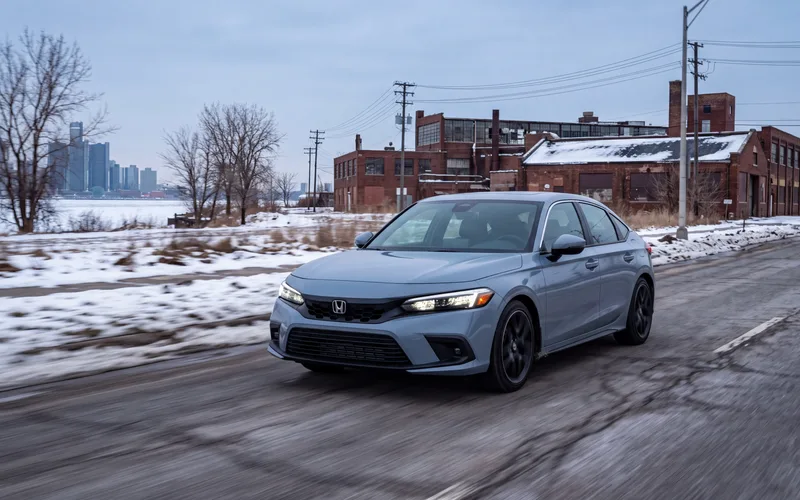 Honda Civic HatchbackCompact HatchbackBetter at: Space and efficiency
It matches the Mazda3's polish closely enough while adding 2.3 inches of rear legroom, 4.4 more cubic feet of cargo and a hybrid that returns about 48 MPG combined for similar money.
Compare 2.25C
2.25C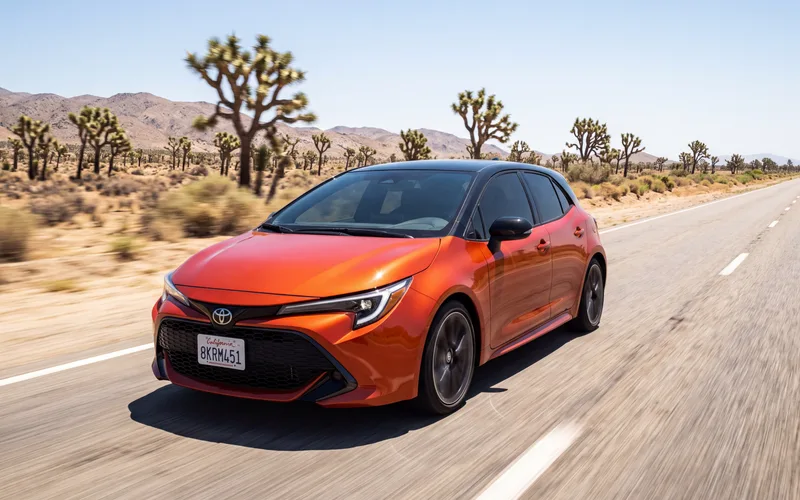 Toyota Corolla HatchbackCompact HatchbackBetter at: Ownership costs
Cheaper to own over five years with stronger resale and a dealer on nearly every corner, if you can live with a plainer cabin and less cargo room.
Compare 2.14C
2.14C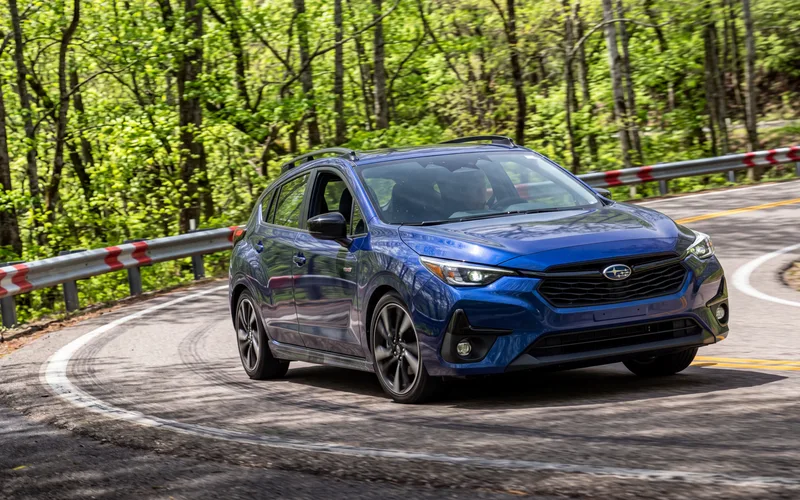 Subaru ImprezaCompact HatchbackBetter at: All-weather traction
The pick if all-wheel drive matters more than refinement — Subaru makes it standard with X-Mode instead of reserving it for pricier Mazda3 trims, and folds flatter for gear.
CompareHow it's evolved
10 scored model years · 2017–2026
Subject scores by year
Hover or tap a score to see what moved it versus the year before. A corner mark flags a big swing.
| Year | Performance | Efficiency | Safety | Space | Cost | Reliability | Tech | Use-case | Driving | Value |
|---|---|---|---|---|---|---|---|---|---|---|
| 2026 | 44 | 51 | 75 | 63 | 62 | 80 | 64 | 57 | 74 | 68 |
| 2025 | 44 | 48 | 79 | 62 | 64 | 80 | 50 | 55 | 74 | 68 |
| 2024 | 44 | 47 | 79 | 63 | 67 | 80 | 54 | 57 | 74 | 71 |
| 2023 | 42 | 47 | 73 | 62 | 68 | 80 | 52 | 52 | 75 | 71 |
| 2022 | 43 | 45 | 74 | 62 | 69 | 81 | 51 | 51 | 76 | 69 |
| 2021 | 43 | 45 | 74 | 62 | 70 | 83 | 50 | 52 | 77 | 72 |
| 2020 | 40 | 48 | 75 | 62 | 70 | 71 | 48 | 52 | 77 | 72 |
| 2019 | 39 | 48 | 77 | 62 | 69 | 66 | 49 | 54 | 77 | 70 |
| 2018 | 36 | 48 | 59 | 63 | 76 | 76 | 34 | 51 | 77 | 69 |
| 2017 | 30 | 52 | 60 | 63 | 75 | 81 | 30 | 50 | 76 | 71 |
Compare two years
Best fit & conditions
Higher scores mean a better fit for that use case. Learn more about use-case fit →
Subject profile
Academic Probation · NHTSA safety recalls
Jul 14, 2023Back over prevention: sensing system: cameraThe rearview camera image may not display properly by showing a flickering or distorted image.
Defect
Mazda North American Operations (Mazda) is recalling certain 2014-2018 Mazda3 and 2016-2021 CX-3 vehicles. The rearview camera image may not display properly by showing a flickering or distorted image.
Risk
A rearview camera that does not display properly can reduce the driver's rear view, increasing the risk of a crash or injury.
Remedy
Dealers will inspect and replace the rearview camera, as necessary. In addition, dealers will install a wiring harness fastening seal. All repairs will be performed free of charge. Interim notification letters, notifying owners of the safety risk, were mailed September 13, 2023. Final owner letters for affected models and model years in the states of CT, MA, MD, NJ, NY, PA and VA were mailed August 14, 2024. The remaining owner notification letters will be mailed at a future date, anticipated on or before May 1, 2025. Owners may contact Mazda customer service at 1-800-222-5500, Option 6. Mazda's number for this recall is 6023G.
NHTSA campaign 23V487000 ↗Manufacturer no. 6023G236,100 vehicles potentially affected (all models in the campaign)Owners notified Aug 14, 2024Filed by Mazda North American OperationsFiled as MAZDA3Apr 4, 2019Visibility: windshield wiper/washerA defective windshield wiper relay may cause the windshield wipers to become inoperative, reducing the driver's visibility.
Defect
Mazda North American Operations (Mazda) is recalling certain 2016-2018 Mazda3 vehicles. A defective windshield wiper relay may cause the windshield wipers to become inoperative, reducing the driver's visibility.
Risk
Reduced visibility while driving can increase the risk of crash.
Remedy
Mazda will notify owners, and dealers will replace the front body control module with a new module which uses an improved wiper relay design, free of charge. The recall began May 7, 2019. Owners may contact Mazda customer service at 1-800-222-5500, option 4. Mazda's number for this recall is 3219D.
NHTSA campaign 19V272000 ↗Manufacturer no. 3219D187,880 vehicles potentially affected (all models in the campaign)Owners notified May 7, 2019Filed by Mazda North American OperationsFiled as MAZDA3
13 recalls on other model years of the Mazda3 Hatchback (2018–2021, 2024–2025)
May 29, 2025Air bags: air bag/restraint control module: softwareThe Sophisticated Air Bag Sensor (SAS) units may set an error code and deactivate the air bags, due to a low battery condition.
Defect
Mazda North American Operations is recalling certain 2024-2025 Mazda3 and CX30 vehicles. The Sophisticated Air Bag Sensor (SAS) units may set an error code and deactivate the air bags, due to a low battery condition.
Risk
Air bags that do not deploy in the event of a crash increase the risk of injury.
Remedy
Dealers will reprogram the SAS unit with improved software or replace the unit, free of charge. Owner notification letters were mailed July 24, 2025. Mazda's number for this recall is 7525E.
NHTSA campaign 25V357000 ↗Manufacturer no. 7525E171,412 vehicles potentially affected (all models in the campaign)Owners notified Jul 22, 2025Filed by Mazda North American OperationsFiled as MAZDA3Sep 3, 2024Exterior lighting: headlights · Forward collision avoidance: automatic emergency braking · Lane departure: sensing system: cameraA malfunction in the forward sensing camera (FSC) may prevent the automatic emergency braking system and the lane-keep assist system from functioning. In addition, the headlights will not automatically adjust from high beams to low beams as intended.
Defect
Mazda North American Operations (Mazda) is recalling certain 2024 Mazda 3, CX-30, and 2025 CX-50 vehicles. A malfunction in the forward sensing camera (FSC) may prevent the automatic emergency braking system and the lane-keep assist system from functioning. In addition, the headlights will not automatically adjust from high beams to low beams as intended.
Risk
Automatic braking, steering assist, and headlight control systems that do not function as intended can increase the risk of a crash.
Remedy
Dealers will inspect and replace the forward sensing camera as necessary, free of charge. Owner notification letters were mailed September 24, 2024. Owners may contact Mazda customer service at 1-800-222-5500, Option 6. Mazda's number for this recall is 6824H.
NHTSA campaign 24V649000 ↗Manufacturer no. 6824H672 vehicles potentially affected (all models in the campaign)Owners notified Sep 24, 2024Filed by Mazda North American OperationsFiled as MAZDA3Oct 26, 2023Back over prevention: sensing system: camera · Forward collision avoidance: sensing system: camera · Lane departure: sensing system: cameraDue to a software error, the rearview, front, and/or side camera images may not appear on the display. As such, these vehicles fail to comply with the requirements of Federal Motor Vehicle Safety Standard number 111, "Rear Visibility."
Defect
Mazda North American Operations (Mazda) is recalling certain 2024 CX-90 and MAZDA3 vehicles. Due to a software error, the rearview, front, and/or side camera images may not appear on the display. As such, these vehicles fail to comply with the requirements of Federal Motor Vehicle Safety Standard number 111, "Rear Visibility."
Risk
A camera that does not display an image can reduce the driver's view, increasing the risk of a crash or injury.
Remedy
Dealers will update the view monitor control module software, free of charge. Owner notification letters were mailed December 20, 2023. Owners may contact Mazda customer service at 1-800-222-5500 Option 6. Mazda's number for this recall is 6223J.
NHTSA campaign 23V718000 ↗Manufacturer no. 6223J11,903 vehicles potentially affected (all models in the campaign)Owners notified Dec 20, 2023Filed by Mazda North American OperationsFiled as MAZDA3Nov 12, 2021Fuel system, gasoline: delivery: fuel pumpThe impeller inside the low-pressure fuel pump may crack and deform, potentially causing the fuel pump to fail.
Defect
Mazda North American Operations (Mazda) is recalling certain 2018 Mazda3, Mazda6, 2019 CX-3, 2018-2019 MX-5, CX-5, CX-9, and 2019-2020 Mazda2 vehicles. The impeller inside the low-pressure fuel pump may crack and deform, potentially causing the fuel pump to fail.
Risk
Fuel pump failure may cause an engine stall, increasing the risk of a crash.
Remedy
Dealers will replace the fuel pumps, free of charge. Owner notification letters were mailed July 18, 2022. Owners may contact Mazda customer service at 1-800-222-5500 Option 4. Mazda's number for this recall is 5321K.
NHTSA campaign 21V875000 ↗Manufacturer no. 5321K121,038 vehicles potentially affected (all models in the campaign)Owners notified Jul 18, 2022Filed by Mazda North American OperationsFiled as MAZDA3Feb 22, 2021Tires: valveAir may suddenly leak from the tire air valve.
Defect
Mazda North American Operations (Mazda) is recalling certain 2021 Mazda3 and CX-30 vehicles. Air may suddenly leak from the tire air valve.
Risk
A sudden air leak from the tire air valve may cause a loss of vehicle control while driving, increasing the risk of a crash.
Remedy
Mazda will notify owners, and dealers will replace all four tire air valves with new parts, free of charge. The recall began April 6, 2021. Owners may contact Mazda customer service at 1-800-222-5500 Option 4. Mazda's number for this recall is 4721B.
NHTSA campaign 21V101000 ↗Manufacturer no. 4721B599 vehicles potentially affected (all models in the campaign)Owners notified Apr 6, 2021Filed by Mazda North American OperationsFiled as MAZDA3Jun 12, 2020Service brakes, hydraulic: foundation components: disc: caliperThe front brake caliper mounting bolts may not have been tightened properly during assembly, possibly allowing the calipers to loosen.
Defect
Mazda North American Operations (Mazda) is recalling certain 2020 CX-30 and Mazda3 vehicles. The front brake caliper mounting bolts may not have been tightened properly during assembly, possibly allowing the calipers to loosen.
Risk
Loose brake calipers can reduce braking performance or interfere with wheel rotation, affecting vehicle handling. Either of these scenarios can increase the risk of a crash.
Remedy
Mazda will notify owners, and dealers will inspect the front brake caliper bolts, tightening them as necessary. If bolts are missing, the affected brake caliper will be replaced. Repairs will be performed free of charge. The recall began July 24, 2020. Owners may contact Mazda customer service at 1-800-222-5500, Option 4. Mazda's number for this recall is 4420F.
NHTSA campaign 20V346000 ↗Manufacturer no. 4420F24,037 vehicles potentially affected (all models in the campaign)Owners notified Jul 24, 2020Filed by Mazda North American OperationsFiled as MAZDA3Dec 19, 2019Forward collision avoidance: automatic emergency brakingThe Smart Brake System (SBS) can falsely detect an obstacle while driving, activating the automatic emergency braking system and suddenly stopping the vehicle.
Defect
Mazda North American Operations (Mazda) is recalling certain 2019-2020 Mazda3 vehicles. The Smart Brake System (SBS) can falsely detect an obstacle while driving, activating the automatic emergency braking system and suddenly stopping the vehicle.
Risk
Stopping the vehicle unexpectedly increases the risk of a crash.
Remedy
Mazda will notify owners, and dealers will update the SBS software. In addition, vehicles with certain production dates will receive an instrument cluster software update or replacement and a replacement owner's manual. These repairs will be performed free of charge. The recall began February 14, 2020. Owners may contact Mazda customer service at 1-800-222-5500, Option 4. Mazda's number for this recall is 4219L.
NHTSA campaign 19V907000 ↗Manufacturer no. 4219L35,390 vehicles potentially affected (all models in the campaign)Owners notified Feb 14, 2020Filed by Mazda North American OperationsFiled as MAZDA3Jul 29, 2019Visibility: glass, side/rearThe adhesive between the interior rearview mirror and the housing may not be properly bonded, allowing the mirror to detach from the housing. Note: Vehicles equipped with auto dimming mirrors are not affected by this recall.
Defect
Mazda North American Operations (Mazda) is recalling certain 2019 Mazda3 vehicles equipped with manual dimming mirrors. The adhesive between the interior rearview mirror and the housing may not be properly bonded, allowing the mirror to detach from the housing. Note: Vehicles equipped with auto dimming mirrors are not affected by this recall.
Risk
Rearward visibility will be reduced without the rearview mirror, increasing the risk of a crash.
Remedy
Mazda will notify owners, and dealers will replace the interior rearview mirror assembly, free of charge. The recall began September 19, 2019. Owners may contact Mazda customer service at 1-800-222-5500, option 4. Mazda's number for this recall is 3919G.
NHTSA campaign 19V558000 ↗Manufacturer no. 3919G22,571 vehicles potentially affected (all models in the campaign)Owners notified Sep 19, 2019Filed by Mazda North American OperationsFiled as MAZDA3Jul 5, 2019Seats: front assembly: head restraintThe seat cover material on both front seats may interfere with the head restraint lock release button, causing it to stick in the release position and not allow the head restraint to lock into place.
Defect
Mazda North American Operations (Mazda) is recalling certain 2019 Mazda3 vehicles. The seat cover material on both front seats may interfere with the head restraint lock release button, causing it to stick in the release position and not allow the head restraint to lock into place.
Risk
Loose head restraints may increase the risk of injury in the event of a crash.
Remedy
Mazda will notify owners, and dealers will install spacers at the bottom of the lock release buttons on both front seat head restraints, free of charge. The recall began August 20, 2019. Owners may contact Mazda customer service at 1-800-222-5500, option 4. Mazda's number for this recall is 3819F.
NHTSA campaign 19V514000 ↗Manufacturer no. 3819F9,430 vehicles potentially affected (all models in the campaign)Owners notified Aug 20, 2019Filed by Mazda North American OperationsFiled as MAZDA3Jun 27, 2019Engine · Power train: automatic transmission: control module (tcm/pcm/tecm)A software error in the powertrain control module (PCM) may cause the engine to stall.
Defect
Mazda North American Operations (Mazda) is recalling certain 2018-2019 CX-5, Mazda6, and 2019 Mazda3 vehicles. A software error in the powertrain control module (PCM) may cause the engine to stall.
Risk
An unexpected stall increases the risk of a crash.
Remedy
Mazda will notify owners, and dealers will reprogram the PCM software, free of charge. The recall began August 20, 2019. Owners may contact Mazda customer service at 1-800-222-5500, option 4. Mazda's number for this recall is 3719F.
NHTSA campaign 19V497000 ↗Manufacturer no. 3719F262,220 vehicles potentially affected (all models in the campaign)Owners notified Aug 20, 2019Filed by Mazda North American OperationsFiled as MAZDA3Jun 7, 2019Wheels: lugs/nuts/bolts/studsThe lug nuts on all four wheels may loosen, potentially resulting in a wheel detaching from the vehicle.
Defect
Mazda North American Operations (Mazda) is recalling certain 2019 Mazda3 vehicles. The lug nuts on all four wheels may loosen, potentially resulting in a wheel detaching from the vehicle.
Risk
A wheel separating from the vehicle increases the risk of a crash.
Remedy
Mazda will notify owners, and dealers will tighten the front and rear wheel lug nuts to the correct specification, free of charge. The recall began July 9, 2019. Owners may contact Mazda customer service at 1-800-222-5500, Option 4. Mazda's number for this recall is 3519F.
NHTSA campaign 19V425000 ↗Manufacturer no. 3519F25,003 vehicles potentially affected (all models in the campaign)Owners notified Jul 9, 2019Filed by Mazda North American OperationsFiled as MAZDA3May 14, 2019Electrical system: instrument cluster/panel · Seat belts: front: warning light/devicesDue to incorrect programing, the passenger air bag deactivation indicator light may erroneously turn off although the passenger air bag is deactivated. In addition, the seat belt status indicators for both the front passenger seat and/or rear seats may erroneously turn off although the front passenger and/or rear seat belts are unfastened.
Defect
Mazda North American Operations (Mazda) is recalling certain 2019 Mazda3 vehicles. Due to incorrect programing, the passenger air bag deactivation indicator light may erroneously turn off although the passenger air bag is deactivated. In addition, the seat belt status indicators for both the front passenger seat and/or rear seats may erroneously turn off although the front passenger and/or rear seat belts are unfastened.
Risk
Incorrect indicator warning lights may lead the driver and/or passengers to be unaware of deactivated air bags or unfastened seat belts, increasing the risk of injury.
Remedy
Mazda will notify owners, and dealers will replace the passenger air bag/seat belt status indicator assembly, free of charge. The recall began July 9, 2019. Owners may contact Mazda customer service at 1-800-222-5500, Option 4. Mazda's number for this recall is 3319E.
NHTSA campaign 19V363000 ↗Manufacturer no. 3319E17,016 vehicles potentially affected (all models in the campaign)Owners notified Jul 9, 2019Filed by Mazda North American OperationsFiled as MAZDA3Nov 21, 2017Engine and engine cooling: exhaust systemThe incorrect exhaust valve spring may fail while driving, potentially causing an engine stall.
Defect
Mazda North American Operations (Mazda) is recalling certain 2018 Mazda3 vehicles, equipped with an incorrect exhaust valve spring. The incorrect exhaust valve spring may fail while driving, potentially causing an engine stall.
Risk
An engine stall can increase the risk of a crash.
Remedy
Mazda will notify owners, and dealers will inspect the engines and replace any incorrect exhaust valve springs, free of charge. The recall is expected to begin January 20, 2018. Owners may contact Mazda customer service at 1-800-222-5500. Mazda's number for this recall is 1717K.
NHTSA campaign 17V745000 ↗Manufacturer no. 1717K144 vehicles potentially affected (all models in the campaign)Owners notified Jan 22, 2018Filed by Mazda North American OperationsFiled as MAZDA3
Source: NHTSA Office of Defects Investigation recall database, model years 2017–2026. Recalls are listed by model year as the manufacturer filed them; whether a specific car is affected depends on its VIN — check a VIN at nhtsa.gov ↗. NHTSA model names matched to this page: MAZDA3.
Detailed scoring by subject
1Performance & PowertrainThe Mazda3 Hatchback's lowest-graded category.0.00F
2017 is the BN facelift of the third-generation Mazda3, and the volume 5-Door trims — Sport and Touring — both carry the 155-hp naturally aspirated 2.0L; the 184-hp 2.5L is reserved for the Touring 2.5 and Grand Touring trims above them. 155 hp is modest by compact standards and well short of the turbocharged output rivals were moving to.
150 lb-ft that does not arrive until 4,000 rpm is the signature of the 13.0:1 naturally aspirated Skyactiv-G — the car has to be revved to feel quick, where turbocharged compacts of the same year made peak twist near 2,000 rpm.
Edmunds' instrumented run of a 2.0L automatic Mazda3 returned 8.3 s and called it quicker than average for a compact on its base engine — a light curb weight doing the work 155 hp cannot. The 5-Door is 27 lb lighter than the equivalent sedan, so the figure carries across essentially unchanged; slow in absolute terms and roughly eight tenths behind the 2.5L cars.
With no turbocharger there is nothing to lag or surge — throttle response is linear, reviewers describe the 2.0L as accelerating quickly and smoothly, and the 2017 facelift specifically added acoustic work that made the car about 3 dB quieter at 25 mph over rough roads. It is held out of the top band because 155 hp must be worked hard to keep pace and the engine turns buzzy in the upper third of a 6,800-rpm tach.
The Skyactiv-Drive six-speed torque-converter automatic remains a genuine class advantage — quick, smooth, decisive on kickdown, and free of the drone that afflicts the CVT-equipped Civic, Corolla and Sentra — and the Skyactiv-MT six-speed manual is offered on every 5-Door trim with either engine, which almost no rival could still claim. It loses points only for carrying six ratios where rivals were fielding eight.
The 2017 Mazda3 5-Door is front-wheel drive only — no AWD at any trim, with either engine, with either transmission. i-Activ AWD did not reach the Mazda3 until the fourth generation arrived for 2019, so a 2017 buyer wanting all-wheel drive had to leave the nameplate.
Two real engine choices (155-hp 2.0L, 184-hp 2.5L), each pairable with a six-speed manual or a six-speed automatic, is broad by 2017 compact standards, and the 5-Door spreads the 2.5L one trim lower than the sedan does via the hatch-only Touring 2.5. But every option is a naturally aspirated gasoline four differing only in displacement — no turbo, no hybrid, no plug-in, and the BN facelift explicitly deleted the diesel that other markets had (the US never received it).
2Efficiency & RangeGrades below the middle of the scale.1.49D
The volume 2017 5-Door is the 155-hp 2.0L, EPA-rated 31 MPG combined with either transmission — strong for a naturally aspirated engine with no stop-start and no electrification, helped by a tall 0.599:1 sixth and 13.0:1 compression. It trails the equivalent sedan by a point on the hatchback's worse aerodynamics, and the CVT-equipped Civic and Corolla were reaching into the mid-30s.
28 MPG city for the volume 2.0L automatic. The torque-converter six-speed and high-compression direct injection do well in stop-and-go for a non-hybrid, but the US-market car gets no engine stop-start and no cylinder deactivation, both of which rivals were using to push higher.
37 MPG highway is the car's strongest EPA number and the one that comes closest to the class leaders — a 0.599:1 top gear and a 2,940-lb curb weight working in the same direction, and identical to the sedan's figure despite the hatch's blunter tail.
EPA puts total range at 409 miles — respectable, but earned on economy rather than tank size: 13.2 gallons is small, and compact rivals with 14-gallon-plus tanks cleared 450 miles on similar MPG. This is the weakest part of an otherwise good efficiency case.
EPA's estimate at standard assumptions for the volume 2.0L 5-Door — cheap to run in absolute terms and better than the segment-wide average, though a hybrid compact of the same year undercuts it by roughly a third.
Regular 87-octane unleaded delivers the full rated 155 hp despite a 13.0:1 compression ratio — no premium recommendation, no plug, no special infrastructure, the cheapest and simplest arrangement a buyer can have. Held just short of the top because the 13.2-gallon tank means noticeably more frequent stops than rivals.
3SafetyMid-pack among this car's ten categories.2.03C
NHTSA gave the 2017 Mazda3 5-door hatchback 5 stars overall, with 5 stars in the combined frontal and side tests and 5 stars in the side pole test. Only rollover falls short at 4 stars — a 10.5% rollover possibility, which is normal for a front-drive compact and not a defect.
The 2017 Mazda3 hatchback took Good in every crashworthiness test IIHS ran on it and carried a 2017 TOP SAFETY PICK+ award — the structure is not the weak point of this car. It sits below the top of the band for two reasons that are about the award rather than the shell: the plus was conditional on optional front crash prevention and on headlights only one expensive configuration had, and the passenger-side small overlap test did not yet exist in 2017, so half of the hardest crash evaluation is simply unproven on this body.
On the volume Touring five-door, standard active safety amounts to low-speed-only Smart City Brake Support plus alert-only blind-spot monitoring with rear cross-traffic alert; adaptive cruise, lane-departure warning and lane-keep assist all sit inside the $1,100 i-ACTIVSENSE package, which 2017 restricted to the Grand Touring and the manual Touring. The hatchback is a notch worse off than the sedan at the bottom of the range: the $1,000 Preferred Equipment Package that adds blind-spot monitoring to a Sport is sedan-only, so a base five-door leaves the lot with a reversing camera and nothing else.
As the volume trim is actually equipped, IIHS rated front crash prevention only Advanced — the standard Smart City Brake Support avoided the 12 mph collision but failed to slow the car at 25 mph, because it is a camera-and-laser city system rather than the radar-based Smart Brake Support. Superior is available, but only by buying the optional i-ACTIVSENSE package. Pedestrian detection is absent from the US car despite the facelift adding it elsewhere, and the nighttime pedestrian test that would expose that had not been invented yet.
Advanced Blind Spot Monitoring with Rear Cross Traffic Alert is standard on the volume Touring and on Grand Touring, which is respectable for a 2017 compact, but it is warning-only — no steering or braking intervention, no rear cross-traffic braking, no safe-exit alert, and no surround-view camera anywhere in the range. Unlike the sedan there is no way to option it onto a base five-door at all, so the coverage is standard-or-nothing depending on trim.
Lane Keep Assist was genuinely new for 2017 with the BN facelift, but it arrives only inside the optional $1,100 i-ACTIVSENSE package on Grand Touring and manual Touring — the volume automatic Touring cannot have it. What it delivers is a corrective nudge off the lane marking rather than sustained centering; no lane-centering or highway-assist function existed on the 2017 Mazda3 in any market configuration sold here.
Mazda Radar Cruise Control is an option rather than standard equipment, and it is not a full-speed-range system: it works only between roughly 19 and 90 mph with no stop-and-go or low-speed follow, so it drops out in exactly the traffic where adaptive cruise earns its keep. With no lane centering to pair it with, there is no combined highway-assist mode at all.
No hands-free highway driving system was offered on the 2017 Mazda3 at any trim or price, and Mazda had no such product anywhere in its 2017 lineup. The most capable assist in the catalog is hands-on radar cruise inside the i-ACTIVSENSE package.
IIHS rated the standard halogen projector headlights Marginal on Sport, Touring and the plain Grand Touring — that is what the volume hatchback actually leaves the dealership with. Acceptable is reachable only on a Grand Touring carrying the $1,600 Premium Equipment Package's curve-adaptive LED projectors, and Good is not available at any price; that single Acceptable configuration is the sole reason the car qualified for the plus half of its Top Safety Pick+.
The third-generation hatchback is far easier to see out of than the fastback that replaced it in 2019, but it is still the compromised member of the Mazda3 family: reviewers single out the thick reinforced pillars and the short, steeply raked backlight as restricting the rear three-quarter view, where the sedan's larger side glass does better. A reversing camera is standard on every trim, blind-spot monitoring covers the volume Touring, and no surround-view camera was offered on any 2017 Mazda3 to fill in the rest.
IIHS rates the hardware Acceptable — two outboard positions with complete lower anchors and tethers, easy enough to find and connect — which is ordinary rather than good for a compact. The limiting factor is the car around the anchors: the Mazda3's tight rear legroom makes a rear-facing seat a genuine negotiation with the front passenger, and three across the back is not happening in a car this narrow.
4Space & ComfortMid-pack among this car's ten categories.2.24C
Five belted positions on every 2017 Mazda3 5-Door trim — two front buckets and a 60/40-split three-place bench. That is the maximum a compact hatchback offers and the top of the segment band.
38.6 in is generous for a compact hatchback and sits comfortably above the segment midpoint — the BN Mazda3's low-slung dashboard buys back the height its roofline gives away. Unusually, Mazda publishes the same figure for the moonroof-equipped Touring 2.5 and Grand Touring as for the moonroof-free Sport, so there is no headroom penalty to note.
42.2 in is a touch above the middle of the compact band — enough that six-footers sit comfortably behind a tilt-and-telescoping wheel, but nothing like the class leaders. It is the same figure the 2017 sedan publishes, since both bodies share the 106.3-in wheelbase and identical front structure.
37.6 in is a genuinely good number for a compact hatchback and better than what replaced it — the fourth-generation car that arrived for 2019 gave up half an inch here to its faster roofline. Rear headroom is not what makes this back seat tight.
35.8 in is the Mazda3's long-standing weak point and the reason this car reads as a size smaller than a Civic or Corolla from the back seat — roughly four inches short of the compacts that prioritize rear passengers. It is the constraint Cars.com's car-seat check singles out for rear-facing installs, and it caps everything this category measures about carrying four adults.
20.2 cu ft behind the seats is solidly above the compact-hatchback midpoint and is the single biggest practical advantage the 5-Door holds over the sedan, whose trunk measures 12.4 cu ft. Folding the 60/40 bench opens 47.1 cu ft through a wide hatch aperture, which is what makes this the body style to buy if you carry anything bulky.
The 2017 facelift was specifically a storage year: Mazda moved to an electronic parking brake, which freed the console for a sliding covered center bin borrowed from the Mazda6, and enlarged the front door pockets to roughly three times their previous size. What is there is well designed — bottle holders in all four doors, a covered armrest bin, a seatback pocket, a rear armrest with cupholders from Touring up — but there is no underfloor cargo well, no second-row USB or 110V outlet, and a single 12-volt socket for the whole cabin, so it is competitive rather than clever.
The front sport seats are a genuine strength — reviewers rate them among the best in the class, with cushions long enough for tall drivers and real lateral support, and the 2017 update paired them with a redesigned leather-wrapped wheel. Two things keep them out of the top band: the driver's seat gets only six-way power with manual lumbar (the passenger stays manual on every trim, and there is no power lumbar or thigh extension at any price), and the back seat is a short-trip proposition because of 35.8 in of legroom rather than because of its cushioning.
Mazda tuned this chassis for the corner rather than the commute, and reviewers say so plainly: ride comfort takes a back seat to the handling. The 2017 car is the better-resolved version of the BN — G-Vectoring Control shaves the small corrections that make a compact feel busy, and reviewers driving it back-to-back with the 2016 called it slightly more composed — but the Grand Touring's 18-inch wheels sharpen the handling and coarsen the secondary ride in the same stroke, and broken pavement still registers more sharply than in a Civic or a Golf.
Noise is the criticism that follows this generation, and 2017 is the year Mazda attacked it — tighter body gaps, extra sound insulation and redesigned weather stripping made the car about 3 dB quieter at 25 mph over rough pavement, a change owners of the earlier car describe as transformative. It still is not a quiet compact: reviewers who came to the 2017 fresh call road noise high even for this price class, and the fix addressed coarse-surface roar rather than sustained highway drone.
The volume Touring 5-Door arrives with dual-zone automatic climate control and variable heated front seats standard, which is better than a 2017 compact buyer had any right to expect, and a heated steering wheel — genuinely rare in the class — is available inside the Grand Touring's Premium Equipment Package. Against that, the base Sport makes do with single-zone manual air conditioning and unheated cloth seats, there are no rear-seat vents anywhere in the range, ventilated seats are not offered at any price, and remote pre-conditioning exists only as a $500 dealer-installed accessory on automatics.
5Cost of OwnershipOne of the Mazda3 Hatchback's strongest categories.3.12B
The 2017 BN facelift held Mazda3 pricing steady, and the 5-Door opens at $19,095 plus $835 destination — a $1,250 body-style premium over the equivalent Sport sedan, but still comfortably under the hatchback band floor.
Touring with the six-speed automatic is the volume 5-Door configuration — the 155-hp 2.0L trim where 18-inch wheels, dual-zone climate, a power driver's seat, heated leatherette and Smart City Brake Support become standard, at $22,245 plus $835 destination. It matches the 155-hp car described in this vehicle's Performance category.
CarEdge projects $1,814 in maintenance and repairs over five years for the Mazda3 Hatchback, and RepairPal's $433/yr average across the nameplate implies about $2,165 — the 5-Door is mechanically identical to the sedan, so both series land within $50 of each other and ~$2,300 covers the repairs that fall outside the 3yr/36k basic warranty in years four and five.
Mazda is a top-five mainstream brand for resale, and the Mazda3's mechanical twin sedan retains about 62%. CarEdge's 41% depreciation figure for the Hatchback series is computed against a $32,927 average new price inflated by current-generation turbo trims that did not exist in 2017, so 60% is the defensible split for a 2017 5-Door — a little behind the sedan, well behind Civic and Corolla benchmarks, but strong for the band.
Mazda's 2017 New Vehicle Limited Warranty is the mainstream-industry minimum at three years or 36,000 miles — level with Honda and Toyota, but half the Korean brands' five-year basic coverage on comparable 2017 compacts.
Five years or 60,000 miles of powertrain coverage sits at the floor of the band — half the 10yr/100k Hyundai and Kia offered on 2017 compacts, and a real weakness against the naturally aspirated Skyactiv-G's otherwise strong durability record.
Mazda included no complimentary scheduled maintenance on the 2017 Mazda3 — the sole ownership perk is the 3-year/36,000-mile 24/7 Roadside Assistance program, which puts it at the floor of the 'basic roadside only' band. There is no connected-services trial either: MAZDA CONNECT in this generation is phone-tethered rather than embedded telematics.
$23,080 volume-trim price minus its estimated resale value after 5 years (60% retained, or about $13,848) leaves about $9,232 in depreciation. Add the projected $2,300 in 5-year maintenance and repairs, and owning this vehicle for 5 years costs about $11,532 in total.
6Reliability & QualityThe Mazda3 Hatchback's best-graded category.3.53A-
The hard field data on this exact model year is the best in the compact class by a wide margin — 83 NHTSA complaints across both body styles against 580 for the 2017 Civic and 763 for the Elantra — and Consumer Reports' owner survey concludes outright that the 2017 Mazda 3 is more reliable than other cars of its year. The most on-point brand study is the 2020 J.D. Power VDS, which surveyed 2017-model-year owners at three years and put Mazda above the 134 PP100 industry average with the single largest year-over-year improvement of any brand. Held below the high 80s by two mixed signals: J.D. Power's consumer-facing Quality & Reliability score for this model year is only middling, and CR's own trouble-spot detail flags in-car electronics and sunroof water intrusion. Scored a shade below where the pure complaint count would put it because the 5-Door offers a manual on Sport, Touring 2.5 and Grand Touring where the volume sedan configuration is automatic, so more hatchback owners sit inside the clutch-failure exposure at 6.1.4.
Mazda's dependability standing was already improving when this car was three years old and has strengthened since — the 2020 VDS wave that surveyed 2017-MY owners moved Mazda above the industry average by the biggest margin of improvement in the study, and the brand now sits 3rd overall and 2nd among mass-market brands in J.D. Power's VDS with Consumer Reports placing it 3rd for used-vehicle reliability, which is exactly the cohort a 2017 car falls into today. Top-tier rather than merely mid-pack, but kept out of the 90s because the run-up years were genuinely average rather than podium.
2017 is the cleanest recall year of the whole BM/BN generation: two campaigns against four for 2014, 2015 and 2018 and six each for 2016 and 2019, and neither of the two touches powertrain, fire or structure — a windshield-wiper relay that can leave the wipers inoperative and a rearview camera that can flicker or distort. Both were remedied free of charge. What holds it out of the top band is a generation-wide bulletin pattern rather than a recall one: Mazda Connect infotainment faults, sunroof water intrusion, brake noise/judder, loose interior and exterior trim, steering-wheel leather wear and unintended Smart City Brake Support activation all have TSBs against this generation, and the complaint record is correspondingly concentrated in electrical (20) and back-over prevention (11). The camera recall is marginally more relevant to this body style than to the sedan, since the remedy adds a wiring-harness fastening seal to a camera mounted on a moving liftgate.
Both engines offered in the 2017 5-Door — the 155 hp Skyactiv-G 2.0 in Sport and Touring and the 184 hp Skyactiv-G 2.5 in Touring 2.5 and Grand Touring — are naturally aspirated, timing-chain, port-plus-direct-injection units with no turbocharger, and the volume automatic is a conventional Skyactiv-Drive six-speed torque converter rather than a CVT or dual-clutch. That combination is the single biggest durability advantage the Mazda3 holds over the Civic, Corolla, Elantra and Forte of the same year, and the NHTSA record backs it: only 3 powertrain and 3 fuel/propulsion complaints out of 83. The two known caveats are intake-valve carbon deposits from direct injection at high mileage, and clutch failure — CarComplaints' worst logged 2017 problem at roughly $3,600 and 24,000 miles, and a manual-only component that a larger share of 5-Door buyers is exposed to because the manual is offered on Sport, Touring 2.5 and Grand Touring hatchbacks.
2017 is the US debut of the BN facelift, and the cabin is where most of that money went: a redesigned dashboard with the screen better integrated into a new housing, an electronic parking brake freeing up console space, added sound insulation, and leatherette or leather upholstery on nearly every trim. Reviewers put it a class above its compact price rather than merely competitive with it, and the head-up display and commander-knob control layout reinforce the impression. Short of the very top band only because the lower cabin is still hard plastic and the 155-hp Sport is the price-leader configuration.
Assembly is solid and owners routinely name build quality as a reason they kept the car, but this generation collects a consistent trickle of secondary-quality complaints rather than a clean sheet: Consumer Reports' own trouble spots for the 2017 car include water intrusion through the sunroof seal and loose paint and trim, and the generation's problem lists repeat paint fading, chalking and peeling alongside loose interior and exterior mouldings. Scored two points under the sedan for a body-specific reason — the 2016 facelift restyled the rear only on the hatchback, so the 5-Door carries new-for-2017 rear body tooling and a newly packaged liftgate camera harness (later the subject of recall 23V487000) where the sedan's rear structure carried over.
Service quality is genuinely excellent and independently measured — Mazda ranks highest in the mass-market car segment of J.D. Power's most recent Customer Service Index, ahead of Subaru and Chevrolet, and has been top-three for several years running. Density is the limiter and always has been: roughly 550 US franchised Mazda stores is well under half of Toyota's or Honda's footprint, so an owner outside a major metro drives further for warranty or recall work, and this car has two open-ended recall remedies to collect.
Running costs are low and measured as such — RepairPal puts the Mazda 3 at $433 average annual repair and maintenance with an Excellent 4.0/5.0 rating, 0.4 unscheduled shop visits a year and only a 10% chance a given repair is severe — and the Mazda3 is a high-volume global nameplate, so mechanical parts and consumables are cheap and widely stocked. It sits just below the top band rather than in it because Mazda's US volume is an order of magnitude under Toyota's or Honda's, which leaves a thinner independent-parts and aftermarket catalogue than a Civic or Corolla enjoys, and hatchback-specific rear body panels, liftgate hardware and rear glass are effectively dealer-order items with longer lead times than the sedan equivalents.
7Technology & InfotainmentOne of the Mazda3 Hatchback's weakest categories.0.00F
Every 2017 Mazda3 5-Door, from the $19,930 Sport to the $25,780 Grand Touring, carries the same 7-inch tablet-style display perched on the dash — there is no larger screen at any price. Seven inches sits at the very bottom of the modern band this framework normalizes against, which is the honest reading of a 2017 compact's screen against a 2026-anchored scale.
MAZDA CONNECT's rotary Commander knob on the console is the right idea — it lets you work the menus by feel instead of stabbing at a screen, and Mazda locks out touch input above walking pace precisely to force that habit. The execution is where it falls down: reviewers find the console controller tedious for simple tasks, the graphics visibly less crisp than rivals', and the feature set thin, and the two-input scheme means the shortcut you want is often on whichever control you are not using.
Not offered — not wirelessly and not even wired. No 2017 Mazda3 trim or package included Apple CarPlay or Android Auto; Mazda's spec sheet lists Aha, Pandora and Stitcher integration in their place. Mazda later sold a dealer-installed Smartphone Screen Mirroring retrofit kit that adds wired CarPlay and Android Auto to MAZDA CONNECT cars, but that is an aftermarket upgrade requiring a firmware update and a hardware swap, not equipment the car could be bought with in 2017.
Voice command is standard but it is a rigid command-tree system from the era before natural language — you learn its phrases or it does not respond. Native navigation is not standard on any trim: it arrives either as a $400-class SD card the dealer plugs in or bundled into the Grand Touring's Premium Equipment Package, and with no CarPlay or Android Auto to fall back on, a buyer who skips it has no in-dash mapping at all.
The Bose nine-speaker surround system with Centerpoint 2 and AudioPilot 2 is standard on Grand Touring and is a genuinely good compact-car stereo — a branded premium system that many rivals charged extra for or did not offer. The catch is that it is top-trim-only: Sport, Touring and Touring 2.5 all get a plain six-speaker AM/FM head unit, and there is no way to option the Bose onto them.
There is no configurable digital cluster on any 2017 Mazda3 — the instrument pod is a fixed three-ring analog binnacle with one dial rendered as a small digital readout, and which dial that is flips by trim: Sport, Touring and Touring 2.5 get an analog speedometer with a digital tachometer, while Grand Touring reverses it to an analog tachometer with a digital speedometer in the center ring. Nothing about it reconfigures, and there are no alternate layouts or full-screen map views.
No over-the-air capability of any kind — the 2017 Mazda3 has no embedded modem and no connected-services subscription behind it. MAZDA CONNECT firmware is updated by carrying a USB stick to the car or booking a dealer visit, and map data ships on a physical SD card. Nothing about the vehicle improves after it leaves the lot without someone plugging something in.
There is a phone app, but it is a paid bolt-on rather than built-in connectivity. Mazda Mobile Start is a dealer-installed accessory carrying a $500 MSRP and, after a complimentary first year, a $65 annual subscription; it is offered on automatic cars only, so a manual 5-Door cannot have it at all. What it delivers is respectable for its era — remote engine start with up to a half-hour idle, remote lock/unlock and door-status check, panic alarm and a GPS car-finder — but there is no digital key, no vehicle-health or trip data, and no free tier.
Two USB-A audio inputs in the front console and a single 12-volt socket is the entire device-power provision. There is no USB-C anywhere, no wireless charging pad at any trim or in any package, nothing at all for second-row passengers, and no household outlet — so rear occupants on a long drive are dependent on whatever the front seats are willing to share.
Push-button start is standard on every trim including the base Sport, which was not a given in the 2017 compact class, and Mazda Advanced Keyless Entry — proximity unlocking by touching the door handle — is standard from the volume Touring upward, leaving only the Sport on a conventional remote-fob unlock. Remote start is the gap: it is not factory equipment at any trim, only a dealer-installed accessory restricted to automatics, and phone-as-key did not exist in Mazda's 2017 lineup.
A reversing camera is standard on all four trims — but that is the whole of it. No 360-degree view monitor was offered on any 2017 Mazda3 at any price, front sensors do not exist, and even rear parking sensors are relegated to the dealer accessory catalog rather than being a factory option, so a car built on the line has no audible parking assistance at all. The camera image itself is the low-resolution unit of its generation displayed on a 7-inch screen.
The 2017 facelift upgraded Mazda's Active Driving Display to full color, and it is standard on the Grand Touring — a real head-up display in a $25,000 compact, which was unusual. Two things hold it mid-band: it is top-trim-only, unavailable on the Sport, Touring or Touring 2.5 that most buyers actually leave with, and it projects onto a small pop-up plastic combiner rather than the windshield, so it is smaller and less crisp than the windshield-projected units that replaced it in the following generation.
8Use-Case FitOne of the Mazda3 Hatchback's weakest categories.1.37D
The hatchback body helps — a wide tailgate opening onto 20.2 cu ft swallows a stroller without folding anything, and the LATCH hardware is rated Acceptable with complete anchors and tethers in both outboard positions. The car around those anchors is the problem: 35.8 in of rear legroom makes a rear-facing seat a negotiation with whoever is sitting in front of it, three across the back is not happening in a compact this narrow, and the low roofline means lifting a child into a seat is a stoop rather than a step.
The crash credentials are excellent — five NHTSA stars overall and Good in every IIHS crashworthiness test IIHS ran, with a 2017 Top Safety Pick+ on the board. What families actually get on the trims they buy is thinner: the volume automatic Touring's standard active safety is low-speed-only Smart City Brake Support plus warning-only blind-spot monitoring, its halogen headlights are rated Marginal, and adaptive cruise, lane-departure warning and lane-keep assist all live in a $1,100 package that 2017 restricted to the Grand Touring and the manual Touring. There is no rear-occupant reminder anywhere in the range.
For two adults up front and small kids behind, this works — the front seats are among the class's best and there is 20.2 cu ft of luggage room with everyone aboard. Beyond that it thins out fast: 35.8 in of rear legroom is short for teenagers over four hours, there are no rear air vents, no rear USB ports and no rear-seat entertainment provision of any kind, and the cabin is noisier than the compact norm even after the 2017 sound-deadening update, which is exactly the fatigue factor that matters on a long day.
This is where the Mazda3 earns its keep. The Skyactiv-Drive six-speed torque-converter automatic is decisive and free of the drone that afflicts the CVT-equipped compacts it competed against, the naturally aspirated 2.0L has no turbo lag to calibrate around so tip-in is linear, and G-Vectoring Control quietly reduces the small steering corrections that make a commute tiring. It falls short of the top band because 155 hp has to be worked to merge, the cabin is noisier than the class norm in stop-and-go, and the adaptive cruise that would actually help in traffic is an option the volume automatic Touring cannot even be given.
31 MPG combined on regular unleaded, an EPA annual fuel bill of about $2,000, and a naturally aspirated Skyactiv-G that asks for nothing exotic in the way of consumables make this a cheap car to commute in by 2017 compact standards — and observed economy tends to beat the sticker, with one tester recording 34 MPG against a 29-MPG rating. It is not exceptional in absolute terms, though: with no hybrid or plug-in option anywhere in the Mazda3 range, a Prius or a hybrid Ioniq buyer pays roughly half as much per mile.
A 34.8-ft curb-to-curb turning circle is genuinely tight — near the best of the compact band — and at 175.6 in long and 70.7 in wide the 5-Door is a full six inches shorter than the sedan it shares a wheelbase with, which is felt every time you back into a city space. Two things hold it back: the thick rear pillars and short, steeply raked backlight restrict the over-the-shoulder view, and parking assistance stops at the standard reversing camera because sensors are a dealer accessory and no surround-view system was offered.
A front-wheel-drive compact hatchback with 155 hp and no US tow rating is not a work vehicle in any meaningful sense — Mazda does not publish a towing capacity for the 2017 Mazda3 and sells no factory hitch for it. What capability exists is cargo capability: 47.1 cu ft with the seatback down and a flat load floor through a wide hatch is enough for a courier run or a trades apprentice's hand tools, and no more than that.
The mechanical package is the durable part: a naturally aspirated Skyactiv-G four with no turbocharger to cook and a conventional torque-converter automatic rather than a CVT is about as low-stress a compact drivetrain as 2017 offered, and the Skyactiv body ring structure is a stiff shell. But this is a car built for private buyers, not fleets — cloth or leatherette interiors with no washable or vinyl option, no fleet program behind it, and no track record of the kind of hard, loaded, high-mileage duty that separates a work vehicle from a commuter.
Essentially nothing here is aimed at work. Onboard power is one 12-volt socket — no inverter, no AC outlet, no rear power at all. There are no factory tie-down points, no bed or open load area, and no roof rails: mounting anything overhead first requires buying roof moldings, then cross bars, then the carrier. Cargo hooks, a cargo net and an all-weather tray exist, but all of them are dealer accessories bought after the fact rather than provisions designed in.
The pieces that make a good tourer are half present. Range is strong for a compact — a 13.2-gal tank at 31 MPG combined is roughly 409 miles between stops — and the front seats are praised for long-haul support with cushions long enough for tall drivers. Against that, the cabin is the noisy one in its class even after 2017's sound-deadening work, the ride is tuned firm enough that reviewers say comfort takes a back seat to handling, and the driver-assist that reduces highway fatigue is optional and unavailable on the volume automatic Touring, so most cars cross the country on plain cruise control.
The 2017 Mazda3 is front-wheel drive only — i-Activ AWD did not reach this nameplate until the fourth generation — and 6.1 in of laden ground clearance with a front air dam on the accessory list marks it as pavement-and-gravel, not trail. What it does have is a decent toy-carrying ecosystem: Thule bike, kayak, ski/snowboard and surfboard mounts plus a roof basket, and a flat 47.1 cu ft load bay for camping gear. No tow rating means no small trailer, and there is no 110V outlet to run anything at a campsite.
This is the hatchback's argument. 20.2 cu ft behind the rear seats is nearly two-thirds more than the equivalent sedan's 12.4-cu-ft trunk, the 60/40 seatback opens 47.1 cu ft of flat floor, and the tall square hatch aperture takes bulky objects a trunk lid simply will not. It stops short of the top band because the flexibility is basic — a single 60/40 split with no 40/20/40 pass-through, no underfloor storage well, no adjustable load floor, and roof carriage that requires buying moldings and bars before any rack goes on.
9Driving ExperienceOne of the Mazda3 Hatchback's strongest categories.3.13B
Handling is the reason this car exists, and reviewers rate it at or near the top of the compact class — a light, stiff Skyactiv shell, quick responses and real composure when a road turns bad. The 2017 refresh added G-Vectoring Control as standard, which trims engine torque fractionally on turn-in to load the front axle; the effect is real but subtle enough that testers driving the 2017 back-to-back against the 2016 struggled to isolate it. Held out of the top band because grip is limited by economy-biased tires and modest 16- or 18-inch rubber, and there is no adaptive damping or torque vectoring by brake to lean on.
Mazda's electric rack in this generation is the class benchmark for feel — reviewers describe it as crisp and communicative, weighting up naturally off-center and telling the driver what the front tires are doing at a time when most compacts had gone numb. G-Vectoring's small torque modulation reinforces it by reducing the corrective inputs a driver has to make. It lands just short of the top of the band because the feedback, while genuinely present, is filtered rather than the hydraulic-grade texture of the very best sporting cars.
Instrumented stopping is squarely average for the class — Edmunds brought a Grand Touring hatchback to a halt from 60 mph in 120 feet, a competent rather than notable figure. Pedal feel is the better part of the story: a firm, progressive pedal that matches the car's sporting brief, and the electronic parking brake that became standard for 2017 brought hill launch assist with it so the car does not roll back on a grade. Nothing about the hardware is exotic — ventilated front and solid rear discs, no upsized package at any trim.
With no turbocharger in the system there is nothing to lag or surge: throttle response is linear from tip-in, and the Skyactiv-Drive six-speed torque-converter automatic shifts quickly and decisively rather than slurring the way the CVTs in the Civic, Corolla and Sentra of the same year did. The Skyactiv-MT manual, offered on every 5-Door trim with either engine, is widely called one of the best shifters at any price. The limit is not calibration but output — 155 hp peaking at 6,000 rpm with 150 lb-ft that does not arrive until 4,000 means the car has to be revved to respond, where a turbo rival simply leans on torque.
The 2017 update helped — tighter body gaps, added insulation and new weather stripping made the car roughly 3 dB quieter over rough pavement at 25 mph, and the absence of a CVT means no rubber-band drone under load. But a high-compression naturally aspirated four that has to be taken to 6,000 rpm to make its power gets audibly busy in the top third of the tach, and the engine note it makes there is workmanlike rather than pleasant. It is inoffensive at a cruise and coarse when hurried.
34.8 ft is near the tight end of the compact band and a real everyday asset — U-turns and multi-storey ramps take one bite rather than three. Mazda publishes the same figure for 16-inch and 18-inch cars alike, so the sporting trims give nothing away here.
Mazda gets the fundamentals right: a low-slung, pedals-square-to-the-driver seating position, a tilt-and-telescoping wheel standard on every trim, and supportive sport seats that testers grade highly for room. Two things cap it. Adjustability is thin for the money — six-way power with manual lumbar for the driver at best, a manual passenger seat on every trim, no memory and no thigh extension — and the hatchback's thick, heavily reinforced rear pillars with a short raked backlight restrict the over-the-shoulder view in a way the sedan does not suffer.
This is the enthusiast's default recommendation in the segment, and 2017 is arguably the sweet spot of the generation: communicative steering, a chassis that rewards being driven, and a six-speed manual available on every 5-Door trim with either engine — something almost no rival could still claim, and something Mazda itself pared back later. It is not a hot hatch: 155 hp in the volume car means the fun is in cornering and shifting rather than in acceleration, and the engine's voice at the redline is not part of the reward.
10Value & Market PositionGrades above the middle of the scale.2.78B-
The base Sport 5-Door is decently kitted — 7-inch MAZDA CONNECT display, push-button start, electronic parking brake, rearview camera two years before the federal mandate — but it asks $1,250 more than the Sport sedan for that same content, and every active-safety feature is paywalled: Smart City Brake Support and blind-spot monitoring start at Touring, and the full i-ACTIVSENSE suite is a $1,100 option on Grand Touring. That is a real competitive gap in 2017, the year Toyota made Safety Sense-P standard across the Corolla range.
What the Mazda3 5-Door delivers per dollar is chassis and cabin quality plus genuine practicality rather than a features checklist: the 2017 refresh added G-Vectoring Control, a redesigned dashboard and materially better sound insulation at held pricing, and the hatchback body brings 20.2 cu ft of cargo against the sedan's 12.4 for a $750–$1,250 premium. It charges more than a Corolla or Elantra for equivalent equipment, but a class-benchmark driving experience and near-premium interior at $23,080 is strong bang-for-buck.
The 5-Door gets the broader lineup of the two bodies — four trims (Sport / Touring / Touring 2.5 / Grand Touring) against the sedan's three, with the hatch-only Touring 2.5 dropping the 184-hp engine a rung lower, and the six-speed manual offered on every trim except Touring 2.0. The gaps are drivetrain ones: FWD only (i-Activ AWD did not arrive until the 2019 redesign) and no performance variant since the Mazdaspeed3 ended.
Mazda3 nameplate volume fell to 75,018 in 2017, down 21.5% from 95,567 and down 44% from the 2012 peak of 134,636 — steeper than the compact segment's own slide, and a fraction of Civic or Corolla volume. The 5-Door carries the additional drag of being the minority body style in a market that had turned decisively against hatchbacks in favour of crossovers, which is where Mazda's own growth went that year.
Mazda in 2017 carried genuine enthusiast affection and a credible move upmarket — KODO styling, SKYACTIV engineering, an unusually consistent critical record — but it is a sub-2%-share brand with a thin dealer network and no luxury halo, and its resale sits mid-pack rather than at the Honda/Toyota top. The image helps the Mazda3 more with reviewers than with mass-market shoppers.
Scored for buyer benefit: with compact demand collapsing, Mazda3 volume off 21.5% and the hatchback the slower-turning of the two bodies, the car was readily negotiable in 2017 and drew subvented APR plus customer cash in an industry averaging roughly $3,000 per vehicle in incentives. Mazda spends below the industry average, so discounts stayed short of desperation pricing — good for buyers without signalling a fire sale.
2017 is the refresh year, not a carry-over, and the hatchback got more of it than the sedan did — the BN facelift's revised rear-end styling was hatchback-only, on top of the new front styling, redesigned dashboard, added sound insulation, first-of-its-kind G-Vectoring Control and expanded driver assistance shared with the sedan. The third generation still dates to 2014 and the fourth-generation redesign landed for 2019, so a 2017 buyer got current tech but sat two years from replacement.
About as decorated as a compact gets: a Car and Driver 10Best winner for 2017 — its fourth consecutive and seventh overall — plus IIHS Top Safety Pick+ for the hatchback body specifically and an Edmunds Best Used Car pick. Reviewers routinely made it the driver's choice of the class, and the 5-Door is usually the body they recommend; the recurring criticisms are rear-seat space, road noise and the modest 2.0L, not the car's fundamentals.