

The verdict
A struggling subcompact suv, strong on value and held back by performance.
The 2026 Kicks is one of the best deals in new-car showrooms: $22,730 to start (about $24,275 delivered) buys a 12.3-inch touchscreen with wireless CarPlay and Android Auto, a full driver-assist suite, and 8.4 inches of ground clearance — content rivals charge thousands more to match. It is also the slowest thing in its class, taking 9.5 to 10.3 seconds to reach 60 mph from a 141-hp four-cylinder that gets loud and droning whenever you ask it for anything. Fuel economy is respectable at 31 MPG combined but nowhere near the 40-plus MPG of hybrid rivals, and Nissan's 3-year/36,000-mile warranty is the industry minimum. Buy it for the price, the standard equipment, and the easy city manners; skip it if you drive a lot of highway miles or want any driving satisfaction at all.
Jump to scoresStrengths
- The price is the whole argument
- Big-screen tech and full safety kit standard on the cheapest trim
- Cheap to feed and cheap to fix
What holds it back
- The slowest vehicle in its class, and it feels it
- It is loud, and that gets old on the highway
- No hybrid, and the gas numbers can't keep up
Top alternatives
Cars shoppers cross-shop with the Nissan Kicks 1.21D
1.21D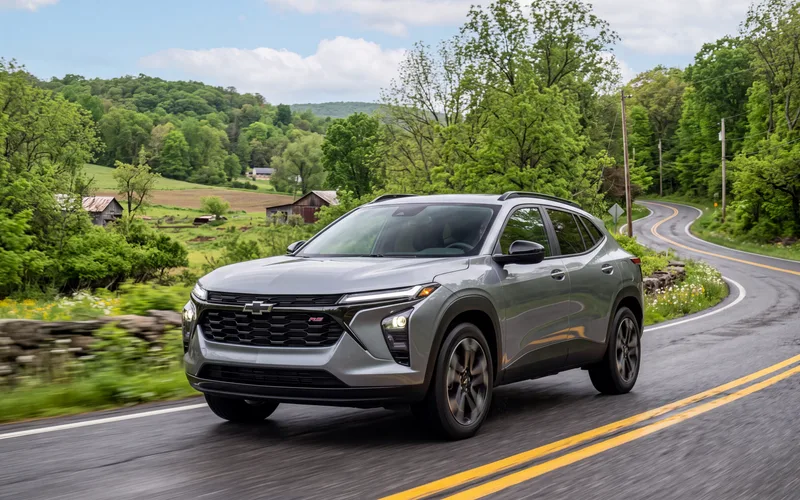 Chevrolet TraxSubcompact SUVBetter at: Value and pace
Costs less, feels quicker thanks to a turbo engine making torque at 2,500 rpm, and offers a broader five-trim lineup — the trade is no all-wheel drive at any price and less ground clearance.
Compare 1.54D
1.54D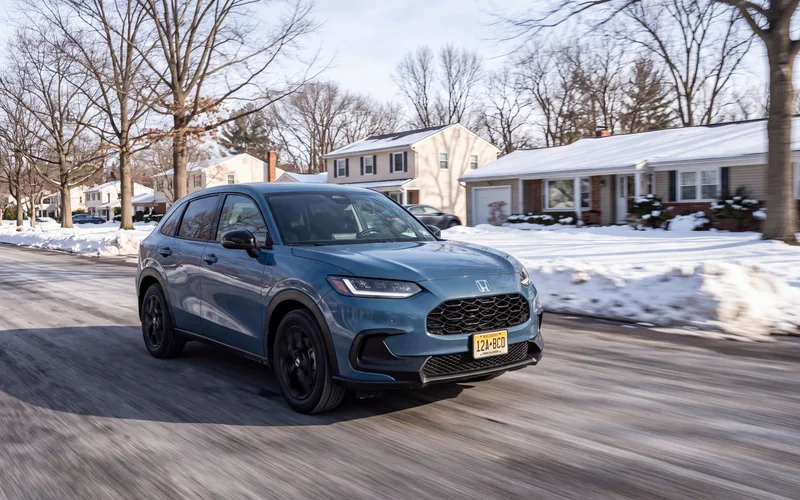 Honda HR-VSubcompact SUVBetter at: Refinement and resale
Roomier back seat, a quieter and better-settled ride, and substantially stronger resale value for shoppers who plan to trade in rather than run it into the ground.
Compare 1.93C-
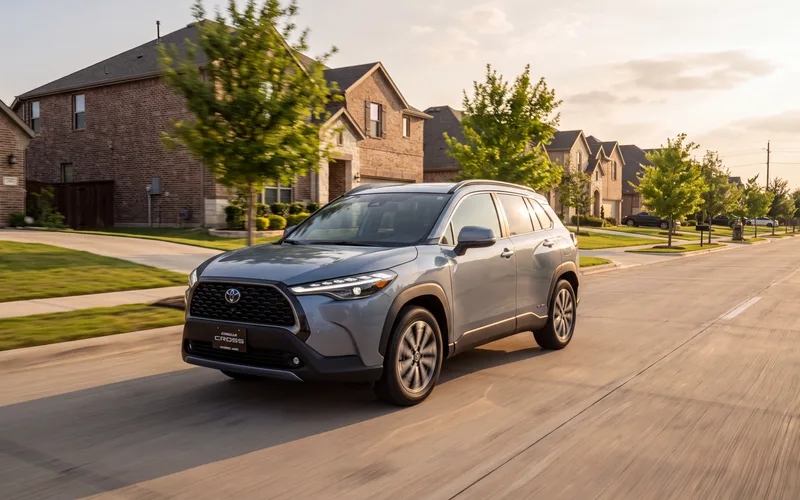 Toyota Corolla CrossSubcompact SUVBetter at: Fuel economy
The hybrid clears 40 MPG against the Kicks' 31 and Toyota residuals lead the segment, so it recovers its higher purchase price over a long ownership period.
CompareHow it's evolved
9 scored model years · 2018–2026
Subject scores by year
Hover or tap a score to see what moved it versus the year before. A corner mark flags a big swing.
| Year | Performance | Efficiency | Safety | Space | Cost | Reliability | Tech | Use-case | Driving | Value |
|---|---|---|---|---|---|---|---|---|---|---|
| 2026 | 17 | 71 | 59 | 40 | 70 | 68 | 61 | 53 | 58 | 74 |
| 2025 | 17 | 67 | 60 | 40 | 70 | 67 | 56 | 50 | 58 | 72 |
| 2024 | 9 | 73 | 54 | 35 | 67 | 68 | 44 | 43 | 52 | 58 |
| 2023 | 9 | 73 | 54 | 36 | 69 | 67 | 42 | 48 | 52 | 58 |
| 2022 | 9 | 73 | 56 | 37 | 63 | 65 | 44 | 44 | 53 | 56 |
| 2021 | 12 | 73 | 60 | 36 | 67 | 62 | 41 | 42 | 53 | 64 |
| 2020 | 13 | 77 | 54 | 39 | 71 | 57 | 37 | 43 | 55 | 64 |
| 2019 | 10 | 73 | 51 | 37 | 76 | 56 | 27 | 42 | 49 | 66 |
| 2018 | 11 | 73 | 39 | 38 | 67 | 58 | 33 | 43 | 50 | 64 |
Compare two years
Best fit & conditions
Higher scores mean a better fit for that use case. Learn more about use-case fit →
Subject profile
Academic Probation · NHTSA safety recalls
May 21, 2026Electrical system: instrument cluster/panelA software error in the combination meter may cause the screen display to go partially or fully blank. As such, these vehicles fail to comply with the requirements of Federal Motor Vehicle Safety Standard number 101, "Control and Displays."
Defect
Nissan North America, Inc. (Nissan) is recalling certain 2025-2026 Kicks vehicles. A software error in the combination meter may cause the screen display to go partially or fully blank. As such, these vehicles fail to comply with the requirements of Federal Motor Vehicle Safety Standard number 101, "Control and Displays."
Risk
A partial or blank screen display will not show critical safety information such as vehicle speed and warning lights, increasing the risk of a crash.
Remedy
Dealers will resume the software reprogramming of the combination meter software, free of charge. Owner notification letters were mailed July 6, 2026. Owners may contact Nissan's customer service at 800-647-7261. Nissan's number for this recall is PMA66. Vehicle Identification Numbers (VINs) involved in this recall became searchable on NHTSA.gov on May 22, 2026.
NHTSA campaign 26V331000 ↗Manufacturer no. PMA6651,598 vehicles potentially affected (all models in the campaign)Owners notified Jul 1, 2026Filed by Nissan North America, Inc.Filed as KICKSMar 13, 2026SeatsThe hook bracket of the front seat frames may be insufficiently welded, which can cause the front seat frames to become loose. As such, these vehicles fail to comply with the requirements of Federal Motor Vehicle Safety Standard (FMVSS) numbers 207, "Seating Systems" and 210, "Seat Belt Assembly Anchorages."
Defect
Nissan North America, Inc. (Nissan) is recalling certain 2026 Kicks and Sentra vehicles. The hook bracket of the front seat frames may be insufficiently welded, which can cause the front seat frames to become loose. As such, these vehicles fail to comply with the requirements of Federal Motor Vehicle Safety Standard (FMVSS) numbers 207, "Seating Systems" and 210, "Seat Belt Assembly Anchorages."
Risk
A loose seat may not restrain the occupant as intended, increasing the risk of injury during a crash.
Remedy
Dealers will replace the front seat assemblies, free of charge. Owner notification letters were mailed May 18, 2026. Owners may contact Nissan's customer service at 800-647-7261. Nissan's number for this recall is PMA64. Vehicle Identification Numbers (VINs) involved in this recall became searchable on NHTSA.gov on March 13, 2026.
NHTSA campaign 26V145000 ↗Manufacturer no. PMA6415 vehicles potentially affected (all models in the campaign)Owners notified May 11, 2026Filed by Nissan North America, Inc.Filed as KICKSJan 20, 2026Latches/locks/linkages: doors: latchThe door strikers may have been improperly welded and break, allowing the door to open while moving. As such, these vehicles fail to comply with the requirements of Federal Motor Vehicle Safety Standard number 206, "Door Locks and Door Retention Components."
Defect
Nissan North America, Inc. (Nissan) is recalling certain 2025 Altima, Sentra, 2025-2026 Frontier, and 2026 Kicks vehicles. The door strikers may have been improperly welded and break, allowing the door to open while moving. As such, these vehicles fail to comply with the requirements of Federal Motor Vehicle Safety Standard number 206, "Door Locks and Door Retention Components."
Risk
A door that opens unexpectedly while the vehicle is in motion increases the risk of injury or a crash.
Remedy
Dealers will replace the door strikers, free of charge. Owner notification letters were mailed March 17, 2026. Owners may contact Nissan's customer service at 800-647-7261. Nissan's numbers for this recall are PD185 and PMA61. Vehicle Identification Numbers (VINs) involved in this recall will be searchable on NHTSA.gov beginning January 28, 2026.
NHTSA campaign 26V023000 ↗Manufacturer no. PD185, PMA6126,432 vehicles potentially affected (all models in the campaign)Owners notified Mar 13, 2026Filed by Nissan North America, Inc.Filed as KICKS
7 recalls on other model years of the Kicks (2018–2019, 2021, 2023–2025)
Jun 4, 2025Back over prevention: softwareThe center information display unit may display a blank screen when shifted into reverse. As such, these vehicles fail to comply with Federal Motor Vehicle Safety Standard (FMVSS) number 111, "Rear Visibility."
Defect
Nissan North America, Inc. (Nissan) is recalling certain 2025 Frontier and Kicks vehicles. The center information display unit may display a blank screen when shifted into reverse. As such, these vehicles fail to comply with Federal Motor Vehicle Safety Standard (FMVSS) number 111, "Rear Visibility."
Risk
A rearview image that does not display can reduce the driver's view of what is behind the vehicle, increasing the risk of a crash.
Remedy
Dealers will update the software on the vehicleâs center information display, free of charge. Owner notification letters were mailed July 10, 2025. The manufacturer numbers for this recall are PD152 and PMA48.
NHTSA campaign 25V324000 ↗Manufacturer no. PD152, PD153, PMA4879,755 vehicles potentially affected (all models in the campaign)Owners notified Jul 10, 2025Filed by Nissan North America, Inc.Filed as KICKSApr 17, 2025Equipment: other: labelsThe certification label may have been printed with the incorrect Gross Vehicle Weight Rating (GVWR) and Gross Axle Weight Rating (GAWR) values, which can result in the vehicle being overloaded. As such, these vehicles fail to comply with the requirements of 49 CFR Part 567, "Certification." Additionally, certain 2025 Nissan Kicks SR trim level vehicles equipped with an optional 19-inch wheel package may have a certification label that states an incorrect wheel size. As such, these vehicles fail to comply with Federal Motor Vehicle Safety Standard number 110, "Tire Selection and Rims."
Defect
Nissan North America, Inc. (Nissan) is recalling certain 2025 Kicks vehicles. The certification label may have been printed with the incorrect Gross Vehicle Weight Rating (GVWR) and Gross Axle Weight Rating (GAWR) values, which can result in the vehicle being overloaded. As such, these vehicles fail to comply with the requirements of 49 CFR Part 567, "Certification." Additionally, certain 2025 Nissan Kicks SR trim level vehicles equipped with an optional 19-inch wheel package may have a certification label that states an incorrect wheel size. As such, these vehicles fail to comply with Federal Motor Vehicle Safety Standard number 110, "Tire Selection and Rims."
Risk
An overloaded vehicle can increase the risk of a crash. Vehicles with incorrect wheel and tire information may lead to tires that are inflated improperly, which can also increase the risk of a crash.
Remedy
Dealers will install new labels, free of charge. Additionally, dealers will mail replacement labels to owners. Owner notification letters were mailed May 27, 2025. Owners may contact Nissan's customer service at 800-647-7261. Nissan's numbers for this recall are PD136 and PMA47.
NHTSA campaign 25V188000 ↗Manufacturer no. PD136, PMA4737,003 vehicles potentially affected (all models in the campaign)Owners notified May 23, 2025Filed by Nissan North America, Inc.Filed as KICKSDec 23, 2024Electrical system: body control module/bcmThe "Shift-to-Park" warning may not activate as intended when the vehicle is shut off and still in a gear other than "Park." As such, these vehicles fail to comply with the requirements of Federal Motor Vehicle Safety Standard (FMVSS) number 114, "Theft Protection and Rollaway Prevention."
Defect
Nissan North America, Inc. (Nissan) is recalling certain 2025 Kicks vehicles. The "Shift-to-Park" warning may not activate as intended when the vehicle is shut off and still in a gear other than "Park." As such, these vehicles fail to comply with the requirements of Federal Motor Vehicle Safety Standard (FMVSS) number 114, "Theft Protection and Rollaway Prevention."
Risk
When the vehicle is not in "Park" and the ignition is shut off, the vehicle could move unexpectedly, increasing the risk of a vehicle rollaway and crash.
Remedy
Dealers will reconfigure the body control module (BCM) to activate the "Shift-to-Park" warning, free of charge. Some owner notification letters were mailed January 29, 2025. The remaining owner notification letters will be mailed at a future date, anticipated, May 7, 2025. Owners may contact Nissan customer service at 1-800-867-7669. Nissan's number for this recall is PMA42.
NHTSA campaign 24V969000 ↗Manufacturer no. PMA4289 vehicles potentially affected (all models in the campaign)Owners notified Jan 29, 2025Filed by Nissan North America, Inc.Filed as KICKSFeb 27, 2024Air bags: frontal: driver side: inflator moduleDue to a manufacturing issue, the driver's air bag inflator may absorb moisture, and cause the air bag to deploy improperly.
Defect
Nissan North America, Inc. (Nissan) is recalling certain 2024 Titan, Frontier, Infiniti QX60, Pathfinder, 2023-2024 Sentra, Versa, Kicks, Infiniti QX50, and 2023 Rogue vehicles. Due to a manufacturing issue, the driver's air bag inflator may absorb moisture, and cause the air bag to deploy improperly.
Risk
An air bag that deploys improperly may not protect the driver as intended during a crash, increasing the risk of injury.
Remedy
Dealers will replace the front driver's air bag assembly, free of charge. Owner notification letters were mailed April 10, 2024. Owners may contact Nissan customer service at 1-800-867-7669. Nissan's numbers for this recall are PD103, PD104, and PMA34.
NHTSA campaign 24V154000 ↗Manufacturer no. PD103, PD104, PMA34351 vehicles potentially affected (all models in the campaign)Owners notified Apr 10, 2024Filed by Nissan North America, Inc.Filed as KICKS, REDUNDANT KICKSJul 18, 2023Steering: electric power assist systemAn intermittent electrical connection in the electric power steering (EPS) torque sensor can disable the power steering assist.
Defect
Nissan North America, Inc. (Nissan) is recalling certain 2021 Versa and Kicks vehicles. An intermittent electrical connection in the electric power steering (EPS) torque sensor can disable the power steering assist.
Risk
Loss of power steering assist can increase the steering effort required, especially at low speeds, and increase the risk of a crash.
Remedy
Dealers will inspect the steering column torque sensor lot code and replace the steering column assembly, if necessary, free of charge. Owner notification letters are expected to be mailed September 8, 2023. Owners may contact Nissan's customer service at 1-800-867-7669. Nissan's number for this recall is PMA26. This recall involves vehicles that were previously inspected, but did not receive a steering column replacement, under recall number 22V-693. These vehicles will need to be reinspected for this recall.
NHTSA campaign 23V496000 ↗Manufacturer no. PMA2611,824 vehicles potentially affected (all models in the campaign)Owners notified Sep 8, 2023Filed by Nissan North America, Inc.Filed as KICKSSep 15, 2022Steering: electric power assist systemAn intermittent electrical connection in the electric power steering (EPS) torque sensor can disable the power steering assist.
Defect
Nissan North America, Inc. (Nissan) is recalling certain 2021 Versa and Kicks vehicles. An intermittent electrical connection in the electric power steering (EPS) torque sensor can disable the power steering assist.
Risk
Loss of power steering assist can increase the steering effort required, especially at low speeds, and increase the risk of a crash.
Remedy
Dealers will inspect the steering column torque sensor lot code, and replace the column, if necessary, free of charge. Owner notification letters are expected to be mailed November 9, 2022. Owners may contact Nissan's customer service at 1-800-867-7669. Nissan's numbers for this recall are PMA10 / PMA25.
NHTSA campaign 22V693000 ↗Manufacturer no. PMA10 / PMA2520,040 vehicles potentially affected (all models in the campaign)Owners notified Nov 10, 2022Filed by Nissan North America, Inc.Filed as KICKSSep 12, 2019Back over prevention: sensing system: cameraAdditionally included are 2019 Nissan GT-R and Taxi and Infiniti QX50, QX60, Q70, Q70L vehicles. The back-up camera and display settings can be adjusted such that the rear view image is no longer visible and the system will retain that setting the next time the vehicle is placed in reverse. As such, these vehicles fail to comply with the requirements of Federal Motor Vehicle Safety Standard (FMVSS) number 111, "Rear Visibility."
Defect
Nissan North America, Inc. (Nissan) is recalling certain 2018-2019 Nissan Altima, Armada, Frontier, Kicks, Leaf, Maxima, Murano, NV, NV200, Pathfinder, Rogue, Rogue Sport, Sentra, Titan, Titan Diesel, Versa Note and Versa Sedan vehicles, as well as Infiniti Q50, Q60, QX30 and QX80 vehicles. Additionally included are 2019 Nissan GT-R and Taxi and Infiniti QX50, QX60, Q70, Q70L vehicles. The back-up camera and display settings can be adjusted such that the rear view image is no longer visible and the system will retain that setting the next time the vehicle is placed in reverse. As such, these vehicles fail to comply with the requirements of Federal Motor Vehicle Safety Standard (FMVSS) number 111, "Rear Visibility."
Risk
The lack of an image in the back-up camera display increases the risk of a crash.
Remedy
Nissan will notify owners in phases, having dealers update the back-up camera settings software, free of charge. The recall began November 11, 2019 and all affected VINs should be activated. Owners may contact Nissan customer service at 1-800-867-7669 or INFINITI customer service at 1-800-662-6200.
NHTSA campaign 19V654000 ↗1,228,830 vehicles potentially affected (all models in the campaign)Owners notified Nov 11, 2019Filed by Nissan North America, Inc.Filed as KICKS
Source: NHTSA Office of Defects Investigation recall database, model years 2018–2026. Recalls are listed by model year as the manufacturer filed them; whether a specific car is affected depends on its VIN — check a VIN at nhtsa.gov ↗. NHTSA model names matched to this page: KICKS, REDUNDANT KICKS.
Detailed scoring by subject
1Performance & PowertrainThe Kicks's lowest-graded category.0.00F
The 2026 Kicks carries the second generation's sole powertrain, a naturally aspirated 2.0-liter MR20-series four making 141 hp at 6,000 rpm; there is no optional engine, so the volume SV trim and the model-range maximum are the same figure.
Peak torque is 140 lb-ft at 4,000 rpm from the same 2.0L four across every trim and both drivetrains. A few outlets round this to 141 lb-ft; Nissan and the major spec databases list 140.
Nissan publishes no acceleration claim. Consumer Reports instrumented an SV AWD — effectively the volume configuration — at 9.5 seconds, while Edmunds recorded 10.3 seconds; reviewers consistently call the Kicks the slowest vehicle in the subcompact SUV class.
With no turbo and no hybrid handoffs there is nothing to lag or stumble at light throttle, but the 141-hp four has to be worked constantly and turns coarse and loud doing it — reviewers describe a grumbly note and rising revs with no matching surge on highway merges and grades.
Nissan's Xtronic CVT is smooth and shift-shock-free in gentle around-town use, which is most of this car's life, but it holds revs under any real demand and the resulting drone is a recurring complaint in 2026 reviews — the classic CVT trade-off, not a broken unit.
Nissan does not publish a US tow rating for the Kicks — it is absent from Nissan's own towing-capacity guide, and the factory offers no tow package. Aftermarket Class 3 hitches sold for the 2025–2026 Kicks are rated to 2,000 lbs by the hitch maker, which is not a manufacturer vehicle rating.
Intelligent AWD is optional on all three trims (S, SV, SR) — not gated behind the top trim as it is at several rivals — and AWD cars add Snow mode plus a multi-link rear suspension in place of the FWD torsion beam. The system itself is a basic reactive on-demand setup with no low range, locker, or true torque vectoring.
The 8.4-inch ground clearance is genuinely best-in-class for a subcompact crossover and Snow mode helps on unplowed roads, but there is no off-road trim, no skid plating, no locker or terrain-mode suite, modest approach angles and street tires — this is a snow-belt commuter, not a trail vehicle.
One engine, one transmission, no electrification: the 2.0L four with the Xtronic CVT is the only choice on every 2026 Kicks, with FWD or AWD the sole drivetrain decision. Nissan sells e-Power hybrid Kicks variants in other markets but offers none in the US for 2026.
2Efficiency & RangeOne of the Kicks's strongest categories.2.81B-
Every 2026 Kicks uses the same 2.0L I4 (141 hp) and Xtronic CVT, so EPA ratings are flat across S, SV and SR — only drive layout moves the number. FWD is the volume configuration.
A naturally-aspirated 2.0L with no hybrid assist gives up city economy to electrified subcompacts, and the 2026 Kicks is heavier than the first-generation car it replaced.
Highway is the Kicks' strongest EPA figure — the CVT and modest 141 hp output suit steady-state cruising, and 35 MPG is competitive with turbo-three rivals like the Trax (32 hwy).
Range is limited by a small 11.8-gallon tank rather than by efficiency — 31 MPG combined on that tank yields roughly 366 miles, mid-pack for a subcompact SUV. The AWD model's larger 12.4-gallon tank offsets its 1-MPG penalty.
Roughly 484 gallons a year at EPA's 15,000-mile, 55/45 assumptions — one of the cheaper non-hybrid SUVs to feed, and about $50 a year under the 30-MPG Chevrolet Trax.
Regular 87-octane unleaded on every trim, with no premium recommendation and no special fuel or charging infrastructure to arrange. The only knock is the small tank, which means more frequent stops rather than costlier ones.
3SafetyMid-pack among this car's ten categories.1.97C-
NHTSA rates the 2026 Kicks 4 out of 5 stars overall; a 3-star frontal result for the second-generation body is what pulls the composite below the 5-star mark despite a 5-star side score.
No 2026 Top Safety Pick award: the Kicks earns Good in small overlap front, the updated side test, pedestrian protection and seat belt reminders, but is Marginal in the updated moderate overlap front test on rear-occupant protection (elevated chest injury risk, lap belt riding up). A Marginal in a core crashworthiness test puts it in the bottom band.
Nissan Safety Shield 360 is standard on every 2026 trim (S/SV/SR) — AEB with pedestrian detection, rear automatic braking, blind spot warning, rear cross-traffic alert, lane departure warning, high-beam assist — and Intelligent Cruise Control is standard on S and SV. From a $22,730 base that is an unusually complete standard suite for the subcompact segment; only true lane centering (ProPILOT Assist) is trim-gated.
Split result: Good in IIHS pedestrian front crash prevention, but Marginal in the tougher vehicle-to-vehicle front crash prevention 2.0 evaluation — the system handled four-wheeled targets well yet faltered against motorcycle targets, with higher-speed and off-center motorcycle runs going untested.
Blind Spot Warning and Rear Cross Traffic Alert are standard on all three trims — better availability than most subcompact rivals that gate them behind mid trims — but coverage is alert-only with no steering intervention and no safe-exit alert; rear automatic braking is the one active backstop.
Volume S and SV trims get lane departure warning only; actual lane centering requires ProPILOT Assist on the top SR. The ProPILOT 1.0 implementation holds a lane competently on well-marked highways but disengages readily where markings fade, and it is a generation behind the centering systems in Taos or Crosstrek.
Intelligent Cruise Control is standard on S and SV — full-speed-range adaptive cruise at the base price is above segment par — and the SR's ProPILOT Assist adds stop-and-hold with resume plus steering assist. The hardware is capable but the calibration is the older ProPILOT 1.0, without the smoother navigation-linked behavior of newer systems.
No hands-free highway system is offered at any 2026 Kicks trim — ProPILOT Assist 1.0 is hands-on-wheel only, and Nissan's hands-off ProPILOT Assist 2.x is not available on this platform in the US.
IIHS rates the 2026 Kicks headlights Good, and High Beam Assist is bundled into the standard Safety Shield 360 suite, so automatic high beams reach every trim rather than only the loaded one.
The upright subcompact-SUV greenhouse and high seating position give decent forward and quarter sightlines, but the second-generation body's thicker rear pillars and shallower back glass create real over-the-shoulder blind zones. Camera compensation is uneven — a rearview camera is standard, while the Intelligent Around View 360-degree monitor is confined to the SR.
IIHS rates the Kicks' LATCH hardware Good for ease of use, with two rear positions carrying complete anchor sets plus a third tether position that can borrow lower anchors. The limiting factor is the subcompact rear cabin itself — three seats across is a squeeze and rear-facing installs eat into front legroom — not the anchors.
4Space & ComfortOne of the Kicks's weakest categories.0.62F
The second-generation Kicks is a two-row subcompact SUV seating five across every 2026 trim (S, SV, SR); no 6/7-seat configuration is offered.
Published 2026 front headroom is 39.7 in; Nissan notes the redesigned slimmer panoramic moonroof intrudes less into headroom than the prior generation's unit.
Front legroom of 42.7 in is generous for a subcompact SUV and sits mid-band for the SUV segment as a whole.
38.5 in of second-row headroom is a genuine strength — the boxy roofline gives the Kicks more rear head space than most subcompact rivals.
34.5 in of second-row legroom is the Kicks' clearest packaging compromise — adequate for kids and short adult trips but well behind class leaders like the HR-V.
The Kicks is strictly a two-row, five-seat subcompact SUV — no third row is offered on any 2026 trim, so this scores in the low band by definition.
Volume SV FWD holds 29.2 cu ft behind the second row — average for a subcompact SUV but near the bottom of the all-SUV normalization band; choosing AWD costs roughly five cubic feet.
Maximum cargo of about 59 cu ft with the 60/40 rear seats folded is competitive within the subcompact class but low against SUVs generally; AWD drops it to roughly 50 cu ft because of the rear driveline hardware under the floor.
Everyday storage is competitive rather than clever: oversized front cupholders sized for 30-oz tumblers, door bottle holders that take 32-oz bottles, big front and rear door pockets, a covered console bin and a two-level cargo floor — but no segment-standout innovation.
Front seats draw consistent praise for contouring and an easy step-in height, with breathable synthetic-leather/fabric trim on SR; the rear bench is flatter and the short legroom limits long-haul comfort back there.
The second-generation chassis improved suspension composure over the first-gen car, but reviewers still call the ride busy over broken pavement — especially on the SR's 19-inch wheels — leaving it mid-pack rather than segment-leading.
Noise is the Kicks' weakest comfort trait: tire roar, wind rustle and CVT drone combine into a constant highway hum, and reviewers place it behind the HR-V and Crosstrek. The optional Bose system's headrest speakers mask it rather than fix it.
Comfort equipment is thin for 2026: heated seats, heated mirrors and rear floor ducts arrive only via the new Cold Weather Package on SV and SR (unavailable on S), a heated steering wheel requires the SR Premium Package, and there are no ventilated seats or rear climate zone anywhere in the lineup.
5Cost of OwnershipOne of the Kicks's strongest categories.2.77B-
The 2026 Kicks S FWD opens at $22,730 MSRP, and Nissan's $1,545 destination and handling charge brings the real entry price to $24,275 — below the bottom of the SUV normalization band, so it maxes the item.
The SV is the value-volume grade — alloy wheels, hands-free keyless entry and wireless charging on top of the now-standard 12.3-inch touchscreen — at $24,470 plus $1,545 destination. Even the SR FWD at $29,110 delivered sits under the $27,000 band floor's peers, so the volume trim scores at the ceiling.
A naturally aspirated 2.0L four with a conventional CVT and no turbo, hybrid or battery hardware keeps service cheap; the Kicks lands near the bottom of the SUV maintenance band.
The Kicks holds value better than the subcompact-SUV average thanks to constant demand for cheap transportation, but Nissan's brand-level residuals and incentive exposure on the higher-volume second generation keep it short of the segment's Toyota/Honda benchmarks.
Nissan sticks to the industry-minimum 3-year/36,000-mile basic warranty, at the floor of the normalization band and well behind the Hyundai/Kia 5-year and Mitsubishi 5-year coverage the Kicks competes against.
5 years/60,000 miles is the band floor — a real gap against subcompact-SUV rivals offering 10-year/100,000-mile powertrain coverage, and a meaningful one given the Xtronic CVT's repair-cost history.
Nissan includes no complimentary scheduled maintenance in the US — the only included perks are 3-year/36,000-mile roadside assistance and a NissanConnect connected-services trial, so the first oil change is out of pocket. That is below rivals bundling 2 years or 25,000 miles of free service (Toyota Corolla Cross, Chevrolet's included first visit) and lands in the 'no complimentary coverage' band.
$26,015 volume-trim price minus its estimated resale value after 5 years (59% retained, or about $15,349) leaves about $10,666 in depreciation. Add the projected $3,459 in 5-year maintenance and repairs, and owning this vehicle for 5 years costs about $14,125 in total.
6Reliability & QualityMid-pack among this car's ten categories.2.57C+
Both major predictors are favorable: Consumer Reports gives the Kicks a 76 predicted-reliability score in the subcompact SUV set and lists it as a Recommended model, while J.D. Power rates 2026 Quality & Reliability 82/100 ("Great"). Held below the 80+ band because the second-generation car only launched for 2025, so the prediction rests on a short real-world record and the launch recalls (see 6.1.3) argue for caution.
Nissan has moved decisively into the upper half: 6th of 26 brands in Consumer Reports' 2026 reliability rankings (score 57 vs 66 for the leader), 10th in the J.D. Power 2026 VDS at 194 PP100 — a nine-position jump to above industry average — and 2nd among mass-market brands in the 2026 IQS at 156 PP100. Short of the 80+ band because that standing is a recent turnaround rather than a consistent multi-year top-5 record.
The new generation has drawn repeated safety recalls in its first two model years, several of them assembly-quality failures: improperly welded door strikers that can break and let a door open while driving (PD185/PMA61), insufficiently welded front-seat frame hook brackets (PMA64), a combination-meter software fault blanking the instrument display on 51,000+ 2025–2026 Kicks (PMA66), and a rear-camera display that can go blank in reverse. Nothing is powertrain or fire related, which keeps it off the floor, but the volume and the structural nature of two of them sit below segment-typical.
The 2026 Kicks carries over the naturally aspirated 2.0-liter four (141 hp / 140 lb-ft) with the Xtronic CVT — a low-stress, long-serving Nissan combination with no turbo or hybrid complexity to fail. The CVT remains the reservation: Nissan's current-generation units are materially improved and validated over millions of test miles, and low-torque applications like Kicks and Sentra have fared far better than the high-torque ones, but owner reports of slipping and premature wear still follow the family and a replacement is expensive.
Reviewers consistently rate the redesigned cabin above expectations for an economy subcompact — soft-touch surfaces at the main touchpoints on SV/SR, cohesive design, hard plastics confined to lower, less-noticed areas. Good for the price but not class-leading; nothing here reads premium.
Brand-level initial quality is strong — Nissan placed 2nd among mass-market brands in the 2026 IQS at 156 PP100 — and reviewers describe the Kicks' assembly as tight for the price. That is pulled down by model-specific evidence of assembly inconsistency: two weld-quality recalls (door strikers, front-seat frame brackets) plus early owner reports of a dead instrument display and an improperly seated interior plastic connector causing vibration.
Nissan runs one of the denser mass-market service networks in the US and its dealer service satisfaction is measurably above average — 885 points and 2nd place among mass-market SUV/minivan brands in the 2026 J.D. Power CSI study, against an industry average of 868, following two consecutive years ranked highest among truck brands.
Cheap to keep running: Nissan averages about $500/year in maintenance and repair against a $652 industry average, and the Kicks specifically projects roughly $7,791 over ten years — about $721 better than the SUV average. Parts are commodity-priced and widely stocked given shared Nissan mechanicals; the one real exposure is out-of-warranty CVT replacement, which is a large single bill.
7Technology & InfotainmentMid-pack among this car's ten categories.2.09C
For 2026 the 12.3-inch center touchscreen becomes standard on the base S grade, replacing the 7-inch unit it used in 2025 — every Kicks trim now has the same large display, which is class-leading screen real estate for a subcompact SUV at this price.
Reviewers report crisp, vibrant graphics, logical menu layout and a system that keeps up with rapid taps, and Nissan updated the software for 2026 with quicker boot-up and revised icon placement; Nissan also retains physical climate and volume controls. Feature depth is shallow, but for outright daily usability it is one of the better systems in the subcompact class.
Both wireless Apple CarPlay and wireless Android Auto are standard on every 2026 trim including the base S — the headline change for this model year, since the 2025 S had a wired-only 7-inch system. Textbook 80–100 band behavior with no trim caveats.
There is no built-in navigation on any 2026 Kicks trim — owners are expected to use CarPlay or Android Auto for directions — and Google built-in (Maps/Assistant/Play) is offered on Rogue, Ariya and LEAF but not on the Kicks. On-board voice is limited to basic recognition for climate and audio commands, which lands this in the "poor or absent" band despite phone projection covering the gap in practice.
The standard six-speaker system is unremarkable, but the optional Bose Personal Plus setup — 10 speakers including two UltraNearfield drivers built into the front headrests — is a genuinely strong premium option for a subcompact and is well regarded by reviewers. It is gated behind the SR Premium Package, so the volume SV cannot get it.
S and SV pair analog gauges with a 7-inch driver information display; only the top SR gets the full 12.3-inch digital cluster. The volume trim therefore gets a partial-digital setup that reviewers describe as showing only basic driver information — squarely the 50–79 "full digital on upper trims only" band.
The Kicks' NissanConnect head unit accepts over-the-air software and map updates through the built-in modem or home Wi-Fi, but this is infotainment-level updating — Nissan does not push whole-vehicle, feature-adding OTA releases to the Kicks the way EV-platform rivals do. Bottom of the 50–79 "infotainment/maps OTA only" band.
The MyNISSAN app covers the core set — remote engine start with Intelligent Climate Control, remote lock/unlock, vehicle locate, alerts — with a one-year NissanConnect Services Premium trial before a paid subscription. There is no phone-as-key/digital key on the Kicks, and remote start itself requires SV or above, so this sits mid-band rather than high.
Two USB-C ports are standard, rising to four on the SR, and a wireless charging pad is fitted to SV and SR. That is adequate but not generous — front-biased port count on the volume trims and no household AC outlet — matching the "adequate ports; wireless charging on upper trims" description.
The volume SV and top SR carry Nissan Intelligent Key with push-button start, approach unlock and walk-away lock plus available remote engine start, but the base S makes do with conventional remote keyless entry. No hands-free liftgate and no phone-as-key on any trim, so it settles into the middle of the 50–79 band.
A rear-view camera is standard fleet-wide and the Intelligent Around View Monitor 360-degree system is a real strength for the class — but Nissan restricts it to the SR, leaving the volume SV without surround view. There is no automated parking function on any trim.
No head-up display is offered on the 2026 Kicks at any trim or in any option package — consistent with the subcompact economy segment, but it is a straight absence of the feature this item measures.
8Use-Case FitOne of the Kicks's weakest categories.1.58D
Best-in-class cargo behind the rear seat (29.2–30.0 cu ft FWD) with a wide, square opening swallows strollers easily, and IIHS rates the LATCH hardware Good for ease of use. Offset by narrow rear door openings, a high rear cushion that complicates loading a child into a convertible seat, only 34.5 in of rear legroom, and an AWD cargo hit to 23.9 cu ft.
Safety Shield 360 (AEB with pedestrian detection, blind spot, rear cross traffic, rear automatic braking, lane departure, high beam assist) plus Rear Door Alert is standard all the way down to the $22,730 S, which is exactly the trim families on this budget buy. Crash results hold it back: NHTSA 4 stars overall with only 3 stars frontal, and IIHS rates vehicle-to-vehicle front crash prevention Marginal — no Top Safety Pick.
Rear amenities are thin even by subcompact standards: no rear climate zone, rear heat vents arrive only as underseat floor ducts inside the $300 Cold Weather Package on SV/SR, rear USB-C is optional, and there is no rear sunshade or entertainment provision. Reviewers consistently call out highway road, wind and engine noise loud enough to force raised voices, which is the wrong trait for four-plus people over multiple hours.
Light steering, an upright commanding seating position, standard Intelligent Cruise Control on S and SV and stop-and-go ProPILOT Assist on SR make stop-start traffic genuinely easy. The 141-hp 2.0L needs 9.5–10.3 s to 60 mph and the CVT holds revs under load, so merging and passing demand planning, and the ride is described as busy on poor pavement.
Regular unleaded, 31 MPG combined FWD and roughly $1,600/yr in fuel at 15,000 mi, plus cheap consumables — Edmunds TCO puts maintenance and repair near $691/yr and the small 16–19 in tires are inexpensive. It is only average-to-good rather than exceptional because hybrid subcompact rivals (Kona Hybrid, Niro, Corolla Cross Hybrid) run 40+ MPG and the Kicks offers no electrified option in the US.
A 171.9-in length and a 34.8-ft turning diameter make it one of the easiest vehicles in any SUV class to thread through a city, helped by upright glass and a standard RearView Monitor. Only the 360-degree Intelligent Around View Monitor being locked to the SR keeps it out of the very top band.
The Kicks carries no factory tow rating at all and has roughly 900–960 lb of payload with a 141-hp engine, so it is not a meaningful work vehicle. The only work-adjacent asset is a large, flat-floored 60 cu ft cargo hold (FWD) that can move light supplies or tools.
A unibody economy crossover with cloth or synthetic-leather seating and no wear-oriented trim or fleet program; the second-generation platform and 2.0L/CVT combination are too new to have a proven hard-duty record, and Nissan's Xtronic CVT history is a known question mark for high-mileage abuse. Nothing here is fragile, but nothing is built for it either.
There is no onboard AC inverter, no factory hitch (the vehicle is untowable-rated), no washable cargo surfaces and only basic cargo hooks. Roof rails standard from SV up with Nissan accessory crossbars rated to 100 lb, plus an underfloor bin, are effectively the whole work provision.
Range is mediocre — an 11.8-gal FWD tank at 31 MPG combined works out to roughly 366 mi, well short of what larger crossovers manage between stops — and reviewers single out sustained road, wind and engine drone as fatiguing on long highway runs. Seats are well-contoured and ProPILOT Assist genuinely reduces fatigue, but it is SR-only; volume SV buyers get plain adaptive cruise without lane centering.
Class-leading 8.4 in of ground clearance on every trim, available Intelligent AWD with a Snow drive mode and a multi-link rear suspension, and standard roof rails from SV up make gravel roads, trailheads and winter ruts a non-issue. It stops well short of a genuine adventure enabler: no tow rating for toys, no skid plates or off-road mode, no 120V outlet, and 141 hp at altitude with gear aboard.
In FWD volume form the Kicks is a genuine gear-hauler for its size: 29.2–30.0 cu ft behind the rear seat (best in the subcompact class), up to 60 cu ft folded, 55.7 in of max cargo length, a wide square opening, 60/40 split fold and a standard underfloor bin, with roof rails for bikes or a box. Two real caveats — choosing AWD drops those figures to 23.9/50.1 cu ft, and there is no hitch option for a rack or small trailer.
9Driving ExperienceMid-pack among this car's ten categories.1.89C-
The second-generation Kicks' stiffer platform and short overhangs make it genuinely nimble in town, and Consumer Reports calls it "a willing companion to take through corners," but the same report grades the handling "mundane" with a choppy ride, and reviewers agree it is competent rather than sporty. Places it mid-pack among subcompact SUVs — above the Trailblazer/Envista, below the CX-30 and Taos.
Light and accurate at parking speeds, which suits the Kicks' city brief, but numb on-center with little road feel and enough over-assist that reviewers note inputs require turning the wheel farther than expected. That combination of vagueness and excessive lightness sits at the top of the 0-49 band.
The clear dynamic high point: Consumer Reports found good grip with short stops on both dry and wet surfaces and a brake pedal that is easy to modulate, and MotorWeek recorded straight, consistent 60-0 stops of 106 ft. Edmunds' longer 132 ft panic stop keeps this out of the 80+ band pending more instrumented data.
The 2.0L/141-hp four and Xtronic CVT are adequate around town — Nissan retuned throttle response for 2026 and low-speed drivability is smoother than at launch — but there is no reserve: 0-60 takes 9.5-10.7 sec depending on tester, and highway merges or grades produce rising revs without a corresponding surge, the classic CVT flare. Bottom of the "occasional lag" band.
Nissan added sound deadening for 2026 and the cabin is quieter than the launch car, but the engine still sends a coarse note into the cabin whenever it is asked for power and the CVT holds revs under load, producing the drone this powertrain is known for. Reviewers describe a constant highway hum that forces raised voices — intrusive enough to sit in the bottom band.
34.8 ft curb-to-curb is near the tight end of the subcompact-SUV band and one of the Kicks' genuine everyday strengths, pairing with the light low-speed steering to make it easy in city parking. Figure is consistent across multiple Nissan dealer spec listings for the 2026 model year; nissanusa.com could not be fetched directly.
The boxy body gives an SUV-height seating position and good outward vision, and the physical-button control layout is among the clearest in any new car — the 12.3-inch screen becomes standard for 2026 without swallowing the climate controls. Held back by a small rear window, narrow front seats with no lumbar adjustment, and what Consumer Reports calls awkward aspects of the driving position.
Nothing about the Kicks invites the long way home: the slowest 0-60 in the class, a droning CVT, over-light steering with no feedback, and a busy ride. It is a well-judged appliance for commuting — even the SR AWD, the closest thing to a sporty trim, brings no dynamic upgrades beyond wheels and trim.
10Value & Market PositionThe Kicks's best-graded category.3.00B
For 2026 Nissan made the 12.3-inch touchscreen with wireless Apple CarPlay/Android Auto and dual front USB-C ports standard all the way down to the base S, on top of an already-standard full driver-assist suite (forward and reverse AEB with pedestrian detection, blind-spot warning, rear cross-traffic alert, lane-departure warning, adaptive cruise, rear parking sensors, auto high beams) plus a 7-inch digital cluster, keyless entry and push-button start. That is a lot of content at a ~$24K out-the-door base price, where rivals such as the Honda HR-V LX still make do with a small screen and no blind-spot monitoring.
At $22,730 base ($23,925 with destination) the Kicks bundles a big-screen infotainment system, a complete active-safety suite and 8.4 inches of ground clearance, with AWD available on any trim for about $1,500 — genuine bang-for-buck in the subcompact class. It stops short of standout because the 141-hp 2.0-liter/CVT powertrain gives away performance to the turbocharged Chevrolet Trax, which also undercuts it on sticker, and the base car still runs a four-speaker stereo and manual seats.
Three trims (S, SV, SR) with front- or all-wheel drive available on each gives six core configurations spanning roughly $22.7K to $29.1K, and 2026 adds a Cold Weather package for SV and SR. But it is a single powertrain with no hybrid or EV option, and the Rock Creek edition that broadens the range elsewhere is not offered in the US — a narrower ladder than the five-trim Chevrolet Trax.
The second-generation Kicks has been one of the fastest risers in the segment: calendar-year 2025 US sales climbed 33.9% to the nameplate's best-ever annual volume, with all-time quarterly records set in Q3 and Q4. Momentum carried through every quarter of 2025 rather than fading after the redesign launch.
Nissan is a broadly accepted mainstream brand but carries no image halo in this segment, and its resale reputation is a real drag: it sits near the bottom of mainstream brands on residual-value rankings, well behind Toyota, Honda and Subaru, whose badges buyers in this class actively pay a premium for.
Nissan is one of the more incentive-heavy mainstream brands and the Kicks benefits directly: customer cash of up to $2,000 plus subsidized lease and finance programs are routinely advertised on the current model year, and student/military programs stack on top. That is meaningful buyer benefit without the fire-sale pricing that signals a failing model — sales are in fact at record levels.
The 2026 car is only the second year of an all-new second generation launched for 2025 — bigger body and wheelbase, a new 2.0-liter engine replacing the old 1.6, and the first-ever AWD option outside Japan. 2026 layers on a standard 12.3-inch screen and a Cold Weather package, so the lineup is current with essentially zero redesign risk for a buyer this year.
Reviews of the redesigned car are solidly positive and it has collected real hardware — U.S. News named it 2026 Best Subcompact SUV for the Money and scores it 8.7/10, and the generation launched with an IIHS Top Safety Pick and a Wards 10 Best Interiors & UX nod. It stops short of the top band because it ranks mid-pack rather than first in class (#6 of subcompact SUVs at U.S. News) and reviewers consistently flag the 141-hp CVT powertrain as the reason it rarely wins a comparison outright.