
The verdict
A mixed-report hot hatch, strong on driving and held back by efficiency.
The 2026 Golf R is the fastest, most weatherproof and most completely equipped hot hatch you can buy — 328 hp, standard 4Motion all-wheel drive with a torque-vectoring rear differential, roughly 3.9 seconds to 60 mph, and 19.9 cu ft of cargo behind the rear seats, all in a car small enough to park anywhere. Because VW sells it as one fully-loaded trim, the ~$48,500 window sticker already includes adaptive dampers, matrix LED headlights, a head-up display, Harman Kardon audio, a panoramic roof and heated/ventilated/massaging leather sport seats. The costs are equally specific: 23 MPG combined on premium fuel (~$2,800 a year), a 4-year/50,000-mile warranty with no separate powertrain coverage behind a heavily stressed turbo AWD driveline, and a VW reliability record that sits in the bottom third of the industry. Note too that neither IIHS nor NHTSA has published crash ratings for this generation of Golf R, so its safety score rests on standard equipment rather than tested results.
Jump to scoresStrengths
- Genuinely fast, and fast in any weather
- The most capable chassis in the class
- Everything is standard because there's only one trim
What holds it back
- It drinks, and it drinks premium
- Near-$50,000 for a compact hatchback
- Expensive to keep on the road
Top alternatives
Cars shoppers cross-shop with the Volkswagen Golf R 2.43C+
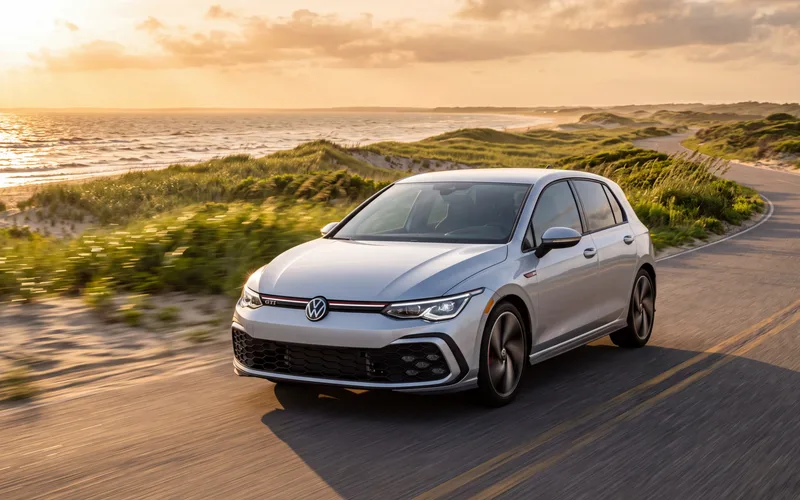 Volkswagen Golf GTIHot HatchBetter at: Value
Nearly the same car for about $15,000 less, with better fuel economy and a more forgiving ride — the right call unless you specifically need all-wheel drive.
Compare 2.62C+
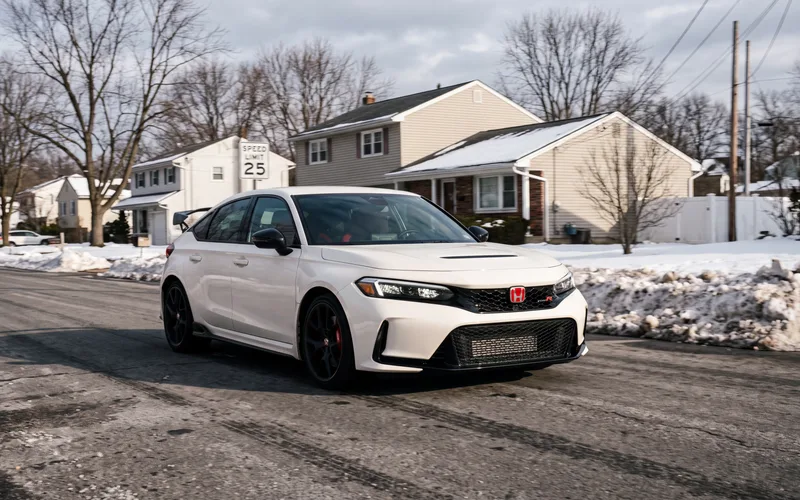 Honda Civic Type RHot HatchBetter at: Driver engagement
A sharper, more communicative driver's car with a standard manual, better reliability and a longer powertrain warranty for slightly less money.
Compare 2.69C+
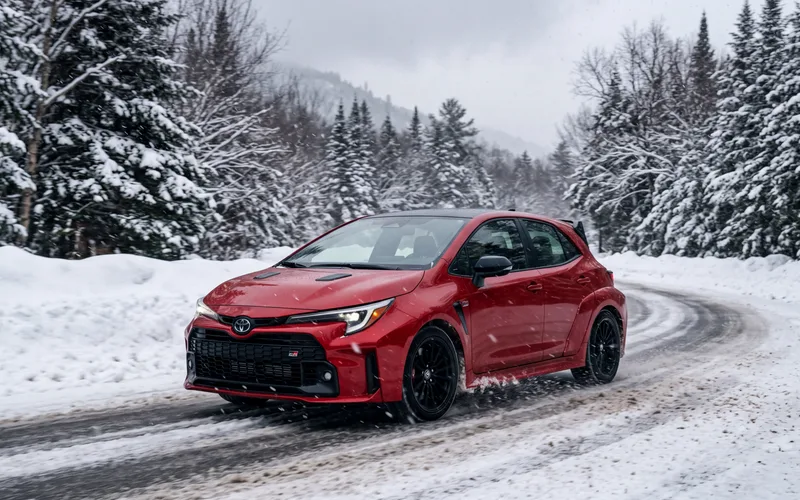 Toyota GR CorollaHot HatchBetter at: Cost of ownership
All-wheel drive and 300 hp for roughly $8,000 less, with Toyota reliability and a manual gearbox, if you can live without the Golf's refinement and space.
CompareHow it's evolved
8 scored model years · 2017–2026
Subject scores by year
Hover or tap a score to see what moved it versus the year before. A corner mark flags a big swing.
| Year | Performance | Efficiency | Safety | Space | Cost | Reliability | Tech | Use-case | Driving | Value |
|---|---|---|---|---|---|---|---|---|---|---|
| 2026 | 67 | 17 | 74 | 67 | 48 | 56 | 72 | 57 | 80 | 70 |
| 2025 | 66 | 22 | 60 | 66 | 48 | 58 | 73 | 58 | 76 | 70 |
| 2024 | 66 | 20 | 57 | 67 | 50 | 57 | 63 | 55 | 76 | 68 |
| 2023 | 66 | 25 | 61 | 66 | 55 | 57 | 63 | 55 | 72 | 69 |
| 2022 | 66 | 25 | 61 | 66 | 53 | 54 | 62 | 55 | 72 | 68 |
| 2019 | 62 | 25 | 72 | 65 | 58 | 61 | 48 | 53 | 79 | 65 |
| 2018 | 62 | 22 | 71 | 68 | 58 | 59 | 48 | 55 | 79 | 66 |
| 2017 | 62 | 23 | 60 | 66 | 48 | 62 | 40 | 52 | 81 | 64 |
Compare two years
Best fit & conditions
Higher scores mean a better fit for that use case. Learn more about use-case fit →
Subject profile
Academic Probation · NHTSA safety recalls
No NHTSA safety recall is on record for the 2026 Volkswagen Golf R. Other model years of the Golf R have 12 — listed below.
12 recalls on other model years of the Golf R (2018–2019, 2022–2025)
Sep 24, 2025Seat belts: front: retractorThe torsion bar in one or both front seat belt retractors may have been damaged during production.
Defect
Volkswagen Group of America, Inc. (Volkswagen) is recalling certain 2025 GTI, Golf R, Audi A5, A6 Sportback E-Tron, S5, S6 Sportback E-Tron, 2026 Q4 Sportback E-Tron, and Q4 E-Tron vehicles. The torsion bar in one or both front seat belt retractors may have been damaged during production.
Risk
In a crash, a damaged torsion bar in a retractor could fail. If this happens, the seat belt may not properly restrain an occupant during a crash, increasing the risk of injury.
Remedy
Dealers will replace one or both front seat belts, free of charge. Owner notification letters were mailed October 30, 2025, and October 31, 2025. Owners may contact Audi at 1-800-253-2834 or Volkswagen at 1-800-893-5298. Audi's number for this recall is 69UM; Volkswagenâs number for this recall is 694T. Vehicle Identification Numbers (VINs) involved in this recall will be searchable on NHTSA.gov beginning September 26, 2025.
NHTSA campaign 25V638000 ↗Manufacturer no. 694T 69UM1,042 vehicles potentially affected (all models in the campaign)Owners notified Oct 31, 2025Filed by Volkswagen Group of America, Inc.Filed as GOLF RJun 27, 2024Back over prevention: softwareThe rearview camera image may be delayed or deactivated after shifting into reverse. As such, these vehicles fail to comply with the requirements of Federal Motor Vehicle Safety Standard number 111, "Rear Visibility."
Defect
Volkswagen Group of America, Inc. (VW) is recalling certain 2022-2024 Golf R, Golf GTI, 2024 Atlas, and 2024 Atlas Cross Sport vehicles. The rearview camera image may be delayed or deactivated after shifting into reverse. As such, these vehicles fail to comply with the requirements of Federal Motor Vehicle Safety Standard number 111, "Rear Visibility."
Risk
A rearview camera with a delayed or deactivated image reduces the driver's view of what is behind the vehicle, increasing the risk of injury or crash.
Remedy
Dealers will update the infotainment system software, free of charge. Owner notification letters were mailed July 15, 2024, and July 16, 2024. Owners may contact VW customer service at 1-800-893-5298. VW's number for this recall is 91US.
NHTSA campaign 24V480000 ↗Manufacturer no. 91US84,432 vehicles potentially affected (all models in the campaign)Owners notified Jul 15, 2024Filed by Volkswagen Group of America, Inc.Filed as GOLF RJun 21, 2023Suspension: front: macpherson strutThe strut mount may be deformed, loosening the bolted connections to the suspension strut mounting.
Defect
Volkswagen Group of America, Inc. (Volkswagen) is recalling certain 2023 Golf R A8 and Golf GTI vehicles. The strut mount may be deformed, loosening the bolted connections to the suspension strut mounting.
Risk
Loose suspension connections can cause steering instability, increasing the risk of a crash.
Remedy
Dealers will inspect and replace the right and/or left suspension strut mountings, as necessary, free of charge. Owner notification letters are expected to be mailed August 18, 2023. Owners may contact Volkswagen's customer service at 1-800-893-5298. Volkswagen's number for this recall is 40T3.
NHTSA campaign 23V437000 ↗Manufacturer no. 40T359 vehicles potentially affected (all models in the campaign)Owners notified Jul 6, 2023Filed by Volkswagen Group of America, Inc.Filed as GOLF RNov 2, 2022Back over prevention: display functionThe rearview camera image may be blank or unresponsive when the vehicle is placed in reverse gear or when the park function is manually activated. As such, these vehicles fail to comply with the requirements of Federal Motor Vehicle Safety Standard number 111, "Rear Visibility."
Defect
Volkswagen Group of America, Inc. (Volkswagen) is recalling certain 2022 Golf R A8, Audi S3, RS3 Sedan, Q4 E-Tron SUV, A3 Sedan, and 2022-2023 Volkswagen Golf GTI, and ID4 vehicles. The rearview camera image may be blank or unresponsive when the vehicle is placed in reverse gear or when the park function is manually activated. As such, these vehicles fail to comply with the requirements of Federal Motor Vehicle Safety Standard number 111, "Rear Visibility."
Risk
An inoperative rearview camera display can reduce the driver's rear visibility, increasing the risk of a crash.
Remedy
Dealers will replace the rearview camera, free of charge. Owner notification letters were mailed to Audi owners February 14, 2023. Volkswagen owners will receive an owner notification letter once remedy parts become available. Owners may contact Volkswagen's customer service at 1-800-893-5298 and Audi's customer service at 1-800-253-2834. Volkswagen's numbers for this recall are (Volkswagen) 91EK and (Audi) 91EL.
NHTSA campaign 22V823000 ↗Manufacturer no. VW: 91EK, Audi: 91EL2,607 vehicles potentially affected (all models in the campaign)Owners notified Feb 14, 2023Filed by Volkswagen Group of America, Inc.Filed as GOLF ROct 31, 2022Tires: pressure monitoring and regulating systemsThe tire pressure monitoring system may not detect an air pressure loss in adequate time when deflating occurs among all four tires simultaneously. As such, these vehicles fail to comply with the requirements of Federal Motor Vehicle Safety Standard number 138, "Tire Pressure Monitoring Systems."
Defect
Volkswagen Group of America, Inc. (Volkswagen) is recalling certain 2019 Volkswagen Tiguan LWB, Golf Sportswagen A7, Golf Alltrack, Golf R GP, Audi Q3, Audi A3 Cabriolet, 2019-2020 Jetta NF, Jetta GLI, Golf GTI, Atlas, Golf A7, Audi A3, 2020-2021 Atlas Cross Sport, and 2021 Atlas FL vehicles. The tire pressure monitoring system may not detect an air pressure loss in adequate time when deflating occurs among all four tires simultaneously. As such, these vehicles fail to comply with the requirements of Federal Motor Vehicle Safety Standard number 138, "Tire Pressure Monitoring Systems."
Risk
An undetected sudden loss of pressure in all four tires increases the risk of a crash.
Remedy
Dealers will update the TPMS software, free of charge. Owner notification letters were mailed November 18, 2022. Owners may contact Volkswagen's customer service at 1-800-893-5298 or AudiÂs customer service at 1-800-253-2834. Volkswagen's numbers for this recall are (Audi) 45J7, and (VW) 45J6 and 45J8.
NHTSA campaign 22V815000 ↗Manufacturer no. AU:45J7,VW:45J6,45J8296,044 vehicles potentially affected (all models in the campaign)Owners notified Nov 18, 2022Filed by Volkswagen Group of America, Inc.Filed as GOLF RSep 21, 2022Engine and engine cooling: cooling system: radiator assemblyThe radiator may not have been attached correctly to the intercooler, which can result in a damaged coolant hose.
Defect
Volkswagen Group of America, Inc. (Volkswagen) is recalling certain 2022-2023 Golf R A8 and Golf GTI vehicles. The radiator may not have been attached correctly to the intercooler, which can result in a damaged coolant hose.
Risk
A damaged coolant hose can leak, causing the engine to overheat, and increasing the risk of fire. In addition, large amounts of coolant spilling onto the roadway can increase the risk of a crash to other vehicles.
Remedy
Dealers will inspect the radiator and replace any damaged parts, as necessary, free of charge. Owner notification letters are expected to be mailed November 18, 2022. Owners may contact Volkswagen's customer service at 1-800-893-5298. Volkswagen's number for this recall is 19Q8.
NHTSA campaign 22V707000 ↗Manufacturer no. 19Q88,038 vehicles potentially affected (all models in the campaign)Owners notified Nov 15, 2022Filed by Volkswagen Group of America, Inc.Filed as GOLF RJul 27, 2022Visibility: sun/moon roof assemblyThe touch switch for the sunroof may be too sensitive, allowing it to be inadvertently pressed. As such, these vehicles fail to comply with the requirements of Federal Motor Vehicle Safety Standard number 118, "Power-Operated Window Systems."
Defect
Volkswagen Group of America, Inc. (Volkswagen) is recalling certain 2022 Golf R A8 and Golf GTI vehicles. The touch switch for the sunroof may be too sensitive, allowing it to be inadvertently pressed. As such, these vehicles fail to comply with the requirements of Federal Motor Vehicle Safety Standard number 118, "Power-Operated Window Systems."
Risk
A sunroof switch that is inadvertently pressed can result in unintended auto-closure of the sunroof, increasing the risk of injury.
Remedy
Dealers will replace the roof module switch, free of charge. Owner notification letters are expected to be mailed September 23, 2022. Owners may contact Volkswagen's customer service at 1-800-893-5298. Volkswagen's number for this recall is 60F6.
NHTSA campaign 22V542000 ↗Manufacturer no. 60F62,238 vehicles potentially affected (all models in the campaign)Owners notified Sep 22, 2022Filed by Volkswagen Group of America, Inc.Filed as GOLF RMar 16, 2022EngineCertain driving situations, such as high acceleration driving maneuvers, may loosen the engine design cover.
Defect
Volkswagen Group of America, Inc. (Volkswagen) is recalling certain 2022 Golf GTI and Golf R vehicles. Certain driving situations, such as high acceleration driving maneuvers, may loosen the engine design cover.
Risk
A loose engine design cover may contact hot surfaces in the engine compartment and melt, increasing the risk of a fire.
Remedy
Dealers will remove the engine design cover, free of charge. Once parts become available, Volkswagen will provide a free updated engine design cover under a separate Service Action. Owner notification letters were mailed by March 29, 2022. Owners may contact Volkswagen customer service at 1-800-893-5298. Volkswagen's number for this recall is 10H5.
NHTSA campaign 22V163000 ↗Manufacturer no. 10H54,269 vehicles potentially affected (all models in the campaign)Owners notified Mar 29, 2022Filed by Volkswagen Group of America, Inc.Filed as GOLF RMay 5, 2021Unknown or otherThese internal-use vehicles were sold without confirmation that they were built to all applicable regulatory requirements and may have been modified prior to sale. As such, these vehicles may fail to comply with the requirements of various Federal Motor Vehicle Safety Standards.
Defect
Volkswagen Group of America, Inc. (Volkswagen) is recalling certain 2017 Touareg GP, Tiguan, Golf A6, E-Golf GP, CCF, 2016-2017 Passat GP, 2018-2019 Golf R GP, and 2018 Atlas vehicles. These internal-use vehicles were sold without confirmation that they were built to all applicable regulatory requirements and may have been modified prior to sale. As such, these vehicles may fail to comply with the requirements of various Federal Motor Vehicle Safety Standards.
Risk
Vehicles that do not meet all regulatory requirements may have an increased risk of injury, crash, or fire.
Remedy
Volkswagen will repurchase the vehicles. Owner notification letters were mailed May 20, 2021. Owners may contact Volkswagen customer service at 1-800-893-5298. Volkswagen's number for this recall is 01F1.
NHTSA campaign 21V321000 ↗Manufacturer no. 01F146 vehicles potentially affected (all models in the campaign)Owners notified May 20, 2021Filed by Volkswagen Group of America, Inc.Filed as GOLF RSep 16, 2020Unknown or otherThese internal use vehicles were sold without confirmation that they were built to all applicable regulatory requirements and may have been modified prior to sale. As such, these vehicles may fail to comply with the requirements of various Federal Motor Vehicle Safety Standards.
Defect
Volkswagen Group of America, Inc. (Volkswagen) is recalling certain 2018 Volkswagen Golf R and Atlas, 2017 Golf Alltrack and E-Golf and 2016-2018 Passat vehicles. These internal use vehicles were sold without confirmation that they were built to all applicable regulatory requirements and may have been modified prior to sale. As such, these vehicles may fail to comply with the requirements of various Federal Motor Vehicle Safety Standards.
Risk
Vehicles that do not meet all regulatory requirements may have an increased risk of a crash or injury to vehicle occupants.
Remedy
Volkswagen will notify owners and will repurchase the vehicles. The recall began October 6, 2020. Owners may contact Volkswagen customer service at 1-800-893-5298. Volkswagen's number for this recall is 01E9.
NHTSA campaign 20V561000 ↗Manufacturer no. 01E923 vehicles potentially affected (all models in the campaign)Owners notified Oct 6, 2020Filed by Volkswagen Group of America, Inc.Filed as GOLF RDec 5, 2018Fuel system, gasoline: delivery: hoses, lines/piping, and fittingsThe fuel hose quick connector may detach from the fuel supply line in the engine bay, resulting in a fuel leak.
Defect
Volkswagen Group of America, Inc. (Volkswagen) is recalling certain 2018 Volkswagen Golf R vehicles. The fuel hose quick connector may detach from the fuel supply line in the engine bay, resulting in a fuel leak.
Risk
A fuel leak in the engine compartment can increase the risk of a fire.
Remedy
Volkswagen will notify owners, and dealers will secure the fuel line connection, as necessary, free of charge. The recall began January 11, 2019. Owners may contact Volkswagen customer service at 1-800-893-5298. Volkswagen's number for this recall is 20Bi.
NHTSA campaign 18V864000 ↗Manufacturer no. 20Bi516 vehicles potentially affected (all models in the campaign)Owners notified Jan 11, 2019Filed by Volkswagen Group of America, Inc.Filed as GOLF RNov 14, 2018Seats: mid/rear assemblyThe rear seat frame head restraint guide sleeves may be incorrectly welded to the seat frame.
Defect
Volkswagen Group of America, Inc. (Volkswagen) is recalling certain 2018 Volkswagen e-Golf and Golf R vehicles, and Audi A3 Sedan and RS3 vehicles. The rear seat frame head restraint guide sleeves may be incorrectly welded to the seat frame.
Risk
If the guide sleeves are incorrectly welded, in the event of a crash, the rear seat head restraints may have reduced stability, increasing the risk of injury.
Remedy
Volkswagen and Audi will notify their owners, and dealers will inspect the guide sleeves for incorrect welds, replacing the rear seat frame, as necessary, free of charge. The recall began December 28, 2018. Owners may contact Volkswagen customer service at 1-800-893-5298 or Audi customer service at 1-800-253-2834. Volkswagen's numbers for this recall are 72H8 (VW) and 72H9(Audi).
NHTSA campaign 18V803000 ↗Manufacturer no. VW 72H8 / Audi 72H9169 vehicles potentially affected (all models in the campaign)Owners notified Dec 28, 2018Filed by Volkswagen Group of America, Inc.Filed as GOLF R
Source: NHTSA Office of Defects Investigation recall database, model years 2017–2026. Recalls are listed by model year as the manufacturer filed them; whether a specific car is affected depends on its VIN — check a VIN at nhtsa.gov ↗. NHTSA model names matched to this page: GOLF R.
Detailed scoring by subject
1Performance & PowertrainMid-pack among this car's ten categories.2.53C+
The Mk8.5 facelift raised the US Golf R's EA888 evo4 2.0L turbo four from 315 to 328 hp, and 2026 carries that output forward unchanged across both the standard car and the Black Edition. That is the highest figure in the hot-hatch set — above the Civic Type R (315) and GR Corolla (300) — though it still normalizes only into the low 50s against a hatchback band that stretches to 520 hp and includes six-cylinder luxury liftbacks like the A7.
295 lb-ft (400 Nm) is unchanged through the facelift — the Mk8.5's extra power came from the top of the rev range, not from peak torque. It trails the Civic Type R's 310 lb-ft on paper but arrives on a wide plateau from 2,100 rpm and, crucially, is fed to all four wheels, so the Golf R converts it far more completely than any front-driver in the segment.
Instrumented tests of the DSG Golf R land at roughly 3.9 s to 60 mph, well inside VW's conservative ~4.5 s claim — launch control plus 4Motion means the Golf R simply hooks up and goes where the FWD Type R (5.0 s) scrabbles. This is the standout number in the category and the single biggest reason the Golf R clears the GR Corolla (4.2 s) and its own GTI sibling (5.6 s) by a wide margin.
The same EA888 evo4 that makes the GTI the most tractable engine in the class (83), here with more boost and a freer-breathing exhaust: response off idle is immediate, lag is essentially absent above 2,000 rpm, and the engine stays civil in Comfort mode in a way the GR Corolla's coarse three-cylinder (76) never manages. It stops just short of a higher mark because the Golf R's four goes flat near redline and leans on augmented sound to fill the gap.
The 7-speed DSG is calibrated more aggressively in R form than in the GTI (78) — quicker paddle response, sharper Sport-mode logic, and a launch-control routine that is genuinely repeatable — but it inherits the same dual-clutch low-speed hesitation and occasional creep shunt in traffic. It is also the only transmission offered: VW dropped the US Golf R's six-speed manual after the 2023 model year, so unlike the Type R (96) and GR Corolla (88) there is no manual to credit here.
4Motion all-wheel drive is standard — there is no FWD Golf R — and it is the most sophisticated system in the segment: the R-Performance torque-vectoring rear axle uses twin clutches to send up to 100% of available rear-axle torque to a single rear wheel, enabling the Special (Nürburgring) and Drift drive modes. That is a clear step beyond the GR Corolla's front/rear-split GR-Four (90); it falls short of the top of the band only because a hot hatch offers none of the low-range or terrain hardware described there.
One engine, one gearbox, no alternatives — every 2026 Golf R is the 328 hp 2.0T with the 7-speed DSG, and the Black Edition differs only in appearance and equipment. There is no hybrid, PHEV or EV variant of the nameplate, and the range actually narrowed when the manual was discontinued after 2023, leaving it level with the equally single-powertrain GTI (18).
2Efficiency & RangeThe Golf R's lowest-graded category.0.00F
The 2026 Golf R carries the Mk8.5 328-hp 2.0L TSI with the 7-speed DSG and standard 4Motion AWD as its only configuration, rating roughly 23 MPG combined — about 4 MPG behind the front-drive Golf GTI and near the bottom of the hatchback band.
City economy sits at the floor of the hatchback band — the AWD hardware, roughly 3,400-lb curb weight and high-output tune all cost fuel in stop-and-go running.
Highway economy is the Golf R's best fuel-economy figure, helped by the tall top gears of the 7-speed DSG, but it still trails the GTI by 6 MPG because of AWD driveline drag and the standard performance tires.
A small Golf-platform tank paired with 23 MPG combined yields roughly 300 miles of range — short enough that enthusiastic driving puts fuel stops well under 250 miles.
Twenty-three MPG combined on premium fuel puts annual energy cost at the very top of the hatchback range — roughly $400/yr more than a Golf GTI and more than double a Prius or Civic Hatchback.
The Golf R's high-output EA888 is specified for premium 91 AKI, so the owner pays the premium spread on every fill — scored just inside the 0-49 'premium required' band, but above the Civic Type R and GR Corolla because VW's engine tolerates 87 AKI at reduced output rather than prohibiting it.
3SafetyOne of the Golf R's strongest categories.3.04B
NHTSA has never crash-tested the Mk8-generation Golf R (2022–2026), and because VW never brought the standard Mk8 Golf to the US there is no volume sibling to borrow a published rating from — the Golf R's annual US volume is a fraction even of the GTI's. The 5-star value is inferred from the shared MQB Evo shell's Euro NCAP result and the prior-generation Golf's US 5-star overall, and matches the value carried for the mechanically identical Golf GTI body.
The Golf R carries no IIHS award and no published IIHS crashworthiness results for this generation — no small-overlap, updated moderate-overlap or updated side result exists to point to. Strong Euro NCAP structural performance on the shared shell keeps it out of the penalty band, but with zero US crashworthiness data it cannot approach the Civic Hatchback (88) or the Type R (72), which at least shares a TSP+ unibody; it lands level with its own GTI sibling (55) and the GR Corolla (54), whose Corolla relative does have Good small-overlap results on file.
The US Golf R is sold as a single fully-equipped trim (the Black Edition being an appearance package rather than a content tier), so the entire IQ.DRIVE suite is standard with nothing trim-gated: Front Assist with pedestrian monitoring and autonomous emergency braking, Blind Spot Monitor, Rear Traffic Alert, Lane Assist, Travel Assist lane centering, adaptive cruise with Stop & Go, Emergency Assist and Park Assist Plus. That single-trim structure edges it past the GTI (87), where Park Assist Plus is an Autobahn exclusive, and puts it clear of the base Civic Hatchback (72) where blind-spot monitoring requires stepping up from LX.
Front Assist with pedestrian monitoring is standard and is a competent radar-plus-camera system, but there is no IIHS front crash prevention result — vehicle-to-vehicle or pedestrian, day or night — for the Mk8 Golf R to substantiate it. That leaves it behind the GR Corolla (80), which inherits a Good vehicle-to-vehicle result from the Corolla, and the Type R (73), whose sensor set is shared with a TSP+ Civic; Euro NCAP's 78% safety assist score for the Mk8 Golf is supportive but tests a different protocol than IIHS's night-pedestrian work. Scored level with the GTI, which uses the identical sensor hardware and software calibration.
Blind Spot Monitor and Rear Traffic Alert are standard, which is the main thing that matters here, but the implementation is alert-only — mirror icons and an audible warning, with no active steering or braking intervention and no safe-exit warning for cyclists. That is the same alert-only standard-fit picture as the GTI (74) and Type R (76), a step behind the GR Corolla (76) which adds Safe Exit Assist, and well ahead of the Civic Hatchback (58) where the feature starts at Sport trim.
Travel Assist is one of the better mainstream lane-centering systems — it holds the middle of the lane confidently at highway speed with little of the ping-ponging that afflicts cheaper implementations, and Lane Assist departure correction is standard. It rates above Honda's LKAS (77–78) and Toyota's Lane Tracing Assist (77) on the strength of that composure, stopping short of the 90s only because it still nags for steering torque and gives up on faded markings.
Adaptive cruise with Stop & Go is standard and, because the Mk8.5 Golf R is 7-speed DSG-only in the US, it delivers genuine full-speed-range stop-and-go traffic following — a decisive advantage over the manual-only Type R (72) and the base 6MT GR Corolla (62), where ACC either requires clutch work or is tied to the automatic. Travel Assist knits the ACC and lane centering into a coherent highway assist, and for 2026 VW restored physical buttons to the steering wheel in place of the Mk8's capacitive pads, making set-speed and following-distance adjustments materially less distracting.
No hands-free driving is offered on the Golf R, and Volkswagen markets no BlueCruise/Super Cruise equivalent anywhere in its US lineup. Travel Assist is explicitly a hands-on system that demands steering-wheel torque and warns, then disengages, if the driver lets go.
Because the Golf R is a single loaded trim, VW's IQ.LIGHT LED matrix headlights with adaptive beam patterning and automatic high beams are standard rather than trim-gated as on the GTI (73) — the best lighting hardware in the hot-hatch set, and the one everyday-safety item where the R meaningfully out-equips its sibling. It is held out of the top band only because no IIHS headlight rating exists for this generation to confirm real-world reach, unlike the Civic Hatchback's confirmed Good rating (82) or the Corolla-derived Good result behind the GR Corolla (76).
The Golf's upright greenhouse, low cowl and relatively slim pillars give it the best natural sightlines in the hot-hatch set, and the R's modest roof-edge spoiler leaves the rear view clear rather than bisecting it like the Type R's fixed wing (66). It falls short of the top band only because no 360-degree camera is offered, leaving a standard reversing camera and parking sensors to cover the over-the-shoulder blind zones.
Two complete outboard LATCH sets plus three top-tether anchors, four real doors, and a squared-off roofline that makes lifting a seat in easier than in a fastback — workable, but the compact footprint bites. Rear-facing installs eat most of the rear legroom behind a tall driver, the door apertures are modest, and the anchors sit buried in the seat bight, putting the Golf R in the same tight-compact company as its GTI sibling (63), the Civic Hatchback (65) and the Type R (62).
4Space & ComfortMid-pack among this car's ten categories.2.51C+
The 2026 Golf R is a five-seat, five-door hatchback in every US configuration (Golf R and Golf R Black Edition); the Mk8.5 facelift left the seating layout untouched.
Shares the Mk8 Golf bodyshell with the GTI, so the published front headroom figure carries over unchanged through the Mk8.5 facelift. Unlike the GTI S, the Golf R has a panoramic roof as standard equipment, so real-world clearance for tall drivers sits below the published number.
Carryover Mk8 packaging figure. Adequate but not generous for a compact hatch — the Golf R's low, deeply bolstered driving position uses some of that space, and the number trails roomier compacts.
The Golf's upright hatch roofline is a genuine advantage over fastback-profile sport compacts, giving adults real rear head clearance — a clear win against the Integra Type S and the Civic Type R's lower rear roof.
The weakest passenger-space number and unchanged since the Mk8 launch: 35.0 in is tight for adults behind a tall driver and well short of the Civic Hatchback or Impreza. Fine for kids and short hops, cramped on a long trip.
The Golf R's practicality trump card and the single biggest reason it beats the GR Corolla and Civic Type R in this category: a square hatch opening and nearly 20 cu ft behind the rear seats, at the top of the hatchback normalization band. The 4Motion rear differential raises the load floor slightly but does not change the published figure.
Competent and conventional, identical to the GTI: covered center console bin, standard wireless charging pad, deep door pockets, dual-level cargo floor and a 60/40 folding rear seat. Nothing innovative — no frunk, underfloor bin network, or onboard power — so it sits mid-band rather than in the 80s.
Better equipped than the GTI it is based on: the Golf R's standard leather-trimmed R sport seats are 12-way power-adjustable with heating, ventilation, memory and driver massage, and they hold you firmly without the punishing fixed-back rigidity of the Civic Type R or GR Corolla buckets. Docked below the 90s by the same flat, short-cushioned rear bench the GTI has.
DCC adaptive damping is standard (not optional as on lower GTIs) and its Comfort setting makes the Golf R genuinely usable as a daily driver, but standard 19-inch wheels on low-profile performance tires leave it firmer and busier over broken pavement than the GTI on 18s. Composed and well damped rather than plush — a small step behind its platform-mate, still far ahead of the hardest hot hatches.
Slightly noisier than the GTI. The Golf's tidy aero keeps wind noise down, but the wider 19-inch summer tires generate more coarse-surface roar and the standard active exhaust plus piped-in engine sound make the powertrain a constant presence under load. Average-to-below-average for a compact, normal for a performance model.
Because the Golf R is sold essentially as a single loaded trim, the comfort content that is top-trim-only on the GTI is all standard here: multi-zone Climatronic automatic climate control, heated and ventilated power front seats with massage, heated steering wheel, heated washer nozzles, panoramic sunroof and remote start. Short of the 90s only because there is no rear-seat climate control beyond vents.
5Cost of OwnershipOne of the Golf R's weakest categories.1.23D
The Golf R is the most expensive mainstream hot hatch sold in the US — roughly $15,000 above the Golf GTI it shares a body with, and above both the Civic Type R and GR Corolla — which lands it near the top of the hatchback price band and scores poorly here. The 2026 figure is carried forward from documented Mk8.5 Golf R pricing with an expected model-year increase; live source verification was unavailable in this run.
The US Golf R is effectively a one-trim car — the standard Golf R is the volume seller and the Black Edition adds only blacked-out exterior trim for roughly $1,500–$2,000 — so transaction prices cluster tightly just under $50,000 with paint the only meaningful option. That is near-luxury money for a compact hatchback and sits low in the band.
Running costs land clearly above the Golf GTI's and well above the compact-hatch average: the 328 hp EA888 requires 91-octane, the 7-speed DSG and the 4Motion rear drive unit each carry their own periodic fluid services, and the standard 235/35R19 summer performance tires are a roughly $1,200–$1,500 replacement item that wears fast. Upper-middle of the hatchback band.
Enthusiast demand, standard 4Motion all-wheel drive and constrained US allocation make the Golf R the strongest residual performer in the Volkswagen range, holding value a little better than the GTI and much better than a Jetta or Atlas. It still trails the Honda and Toyota performance rivals in the 60s, because VW brand-level depreciation and reliability perception drag on used values and because there is more MSRP to shed.
Volkswagen's New Vehicle Limited Warranty runs 4 years/50,000 miles, a year longer than the mainstream 3-year standard and matching the German luxury brands, though the 50,000-mile cap is tight. Mid-band for this item.
Volkswagen offers no powertrain coverage beyond the 4-year/50,000-mile bumper-to-bumper term, having dropped its former 6-year/72,000-mile powertrain warranty. That is the weakest structure in the segment — Honda and Toyota give 5 years/60,000 miles, Hyundai and Kia 10 years/100,000 miles — and it is a real exposure on a highly stressed turbo AWD drivetrain, so it sits below the floor of this item's band and scores zero.
Volkswagen's Carefree Coverage bundles two years/20,000 miles of complimentary scheduled maintenance — in practice the first two services — plus three years/36,000 miles of 24-hour roadside assistance and a Car-Net connected-services trial. Multi-year on paper but only two covered visits, and nothing performance-specific such as a track-day or driving-school credit, which places it a tier below the three-year luxury-brand programs and in the upper half of the mid band.
$49,300 volume-trim price minus its estimated resale value after 5 years (54% retained, or about $26,622) leaves about $22,678 in depreciation. Add the projected $6,300 in 5-year maintenance and repairs, and owning this vehicle for 5 years costs about $28,978 in total.
6Reliability & QualityOne of the Golf R's weakest categories.1.78C-
The 2026 Golf R is a mature Mk8.5 carryover — the hardware has been in US service since MY2022 and the facelift already answered the early Mk8 infotainment complaints — but it sits below the segment midpoint and just under its own GTI sibling. It carries Volkswagen's below-average predicted-reliability record and then adds every complexity the GTI does not: 4MOTION with the R-Performance torque-vectoring rear differential, a higher-output state of tune on the same block, and a DSG that is the only transmission offered. Low-volume performance variants also rarely accumulate enough Consumer Reports survey responses for a model-specific predicted-reliability number, so the brand record does most of the work here.
Volkswagen sits in the bottom third of recent Consumer Reports brand-reliability rankings and below the industry average in J.D. Power's Vehicle Dependability Study — a sustained multi-year pattern rather than one bad study year. This is a brand-level judgment held identical across every VW in the dataset; the Golf R earns no credit here for being the halo model, and its model-specific standing is expressed at 6.1.1 and 6.1.4 instead.
The Golf R shares the Mk8 platform's recall record with the GTI — routine in volume and moderate in severity, running to software, camera, lighting and restraint-module campaigns rather than fire or structural actions. It lands a shade below the GTI because it carries the same heavy infotainment and control-module TSB traffic that defined this generation plus AWD-specific service themes of its own (Haldex pump and rear-differential control work), and because its far lower US volume means less field data behind the record.
The block is proven — the EA888 2.0 TSI has well over a decade of high-mileage US service and the evo4 revision carries the gen3 fixes to timing-chain tensioner and oil consumption plus combined port and direct injection that blunts the family's historic intake carbon problem. But the Golf R asks more of every part of that driveline than the GTI does: 328 hp against 241 from the same architecture, a DQ381 wet-clutch seven-speed that is the only transmission offered and now handles both more torque and AWD launches, and a Haldex-based rear drive unit with its own twin-clutch torque-vectoring hardware, pump and fluid-service requirements. Mid-band is right for a proven engine wearing a high-output tune behind two clutch-pack systems that are expensive out of warranty.
In absolute terms this is the best cabin in the hot-hatch set — soft-touch upper dash and door tops, standard nappa leather R sport seats with blue contrast stitching, a carbon-look trim inlay, a heated R-badged steering wheel, standard ambient lighting and the 12.9-inch MIB4 display. The score is held to the upper-middle band because the item measures richness relative to price: at roughly $50,000 the Golf R asks near-luxury money for an architecture shared with a $33,000 GTI, and the Mk8's decontenting against the Mk7 is still visible in hard plastic on the lower door cards and rear console plus large expanses of scratch-prone piano black.
Physical assembly is a genuine strength — the Wolfsburg-built Golf has tight, consistent panel gaps, a solid door thunk and a rigid, rattle-free structure that reviewers routinely say feels a class above the price, and the R inherits all of it unchanged. It sits below the segment's best because Volkswagen's initial-quality standing runs under the industry average, and for this generation the complaints land on infotainment and driver-assist behavior rather than on how the car is screwed together.
Volkswagen's US network is roughly 600–650 dealers — about half of Toyota's and well under Honda's — leaving real coverage gaps in rural and interior markets. Metro coverage, where essentially every Golf R is sold, is adequate and service satisfaction is mid-pack, so this sits mid-band rather than low; it is held level with the other gas-powered VWs in the dataset.
Availability is a strength: the Golf R draws on the same deep VW/Audi enthusiast aftermarket and independent-specialist trade as the GTI, and MQB/EA888 commonality across Jetta GLI, Tiguan, Atlas and the Audi A3/S3 keeps most components plentiful. Cost is where it gives ground to its own sibling — 19-inch summer tires, larger R brakes, DSG fluid service plus Haldex pump and rear-diff service, AWD-specific driveline parts that do not share with front-drive Golfs, and VW parts pricing that already runs above the Japanese equivalents. Coverage still ends at 4 years/50,000 miles with no longer powertrain term behind any of it.
7Technology & InfotainmentOne of the Golf R's strongest categories.2.87B-
The Mk8.5 facelift standardized the 12.9-inch MIB4 infotainment display across the US Golf range, and the Golf R — sold as a single fully-equipped trim plus the Black Edition appearance package — gets it as the only configuration. Large for a compact hatch but short of the 15-inch class leaders.
MIB4 is a substantial recovery from the widely panned Mk8 system — faster hardware, backlit climate/volume slider bars, and the return of real physical buttons on the steering wheel. Reviewers still criticize the touch-dependent climate controls and layered menus, so the R lands mid-pack alongside the GTI rather than best-in-class.
Wireless App-Connect covering both wireless Apple CarPlay and wireless Android Auto is standard on the US Golf R, with no wired-only configuration anywhere in the range.
The Mk8.5 brings VW's IDA natural-language assistant with ChatGPT-backed responses, and native navigation ships with the standard 12.9-inch system. Above segment average, but as in most mainstream cars owners still default to phone projection for routing.
The 480-watt Harman Kardon premium system is standard on the Golf R rather than gated to a top trim as on the GTI Autobahn, and it reviews well for clarity and punch in a small cabin. Held out of the top band because it is a good mainstream premium system, not a reference-grade one.
The 10.25-inch Digital Cockpit Pro is standard, crisp, and offers multiple configurable layouts including R-specific performance views. Full-digital and standard across the range puts it in the top band.
The Mk8.5 supports over-the-air updates for the infotainment system and maps, but VW does not ship the kind of regular whole-vehicle OTA releases that add powertrain or driver-assist features on the Golf. That places it in the infotainment/maps-only band.
The myVW / Car-Net app covers the core set — remote lock/unlock, remote start, vehicle locate, and status — but functions move behind a paid Remote Access subscription once the included trial lapses, and there is no phone-as-key digital key on the Golf. App reliability draws mixed owner reviews.
USB-C data/charge ports front and rear plus a standard wireless phone charging pad — standard here rather than trim-gated as on the GTI — cover device needs well for a compact hatch. Held below the top band by the absence of any household AC outlet and only two front ports.
KESSY proximity entry with push-button start is standard on the Golf R, with app-based remote start available. It falls short of the top band because there is no phone-as-key digital key and, as a hatchback, no hands-free power liftgate.
Rear-view camera plus front and rear Park Distance Control sensors and Park Assist Plus are standard on the R rather than optional, but VW does not offer a 360-degree surround-view camera on the US Golf at any price. That missing surround view is the clearest technology gap versus rivals at this price.
A windshield-projected head-up display is part of the Golf R's standard specification rather than a top-trim option, and it shows speed, navigation prompts and R drive-mode data. Scored in the top band for standard fitment, tempered by a fairly small projection area versus larger luxury HUDs.
8Use-Case FitMid-pack among this car's ten categories.1.84C-
Shares the GTI's genuinely usable family hardware: four real doors, a five-seat 60/40 folding bench with two outboard LATCH positions and three top tethers, 19.9 cu ft behind the rear seat with a dual-level adjustable floor, and an upright hatch roofline that makes lifting a seat in easier than in a fastback. It scores one point under the GTI because the R's standard 12-way leather sport buckets are more aggressively bolstered, making it more awkward to lean past them to buckle a rear-facing seat, and the 4Motion rear differential raises the load floor slightly.
Because the US Golf R is sold as a single fully-equipped trim (the Black Edition being an appearance package, not a content tier), there is no trim-gating at all: the full IQ.DRIVE suite, Park Assist Plus and IQ.LIGHT LED matrix headlights are all standard, which edges it past the GTI where those last two are Autobahn-only. The offset is a real credentials gap — neither IIHS nor NHTSA publishes crashworthiness ratings for the Mk8-generation Golf R, so unlike the Civic Hatchback there is no third-party crash verification for a family buyer to point at.
Front-seat provision is the best in the hot-hatch set — heated, ventilated, massaging 12-way power seats, multi-zone Climatronic, heated wheel and panoramic roof all standard — and 19.9 cu ft stays available with four aboard. What cancels that out for multi-hour family duty is everything behind the front seats and outside the cabin: rear amenities stop at vents and USB-C with no rear climate controls or shades, 35.0 in of rear legroom is tight for adults, the 19-inch summer tires push cruise noise into the low 70s dBA, and roughly 304 miles of range means more fuel stops than the GTI's ~356. Net a wash against its sibling.
By a wide margin the most livable hot hatch here: DSG-only means no clutch work in traffic, adaptive cruise with Stop & Go and Travel Assist are standard, standard DCC adaptive dampers give it a real Comfort setting, and 4Motion removes the traction anxiety that dogs 300-hp front-drivers in the wet. It lands two points under the GTI rather than above it because the standard 19-inch wheels on low-profile summer performance tires are harsher over broken pavement and a genuine cold-weather liability, the R's more aggressive DSG calibration adds low-speed shunt, and the touch-dependent climate controls remain a daily irritant even after the Mk8.5 restored physical steering-wheel buttons.
The worst commuter economics in the hot-hatch set. At 23 MPG combined on premium the Golf R burns roughly $2,800 a year at 15,000 miles — about $400 more than a GTI and below even the Civic Type R and GR Corolla on fuel — and the consumables compound it: AWD and dual-clutch fluid services push five-year maintenance near $6,300, insurance runs about $2,550/yr, and the standard 235/35R19 summer tires are a $1,200–$1,500 replacement that wears fast. It sits a shade above the Type R and level with the GR Corolla only because VW's EA888 tolerates 87 AKI at reduced output rather than requiring 91.
Roughly 169 inches long on a compact footprint with the Golf's upright glasshouse, low cowl and slim pillars, and — unlike the GTI, where they are upper-trim items — front and rear Park Distance Control and Park Assist Plus are standard alongside the rear camera. That standard parking kit offsets a turning circle that is wider than the GTI's 37.3 ft on the R's broader 19-inch rubber and AWD hardware. It stops short of the top band because VW offers no surround-view camera on the US Golf at any price.
Not a work vehicle in any meaningful sense: Volkswagen publishes no US tow rating for the Golf line, there is no factory hitch, no bed, and no payload provision beyond passenger-car GVWR. It earns a single point over the GTI because standard 4Motion gives a loaded car real traction on a muddy or snowy site, and 34.5 cu ft of enclosed cargo with the bench folded will swallow more tools than most sedans — light-duty errand running, not job duty.
Scores below its own GTI sibling. The EA888 evo4 block is proven and the Wolfsburg-built body is structurally solid, but the R asks more of the driveline — 328 hp on the same architecture, a DQ381 wet-clutch DSG that is the only transmission offered, and Haldex-based AWD with its own pump and rear-differential service needs — while Volkswagen sits in the bottom third of brand reliability rankings. The interior works against it too: standard nappa leather and 19-inch summer tires are the opposite of work-duty specification, with no wash-out surfaces or vinyl-floor option anywhere in the range.
Work provisions amount to what any hatchback offers — cargo tie-down hooks, a dual-level adjustable load floor, a 60/40 folding bench, and dealer accessory base carrier bars, rubber cargo trays and all-weather mats. There is no 110V outlet anywhere in the Golf range, no factory hitch, no upfit program and no washable interior option, and the R lands two points under the GTI because its standard nappa leather is actively worse than cloth for dirty cargo.
A comfortable mile-eater held back by its fuel tank. The standard heated, ventilated, massaging 12-way sport seats are the best long-haul chairs in the segment, standard DCC has a real Comfort mode, and a standard head-up display plus Travel Assist and ACC with Stop & Go cut highway fatigue. Against that, roughly 304 miles between fills is about 50 miles short of a GTI and drops well under 250 when driven hard, and the 19-inch summer tires push a 70-mph cruise into the low 70s dBA with constant active-exhaust presence — so it lands just under its sibling despite the better seats.
This is where the Golf R separates itself decisively from the GTI and the front-drive hot hatches: standard 4Motion with the R-Performance torque-vectoring rear differential is the most sophisticated AWD in the segment, making snowy passes and graded forest roads genuinely accessible, and VW's base carrier bars take bikes or a roof box. It sits just under the GR Corolla, its closest AWD analogue, because the R's standard 235/35R19 summer tires on low-profile 19-inch wheels are markedly more vulnerable on gravel than the Corolla's 18-inch setup, and it shares the same pavement-car limits: roughly 5.5 in of ride height and no US tow rating for a trailer or toy hauler.
The hatchback body is the Golf R's practicality trump card — a square opening, 19.9 cu ft behind the bench expanding to 34.5 cu ft folded, a dual-level adjustable load floor and a 60/40 split all make it far more useful than its performance billing suggests. It scores a point under the GTI because the 4Motion rear differential eats into the underfloor space, and it stays out of the top band because the Golf has no factory roof rails (accessory carrier bars clamp to the door frames), no factory hitch, and no underfloor bin network.
9Driving ExperienceThe Golf R's best-graded category.3.46B+
The Golf R is the most capable point-to-point car in the hot-hatch set: the R-Performance torque-vectoring rear axle (twin clutches, up to 100% of rear-axle torque to a single wheel — scored 92 in cat1 item 1.3.1) rotates the car on throttle instead of pushing wide, standard 15-step DCC adaptive damping keeps body control flat without wrecking the ride, and 235/35R19 summer rubber plus 4Motion delivers roughly 1.0 g of grip in all weather. It sits above the GTI (82) on outright composure and traction; it stays below the very top only because the Civic Type R's lighter front-drive chassis is more adjustable at the limit and communicates more of what the tires are doing.
The progressive variable-ratio rack is quick, accurate and consistently weighted — the Golf R goes exactly where it is pointed — but feedback is the car's persistent dynamic weak point, and the AWD front end filters out even more texture than the GTI's (76). Reviewers routinely describe it as precise but synthetic, which is squarely the 'precise enough but numb' band.
Larger front discs than the GTI (roughly 14.1 in with two-piston front calipers) plus wide summer tires produce genuinely short, repeatable stops — instrumented 70-0 mph testing of the Mk8 Golf R lands around 148 ft — with a firm, progressive pedal and good fade resistance on repeated hard use. Strong enough for the upper band, and ahead of the GTI (80), but short of the Type R's shorter stops and race-grade pedal.
The 328 hp EA888 evo4 is the smoothest and most tractable engine in the segment — boost from about 1,600 rpm, near-absent lag, linear tip-in — and launch control plus 4Motion means it simply hooks up (~3.9 s to 60 mph, cat1 item 1.1.3 = 86). What keeps it out of the top band is the same DSG calibration flaw the GTI has: the seven-speed dual-clutch is decisive once moving but shows low-speed creep hesitation in parking lots and stop-and-go, and 2026 offers no manual alternative.
Mechanically the four is smooth and sends no vibration through the wheel or pedals, and it is far less coarse under load than the GR Corolla's three-cylinder or the Type R's raucous top end. The standard active exhaust gives it more genuine character than the GTI (73), but VW still augments the note through the speakers and the constant powertrain presence under load is part of why cabin quietness scored only 65 in cat4 — enough to keep it out of the top band.
The Golf's compact 103.5 in wheelbase and short overhangs give it a tight 35.8 ft curb-to-curb circle despite the R's wider track and 19-inch wheels — near the good end of the hatchback band and a real everyday advantage over the wide-track Civic Type R (40.5 ft). Corrects the placeholder's invented 38.8 ft.
The fundamentals are excellent and slightly better equipped than the GTI's: 12-way power R sport seats with memory sit low and hold firmly without the Type R's fixed-back rigidity (cat4 item 4.3.1 = 84), wheel reach and rake adjustment is generous, and the upright hatch greenhouse gives far better outward visibility than fastback rivals. Control placement is what holds it back — the Mk8.5 restored physical steering-wheel buttons and backlit slider bars, but climate remains touch-dependent through layered menus.
Genuinely fun and firmly enthusiast-recommended: the torque-vectoring rear axle plus Drift and Special modes give it a playful side no other AWD hatch offers, and it is savagely quick without demanding anything of the driver in bad weather. Two things keep it below the hardcore front-drive trio — the DSG-only 2026 lineup removes the manual that defines much of the segment's appeal, and reviewers consistently find the R more impressive than involving next to the Type R and GR Corolla, whose steering talks back more.
10Value & Market PositionGrades above the middle of the scale.2.75B-
The US Golf R is sold as one fully-loaded car — there is no stripped base trim and essentially no cost-option list, so the $48K entry price buys DCC adaptive dampers, 4Motion with the R-Performance torque-vectoring rear differential, 19-inch wheels on summer performance tires, IQ.LIGHT LED matrix headlights, a 12.9-inch MIB4 touchscreen, 10.25-inch Digital Cockpit Pro, head-up display, 480-watt Harman Kardon audio, panoramic sunroof, leather 12-way power heated/ventilated/massaging R sport seats and the full IQ.DRIVE assist suite. Much of that is Autobahn-only or unavailable on the GTI, and the Civic Type R at similar money omits the sunroof, leather, HUD and AWD entirely.
Content-per-dollar is strong — near-luxury equipment, 328 hp and a genuinely sophisticated AWD system for roughly $48.5K — but performance-per-dollar is only fair in this company: the GR Corolla delivers 300 hp and AWD from about $40K and the Civic Type R matches the power and beats the Golf R in most instrumented handling tests for roughly $1.5K less. The mechanically related Audi S3 also sits close enough to pull badge-conscious buyers up a rung, and German assembly leaves 2026 pricing exposed to US import tariffs.
The 2026 lineup is Golf R and Golf R Black Edition, and the difference between them is almost entirely appearance — same 328 hp EA888 evo4, same 7-speed DSG, same 4Motion hardware. With the manual gone after MY2023 there is no transmission choice, no drivetrain choice and no powertrain choice; buyers pick a color, the black appearance package and a handful of accessories. Broader than the single-trim Civic Type R but far narrower than the GTI's three trims spread across roughly $9K.
The Golf R is the low-volume half of an already small Golf family — US Golf sales run in the mid-teens of thousands annually across GTI and R combined, with the R taking the smaller share, on the order of a few thousand units a year. Allocations clear and enthusiast acceptance is genuine, but absolute volume is niche and the hot-hatch segment continues to contract as buyers move to compact crossovers.
The R badge is Volkswagen's halo performance sub-brand and carries real credibility with enthusiasts, which underpins the model's unusually strong resale for a VW. It is held below the aspirational band by the parent brand's middling US standing — below-average reliability and dealer-service reputations, lingering Dieselgate memory — and by the fact that the R does not carry the GTI's 50-year nameplate legend.
The Golf R generally transacts at or near MSRP with occasional VW Credit APR and lease support — a real buyer advantage over the Civic Type R and GR Corolla, which have historically carried dealer market adjustments. Discount depth is thinner than on the higher-volume GTI because allocations are small, and tariff pressure on German-built imports is the main risk to 2026 deal availability.
2026 is the second year of the Mk8.5 facelift, which brought the 13-hp bump to 328 hp, restyled front and rear ends, IQ.LIGHT matrix headlights, an illuminated grille badge and the much-improved MIB4 infotainment with reinstated physical steering-wheel switches. The underlying Mk8 generation and MQB Evo platform date to 2019 (MY2022 in the US), making this a well-freshened mid-cycle car rather than a new one, with no imminent replacement announced.
Reviewers consistently rate the Golf R as the most complete and usable car in the hot-hatch class — brutally quick in any weather, comfortable enough to daily-drive, and built to a standard its rivals do not match — and the Mk8.5 answered most of the Mk8's interface criticism. It still tends to finish behind the Civic Type R in head-to-head comparison tests on steering feel and driver engagement, and the DSG-only lineup plus a price near $50K keep it off the award lists the GTI nameplate has historically owned.