

The verdict
A mixed-report mid-size suv, strong on driving and held back by ownership.
The 2026 Durango is the three-row SUV for people who refuse to give up a V8 and a real trailer hitch. Properly equipped it tows 8,700 lbs — more than any mainstream rival — and the R/T and SRT trims give it a muscle-car personality nothing else in the class can match. The price is paid at the pump and the service counter: 20 MPG combined for the volume V6 AWD, roughly $2,700 a year in fuel, an estimated $8,500 in five-year maintenance, and a 3-year/36,000-mile warranty at the bottom of the segment. On a 16-year-old platform with a 4-star NHTSA rating, no IIHS Top Safety Pick, and adaptive cruise still bundled in an option package, it's a specialist buy — brilliant if you tow or want the noise, hard to justify if you don't.
Jump to scoresStrengths
- Best-in-class towing for a three-row SUV
- The only three-row SUV that's genuinely fun
- Uconnect 5 is a real infotainment strength
What holds it back
- The running costs are the worst part of the car
- Fuel economy near the bottom of the class
- A 16-year-old platform, and it shows
Top alternatives
Cars shoppers cross-shop with the Dodge Durango 2.43C+
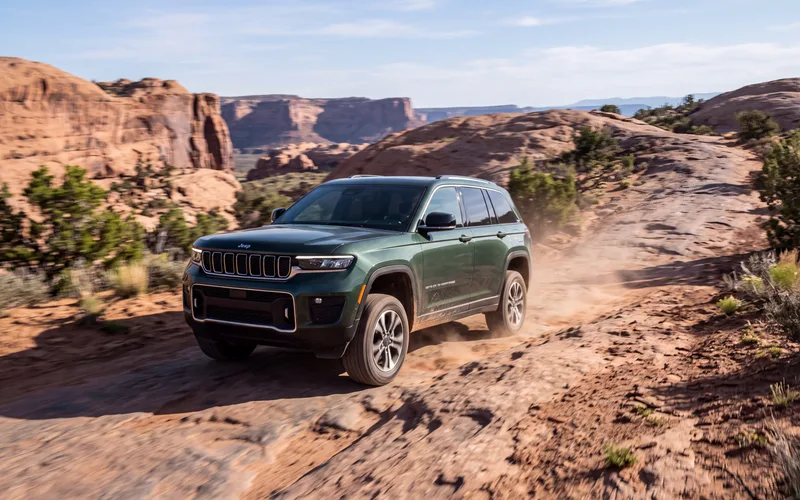 Jeep Grand CherokeeMid-Size SUVBetter at: Modern platform
Same family, newer bones — better safety tech, an available plug-in hybrid and real off-road hardware, if you can live without the third row and the 8,700-lb tow rating.
Compare 2.79B-
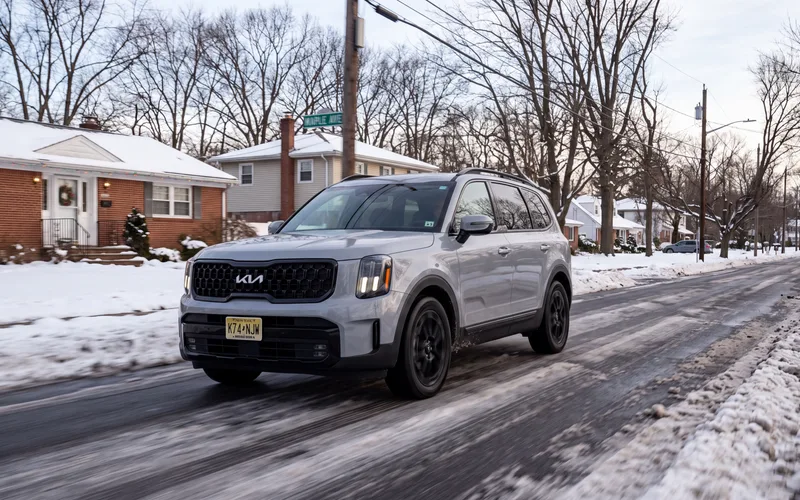 Kia TellurideMid-Size SUVBetter at: Warranty & reliability
The low-risk three-row alternative: stronger standard safety gear, a 10 yr/100k powertrain warranty and better predicted reliability for similar money.
Compare 2.47C+
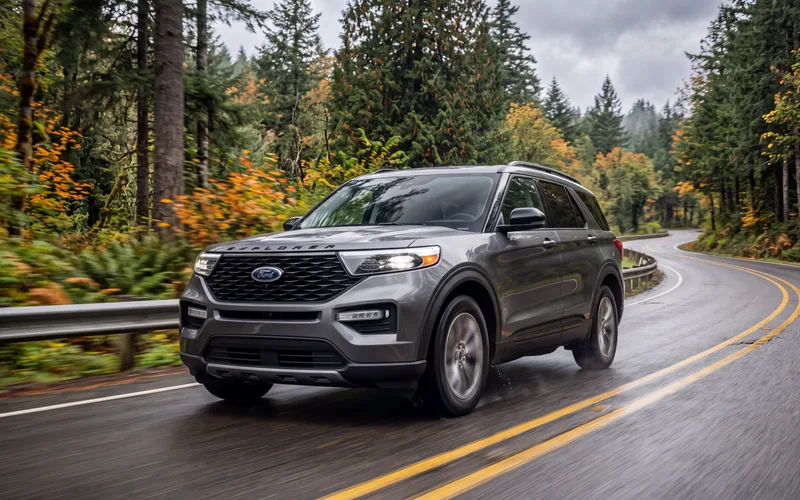 Ford ExplorerMid-Size SUVBetter at: Driver assistance
Keeps the rear-drive three-row formula but adds hands-free BlueCruise highway driving and better fuel economy, at the cost of about 3,000 lbs of towing.
CompareHow it's evolved
10 scored model years · 2017–2026
Subject scores by year
Hover or tap a score to see what moved it versus the year before. A corner mark flags a big swing.
| Year | Performance | Efficiency | Safety | Space | Cost | Reliability | Tech | Use-case | Driving | Value |
|---|---|---|---|---|---|---|---|---|---|---|
| 2026 | 58 | 42 | 53 | 63 | 31 | 64 | 68 | 65 | 70 | 62 |
| 2025 | 57 | 37 | 43 | 60 | 34 | 65 | 62 | 61 | 63 | 60 |
| 2024 | 57 | 43 | 43 | 59 | 38 | 65 | 53 | 59 | 61 | 56 |
| 2023 | 51 | 44 | 44 | 59 | 31 | 63 | 52 | 58 | 60 | 55 |
| 2022 | 51 | 45 | 50 | 58 | 35 | 56 | 47 | 53 | 51 | 53 |
| 2021 | 47 | 45 | 42 | 53 | 44 | 61 | 49 | 53 | 48 | 52 |
| 2020 | 51 | 45 | 45 | 59 | 37 | 61 | 45 | 53 | 55 | 58 |
| 2019 | 46 | 46 | 44 | 59 | 49 | 62 | 43 | 54 | 47 | 58 |
| 2018 | 47 | 46 | 43 | 60 | 51 | 61 | 38 | 54 | 56 | 57 |
| 2017 | 46 | 46 | 45 | 61 | 60 | 48 | 41 | 54 | 61 | 54 |
Compare two years
Best fit & conditions
Higher scores mean a better fit for that use case. Learn more about use-case fit →
Subject profile
Academic Probation · NHTSA safety recalls
No NHTSA safety recall is on record for the 2026 Dodge Durango. Other model years of the Durango have 19 — listed below.
19 recalls on other model years of the Durango (2017–2023)
Aug 13, 2026Structure: body: hatchback/liftgateThe rear spoiler may not be aligned properly with the roof, possibly resulting in damage to the spoiler during liftgate use.
Defect
Chrysler (FCA US, LLC) is recalling certain 2021-2023 Dodge Durango vehicles. The rear spoiler may not be aligned properly with the roof, possibly resulting in damage to the spoiler during liftgate use.
Risk
A damaged rear spoiler may detach and create a road hazard, increasing the risk of a crash.
Remedy
Dealers will inspect and replace or repair the spoiler and align the liftgate as necessary, free of charge. Interim notification letters, notifying owners of the safety risk, were mailed September 10, 2026. A second notice will be sent once the final remedy is available. Owners may contact Chrysler customer service at 1-800-853-1403. Chrysler's number for this recall is 61D. Vehicle Identification Numbers (VINs) involved in this recall will become searchable on NHTSA.gov on August 20, 2026. Vehicles in this recall were previously recalled under 21V842 or 23V115. Vehicles repaired under the prior recalls will need the new repair completed.
NHTSA campaign 26V528000 ↗Manufacturer no. 61D74,578 vehicles potentially affected (all models in the campaign)Filed by Chrysler (FCA US, LLC)Filed as DURANGONov 7, 2024Service brakes, hydraulic: antilock/traction control/electronic limited slip: control unit/moduleA malfunction in the antilock-brake system (ABS) module may incorrectly illuminate the brake lights and disable the ABS and electronic stability control (ESC). In addition, the vehicle operator may be able to start and shift out of Park without the brake pedal being applied.
Defect
Chrysler (FCA US, LLC) is recalling certain 2018-2019 Jeep Grand Cherokee and Dodge Durango vehicles. A malfunction in the antilock-brake system (ABS) module may incorrectly illuminate the brake lights and disable the ABS and electronic stability control (ESC). In addition, the vehicle operator may be able to start and shift out of Park without the brake pedal being applied.
Risk
A vehicle that can be started and shifted out of Park without applying the brake pedal can result in a vehicle rollaway. Disabled ABS and ESC systems can reduce vehicle handling and control in certain driving situations. Brake lights that incorrectly illuminate can fail to properly indicate the driver's intention to following traffic. Any of these scenarios can increase the risk of a crash.
Remedy
Dealers will replace the integrated pressure transducer and update the ABS module software, as necessary free of charge. Owner notification letters were mailed December 16, 2025. Owners may contact FCA customer service at 1-800-853-1403. FCA's number for this recall is 94B. This recall replaces previous recall number 22V-426. Vehicles previously remedied under 22V-426 will need to have the new remedy completed.
NHTSA campaign 24V838000 ↗Manufacturer no. 94B206,502 vehicles potentially affected (all models in the campaign)Owners notified Dec 16, 2025Filed by Chrysler (FCA US, LLC)Filed as DURANGOJun 13, 2024Back over prevention: sensing system: cameraThe radio software may prevent the rearview image from displaying. As such, these vehicles fail to comply with the requirements of Federal Motor Vehicle Safety Standard number 111, "Rear Visibility."
Defect
Chrysler (FCA US, LLC) is recalling certain 2021-2022 Dodge Durango, 2021-2023 Chrysler Pacifica, Jeep Grand Cherokee L, 2022 Ram 1500, 2500, 3500, Chrysler Voyager, 2022-2023 Jeep Compass, Grand Cherokee, Wagoneer, Grand Wagoneer, and Ram Promaster vehicles. The radio software may prevent the rearview image from displaying. As such, these vehicles fail to comply with the requirements of Federal Motor Vehicle Safety Standard number 111, "Rear Visibility."
Risk
A rearview camera image that does not display decreases the driver's visibility, increasing the risk of a crash.
Remedy
Dealers will update the radio software or the software will be OTA, "Over-The-Air," free of charge. Owner notification letters were mailed beginning July 9, 2024. Owners may contact FCA US, LLC customer service at 1-800-853-1403. FCA US, LLC's numbers for this recall are 66B and 79B.
NHTSA campaign 24V436000 ↗Manufacturer no. 66B, 79B1,033,433 vehicles potentially affected (all models in the campaign)Owners notified Jul 9, 2024Filed by Chrysler (FCA US, LLC)Filed as DURANGOJun 6, 2024Electronic stability control (esc): control module · Service brakes, air: antilock: control unit/moduleDue to a software malfunction, the ABS control module may disable the electronic stability control system. As such, these vehicles fail to comply with the requirements of Federal Motor Vehicle Safety Standard number 126, "Electronic Stability Control Systems."
Defect
Chrysler (FCA US, LLC) is recalling certain 2022 Dodge Durango and Ram 2500 and 3500 vehicles. Due to a software malfunction, the ABS control module may disable the electronic stability control system. As such, these vehicles fail to comply with the requirements of Federal Motor Vehicle Safety Standard number 126, "Electronic Stability Control Systems."
Risk
Driving with a disabled electronic stability control system can increase the risk of a crash.
Remedy
Dealers will update the ABS control module software, free of charge. Owner notification letters were mailed beginning July 11, 2024. Owners may contact FCA US, LLC customer service at 1-800-853-1403. FCA US, LLC's number for this recall is 55B.
NHTSA campaign 24V415000 ↗Manufacturer no. 55B211,581 vehicles potentially affected (all models in the campaign)Owners notified Jul 11, 2024Filed by Chrysler (FCA US, LLC)Filed as DURANGOSep 18, 2023Power train: automatic transmission: lever and linkage: column shiftThe shifter may experience an interference with the shifter boot and come out of gear while driving, which can result in a sudden loss of drive power.
Defect
Chrysler (FCA US, LLC) is recalling certain 2023 Dodge Durango Pursuit vehicles equipped with an instrument panel mounted shifter. The shifter may experience an interference with the shifter boot and come out of gear while driving, which can result in a sudden loss of drive power.
Risk
A sudden loss of drive power can increase the risk of a crash.
Remedy
Dealers will replace the instrument panel mounted shifter boot, free of charge. Owner notification letters were mailed November 7, 2023. Owners may contact FCA US, LLC customer service at 1-800-853-1403. FCA US, LLC's number for this recall is 94A.
NHTSA campaign 23V640000 ↗Manufacturer no. 94A125 vehicles potentially affected (all models in the campaign)Owners notified Nov 7, 2023Filed by Chrysler (FCA US, LLC)Filed as DURANGOFeb 23, 2023Structure: body: hatchback/liftgateThe rear spoiler may not be aligned properly with the roof, resulting in damage to the spoiler during liftgate use.
Defect
Chrysler (FCA US, LLC) is recalling certain 2021-2023 Dodge Durango vehicles. The rear spoiler may not be aligned properly with the roof, resulting in damage to the spoiler during liftgate use.
Risk
A damaged rear spoiler can detach and become a road hazard, increasing the risk of a crash.
Remedy
Dealers will inspect and replace the rear spoiler, as necessary, free of charge. Owner notification letters were mailed March 9, 2023. Owners may contact Chrysler customer service at 1-800-853-1403. Chrysler's number for this recall is 20A. This recall is an expansion of recall number 21V-842.
NHTSA campaign 23V115000 ↗Manufacturer no. 20A139,019 vehicles potentially affected (all models in the campaign)Owners notified Mar 9, 2023Filed by Chrysler (FCA US, LLC)Filed as DURANGONov 23, 2022Power train: manual transmission: column shift assemblyThe shifter assembly was not properly heat-treated, which can prevent the shifter from properly engaging in the "drive" position.
Defect
Chrysler (FCA US, LLC) is recalling certain 2022 Dodge Charger and Durango vehicles. The shifter assembly was not properly heat-treated, which can prevent the shifter from properly engaging in the "drive" position.
Risk
An improperly engaged shifter assembly may slip out of the "drive" position, resulting in a sudden loss of drive power, increasing the risk of a crash.
Remedy
Dealers will replace the shifter assembly, free of charge. Owner notification letters were mailed January 17, 2023. Owners may contact FCA US, LLC customer service at 1-800-853-1403. FCA US, LLC's number for this recall ZB3.
NHTSA campaign 22V866000 ↗Manufacturer no. ZB35,834 vehicles potentially affected (all models in the campaign)Owners notified Jan 17, 2023Filed by Chrysler (FCA US, LLC)Filed as DURANGOJun 9, 2022Service brakes, hydraulic: antilock/traction control/electronic limited slip: control unit/moduleA malfunction in the antilock-brake system (ABS) module may illuminate the brake lights, and allow the vehicle to start and shift out of Park without the brake pedal being applied.
Defect
Chrysler (FCA US, LLC) is recalling certain 2018-2019 Jeep Grand Cherokee and Dodge Durango vehicles. A malfunction in the antilock-brake system (ABS) module may illuminate the brake lights, and allow the vehicle to start and shift out of Park without the brake pedal being applied.
Risk
A vehicle that starts and shifts out of Park without applying the brake pedal can result in vehicle rollaway, increasing the risk of a crash without prior warning and/or injury to others outside of the vehicle.
Remedy
This recall is replaced by NHTSA recall number 24V838. Vehicles already repaired under this recall will need to have the new remedy completed. The remedy includes updated HCU/ABS module software that prevents the HCU/ABS module from falsely reading pressure in the primary circuit. FCA has decided to do a two-Phase Campaign remedy schedule. Phase 1 began November 17, 2022. Phase 2 begin date has not been determined yet. Interim owner notification letters explaining the safety risk were mailed July 28, 2020. Owner notification letters were mailed on November 29, 2022. Owners may contact FCA US, LLC customer service at 1-800-853-1403. FCA US, LLC's number for this recall is Z48.
NHTSA campaign 22V426000 ↗Manufacturer no. Z48206,502 vehicles potentially affected (all models in the campaign)Owners notified Nov 29, 2022Filed by Chrysler (FCA US, LLC)Filed as DURANGOApr 28, 2022Engine and engine cooling: exhaust system: emission control: gas recirculation valve (egr valve)The exhaust gas recirculation (EGR) valve may stick open, resulting in an unexpected loss of drive power.
Defect
Chrysler (FCA US, LLC) is recalling certain 2021 Dodge Durango, Jeep Grand Cherokee WK, 2022 Jeep Grand Cherokee, and 2021-2022 Jeep Grand Cherokee L vehicles equipped with 3.6L engines. The exhaust gas recirculation (EGR) valve may stick open, resulting in an unexpected loss of drive power.
Risk
An unexpected loss of drive power increases the risk of a crash.
Remedy
Dealers will replace the EGR valve assembly, free of charge. Owner notification letters were mailed June 23, 2022. Owners may contact FCA US, LLC customer service at 1-800-853-1403. FCA US, LLC's number for this recall is Z31.
NHTSA campaign 22V284000 ↗Manufacturer no. Z311,308 vehicles potentially affected (all models in the campaign)Owners notified Jun 23, 2022Filed by Chrysler (FCA US, LLC)Filed as DURANGOMar 14, 2022Steering: rack and pinionThe steering gear rack bar may have been insufficiently hardened during manufacturing, possibly allowing it to bind within the steering rack, and resulting in difficulty steering or a loss of steering control.
Defect
Chrysler (FCA US, LLC) is recalling certain 2021-2022 Dodge Durango and 2022 Jeep Grand Cherokee vehicles. The steering gear rack bar may have been insufficiently hardened during manufacturing, possibly allowing it to bind within the steering rack, and resulting in difficulty steering or a loss of steering control.
Risk
Difficulty steering, or a loss of steering control, can increase the risk of a crash.
Remedy
Dealers will replace the steering gear assembly, free of charge. Owner notification letters were mailed on May 12, 2022. Owners may contact FCA US, LLC customer service at 1-800-852-1403. FCA US, LLC's number for this recall is Z18.
NHTSA campaign 22V154000 ↗Manufacturer no. Z18931 vehicles potentially affected (all models in the campaign)Owners notified May 12, 2022Filed by Chrysler (FCA US, LLC)Filed as DURANGOMar 10, 2022Electronic stability control (esc) · Service brakes, hydraulic: antilock/traction control/electronic limited slip: control unit/moduleThe ABS control module software may prevent the electronic stability control (ESC) malfunction indicator light from illuminating during certain conditions. As such, these vehicles fail to comply with the requirements of Federal Motor Vehicle Safety Standard number 126, "Electronic Stability Control Systems."
Defect
Chrysler (FCA US, LLC) is recalling certain 2019-2022 Ram 2500 and 2021-2022 Dodge Durango vehicles, and 2019-2022 3500 cab chassis with GVWR less than 10,000 lbs. The ABS control module software may prevent the electronic stability control (ESC) malfunction indicator light from illuminating during certain conditions. As such, these vehicles fail to comply with the requirements of Federal Motor Vehicle Safety Standard number 126, "Electronic Stability Control Systems."
Risk
An ESC malfunction indicator light that fails to illuminate during an electronic stability control problem can increase the risk of a crash.
Remedy
Dealers will update the ABS control module software, free of charge. Owner notification letters were mailed March 29, 2022. Owners may contact FCA US, LLC customer service at 1-800-853-1403. FCA US, LLC's number for this recall is Z20.
NHTSA campaign 22V140000 ↗Manufacturer no. Z20370,437 vehicles potentially affected (all models in the campaign)Owners notified Mar 29, 2022Filed by Chrysler (FCA US, LLC)Filed as DURANGOOct 28, 2021Structure: bodyThe rear spoiler may not be aligned properly with the roof, resulting in damage to the spoiler during liftgate use.
Defect
Chrysler (FCA US, LLC) is recalling certain 2021 Dodge Durango vehicles. The rear spoiler may not be aligned properly with the roof, resulting in damage to the spoiler during liftgate use.
Risk
A damaged rear spoiler could detach and become a road hazard, increasing the risk of a crash.
Remedy
Dealers will inspect and replace the rear spoiler, as necessary, free of charge. Owner notification letters were mailed December 21, 2021. Owners may contact FCA US, LLC customer service at 1-800-853-1403. FCA US, LLC's number for this recall is Y73.
NHTSA campaign 21V842000 ↗Manufacturer no. Y734,837 vehicles potentially affected (all models in the campaign)Owners notified Dec 21, 2021Filed by Chrysler (FCA US, LLC)Filed as DURANGOApr 22, 2021Air bags: critical fasteners · Air bags: side/window: curtainThe Side Air Bag Inflatable Curtain (SABIC) fastener may be loose or missing.
Defect
Chrysler (FCA US, LLC) is recalling certain 2020-2021 Dodge Durango vehicles. The Side Air Bag Inflatable Curtain (SABIC) fastener may be loose or missing.
Risk
A loose or missing fastener may cause the side curtain air bag to deploy incorrectly, increasing the risk of injury.
Remedy
Dealers will tighten or replace the fastener, free of charge. Owner notification letters were sent on May 7, 2021. Owners may contact Chrysler customer service at 1-800-853-1403. Chrysler's number for this recall is Y16.
NHTSA campaign 21V280000 ↗Manufacturer no. Y162,721 vehicles potentially affected (all models in the campaign)Owners notified May 7, 2021Filed by Chrysler (FCA US, LLC)Filed as DURANGOSep 10, 2020Back over prevention: sensing system: cameraA software error can cause the rearview camera image to remain displayed after the vehicle has been shifted out of reverse. As such, these vehicles fail to comply with the requirements of Federal Motor Vehicle Safety Standard (FMVSS) number 111, "Rearview Mirrors."
Defect
Chrysler (FCA US LLC) is recalling certain 2020 Jeep Gladiator and Jeep Cherokee, 2019-2020 Ram 1500 Pickup, Ram 2500 Pickup, Ram 3500 Pickup, Chrysler Pacifica, Dodge Durango, Jeep Grand Cherokee, Jeep Wrangler, and Jeep Renegade and 2019 Dodge Challenger vehicles equipped with 8.4" or 12" radio displays. A software error can cause the rearview camera image to remain displayed after the vehicle has been shifted out of reverse. As such, these vehicles fail to comply with the requirements of Federal Motor Vehicle Safety Standard (FMVSS) number 111, "Rearview Mirrors."
Risk
The lingering rearview image can distract the driver, increasing the risk of a crash.
Remedy
Chrysler has notified owners, and dealers will update the radio display software, free of charge. Optionally, owners can choose to remotely update their software via an Over-The-Air (OTA) update available as of May 1, 2020. The recall began April 27, 2020. Owners may contact Chrysler customer service at 1-800-853-1403. Chrysler's number for this recall is W30-W37.
NHTSA campaign 20V191000 ↗Manufacturer no. W30-W37319,610 vehicles potentially affected (all models in the campaign)Owners notified Apr 27, 2020Filed by Chrysler (FCA US LLC)Filed as DURANGOMar 26, 2020Power train: driveline: differential unitThe front differential may have been assembled with pinion gears that are insufficiently hardened, which can lead to the gear teeth wearing down. If both pinion gears have their teeth sufficiently worn off, torque power can not be transferred from the front wheels to the driveline, resulting in loss of power while driving and loss of the PARK function when stationary.
Defect
Chrysler (FCA US LLC) is recalling certain 2019 Jeep Grand Cherokee and Dodge Durango vehicles. The front differential may have been assembled with pinion gears that are insufficiently hardened, which can lead to the gear teeth wearing down. If both pinion gears have their teeth sufficiently worn off, torque power can not be transferred from the front wheels to the driveline, resulting in loss of power while driving and loss of the PARK function when stationary.
Risk
A sudden loss of power while driving or loss of the transmission PARK function can increase the risk of a crash.
Remedy
Chrysler will notify owners, and dealers will replace the front differential, free of charge. The recall began May 21, 2020. Owners may contact Chrysler customer service at 1-800-853-1403. Chrysler's number for this recall is W22.
NHTSA campaign 20V183000 ↗Manufacturer no. W22515 vehicles potentially affected (all models in the campaign)Owners notified May 21, 2020Filed by Chrysler (FCA US LLC)Filed as DURANGOAug 9, 2018Electrical system: wiring: front underhoodThe powertrain control module may be equipped with a voltage regulator chip in the circuit board that may fail, causing a stall or a no start condition.
Defect
Chrysler (FCA US LLC) is recalling certain 2018 Jeep Renegade, Compass and Grand Cherokee, RAM 1500 and Promaster, Fiat 500x, Dodge Journey, Challenger, Charger and Durango and Chrysler 300x vehicles, 2017-2018 Jeep Wrangler, Dodge Grand Caravan and Chrysler Town and Country vehicles and 2018-2019 Jeep Cherokee and 2018 Chrysler Pacifica and Pacifica Hybrid vehicles. The powertrain control module may be equipped with a voltage regulator chip in the circuit board that may fail, causing a stall or a no start condition.
Risk
A vehicle stall can increase the risk of a crash.
Remedy
Chrysler will notify owners, and dealers will replace the powertrain control module, free of charge. The recall began October 2, 2018. Owners may contact Chrysler customer service at 1-800-853-1403. Chrysler's number for this recall is U87.
NHTSA campaign 18V524000 ↗Manufacturer no. U8712,779 vehicles potentially affected (all models in the campaign)Owners notified Oct 2, 2018Filed by Chrysler (FCA US LLC)Filed as DURANGOMay 17, 2018Electrical system: software · Electrical system: wiring · Vehicle speed control: cruise controlThese vehicles are being recalled to address a defect that could prevent the cruise control system from disengaging. If, when using cruise control, there is a short circuit within the vehicle's wiring, the driver may not be able to shut off the cruise control either by depressing the brake pedal or manually turning the system off once it has been engaged, resulting in either the vehicle maintaining its current speed or possibly accelerating.
Defect
Chrysler (FCA US LLC) is recalling certain 2014-2018 Dodge Journey, Charger and Durango, RAM 2500, 3500, 3500 Cab Chassis (more than 10,000lb), 4500 Cab Chassis and 5500 Cab Chassis, Jeep Cherokee and Grand Cherokee and Chrysler 300, 2014-2019 RAM 1500, 2015-2018 Dodge Challenger, 2015-2017 Chrysler 200, 2016-2018 RAM 3500 Cab Chassis (less than 10,000 lb), 2017-2018 Chrysler Pacifica and 2018 Jeep Wrangler vehicles. These vehicles are being recalled to address a defect that could prevent the cruise control system from disengaging. If, when using cruise control, there is a short circuit within the vehicle's wiring, the driver may not be able to shut off the cruise control either by depressing the brake pedal or manually turning the system off once it has been engaged, resulting in either the vehicle maintaining its current speed or possibly accelerating.
Risk
If the vehicle maintains its speed or accelerates despite attempts to deactivate the cruise control, there would be an increased risk of a crash.
Remedy
Chrysler will notify owners, and dealers will inspect the software, and perform a software flash on the engine or powertrain control module, free of charge. The recall began June 4, 2018. Owners may contact Chrysler customer service at 1-800-853-1403. Note: Owners are advised to stop using cruise control until the software update has been performed. In the event that cruise control cannot be disengaged while driving, owners should firmly and steadily apply the brakes and shift the transmission to neutral, placing the vehicle in park once it has stopped.
NHTSA campaign 18V332000 ↗Manufacturer no. U49,U59-U65,U68,U734,815,661 vehicles potentially affected (all models in the campaign)Owners notified Jun 4, 2018Filed by Chrysler (FCA US LLC)Filed as DURANGOMay 1, 2018Power train: automatic transmissionAn incorrect transmission park lock rod may have been installed in the transmission.
Defect
Chrysler (FCA US LLC) is recalling certain 2018 Dodge Charger, Durango and Challenger, Jeep Grand Cherokee and Wrangler, Chrysler 300, and RAM 1500 vehicles. An incorrect transmission park lock rod may have been installed in the transmission.
Risk
If the incorrect park lock rod is installed, the transmission may not shift into 'PARK' and keep the vehicle from moving, increasing the risk of unintended vehicle movement and the risk of a crash.
Remedy
Chrysler will notify owners, and dealers will install the correct park lock rod, free of charge. The recall began June 28, 2018. Owners may contact Chrysler customer service at 1-800-853-1403. Chrysler's number for this recall is U43.
NHTSA campaign 18V280000 ↗Manufacturer no. U4371 vehicles potentially affected (all models in the campaign)Owners notified Jun 28, 2018Filed by Chrysler (FCA US LLC)Filed as DURANGOAug 31, 2017Power train: axle assembly: axle shaftThe vehicles may have been assembled with rear axle halfshafts that are too short.
Defect
Chrysler (FCA US LLC) is recalling certain 2017 Dodge Durango vehicles. The vehicles may have been assembled with rear axle halfshafts that are too short.
Risk
If a halfshaft is too short, it may disengage from the differential causing a loss of drive and increasing the risk of a crash.
Remedy
Chrysler has notified owners, and dealers will replace both halfshafts, free of charge. The recall began on September 18, 2017. Owners may contact Chrysler customer service at 1-800-853-1403. Chrysler's number for this recall is T55.
NHTSA campaign 17V541000 ↗Manufacturer no. T554 vehicles potentially affected (all models in the campaign)Owners notified Sep 18, 2017Filed by Chrysler (FCA US LLC)Filed as DURANGO
Source: NHTSA Office of Defects Investigation recall database, model years 2017–2026. Recalls are listed by model year as the manufacturer filed them; whether a specific car is affected depends on its VIN — check a VIN at nhtsa.gov ↗. NHTSA model names matched to this page: DURANGO.
Detailed scoring by subject
1Performance & PowertrainMid-pack among this car's ten categories.1.88C-
Volume GT trim uses the 3.6L Pentastar V6 at 295 hp; range extends to the 6.2L supercharged HEMI V8 in the SRT Hellcat variant.
3.6L Pentastar V6 peak torque; V8 variants reach 390 (5.7L), 470 (6.4L), and 645 lb-ft (6.2L SC).
Volume V6 trim is a mid-7-second SUV; upper-trim V8s dramatically outperform (Hellcat 3.5 s, SRT 392 4.4 s).
Aging 3.6L Pentastar V6 delivers adequate but not class-leading smoothness with some coarseness at higher revs; V8 options add character but at the cost of NVH.
ZF-sourced TorqueFlite 8-speed automatic is widely praised for smooth, decisive shifts and prompt kickdowns across the lineup.
Best-in-class tow rating for a three-row SUV when properly equipped with the 5.7L V8 and factory tow package.
AWD available across the trim range (standard on SRT variants), with rear-biased tuning and selectable drive modes; lacks a true low-range transfer case, so ceiling is short of sophisticated 4WD systems.
Street- and tow-oriented tuning with ~8.1 in ground clearance, no dedicated off-road trim, no low range, and no lockers — a marked contrast to platform-mate Grand Cherokee's Trailhawk.
Impressive gas-engine breadth (3.6L V6 plus 5.7L, 6.4L, and 6.2L supercharged HEMI V8s) covering an enormous power range, but no hybrid, PHEV, or EV option — trailing most rivals on electrification.
2Efficiency & RangeOne of the Durango's weakest categories.0.78F
EPA rating for the volume GT V6 AWD trim, the mainstream configuration; V8 variants drop substantially.
EPA city rating for the volume GT V6 AWD trim; heavy body-on-frame SUV with no stop-start hybrid assist penalizes urban economy.
EPA highway rating for the volume GT V6 AWD trim; the 8-speed transmission helps but boxy frame hurts efficiency vs unibody rivals.
Large 24.6-gallon tank on the volume GT V6 AWD offsets mediocre MPG to deliver competitive real-world range for road trips.
EPA estimate for GT V6 AWD at 15k mi/yr on regular gas; V8 trims requiring premium significantly worsen this figure.
Volume GT V6 trim runs on regular 87 octane, but the 5.7L HEMI benefits from midgrade and the R/T 6.4L V8 and SRT Hellcat require premium fuel — mixed lineup docks the score.
3SafetyOne of the Durango's weakest categories.1.56D
The Durango's third-generation (WK2) architecture last received a full NHTSA overall rating of 4 stars; NHTSA has not retested the aged platform in recent model years, so the 4-star result carries forward for 2026.
The current-generation Durango is not an IIHS Top Safety Pick and has never earned TSP/TSP+ this generation. The body-on-frame-adjacent WK2 structure predates the updated moderate-overlap and small-overlap passenger-side protocols, and IIHS has largely stopped testing the model. Aged crash structure with unknown performance against the current test suite is a real risk.
Full-Speed Forward Collision Warning-Plus with AEB, ParkView backup camera, and Advanced Brake Assist are standard. Blind-Spot Monitoring with Rear Cross-Path Detection is standard on GT and above; Adaptive Cruise, Lane Departure Warning-Plus with Lane Keep Assist, and Auto High Beams remain bundled into the optional Advanced Safety Group on lower trims — well behind Honda Sensing, Toyota Safety Sense, and Hyundai SmartSense which include ACC and LKA on every trim.
The Durango's FCW-Plus with active braking is a first-generation Stellantis AEB implementation that predates modern nighttime pedestrian test protocols. IIHS front crash prevention has not been comprehensively re-evaluated on this generation, and reviews note late-triggering behavior compared to newer competitors from Honda, Toyota and Hyundai.
Blind-Spot Monitoring with Rear Cross-Path Detection is standard on GT and above (which represents the bulk of the volume mix) but remains alert-only with no active steering intervention or safe-exit alert. Trailer-aware coverage is available given the Durango's tow focus.
Lane Departure Warning-Plus with Lane Keep Assist is an optional add via Advanced Safety Group and provides basic corrective steering only — no full lane centering. Reviewers describe the system as reactive rather than smoothly proactive, well behind modern lane-centering implementations from Ford Co-Pilot360 or Toyota Safety Sense 3.0.
Adaptive Cruise Control with Stop is available in the Advanced Safety Group package with full-speed range and stop-and-go, and it functions competently on the highway. It is not combined with a modern integrated highway assist — spacing calibration is coarse and the system does not tie into lane centering to form a true traffic-jam assist.
The Durango offers no hands-free highway driving system. Stellantis has not deployed a BlueCruise/Super Cruise-equivalent on any Dodge product, and none is announced for the WK2 Durango's final model years.
Base SXT and GT use LED reflector headlamps; R/T and above use LED projector headlamps with automatic high beams (via Advanced Safety Group). Historic IIHS headlight ratings for the WK2 Durango have ranged Acceptable to Marginal depending on trim, with no Good ratings across the range — a middling result behind newer competitors.
Traditional upright three-row SUV proportions with generous side glass and a relatively low beltline yield decent forward and quarter sightlines. Rear visibility is compromised by thick D-pillars and the third-row headrests; the volume trim lacks a standard surround-view camera to compensate (available on Citadel/higher).
Three rows with wide-opening rear doors and clearly marked LATCH anchors in the two outboard second-row positions plus tether anchors across the second row and outboard third-row positions. Room for two rear-facing seats in the second row with reasonable front-seat leg space; second-row bench allows a rare 3-across fit compared to captain's-chair rivals.
4Space & ComfortMid-pack among this car's ten categories.2.23C
Durango is offered as a 3-row SUV with either a 40/20/40 bench (7-passenger) or 2nd-row captain's chairs (6-passenger); maximum available is 7.
Front headroom carries over unchanged on the long-running WK platform; competitive for the mid-size SUV segment.
Front legroom is on the tight end for a mid-size SUV, a legacy of the WK platform's cab-forward proportions relative to newer three-row rivals.
Excellent second-row headroom near the top of the mid-size SUV band.
Second-row legroom is comfortably above segment average with sliding second row aiding third-row access.
Third row (33.5 in legroom, 37.8 in headroom) is kid-friendly and adult-tolerable for short trips only; power tilt-and-slide 2nd row on higher trims eases access, but the seat sits low with knees-up posture typical of the aging WK architecture.
Cargo behind the second row is mid-pack for a mid-size three-row SUV; behind the third row (17.2 cu ft) is decent for a weekly grocery run with all seats up.
Maximum cargo with all rear seats folded is competitive for the segment but trails class leaders like the Traverse and Grand Highlander.
Adequate console, glovebox, and door bins with a reasonably sized center console, but no standout storage innovation (no underfloor bin, no giga console, no Pro Power-style outlets); layout is showing its age against newer three-row rivals.
R/T and GT Plus seats are well-bolstered with power adjustment and available Nappa leather on upper trims; long-haul comfort is competent though second-row bench cushions draw occasional criticism for flatness.
Composed on the highway on the base steel-spring setup; can feel firm over broken pavement on R/T and larger wheels; optional air suspension improves compliance but is trim-limited on 2026.
Reasonably hushed at cruise with acoustic windshield on upper trims; V8 note is present by design on R/T variants, and older platform doesn't match newer luxury-adjacent rivals for isolation.
Well-equipped for a Premium price class: standard heated front seats and heated steering wheel on GT and up, available ventilated front and heated second-row seats, tri-zone automatic climate, remote start, and available power liftgate; feature availability broadens across trims.
5Cost of OwnershipThe Durango's lowest-graded category.0.00F
The 2026 Durango GT RWD opens the lineup around $44.7k with destination, up modestly from the 2025 MY as Stellantis milks the aging LX platform in its 'Last Call' era. Mid-pack for mid-size 3-row SUVs.
R/T with the 5.7L HEMI V8 remains the volume retail trim thanks to sustained HEMI demand in the Durango's final production years; GT Plus V6 undercuts it by ~$5k but retail buyers overwhelmingly pick the V8. Prices climb another $20k+ for SRT 392 and $95k+ for Hellcat.
Well above segment average. The 5.7L HEMI V8's premium-fuel diet, 15-year-old LX-platform hardware and Dodge's below-average dealer service network all push maintenance and repair costs into the top quartile of mid-size SUVs. V6 GT trims run modestly cheaper.
Middle-of-pack retention. HEMI V8 R/T and SRT variants benefit from 'Last Call' collector interest as Stellantis discontinues the naturally-aspirated HEMI; V6 GT trims depreciate faster given aging platform and heavy fleet/rental exposure. Blended residual sits around segment median.
Standard Stellantis basic coverage — bottom of the segment. Hyundai/Kia (5 yr/60k) and Mitsubishi (5 yr/60k) offer meaningfully longer basic warranties.
Stellantis 5-year/60k powertrain trails Hyundai/Kia (10 yr) and Mitsubishi (10 yr) by a wide margin — a notable gap given the Durango's aging drivetrain and reputation for higher repair costs.
No complimentary scheduled maintenance — Dodge does not offer a free-oil-change program. Buyers get 5 yr/60k roadside assistance bundled with the powertrain warranty and a short Uconnect 5 connected-services trial (SiriusXM Guardian 12-mo on higher trims). No bundled charging or fuel credits.
$54,590 volume-trim price minus its estimated resale value after 5 years (50% retained, or about $27,295) leaves about $27,295 in depreciation. Add the projected $8,500 in 5-year maintenance and repairs, and owning this vehicle for 5 years costs about $35,795 in total.
6Reliability & QualityMid-pack among this car's ten categories.2.32C+
Consumer Reports has consistently rated the Durango's predicted reliability below average within its segment, and Dodge brand-level results drag any model-specific projection. J.D. Power quality data on Stellantis three-row SUVs has been mixed — Initial Quality is respectable but three-year Vehicle Dependability lags the segment.
Dodge is a persistent bottom-third brand in Consumer Reports' annual reliability rankings and typically finishes below industry average in J.D. Power's Vehicle Dependability Study. Multi-year evidence is consistent.
The current-generation Durango (WK2 platform, 2011–present) has accumulated a moderate but not extreme recall record — alternator failure, fuel pump relay, backup camera, wiring/instrument-cluster software, and airbag campaigns across recent model years. Nothing systemic like a fire or drivetrain-failure recall, but volume of TSBs on the aging platform is above segment norm.
Both offered powertrains have deep track records: the 3.6L Pentastar V6 (since 2011) and 5.7L/6.4L HEMI V8 are among the most-produced modern engines in North America with strong high-mileage service history. Known concerns are Pentastar left-bank cylinder heads (mostly resolved post-2013) and HEMI MDS lifter/cam wear on early V8s — but taken together the powertrain family is proven.
The Durango cabin was refreshed for 2021 (new dash, Uconnect 5, revised switchgear) but the underlying architecture dates to 2011 and reviewers consistently call out hard plastics in door panels and lower dash. Higher trims (R/T Plus, SRT, Hellcat) add real leather and Alcantara that improves the feel. Competitive at the price point but not class-leading.
Assembly quality is a relative strength of the mature WK2 platform — reviewers rarely cite squeaks, rattles, or panel misalignment. J.D. Power Initial Quality has been middle-of-the-pack for Dodge, better than the brand's long-term dependability results.
Chrysler-Dodge-Jeep-Ram share one of the densest US dealer footprints — roughly 2,400+ combined dealerships — so service coverage is strong nationwide. Service satisfaction scores in J.D. Power's Customer Service Index have been mid-pack for the group, below Toyota/Lexus/Buick benchmarks.
Pentastar V6, HEMI V8, and 8HP transmission share parts with millions of Ram, Jeep, and Chrysler vehicles, so parts are cheap and abundant with a vast aftermarket — HEMI in particular has one of the largest performance aftermarkets on the market. Repair costs are typical for a body-on-frame-adjacent unibody SUV, above compact-crossover averages but below premium-brand equivalents.
7Technology & InfotainmentOne of the Durango's strongest categories.2.58C+
10.1-inch Uconnect 5 touchscreen is standard on GT (volume trim) and up as part of the 2024 refresh; base retained the older 8.4-inch. Mid-pack for mid-size SUVs, well behind the 12-inch+ screens now common in Hyundai Palisade, Kia Telluride, and Grand Highlander.
Uconnect 5 remains one of the better mainstream systems — fast response, sensible menu logic, and Dodge kept physical volume/tune knobs and climate hard-keys. Reviewers consistently call it a strength across the Stellantis lineup.
Wireless Apple CarPlay and wireless Android Auto are standard on GT and above as part of the Uconnect 5 rollout — no wired-only tier on volume trims.
Amazon Alexa Built-in plus Uconnect's natural-voice engine and TomTom-based connected navigation with real-time traffic. Functional but most owners still default to phone projection for search and routing.
Optional 19-speaker, 825-watt Harman Kardon premium audio is genuinely excellent for the segment and available on Citadel and R/T Plus; the nine-speaker Alpine system is a solid middle step, and the six-speaker base is only adequate.
10.25-inch reconfigurable full-color TFT cluster is standard on GT Plus and above; base GT retains a smaller 7-inch driver info display flanked by analog gauges. Content and configurability are competitive but the base config lags newer rivals.
Uconnect 5 supports OTA updates for infotainment firmware and maps, but Stellantis has not delivered the kind of whole-vehicle feature-add OTAs that Tesla/Rivian/GM/Ford push. The aging LX platform limits what modules can even be updated over the air.
Dodge Connect / Uconnect app handles remote start, lock/unlock, vehicle locate, and vehicle health, but nearly every function becomes subscription-gated after the trial period, and there is no digital-key / phone-as-key.
Multiple USB-C and USB-A ports across all three rows are standard, a wireless charging pad is available on GT Plus and up, and a 115V household outlet is optional — a strong loadout, though no fast-charging USB-C PD specs are published.
Keyless Enter 'n Go proximity entry and push-button start plus key-fob remote start are standard on GT and above; hands-free power liftgate is optional on Citadel. No phone-as-key.
Rear camera plus front and rear ParkSense sensors are standard on GT and above, and a 360-degree Surround View camera is available on upper trims via the Tech Group / standard on Citadel — no automated parking assist.
No head-up display is offered on any 2026 Durango trim — a real gap versus platform-mate Grand Cherokee (which offers HUD on upper trims) and against key rivals like Hyundai Palisade Calligraphy, Kia Telluride SX Prestige, and Mazda CX-90 where HUD is at least an option.
8Use-Case FitOne of the Durango's strongest categories.2.39C+
Three-row 7-seat configuration with a rare 40/20/40 second-row bench that supports a genuine 3-across car-seat fit — a real advantage vs captain's-chair-only rivals; wide-opening rear doors and clearly marked LATCH anchors ease install, though behind-the-third-row cargo (17.2 cu ft) is tight for stroller + groceries.
Aging WK2 platform delivers only 4-star NHTSA and no IIHS TSP, and adaptive cruise / lane keep assist remain packaged in the optional Advanced Safety Group on lower trims — well behind Honda Sensing / Toyota Safety Sense / Hyundai SmartSense which include ACC and LKA on every trim families actually buy.
Strong second-row space (38.6 in legroom, 39.8 in headroom), tri-zone climate, available heated 2nd-row seats, and ~492-mi range make the middle rows road-trip friendly; third row is kid-only (33.5 in legroom) and cargo shrinks to 17.2 cu ft with all seats up, docking full-family utility.
Uconnect 5 UX is a strength with responsive touchscreen and preserved climate hard-keys, and the ZF 8-speed shifts smoothly in traffic, but the aging LX platform lacks lane centering or traffic-jam assist to reduce fatigue and the base V6 feels labored in stop-go traffic vs newer hybrid rivals.
20 MPG combined for the GT V6 AWD and 13–17 MPG for V8 trims puts Durango near the bottom of the mid-size 3-row segment for per-mile fuel cost, with no hybrid/PHEV option and above-average estimated 5-year maintenance — commuting economics are among the segment's worst.
Large mid-size 3-row footprint with a 39.6-ft turning circle and rear visibility compromised by thick D-pillars and third-row headrests; volume GT/R/T trims lack standard surround-view camera (Citadel-only), leaving urban parking harder than in newer camera-rich rivals.
Class-leading 8,700-lb tow rating for a three-row SUV when equipped with the 5.7L HEMI and factory tow package, plus a still-strong 6,200-lb V6 rating; V8 grunt handles trailers and payload authoritatively where unibody rivals wilt, though the ceiling is towing/hauling — no bed, no pro-power features.
15-year-old WK2 architecture is well-proven and the 5.7L HEMI has fleet/police heritage (Durango Pursuit, Charger platform-mate), yielding good tolerance for abuse; premium price and Dodge's above-average repair-cost data hold this back from a true fleet-benchmark score.
Standard tie-downs plus available Class III/IV hitch and 115V AC outlet cover basic jobsite duty, but no true work-focused upfit ecosystem (no bed, no pro-power inverter suite, no washable trim options) — the Durango is a towing tool, not a bed-and-outlet workhorse.
Big 24.6-gal tank yields ~492 mi combined range and highway cruising is composed, with supportive seats on R/T/Citadel; cabin isolation is only midpack for the segment and there is no hands-free / lane-centering ADAS to blunt driver fatigue on long hauls the way BlueCruise or Highway Driving Assist do.
AWD is broadly available (standard on SRT trims) and Class III/IV hitch plus 6,200–8,700 lb tow ratings easily haul boats, ATVs, and off-road trailers, but 8.1 in ground clearance, a single-speed transfer case with no low range or lockers, and no Trailhawk-style off-road trim cap this well below platform-mate Grand Cherokee's adventure ceiling.
Split-folding second- and third-row seats open up 85.1 cu ft with everything down and 47.7 cu ft behind row 2, plus standard roof rails on most trims and a Class III/IV hitch for bike/cargo carriers give real gear flexibility; falls short of class leaders (Traverse ~98 cu ft, Grand Highlander ~97) on absolute volume.
9Driving ExperienceThe Durango's best-graded category.2.74B-
Composed and stable for a ~5,000-lb three-row SUV, but the aging WK-based unibody shows meaningful body roll and truck-like weight transfer in corners on the volume GT trim; R/T and SRT variants sharpen responses considerably but are not the representative configuration.
Electric power steering is accurately geared and reasonably weighted in Sport mode, but feedback is muted — typical of Stellantis calibration on this platform.
Standard four-wheel discs on GT deliver adequate 60-0 stops around 125 ft with acceptable pedal feel; R/T and SRT variants add larger front rotors (SRT gets Brembos) and stop notably shorter, but the volume trim is only average for the class.
The 3.6L Pentastar V6 (295 hp) paired with the ZF 8HP70 eight-speed automatic is one of the smoother mainstream V6/AT combos, with quick kickdowns and minimal stop-start hesitation; the Hemi V8 R/T is characterful but trails the V6 on refinement.
The V6 is quiet at cruise but coarse and vocal past 4,500 rpm; the Hemi R/T is intentionally loud (a selling point for enthusiasts, a detractor for refinement scoring) and transmits mild driveline vibration on light throttle.
Dodge lists 37.1 ft curb-to-curb turning diameter across GT, R/T, and SRT trims — mid-pack for the mid-size SUV class.
Elevated command seating position with power tilt/telescope wheel and 8-way power driver seat is comfortable for most drivers; sightlines are good over the hood but rearward visibility is compromised by thick D-pillars and the post-2021-refresh dash layout is dated but logical.
One of the last three-row SUVs with genuine muscle-car character — even the V6 GT has attitude, and the R/T/SRT lineup gives the Durango a fun-to-drive identity unmatched by mainstream rivals; a bright spot against an otherwise aging chassis.
10Value & Market PositionMid-pack among this car's ten categories.2.21C
SXT base (~$42k) includes Uconnect 5 with 10.1" touchscreen, tri-zone climate, 7-passenger 3-row seating, keyless entry, and Apple CarPlay/Android Auto — competitive but not standout. Rivals like Telluride and Palisade offer more standard tech (larger displays, better standard ADAS) at similar or lower base MSRP.
V8-per-dollar is a segment standout: R/T with the 5.7L Hemi (~$56k) undercuts virtually every other V8 3-row SUV, and the SRT variants deliver supercar power at Escalade money. But base-trim value is only average — the aging WK2 interior, older 8-speed calibration, and dated safety tech drag down the per-dollar case for non-enthusiast buyers.
One of the widest trim ranges in any SUV segment: SXT, GT, R/T, R/T Plus, SRT 392, and SRT Hellcat span from ~$42k family hauler to ~$105k 710-hp muscle-SUV. RWD/AWD both offered, Pentastan V6 and 5.7L/6.4L/6.2L supercharged Hemi V8 powertrains, plus rear captain's chairs or bench.
Durango has held steady in the ~55-70k units/year range — a respectable mid-pack seller but well behind segment leaders (Explorer, Grand Cherokee, Highlander, Palisade, Telluride each move 150k+). Sales are stable rather than growing, buoyed by enthusiast demand for the V8 variants.
Dodge carries strong muscle-car halo appeal that lifts the Durango among enthusiasts, and the SRT variants have genuine icon status. But overall brand image sits middle-tier — Consumer Reports and JD Power brand rankings routinely place Dodge below mainstream leaders on reliability and refinement perception.
Stellantis is one of the most aggressive incentive players in the industry, and Durango consistently sees $3k-$8k in cash back, 0% or low-APR financing, and lease deals — especially on non-SRT trims as the WK2 platform winds down. Strong buyer leverage on negotiation.
The WK2 Durango launched for MY2011 and 2026 marks roughly its 16th model year on essentially the same platform — the oldest 3-row SUV architecture on sale in the US. Facelifts and interior refreshes have kept it presentable, but the bones (chassis, base 8-speed, older ADAS hardware) are ancient. A next-generation Durango is widely expected on Stellantis STLA Large architecture in the near future.
Reviews are consistently mixed: praise for V8 power, standout towing (up to 8,700 lb), driving character, and value on R/T; criticism for dated interior, poor fuel economy, older active safety suite, and rearward visibility. Rarely wins comparison tests against Telluride/Palisade/Grand Highlander but retains loyal fans and specialty-award nods for the SRT variants.