

The verdict
A mixed-report compact suv, strong on safety and held back by performance.
The 2026 Forester is the compact SUV to buy if safety, all-weather traction and outward visibility matter more to you than speed or cargo space. Every trim — including the roughly $31,400 Base — comes with symmetrical all-wheel drive, the full EyeSight driver-assist suite, blind-spot monitoring and rear cross-traffic alert, which is a genuinely rare bundle at this price. The trade is a 180-hp four-cylinder that needs about 8.5 seconds to reach 60 mph, a 1,500-lb tow rating, and 27.5 cu ft of cargo behind the back seat — roughly ten cubic feet less than a CR-V. Buy it for the confidence and the 8.7 inches of ground clearance, not for the driving or the hauling.
Jump to scoresStrengths
- Class-leading safety gear on every trim, not just the expensive ones
- You can actually see out of it
- Genuine bad-weather and light-trail capability, standard
What holds it back
- It is slow, and it sounds like it
- Warranty is the industry floor
- Barely tows, and isn't set up for work
Top alternatives
Cars shoppers cross-shop with the Subaru Forester 2.13C
2.13C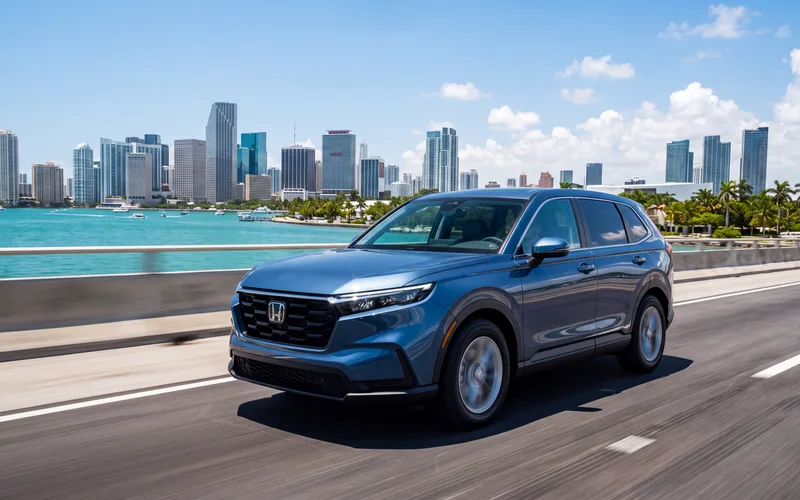 Honda CR-VCompact SUVBetter at: Cargo space
If your reason for an SUV is carrying things, the CR-V's ~39 cu ft behind the rear seat and smoother hybrid make the Forester's 27.5 cu ft hard to justify.
Compare 2.56C+
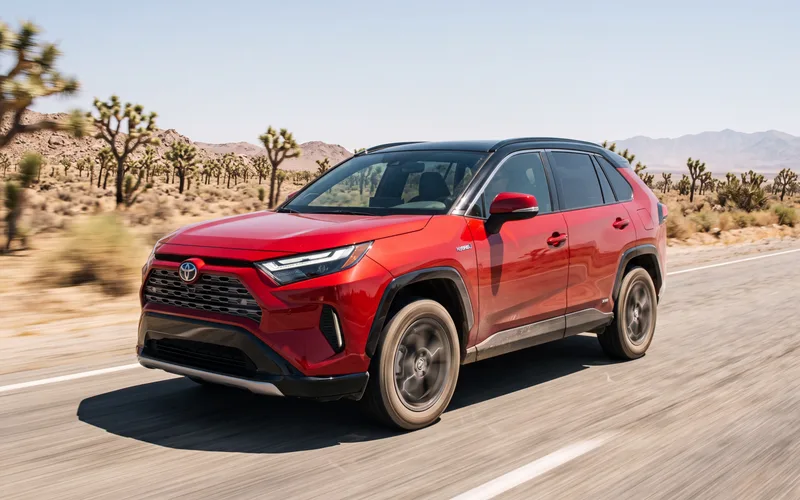 Toyota RAV4Compact SUVBetter at: Efficiency
Better fuel economy across the hybrid lineup, stronger resale value, and two years of included maintenance the Forester doesn't offer.
Compare 2.40C+
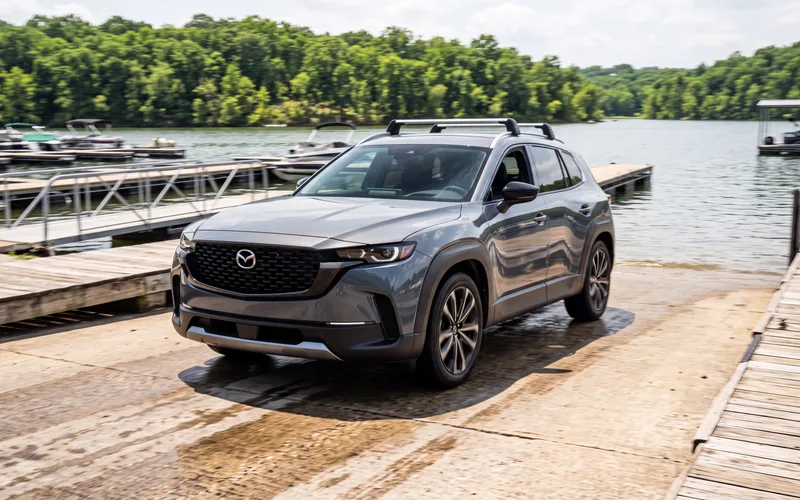 Mazda CX-50Compact SUVBetter at: Driving feel
Standard AWD like the Subaru, but with a turbo option, a 3,500-lb tow rating, and a chassis that rewards a good back road.
CompareHow it's evolved
10 scored model years · 2017–2026
Subject scores by year
Hover or tap a score to see what moved it versus the year before. A corner mark flags a big swing.
| Year | Performance | Efficiency | Safety | Space | Cost | Reliability | Tech | Use-case | Driving | Value |
|---|---|---|---|---|---|---|---|---|---|---|
| 2026 | 33 | 73 | 84 | 53 | 62 | 69 | 60 | 69 | 62 | 73 |
| 2025 | 38 | 72 | 79 | 51 | 59 | 71 | 58 | 69 | 65 | 75 |
| 2024 | 33 | 72 | 76 | 50 | 68 | 74 | 44 | 67 | 62 | 67 |
| 2023 | 33 | 72 | 76 | 50 | 69 | 74 | 44 | 67 | 62 | 69 |
| 2022 | 30 | 72 | 81 | 51 | 72 | 70 | 36 | 60 | 53 | 67 |
| 2021 | 28 | 72 | 79 | 53 | 63 | 72 | 40 | 61 | 59 | 66 |
| 2020 | 29 | 72 | 77 | 55 | 70 | 65 | 33 | 62 | 59 | 68 |
| 2019 | 28 | 72 | 72 | 55 | 70 | 56 | 35 | 62 | 57 | 72 |
| 2018 | 29 | 66 | 61 | 52 | 69 | 48 | 27 | 56 | 55 | 63 |
| 2017 | 30 | 66 | 66 | 53 | 68 | 52 | 25 | 55 | 60 | 66 |
Compare two years
Best fit & conditions
Higher scores mean a better fit for that use case. Learn more about use-case fit →
Subject profile
Trims & configurations
6 trimsScores above reflect the volume trim. Per-trim specs and scores are rolling out — the full lineup:
Academic Probation · NHTSA safety recalls
Jul 7, 2026Equipment: other: labelsThese vehicles were manufactured with an incorrect Gross Axle Weight Rating (GAWR) on the certification label. As such, these vehicles fail to comply with the requirements of Federal Motor Vehicle Safety Standard (FMVSS) 110, "Tire selection and rims."
Defect
Subaru of America, Inc. (Subaru) is recalling certain 2026 Crosstrek Hybrid, 2025-2026 Forester Hybrid, Forester, and 2019-2026 Ascent vehicles. These vehicles were manufactured with an incorrect Gross Axle Weight Rating (GAWR) on the certification label. As such, these vehicles fail to comply with the requirements of Federal Motor Vehicle Safety Standard (FMVSS) 110, "Tire selection and rims."
Risk
An incorrect GAWR label may lead to an overloaded vehicle, increasing the risk of a crash.
Remedy
Subaru will mail a new certification label to owners, free of charge. Owners may also choose to have a dealer install the new label, free of charge. Letters informing owners of the safety risk were mailed August 27, 2026. Additional letters will be mailed once the remedy is available. Owners may contact Subaru customer service at 1-844-373-6614. Subaru's number for this recall is WRH-26.
NHTSA campaign 26V436000 ↗Manufacturer no. WRH-26541,237 vehicles potentially affected (all models in the campaign)Filed by Subaru of America, Inc.Filed as FORESTER, FORESTER HYBRIDMay 28, 2026Visibility: sun/moon roof assemblyThe sliding glass panel of the power moonroof assembly may have been improperly bonded to the sliding frame, allowing the glass panel to detach from the vehicle.
Defect
Subaru of America, Inc. (Subaru) is recalling certain 2026 Forester and Forester Hybrid vehicles. The sliding glass panel of the power moonroof assembly may have been improperly bonded to the sliding frame, allowing the glass panel to detach from the vehicle.
Risk
A detached glass panel may become a road hazard, increasing the risk of a crash.
Remedy
Dealers will inspect the power moonroof glass panel for proper adhesion and, if necessary, replace the glass panel assembly, free of charge. Owner notification letters were mailed July 6, 2026. Owners may contact Subaru customer service at 1-844-373-6614. Subaru's number for this recall is WRF-26. Vehicle Identification Numbers (VINs) involved in this recall became searchable on NHTSA.gov beginning May 29, 2026.
NHTSA campaign 26V346000 ↗Manufacturer no. WRF-2669,663 vehicles potentially affected (all models in the campaign)Owners notified Jul 6, 2026Filed by Subaru of America, Inc.Filed as FORESTER, FORESTER HYBRIDDec 18, 2025Structure: body: hatchback/liftgate: hinge and attachmentsThese vehicles may have been manufactured with an incorrect and/or incorrectly oriented rear hatch support bracket which can detach without prior warning.
Defect
Subaru of America, Inc. (Subaru) is recalling certain 2026 Forester vehicles. These vehicles may have been manufactured with an incorrect and/or incorrectly oriented rear hatch support bracket which can detach without prior warning.
Risk
A rear hatch support bracket that detaches can allow the rear hatch to fall unexpectedly during use and increase the risk of injury.
Remedy
Dealers will inspect the rear hatch support brackets and, if necessary, replace the stay and support bracket, free of charge. Owner notification letters were mailed January 29, 2026. Owners may contact Subaru customer service at 1-844-373-6614. Subaru's number for this recall is WRG-25. Vehicle Identification Numbers (VINs) involved in this recall became searchable on NHTSA.gov on December 20, 2025.
NHTSA campaign 25V889000 ↗Manufacturer no. WRG-255,603 vehicles potentially affected (all models in the campaign)Owners notified Jan 29, 2026Filed by Subaru of America, Inc.Filed as FORESTER
12 recalls on other model years of the Forester (2017–2019, 2022–2025)
Feb 23, 2026Fuel system, gasoline: storage: tank assembly: filler pipe and capWhen the fuel tank is near full capacity, an increase in ambient temperature may cause the fuel to expand and spill out of the filler neck due to an insufficient seal on the fuel cap.
Defect
Subaru of America, Inc. is recalling certain 2026 Crosstrek hybrid, and 2025 Forester hybrid vehicles. When the fuel tank is near full capacity, an increase in ambient temperature may cause the fuel to expand and spill out of the filler neck due to an insufficient seal on the fuel cap.
Risk
A fuel leak in the presence of an ignition source increases the risk of a fire.
Remedy
Owners are advised to park outside and away from structures, and to limit the fuel level to 50% until the remedy is completed. Dealers will replace the fuel filler cap gasket, free of charge. Owner notification letters were mailed March 25, 2026. Owners may contact Subaru customer service at 1-844-373-6614. Subaru's number for this recall is WRD-26. Vehicle Identification Numbers (VINs) involved in this recall became searchable on NHTSA.gov on February 16, 2026.
NHTSA campaign 26V106000 ↗Manufacturer no. WRD-2669,870 vehicles potentially affected (all models in the campaign)Owners notified Mar 25, 2026Filed by Subaru of America, Inc.Filed as FORESTER HYBRIDJun 19, 2025Child seatThe child seat anchor bolts may have been improperly tightened, allowing the bolts to come loose.
Defect
Subaru of America, Inc. (Subaru) is recalling certain 2025 Forester vehicles. The child seat anchor bolts may have been improperly tightened, allowing the bolts to come loose.
Risk
A loose child seat anchor bolt increases the risk of injury to a child during a crash.
Remedy
Dealers will inspect the child seat anchor bolts and, if necessary, tighten the bolts, free of charge. Owner notification letters are expected to be mailed August 15, 2025. Owners may contact Subaru customer service at 1-844-373-6614. Subaru's number for this recall is WRC-25.
NHTSA campaign 25V419000 ↗Manufacturer no. WRC-252,938 vehicles potentially affected (all models in the campaign)Owners notified Jul 17, 2025Filed by Subaru of America, Inc.Filed as FORESTERJan 23, 2025WheelsThe wheels may have been manufactured with an incorrectly specified lug seat surface, which can result in the wheel being improperly attached and cause a loss of vehicle stability.
Defect
Subaru of America, Inc. (Subaru) is recalling certain 2025 Forester vehicles equipped with 18" aluminum alloy wheels. The wheels may have been manufactured with an incorrectly specified lug seat surface, which can result in the wheel being improperly attached and cause a loss of vehicle stability.
Risk
A loss of vehicle stability increases the risk of a crash.
Remedy
Dealers will inspect and replace the wheels, as necessary, free of charge. Owner notification letters were mailed February 28, 2025. Owners may contact Subaru customer service at 1-844-373-6614. Subaru's number for this recall is WRB-25.
NHTSA campaign 25V033000 ↗Manufacturer no. WRB-2520,366 vehicles potentially affected (all models in the campaign)Owners notified Feb 28, 2025Filed by Subaru of America, Inc.Filed as FORESTERNov 9, 2023Power train: automatic transmission: park/neutral start interlock switchAn insufficient weld may allow water to enter the inhibitor switch, causing it to fail.
Defect
Subaru of America, Inc. is recalling certain model year 2021 Crosstrek, 2022 Forester, 2021-2023 Legacy, and Outback vehicles. An insufficient weld may allow water to enter the inhibitor switch, causing it to fail.
Risk
An inoperative inhibitor switch may prevent the reverse lights from illuminating and the rearview camera image from displaying, increasing the risk of a crash.
Remedy
Dealers will replace the inhibitor switch, free of charge. Owner notification letters were mailed January 8, 2024. Owners may contact Subaru customer service at 1-800-782-2783. Subaru's number for this recall is WRQ-23.
NHTSA campaign 23V755000 ↗Manufacturer no. WRQ-2395,830 vehicles potentially affected (all models in the campaign)Owners notified Jan 8, 2024Filed by Subaru of America, Inc.Filed as FORESTERNov 9, 2023Power train: driveline: driveshaftThe front driveshaft assemblies' outer race may develop cracks and break.
Defect
Subaru of America, Inc. (Subaru) is recalling certain 2024 Crosstrek, Impreza, 2023-2024 Forester, and 2023 WRX vehicles. The front driveshaft assemblies' outer race may develop cracks and break.
Risk
A broken driveshaft can cause a loss of drive power while driving or vehicle rollaway when the vehicle is in park without the parking brake engaged. Either of these scenarios can increase the risk of a crash.
Remedy
Dealers will inspect and replace the left and right front driveshafts as necessary, free of charge. Owner notification letters were mailed January 8, 2024. Owners may contact Subaru's customer service at 1-844-373-6614. Subaru's number for this recall is WRP-23.
NHTSA campaign 23V754000 ↗Manufacturer no. WRP-234,701 vehicles potentially affected (all models in the campaign)Owners notified Jan 8, 2024Filed by Subaru of America, Inc.Filed as FORESTEROct 26, 2023Engine and engine coolingThe engine water pipe may have loose attachment bolts, allowing the pipe to lose its seal and leak coolant.
Defect
Subaru of America, Inc. (Subaru) is recalling certain 2024 Forester vehicles. The engine water pipe may have loose attachment bolts, allowing the pipe to lose its seal and leak coolant.
Risk
Leaking coolant can contact a hot exhaust pipe, increasing the risk of a fire.
Remedy
SubaruÂs independent distributor processing facilities will tighten the water pipe attachment bolts. The affected vehicles have not been delivered to dealers or sold to owners and therefore, no owner notification letters will be sent. Owners may contact Subaru's customer service at 1-844-373-6614. Subaru's number for this recall is WRO-23.
NHTSA campaign 23V723000 ↗Manufacturer no. WRO-2349 vehicles potentially affected (all models in the campaign)Owners notified Nov 22, 2023Filed by Subaru of America, Inc.Filed as FORESTERJul 29, 2021Fuel system, gasoline: delivery: fuel pumpThe low-pressure fuel pump inside the fuel tank may fail.
Defect
Subaru of America, Inc. (Subaru) is recalling certain 2019-2020 Ascent, 2018 Forester, 2018-2020 Impreza, Legacy, Outback, 2018-2019 BRZ, WRX, and Toyota 86 vehicles. The low-pressure fuel pump inside the fuel tank may fail.
Risk
Fuel pump failure can cause an engine stall while driving, increasing the risk of a crash.
Remedy
Dealers will replace the low-pressure fuel pump, free of charge. Owner notification letters were mailed September 24, 2021. Subaru and Toyota owners may call customer service at 1-844-373-6614. Subaru's number for this recall is WRG-21.
NHTSA campaign 21V587000 ↗Manufacturer no. WRG-21175,968 vehicles potentially affected (all models in the campaign)Owners notified Sep 24, 2021Filed by Subaru of America, Inc.Filed as FORESTERApr 15, 2021Suspension: rearThe rear stabilizer bracket bolts may loosen and detach.
Defect
Subaru of America, Inc. (Subaru) is recalling certain 2018-2019 Subaru Crosstrek, 2019 Crosstrek Hybrid, and 2019 Forester vehicles. The rear stabilizer bracket bolts may loosen and detach.
Risk
Missing bolts may allow the rear stabilizer bracket to shift, increasing the risk of a crash.
Remedy
Subaru will notify owners, and dealers will retorque and replace any missing bolts, free of charge. Owner notification letters were mailed May 17, 2021. Owners may contact Subaru customer service at 1-844-373-6614. Subaru's number for this recall is WRD-21.
NHTSA campaign 21V263000 ↗Manufacturer no. WRD-21408,271 vehicles potentially affected (all models in the campaign)Owners notified May 17, 2021Filed by Subaru of America, Inc.Filed as FORESTERDec 2, 2019Engine and engine cooling: exhaust system: emission control: crankcase (pcv)The aluminum Positive Crankcase Ventilation (PCV) valve can separate, allowing the separated components to enter the engine, resulting in a loss of power while driving.
Defect
Subaru of America, Inc. (Subaru) is recalling certain 2019 Crosstrek, Forester, and Ascent vehicles. The aluminum Positive Crankcase Ventilation (PCV) valve can separate, allowing the separated components to enter the engine, resulting in a loss of power while driving.
Risk
An unexpected loss of power while driving can increase the risk of a crash.
Remedy
Subaru will notify owners, and dealers will inspect and replace the PCV valve, free of charge. If the PCV valve has separated and the components cannot be found, the short block engine will be replaced, free of charge. The recall began January 31, 2020. Owners may contact Subaru customer service at 1-844-373-6614. Subaru's number for this recall is WUW-08.
NHTSA campaign 19V856000 ↗Manufacturer no. WUW-0851,613 vehicles potentially affected (all models in the campaign)Owners notified Jan 31, 2020Filed by Subaru of America, Inc.Filed as FORESTEROct 3, 2019Air bags: sensor: occupant classificationAn electrical connection in the front passenger seat for the Occupant Detection System (ODS) may loosen.
Defect
Subaru of America, Inc. (Subaru) is recalling certain 2015-2018 Forester vehicles equipped with heated seats. An electrical connection in the front passenger seat for the Occupant Detection System (ODS) may loosen.
Risk
If the connection loosens, the front passenger airbag may deactivate even though the seat is occupied, increasing the risk of injury to the front passenger in the event of a crash.
Remedy
Subaru will notify owners, and dealers will inspect and, as necessary, replace the ODS sensor mat harness, free of charge. The recall began February 11, 2020. Owners may contact Subaru customer service at 1-844-373-6614. Subaru's number for this recall is WUM-98.
NHTSA campaign 19V701000 ↗Manufacturer no. WUM-98366,282 vehicles potentially affected (all models in the campaign)Owners notified Feb 11, 2020Filed by Subaru of America, Inc.Filed as FORESTERFeb 6, 2019Steering: electric power assist systemA connector inside the Electronic Power Steering (EPS) unit may short circuit resulting in a loss of electric power steering assistance.
Defect
Subaru of America, Inc. (Subaru) is recalling certain 2019 Forester and Crosstrek vehicles. A connector inside the Electronic Power Steering (EPS) unit may short circuit resulting in a loss of electric power steering assistance.
Risk
Loss of power steering assist would require higher steering effort, increasing the risk of a crash.
Remedy
None of the affected vehicles have been sold yet. Subaru has notified dealers and they will inspect the steering gearbox, replacing it as necessary, free of charge. The recall began February 7, 2019. Owners may contact Subaru customer service at 1-844-373-6614. Subaru's number for this recall is WUC-88.
NHTSA campaign 19V065000 ↗Manufacturer no. WUC-8810,417 vehicles potentially affected (all models in the campaign)Owners notified Feb 7, 2019Filed by Subaru of America, Inc.Filed as FORESTERJul 10, 2018Equipment: other: labels · TiresThe Certification Label may indicate the incorrect wheel size, tire size, and air pressure. As such, these vehicles fail to comply with the requirements of Federal Motor Vehicle Safety Standard (FMVSS) number 110, "Tire Selection and Rims."
Defect
Subaru of America, Inc. (Subaru) is recalling certain 2018 Subaru Forester vehicles. The Certification Label may indicate the incorrect wheel size, tire size, and air pressure. As such, these vehicles fail to comply with the requirements of Federal Motor Vehicle Safety Standard (FMVSS) number 110, "Tire Selection and Rims."
Risk
Installing incorrect tires or applying incorrect tire air pressure may increase the risk of a crash.
Remedy
Subaru will notify owners, and dealers will install a corrected label, free of charge. The recall began July 26, 2018. Owners may contact Subaru customer service at 1-844-373-6614. Subaru's number for this recall is WTS-78.
NHTSA campaign 18V455000 ↗Manufacturer no. WTS-783,654 vehicles potentially affected (all models in the campaign)Owners notified Jul 26, 2018Filed by Subaru of America, Inc.Filed as FORESTER
Source: NHTSA Office of Defects Investigation recall database, model years 2017–2026. Recalls are listed by model year as the manufacturer filed them; whether a specific car is affected depends on its VIN — check a VIN at nhtsa.gov ↗. NHTSA model names matched to this page: FORESTER, FORESTER HYBRID.
Detailed scoring by subject
1Performance & PowertrainThe Forester's lowest-graded category.0.19F
Volume Premium trim uses the FB25D 2.5L naturally-aspirated boxer-four rated at 180 hp; the new-for-2026 Strong Hybrid combines the Atkinson-cycle 2.5L with electric motors for ~194 hp combined. Output is modest for a compact SUV.
Naturally-aspirated 2.5L boxer produces 178 lb-ft at a peaky 3,700 rpm — well behind turbo compact SUV rivals like Nissan Rogue's VC-Turbo (225 lb-ft) or Hyundai Tucson turbo-hybrid (258 lb-ft).
Independent instrumented tests of the new-generation Forester show roughly 8.5 seconds to 60 mph with the 2.5L/CVT — mid-pack for the segment, slower than turbo and hybrid rivals but adequate around town.
The horizontally-opposed four is smoother than a typical inline-four at idle but coarsens under load, and reviewers consistently note the CVT amplifies engine drone during hard acceleration. Around-town response is fine, but the powertrain never feels eager.
Lineartronic CVT with eight simulated ratios and paddle shifters behaves acceptably in normal driving and mimics stepped shifts, but drones under sustained acceleration and can feel hesitant during passing — a common CVT critique applied to this powertrain.
Standard Forester trims are rated to tow 1,500 lbs — well below capable compact SUVs like the CX-50 (3,500 lbs) or Bronco Sport Badlands (2,200 lbs). The Wilderness variant historically bumps the rating, but the mainstream Forester is a light-duty tow vehicle.
Symmetrical full-time AWD is standard on every Forester trim — a segment-leading position most compact SUV rivals only match by optioning up. Active torque vectoring and X-MODE add real capability.
8.7 inches of ground clearance, standard AWD, dual-function X-MODE (Snow/Dirt and Deep Snow/Mud), and Hill Descent Control make the Forester one of the more genuinely trail-capable compact crossovers — clearly a step above most FWD-based rivals though short of dedicated off-roaders like the Bronco Sport Badlands or 4Runner.
For 2026 the Forester offers two distinct powertrains — the 2.5L NA gas boxer and the all-new Subaru Strong Hybrid — but no turbo option, no plug-in hybrid, and no EV variant (the Solterra is a separate model). Mainstream coverage, but shallow versus rivals offering NA/turbo/hybrid/PHEV.
2Efficiency & RangeOne of the Forester's strongest categories.2.97B-
Volume trim is the gas Premium 2.5L CVT AWD at 29 combined MPG, unchanged from the 2025 refresh. The new Forester Hybrid raises the ceiling to roughly 35 combined but is not the volume seller in year one.
26 city MPG for the volume gas Premium AWD is midpack for a non-hybrid compact SUV; Hybrid trim lifts city to the mid-30s.
33 highway MPG is respectable for full-time symmetrical AWD; Sport/Wilderness variants drop 1–2 MPG.
16.6-gallon tank and 29 combined MPG yield roughly 480 miles of real-world range; Hybrid pushes closer to 580.
At EPA's 15k mi/yr and current regular gas assumptions, the 29-combined gas Forester runs about $1,900/yr; Hybrid drops to roughly $1,550.
All Forester powertrains — gas 2.5L and Hybrid — run on regular 87-octane unleaded; no premium, diesel, or charging infrastructure needed.
3SafetyThe Forester's best-graded category.3.73A
The redesigned 6th-generation Forester earned NHTSA's top 5-star overall rating; the 2026 carries the same platform.
Redesigned Forester earns IIHS Top Safety Pick+ with Good ratings across updated moderate overlap, small overlap, and updated side tests. Subaru historically clears the bar in every crash mode.
EyeSight (AEB, lane departure warning/prevention, lane centering, full-speed adaptive cruise) is standard on every trim, and for the redesigned Forester Blind Spot Detection with Rear Cross Traffic Alert are now standard across the entire lineup — class-leading breadth in the compact SUV segment.
EyeSight's stereo-camera AEB earns Superior/Advanced marks in IIHS front crash prevention including nighttime pedestrian detection; braking is smooth and confident in outlet reviews.
Blind Spot Detection with Lane Change Assist and Rear Cross Traffic Alert are standard on every trim for the redesigned Forester — a meaningful upgrade from prior generations where BSD was locked to Premium and above. Alert-only, no active steering intervention.
EyeSight lane centering and lane departure prevention work well on marked highways but reviewers note the system can ping-pong between lane lines and intervene more assertively than segment leaders.
Full-speed-range adaptive cruise with stop-and-go is standard and generally praised for smooth following distance management; combined with lane centering it makes for a competent highway assist, if not as polished as Honda Sensing or Toyota Safety Sense 3.0.
Subaru offers no hands-free highway system on the Forester — no equivalent to Ford BlueCruise, GM Super Cruise, or Tesla Autopilot. EyeSight remains a hands-on driver assist.
Standard LED low- and high-beam headlights with steering-responsive headlights on Premium and above; the current-generation Forester earns IIHS Good headlight ratings across most trims.
The Forester's tall, upright greenhouse, thin A-pillars, and large glass area continue to deliver among the best outward sightlines in any modern SUV — a hallmark of the model that reviewers consistently call out.
IIHS rates the Forester's LATCH ease of use as Good+ with easily accessible anchors, and wide-opening rear doors plus a boxy cabin make car-seat installation and access straightforward.
4Space & ComfortOne of the Forester's weakest categories.1.53D
Standard five-passenger, two-row layout across the entire 2026 Forester lineup — no third-row option.
Volume Premium trim carries a standard power moonroof, dropping front headroom to 39.9 in from the Base trim's 41.3 in — competitive mid-pack for the compact SUV segment.
Front legroom is a segment strength for the Forester — the 6th-gen's redesigned seat frames and tall greenhouse deliver a class-leading 43.3 in, notably more generous than the CR-V (41.3 in) or RAV4 (41.0 in).
Second-row headroom on the volume Premium trim (with standard moonroof) is 37.7 in — average for the segment; Base trims without the moonroof gain nearly two inches.
Rear legroom is the Forester's strongest passenger-space number — 39.4 in trails only the class-leading CR-V (41.0 in) and is comfortably above most subcompact and compact SUV rivals.
The Forester is a two-row-only compact SUV — no third-row seating is offered at any trim level. Buyers who need seven-passenger capability step up to the Ascent.
Cargo volume behind the second row is 27.5 cu ft — noticeably smaller than the class-leading CR-V (~39 cu ft) and Rogue (~36 cu ft), a weak point of the 6th-gen's more upright rear seatback and thicker second-row bolsters.
Maximum cargo capacity with the 60/40 rear seats folded is 74.4 cu ft — mid-pack for the compact SUV segment; the tall roofline and wide opening make the space more usable than the raw number suggests.
Competitive everyday storage — deep center console, tiered center-stack tray, large door bins, and dual glovebox on higher trims. The wide, flat cargo floor and low load-in height are practical, but there is no standout innovation (no frunk, no in-bed trunk, no giga-console).
Front seats on the 6th-gen Forester are noticeably improved over the previous generation — thicker cushions, better lateral support, and a longer thigh cushion. Rear bench is broad and supportive for two adults. Reviewers call out long-haul comfort as a segment strength.
The 6th-gen platform brings a stiffer body structure, revised suspension geometry, and standard dual-pinion electric power steering — the result is a more absorbent, better-damped ride than the outgoing model, with well-controlled body motions over broken pavement.
Subaru added laminated front-door glass, thicker underbody insulation, and additional sound-deadening for the 6th generation — cabin noise levels are noticeably lower than the previous Forester, though CVT drone under hard acceleration and some tire roar on coarse surfaces still keep it short of segment leaders like the Mazda CX-50.
Heated front seats and heated exterior mirrors are standard from the Premium trim up; heated steering wheel arrives on Sport; heated rear outboard seats and ventilated front seats are reserved for Limited and Touring. Dual-zone auto climate and rear-seat vents are standard from Premium. Rich for the segment, though key items (ventilated seats, heated wheel) don't reach the lower trims.
5Cost of OwnershipMid-pack among this car's ten categories.2.20C
Sixth-gen Forester Base trim carries over the ~$30k starting point, with destination bringing the out-the-door base to just above $31k. Hybrid entry (Premium Hybrid) sits several thousand higher but is not the base configuration.
Premium is the volume trim for Forester; typically-equipped price with destination sits in the low-$33k range. Sport and Limited variants trend up to ~$36k, hybrid Premium adds roughly $3k.
Subaru boxer engine and standard AWD carry slightly higher scheduled service costs than a Honda/Toyota compact SUV, but the Forester remains near the compact-SUV mainstream. Hybrid variant lowers brake wear but adds hybrid-battery/inverter checks.
Forester is a perennial residual leader among mainstream compact SUVs, trailing only the CR-V/RAV4 hybrid duo. New generation and expanded hybrid availability should preserve strong retention.
Subaru's standard limited warranty is 3 years / 36,000 miles — industry baseline, well behind Hyundai/Kia/Mitsubishi.
Standard powertrain coverage matches the industry floor. Federally-mandated hybrid battery coverage of 8 yr / 100,000 mi applies to the new hybrid variant but does not lift the general powertrain figure.
Subaru does not include scheduled maintenance on the Forester (unlike Toyota's ToyotaCare or BMW plans). Buyers do get 3-year roadside assistance and a 3-year Starlink Safety Plus connected-services trial with SOS/automatic collision notification — meaningful but modest against segment leaders that bundle 2 years of oil changes.
$33,500 volume-trim price minus its estimated resale value after 5 years (55% retained, or about $18,425) leaves about $15,075 in depreciation. Add the projected $5,200 in 5-year maintenance and repairs, and owning this vehicle for 5 years costs about $20,275 in total.
6Reliability & QualityGrades above the middle of the scale.2.70B-
The Forester has consistently rated Above Average in Consumer Reports predicted reliability for the outgoing generation, and JDP quality scores have been middle-of-pack. The 6th-gen (2025) redesign is still early in its lifecycle, and the new 2026 hybrid variant is Subaru's first application of Toyota's THS-II hardware — proven tech, but new integration warrants caution.
Subaru consistently lands mid-pack in Consumer Reports brand reliability rankings (typically 10th–15th) and hovers around industry average in J.D. Power VDS. Better than domestic and European rivals, behind Toyota/Lexus/Mazda leaders.
The redesigned 2025 Forester saw typical early-cycle NHTSA recalls (software/component-level, no fires or powertrain systemic issues). Subaru's TSB pattern for the current generation has been ordinary. Older Foresters had oil-consumption and CVT concerns, but the FB25 in current spec has largely resolved those.
The 2.5L FB25 boxer four is a mature engine with a solid long-term record after the earlier oil-consumption issues were addressed. The Lineartronic CVT has improved substantially and is one of the more durable CVTs on the market. The 2026 hybrid uses Toyota's THS-II — best-in-industry hybrid durability — though Subaru's implementation is first-generation.
The redesigned Forester upgraded materials over its predecessor with more soft-touch surfaces and better switchgear, but reviewers still note hard plastics in lower-touch areas. Competitive for the segment and price, not class-leading — CR-V and Tucson feel a bit richer, RAV4 comparable.
Subaru's Lafayette, Indiana assembly plant has a strong initial-quality reputation, and panel gaps and interior assembly on the current Forester are consistent. Isolated rattle complaints exist for the redesign but nothing systemic.
Subaru operates roughly 630 US dealerships — adequate but noticeably sparser than Toyota, Honda, Ford, or Chevrolet, and weaker in the Sun Belt and Plains states than in the Northeast, Pacific Northwest, and Colorado. Service satisfaction is generally solid and Subaru scores respectably in JDP CSI.
RepairPal typically pegs Subaru annual maintenance costs near the industry average (~$600/yr). Boxer engines and AWD driveline carry some unique parts pricing versus a Camry/Accord, but common wear items are widely stocked. Aftermarket support is healthy given Subaru's enthusiast base.
7Technology & InfotainmentOne of the Forester's weakest categories.2.04C
The 6th-gen Forester (carryover into 2026) uses an 11.6-inch portrait tablet-style touchscreen from Premium up; the Base trim retains the legacy dual 7-inch layout.
STARLINK on the 11.6-inch tablet layout looks modern but reviewers consistently flag laggy inputs, small climate touch targets, and menu depth for common tasks; physical volume and tuning knobs help.
Wireless Apple CarPlay and Android Auto are standard on every trim equipped with the 11.6-inch screen (Premium and above); the Base trim's dual-screen setup is wired only.
Native voice recognition remains basic, most owners fall back to CarPlay/Google. TomTom-based embedded navigation is bundled only on the Touring trim; other trims rely on phone projection.
Base six-speaker system is unremarkable, but an available Harman Kardon 11-speaker premium system on Limited/Touring is a genuine step up and competitive with class rivals.
Most trims keep analog dials flanking a small color multi-info display; a larger 12.3-inch color driver display arrives only on the Touring trim and is less configurable than segment leaders.
Subaru delivers over-the-air updates to the STARLINK infotainment and TomTom map data, but not full-vehicle software or feature-adding updates like Tesla/Ford/Hyundai deliver.
MySubaru / STARLINK app covers remote start, climate preconditioning, lock/unlock, vehicle locator, and stolen-vehicle recovery, but the useful remote features live behind the Safety Plus / Security Plus subscription after the trial period; no digital key.
Two front USB-C data ports plus two rear USB-C charging ports, and wireless phone charging is standard from Premium up. No 120V household outlet, but port coverage across both rows is competitive for the class.
Keyless proximity entry with push-button start is standard on every trim except Base; STARLINK app-based remote start is included in the connected-services trial. No phone-as-key.
Standard rear camera on all trims, front-view monitor added with the redesign, and a 360-degree surround-view camera plus front/rear parking sensors with reverse automatic braking are available on Limited and standard on Touring — a meaningful step up over the outgoing Forester.
Subaru does not offer a head-up display on the Forester at any trim level for 2026.
8Use-Case FitMid-pack among this car's ten categories.2.68C+
Wide-opening rear doors, an upright greenhouse with class-leading visibility, and IIHS Good+ LATCH ease-of-use make car-seat installation straightforward, and 39.4 in of rear legroom easily fits rear-facing seats. The only wart is 27.5 cu ft of cargo behind row 2 — below CR-V/Rogue, so a big stroller-plus-groceries load starts to feel tight.
Genuinely class-leading on the trims families actually buy: IIHS Top Safety Pick+, NHTSA 5-star overall, and EyeSight (AEB, adaptive cruise, lane centering) plus Blind Spot Detection and Rear Cross Traffic Alert are standard on every trim including Base — no need to option up to Premium/Limited to get the important gear.
Redesigned front seats, generous rear legroom, standard rear vents (Premium+), rear USB-C, and a compliant ride make it a comfortable four-up tourer. Held back by 27.5 cu ft cargo behind row 2 (a squeeze for family luggage), no rear-seat entertainment option, and heated rear seats reserved for Limited/Touring.
Segment-best outward visibility, standard full-speed adaptive cruise with lane centering, a smooth CVT at low speeds, and a well-damped ride add up to a relaxing daily driver. CVT drone under harder acceleration and the absence of any hands-free highway assist keep it short of a class-leader.
Volume gas Premium AWD returns 29 combined MPG and roughly $1,900/yr in fuel on regular unleaded — average for a compact AWD SUV, better than the 5th-gen but well behind CR-V/RAV4 hybrids. The new Forester Hybrid moves the needle (~35 MPG combined) but adds several thousand dollars up front.
Compact-SUV footprint, tall greenhouse with thin A-pillars, and a standard rear camera make it exceptionally easy to place in tight spaces — one of the segment's genuine visibility strengths. Surround-view camera and front sonar arrive on Limited/Touring; a 38.2 ft turning circle is competitive but not standout.
1,500 lb standard tow rating and 180 hp naturally-aspirated engine limit real work duty to a small utility trailer or pair of jet skis. Cargo volume is usable but the unibody chassis, modest payload, and no bed leave it well behind pickup or body-on-frame alternatives. The Wilderness variant lifts tow to 3,000 lbs but isn't the volume config.
The FB25 boxer and Lineartronic CVT are mature and reliable in normal duty, and standard symmetrical AWD helps on rough surfaces. The interior is car-oriented rather than wipe-clean, and the vehicle has no fleet-work reputation the way a Tacoma or Transit Connect does — should hold up fine with light use, unproven under abuse.
Cargo tie-down hooks and roof rails (standard on Premium+) plus a healthy Subaru accessory catalog (crossbars, hitches, cargo trays) provide the basics, but there is no 120V household outlet, no factory upfit program, and no wipe-clean vinyl seat option — you can bolt on aftermarket work solutions, but the vehicle isn't provisioned for them from the factory.
Roughly 480 mi highway range on gas (580 mi on Hybrid), redesigned supportive front seats, materially improved NVH, and standard adaptive cruise with lane centering make it a capable mile-eater. Still trails class-best tourers on cabin quietness under coarse-surface tire roar and offers no hands-free highway assist.
Standard Symmetrical AWD on every trim, 8.7 in of ground clearance, dual-mode X-MODE (Snow/Dirt and Deep Snow/Mud), Hill Descent Control, and standard roof rails (Premium+) make it one of the most genuinely adventure-ready compact crossovers on sale — a segment strength Subaru owns. Only the 1,500 lb tow rating limits toy-hauling ambitions.
60/40 folding rear seats, wide low-liftover cargo opening, standard roof rails on Premium and above, and 74.4 cu ft max cargo make it competent for gear-hauling — but 27.5 cu ft behind row 2 trails CR-V/Rogue by ~10 cu ft, no underfloor storage of note, and hitch is dealer-installed rather than factory-standard.
9Driving ExperienceMid-pack among this car's ten categories.2.18C
The 2025+ redesign (carried into 2026) added chassis rigidity and retuned dampers, so body control improved over the prior gen — but reviewers uniformly describe cornering as secure and confidence-inspiring rather than sharp. Sits below Honda CR-V (70.4) and VW Tiguan (70.9) and roughly in line with Toyota RAV4 (64) and Mazda CX-5 (63.3). Sport trim is a visual package, not a dynamic one.
Dual-pinion EPS is accurate and appropriately weighted for parking, but reviewers note it filters out most road texture — typical Subaru electric rack. Precise enough to place, numb on-center at highway speeds.
Larger front discs and a firmer pedal on the redesign yield linear, easily modulated braking. Instrumented 60–0 stops in the ~120 ft range are class-average with no fade issues in reviews. Hybrid regen blend is smoother than typical for a Toyota-derived series-parallel setup.
The volume 2.5L FB25 boxer with Lineartronic CVT is adequate but shows the CVT's rubber-band feel at part throttle and slow tip-in from rest. Auto stop/start is smooth. The 2026-new hybrid (Toyota-derived series-parallel with eCVT) is noticeably smoother but not yet the volume trim.
The boxer-plus-CVT combination continues to drone under hard acceleration despite added sound deadening — a long-standing Forester weakness. Cruise refinement is fine; hard merges are coarse. Hybrid is quieter but again not the volume trim.
Subaru USA's spec sheet for the sixth-generation Forester lists a 36.7 ft curb-to-curb minimum turning diameter — mid-pack for a compact SUV. Working from memory of the published spec; live web search was unavailable this run.
One of the Forester's genuine strengths: tall, upright seating with a large greenhouse gives class-leading forward and quarter sightlines; low beltline and thin A-pillars aid outward vision. Broad seat travel and telescope range accommodate a wide range of drivers; ingress/egress is easy, and the redesigned interior retained physical HVAC knobs alongside the portrait touchscreen.
Competent, safe, and utilitarian — no aspect of the modern Forester's tuning targets enthusiasts, and the CVT plus modest 180 hp muffles character. Sport trim is cosmetic (the turbocharged XT is long gone). Enjoyable off-pavement thanks to X-MODE and 8.7 in of ground clearance, but this item asks about on-road enjoyment.
10Value & Market PositionOne of the Forester's strongest categories.2.95B-
Every Forester includes standard symmetrical AWD, the EyeSight driver-assist suite (adaptive cruise, lane centering, auto emergency braking), and the 11.6-inch portrait touchscreen with wireless Apple CarPlay/Android Auto from Premium up. That standard-AWD + standard-ADAS bundle is more generous than most base compact-SUV rivals that charge $1.5–2k extra for AWD.
Base Forester lands around $30k with standard AWD and full ADAS — solid content-for-price versus a front-drive RAV4 LE or CR-V LX at similar money. The lineup tops out in the mid-$40s for Touring Hybrid, which puts it above CR-V Hybrid Sport Touring pricing and blunts the top-trim value case.
For 2026 the Forester spans Base, Premium, Sport, Limited, and Touring on the gas 2.5L, plus a parallel Hybrid line (Premium/Sport/Limited/Touring) added this year — one of the broader compact-SUV lineups on sale, with clear price steps and both powertrain choices under one roof.
Forester is consistently Subaru's #2 US seller behind Crosstrek and reliably places in the compact-SUV top 8–10 at roughly 150–170k units annually — well behind volume leaders RAV4/CR-V but comfortably ahead of Escape/Tiguan and a core Subaru volume model.
Subaru enjoys unusually strong brand loyalty and a distinct outdoor/family/safety image that lifts the Forester's desirability above its raw feature sheet. Not aspirational like a luxury badge, but well above neutral for a mainstream brand.
Subaru is historically among the lowest-incentive mainstream brands — Forester typically transacts near MSRP with modest lease support and little cash-on-hood, so buyers see fewer deals than on Rogue or Escape but rarely pay over sticker either.
The 6th-generation Forester launched for the 2025 model year with a redesigned body, revised platform, and all-new interior, and 2026 adds an all-new Forester Hybrid using Toyota-derived hybrid tech — a two-year-old generation that just expanded its powertrain lineup, with essentially no redesign risk.
Reviews of the current-gen Forester (Car and Driver, MotorTrend, Edmunds) praise visibility, standard safety, ride comfort, and light off-pavement capability but consistently ding tepid 2.5L acceleration and only average infotainment responsiveness; it earns IIHS Top Safety Pick+ but rarely tops CR-V/CX-5 in comparison tests. The 2026 Hybrid should soften the drivetrain critique.