
The verdict
A mixed-report luxury wagon, strong on space and held back by efficiency.
The 2025 V90 Cross Country is the last of a dying breed — a big, lifted, Swedish luxury wagon with 25.5 cu ft of cargo space behind the second row, 7.9 inches of ground clearance, standard all-wheel drive and some of the best front seats in the business, all for $60,995 delivered. It is a superb long-distance tourer and a genuinely practical family car, and it undercuts an Audi A6 allroad by roughly $10,700. The catch is running cost and confidence: 25 MPG combined on required premium fuel works out to $3,050 a year, there is no separate powertrain warranty past 4 years/50,000 miles, and Volvo placed second-worst of 28 brands in J.D. Power's 2026 dependability study. Buy it because you want this specific car — and negotiate hard, because 2025 was its final model year worldwide.
Jump to scoresStrengths
- Cargo space and load-bay practicality that no crossover matches
- One of the best road-trip cars at any price
- The whole safety suite is standard, not an options walk
What holds it back
- Fuel costs like a full-size SUV
- Volvo's dependability record is the worst it has been in years
- Priced as a flagship, warranted like a mainstream car
Top alternatives
Cars shoppers cross-shop with the Volvo V90 Cross Country 2.70B-
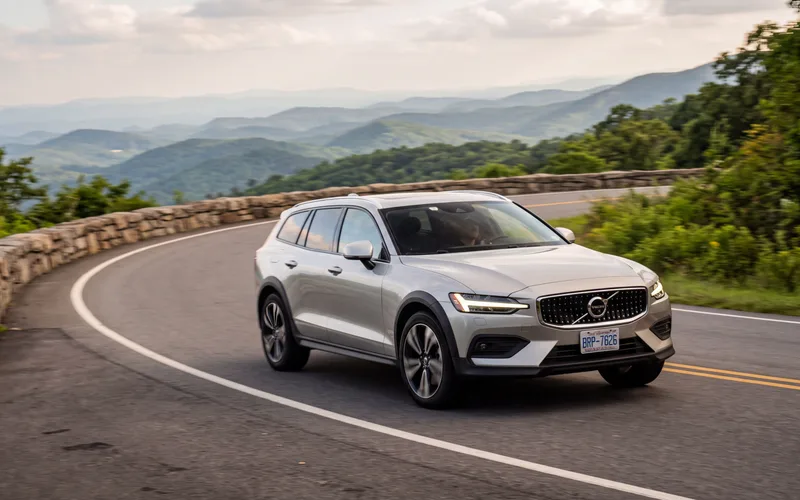 Volvo V60 Cross CountryLuxury WagonBetter at: Value for money
Nearly the same car and experience in a smaller, cheaper, more efficient package — the obvious first cross-shop for anyone who liked the V90 but balked at the price or the fuel bill.
Compare 2.41C+
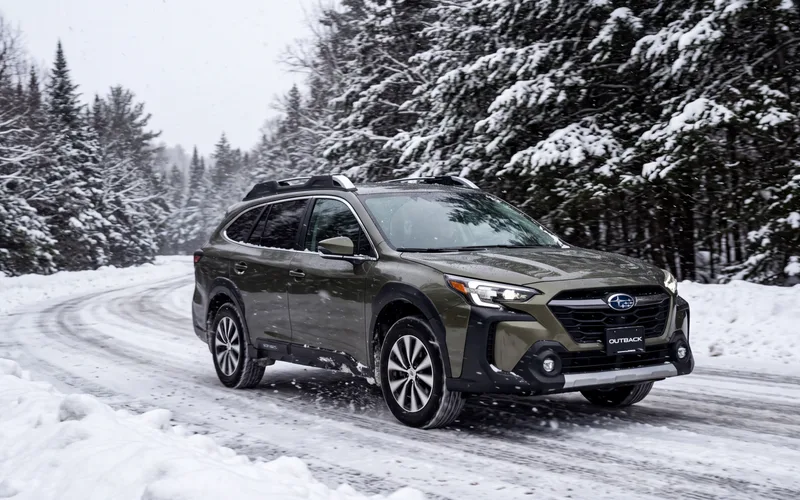 Subaru OutbackWagonBetter at: Running costs
Delivers the same lifted-wagon formula with more rear legroom, better fuel economy on regular gas and a longer powertrain warranty for roughly half the money.
Compare 2.82B-
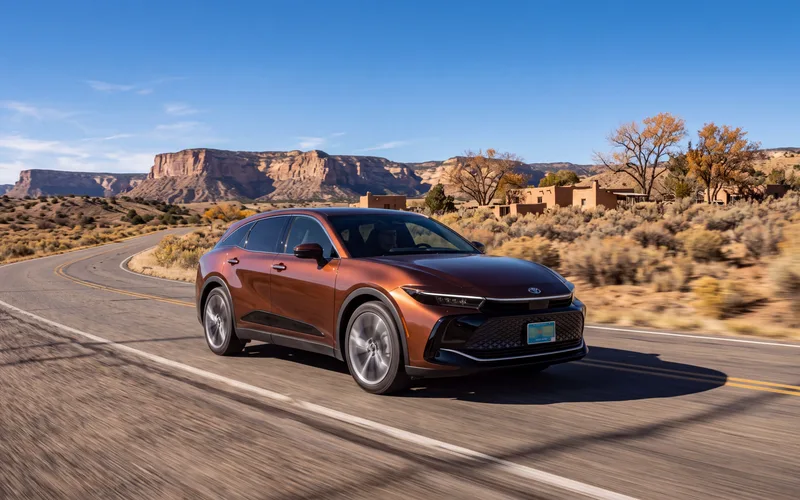 Toyota Crown SigniaMid-Size WagonBetter at: Efficiency
A 39-MPG hybrid with Toyota's dependability record, for buyers who want the wagon shape without Volvo's premium-fuel bill or reliability question marks.
CompareHow it's evolved
9 scored model years · 2017–2025
Subject scores by year
Hover or tap a score to see what moved it versus the year before. A corner mark flags a big swing.
| Year | Performance | Efficiency | Safety | Space | Cost | Reliability | Tech | Use-case | Driving | Value |
|---|---|---|---|---|---|---|---|---|---|---|
| 2025 | 57 | 25 | 72 | 79 | 40 | 57 | 72 | 68 | 70 | 59 |
| 2024 | 57 | 25 | 72 | 79 | 40 | 68 | 71 | 67 | 71 | 62 |
| 2023 | 57 | 25 | 75 | 80 | 41 | 63 | 70 | 68 | 70 | 64 |
| 2022 | 56 | 25 | 76 | 78 | 41 | 57 | 72 | 67 | 66 | 55 |
| 2021 | 55 | 20 | 76 | 78 | 38 | 55 | 61 | 66 | 64 | 59 |
| 2020 | 57 | 20 | 73 | 74 | 36 | 52 | 58 | 61 | 58 | 61 |
| 2019 | 56 | 24 | 75 | 74 | 40 | 51 | 58 | 66 | 61 | 62 |
| 2018 | 56 | 28 | 73 | 70 | 39 | 60 | 58 | 64 | 61 | 64 |
| 2017 | 56 | 24 | 72 | 76 | 45 | 61 | 55 | 66 | 59 | 64 |
Compare two years
Best fit & conditions
Higher scores mean a better fit for that use case. Learn more about use-case fit →
Subject profile
Academic Probation · NHTSA safety recalls
Dec 23, 2025Back over prevention: softwareThe rearview camera image may not display when the vehicle is placed in reverse. As such, these vehicles fail to comply with the requirements of Federal Motor Vehicle Safety Standard number 111, "Rear Visibility."
Defect
Volvo Car USA, LLC (Volvo Car) is recalling certain 2021-2025 XC40, 2022 V90, 2022-2024 C40BEV, 2022-2025 S90, V90CC, XC60, 2023-2025 S60, V60, V60CC, XC90, and 2025 EC40, and EX40 vehicles. The rearview camera image may not display when the vehicle is placed in reverse. As such, these vehicles fail to comply with the requirements of Federal Motor Vehicle Safety Standard number 111, "Rear Visibility."
Risk
A rearview camera image that does not display reduces the driver's view behind the vehicle, increasing the risk of a crash.
Remedy
The software will be updated by a dealer or through an over-the-air (OTA) update, free of charge. Owner notification letters were mailed February 24, 2026. Owners may contact Volvo Carâs customer service at 1-800-458-1552. Volvo Car's number for this recall is R10333. Vehicle Identification Numbers (VINs) involved in this recall will be searchable on NHTSA.gov beginning February 16, 2026. This recall replaces previous NHTSA recall number 25V282. Vehicles previously repaired under recall 25V282 will need to have the new remedy performed.
NHTSA campaign 25V908000 ↗Manufacturer no. R10333413,151 vehicles potentially affected (all models in the campaign)Owners notified Mar 2, 2026Filed by Volvo Car USA, LLCFiled as V90, V90CCMay 8, 2025Back over prevention: softwareThe rearview camera image may not display when the vehicle is placed in reverse. As such, these vehicles fail to comply with the requirements of Federal Motor Vehicle Safety Standard number 111, "Rear Visibility."
Defect
Volvo Car USA, LLC (Volvo Car) is recalling certain 2021-2025 XC40, 2022 V90, 2022-2025 S90, V90CC, C40, XC60, 2023-2025 S60, V60, V60CC, XC90, and 2025 EC40 and EX40 vehicles. The rearview camera image may not display when the vehicle is placed in reverse. As such, these vehicles fail to comply with the requirements of Federal Motor Vehicle Safety Standard number 111, "Rear Visibility."
Risk
A rearview camera image that does not display reduces the driver's view of what is behind the vehicle, increasing the risk of a crash.
Remedy
The software will be updated by a dealer or through an over-the-air (OTA) update, free of charge. Owner notification letters were mailed June 27, 2025. Owners may contact Volvo Car customer service at 1-800-458-1552. Volvo Car's number for this recall is R10320.
NHTSA campaign 25V282000 ↗Manufacturer no. R10320413,151 vehicles potentially affected (all models in the campaign)Owners notified Jun 27, 2025Filed by Volvo Car USA, LLCFiled as V90, V90CC
8 recalls on other model years of the V90 Cross Country (2017–2023)
Mar 24, 2025Electrical system: propulsion system: traction battery · Electrical system: softwareThe high-voltage battery may experience a short circuit within the battery module when the battery is fully charged and the vehicle is parked.
Defect
Volvo Car USA, LLC (Volvo Car) is recalling certain 2020-2021 S90, 2020-2022 S60, V60, XC60, XC90, and 2022 V90 plug-in hybrid vehicles. The high-voltage battery may experience a short circuit within the battery module when the battery is fully charged and the vehicle is parked.
Risk
A short circuit in a high-voltage battery increases the risk of a fire.
Remedy
Owners are advised not to charge their vehicles until the remedy has been completed. Dealers will inspect and replace the high-voltage battery module as necessary. In addition, dealers will update the software to monitor the battery. All repairs will be performed free of charge. Owner notification letters were mailed May 28, 2025. Owners may contact Volvo Car's customer service at 1-800-458-1552. Volvo Car's number for this recall is R10312.
NHTSA campaign 25V179000 ↗Manufacturer no. R103127,483 vehicles potentially affected (all models in the campaign)Owners notified May 14, 2025Filed by Volvo Car USA, LLCFiled as V90Jan 19, 2023Service brakes, hydraulicA diagnostic error in the Brake Control Module 2 (BCM2) may cause a loss of Antilock Brake System (ABS), Electronic Stability Control (ESC), and traction control.
Defect
Volvo Car USA, LLC (Volvo Car) is recalling certain 2023 S60, V60, V60CC, V90CC, XC60, XC90, XC40, and C40 vehicles. A diagnostic error in the Brake Control Module 2 (BCM2) may cause a loss of Antilock Brake System (ABS), Electronic Stability Control (ESC), and traction control.
Risk
A reduction in brake support functions can increase the risk of a crash.
Remedy
Volvo will release an over-the-air (OTA) BCM2 software update, free of charge. Owner notification letters are expected to be mailed March 15, 2023. Owners may contact Volvo Car customer service at 1-800-458-1552. Volvo Car's number for this recall is R10217.
NHTSA campaign 23V012000 ↗Manufacturer no. R1021727,457 vehicles potentially affected (all models in the campaign)Owners notified Feb 27, 2023Filed by Volvo Car USA, LLCFiled as V90CCSep 1, 2021Seat belts · Seat belts: front: retractor · Seat belts: rear/other: retractorThe seat belt automatic locking retractors may deactivate early, which can prevent the child restraint system from securing properly. As such, these vehicles fail to comply with the requirements of Federal Motor Vehicle Safety Standard number 208, "Occupant Crash Protection."
Defect
Volvo Car USA, LLC (Volvo Car) is recalling certain 2021 XC40, XC 40 Recharge, V60CC, V90, V90CC, XC90, and 2021-2022 V60, XC60, S60 vehicles. The seat belt automatic locking retractors may deactivate early, which can prevent the child restraint system from securing properly. As such, these vehicles fail to comply with the requirements of Federal Motor Vehicle Safety Standard number 208, "Occupant Crash Protection."
Risk
An unsecured child restraint system can increase the risk of injury during a crash.
Remedy
Dealers will inspect and replace the seat belt assemblies, as necessary, free of charge. Owner notification letters were mailed October 13, 2021. Owners may contact Volvo Car customer service at 1-888-458-1552. Volvo Car's number for this recall is R10111.
NHTSA campaign 21V682000 ↗Manufacturer no. R1011119,149 vehicles potentially affected (all models in the campaign)Owners notified Oct 12, 2021Filed by Volvo Car USA, LLCFiled as V90, V90CCJun 2, 2021Electrical system: wiring: fuses and circuit breakers · Fuel system, gasoline: delivery: fuel pumpThe low-pressure fuel pump can blow a fuse and fail.
Defect
Volvo Car USA, LLC (Volvo Car) is recalling certain 2019-2020 V90, XC60, S60, V60, V60CC, S90, V90CC, S90L, and XC90 vehicles. The low-pressure fuel pump can blow a fuse and fail.
Risk
Failure of the low-pressure fuel pump can cause a stall, increasing the risk of a crash.
Remedy
Dealers will replace the fuse, free of charge. Owner notification letters were mailed July 2, 2021. Owners may contact Volvo Car customer service at 1-888-458-1552. Volvo Car's number for this recall is R10100.
NHTSA campaign 21V414000 ↗Manufacturer no. R1010085,550 vehicles potentially affected (all models in the campaign)Owners notified Jul 2, 2021Filed by Volvo Car USA, LLCFiled as V90, V90CCJan 7, 2021Air bags · Air bags: air bag/restraint control module · Seat belts: pretensionerThe Supplementary Restraint System (SRS) control unit may not have been properly attached to the car body and may detach during a crash.
Defect
Volvo Cars USA, LLC (Volvo Car) is recalling certain 2021 Volvo V60, V60 Cross Country, V90, V90 Cross Country, XC60, and XC90 vehicles. The Supplementary Restraint System (SRS) control unit may not have been properly attached to the car body and may detach during a crash.
Risk
A detached SRS control unit can decrease the performance of occupant protection systems such as air bags, seat belts, and high voltage battery disconnect, increasing the risk of injury during a crash.
Remedy
Volvo Car will notify owners, and dealers will inspect and, as necessary, tighten the SRS control unit mounting screws, free of charge. The recall began February 12, 2021. Owners may contact Volvo Car customer service at 1-888-458-1552. Volvo Car's number for this recall is R10068.
NHTSA campaign 21V001000 ↗Manufacturer no. R100682,883 vehicles potentially affected (all models in the campaign)Owners notified Feb 15, 2021Filed by Volvo Car USA, LLCFiled as V90, V90CCMar 12, 2020Forward collision avoidance: automatic emergency braking · Forward collision avoidance: software: pedestrian/cyclist/object/obstacle/ recognitionDue to a software/hardware incompatibility, the Automatic Emergency Brake (AEB) system may not detect obstacles and engage as intended.
Defect
Volvo Cars USA LLC (Volvo Cars) is recalling certain 2019-2020 S60, V60, V60 Cross Country, S90L, V90, V90 Cross Country, XC40, XC60, and XC90 vehicles. Due to a software/hardware incompatibility, the Automatic Emergency Brake (AEB) system may not detect obstacles and engage as intended.
Risk
If the automatic emergency braking system does not engage as intended, it can increase the risk of a crash.
Remedy
Volvo will notify owners, and dealers will update the Active Safety Domain Master (ASDM) software, free of charge. The recall began April 9, 2020. Owners may contact Volvo customer service at 1-800-458-1552. Volvo's number for this recall is R29998.
NHTSA campaign 20V144000 ↗Manufacturer no. R29998121,605 vehicles potentially affected (all models in the campaign)Owners notified Apr 9, 2020Filed by Volvo Car USA LLCFiled as V90, V90CCNov 13, 2018Electrical system: softwareThe software installed in the Vehicle Connectivity Module (VCM) may have an error causing the Telematics and Driver Support Systems to function improperly. As a result, the GPS will not provide location information to emergency personnel in the event of an emergency.
Defect
Volvo Car USA LLC (Volvo) is recalling certain 2017-2019 Volvo XC90, S90, V60, V60 Cross Country, V90, XC40, XC60, and V90 Cross Country vehicles. The software installed in the Vehicle Connectivity Module (VCM) may have an error causing the Telematics and Driver Support Systems to function improperly. As a result, the GPS will not provide location information to emergency personnel in the event of an emergency.
Risk
If the GPS location is not provided to emergency personnel it can inhibit emergency response in the event of a crash or injury.
Remedy
Volvo will notify owners, and dealers will correct the software, free of charge. The recall began December 26, 2018. Owners may contact Volvo customer service at 1-800-458-1552. Volvo's number for this recall is R39917.
NHTSA campaign 18V800000 ↗Manufacturer no. R3991717,548 vehicles potentially affected (all models in the campaign)Owners notified Dec 26, 2018Filed by Volvo Car USA LLCFiled as V90, V90CCFeb 16, 2017Air bags: side/windowThe bolts that secure the Inflatable Curtain (IC) air bags in place may break, possibly resulting in the IC air bag deploying improperly in the event of a crash. As, such, these vehicles fail to comply with the requirements of Federal Motor Vehicle Safety Standard (FMVSS) number 226, "Ejection Mitigation."
Defect
Volvo Car USA LLC (Volvo) is recalling certain 2017 XC90, S90, and V90 Cross Country vehicles. The bolts that secure the Inflatable Curtain (IC) air bags in place may break, possibly resulting in the IC air bag deploying improperly in the event of a crash. As, such, these vehicles fail to comply with the requirements of Federal Motor Vehicle Safety Standard (FMVSS) number 226, "Ejection Mitigation."
Risk
If the IC air bags do not deploy properly in the event of a crash, the vehicle occupants have an increased risk of injury.
Remedy
Volvo will notify owners, and dealers will inspect and replace the bolts, as necessary, free of charge. The recall is expected to begin April 1, 2017. Owners may contact Volvo customer service at 1-800-458-1552. Volvo's number for this recall is R89714.
NHTSA campaign 17V104000 ↗Manufacturer no. R8971410,476 vehicles potentially affected (all models in the campaign)Owners notified Apr 14, 2017Filed by Volvo Car USA LLCFiled as V90CC
Source: NHTSA Office of Defects Investigation recall database, model years 2017–2025. Recalls are listed by model year as the manufacturer filed them; whether a specific car is affected depends on its VIN — check a VIN at nhtsa.gov ↗. NHTSA model names matched to this page: V90, V90CC.
Detailed scoring by subject
1Performance & PowertrainOne of the V90 Cross Country's weakest categories.1.82C-
For 2025 — the V90 Cross Country's final US model year — every car is a B6 AWD: a 2.0L inline-four that is both turbocharged and supercharged, with a 48-volt mild-hybrid integrated starter-generator, rated 295 hp. There is no lower or higher engine option, so the volume figure is also the range maximum; the optional Polestar Engineered Optimization is a software recalibration of the same engine, not a distinct powertrain.
The B6 makes 310 lb-ft, with the belt-driven supercharger filling in below the turbo's threshold and the 48-volt starter-generator adding a brief low-rpm assist — a healthy figure for a mid-size wagon and 52 lb-ft more than the smaller V60 Cross Country's B5.
Volvo claims 6.1 seconds to 60 mph for the B6 Cross Country and independent figures for the same powertrain cluster at 6.1–6.2 s, with top speed electronically limited to 112 mph. Genuinely brisk for a 4,300-lb lifted wagon, but mid-pack against the segment's quicker six-cylinder and performance wagons.
The twin-charged B6 is the most convincing version of Volvo's four-cylinder-only strategy: the belt-driven supercharger covers the bottom of the rev range so there is little of the off-boost hesitation reviewers fault in the B5 cars, and the 48-volt starter-generator makes stop/start restarts nearly imperceptible. It stops short of the top band because it is still a 2.0L four doing a six-cylinder's job in a $61k luxury wagon, and it sounds like one when extended.
The 8-speed Geartronic automatic is unobtrusive and well-matched to the B6's broad torque plateau — the 2025 road test found it 'shifts smoothly and quickly' — but Volvo's 8-speed is a known soft spot across the range for reluctant kickdowns and occasional low-speed driveline hesitation, and the fact that Volvo sells a Polestar Engineered Optimization upgrade specifically to sharpen 'throttle response, shift timing, and overall drivability' concedes that the stock calibration leaves something on the table.
All-wheel drive is standard and unavoidable — the Cross Country is sold only as a B6 AWD — and it comes with roughly eight inches of ground clearance, a dedicated Off Road drive mode (raised air-suspension ride height where fitted, lightened steering, sharpened AWD response, hill descent control below ~25 mph) and a front skid plate. It misses the top band because the hardware underneath is a front-biased on-demand clutch-pack coupling with no low range and no true torque-vectoring rear unit.
2025 is a single-powertrain, two-trim run-out year: B6 AWD mild hybrid only, no B5, no T8 plug-in hybrid Recharge (offered on the S90/XC90 and even on the UK V90, but never on the US Cross Country) and no EV alternative on this body. The 48-volt system and the optional Polestar software tune keep it off the floor, but the buyer is given no real powertrain choice, and the nameplate was cancelled outright at the end of this model year.
2Efficiency & RangeThe V90 Cross Country's lowest-graded category.0.00F
The 2025 V90 Cross Country was sold in the US only as the B6 AWD — a 2.0L twin-charged (turbo + electric supercharger) four with a 48V mild-hybrid belt-alternator-starter, rated 25 MPG combined. A mild hybrid cannot move the car on electricity, so it recovers a little braking energy and smooths stop-start but leaves a 4,300 lb AWD wagon near the bottom of the gas-wagon band (18–42), tied with the smaller V60 Cross Country (25) and behind the Outback (28).
22 MPG city is where the mild-hybrid limitation shows most: the 48V system restarts the engine and harvests some deceleration energy, but every mile is still driven by the gas engine through a full-time AWD driveline. Identical to the lighter V60 Cross Country's city rating and roughly a third short of a true hybrid wagon.
Highway is the V90 Cross Country's best EPA figure — a low wagon roofline and tall 8-speed top gears help — but 29 MPG only just clears the wagon band floor of 24, and it is 1 MPG behind the V60 Cross Country's 30 because of the bigger body's extra frontal area and mass.
EPA lists 398 miles from the 15.9-gallon (60 L) SPA-platform tank — adequate for a long day's drive but unremarkable for a car pitched as a continent-crossing tourer, and the small tank is the binding constraint rather than the economy. A Subaru Outback goes roughly 120 miles farther between stops.
This is the weakest item in the category and it is a compound problem: 25 MPG combined priced at premium rather than regular puts the EPA annual cost within $150 of the wagon band ceiling ($3,200), a running cost more typical of a full-size SUV than a mid-size wagon. Note this is EPA's own window-sticker figure — the V60 Cross Country's scorecard carries a lower derived estimate ($2,400) made without live sources, so the two are not directly comparable and that one is the figure to distrust.
EPA lists the B6 as premium gasoline REQUIRED, not merely recommended — Volvo specifies 91 AKI minimum for B4/B5/B6/T8 engines and advises 93 for full output. That is a hard cost penalty on every fill with no offsetting flexibility: no E85, no diesel, and no plug-in variant of the V90 Cross Country in the US, so there is no route to cheap home charging. It lands in the sub-49 band the guidance reserves for a premium requirement, below the V60 Cross Country's 55 (rated there as a recommendation) and well below regular-fuel rivals like the Outback. The one mitigation is that ordinary premium pump gas is universally available.
3SafetyOne of the V90 Cross Country's strongest categories.2.86B-
NHTSA has never crash-tested the V90 Cross Country. The 2025 B6 wagon exists in the SafetyRatings database, but every rating field reads "Not Rated" — only ESC, FCW and LDW are recorded as standard equipment. The 4.5★ placeholder follows this dataset's convention for untested low-volume luxury models (S90, A8, 7 Series, Panamera), and reflects that a special-order Swedish wagon never enters NCAP's tested sample rather than that it performs poorly.
Every crashworthiness result IIHS holds for this car is Good — driver- and passenger-side small overlap front — and it was a Top Safety Pick+ earlier in the generation. But the file is frozen at the old protocols and inherited from the S90 sedan: the 2025 page carries small overlap only, with no moderate overlap (original or updated), no side test (original or updated), no roof strength and no head-restraint entry, and the V90 Cross Country is absent from the 2025 award list. Top of the no-award band — genuinely sound structure, unverified against the updated tests that separate today's leaders.
Volvo's practice of making the safety suite standard rather than optional holds completely here: the volume Plus trim already carries City Safety collision warning with full autobrake (pedestrian, cyclist and large-animal detection), Pilot Assist, adaptive cruise, lane-keeping aid, oncoming-lane mitigation, rear collision mitigation, road sign information, BLIS with cross-traffic alert, and the 360-degree surround-view camera. Across the two-trim US range the only equipment gated to the upper Ultra trim is the head-up display, so nothing in the AEB/ACC/LKA/BSM/RCTA set the top band asks for costs extra.
IIHS rates the standard Collision Warning with Full Autobrake system Advanced — the middle tier — in the daytime pedestrian test, not Superior. It avoided the crossing adult at both 12 and 25 mph and the parallel adult at 25 mph, but only shaved 12 mph off the 25-mph crossing-child impact and 8 mph off the 37-mph parallel-adult run. There is no nighttime pedestrian result and no rating under the current vehicle-to-vehicle protocol, so the part of a modern AEB evaluation that most separates good systems from great ones is simply unmeasured on this car.
BLIS with steering support and cross-traffic alert with autobrake are standard on both trims, so coverage sits in the active-intervention tier rather than alert-only in both directions — the system steers back against a lane change into an occupied blind spot and brakes on its own for traffic crossing behind while reversing. No safe-exit alert for rear occupants and no trailer-aware mode, which is what keeps it out of the very top of the band.
Centering is the weak link in an otherwise strong suite, and the criticism is specific to this car rather than generic. Reviewers testing Pilot Assist in the V90 Cross Country report a persistent bias toward the right-hand side of the lane — unnerving when there is traffic alongside — and near-constant nervous steering corrections in snow, which is exactly the condition this raised, AWD wagon is bought for. It genuinely centers on well-marked highway, but it is not a system reviewers describe as trustworthy.
The adaptive-cruise half of Pilot Assist is the good half: full-speed-range with stop-and-go, standard on both trims, and operated through a single well-integrated control that combines following distance with lane centering. Marked down because reviewers report it struggling to hold a set speed through rolling terrain — a gap-and-throttle management flaw, not a missing capability — and because the following distances are conservative next to German rivals.
No hands-free capability of any kind. Pilot Assist is a hands-on system that nags and disengages if it detects no torque at the wheel, and Volvo's unsupervised-driving program is aimed at the EX90 and the next-generation SPA2 cars — it never reached the 90-series wagon, which ended production in 2025.
IIHS rates the LED reflector headlamps Acceptable, and that single rating applies to all trims across 2021–26 — there is no better lamp to buy up to, which is the usual escape hatch in this class. The pattern is markedly asymmetric: right-side visibility is good on the straightaway and through both right curves, while the left side is inadequate on the straightaway and fair-to-inadequate on the left curves. Curve-adaptive lighting and high-beam assist are standard and earn back enough credit to clear Marginal, but this sits below the segment's Good-rated norm.
The wagon body is a real advantage over the S90 sedan it shares a platform with: reviewers credit thin roof pillars, large glass and well-placed mirrors for good natural sightlines in most directions, and the raised ride height lifts the seating position. The rear three-quarter and straight-back views are the exception — restricted by a high beltline and a load-floor-height tailgate — but the 360-degree surround-view camera and front/rear park assist are standard rather than optional, so low-speed maneuvering is well covered.
Workable but not effortless, and IIHS rates it Acceptable rather than Good. The two outboard positions have complete LATCH hardware with anchors that are neither buried in the seat bight nor stiff to attach, and the center position gets a top tether only; the deduction is that it is difficult to maneuver around the anchors themselves. The long-wheelbase 90-series body's generous rear legroom is the redeeming factor for a rear-facing seat, though the rear cushion is short and set low and the center floor hump eats the middle position's foot space.
4Space & ComfortThe V90 Cross Country's best-graded category.3.36B+
The V90 Cross Country is a two-row, five-passenger wagon in every 2025 US configuration; the rear-facing jump seat of older large Volvo wagons is long gone on this SPA-generation car.
Front headroom lands mid-band for a wagon at roughly 38.0 in — the standard panoramic moonroof costs the better part of an inch versus the fixed-roof figure, and since every US car has the roof, the with-roof number is the honest one.
At 42.2 in the front row is generous and comfortably above the wagon midpoint — front-seat space is not where this car is compromised. The figure is shared with the S90 sedan on the same SPA architecture.
The wagon's flat roofline holds 38.0 in of second-row headroom, a strong showing that scores well up the wagon band and is the clearest space advantage the body style buys over the S90 sedan it shares a platform with.
35.9 in is this car's real packaging weakness and the single biggest drag on the category: a $60k full-size luxury wagon offers less rear legroom than a Subaru Outback (39.5 in) or a Crown Signia (37.4 in). The V90 keeps the standard 115.8 in wheelbase while the US-market S90 got the stretched body, so the wagon does not inherit the sedan's limousine rear seat.
25.5 cu ft behind the second row clears the top of the 10–20 cu ft wagon band outright, so the item maxes out — the long, square load bay is the whole argument for buying this instead of an S90, which manages only 13.5 cu ft.
Practicality is concentrated in the load bay rather than the cabin: underfloor compartments, grocery-bag hooks, a folding cargo-floor divider and power-folding rear seatbacks make the wagon genuinely useful, while Scandinavian minimalism keeps the front console modest. Competitive and well-executed, but nothing innovative enough for the top band — a shade ahead of the V60 Cross Country (76) on load-bay volume alone.
Volvo's front seats remain a genuine class benchmark — orthopedically shaped, extensively powered, with four-way lumbar and available massage on Ultra — and reviewers single them out for long-haul comfort. It stops short of the very top only because 35.9 in of rear legroom limits how comfortable the second row can be on a long trip.
The raised ride height, standard rear self-leveling suspension and adaptive damping make this the most absorbent car of the three Volvo wagons in this dataset — reviewers report it rides as smoothly as pricier rivals with less body roll than an SUV, and stays composed even off pavement. It is held out of the top band by the optional 21-inch wheels, which reviewers found demonstrably harsher.
A well-isolated luxury cabin with little wind noise at a cruise and a mild-hybrid four that stays hushed under light load. As with any wagon, the open cargo bay and larger glass area let more tire roar into the back of the cabin than the equivalent sedan, so it falls short of library-quiet.
Standard equipment is rich even on the base Plus: four-zone automatic climate control, heated front seats, an air purifier with remote cabin pre-cleaning, a panoramic moonroof and memory power front seats. It misses the top band because two features that ought to be standard on a $59,800 Swedish wagon — the heated steering wheel and heated rear seats — sit behind a $750 Climate Package, and ventilated front seats require the Ultra.
5Cost of OwnershipOne of the V90 Cross Country's weakest categories.0.62F
There is no cheap way into a 2025 V90 Cross Country: the single powertrain is the 295-hp B6 mild-hybrid AWD, and the entry Plus trim opens at $59,800 before a $1,195 destination charge. At $60,995 delivered it sits far above the $22,000–$55,000 wagon normalization band, so this item floors at 0.
Plus is the volume trim of a two-trim lineup, but almost no US V90 Cross Country leaves a dealer stripped — metallic paint, the Climate package and a wheel upgrade are near-universal, putting real transaction MSRP around $63,000. That is above the $24,000–$58,000 wagon band, so this item also scores 0; the car is priced as a luxury flagship wagon, not a wagon.
The strongest surprise in the category and genuinely well-sourced: two independent projections land near $3,800, low in the $2,500–$9,000 wagon band despite Volvo dealer labor rates. The reason is coverage overlap — Volvo's complimentary factory scheduled maintenance pays for the 10k/20k/30k services and the 4-year/50,000-mile warranty absorbs repairs, so out-of-pocket exposure is concentrated in year five. Treat it as an optimistic-but-corroborated figure: neither source fully prices 20-inch tires, and CarEdge puts the odds of a major repair inside five years at 33.4%.
The line that rescues this category, and the one place the V90 Cross Country beats brand expectations. Volvos generally depreciate steeply and $60k European wagons usually worse, but the Cross Country's small, committed enthusiast following holds it above mid-band on the 35–65% wagon scale — notably better than the mechanically related S90 sedan. Discontinuation of the V90 line in 2025 plausibly firms this further as the last of the breed, though that is not yet in the published forecasts.
Volvo's New Vehicle Limited Warranty runs 4 years/50,000 miles — one year longer than the mainstream 3/36 standard and level with the German luxury norm, landing exactly mid-band on the 3–5 year scale. The 50,000-mile cap, not the term, is the binding constraint for a high-mileage driver.
Volvo sells no longer standalone powertrain warranty in the US — the B6 engine, 48V mild-hybrid hardware and transmission are covered only for the same 4 years/50,000 miles as the basic warranty. Against a 5–10 year band that scores 0, and it is a real disadvantage: the Subaru Outback and Toyota Crown Signia both carry 5 yr/60,000 mi powertrain terms. The 8 yr/100,000 mi high-voltage battery coverage Volvo publishes applies to PHEV and EV models and does not reach this gas mild-hybrid.
The best item in the category. A 2025 V90 Cross Country gets three years of complimentary factory scheduled maintenance (the 10k/20k/30k services), four years of roadside assistance, and an included connected-services period for the Google built-in infotainment — multi-year included maintenance plus meaningful perks, which clears the 80 bar. It stops short of higher marks because the 30,000-mile cap is modest for a three-year term, and as a gas-only model there are no charging credits to add. Worth noting for context: Volvo cut this program to 2 yr/20,000 mi for 2026 and later, so 2025 is the more generous side of that change.
$63,000 volume-trim price minus its estimated resale value after 5 years (51% retained, or about $32,130) leaves about $30,870 in depreciation. Add the projected $3,800 in 5-year maintenance and repairs, and owning this vehicle for 5 years costs about $34,670 in total.
6Reliability & QualityMid-pack among this car's ten categories.1.84C-
Genuinely mixed, and the mix is structural: the car itself is a nine-year-old design in its final model year, so there is no first-year risk and every mechanical part is a known quantity — but it carries the exact Google-built-in electronics stack that Volvo's problem counts are driven by, and the brand-level reads are poor. Consumer Reports has too little US survey data on a special-order-volume wagon to publish a model-specific grade, so the honest read leans on the brand (15th of 28, reliability score in the low-to-mid 40s) and on the S90 sibling that shares its platform, powertrain and cabin electronics.
This is the item the whole category loses points on, and the data is unambiguous rather than a judgment call: Volvo is bottom-three in both current J.D. Power dependability studies and the trend is downward, not flat. 296 PP100 in the 2026 VDS against a 204 industry average puts it second-worst of 28 brands, worse than the 242-vs-202 it posted a year earlier, and the 2025 Initial Quality Study places it second-worst as well. Consumer Reports is kinder on rank (15th) but still scores the brand in the low 40s. Software, infotainment and connectivity — not drivetrain failures — are the dominant problem categories, which is exactly what a Google-built-in Volvo carries.
The recall record is genuinely light and this is where the V90 Cross Country separates from its S90 sedan sibling. The 2025 model year carries exactly two NHTSA campaigns and they are the same defect — a rearview-camera image that may fail to display in reverse, 25V282000 superseded and expanded by 25V908000 — remediable over the air, with no mechanical, structural or fire exposure. Across the whole 2017-2025 generation the count averages about two campaigns per model year with a single hydraulic-brake campaign (23V012000) in the run, which is light for a European luxury car and nothing systemic. It does not reach the top band because the TSB half of the item runs the other way: Volvo's second-worst-in-industry electronics and connectivity problem volume shows up as heavy software-bulletin activity on this infotainment generation.
A split verdict between a proven engine block and the newer electrification bolted to it. The B6's 2.0-litre VEA four has been in production since 2014 across the S60/V60/XC60/XC90 range with no systemic failure mode, and the Aisin 8-speed automatic behind it is a high-volume, long-service unit. Against that: the VEA uses a toothed timing belt on a 10-year/100,000-mile replacement schedule where tensioner or idler bearing failure destroys the engine rather than merely stranding the car, oil leaks are a recurring ownership theme, and the B6 designation specifically means the 2022-onward twin-charged setup — a belt-driven Roots supercharger replaced by an electric one plus a 48V belt-alternator-starter — so the least-proven subsystem in the car is also its newest. Scored level with the mechanically identical 2025 S90 and below the BMW B58 (87) and Audi EA888 (82) benchmarks in this dataset.
The strongest element of the car's quality case and the reason a design entering its tenth year still reads as a $60,000-plus vehicle: open-pore Gray Ash or Pitched Oak trim, genuine or perforated Nappa leather, brushed metal and machined switchgear, with soft-touch surfaces across essentially every touched panel. Reviewers describe the materials as superb and premium without effort, and the only recurring material complaint is piano-black gloss trim that holds fingerprints. Class-leading for the price, and level with the mechanically identical S90 (84) whose cabin it shares.
Physical assembly is a strength and reviewers reach for bank-vault language: consistent panel work, a solid structure and no widespread rattle, squeak or misalignment pattern, which is what nine model years of refinement on Volvo's mature Torslanda line should produce — and worth a couple of points over the Daqing-built S90 sedan. What holds this below the top band is that the item explicitly covers initial-quality reports, and Volvo placed second-worst in the 2025 J.D. Power Initial Quality Study. Those demerits concentrate in infotainment and connected-services complaints rather than build defects, so the score sits mid-band rather than low.
Adequate rather than good. 281 retailers across 48 states is nationwide coverage on paper but thin against BMW's or Mercedes-Benz's networks, and thin enough that owners outside metro areas drive real distances to a marque-specific technician. Service satisfaction is not a compensating strength — Volvo dropped five places to 13th in the premium segment of J.D. Power's US Customer Service Index. There is a small model-specific penalty on top: the V90 was US special-order only with dealers steered toward the Cross Country, so a given service bay has seen very few of these and none new after 2025.
Bottom of the middle band, for two reasons pulling opposite ways. Mechanically the car is well supported: the VEA engine, Aisin transmission, SPA platform hardware and most electronics are shared with the high-volume XC60, XC90 and S90, so service parts are stocked and a real independent-specialist channel exists. The problem is everything specific to the wagon body. 2025 is the final model year globally — the last V90 was built in October 2025 — on a shape that was special-order-only in the US, so rear hatch, quarter panels, glass and wagon-specific trim are orphaned dealer-channel items with essentially no aftermarket and long lead times. Running costs land above the industry average but below the German three.
7Technology & InfotainmentOne of the V90 Cross Country's strongest categories.2.85B-
For 2025 the V90 Cross Country still carries the original SPA1 9.0-inch portrait head unit on both Plus and Ultra; the 11.2-inch panel that arrived with the refreshed XC90/XC60 never reached the 90-series wagon before it was cancelled, so there is no larger option at any price.
Google built-in (Android Automotive) is the system's saving grace — logical layout, excellent search, a short learning curve — but the 2025 V90 Cross Country runs it on launch-era SPA1 hardware behind a small portrait screen, and climate and defrost live on-screen with almost no physical switchgear. Reviewers testing the same software on Volvo's newer, faster 11.2-inch hardware still called it laggy, which sets a ceiling for the older unit.
Both projection platforms are standard on every 2025 trim, but both are wired only — the phone must be plugged into the white-framed USB port. Volvo's wireless CarPlay never came to the SPA1 90-series; it is confined to the EX90, EX30 and the 2025 XC40. That puts this squarely in the 'wired standard, no wireless' band rather than the top one.
Google built-in means the native navigation IS Google Maps — live traffic, current POI data, no stale onboard map database — and Google Assistant handles natural-language destination, climate and media requests well enough that owners have no reason to reach for phone projection. This is the reference implementation for the item; it misses the very top only because the assistant depends on an active data connection and the small screen limits map interaction.
The audio ladder here is the strongest single element of the car's tech case: a competent 10-speaker high-performance system as base, a 14-speaker Harman Kardon that is optional on Plus and standard on Ultra, and a 19-speaker/1,410-watt Bowers & Wilkins with Room Transformation acoustic modes at the top — among the best factory systems fitted to any wagon.
A 12.3-inch fully digital driver display is standard on both trims, is legible in Volvo's clean typography, and can carry full-screen Google Maps as well as CarPlay content projected across from the center screen. It sits below the top band because the layout is far less configurable than current rivals' clusters and looks sparse when navigation is not running.
Volvo does far more over the air than maps: during 2025 it began pushing the wholly new Volvo Car UX to roughly 2.5 million existing Google built-in cars — the V90 Cross Country named among them — free of charge, which is a feature-adding infotainment replacement rather than a patch. It stops short of the top band because updates beyond infotainment and selected vehicle software are limited on this end-of-life SPA1 platform, and the nameplate went out of production in October 2025, capping how long the drops will keep coming.
The Volvo Cars app covers the core set well — remote lock/unlock, remote start and cabin preconditioning, car locator, send-to-car destinations and service booking — and is bundled with the car's connected-services term rather than sold separately. It lands mid-band because phone-as-key is absent: Volvo's digital key launched on the EX90 only, and the 90-series wagon never received it.
Four USB-C ports — two under the center display and two in the rear of the tunnel console — mean both rows get modern connectors rather than legacy USB-A, and a Qi charging plate sits in the tunnel console. It is adequate rather than abundant: the count is modest for a $61k-plus luxury car, there is no household AC outlet in the cabin or cargo bay, and sources disagree on whether the wireless pad is fitted to every 2025 car.
Keyless entry with push-button start is standard on both trims, the power liftgate opens hands-free, and remote start/preconditioning runs through the Volvo Cars app rather than a fob. The only thing keeping it out of the top band is the absence of phone-as-key, which Volvo reserved for the EX90.
Nothing important is trapped behind an options walk: the 360-degree surround-view camera is standard on the base Plus, as are park-assist sensors front, rear and on both sides, with Volvo's semi-automated Park Assist Pilot in the mix. The score is held out of the top band by image quality — the camera hardware dates to this generation's 2016 launch and looks soft next to current rivals' high-resolution systems.
Volvo's windshield-projected colour head-up display is exclusive to the Ultra, so reaching it means stepping up roughly $5,000 from the Plus — the textbook 'HUD limited to top trims' case. It sits at the upper end of that band rather than the middle because there are only two trims, so the walk is short and the display itself is a clean, well-executed unit.
8Use-Case FitMid-pack among this car's ten categories.2.58C+
The wagon body wins the daily-logistics fundamentals: a 26.8 in cargo floor height means a stroller is slid in rather than lifted, the load opening is wide and square, and there is 25.5 cu ft behind an occupied second row. Volvo's optional two-stage integrated booster cushions in the outer rear positions are a genuine differentiator almost nothing else on sale offers, and IIHS rates the LATCH hardware itself Good. The limit is rear space — 35.9 in of second-row legroom on the standard wheelbase makes a rear-facing seat behind a tall driver a real squeeze in a 195-inch car, and only the two outboard positions carry ISOFIX/LATCH.
Volvo charges nothing for safety and it shows: the $60,995 base Plus already carries Pilot Assist with adaptive cruise, City Safety collision avoidance with pedestrian/cyclist/large-animal detection, lane keeping aid, BLIS with steer assist and cross-traffic alert with autobrake, a 360-degree camera, front/rear/side park assist, laminated side and rear glass, a driver knee airbag and WHIPS — so there is no family-trim penalty at all. What holds it out of the top band is the credentials rather than the equipment: NHTSA has never rated the car, the IIHS ratings that apply to it are carried over from a 2017 S90 test and stop at 'Good' on small overlap front with no current Top Safety Pick, and no rear-occupant alert appears anywhere in the MY25 equipment list.
For four-up touring this is close to ideal: four-zone automatic climate control, heated rear seats, an air purifier, a laminated panoramic roof with power sunshade and two rear USB-C ports are standard on the base Plus, and cat4 scores the seats 90, the climate kit 88 and cabin quietness 84. Crucially, 25.5 cu ft stays behind the second row with everyone aboard — more luggage-with-people than the V60 Cross Country's 23.2 or the Crown Signia's 25.8 in a lower, easier-to-load bay. The 35.9 in of rear legroom is the one genuine constraint for three teenagers, and the amenities thin out on Plus: rear door sunblinds, ventilated front seats and the power cushion extension are all Ultra-only, and there is no rear-seat entertainment at any price.
A low-effort commuter by design: Pilot Assist adaptive cruise with lane centering is standard rather than optional, the Touring Chassis rides well (cat4 ride quality 86), outward visibility from the low wagon body is good for the size (cat3 76), and a standard 360-degree camera with front/rear/side park assist removes most of the anxiety from a 195-inch footprint. Working against it are the twin-charged 2.0L and 8-speed automatic, which are the car's least-polished pairing at crawling speeds — cat1 rates the transmission 72 against 78 for refinement — and the absence of any one-pedal or EV creep mode a hybrid rival brings to stop-and-go.
The weakest use case, and measurably worse than its own smaller sibling. EPA rates the B6 AWD at 22 city / 29 highway / 25 combined on premium gasoline for $3,050 a year — against 24/31/27 and $2,800 for the 2025 V60 Cross Country, 29 combined on regular for an Outback and 39 combined for a Crown Signia hybrid. That is roughly 20 cents a mile in fuel alone before consumables, and the consumables are luxury-grade too: 19-inch wheels standard and 20- or 21-inch optional, with cat6 scoring Volvo parts availability and repair cost 50. The 48-volt mild-hybrid system recovers a little in traffic but does not change the class of the answer.
Physically this is a big car — 195.2 in long on a 115.8 in wheelbase, 80.8 in across the mirrors, and an 11.6 m (38.1 ft) curb-to-curb turning circle — so it is longer than both the Outback and the Crown Signia and needs real thought in a tight structure or a parallel space. What pulls the score back up is that Volvo standardizes the hardware that helps: a 360-degree camera, park assist front, rear and side, auto-retracting mirrors, a low hood and the wagon's large glass area all come on the base Plus, where rivals charge for surround view. Manageable with the camera, not nimble without it.
Light-duty only. Volvo's US figure is 3,500 lb of towing, which covers a small utility trailer, a pair of dirt bikes or a light boat, and the 295 hp / 310 lb-ft B6 pulls that with more authority than the V60 Cross Country's B5 does the same rating. Past that there is no work headroom whatsoever: no bed, no low range, no high-capacity variant, no meaningful payload margin on a 4,330 lb luxury wagon, and a comfort-tuned chassis with an 8-speed automatic that was never engineered for sustained loaded duty.
This is a leather-and-carpet luxury wagon with no wear-friendly upholstery option anywhere in the order guide — every 2025 trim is leather or perforated Nappa, with nothing comparable to Subaru's wipe-clean StarTex — and no fleet or trade presence to establish a hard-use record. The mechanical case is weak too: the B6 is a twin-charged 2.0L four carrying both a turbocharger and a supercharger plus a 48-volt starter-generator, which is a lot of complexity to abuse, and cat6 scores Volvo's brand reliability track record 34 and powertrain durability reputation 50. Scored just below the V60 Cross Country's 45 on the strength of the more complex engine.
Real but strictly light-duty provisions. Standard on every car are bright integrated roof rails (220 lb roof load), a 12V outlet in the luggage area, cargo tie-down points and grocery-bag hooks, and a power tailgate with hands-free kick operation; Volvo's accessory catalogue adds an electrically retractable towbar whose ball section pulls with a single pin to free the receiver for hitch-mounted racks and baskets, plus a broad roof-carrier range. Against that there is no 120V household outlet anywhere in the car, no washable surface, no bed or bed access, and no commercial upfit ecosystem at all — Volvo does not sell this into trades.
The reason the car exists, and its best score in any category. Volvo's front seats are a class benchmark for multi-hour stints, the cabin is genuinely hushed at cruise behind standard laminated side and rear glass, the Cross Country's longer-travel suspension and taller sidewalls smother the broken pavement that ruins a long day, and Pilot Assist lane centering is standard rather than a package. Range is ample without being remarkable: a 60-litre (15.9 gal) tank at 29 MPG highway is roughly 460 miles between stops. Scored above the V60 Cross Country's 86 on the strength of the bigger, quieter body and more luggage room on the same mission; the Ultra's ventilated seats, power cushion extension and massage would push it higher still, but those are not on the volume Plus.
A legitimate trailhead and ski-cabin car rather than an off-roader. Standard all-wheel drive with Instant Traction, an Off-Road drive mode, Hill Descent Control, corner traction control, 201 mm (7.9 in) of ground clearance, a 300 mm wading depth, black wheel-arch cladding, standard roof rails and a 3,500 lb tow rating cover gravel roads, forest tracks, snow and a small toy trailer without drama, and the Ultra's optional Active Chassis with rear air suspension adds real composure on rough surfaces. The ceiling is set by geometry and hardware: 18.9/20.8/17.7-degree approach/departure/breakover angles, no skid plates, no low range, no locking differential, and 20- or 21-inch wheels on the Ultra that are the wrong tool on sharp rock. The Outback's 8.7 in and dual-mode X-Mode remain the segment benchmark.
The classic full-size-wagon strength and the best figure in this comparison set. The load bay is long, low, flat and square — 25.5 cu ft behind the second row and 53.9 cu ft SAE with the 60/40 backrests down, released by levers in the cargo area itself, with power-folding rear headrests so a folded seat sits genuinely flat. The 26.8 in floor height is the lowest of any wagon scored here, which is what makes a bike, a dog or a chest of drawers a one-person job, and standard integrated roof rails (220 lb), cargo tie-downs, grocery-bag hooks, underfloor storage compartments and an available retractable towbar cover the bulky overflow. Only the fixed roofline, which caps tall items a crossover would swallow, keeps it out of the top band.
9Driving ExperienceGrades above the middle of the scale.2.73B-
The SPA chassis underneath is sound — double-wishbone front, a transverse composite leaf-spring rear axle, and a center of gravity well below any comparable SUV, which reviewers translate into easy, natural confidence in a corner and a car that stays planted. But this is a 195-inch, ~4,100-lb wagon lifted to 201 mm of ground clearance on all-season tires, and testers consistently find more pitch and wallow in sharp corners than the air-sprung Mercedes E450 All-Terrain or an A6 Allroad; it leans earlier and grips less than either. Secure and composed at the top of the mid band, not agile — and a step softer than the shorter V60 Cross Country.
Volvo's electrically assisted rack is geared 16.7:1 at 2.9–3.0 turns lock-to-lock and is accurate and direct on center, with selectable weighting — light in Comfort, appreciably heavier in Dynamic, and lightened further in Off Road mode for low-speed maneuvering. Feedback is the persistent complaint: reviewers describe it as numb, and specifically as going numb at exactly the point you lean on it in a corner. Textbook 'precise enough but numb.'
Hardware and outright stopping power are strong points: 345 mm front and 320 mm rear discs on the larger brake package, and Volvo publishes a 35 m stop from 100 km/h, which is a good figure for an all-season-shod luxury wagon. Pedal feel gets mostly favorable reports — predictable, short-travel, light-effort, no lurch at the end of a stop — with a dissenting note about inconsistent initial bite. Held out of the top band because no independent instrumented 70–0 mph result for this car could be found, so the strongest number here is a manufacturer claim.
The B6's twin-charging is what earns this: the belt-driven supercharger fills the bottom of the rev range so there is essentially none of the off-boost hesitation from rest that reviewers fault in the B5 cars, and the 10 kW/40 Nm 48-volt starter-generator makes engine restarts nearly imperceptible while smoothing low-speed driveline shunt. Testers go as far as comparing the delivery to an EV's. What keeps it out of the top band is the 8-speed Aisin automatic's reluctance to kick down — and the fact that Volvo sells a Polestar Engineered software tune specifically to sharpen throttle response and shift timing, which concedes the stock calibration leaves something on the table.
In the driving that fills most of this car's life — cruising — the powertrain effectively disappears: reviewers call the engine very quiet in most situations, and idle vibration through the wheel and pedals is minimal. It only turns audible when pushed hard, and then it sounds like the 2.0-liter four it is, which reads as un-luxurious in a $65k wagon whose German rivals still fit sixes. Better isolated than the smaller V60 Cross Country, but the same fundamental limitation.
Volvo's own 2025 technical specification for the V90 Cross Country publishes an 11.6 m curb-to-curb turning circle, which converts to 38.1 ft, with 12.0 m (39.4 ft) wall-to-wall. That is a consequence of the 2,941 mm wheelbase and 4,959 mm overall length: unremarkable-to-poor for a wagon graded on a 34–40 ft band, and slightly wider than the shorter V60 Cross Country's circle.
The front seats are the standout — very broadly adjustable, wide, well-padded, with massage on the upper trim — and reviewers single them out as comfortable for drivers of every size over long distances, while the wagon greenhouse gives large windows and genuinely good sightlines that crossovers can't match. Two things keep it below the top band: secondary controls live almost entirely in the portrait touchscreen, with icons testers describe as hard to see and hit accurately while driving, and the hip point is low and sports-sedan-like, so a buyer expecting an SUV's commanding view from a lifted wagon won't get one.
The enthusiast appeal of a V90 Cross Country is the format, not the driving: it is one of the last big lifted luxury wagons ever sold, and 2025 was its final US model year, which is why enthusiasts recommend it. The car itself is deliberately not entertaining — Volvo's own handling brief is 'relaxed confidence,' and reviewers describe the experience as extremely pleasant but not exciting, with numb steering and a soft-edged chassis. It is superb at covering ground and mildly rewarding when hustled with the adaptive suspension in Dynamic, but it does not tempt you to take the long way home.
10Value & Market PositionMid-pack among this car's ten categories.2.00C
The entry Plus trim is well stocked for the money: standard AWD, the 295-hp B6 twin-charged mild hybrid, self-leveling rear air suspension, panoramic moonroof, leather, four-zone climate, heated power front seats, power liftgate, 19-inch wheels, rain-sensing wipers, keyless entry/start, a 12.3-inch driver display and the full City Safety/Pilot Assist suite — plus three years of complimentary scheduled maintenance. It loses points only for a 9-inch center screen that is small and dated at this price, with ventilated Nappa leather, the head-up display and the 14-speaker Harman Kardon system all held back for Ultra.
The strongest item in the category: at $59,800 base ($60,995 delivered) the V90 Cross Country undercuts the Audi A6 allroad by roughly $10,700 and the Mercedes E-Class All-Terrain by considerably more, while delivering 295 hp, standard AWD, about eight inches of ground clearance and mid-size wagon cargo room. The ceiling is Volvo's own showroom rather than its rivals — an XC90 B6 costs about the same and adds a third row — and the aging 9-inch infotainment is the clearest place the price does not buy current tech.
Take-it-or-leave-it by design: one powertrain (B6 AWD mild hybrid), one body, and a two-step Plus/Ultra ladder with no entry point under about $60,000. There is no B5, no T8 plug-in hybrid Recharge — offered on the S90 and XC90 and even on the European V90, but never on the US Cross Country — and no Polestar Engineered variant, leaving option choice to paint, wheels and a small number of packages.
This is a terminal-decline seller, not merely a niche one. US volume peaked below 2,000 units in the model's first year and fell by roughly two-thirds the year after; the regular V90 had already been pulled from the US after 2021, leaving the Cross Country as a special-interest order in a body style buyers keep abandoning for the XC60 and XC90. Volvo ended V90 production in autumn 2025 and by the run-out only about 110 new examples remained in US stock nationwide with no replenishment.
Volvo carries a genuinely positive premium image built on safety leadership and Scandinavian design, and its following skews toward precisely this car's buyer — the wagon loyalist who wants to avoid an SUV. It stops short of the top band because Volvo lacks the aspirational pull and residual strength of Mercedes, BMW and Porsche, and because the 90-series wagons never had the brand recognition of the XC-series crossovers that replaced them.
Real buyer benefit, from weakness rather than strength: a slow-turning luxury wagon in its run-out year is among the most negotiable cars on a lot, and Volvo Car Financial Services habitually supports the lineup with bonus cash, subvented leases and low-APR programs. Two things cap it — captive lease support on this specific low-volume model was thin or absent in places, and by late in the run so few cars remained that scarcity started working against the buyer.
The oldest thing about the car. The V90 Cross Country arrived for 2017 on Volvo's SPA architecture, was facelifted for 2021 (sequential LED taillights, trim revisions), gained the 48-volt B6 mild hybrid in 2022 and Google built-in infotainment around 2023 — so 2025 is roughly the ninth year of one generation with nothing left in the pipeline. The buyer risk here is not being caught out by a redesign but by discontinuation: Volvo wound the V90 down entirely, with production ending in autumn 2025 and no successor wagon above the V60.
Warmly regarded rather than decorated. Reviewers love what the car represents — Edmunds went as far as calling it proof that SUVs are a waste — and consistently praise the seats, the interior, the styling and the practicality, but the scores are middling: Edmunds rated the 2025 car 5.5/10, faulting a ride that is rougher and noisier than a $60k luxury wagon's should be, and the dated 9-inch infotainment draws criticism everywhere. On awards it is running on old credit: the 90-series earned IIHS Top Safety Pick+ recognition earlier in the generation, but the 2025 car holds no current IIHS award (its crashworthiness file is frozen at superseded protocols) and NHTSA never crash-tested it. No 10Best, NACTOY or Top Pick for the final years.