
The verdict
A capable full-size luxury sedan, strong on technology and held back by efficiency.
The 2023 G90 is the year Genesis stopped apologizing for building a flagship: an all-new car that won MotorTrend Car of the Year, took an IIHS Top Safety Pick+, and opened at $89,495 delivered with essentially nothing left to option — Nappa leather, massaging front seats, standard AWD, road-preview suspension, Bang & Olufsen audio and the full driver-assist suite all come in the base 3.5T. For the money it is quieter and better equipped than a BMW 740i that starts $5,000 higher and needs another $15,000 of options to match it. The bill comes due in two places: 21 MPG combined on premium works out to roughly $3,700 a year, and a badge the used market still doesn't trust means about 46% retention after five years — roughly $48,000 of depreciation. Buy it to drive it for a decade on the 10-year/100,000-mile powertrain warranty, not to trade it in at year four.
Jump to scoresStrengths
- A genuinely quiet, genuinely luxurious cabin — on the base trim
- Everything is standard — there is no equipment ladder to climb
- Top Safety Pick+ with no safety options to buy
What holds it back
- Depreciation is brutal in absolute dollars
- 21 MPG on premium, and the hybrid trim is worse
- A 12 cubic-foot trunk on a 207-inch car
Top alternatives
Cars shoppers cross-shop with the Genesis G90 3.51A-
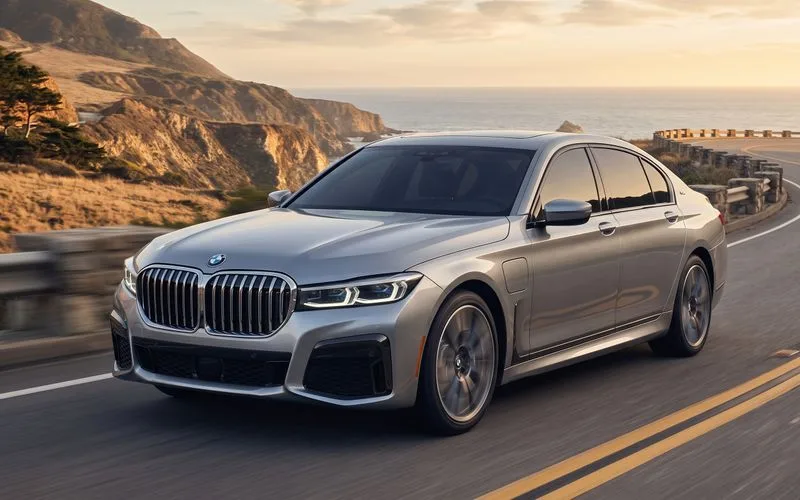 BMW 7 SeriesFull-Size Luxury SedanBetter at: Driving engagement
Costs more once equipped but offers hands-free Highway Assistant, a plug-in 750e and full i7 EV, and a chassis that rewards driving rather than just isolating you from it.
Compare 3.21B+
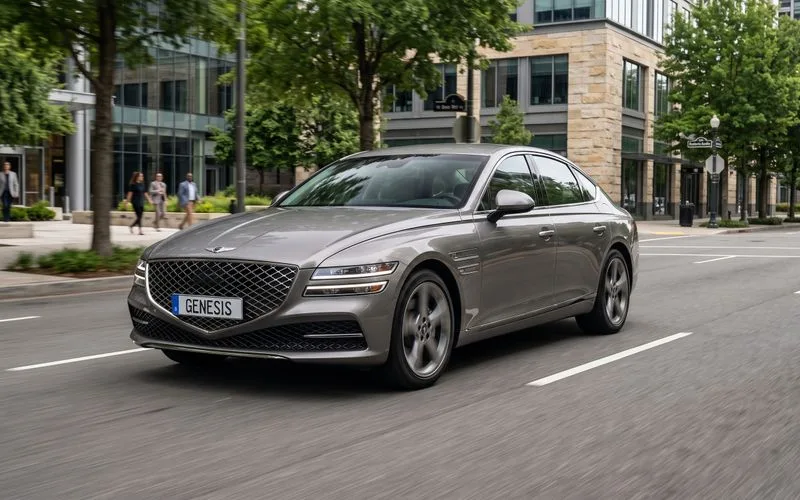 Genesis G80Mid-Size Luxury SedanBetter at: Value
Delivers most of the G90's design, materials and standard-safety story for tens of thousands less, with better resale and newer infotainment including wireless CarPlay.
Compare 3.20B+
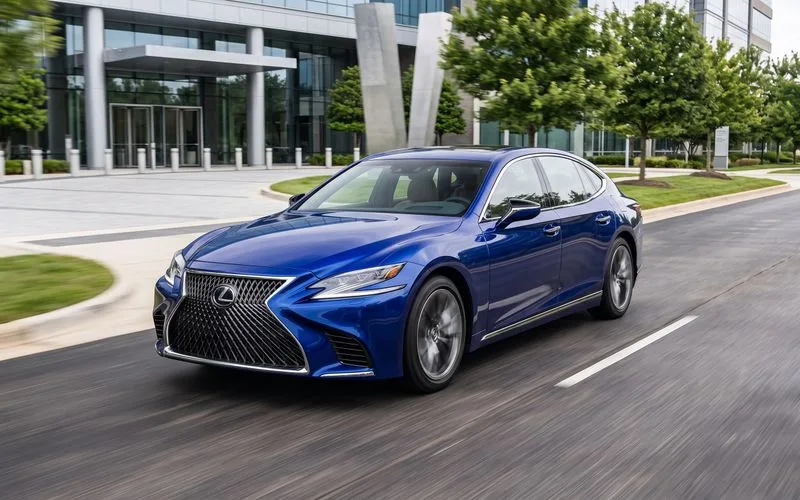 Lexus LSFull-Size Luxury SedanBetter at: Resale value
The safer long-term bet — stronger predicted reliability, roughly 47% five-year value retention against the G90's 37%, and a hybrid powertrain option to cut the fuel bill.
CompareHow it's evolved
10 scored model years · 2017–2026
Subject scores by year
Hover or tap a score to see what moved it versus the year before. A corner mark flags a big swing.
| Year | Performance | Efficiency | Safety | Space | Cost | Reliability | Tech | Use-case | Driving | Value |
|---|---|---|---|---|---|---|---|---|---|---|
| 2026 | 72 | 23 | 78 | 79 | 29 | 78 | 80 | 55 | 72 | 75 |
| 2025 | 71 | 19 | 74 | 73 | 29 | 67 | 80 | 53 | 68 | 74 |
| 2024 | 71 | 19 | 78 | 73 | 29 | 66 | 83 | 53 | 68 | 78 |
| 2023 | 71 | 19 | 79 | 73 | 29 | 63 | 80 | 52 | 68 | 77 |
| 2022 | 71 | 12 | 78 | 77 | 28 | 62 | 62 | 47 | 63 | 63 |
| 2021 | 68 | 13 | 80 | 77 | 28 | 59 | 62 | 47 | 63 | 67 |
| 2020 | 66 | 28 | 80 | 79 | 38 | 62 | 63 | 48 | 62 | 65 |
| 2019 | 66 | 16 | 62 | 80 | 28 | 74 | 55 | 48 | 63 | 66 |
| 2018 | 66 | 16 | 68 | 80 | 40 | 63 | 59 | 47 | 60 | 72 |
| 2017 | 65 | 18 | 68 | 80 | 42 | 66 | 53 | 45 | 64 | 69 |
Compare two years
Best fit & conditions
Higher scores mean a better fit for that use case. Learn more about use-case fit →
Subject profile
Detailed scoring by subject
1Performance & PowertrainGrades above the middle of the scale.2.80B-
2023 is the launch year of the second-generation (RS4) G90, and the volume 3.5T carries the Smartstream G3.5 twin-turbo V6 at 375 hp. The $99,795 3.5T E-Supercharger adds a 48-volt electric supercharger and mild-hybrid assist for 409 hp. Strong on paper for the class but short of the V8-adjacent output of a Lexus LS 500 (416 hp) or Mercedes S 500.
391 lb-ft arriving at 1,300 rpm is the figure that actually describes how a G90 is driven — effortless part-throttle shove rather than top-end rush. Class-competitive: it beats the BMW 740i and Audi A8 while trailing the LS 500.
Genesis publishes no 0–60 claim, so this is the published-test consensus: the base 375-hp 3.5T is quoted around 5.4–5.5 s, while the supercharged car has been instrumented at 5.1 s. Brisk rather than quick, and deliberately so — isolation is this car's argument, not lap time.
The twin-turbo V6 is near-silent at cruise and pulls cleanly off a torque plateau that starts at 1,300 rpm, and the second-generation car's Active Noise Control keeps the engine at arm's length. The optional 48V electric supercharger is a real engineering answer to turbo lag — it builds boost before the exhaust-driven turbos catch up — rather than a marketing one. It sits below the 7 Series and S-Class only because the Genesis V6 has no particular character or sound quality when extended.
Every 2023 G90 uses Genesis's in-house 8-speed torque-converter automatic with paddle shifters — smooth, unobtrusive at cruise, and decisive about gear choice without hunting, which is exactly the brief for a flagship sedan. It stays out of the top band because it lacks the outright snap of BMW's ZF 8HP under hard use and its manual mode is functional rather than engaging.
HTRAC all-wheel drive is standard on both 2023 US trims rather than an option over a rear-drive baseline, with a rear-biased split that varies by drive mode, and it arrives alongside standard rear-wheel steering. That standard fit is the top tier for this body style; it stops short of a perfect score only because the system is tuned purely for on-road traction — no low range, no terrain modes.
The 2023 US G90 offers one engine in two states of tune — the 3.5L twin-turbo V6, and the same V6 with a 48V electric supercharger and mild-hybrid assist. That is the thinnest slate in full-size luxury: no V8, no plug-in hybrid, and no battery-electric G90 for the US, where the Electrified G90 shown in Korea was never marketed. The 48V variant is genuinely distinct hardware rather than a trim sticker, which is the only thing keeping this off the floor.
2Efficiency & RangeThe G90's lowest-graded category.0.00F
A ~4,860 lb full-size sedan with a twin-turbo V6 and standard AWD returns 21 MPG combined — near the bottom of the gas-sedan band, which is where every non-electrified full-size luxury sedan lands. The 48V mild-hybrid E-Supercharger trim is no better, costing a point at 20 MPG.
City is the worst case: mass and a torque-converter automatic with no meaningful electric assist for low-speed running leave it at 18 MPG. The 48V system on the E-Supercharger exists to spin a supercharger, not to move the car, so it buys nothing in traffic and in fact rates a point lower.
Highway is the G90's best case — a tall top gear and slippery bodywork return 26 MPG — but that is still the low end of the sedan highway band against a field that includes 40-plus-MPG hybrids.
Range is where the G90 partially redeems itself: a 19.3-gallon tank converts mediocre economy into a genuinely useful 405-mile cruising leg, mid-pack for the segment and enough to make a long drive a one-stop affair. It is not, however, the 500-plus miles a more efficient large sedan manages on a comparable tank.
At EPA's standard assumptions the G90 burns roughly 715 gallons of premium a year for a $3,700 bill — a running cost that reads like a full-size truck rather than a sedan, and above the top of the sedan band. The EPA scores it 4/10 on both fuel economy and greenhouse gas.
The owner's manual specifies 87 octane (R+M)/2 or higher as acceptable and recommends 91 octane for improved performance, so premium is recommended rather than required and owners have an out a premium-required rival does not offer. In practice nearly every G90 runs 91-octane to reach the published 375 hp, so it is still a real pump-price penalty — which, combined with 21 MPG, is what produces the $3,700 annual bill above.
3SafetyOne of the G90's strongest categories.3.34B+
NHTSA catalogued both 2023 G90 body styles (RWD and AWD) but never crash-tested either — every rating field returns 'Not Rated', as it also does for the 2024 and 2025 cars, so the entire second-generation (RS4) run is untested. Six-figure, low-volume full-size luxury sedans routinely go unbought by NCAP. The 4.5-star placeholder follows the convention already applied to the untested Audi A8 and to the 2024/2025 G90 in this dataset, and is arguably conservative: every Genesis model NHTSA has actually tested (G70, G80, GV70, GV80) carries a 5-star overall.
The all-new RS4 G90 launched straight into an IIHS Top Safety Pick+, listed as the '2023-24 Genesis G90 4-door sedan', and every crash test IIHS ran on it came back Good — small overlap front driver and passenger, the original moderate overlap front, and the updated side test that IIHS made heavier and faster for 2023. Unlike the 2024 car the 2023 award carries no build-date qualifier. Two things keep it out of the high 80s: roof strength and head restraints were never rated, and the updated moderate overlap front test (which grades rear-occupant protection) was not run on this model year — when IIHS did run it on the same shell it returned only Acceptable, and Genesis revised the rear seat belts in October 2023 in response, so the 2023 build is on the wrong side of that fix.
Genesis's own 2023 brochure marks every driver-assistance feature standard on both trims (3.5T and 3.5T E-Supercharger) — there is no safety option package to buy. Forward Collision-Avoidance Assist, Lane Keeping Assist, Lane Following Assist, Blind-Spot Collision-Avoidance Assist, Blind-Spot View Monitor, Rear Cross-Traffic Collision-Avoidance Assist, Highway Driving Assist II, Smart Cruise Control with Stop & Go, Intelligent Speed Limit Assist, Driver Attention Warning, High Beam Assist, Surround View Monitor, Parking Distance Warning, Parking Collision-Avoidance Assist, Remote Smart Parking Assist, Safe Exit Assist, Advanced Rear Occupant Alert and 10 airbags are all baseline. That is a more complete standard suite than German rivals that still gate blind-spot monitoring and highway assist behind four-figure packages, and it is notable that HDA II shipped standard at launch rather than being chip-shortage-deleted as it was on some 2022 Genesis models.
A split result. Pedestrian detection is as good as the test allows — Superior in both the daytime and the nighttime vehicle-to-pedestrian evaluations, which is the specific nighttime capability the top band asks for and which is what earned the car its 2023 TSP+. Against that, the much harder vehicle-to-vehicle 2.0 test IIHS introduced afterwards (higher closing speeds, plus a motorcycle and a semi-trailer target) returned only Acceptable, and that rating explicitly covers 2023-26 cars, so it describes this model year's hardware. Scored at the bottom of the top band: the pedestrian half earns it outright, the vehicle-to-vehicle half does not.
Best-in-class coverage, standard on both trims and intervening rather than merely chiming. Blind-Spot Collision-Avoidance Assist applies subtle steering intervention when you try to change lanes into an occupied lane; Rear Cross-Traffic Collision-Avoidance Assist brakes autonomously backing out; Safe Exit Assist warns against opening the rear doors into approaching traffic, which matters more than usual on a car whose back seat is the point of it. Layered over that, the Blind-Spot View Monitor throws a live side-camera feed into the digital cluster the moment you signal — a genuine double-check rather than a warning lamp.
Lane Following Assist centering inside Highway Driving Assist II is smooth and sits confidently mid-lane rather than ping-ponging between the markings, and on this launch-year car HDA II was standard on both trims rather than reserved for a package. It stays short of the top of the band because the calibration is deliberately conservative and Genesis's own documentation is explicit about the limits: it needs clearly visible lane markings and is not to be used in poor weather, heavy or varying traffic, or on winding or slippery roads.
Smart Cruise Control is full-speed-range with stop-and-go and is standard on both trims, integrated with Highway Driving Assist II and Intelligent Speed Limit Assist so it reads navigation and sign data to slow for curves and for changing limits rather than barrelling into them at the set speed. On the G90 the ride side of that is smoothed further by the road-preview electronically controlled suspension (3.5T) or the multi-chamber air suspension (E-SC). It sits just under the top of the band because it remains a hands-on system with no hands-free tier above it, and because the same documentation that describes the curve slowdown limits it to highways with map data available.
There is no hands-free option on the 2023 US-market G90 at any trim or price, and Genesis says so directly: the brochure introduces a new Hands-On Detection feature that exists precisely to confirm your hands are on the wheel while HDA is active. Genesis announced a Level 3 Highway Driving Pilot for the Korean-market G90 around this launch, but it was repeatedly delayed and never offered in the United States. In a segment where the 7 Series offers Highway Assistant and the S-Class offers Drive Pilot, this is the flagship's biggest safety-tech deficit; the small non-zero score credits a capable hands-on assist, not any hands-free capability.
The G90's Two-Line LED headlamps are the brand's design signature and ship standard along with High Beam Assist, so there is no trim lottery — but IIHS measured them and returned only Acceptable, a rating it applies to all trims across 2023-26. Uniform Acceptable across the range is squarely the middle band: better than a car whose volume trim gets Marginal lighting, well short of a Good rating. The strength of the technology on paper does not override the measured result, and Acceptable headlights still cleared the 2023 TSP+ threshold, which is why the award survives it.
Natural sightlines are ordinary: 207.7 inches of length on a 125.2-inch wheelbase, 76.0 inches of width, a high beltline and a steeply raked rear screen, with rear headrests and the standard power rear and rear side sunshades cutting further into the mirror view. What lifts it above mid-pack is thorough, standard camera compensation — a Surround View Monitor, the Blind-Spot View Monitor feeding the cluster on signal, Rearview Camera with dynamic guidelines, front and rear Parking Distance Warning with Parking Collision-Avoidance Assist, and Remote Smart Parking Assist for spaces too tight to see out of. Nearly every obscured zone has a screen covering it, but you are relying on the screens.
Workable, and not what this car is built around. There are two complete LATCH sets in the outboard rear positions plus a top tether for the centre, and the rear doors open wide onto a comfortable bench — but the lower anchors sit buried deep in the seat bight, the usual luxury-sedan pattern that costs points on ease of use, and the rear compartment is less accommodating than the flagship badge suggests at 37.8 inches of legroom in this standard-wheelbase US car. Heavily contoured rear seats, a raised tunnel and (on the E-Supercharger) power/ventilated/massaging rear thrones make the centre position impractical for a third seat, so three-across is out.
4Space & ComfortGrades above the middle of the scale.2.94B-
2023 is the launch year of the second-generation G90, and both US configurations (3.5T AWD and 3.5T e-Supercharger AWD) are five-seaters. The long-wheelbase four-seat G90 sold in Korea is not offered in the United States.
Genesis publishes a single headroom figure for both US trims, and the panoramic sunroof is standard equipment on each — so 39.4 in is what a buyer actually gets, not a sunroof-delete best case. Generous for a 58.7-in-tall sedan.
42.3 in is mid-pack for a full-size luxury sedan — the G90's 125.2-in wheelbase is spent more evenly between the rows than a long-wheelbase S-Class, and the front row gets a conventional rather than a stretched allocation.
38.0 in of rear headroom is good for the class and is preserved despite the standard panoramic sunroof and the fastback-leaning roofline created by the Parabolic Line side profile.
37.8 in is the G90's clearest packaging compromise: adequate but not limousine-like, and reviewers testing the car as a chauffeur-mode flagship called the rear seat snug. The extended-wheelbase version that would fix this stays in Korea.
12.0 cu ft is small for a 207.7-in-long car and is the G90's weakest practicality number — reviewers flagged it directly. The e-Supercharger's 48-volt hardware costs another 1.4 cu ft.
The G90's interior brief was deliberately minimalist — 'a minimalist space where you are surrounded by elegant simplicity' — which buys visual calm at the cost of cubby volume, and the small trunk with no fold-down rear seatback removes the usual sedan escape valve. What lifts it above average is genuine novelty rather than capacity: a UV-C sanitizing tray in the rear armrest, five USB-C ports, and a front wireless charger standard.
The front seats are among the best in the class on the volume trim itself: 18-way driver / 16-way passenger power adjustment, standard heating, ventilation and a four-mode Ergo Relaxing massage, power bolsters that inflate in Sport and deflate for entry and exit, and 4-way power headrests. The rear is where the volume 3.5T gives ground — heated only, with reclining, ventilated and massaging rear seats reserved for the e-Supercharger.
MotorTrend's judges made ride the centrepiece of naming the G90 their 2023 Car of the Year, calling it among the most comfortable luxury sedans in the world. One caveat keeps this out of the 90s: the multi-chamber air suspension that drew most of that praise is e-Supercharger-only, and the volume 3.5T rides on the (still excellent) camera-scanning Electronically Controlled Suspension with Road Preview.
Quietness is the G90's headline engineering claim and it is delivered with standard hardware rather than an options-box upgrade: acoustic laminated glass at the windshield and both front and rear side windows, plus Active Noise Control – Road that generates a per-seat inverted-wave signal and adapts to each tire's changing acoustic signature.
Everything a luxury-sedan shopper checks for is standard on the base trim: 3-zone climate, heated and ventilated front seats, heated rear seats, a heated power tilt-and-telescopic wheel, and power rear plus rear-side sunshades. Mood Curator goes further than rivals by coordinating lighting, massage, audio and an onboard fragrance system, and remote engine/climate pre-conditioning runs from the Genesis App or an Alexa/Google Home device.
5Cost of OwnershipOne of the G90's weakest categories.0.00F
2023 is the launch year of the second-generation G90, and the US lineup opens at $88,400 before the $1,095 destination charge for the 3.5T AWD — far past the framework's $55,000 sedan ceiling, so it scores 0 on price alone even though it undercuts every direct flagship rival.
Unusually for the segment, the volume trim and the base trim are the same car: the $89,495 3.5T AWD already carries Nappa leather with power front massage, heated and ventilated front seats, heated rear seats, electronically controlled suspension with road preview, Highway Driving Assist II and Bang & Olufsen audio, so there is no equipment step most buyers must take. The only meaningful options are paint, which is why the as-typically-equipped figure sits within a few hundred dollars of the sticker; the $10,300 e-Supercharger car is the enthusiast/chauffeur pick, not the volume one.
Two factory programs absorb most of the first five years: complimentary scheduled maintenance covers years one through three, and the 5-year/60,000-mile bumper-to-bumper warranty covers almost every repair until roughly year four at 15,000 miles annually. What remains is the 40k–75k service interval on premium fuel, 20-inch tires and a twin-turbo V6, plus the first post-warranty repairs. The figure is set above CarEdge's projection to account for flagship parts and labour rates, on the same basis this dataset uses for the G80, and it remains a fraction of what a 7 Series costs over the same period.
Depreciation is where the G90's value argument comes apart: a flagship sedan carrying a badge with barely a decade of US history sheds roughly half its sticker in five years, and three years of observed 2023-car transactions now sit behind the projection rather than a forecast alone. Retention is nonetheless a few points better than the luxury-large-car average and materially better than a 7 Series or S-Class percentage, because the G90's lower entry price means less absolute money sitting on the hood. 46% is taken just below the published 47–48% projections, since the first-generation car's actual record was worse and Genesis added heavy factory cash to flagship sedans after 2023 stock was sold.
$89,495 volume-trim price minus its estimated resale value after 5 years (46% retained, or about $41,168) leaves about $48,327 in depreciation. Add the projected $4,900 in 5-year maintenance and repairs, and owning this vehicle for 5 years costs about $53,227 in total.
Genesis's 5-year/60,000-mile bumper-to-bumper term is the longest available in the luxury segment and tops the framework's 3–5 year sedan band outright. Every German and Japanese flagship rival stops at 4 years — BMW and Mercedes-Benz at 4/50,000, Lexus at 4/50,000 — so a 2023 G90 buyer gets a full extra year of comprehensive coverage.
The Hyundai-group 10-year/100,000-mile powertrain term carries over to the flagship and sits at the top of the framework's 5–10 year sedan band. Nothing else in the full-size luxury class comes close: BMW and Mercedes-Benz fold the powertrain into the same 4-year/50,000-mile basic term with no extended coverage at all.
Three years of complimentary scheduled maintenance is paired with three years of Genesis Service Valet — a concierge collects the car from home or office, leaves a loaner, and returns it serviced and washed — plus five years of unlimited-mileage roadside assistance and a complimentary Genesis Connected Services subscription with over-the-air map and software updates. That is a multi-year maintenance program plus genuinely meaningful perks, placing it at the top of the 80–100 band; only the absence of anything like a charging or fuel credit keeps it off a perfect score.
6Reliability & QualityMid-pack among this car's ten categories.2.27C
Neither authority produces a usable model-specific prediction, and that absence is itself the finding: Consumer Reports' 2023 G90 reliability page returns "No Detailed Data Available" because US G90 volume falls far short of the 200-400 survey samples CR needs, and jdpower.com refuses automated fetch. With no owner-survey signal the prediction leans on observables, and for this model year they are the worst of the generation. 2023 is the launch year of the second-generation RS4 car — not a settled carry-over — and it carries six NHTSA campaigns against four for the 2024 and 2025, three of them with a genuine injury, fire or loss-of-power consequence. The contemporaneous brand signal was also at its weakest here: Genesis dropped out of the premium top three entirely in the 2023 IQS after leading it from 2017 to 2020, and no G90 segment award was issued. Working the other way, this is the most feature-dense car Genesis builds (multi-chamber air suspension, rear-wheel steering, active road-noise cancellation, 23-speaker B&O, dual 12.3-inch displays), which is where predicted-reliability scores are lost rather than won. Scored four points under the 2024 G90 (60) for launch-year exposure plus the two additional campaigns, and well below the segment median (71.5). This must NOT be read as carrying the 2026 G90's 74 backward — that score was written without live grounding and self-identifies as such.
Genesis's dependability signals point in opposite directions, and this is a brand-level fact, so it is scored identically here and on the 2023/2024/2025 G80 and the 2024/2025 G90. The contemporaneous picture for a 2023 car is the weaker end of the brand's record: Genesis had ranked highest among premium brands in Initial Quality from 2017 through 2020 and second in 2021, but in the 2023 IQS it fell out of the premium top three entirely. It has since recovered — 184 PP100 and third premium in 2024, 183 PP100 and third premium in 2025, 151 PP100 and second overall in 2026. Three-year dependability is the deteriorating side, and it is the side that matters most for a car now three years old: Genesis scored 144 PP100 and second among premium brands in the 2023 VDS but 208 PP100 in the 2026 VDS — third among premium brands yet below the 204 PP100 industry average, and the 2026 VDS is the study whose cohort this 2023 car belongs to. Consumer Reports is harsher still, ranking Genesis 21st of 26 brands at 33/100 with no model rated average-or-better. Strong on day 90 and below-average at year three is mid-pack across an ownership cycle, not the "consistently top-5" the 80+ tier requires.
This is where the 2023 separates sharply from the rest of its generation, and it separates downward: six NHTSA campaigns reach the 2023 G90 against four for the 2024 and 2025, and the two extras are both severe. 23V210000 (Genesis 013G) covers front driver-side, passenger-side AND rear seat belt pretensioners that may explode on deployment, projecting metal fragments into the occupant compartment — broader in scope than the front-only version of the same defect that hit the G80, though only 575 G90s are involved. 24V282000 (Genesis 022G) is a low-pressure fuel pump whose impeller can deform and seize, "resulting in a sudden reduction or loss of drive power"; it covers 2022-2023 build and reaches this car but not the 2024. Those sit on top of the four that hit the whole generation: a fuel leak at the fuel-pipe/fuel-rail connection (fire risk, and the known high-pressure crossover-pipe weakness of this engine family), front seat belt anchors that may detach, an instrument-panel display software failure that loses the speedometer and warning indicators (an FMVSS 101 non-compliance), and a Highway Drive Assist corner radar that can brake the car unintentionally — severe enough that Genesis told owners to stop using HDA until the bumper beam was replaced. That is two independent restraint campaigns, two independent fuel-delivery campaigns and two driver-facing electronics campaigns on a single low-volume flagship, which is repeated recall activity in safety systems rather than typical activity. What keeps it from scoring lower is that nothing here is a systemic engine, transmission or structural defect, every campaign carries a free dealer remedy, and several were remedied by OTA software update.
The volume 2023 G90 is the 3.5T AWD, running the 3.5L Smartstream twin-turbo V6 (375 hp / 391 lb-ft) through the in-house 8-speed torque-converter automatic with standard HTRAC AWD — no belt-driven compressor, no traction motor, no high-voltage battery in the volume configuration, which is a real durability advantage against the complexity this car carries elsewhere, and a clear advantage over the 2023 G80's 2.5L four (58), whose piston-ring oil-consumption window this model year sits inside. The Smartstream G3.5 family is assessed as a clear improvement on the older Lambda II V6, with no systemic failure mode on record and an estimated ~160,000-mile useful life, but it is not a proven high-mileage design: documented concerns are timing-chain wear, overheating and oil-pump reliability, plus the high-pressure crossover fuel-pipe weakness behind this generation's fire-risk recall. Scored two points under the 2024 G90 (66) for two year-specific reasons: 2023 is the first year of this engine's application in the RS4 flagship with no accumulated fleet service behind it, and the 24V282000 low-pressure fuel-pump campaign — a fuel-delivery failure causing loss of drive power — reaches the 2023 build while the 2024 falls outside it. The $99,795 3.5T e-Supercharger trim adds a 48V electric supercharger and mild-hybrid system (409 hp) with a much shorter track record; it is not the volume trim and is not what is scored here. The 10-year/100,000-mile powertrain warranty backs the risk for an original owner and, unlike the basic warranty, is still live on a 2023 car.
The cabin is the strongest thing about this car and the clearest reason it exists, and 2023 is the model year that introduced it. The volume 3.5T is not a stripped entry point — Nappa leather, matte open-pore wood, brushed aluminum, a suede-style microfiber headliner and suede-wrapped pillars are standard, so soft-touch coverage continues into the secondary surfaces where German rivals switch to plastic. The flagship also carries detailing nothing else in the class attempts: real black wood veneer, a decorative trim made from recycled newspaper, and door metal inlays crafted using traditional Korean techniques. What makes this class-leading rather than merely competitive is the price anchor — the G90 opened at $89,495 delivered against roughly $117,000 for an S 500 4MATIC and $94,295 for a 740i — and reviewers still placed its materials in the same conversation. Held level with the 2024 and 2025 G90 (92) as the same launch-specification cabin, and above the 2023 G80 (88) as the flagship expression of the same design language.
Physical assembly draws essentially no criticism — launch reviewers called fit, finish and craftsmanship "superb" and "impeccable," with "no stitch out of place" — and the flagship is built at lower volume and higher attention than the rest of the range. Three things keep it below the 2024 and 2025 cars (84) rather than level with them. First, 2023 is the launch year of an all-new platform and body, which is structurally the least settled point of a generation. Second, the brand-level support that props up the later years is absent for this one: Genesis fell out of the premium IQS top three entirely in 2023 after leading it from 2017 to 2020, and no G90 segment award was issued in 2023 or any year since — the Genesis newsroom names the G70, G80 and GV80, never the G90. Third, the defects owners actually report on this specific build are electronic and not trivial: 2023 G90 owners describe the dashboard lighting up with every warning light, a "STOP ENGINE / check brake system" message and an electronic parking brake that would not release, stranding the car — the fault behind Genesis recall 027G, whose scope begins with cars built Apr 21, 2022, the start of 2023 production. In-car electronics is the dominant IQS problem category industry-wide and CR's largest trouble spot for the brand, and the G90 carries more of that content than anything else Genesis builds.
Coverage is the weak link and it is a brand fact rather than a model-year one: Genesis operates roughly 85 dedicated standalone retail facilities in the US against roughly 240 dedicated Lexus stores and 350-380 Mercedes-Benz and BMW dealerships, with the rest of the lineup sold through 200-plus independent, typically Hyundai-affiliated retailers — so a buyer outside a major metro may have no dedicated Genesis service point nearby. That gap bites hardest exactly here, on a near-$90,000 flagship cross-shopped against brands with dedicated showrooms and a settled service reputation. This scores two points under the 2024 and 2025 G90 (70) for one concrete reason, the same one applied to the 2023 G80: a 2023 car delivered in 2022-2023 has passed the three-year mark as of the 2026-09 scoring date, so its complimentary Service Valet and scheduled-maintenance coverage has lapsed and the owner now faces the thin network directly rather than having a concierge absorb it. The 10-year/100,000-mile powertrain warranty and five years of unlimited-mileage roadside assistance still apply. Network growth is real but recent, so the footprint disadvantage remains the current condition.
Running costs are low by full-size-luxury standards because the mechanical hardware is shared across the Hyundai group: CarEdge projects about $564 a year, roughly $2,822 over five years and $8,161 over ten — about $1,529 under the industry average — against roughly $990 in first-post-warranty-year repairs for an S-Class, and RepairPal puts Genesis brand average annual maintenance at $524. All six open recalls carry free dealer remedies rather than owner cost, and the 10-year/100,000-mile powertrain warranty still covers the expensive failures on a 2023 car. What caps this well below the G80 (77) is how little of the G90 is shared: the multi-chamber air suspension, rear-wheel-steering hardware, 23-speaker Bang & Olufsen system, acoustic glass and flagship-specific trim are dealer-only with essentially no aftermarket — RepairPal singles out the G90's electronically controlled suspension as what makes it materially more complex than the rest of the range — and US G90 volume is low enough that CR cannot assemble a survey sample, which means parts sourcing for those items is slow. Scored a point under the 2024 and 2025 G90 (70) because the deferral those years lean on has run out here: a 2023 car is past both the 3-year/36,000-mile complimentary maintenance window and, at three years and roughly 45,000 miles, at or beyond the 5-year/60,000-mile basic warranty's mileage limit, so flagship-specific electronics and suspension failures now land on the owner at dealer rates. Cheap to maintain, expensive and slow to repair when something flagship-specific fails.
7Technology & InfotainmentThe G90's best-graded category.3.43B+
Genesis fits one 12.3-in center screen on every 2023 US G90, with no larger option. It reads wider than it measures because the cluster and center display are styled as a single panoramic band, but the touch surface itself is 12.3 in — mid-pack against rivals already shipping 14-plus-inch panels.
The system is well regarded — cloud-based Connected Car Integrated Cockpit, a customizable split screen, and, crucially, retained physical buttons for navigation and radio alongside both touch and a console rotary controller. The deduction is an ergonomic own-goal: the center console carries two near-identical rotary dials, one a gear selector and one the infotainment controller, and reviewers report a real learning curve in knowing whether to swipe, rotate, shift or press.
As delivered in 2023 the G90 offered Apple CarPlay and Android Auto on every trim but WIRED ONLY — a conspicuous gap in a $90,000 flagship with a standard wireless charging pad, and the single most-cited criticism of its tech package. Genesis subsequently enabled wireless projection on 23MY G90s through an over-the-air update (the 21MY and 22MY cars were excluded for lacking the required head unit), which is why this sits at the top of the wired-standard band rather than the bottom.
Native navigation is standard on both trims with complimentary annual map updates for three years, cloud-connected driver profiles, and send-to-car destination push from the phone app — a complete package that owners have little reason to bypass. Voice recognition is the softer half: testers found it handled navigation and media well but stumbled on climate and seat commands.
Bang & Olufsen Premium Audio is standard on the volume 3.5T — no base-audio penalty at all — and the e-Supercharger's 26-speaker, 14-channel B&O 3D system with pop-up tweeters, headliner and headrest drivers and Virtual Venues acoustic modelling is one of the strongest factory systems sold at any price. A tester called it 'sensational.'
A 12.3-in full-digital cluster is standard on both trims, is configurable enough to show map views or live ADAS status, and doubles as the display surface for the Blind-Spot View Monitor's camera feed. Reviewers singled out its configurability alongside the head-up display.
This is genuine whole-vehicle OTA, not maps-only: Genesis states the scope covers the navigation system, the instrument cluster and the advanced driver assistance software. It also demonstrably added a feature after delivery — the update that turned on wireless CarPlay and Android Auto reached 23MY G90s while skipping the older 21/22MY cars. It stays below the top band because updates arrive on a slow cadence and require an active Connected Services subscription.
Digital Key 2 is the standout — ultra-wideband phone-as-key stored in Apple Wallet, usable from an Apple Watch and shareable with family by iMessage, with the flush door handles deploying as you walk up. Around it sits a complete app: remote start and climate, lock/unlock check, vehicle locate, valet mode, send-to-car navigation, remote image capture of the car's surroundings, plus Alexa and Google Home voice control. Connected Services is complimentary at purchase rather than an immediate add-on bill.
Five USB-C ports are standard across both trims — all modern connector, no legacy USB-A mix — and a front wireless charging pad is standard. Two things hold it short of the top band: the rear wireless charger is e-Supercharger-only, and there is no household AC outlet anywhere in the car.
About as complete as keyless access gets in 2023. Ultra-wideband Digital Key 2 means no fob at all; flush handles deploy on approach; a fingerprint reader authenticates the driver and loads seat, mirror and radio profiles; the power hands-free smart trunk opens on proximity; power door closure (3.5T) or Easy Close Power Doors (e-SC) shuts the doors; and Remote Smart Parking Assist 2 lets you park the car from outside it.
The full parking suite is standard on the volume trim, not reserved for the top car: a four-camera Surround View Monitor rendering a 3D perimeter view, parking distance warning, Parking Collision-Avoidance Assist with automatic braking front/side/rear, and Remote Smart Parking Assist 2 that handles parallel, perpendicular and diagonal spaces from outside the vehicle. A remote image capture feature even pulls a snapshot of the car's surroundings to your phone.
A head-up display is standard on the volume trim, is integrated into the same cockpit data layer as the cluster and center screen, and testers rated the image excellent. The only knock is the universal one — it washes out behind polarized sunglasses.
8Use-Case FitOne of the G90's weakest categories.1.45D
The basics are fine — wide rear door openings on a 125.2-in wheelbase, 38.0 in of rear headroom for a booster, outboard LATCH, and both Safe Exit Assist and Advanced Rear Occupant Alert standard. What holds it to the middle band is gear rather than kids: a 12.0 cu ft trunk with no fold-down rear seatback is a genuine problem for a stroller plus luggage, and 37.8 in of rear legroom is tight once a rear-facing seat pushes the front chair forward.
IIHS named the 2023 G90 a TOP SAFETY PICK+, and unusually there is no trim penalty at all — the entire ADAS suite including Highway Driving Assist II, Blind-Spot View Monitor, Safe Exit Assist and Advanced Rear Occupant Alert is standard on the base car, with 10 airbags. Two things cap it: headlights rated only Acceptable, and the family-safety proposition starts at roughly $89,500, which is not a family-friendly price point.
For the occupants, excellent: class-leading quiet, 3-zone climate, heated rear seats, power rear and rear-side sunshades, an 8-in rear armrest touchscreen and five USB-C ports, all on the volume trim. Two real limits keep it out of the top band — the reclining, ventilated, massaging rear seats that define the G90's rear-seat reputation are e-Supercharger-only, and 12.0 cu ft of trunk simply will not hold four people's luggage for a week.
This is what the G90 is built for. The camera-scanning Electronically Controlled Suspension with Road Preview is standard on the volume trim, the twin-turbo V6 and 8-speed pair smoothly, and Highway Driving Assist II with Smart Cruise Control Stop & Go removes most of the effort from a congested commute. Reviewers describe buttery-smooth throttle, steering and braking response, and the car idles almost inaudibly at 500 rpm.
Expensive per mile on every axis: 21 MPG combined on required-for-performance premium fuel works out to an EPA-estimated $3,700 a year, and the staggered 245/45R20 front and 275/40R20 rear all-seasons cannot be rotated front-to-rear, so tire replacement comes in fours at luxury prices. The 48-volt e-Supercharger makes it worse, not better, at 20 MPG combined.
207.7 in long and 76.0 in wide is a lot of car for a parking structure, and the volume 3.5T does not get the rear-wheel steering that trims its e-Supercharger sibling's turning circle from roughly 40 ft to 37 ft. The electronics claw a good deal of that back: a four-camera 3D surround view, parking distance warning, collision-avoidance braking while parking, and Remote Smart Parking Assist 2 that will park the car while you stand outside it.
Not a work vehicle in any sense the item measures. Genesis publishes no towing capacity for either US trim, there is no bed, and the 12.0 cu ft trunk with a fixed rear seatback cannot swallow long or bulky material. The powertrain has the torque, but nothing is rated to use it for work.
Genesis ranked #1 among luxury brands in J.D. Power's 2022 U.S. Vehicle Dependability Study and backs the car with 10 years/100,000 miles of powertrain coverage, so the mechanicals are not the concern. The cabin is: quilted Nappa leather, matte-finish wood, a leatherette upper instrument panel and a microfiber suede headliner are the opposite of wear-friendly, and the G90 has no fleet or commercial history to draw on.
Essentially nothing here. No 110V household outlet, no roof rails, no hitch or hitch prep, no cargo-management system or tie-down provision, and no upfit ecosystem — every surface a tool would touch is leather, suede or wood.
The G90's strongest use case. Acoustic laminated glass front and rear plus per-seat Active Noise Control – Road make it world-class quiet; the 18-way front seats add ventilation and four-mode massage as standard; Highway Driving Assist II handles lane centering and distance keeping; and 19.3 gallons at 21 MPG combined gives roughly 400 miles between stops. MotorTrend's judges called it among the most comfortable luxury sedans in the world.
AWD is standard on both US powertrains, which makes the G90 credible on a snowy or wet road to a trailhead. Everything else argues against it: 5.8 in of ground clearance, staggered low-profile 20-in all-seasons, no roof rails, no tow rating for a bike or kayak trailer, and no 110V outlet for camp power.
The G90's weakest practical dimension. 12.0 cu ft is small in absolute terms and remarkable on a 207.7-in car, there is no fold-down rear seatback or ski pass-through to extend it, and with no roof rails and no hitch there is nowhere to put anything that does not fit in the trunk.
9Driving ExperienceMid-pack among this car's ten categories.2.57C+
Secure and balanced rather than engaging — the G90 is a 4,861-lb flagship tuned first for isolation, and the volume 3.5T goes without the two pieces of hardware that sharpen it. Rear-wheel steering (up to four degrees) and the multi-chamber air suspension are both e-Supercharger-only, and most of the press praise for how much speed the G90 can carry through a corner came from cars fitted with them.
Deliberately calibrated for calm, not communication. The rack-mounted motor-driven system with variable gear ratio is accurate and pleasantly relaxed on-center at highway speed, but effort is light and feedback is thin — appropriate for the mission, unremarkable as steering.
The instrumented result is genuinely strong — 105 ft from 60 mph for a car weighing nearly 4,900 lb, with stops described as consistently straight and true. Ventilated front and rear discs are standard, and braking character is selectable across Comfort, Sport and Chauffeur modes. The deduction is pedal calibration: testers found the brakes a touch grabby in normal driving.
The 3.5L twin-turbo V6 and 8-speed automatic are calibrated to deliver power without announcing it — smooth tip-in, unobtrusive shifts, and a near-silent 500 rpm idle. It sits below the top band precisely because Genesis sells the fix as an upgrade: the 48-volt e-Supercharger exists to cut the low-speed turbo lag the base 3.5T still carries.
The V6 is close to inaudible in normal use, helped by acoustic laminated glass at the windshield and both front and rear side windows plus per-seat Active Noise Control – Road. It stops short of the top band only because the engine has no particular character to offer when you do wake it — it is quiet rather than pleasant.
Genesis does not publish a turning circle in the 2023 brochure, so this is the corroborated third-party figure for the volume 3.5T — poor even for a full-size sedan, and a direct consequence of the 125.2-in wheelbase without the rear-wheel steering reserved for the e-Supercharger.
Adjustability is outstanding: an 18-way driver's seat with 4-way power headrest and inflatable bolsters, a heated power tilt-and-telescopic wheel, and an Entry & Exit function that deflates the bolsters so you can slide out of a car that sits just 58.7 in tall. Physical buttons survive for navigation, radio and climate. The one real ergonomic misstep is the pair of near-identical console rotary dials — one a gear selector, one the infotainment controller.
The G90 is engineered to be undramatic and succeeds completely — 375 hp moves it briskly, but the car's pleasures are serenity, silence and the Mood Curator, not corner exit. Genesis even offers a Chauffeur drive mode whose whole purpose is to prioritise the person not driving. Pleasant, accomplished, and not a car enthusiasts recommend for the drive itself.
10Value & Market PositionOne of the G90's strongest categories.3.20B+
The 2023 G90 has essentially one equipment level: the $89,495 base 3.5T AWD already includes Nappa leather with power front massage, heated and ventilated front seats, heated rear seats, electronically controlled suspension with road preview, standard all-wheel drive, Highway Driving Assist II and Bang & Olufsen audio. Rivals charge thousands for parity — massaging front seats were a $1,200 option on a 740i, and AWD and a heated steering wheel are extra-cost on several German flagships — which is exactly the 80–100 case. It sits above the G80's 84 in this dataset because the G90 has no meaningful equipment step to climb at all.
At $89,495 delivered with 375 hp, standard AWD, a road-preview air-assisted chassis and a cabin MotorTrend judged among the most cosseting in the world, the G90 undercuts a comparably equipped S-Class by roughly $20,000 and a matched 740i by $15,000–$20,000, while adding a year of bumper-to-bumper coverage, six years of powertrain coverage and three years of prepaid maintenance. That is standout bang-for-buck in the class. It stops short of the G80's 86-plus territory being pushed higher only because the absolute dollars lost to depreciation (see cat5) claw back much of what the sticker saves.
Launch-year choice is close to take-it-or-leave-it: two trims, both all-wheel drive, both short-wheelbase, differing only in whether the V6 carries the 48V e-Supercharger, with paint and interior colour the practical extent of the options list. The long-wheelbase G90 that broadens the range does not arrive until 2024. The narrowness is a deliberate consequence of the fully-loaded-at-base strategy that earns 10.1.1 its high mark, but as configuration flexibility it is thin — well below the G80's 74 and the 7 Series' 65 in this dataset.
1,268 US sales in 2023 is a slow seller in absolute terms even by the standards of a shrinking full-size luxury sedan class — a small fraction of S-Class or 7 Series volume, and below the Lexus LS. The trajectory is the mitigating fact: the all-new generation was running about 35% ahead of the outgoing car through July 2023, so this is a low base rising rather than a model in decline. That combination sits at the top of the 0–49 band, just below the 40 this dataset gives the G80.
Genesis in 2023 is a credible and rising luxury brand — it outsold Infiniti in the US and has collected three MotorTrend of-the-year titles — but it is still barely eight years old, and badge equity matters more at flagship level than anywhere else in a lineup. That is the single clearest explanation for why a car this well received sells in three figures a quarter, and it is also what drags the resale percentage in cat5. Neutral-to-positive perception rather than an aspirational halo, so mid-band, a notch under the G80's 69 because the buyer being asked to overlook the badge here is spending $90,000.
At launch there was little to negotiate — lease programs carried no incentive cash, with money factors around .00136 and 46–50% residuals — so early 2023 buyers paid close to sticker. As the year ran on and volume stayed in the low thousands, flagship sedan stock became discountable, and Genesis has since layered substantial cash and APR support onto G90s. Net buyer benefit is occasional-to-decent rather than a car that sells over MSRP, which places it in the upper half of the 50–79 band, level with the G80 and 7 Series in this dataset.
2023 is year one of an all-new second-generation G90 — new platform architecture, new twin-turbo V6 with an available 48V e-Supercharger, new interior and infotainment — replacing a first-generation car whose roots ran back to 2015 and its 2018 restyle. A buyer in this model year carries essentially no redesign risk, which is the definition of the 80–100 band.
The G90 did not merely review well — it won MotorTrend Car of the Year for 2023, the single most prominent of-the-year title in the US, and was also named Cars.com Best Luxury Car of 2023 and took a 2023 Red Dot Design Award. That is award-winner territory rather than well-regarded-but-never-the-pick. It stops short of the high 90s because the G90 is rarely fielded in head-to-head flagship comparison tests, so the record is awards-heavy rather than comparison-win-heavy, and reviewers consistently note it trails the Germans on driver engagement.