
The verdict
A mixed-report mid-size suv, strong on reliability and held back by performance.
The 2026 Highlander is the safe, sensible three-row SUV — Toyota reliability, a 35 MPG hybrid, and standard safety gear on every trim, all in a body small enough to park easily. The catch is the third row: 28 inches of legroom and just 16 cu ft of cargo space behind it make it a kids-only bench, and Toyota's own Grand Highlander exists precisely because of that. Buy the hybrid, buy the XLE (around $46,800 with AWD), and you get one of the lowest-hassle family vehicles on sale. Buy it expecting to carry seven adults or a week's luggage and you'll be disappointed.
Jump to scoresStrengths
- Toyota ownership experience is the real product here
- The hybrid is a genuinely cheap three-row to run
- Full safety-assist suite standard from the base LE
What holds it back
- The third row is the smallest in the class — and the cargo hold behind it barely exists
- The gas engine is thirsty and coarse — the hybrid isn't optional so much as necessary
- No IIHS Top Safety Pick — and its showroom sibling has one
Top alternatives
Cars shoppers cross-shop with the Toyota Highlander 2.88B-
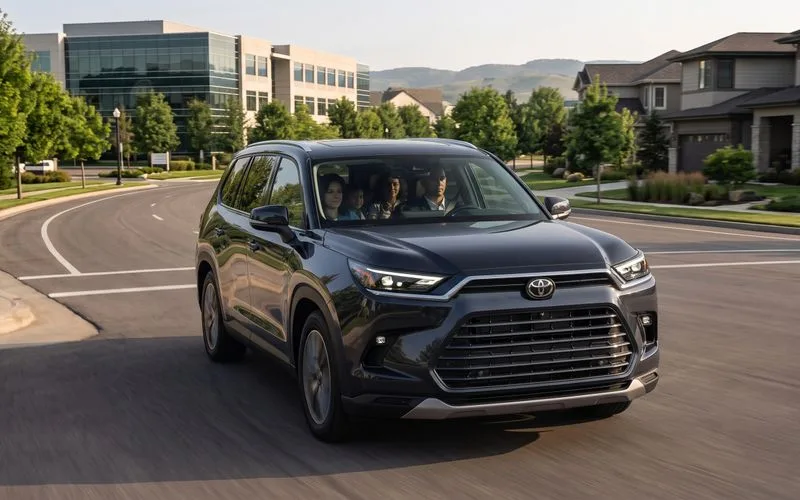 Toyota Grand HighlanderMid-Size SUVBetter at: Third-row space
Same Toyota reliability and the same hybrid tech, but with a third row and cargo hold that actually work — and an IIHS Top Safety Pick+ rating the Highlander doesn't have.
Compare 2.79B-
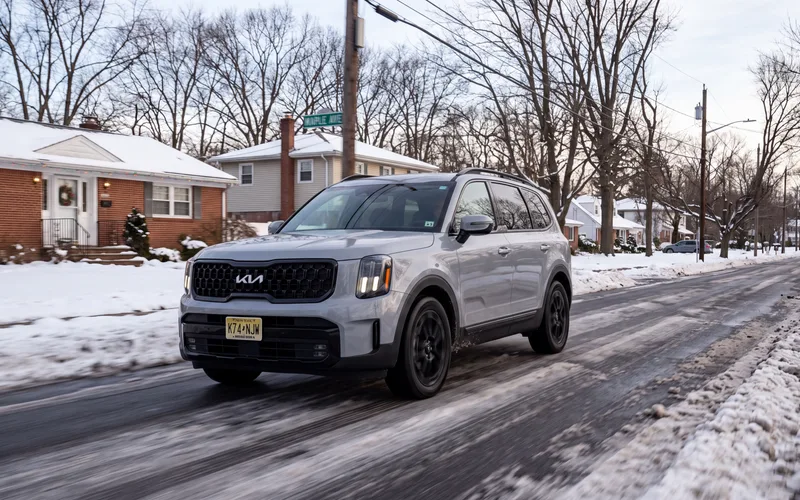 Kia TellurideMid-Size SUVBetter at: Space and warranty
More room, a nicer-feeling cabin at the same price, and a 10-year/100,000-mile powertrain warranty against Toyota's 5/60.
Compare 2.43C+
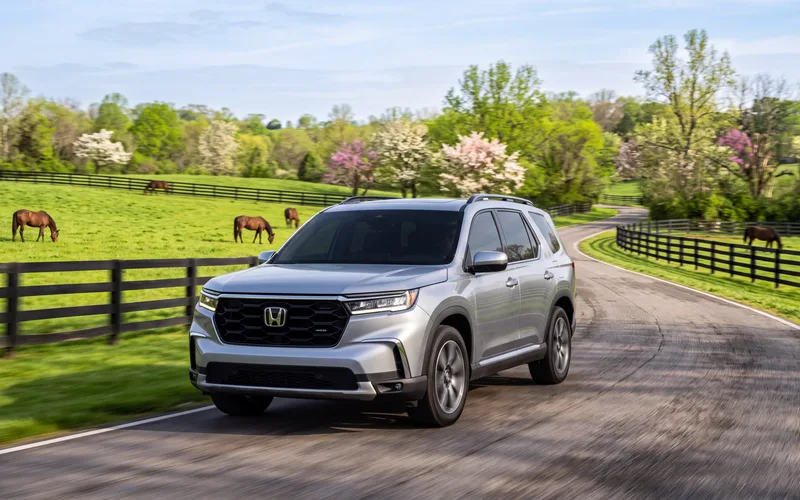 Honda PilotMid-Size SUVBetter at: Cargo versatility
The closest direct rival on size and price, with a more usable third row, smarter cargo solutions and a TrailSport trim for light off-road use.
CompareHow it's evolved
10 scored model years · 2017–2026
Subject scores by year
Hover or tap a score to see what moved it versus the year before. A corner mark flags a big swing.
| Year | Performance | Efficiency | Safety | Space | Cost | Reliability | Tech | Use-case | Driving | Value |
|---|---|---|---|---|---|---|---|---|---|---|
| 2026 | 49 | 54 | 71 | 72 | 55 | 80 | 65 | 65 | 62 | 62 |
| 2025 | 48 | 54 | 70 | 72 | 58 | 80 | 65 | 64 | 62 | 61 |
| 2024 | 47 | 54 | 80 | 72 | 60 | 77 | 64 | 64 | 62 | 64 |
| 2023 | 47 | 51 | 80 | 72 | 59 | 74 | 64 | 64 | 61 | 66 |
| 2022 | 49 | 43 | 79 | 72 | 60 | 81 | 52 | 63 | 65 | 65 |
| 2021 | 51 | 44 | 79 | 72 | 61 | 79 | 50 | 63 | 66 | 68 |
| 2020 | 50 | 49 | 76 | 72 | 61 | 77 | 50 | 63 | 64 | 68 |
| 2019 | 51 | 41 | 68 | 69 | 61 | 81 | 33 | 62 | 59 | 62 |
| 2018 | 50 | 47 | 70 | 70 | 59 | 80 | 33 | 61 | 60 | 71 |
| 2017 | 51 | 46 | 70 | 70 | 62 | 78 | 32 | 62 | 60 | 73 |
Compare two years
Best fit & conditions
Higher scores mean a better fit for that use case. Learn more about use-case fit →
Subject profile
Trims & configurations
5 trimsScores above reflect the volume trim. Per-trim specs and scores are rolling out — the full lineup:
Academic Probation · NHTSA safety recalls
No NHTSA safety recall is on record for the 2026 Toyota Highlander. Other model years of the Highlander have 23 — listed below.
23 recalls on other model years of the Highlander (2017–2025)
Mar 5, 2026Seats: mid/rear assembly: reclinerThe second-row seat backs may fail to lock into position during seat back adjustment.
Defect
Toyota Motor Engineering & Manufacturing (Toyota) is recalling certain 2021-2025 Highlander and Highlander Hybrid vehicles. The second-row seat backs may fail to lock into position during seat back adjustment.
Risk
A seat back that fails to lock may not properly restrain an occupant during a crash, increasing the risk of injury.
Remedy
Dealers will replace the return springs in the seat back recliner assemblies, free of charge. Owner letters were mailed September 9, 2026. This is a phased recall. Owners may contact Toyotaâs customer service at 1-800-331-4331. Toyota's numbers for this recall are 26TB06 and 26TA06.
NHTSA campaign 26V128000 ↗Manufacturer no. 26TB06 / 26TA06686,588 vehicles potentially affected (all models in the campaign)Owners notified Sep 4, 2026Filed by Toyota Motor Engineering & ManufacturingFiled as HIGHLANDER, HIGHLANDER HYBRIDDec 17, 2025Seat belts: rear/other: anchorageThe third row center seat belt roof anchor may have been installed at an incorrect angle, preventing the seat belt from properly restraining the occupant.
Defect
Toyota Motor Engineering & Manufacturing (Toyota) is recalling certain 2024-2025 Highlander and Highlander Hybrid vehicles. The third row center seat belt roof anchor may have been installed at an incorrect angle, preventing the seat belt from properly restraining the occupant.
Risk
A seat belt that does not properly restrain an occupant increases the risk of injury during a crash.
Remedy
Dealers will reinstall the seat belt anchor with a new bolt, free of charge. Owner notification letters were mailed January 27, 2026. Owners may contact Toyota customer service at 1-800-331-4331. Toyota's number for this recall is 25TA16.
NHTSA campaign 25V872000 ↗Manufacturer no. 25TA1639 vehicles potentially affected (all models in the campaign)Owners notified Jan 20, 2026Filed by Toyota Motor Engineering & ManufacturingFiled as HIGHLANDER, HIGHLANDER HYBRIDOct 30, 2025Back over prevention: display functionPlease see the recall report for a complete list of models. A software error may cause the rearview camera to freeze or display a blank screen when the vehicle is in reverse. As such, these vehicles fail to comply with the requirements of Federal Motor Vehicle Safety Standard (FMVSS) number 111, "Rear Visibility."
Defect
Toyota Motor Engineering & Manufacturing (Toyota) is recalling certain 2022-2026 Toyota, Lexus, and Subaru Solterra vehicles equipped with a Panoramic View Monitor (PVM) system. Please see the recall report for a complete list of models. A software error may cause the rearview camera to freeze or display a blank screen when the vehicle is in reverse. As such, these vehicles fail to comply with the requirements of Federal Motor Vehicle Safety Standard (FMVSS) number 111, "Rear Visibility."
Risk
A rearview camera that fails to display an image can reduce the driver's view behind the vehicle, increasing the risk of a crash.
Remedy
Dealers will update the parking assist software, free of charge. Owner letters were mailed January 2, 2026. Owners may contact Toyota's customer service at 1-800-331-4331. Toyota's numbers for this recall are 25TB13 and 25LB06. Subaru's number for this recall is WRE25.
NHTSA campaign 25V744000 ↗Manufacturer no. 25TB13/25LB06/WRE251,024,407 vehicles potentially affected (all models in the campaign)Owners notified Dec 5, 2025Filed by Toyota Motor Engineering & ManufacturingFiled as HIGHLANDER, HIGHLANDER HYBRIDSep 11, 2025Electrical system: instrument cluster/panelDue to an error in the instrument panel software at vehicle startup, the instrument panel may fail to display vehicle speed, brake system, and tire pressure warning lights.
Defect
Toyota Motor Engineering & Manufacturing (Toyota) is recalling certain 2023-2024 Toyota Venza, 2023-2025 RAV4 Prime, RAV4, Highlander, GR Corolla, Crown, 2024-2025 Lexus TX, LS, Toyota Tacoma, Grand Highlander, and 2025 Lexus RX, Toyota Crown Signia, Camry, RAV 4 Plug-in Hybrid (PHEV), and 4 Runner vehicles. Due to an error in the instrument panel software at vehicle startup, the instrument panel may fail to display vehicle speed, brake system, and tire pressure warning lights.
Risk
An instrument panel display that does not show critical information can increase the risk of a crash or injury.
Remedy
Dealers will update the instrument panel software over-the-air (OTA) for non-PHEV vehicles, free of charge. For PHEV vehicles, dealers will inspect the instrument panel assembly, and either replace it, or update the software, free of charge. Owner letters were mailed December 5, 2025. Additional letters will be sent, anticipated in May 2026. This is a phased recall. Owners may contact Toyota's customer service at 1-800-331-4331. Toyota's numbers for this recall are 25TB08 and 25TA08. Lexus' numbers for this recall are 25LB05 and 25LA05.
NHTSA campaign 25V595000 ↗Manufacturer no. See Part 573 Report591,377 vehicles potentially affected (all models in the campaign)Owners notified Dec 5, 2025Filed by Toyota Motor Engineering & ManufacturingFiled as HIGHLANDERJan 29, 2025Air bags: frontal: driver clockspring/spiral cassette · Steering: columnAn electrical connection inside the steering column's spiral cable assembly may be insufficiently welded, causing the connection to separate and deactivate the driver's air bag. As such, these vehicles fail to comply with the requirements of Federal Motor Vehicle Safety Standard number 208, "Occupant Crash Protection."
Defect
Toyota Motor Engineering & Manufacturing (Toyota) is recalling certain 2023 Toyota Corolla, Corolla Cross, Corolla Cross Hybrid, Highlander, Highlander Hybrid, Tacoma, Lexus RX350, 2023-2024 NX250, and NX350 vehicles that may have been incorrectly repaired under previous NHTSA recall number 23V-480. An electrical connection inside the steering column's spiral cable assembly may be insufficiently welded, causing the connection to separate and deactivate the driver's air bag. As such, these vehicles fail to comply with the requirements of Federal Motor Vehicle Safety Standard number 208, "Occupant Crash Protection."
Risk
A deactivated driver's air bag will not deploy as intended, increasing the risk of injury during a crash.
Remedy
Dealers will inspect and replace the spiral cable assembly as necessary, free of charge. Owner notification letters were mailed March 17, 2025. Owners may contact Toyota's customer service at 1-800-331-4331. Toyota's number for this recall is 25TA02. Lexus' number for this recall is 25LA02.
NHTSA campaign 25V040000 ↗Manufacturer no. 25TA02/25LA021,716 vehicles potentially affected (all models in the campaign)Owners notified Mar 17, 2025Filed by Toyota Motor Engineering & ManufacturingFiled as HIGHLANDER, HIGHLANDER HYBRIDJul 23, 2024Equipment: other: labelsThe load carrying capacity modification label may display inaccurate added weight values. As such, these vehicles fail to comply with the requirements of Federal Motor Vehicle Safety Standard number 110, "Tire Selection and Rims."
Defect
Gulf States Toyota, Inc. (GST) is recalling certain Toyota 2023 GR Supra, 2024 4 Runner, Corolla, Grand Highlander, Grand Highlander Hybrid, Land Cruiser Hybrid, Tacoma, Tacoma Hybrid, 2023-2024 BZ4X, Corolla Cross Hybrid, GR Corolla, GR86, Highlander, Highlander Hybrid, Prius, Prius Prime, Sequoia Hybrid, Tundra, Tundra Hybrid, Venza Hybrid, 2023-2025 Crown, and 2025 Camry Hybrid vehicles equipped with GST accessories. The load carrying capacity modification label may display inaccurate added weight values. As such, these vehicles fail to comply with the requirements of Federal Motor Vehicle Safety Standard number 110, "Tire Selection and Rims."
Risk
A vehicle with an incorrect maximum capacity weight value may be overloaded, which can increase the risk of a crash.
Remedy
GST will mail new labels to owners, free of charge. Owner notification letters were mailed September 16, 2024. Owners may contact GST customer service at 1-800-444-1074. GST's number for this recall is 24R2.
NHTSA campaign 24V548000 ↗Manufacturer no. 24R233,848 vehicles potentially affected (all models in the campaign)Owners notified Sep 16, 2024Filed by Gulf States Toyota, Inc.Filed as HIGHLANDER, HIGHLANDER HYBRIDJun 18, 2024TiresThe 20-inch accessory tires with an insufficient load rating for the vehicle's Gross Axle Weight Rating (GAWR) were installed. As such, these vehicles fail to comply with the requirements of Federal Motor Vehicle Safety Standard number 110, "Tire Selection and Rims."
Defect
Southeast Toyota Distributors, LLC (SET) is recalling certain 2021-2024 Highlander vehicles. The 20-inch accessory tires with an insufficient load rating for the vehicle's Gross Axle Weight Rating (GAWR) were installed. As such, these vehicles fail to comply with the requirements of Federal Motor Vehicle Safety Standard number 110, "Tire Selection and Rims."
Risk
Tires with an insufficient load rating can be overloaded and fail, increasing the risk of a crash.
Remedy
SET will inspect and replace the tires and information placard, as necessary free of charge. Owner notification letters were mailed August 16, 2024. Owners may contact SET's customer service at 1-866-405-4226. SET's number for this recall is SET24A.
NHTSA campaign 24V452000 ↗Manufacturer no. SET24A4,763 vehicles potentially affected (all models in the campaign)Owners notified Aug 16, 2024Filed by Southeast Toyota Distributors, LLCFiled as HIGHLANDERJun 6, 2024TiresThe installed tires have an insufficient load rating. As such, these vehicles fail to comply with the requirements of Federal Motor Vehicle Safety Standard number 110, "Tire Selection and Rims."
Defect
Gulf States Toyota, Inc. (GST) is recalling certain 2022-2024 model year Highlander L and Highlander LE vehicles equipped with the Blackout Package that includes 20" black alloy wheels and tires. The installed tires have an insufficient load rating. As such, these vehicles fail to comply with the requirements of Federal Motor Vehicle Safety Standard number 110, "Tire Selection and Rims."
Risk
Tires with an insufficient load rating may be overloaded and fail, increasing the risk of a crash.
Remedy
GST will inspect and replace the tires as necessary, and install a new tire information label as necessary, free of charge. Owner notification letters were mailed August 8, 2024. Owners may contact GST customer service at 1-800-444-1074. GST's number for this recall is 24R1.
NHTSA campaign 24V419000 ↗Manufacturer no. 24R14,869 vehicles potentially affected (all models in the campaign)Owners notified Aug 8, 2024Filed by Gulf States Toyota, Inc.Filed as HIGHLANDERDec 20, 2023Air bags: sensor: occupant classificationA short circuit may develop in the Occupant Classification System (OCS) sensor, preventing the front passenger air bag from deploying.
Defect
Toyota Motor Engineering & Manufacturing (Toyota) is recalling certain 2020-2021 Avalon, Avalon Hybrid, Corolla, Highlander, Highlander Hybrid, RAV4, RAV4 Hybrid, Lexus ES350, Lexus RX350, Lexus RX450H, 2021 Sienna Hybrid, Lexus ES250, 2020-2022 Camry, Camry Hybrid, and ES300H vehicles. A short circuit may develop in the Occupant Classification System (OCS) sensor, preventing the front passenger air bag from deploying.
Risk
An air bag that does not deploy during a crash increases the risk of injury.
Remedy
Dealers will inspect and replace the sensor as necessary, free of charge. Interim letters notifying owners of the safety risk were mailed in February 2024. Some final remedy owner letters were mailed October 31, 2024. Letters will continue to be mailed in phases through January 2026. Owners may contact Toyota customer service at 1-800-331-4331. Toyota's number for this recall is 23TB15/23TA15 Lexus 23LB03/23LA03.
NHTSA campaign 23V865000 ↗Manufacturer no. 23TA15, 23LA03999,901 vehicles potentially affected (all models in the campaign)Owners notified Oct 31, 2024Filed by Toyota Motor Engineering & ManufacturingFiled as HIGHLANDER, HIGHLANDER HYBRIDOct 26, 2023Structure: body: bumpersDuring normal vehicle operation, minor impact to the front lower bumper cover may result in the cover coming loose or detaching.
Defect
Toyota Motor Engineering & Manufacturing (Toyota) is recalling certain 2020-2023 Highlander & Highlander Hybrid vehicles. During normal vehicle operation, minor impact to the front lower bumper cover may result in the cover coming loose or detaching.
Risk
A detached front bumper cover can become a road hazard, increasing the risk of a crash.
Remedy
Dealers will repair or replace the upper and lower front bumper covers as necessary, free of charge. Owner letters were mailed April 22, 2024. Owners may contact Toyota customer service at 1-800-331-4331. Toyota's number for this recall is 23TB12/23TA12.
NHTSA campaign 23V720000 ↗Manufacturer no. 23TB12 / 23TA12750,795 vehicles potentially affected (all models in the campaign)Owners notified Apr 22, 2024Filed by Toyota Motor Engineering & ManufacturingFiled as HIGHLANDER, HIGHLANDER HYBRIDJul 12, 2023Air bags: frontal: driver clockspring/spiral cassette · Steering: columnAn electrical connection inside the steering column's spiral cable assembly may be insufficiently welded, causing the connection to separate and deactivate the driver's air bag. As such, these vehicles fail to comply with the requirements of Federal Motor Vehicle Safety Standard number 208, "Occupant Crash Protection."
Defect
Toyota Motor Engineering & Manufacturing (Toyota) is recalling certain 2023 Corolla, Corolla Cross, Corolla Cross Hybrid, Highlander, Highlander Hybrid, Tacoma, 2023 Lexus RX350, RX350 Hybrid, RX500 Hybrid, 2023-2024 Lexus NX250, NX350, and NX350 Hybrid vehicles. An electrical connection inside the steering column's spiral cable assembly may be insufficiently welded, causing the connection to separate and deactivate the driver's air bag. As such, these vehicles fail to comply with the requirements of Federal Motor Vehicle Safety Standard number 208, "Occupant Crash Protection."
Risk
A deactivated driver's air bag that does not deploy as intended increases the risk of injury during a crash.
Remedy
Dealers will inspect and replace the spiral cable assembly, if necessary, free of charge. Owner notification letters were mailed September 8, 2023. Owners may contact Toyota's customer service at 1-800-331-4331. Toyota's number for this recall is 23TA08. Lexus' number for this recall is 23LA02.
NHTSA campaign 23V480000 ↗Manufacturer no. 23TA08/ 23LA02152,927 vehicles potentially affected (all models in the campaign)Owners notified Sep 8, 2023Filed by Toyota Motor Engineering & ManufacturingFiled as HIGHLANDER, HIGHLANDER HYBRIDMay 6, 2022Equipment: other: labelsThe load carrying capacity modification labels may not be permanent and can fade, becoming illegible. As such, these vehicles fail to comply with the requirements of Federal Motor Vehicle Safety Standard number 110, "Tire Selection and Rims."
Defect
Gulf States Toyota, Inc. (GST) is recalling certain 2022 4Runner, Tacoma, Highlander, and Highlander Hybrid vehicles. The load carrying capacity modification labels may not be permanent and can fade, becoming illegible. As such, these vehicles fail to comply with the requirements of Federal Motor Vehicle Safety Standard number 110, "Tire Selection and Rims."
Risk
An illegible label may allow the vehicle to be overloaded, increasing the risk of a crash.
Remedy
GST will notify owners by mail, including a replacement load carrying capacity modification label for their vehicle and detailed replacement instructions, free of charge. Owner notification letters were mailed June 30, 2022. Owners may contact GST customer service at 1-800-444-1074. GST's number for this recall is 22R1.
NHTSA campaign 22V310000 ↗Manufacturer no. 22R1661 vehicles potentially affected (all models in the campaign)Owners notified Jun 30, 2022Filed by Gulf States Toyota, Inc.Filed as HIGHLANDER, HIGHLANDER HYBRIDApr 13, 2022Electronic stability control (esc): control module: softwareThe Skid Control ECU software may not turn on the Vehicle Stability Control (VSC) system when the vehicle is restarted after the driver has disabled the VSC system. As such, these vehicles fail to comply with the requirements of Federal Motor Vehicle Safety Standard number 126, "Electronic Stability Control Systems."
Defect
Toyota Engineering & Manufacturing (Toyota) is recalling certain 2022 Lexus LX 600, Lexus NX 350h, Lexus NX 450h+, Toytoa RAV4 Hybrid, 2021-2022 Lexus LS 500h, Toyota Mirai, RAV4 PRIME, Sienna, Venza, and 2020-2022 Toyota Highlander Hybrid vehicles. The Skid Control ECU software may not turn on the Vehicle Stability Control (VSC) system when the vehicle is restarted after the driver has disabled the VSC system. As such, these vehicles fail to comply with the requirements of Federal Motor Vehicle Safety Standard number 126, "Electronic Stability Control Systems."
Risk
Driving with a deactivated stability control system increases the risk of a crash.
Remedy
Dealers will update the Skid Control ECU software, free of charge. Owner notification letters were mailed May 27, 2022. Owners may contact Toyota customer service at 1-800-331-4331. Toyota's number for this recall is 22TA03. Lexus' number for this recall is 22LA01.
NHTSA campaign 22V239000 ↗Manufacturer no. 22TA03, 22LA01458,110 vehicles potentially affected (all models in the campaign)Owners notified May 27, 2022Filed by Toyota Motor Engineering & ManufacturingFiled as HIGHLANDER HYBRIDNov 4, 2020Fuel system, gasoline: delivery: fuel pumpThe low-pressure fuel pump inside the fuel tank may fail.
Defect
Toyota Motor Engineering & Manufacturing (Toyota) is recalling certain 2018-2019 4Runner, 2019-2020 Avalon, 2019 Corolla Hatchback, 2017-2019 Highlander, 2018-2020 Camry, 2020 Corolla, 2018-2019 Land Cruiser, 2017-2020 Tacoma, 2019-2020 RAV4, 2019-2020 Sequoia, 2017-2020 Sienna, 2019-2020 Tundra, 2018-2020 Lexus ES350, 2017 Lexus GS200t, 2017-2019 Lexus GS350, 2019 Lexus GS300, 2018-2020 Lexus LC500h, 2019-2020 Lexus LS500, 2018-2019 Lexus GX460, 2017 Lexus IS200t, 2019 Lexus IS300, 2019 Lexus IS350, 2018-2020 Lexus LC500, 2018 Lexus LS500, 2019 Lexus LS500h, 2018-2019 Lexus LX570, 2017 Lexus RC200t, 2019 Lexus RC300, RC350, 2017 and 2019-2020 Lexus RX350, 2018-2020 RX350L, 2019 Lexus UX200, 2018-2019 Lexus NX300 vehicles. The low-pressure fuel pump inside the fuel tank may fail.
Risk
If the fuel pump fails, the engine can stall while driving, increasing the risk of a crash.
Remedy
Toyota will notify owners, and dealers will replace the fuel pump assembly with an improved one, free of charge. Owners of specific models were notified that remedy parts were available starting January 21, 2021. Owners of other models will be notified as remedy parts become available. Remedy parts should be available for all affected vehicles by late March 2021. Owners may contact Toyota customer service at 1-888-270-9371 or Lexus customer service at 1-800-255-3987. Note: This recall is an expansion of recall 20V-012. Toyota's number for this recall is 20TA02. Lexus' number for this recall is 20LA01.
NHTSA campaign 20V682000 ↗Manufacturer no. 20TA02, 20LA011,525,742 vehicles potentially affected (all models in the campaign)Owners notified Jan 21, 2021Filed by Toyota Motor Engineering & ManufacturingFiled as HIGHLANDEROct 14, 2020Air bags · SeatsIncorrect seat trim covers on one or both of the front seats can prevent the seat-mounted side air bag from deploying properly.
Defect
Toyota Motor Engineering & Manufacturing (Toyota) is recalling certain 2020 Highlander and Highlander hybrid vehicles. Incorrect seat trim covers on one or both of the front seats can prevent the seat-mounted side air bag from deploying properly.
Risk
Improper deployment of the seat-mounted side air bag increases the risk of injury in the event of a crash.
Remedy
Toyota will notify owners, and dealers will inspect the front seats and replace the seat trim covers as necessary, free of charge. The recall began December 11, 2020. Owners may contact Toyota customer service at 1-800-331-4331. Toyota's number for this recall is 20TB14 / 20TA14.
NHTSA campaign 20V633000 ↗Manufacturer no. 20TB14 / 20TA143,121 vehicles potentially affected (all models in the campaign)Owners notified Dec 11, 2020Filed by Toyota Motor Engineering & ManufacturingFiled as HIGHLANDER, HIGHLANDER HYBRIDMar 19, 2020Engine · Fuel system, gasoline: deliveryDue to an Engine Control Unit (ECU) programming error, fuel may not be correctly supplied to the engine while using the stop and restart feature.
Defect
Toyota Motor Engineering & Manufacturing (Toyota) is recalling certain 2020 Highlander vehicles equipped with a 3.5 L, V6 (2GR-FKS) gasoline engine. Due to an Engine Control Unit (ECU) programming error, fuel may not be correctly supplied to the engine while using the stop and restart feature.
Risk
Improper fuel supply programming can result in a vehicle stall, increasing the risk of a crash.
Remedy
Toyota will notify owners, and dealers will reprogram the ECU, free of charge. The recall began May 15, 2020. Owners may contact Toyota customer service at 1-888-270-9371. Toyota's number for this recall is 20TA06.
NHTSA campaign 20V162000 ↗Manufacturer no. 20TA0638,810 vehicles potentially affected (all models in the campaign)Owners notified May 15, 2020Filed by Toyota Motor Engineering & ManufacturingFiled as HIGHLANDERJan 13, 2020Fuel system, gasoline: delivery: fuel pumpToyota Motor Engineering & Manufacturing (Toyota) recalled certain 2018-2019 4Runner, Highlander, Camry, Land Cruiser, Sequoia, Sienna, Tacoma and Tundra, and Lexus RC 300, RC 350, GS 350, GX 460, IS 300, LC 500, LS 500, LX 570, RX 350L, and 2019 Toyota Avalon and Corolla, and certain Lexus NX 300, and ES 350 vehicles on January 13, 2020. On March 4, 2020, Toyota expanded the recall to include certain 2014-2015 Toyota 4Runner and Land Cruiser, 2018 Avalon, Corolla, 2014 FJ Cruiser, 2017 Sienna and Lexus 2018 ES 350, 2018-2019 GS 300, 2013-2014 GS350, 2014-2015 GX 460, IS 350 and LX 570, 2014 IS F, 2018-2019 IS 350, LC 500H and LS 500H, 2013-2015 LS 460, 2015 NX 200T and RC350, 2017 RC 200T and RX 350. Toyota also removed the 2018-2019 Toyota 4Runner and Land Cruiser and 2018-2019 Lexus GX 460 and LX 570 and 2019 NX300 from inclusion in this recall. On March 19, 2020, Toyota expanded the recall to include 2015 Lexus GS350 vehicles. The low-pressure fuel pump inside the fuel tank may fail.
Defect
Toyota Motor Engineering & Manufacturing (Toyota) recalled certain 2018-2019 4Runner, Highlander, Camry, Land Cruiser, Sequoia, Sienna, Tacoma and Tundra, and Lexus RC 300, RC 350, GS 350, GX 460, IS 300, LC 500, LS 500, LX 570, RX 350L, and 2019 Toyota Avalon and Corolla, and certain Lexus NX 300, and ES 350 vehicles on January 13, 2020. On March 4, 2020, Toyota expanded the recall to include certain 2014-2015 Toyota 4Runner and Land Cruiser, 2018 Avalon, Corolla, 2014 FJ Cruiser, 2017 Sienna and Lexus 2018 ES 350, 2018-2019 GS 300, 2013-2014 GS350, 2014-2015 GX 460, IS 350 and LX 570, 2014 IS F, 2018-2019 IS 350, LC 500H and LS 500H, 2013-2015 LS 460, 2015 NX 200T and RC350, 2017 RC 200T and RX 350. Toyota also removed the 2018-2019 Toyota 4Runner and Land Cruiser and 2018-2019 Lexus GX 460 and LX 570 and 2019 NX300 from inclusion in this recall. On March 19, 2020, Toyota expanded the recall to include 2015 Lexus GS350 vehicles. The low-pressure fuel pump inside the fuel tank may fail.
Risk
If the fuel pump fails, the engine can stall while driving, increasing the risk of a crash.
Remedy
Toyota will notify owners, and dealers will replace the fuel pump, free of charge. The recall began May 4, 2020. Owners may contact Toyota customer service at 1-888-270-9371 or Lexus customer service at 1-800-255-3987. Toyota's numbers for this recall are 20TB02 and 20TA02 for Toyota vehicles and 20LB01 and 20LA01 for Lexus vehicles.
NHTSA campaign 20V012000 ↗Manufacturer no. 20TB02/20TA02/20LB011,830,752 vehicles potentially affected (all models in the campaign)Owners notified May 1, 2020Filed by Toyota Motor Engineering & ManufacturingFiled as HIGHLANDERMar 27, 2019Equipment: other: labelsThe text on the load capacity label may become illegible. As such, these vehicles fail to comply with the requirements of Federal Motor Vehicle Safety Standard (FMVSS) number 110, "Tire Selection and Rims."
Defect
Gulf States Toyota (GST) is recalling certain 2019 C-HR, 4Runner, Avalon, Avalon Hybrid, Camry, Camry Hybrid, Highlander, Land Cruiser, Prius, RAV4, Sequoia, Tacoma, Sienna, Tundra and Yaris vehicles. The text on the load capacity label may become illegible. As such, these vehicles fail to comply with the requirements of Federal Motor Vehicle Safety Standard (FMVSS) number 110, "Tire Selection and Rims."
Risk
If the driver cannot read the label, they may unknowingly overload the vehicle, increasing the risk of a crash.
Remedy
GST will notify owners, and dealers will provide corrected load carrying capacity modification labels, free of charge. The recall began May 24, 2019. Owners may contact GST customer service at 1-800-444-1074. GST's number for this recall is 19R1.
NHTSA campaign 19V244000 ↗Manufacturer no. 19R13,634 vehicles potentially affected (all models in the campaign)Owners notified May 24, 2019Filed by Gulf States Toyota, Inc.Filed as HIGHLANDERNov 27, 2018Electrical system · Visibility: windshieldThe windshields have an attached wire harness that water may leak into, possibly causing damage to the vehicle's Engine Control Module (ECM).
Defect
Fujian Wanda Automobile Glass Industry (Wanda) is recalling certain aftermarket Replacement Windshields sold for use in 2014-2018 Toyota Highlander vehicles. The windshields have an attached wire harness that water may leak into, possibly causing damage to the vehicle's Engine Control Module (ECM).
Risk
The ECM damage may result in the engine stalling, increasing the risk of a crash.
Remedy
Wanda will notify owners, and service centers will replace the windshields, and inspect the ECM for damage, having it replaced, as necessary, free of charge. The recall began January 29, 2019. Owners may contact Wanda customer service at 1-864-281-2760.
NHTSA campaign 18E107000 ↗8,202 vehicles potentially affected (all models in the campaign)Owners notified Jan 29, 2019Filed by Fujian Wanda Automobile Glass Industry CFiled as HIGHLANDERApr 3, 2018Service brakes, hydraulic: power assist: vacuumDuring the manufacturing process, the oil galley in the rotor for the brake booster vacuum pump assembly may have been improperly machined possibly resulting in a sudden loss of brake assist.
Defect
Toyota Motor Engineering & Manufacturing (Toyota) is recalling certain 2018 Toyota Camry and Highlander vehicles, 2017 Toyota Sienna and Tacoma vehicles and 2017 Lexus RX350 vehicles. During the manufacturing process, the oil galley in the rotor for the brake booster vacuum pump assembly may have been improperly machined possibly resulting in a sudden loss of brake assist.
Risk
A sudden loss of braking assist can increase the risk of a crash.
Remedy
Toyota will notify owners, and dealers will replace the brake booster vacuum pump, free of charge. The recall began on May 9, 2018. Owners may contact Toyota customer service at 1-888-270-9371, or Lexus customer service at 1-800-255-3987. Toyota's numbers for this recall are J0K/JLD.
NHTSA campaign 18V211000 ↗Manufacturer no. J0K/JLD6,046 vehicles potentially affected (all models in the campaign)Owners notified May 9, 2018Filed by Toyota Motor Engineering & ManufacturingFiled as HIGHLANDERDec 20, 2017Equipment: other: labelsThese vehicles may have incorrect load carrying capacity modification labels. As such, these vehicles fail to comply with the requirements of Federal Motor Vehicle Safety Standard (FMVSS) number 110, "Tire Selection and Rims."
Defect
Toyota Motor Engineering & Manufacturing (Toyota) is recalling certain 2017-2018 Toyota 4Runner and Tundra, 2018 Toyota Highlander, RAV4 and Lexus GX460 and 2017 Toyota Sienna and Tacoma vehicles. These vehicles may have incorrect load carrying capacity modification labels. As such, these vehicles fail to comply with the requirements of Federal Motor Vehicle Safety Standard (FMVSS) number 110, "Tire Selection and Rims."
Risk
An incorrect load information label can result in the operator overloading the vehicle and increasing the risk of a crash.
Remedy
Toyota will notify owners and provide them with corrected labels, free of charge. The recall began on January 23, 2018. Owners may contact Toyota customer service at 1-800-331-4331. Toyota's numbers for this recall are H0Z for Toyota vehicles, and HLF for Lexus vehicles.
NHTSA campaign 17V831000 ↗Manufacturer no. Toyota H0Z Lexus HLF649 vehicles potentially affected (all models in the campaign)Owners notified Jan 23, 2018Filed by Toyota Motor Engineering & ManufacturingFiled as HIGHLANDERAug 23, 2017EquipmentThe fasteners for the roof rails may not be torqued properly.
Defect
Gulf States Toyota, Inc. (GST) is recalling certain 2017 Toyota Highlander and Highlander Hybrid vehicles equipped with accessory roof rail cross bars. The fasteners for the roof rails may not be torqued properly.
Risk
The roof rails may loosen and possibly detach from the vehicle, becoming a road hazard and increasing the risk of a crash.
Remedy
GST will notify owners, and dealers will inspect and properly torque the fasteners, free of charge. The recall began September 29, 2017. Owners may contact GST customer service at 1-800-444-1074. GST's number for this recall is 17R3.
NHTSA campaign 17V520000 ↗Manufacturer no. 17R31,121 vehicles potentially affected (all models in the campaign)Owners notified Sep 29, 2017Filed by Gulf States Toyota, Inc.Filed as HIGHLANDER, HIGHLANDER HYBRIDMay 2, 2017Tires: temporary/emergency spare tireThe spare tire air pressure was not adjusted to the proper pressure as stated on the Tire Pressure Label.
Defect
Gulf States Toyota, Inc. (Gulf States) is recalling certain 2017 4Runner , 86, Avalon, Camry, Camry Hybrid, Corolla, Corolla iM, Highlander, Highlander Hybrid, Prius, Prius C, RAV4, RAV4 Hybrid, Sienna and Yaris vehicles. The spare tire air pressure was not adjusted to the proper pressure as stated on the Tire Pressure Label.
Risk
A spare tire that is not inflated to the proper value may not perform as intended, increasing the risk of a crash.
Remedy
Gulf States will notify owners, and dealers will inspect the spare tires, adjusting their pressure as necessary, free of charge. The recall began June 15, 2017. Owners may contact Gulf States customer service at 1-800-444-1074. Toyota's number for this recall is 17R2.
NHTSA campaign 17V295000 ↗Manufacturer no. 17R2409 vehicles potentially affected (all models in the campaign)Owners notified Jun 15, 2017Filed by Gulf States Toyota, Inc.Filed as HIGHLANDER, HIGHLANDER HYBRID
Source: NHTSA Office of Defects Investigation recall database, model years 2017–2026. Recalls are listed by model year as the manufacturer filed them; whether a specific car is affected depends on its VIN — check a VIN at nhtsa.gov ↗. NHTSA model names matched to this page: HIGHLANDER, HIGHLANDER HYBRID.
Detailed scoring by subject
1Performance & PowertrainThe Highlander's lowest-graded category.1.26D
Volume XLE trim runs the T24A-FTS 2.4L turbo four rated 265 hp, which replaced the 3.5L V6 for the 2023 model year and carries through the XU70 generation; the 2.5L hybrid is rated 243 hp combined. Modest output for a mid-size three-row, well under V6 and turbo-six rivals.
The turbo four's 310 lb-ft arrives low and broad, a meaningful gain over the 263 lb-ft of the superseded V6 and the main reason the car feels adequate despite modest peak horsepower.
Instrumented testing of the 2.4T AWD has landed around 7.0 seconds — mid-pack for the mid-size three-row segment, quicker off the line than the outgoing V6 thanks to low-end boost but not class-leading.
Adequate but not polished: the 2.4T pulls well on its low-end torque yet is widely criticized as coarse and thrashy at high revs with noticeable off-the-line lag, a step back in smoothness from the V6 it replaced. The hybrid is markedly more refined around town but noisy under full throttle.
The 8-speed automatic is smooth and unobtrusive in normal driving but is reported to hesitate and hunt when asked for a quick downshift; the hybrid's eCVT is seamless in traffic but drones under hard acceleration. Solidly mid-band, neither a strength nor a flaw.
5,000 lbs properly equipped with the turbo four matches the Pilot and Explorer and is a genuine strength relative to compact crossovers, though it trails body-on-frame and turbo-six three-rows. The hybrid drops to 3,500 lbs.
AWD is optional across essentially the whole trim range rather than restricted to the top, and upper gas trims get Dynamic Torque Vectoring AWD with a rear driveline disconnect while the hybrid uses electric E-Four. But there is no low range, and LE/XLE make do with a basic on-demand coupling — capable, not sophisticated.
Squarely pavement-oriented. Roughly 8 inches of ground clearance, unibody construction, no skid plates, no locking differentials and no dedicated off-road trim — the Nightshade package is cosmetic only. Rates well below the Pilot TrailSport or any TRD-equipped Toyota.
Two distinct powertrains — the 2.4L turbo gas four and the 2.5L hybrid — cover mainstream needs and include an electrified option available across most of the range. No PHEV, no EV variant and no performance engine keeps it out of the top band.
2Efficiency & RangeOne of the Highlander's weakest categories.1.61D
Volume config is the XLE AWD with the 2.4L turbo four and 8-speed automatic, EPA-rated 24 MPG combined; the optional 2.5L hybrid lifts that to 35-36 MPG combined but is not the volume powertrain.
City economy is the turbo four's weakest figure — no electric assist off the line in a ~4,300 lb three-row — and it trails the hybrid by roughly 15 MPG in exactly the driving where families spend most of their miles.
The turbo four's tall 8-speed top gears make highway its best case, and it closes most of the gap to the hybrid here (28 vs 34) — the hybrid's advantage is overwhelmingly a city-cycle advantage.
A 17.9-gallon tank at 24 MPG combined gives roughly 430 miles between fills — mid-pack for a mid-size three-row, ahead of the Pilot's ~390 but well short of what the same tank returns in hybrid form.
At EPA's standard 15,000 miles a year the gas Highlander burns about 625 gallons of regular, around $2,060 — roughly $645 a year more than the same vehicle in hybrid form, which is the number that decides whether the hybrid premium pays back.
Both powertrains run on 87-octane regular with no premium recommendation and no power or torque penalty for using it, and neither needs charging infrastructure — the least demanding energy setup available short of an EV with home charging.
3SafetyOne of the Highlander's strongest categories.2.82B-
NHTSA rates the fourth-generation (XU70) Highlander 5 stars overall, with the frontal-crash and rollover sub-scores at 4 stars; the 2026 car is a carryover of the 2024-refreshed structure so the rating carries forward.
The Highlander carries no IIHS Top Safety Pick award: it earns Good in the original small overlap (driver and passenger), roof strength and head restraints, but falls to Marginal in the updated moderate overlap front test on rear-passenger protection, which disqualifies it outright. Its own showroom sibling, the Grand Highlander, is a TSP+ — a direct in-family contrast that makes the gap hard to excuse.
Toyota Safety Sense 3.0 is standard on every trim from the base LE up — pre-collision with pedestrian, cyclist and intersection-turn detection, full-speed-range adaptive cruise, lane departure alert with steering assist, lane tracing assist, road sign assist, automatic high beams and Proactive Driving Assist — and Blind Spot Monitor with Rear Cross-Traffic Alert is standard across the range too, so nothing in the core five is paywalled.
The TSS 3.0 pre-collision system earns Superior in the legacy IIHS vehicle-to-vehicle and daytime pedestrian evaluations and detects pedestrians at night, but it is only mid-pack against the 2024-updated higher-speed front crash prevention test that raised closing speeds to 31-43 mph — solid rather than class-leading.
Blind Spot Monitor and Rear Cross-Traffic Alert are standard on every trim, which is better than several mainstream three-row rivals, but coverage is alert-only on the volume LE/XLE — rear cross-traffic braking and Safe Exit Assist appear only on Limited and Platinum.
Lane Departure Alert with Steering Assist plus Lane Tracing Assist give real centering on the highway, and Proactive Driving Assist adds gentle corner and lead-car braking, but reviewers consistently describe Toyota's centering as reactive — it drifts toward a lane edge before correcting rather than holding the middle the way the best systems do.
Full-Speed Range Dynamic Radar Cruise Control is standard on all trims and works down to a stop with automatic resume in traffic; it is one of the smoother mainstream systems for following distance and merge handling, held back only by lane tracing that is less confident than the cruise control itself.
There is no hands-free highway driving on the Highlander at any trim or price — Toyota Teammate Advanced Drive remains a Lexus-side offering — so a shopper cross-shopping a BlueCruise Explorer or a Super Cruise Traverse simply cannot get the feature here.
LED projector headlights with automatic high beams are standard across the line and rate at least Acceptable, with the better-performing units on Limited and Platinum — good enough not to block an award, but the volume LE/XLE trims do not get the strongest setup.
Forward and over-the-shoulder sightlines are respectable for a three-row, helped by a relatively low beltline, but the thick D-pillars and shallow rear glass create a real rearward blind zone with the third row up; the 360-degree Panoramic View Monitor that compensates for it is confined to Limited and Platinum, leaving volume trims with a plain backup camera.
Two full LATCH positions in the second row plus tether anchors including the third row, with wide rear door openings and available second-row captain's chairs that make loading easy — but the lower anchors sit deep in the seat bight and take some digging, and the Highlander's second row is narrower than the Grand Highlander's for three-across seats.
4Space & ComfortOne of the Highlander's strongest categories.2.89B-
The 2026 Highlander carries the XU70 generation's three-row layout unchanged: an eight-passenger second-row bench on LE/XLE and seven passengers when the second-row captain's chairs are fitted (standard on XSE/Limited/Platinum). Replaces a placeholder that wrongly listed the Highlander as a five-seater.
Front headroom is generous for a mid-size three-row SUV, and the figure quoted is the non-moonroof measurement per the item's instruction; moonroof-equipped upper trims give up roughly 1.7 in.
Front legroom of 42.0 in is mid-pack for the segment — adequate but noticeably behind the Grand Highlander and the Palisade/Telluride pair, reflecting the Highlander's tighter overall packaging.
Second-row headroom of 39.4 in is near the top of the SUV normalization band and one of the Highlander's genuine packaging strengths — the boxy roofline pays off in the middle row.
At 41.0 in the sliding second row is class-competitive and comfortably adult-sized, though that measurement is taken with the bench rearward, which is precisely the position that leaves the third row unusable.
The Highlander's third row is the weakest part of the package: roughly 28 in of legroom and 36 in of headroom make it a children-only bench, and adults can only be seated by sliding the second row uncomfortably far forward. Access via the tilt-and-slide second row is easy enough, but Toyota effectively conceded the point by launching the Grand Highlander for buyers who need real third-row space.
With the third row folded the Highlander offers 48.4 cu ft — usable but well short of the Grand Highlander's 57.9 cu ft and the larger Korean rivals. The 16.0 cu ft available with all three rows up is enough for a modest grocery run but not a family's luggage.
Maximum cargo volume of 84.3 cu ft is solidly mid-pack for a mid-size three-row SUV, and both rear rows fold to a near-flat load floor.
Competitive everyday storage without a headline trick: the full-width dashboard shelf with a pass-through behind the center stack is genuinely useful, and the deep console, large door bins and five USB ports cover family duty. There is no underfloor cargo well, no fold-flat front passenger seat and nothing approaching a Pilot-style removable middle seat or a giga-console.
Front seats are well shaped and comfortable over long stints with power adjustment and lumbar on the volume XLE and above, and the second row is supportive whether bench or captain's chairs. The score is held out of the top band by a third row that is uncomfortable for anyone larger than a child and by second-row cushions that sit fairly low to the floor.
The Highlander rides in a composed, absorbent way that suits its family-hauler brief — body motions are well damped and broken pavement is soaked up without float. Limited and Platinum trims on 20-inch wheels pick up noticeably more sharp-edged impact harshness, which keeps it below the segment's plushest offerings.
Wind and road noise are well suppressed at cruise, but the powertrains are the problem: the 2.4-liter turbo four sounds coarse and thrashy under load and the hybrid's 2.5-liter drones under hard acceleration, both a step back from the smooth V6 this generation used to offer. Acoustic front glass on upper trims helps but does not fix the engine note.
Comfort equipment is strong and reaches down the range: tri-zone automatic climate control with second- and third-row vents and remote start are standard across the lineup, heated front seats and a heated steering wheel arrive on the volume XLE, and ventilated front seats plus heated second-row seats are available on Limited and Platinum. It falls short of the top band only because ventilation and heated rear seats stay locked to the two most expensive trims.
5Cost of OwnershipOne of the Highlander's weakest categories.1.72C-
2026 Highlander carries over the facelifted XU70 with no redesign, so entry pricing tracks a normal year-over-year step from the 2025 LE FWD (~$40,010 + $1,450 destination) to roughly $40,800 + $1,495. Priced mid-pack for a mainstream three-row: above Pilot/Telluride entry points, below Grand Highlander.
XLE is the Highlander's volume trim and AWD is the dominant mix in this segment; the previous placeholder ($36,541) sat below any real Highlander trim, which accounts for most of this item's downward delta. Hybrid adds roughly $2,600 over the equivalent gas trim.
Toyota mid-size SUVs sit near the bottom of the segment's maintenance-and-repair curve: long service intervals, high parts availability, and few out-of-warranty repair events on the 2.4L turbo and the 2.5L hybrid. Well inside the cheap end of the SUV band (3,000–9,500).
The Highlander is one of the stronger residual performers among mainstream three-row SUVs — persistent used demand, Toyota reliability reputation, and hybrid availability all support values. Strong for the class but short of the body-on-frame Toyotas (4Runner, Land Cruiser) that top the retention charts.
Toyota's standard 36-month/36,000-mile basic coverage is the floor of the 3–5 year band, so it normalizes to 0 — materially behind Hyundai/Kia's 5 yr/60,000 mi. The prior placeholder assumed 3.9 years, which no Toyota offers.
The volume gas trim carries Toyota's 60-month/60,000-mile powertrain coverage — bottom of the 5–10 year band, hence a 0. Hybrid buyers get materially better protection (10 yr/150,000 mi on the battery), but that does not apply to the gas XLE scored as representative.
ToyotaCare covers 2 years/25,000 miles of factory-scheduled maintenance plus 2 years of unlimited-mileage roadside assistance, and connected services ship with trial periods. Solid and genuinely multi-year, but shorter than the 3 yr/36,000 mi plans from Hyundai/Genesis and thinner on perks than luxury rivals — upper-middle of the guidance band rather than top tier.
$46,800 volume-trim price minus its estimated resale value after 5 years (55% retained, or about $25,740) leaves about $21,060 in depreciation. Add the projected $4,200 in 5-year maintenance and repairs, and owning this vehicle for 5 years costs about $25,260 in total.
6Reliability & QualityThe Highlander's best-graded category.3.46B+
The Highlander is one of the most consistently dependable three-row mainstream SUVs, with Consumer Reports predicted reliability at or above average across the XU70 generation and strong J.D. Power quality standing; 2026 is a late, mature year of that generation with the early bugs worked out. Held below the 90s because the volume gas trim now uses the 2.4L turbo four adopted in 2023, which has a shorter record than the 3.5L V6 it replaced.
Toyota is the benchmark mass-market brand for dependability, placing top-two in Consumer Reports brand reliability rankings year after year (usually behind or alongside Lexus) and finishing above industry average in J.D. Power's Vehicle Dependability Study.
The XU70 generation has carried typical-to-slightly-elevated recall activity over its run — the industry-wide Denso low-pressure fuel pump campaign, seat belt/third-row anchor and backup-camera software actions — but nothing systemic to the engine or transmission. Scored conservatively because the 2026-specific NHTSA campaign list could not be checked.
The hybrid's 2.5L A25A-FXS with THS II eCVT is one of the most proven high-mileage powertrains on sale, shared with Camry and RAV4 and hardened by fleet duty. The volume gas trim's 2.4L T24A-FTS turbo four with the 8-speed automatic has been in Highlander only since 2023 and lacks a comparable 150k-mile record, which caps this item well short of the V6 era's reputation.
The cabin is durable and sensibly laid out but is a repeated criticism in reviews: hard plastics across the lower dash and door cards on the volume XLE trim, and perceived richness behind Palisade, Telluride and Pilot at similar money. Platinum trim's leather and upgraded surfaces close the gap only partway.
Assembly quality is a strength — tight, consistent panel gaps and few rattle or squeak complaints from a mature production line, with Toyota around industry average on J.D. Power Initial Quality (a study that penalizes infotainment friction more than build defects).
Toyota runs one of the densest US dealer networks — roughly 1,200 franchised dealers, so service is reachable almost anywhere in the country — with service satisfaction that rates solidly, if not exceptionally, among mass-market brands.
Parts are abundant, inexpensive and widely stocked given Highlander's volume and long production run, with strong independent-shop familiarity and a large aftermarket. Estimated annual repair cost runs below the mid-size SUV average; the turbo four adds some complexity versus the old V6 but no unusual parts cost.
7Technology & InfotainmentMid-pack among this car's ten categories.2.40C+
The volume XLE grade still ships the 8.0-inch Toyota Audio Multimedia head unit introduced with the 2023 XU70 facelift; the 12.3-inch display remains a Limited/Platinum item. Eight inches is at the bottom of the mid-size SUV band for 2026, where rivals standardize 12-inch-plus screens.
Toyota Audio Multimedia is quick, logically laid out, and keeps real volume/tuning knobs plus physical climate controls — a genuine strength against touch-only rivals. It loses points for the small 8-inch panel on volume trims, which leaves large dashboard bezels and cramped split-screen views.
Wireless Apple CarPlay and wireless Android Auto are standard on every Highlander grade, including the base LE — the top band of this item and one of the vehicle's clearest tech wins.
The 'Hey Toyota' Intelligent Assistant handles natural-language climate, audio and destination requests competently, but both it and cloud navigation sit behind the Drive Connect subscription once the trial lapses — so most volume-trim owners fall back to phone projection for maps.
The base six-speaker system is merely adequate, and the 11-speaker JBL Premium upgrade — available on Limited, standard on Platinum — is a solid but unremarkable branded system next to the Bose and Harman setups in Palisade and Telluride.
Volume grades get a part-analog cluster with a 7-inch multi-information display; the full 12.3-inch digital cluster is a top-trim item (standard Platinum, available Limited). That is squarely the 'partial digital / full digital on upper trims only' band.
Toyota Audio Multimedia accepts over-the-air updates for the infotainment software and map data, but the Highlander has no whole-vehicle OTA architecture that adds powertrain, chassis or driver-assist features after delivery.
The Toyota app covers the core set — remote start/climate, lock/unlock, vehicle locate and status — and Digital Key is offered, but Remote Connect reverts to a paid subscription after its trial, which is the main drag on an otherwise competent app.
USB-C data/charge ports are distributed across all three rows and Qi wireless charging is standard from XLE up, which covers a family SUV's needs. No household 120V AC outlet is offered, which caps it below the top band.
Smart Key proximity entry with push-button start and key-fob remote start are standard across the lineup, a hands-free power liftgate arrives on upper grades, and Digital Key phone-as-key is offered — strong convenience coverage, held just below the top band by the subscription tie and trim-gated hands-free liftgate.
Rear camera is standard and parking sensors with automatic braking are widely fitted, but the Panoramic View Monitor surround camera is reserved for Limited/Platinum, its resolution trails newer rivals, and no automated parking feature is offered on the Highlander.
A 10-inch color head-up display is offered only on the range-topping Platinum grade, so no volume-trim buyer can get one — the 'HUD limited to top trims' band.
8Use-Case FitMid-pack among this car's ten categories.2.37C+
Wide rear door openings, a tilt-and-slide second row that opens third-row access without uninstalling a seat, two full LATCH sets and available captain's chairs cover everyday kid duty well. Held mid-band because the lower anchors sit deep in the seat bight, the second row is too narrow for three car seats across, and only 16.0 cu ft behind the third row leaves no room for a stroller once the car is full.
Toyota Safety Sense 3.0 plus Blind Spot Monitor with Rear Cross-Traffic Alert are standard from the base LE up, and NHTSA gives the Highlander 5 stars overall — families get the real safety content on the trims they actually buy. It cannot reach the top band because IIHS rates it Marginal in the updated moderate overlap front test, so it carries no Top Safety Pick while its own showroom sibling the Grand Highlander is a TSP+, and Safe Exit Assist plus the 360-degree camera are locked to Limited/Platinum.
The second row is genuinely good for long hauls — 41.0 in of sliding legroom, 39.4 in of headroom, supportive cushions, and standard tri-zone automatic climate with second- and third-row vents plus USB-C ports in all three rows. It falls to the middle of the band because the third row is a children-only bench at 28.0 in of legroom, luggage space with all seven or eight aboard is just 16.0 cu ft, and there is no rear entertainment or 120V outlet anywhere in the lineup.
This is the Highlander's home ground: the hybrid's eCVT is seamless in stop-and-go, the ride is compliant, controls are light, and TSS 3.0 puts full-speed-range adaptive cruise, Lane Tracing Assist and Proactive Driving Assist on every trim including the base LE. It stops short of the top band because the 2.4L turbo four is coarse and boomy under load and rearward sightlines are poor with the third row up.
The hybrid returns 35 MPG combined AWD (36 FWD) for roughly $1,415 a year in regular unleaded, near the top of anything with three rows, and Toyota's running costs are class-leading — annual repair around $490 against a roughly $570 segment average, plus 2 years/25,000 miles of ToyotaCare. It misses the top band because the volume gas XLE runs the 2.4T at only 24 MPG combined AWD (~$2,060/yr), which is merely average for the class.
A 36.3 ft turning circle is good for a three-row and the Highlander's footprint is the smallest among mainstream mid-size three-rows, so it threads city streets and garages more easily than a Telluride or Grand Highlander. It stays mid-band because thick D-pillars and shallow rear glass create a real blind zone, the 360-degree Panoramic View Monitor is confined to Limited and Platinum, and no automated parking assist is offered at all.
Properly equipped with the 2.4L turbo the Highlander tows 5,000 lbs — enough for a small utility trailer, a pair of jet skis or a modest boat, and level with the Pilot and Explorer — but the hybrid most efficiency buyers choose drops to 3,500 lbs. It sits at the bottom of the light-duty band because there is no bed, the unibody platform offers modest payload, and the 265 hp turbo four is working hard anywhere near its rating.
Toyota's dependability record is the strongest in the mass market — top-two in Consumer Reports brand reliability, above average in J.D. Power's dependability study, cheap and universally stocked parts — and the cloth interiors on LE and XLE shrug off abuse better than the leather-lined rivals. It stays out of the fleet-proven band because the Highlander is a family unibody crossover with no commercial or work-fleet history in this role, and the T24A-FTS turbo four is a newer, less-proven unit than the 3.5L V6 it replaced in 2023.
Work-oriented provisions are thin: cargo-area tie-down hooks, roof rails from XLE up and a dealer-accessory tow hitch are essentially the whole list. It lands in the low band because no 120V household outlet is offered anywhere in the lineup, there are no washable or rubberized cargo surfaces from the factory (the all-weather liner is an accessory), and there is no commercial upfit ecosystem behind the vehicle.
The hybrid's roughly 625-mile range on a 17.9-gallon tank is a genuine touring advantage, and comfortable front seats, a compliant ride and TSS 3.0's full-speed radar cruise plus Lane Tracing Assist keep fatigue low over a long day. It stays in the upper-middle of the band because cabin quietness is only mid-pack for the class, the gas 2.4T manages about 430 miles a tank, and no hands-free highway assist is available.
AWD is available across essentially the whole range — electric E-Four on the hybrid, Dynamic Torque Vectoring with a rear driveline disconnect on upper gas trims — and roof rails plus a 5,000 lb tow rating handle bikes, a cargo box or a small camper. It sits mid-band because roughly 8.0 in of ground clearance, unibody construction, no low range, no skid plates, no locking differential, no off-road trim (Nightshade is cosmetic only) and no 120V camp power keep it to gravel roads and trailheads rather than trails.
Both rear rows fold 60/40 to a near-flat floor for 84.3 cu ft, and roof rails plus an accessory hitch cover bikes, boxes and a small trailer. It stays in the middle of the band because 84.3 cu ft is no better than mid-pack for a three-row, the 16.0 cu ft behind the third row is genuinely restrictive when the car is full, and there is no underfloor cargo well and no fold-flat front passenger seat for long items.
9Driving ExperienceMid-pack among this car's ten categories.2.17C
The XU70 Highlander is the most compact of the mainstream three-rows (roughly 195 in long on a 112.2-in wheelbase), and the TNGA-K platform gives it tidy, secure body control that makes it feel a size smaller than a Pilot or Traverse. Grip and turn-in are unremarkable on the comfort-biased all-seasons and there is clear body roll when pushed, so it lands solidly mid-band: easy and confidence-inspiring rather than engaging.
Toyota's electric rack is accurate, consistent, and light enough to make parking-lot work effortless, which suits the mission, but it is heavily isolated with essentially no road feedback and little build-up in weight off-center. Precise enough but numb — textbook mid-band.
Stopping power is class-typical for a ~4,300-4,600 lb three-row and no fade complaints attach to this generation. The gas 2.4T has a firm, predictable pedal; the hybrid's regen blending is well-sorted by Toyota's long-running HSD calibration but gives the pedal a slightly soft, numb initial travel. Adequate and untroubling rather than a strength.
Split result across the two powertrains. The 2.4L turbo four (265 hp / 310 lb-ft) with the 8-speed automatic is genuinely quick for the class at roughly seven seconds to 60 mph, but it trades away the outgoing V6's linearity — there is noticeable off-idle lag at tip-in and the transmission can be slow to commit to a downshift. The 2.5L hybrid's eCVT is the smoother of the two, with seamless engine start/stop and no shift shock. Averaged across the volume gas and hybrid trims, this sits mid-band.
The clearest dynamic weak point. The 2.4L turbo four is audibly coarser and less pleasant under load than the V6 it replaced — a criticism that followed this engine across Toyota's lineup — and the hybrid drones under hard acceleration as the eCVT holds revs. Both are well-isolated at a steady cruise, and there is no objectionable vibration through the controls, which keeps it out of the bottom band.
Toyota's published curb-to-curb turning diameter for the XU70 Highlander is 37.6 ft on the 18-inch wheels fitted to the volume LE/XLE trims, rising to 38.4 ft on the 20-inch wheels of Limited and Platinum. That is mid-pack in the SUV band (34-42 ft) and better than larger three-rows like the Pilot, consistent with the Highlander's shorter wheelbase.
One of the Highlander's genuine strengths: a tall, commanding seating position with a low cowl and good forward sightlines, easy step-in height for a three-row, generous seat and wheel adjustment on the volume XLE, and — unlike several rivals — retained physical HVAC and volume controls alongside the touchscreen. Rearward visibility past the thick D-pillars is the main compromise.
The Highlander is the segment's archetypal appliance and is engineered to be exactly that. It is quick enough in 2.4T form and pleasant to cover ground in, but the numb steering, muted chassis responses, and coarse engine note give it no character to enjoy; no trim in the range is aimed at a driver, and enthusiasts do not recommend it on dynamics.
10Value & Market PositionMid-pack among this car's ten categories.2.17C
Base LE covers the essentials — Toyota Safety Sense 3.0, tri-zone climate, LED headlights, wireless Apple CarPlay/Android Auto and three rows standard — but Toyota keeps the larger 12.3-inch screen, power passenger seat, leatherette and heated seats for XLE and above, so a comparably equipped Highlander lands higher up the range than a Telluride or Palisade does.
Fair rather than standout: the Highlander asks mid-size-3-row money (roughly $41K–$56K across LE to Platinum) while giving up meaningful third-row and cargo space to Telluride, Palisade, Pilot and Toyota's own Grand Highlander, and the modest hybrid premium plus class-leading resale are what pull the equation back to par.
A genuinely wide ladder — LE, XLE, XSE, Limited and Platinum plus Nightshade appearance treatment — with FWD or AWD and a choice of 2.4L turbo gas or hybrid across most of the range, so buyers can enter cheaply or load it up without gaps.
Still one of the highest-volume three-row SUVs in the US and comfortably ahead of most individual rivals, but the trajectory is downward for the nameplate itself as the larger Grand Highlander pulls buyers out of the same showroom.
Toyota is about as strong as mainstream brand equity gets — the reliability and resale halo is a real purchase driver for family-SUV shoppers, and the Highlander is one of the nameplates that halo was built on.
Scored on buyer benefit: Toyota is disciplined on incentives and the Highlander — hybrids especially — tends to transact close to sticker, so occasional subvented financing on gas models is about the extent of the leverage a shopper gets.
The XU70 generation dates to model year 2020, making 2026 its seventh year on sale; the 2023 swap from the 3.5L V6 to the 2.4L turbo four plus the Toyota Audio Multimedia interior update bought it time, but this is now the oldest design in the class with a replacement due and the Grand Highlander already carrying the newer hardware.
Textbook 'well-reviewed, rarely the pick of the class' — reviewers reliably praise the hybrid's efficiency, ride refinement and resale while docking it for the smallest third row and cargo hold in the segment, so it collects safety and resale awards but loses comparison tests to Telluride, Palisade and Pilot.