
The verdict
A mixed-report off-road suv, strong on reliability and held back by efficiency.
The Land Cruiser name came back to the US in 2024 at half its old price, and the 2026 car delivers what the badge promises: full-time 4WD with a locking center differential, an electronic locking rear diff, CRAWL Control and 465 lb-ft of hybrid torque standard on every trim, plus resale value that ranks among the best of anything on sale. What it does not deliver is space or a bargain — 32.0 inches of second-row legroom is tighter than a Bronco's, there is no third row at all, and the volume grade runs about $65,700 with 23 MPG combined and a coarse four-cylinder soundtrack. Buy it if you actually go where the hardware matters and you plan to keep it a decade. If you mostly haul people and groceries, a 4Runner does 90% of this for $15,000 less, and almost any crossover does the family part better.
Jump to scoresStrengths
- Every single one is a real 4x4 — no two-wheel-drive versions exist
- It holds its value better than almost anything you can buy
- 465 lb-ft from just off idle, and 6,000 lbs of towing on every trim
What holds it back
- The back seat is the tightest here, and there is no third row
- Premium pricing with a bargain-basement warranty
- The hybrid doesn't buy crossover fuel economy
Top alternatives
Cars shoppers cross-shop with the Toyota Land Cruiser 2.38C+
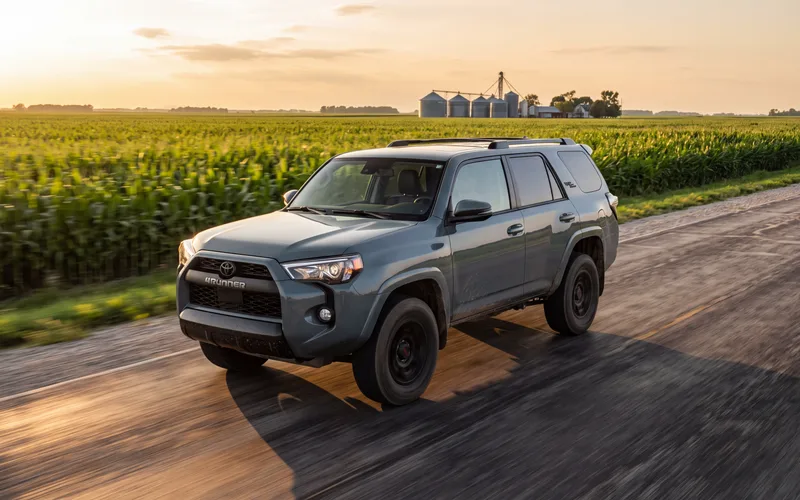 Toyota 4RunnerOff-Road SUVBetter at: Value
Same platform, engine and 6,000-lb tow rating for roughly $17,000 less, with more cargo room, an available third row and factory TRD Pro and Trailhunter off-road builds the Land Cruiser doesn't offer.
Compare 2.80B-
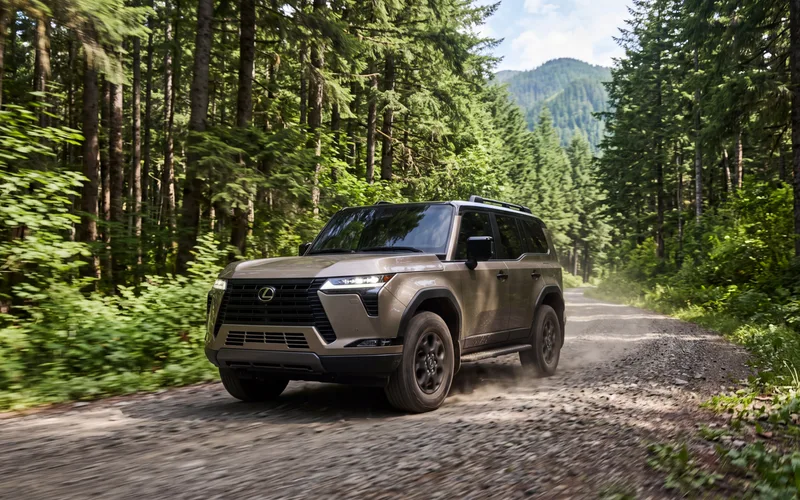 Lexus GXLuxury Off-Road SUVBetter at: Interior and seating
The luxury version of this exact chassis — a twin-turbo V6, a third row, genuinely premium materials and a head-up display — for buyers whose objection to the Land Cruiser is its plain interior and five-seat-only packaging.
Compare 1.95C-
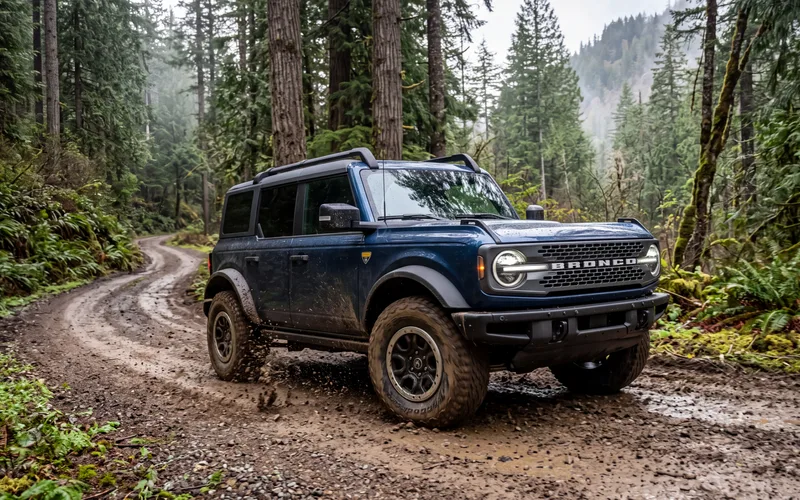 Ford BroncoOff-Road SUVBetter at: Fun and price
Costs less, seats rear passengers far better with 36.3 inches of legroom, and the roof and doors come off — the choice if the Land Cruiser's price and tight back seat are the sticking points and you can live with 17–20 MPG.
CompareHow it's evolved
8 scored model years · 2017–2026
Subject scores by year
Hover or tap a score to see what moved it versus the year before. A corner mark flags a big swing.
| Year | Performance | Efficiency | Safety | Space | Cost | Reliability | Tech | Use-case | Driving | Value |
|---|---|---|---|---|---|---|---|---|---|---|
| 2026 | 61 | 49 | 66 | 50 | 53 | 75 | 70 | 68 | 66 | 65 |
| 2025 | 59 | 36 | 65 | 56 | 51 | 73 | 74 | 68 | 55 | 69 |
| 2024 | 58 | 36 | 65 | 56 | 51 | 72 | 72 | 66 | 55 | 70 |
| 2021 | 69 | 14 | 45 | 60 | 53 | 85 | 35 | 59 | 59 | 52 |
| 2020 | 69 | 14 | 43 | 62 | 45 | 84 | 34 | 60 | 60 | 54 |
| 2019 | 68 | 16 | 43 | 61 | 41 | 81 | 35 | 63 | 59 | 55 |
| 2018 | 69 | 16 | 44 | 62 | 39 | 82 | 34 | 62 | 59 | 56 |
| 2017 | 69 | 16 | 45 | 62 | 29 | 82 | 36 | 63 | 62 | 56 |
Compare two years
Best fit & conditions
Higher scores mean a better fit for that use case. Learn more about use-case fit →
Subject profile
Academic Probation · NHTSA safety recalls
No NHTSA safety recall is on record for the 2026 Toyota Land Cruiser. Other model years of the Land Cruiser have 7 — listed below.
7 recalls on other model years of the Land Cruiser (2017–2019, 2024–2025)
May 27, 2026Electrical system: instrument cluster/panelThe instrument panel cluster combination meter may fail to display certain warnings or indicators. As such, these vehicles fail to comply with the requirements of Federal Motor Vehicle Safety Standard (FMVSS) number 101, "Control and Displays" and in addition, for the subject Mirai vehicles, FMVSS 305, "Electric-powered vehicles: Electrolyte Spillage and Electrical Shock Protection."
Defect
Toyota Motor Engineering & Manufacturing (Toyota) is recalling certain 2025 Lexus UX Hybrid, 2024 Lexus GX, Toyota Mirai, and 2024-2025 Toyota Land Cruiser Hybrid vehicles. The instrument panel cluster combination meter may fail to display certain warnings or indicators. As such, these vehicles fail to comply with the requirements of Federal Motor Vehicle Safety Standard (FMVSS) number 101, "Control and Displays" and in addition, for the subject Mirai vehicles, FMVSS 305, "Electric-powered vehicles: Electrolyte Spillage and Electrical Shock Protection."
Risk
An instrument panel display that fails to show critical safety information, such as engine coolant temperature or electrical charge increases the risk of a crash or injury.
Remedy
Dealers will update the combination meter software through an over-the-air (OTA) update, free of charge. Owner notification letters were mailed July 23, 2026. Owners may contact Toyota's customer service at 1-800-331-4331. Toyota's numbers for this recall are 26LB06, 26LA06, 26TB10, and 26TA10.
NHTSA campaign 26V341000 ↗Manufacturer no. See attached Part57381,893 vehicles potentially affected (all models in the campaign)Owners notified Jul 23, 2026Filed by Toyota Motor Engineering & ManufacturingFiled as LAND CRUISER HYBRIDMar 24, 2026Equipment: other: labelsThe load carrying capacity modification label may display inaccurate added weight values. As such, these vehicles fail to comply with the requirements of Federal Motor Vehicle Safety Standard number 110, "Tire Selection and Rims."
Defect
Toyota Motor Engineering & Manufacturing (Toyota) is recalling certain 2024-2025 Toyota Tundra, Tacoma Hybrid, Tacoma, RAV4 Hybrid, Land Cruiser Hybrid, Lexus GX550, 2024-2026 Tundra Hybrid, 2025 Sequoia Hybrid, Crown Signia, Grand Highlander, Lexus TX500 Hybrid, Lexus NX350 Hybrid, 2025-2026 Grand Highlander Hybrid, and Lexus TX350 vehicles. The load carrying capacity modification label may display inaccurate added weight values. As such, these vehicles fail to comply with the requirements of Federal Motor Vehicle Safety Standard number 110, "Tire Selection and Rims."
Risk
A vehicle with an incorrect maximum capacity weight value may be overloaded, which can increase the risk of a crash.
Remedy
Dealers will replace the load carrying capacity modification label, free of charge. Owner letters were mailed May 26, 2026. Owners may contact Toyota's customer service at 1-800-331-4331. Toyota's numbers for this recall are 26LB04, 26LA04, 26TB07, and 26TA07.
NHTSA campaign 26V179000 ↗Manufacturer no. See attached Part5738,230 vehicles potentially affected (all models in the campaign)Owners notified May 22, 2026Filed by Toyota Motor Engineering & ManufacturingFiled as LAND CRUISER HYBRIDOct 30, 2025Back over prevention: display functionPlease see the recall report for a complete list of models. A software error may cause the rearview camera to freeze or display a blank screen when the vehicle is in reverse. As such, these vehicles fail to comply with the requirements of Federal Motor Vehicle Safety Standard (FMVSS) number 111, "Rear Visibility."
Defect
Toyota Motor Engineering & Manufacturing (Toyota) is recalling certain 2022-2026 Toyota, Lexus, and Subaru Solterra vehicles equipped with a Panoramic View Monitor (PVM) system. Please see the recall report for a complete list of models. A software error may cause the rearview camera to freeze or display a blank screen when the vehicle is in reverse. As such, these vehicles fail to comply with the requirements of Federal Motor Vehicle Safety Standard (FMVSS) number 111, "Rear Visibility."
Risk
A rearview camera that fails to display an image can reduce the driver's view behind the vehicle, increasing the risk of a crash.
Remedy
Dealers will update the parking assist software, free of charge. Owner letters were mailed January 2, 2026. Owners may contact Toyota's customer service at 1-800-331-4331. Toyota's numbers for this recall are 25TB13 and 25LB06. Subaru's number for this recall is WRE25.
NHTSA campaign 25V744000 ↗Manufacturer no. 25TB13/25LB06/WRE251,024,407 vehicles potentially affected (all models in the campaign)Owners notified Dec 5, 2025Filed by Toyota Motor Engineering & ManufacturingFiled as LAND CRUISER HYBRIDJul 23, 2024Equipment: other: labelsThe load carrying capacity modification label may display inaccurate added weight values. As such, these vehicles fail to comply with the requirements of Federal Motor Vehicle Safety Standard number 110, "Tire Selection and Rims."
Defect
Gulf States Toyota, Inc. (GST) is recalling certain Toyota 2023 GR Supra, 2024 4 Runner, Corolla, Grand Highlander, Grand Highlander Hybrid, Land Cruiser Hybrid, Tacoma, Tacoma Hybrid, 2023-2024 BZ4X, Corolla Cross Hybrid, GR Corolla, GR86, Highlander, Highlander Hybrid, Prius, Prius Prime, Sequoia Hybrid, Tundra, Tundra Hybrid, Venza Hybrid, 2023-2025 Crown, and 2025 Camry Hybrid vehicles equipped with GST accessories. The load carrying capacity modification label may display inaccurate added weight values. As such, these vehicles fail to comply with the requirements of Federal Motor Vehicle Safety Standard number 110, "Tire Selection and Rims."
Risk
A vehicle with an incorrect maximum capacity weight value may be overloaded, which can increase the risk of a crash.
Remedy
GST will mail new labels to owners, free of charge. Owner notification letters were mailed September 16, 2024. Owners may contact GST customer service at 1-800-444-1074. GST's number for this recall is 24R2.
NHTSA campaign 24V548000 ↗Manufacturer no. 24R233,848 vehicles potentially affected (all models in the campaign)Owners notified Sep 16, 2024Filed by Gulf States Toyota, Inc.Filed as LAND CRUISER HYBRIDNov 4, 2020Fuel system, gasoline: delivery: fuel pumpThe low-pressure fuel pump inside the fuel tank may fail.
Defect
Toyota Motor Engineering & Manufacturing (Toyota) is recalling certain 2018-2019 4Runner, 2019-2020 Avalon, 2019 Corolla Hatchback, 2017-2019 Highlander, 2018-2020 Camry, 2020 Corolla, 2018-2019 Land Cruiser, 2017-2020 Tacoma, 2019-2020 RAV4, 2019-2020 Sequoia, 2017-2020 Sienna, 2019-2020 Tundra, 2018-2020 Lexus ES350, 2017 Lexus GS200t, 2017-2019 Lexus GS350, 2019 Lexus GS300, 2018-2020 Lexus LC500h, 2019-2020 Lexus LS500, 2018-2019 Lexus GX460, 2017 Lexus IS200t, 2019 Lexus IS300, 2019 Lexus IS350, 2018-2020 Lexus LC500, 2018 Lexus LS500, 2019 Lexus LS500h, 2018-2019 Lexus LX570, 2017 Lexus RC200t, 2019 Lexus RC300, RC350, 2017 and 2019-2020 Lexus RX350, 2018-2020 RX350L, 2019 Lexus UX200, 2018-2019 Lexus NX300 vehicles. The low-pressure fuel pump inside the fuel tank may fail.
Risk
If the fuel pump fails, the engine can stall while driving, increasing the risk of a crash.
Remedy
Toyota will notify owners, and dealers will replace the fuel pump assembly with an improved one, free of charge. Owners of specific models were notified that remedy parts were available starting January 21, 2021. Owners of other models will be notified as remedy parts become available. Remedy parts should be available for all affected vehicles by late March 2021. Owners may contact Toyota customer service at 1-888-270-9371 or Lexus customer service at 1-800-255-3987. Note: This recall is an expansion of recall 20V-012. Toyota's number for this recall is 20TA02. Lexus' number for this recall is 20LA01.
NHTSA campaign 20V682000 ↗Manufacturer no. 20TA02, 20LA011,525,742 vehicles potentially affected (all models in the campaign)Owners notified Jan 21, 2021Filed by Toyota Motor Engineering & ManufacturingFiled as LAND CRUISERMar 27, 2019Equipment: other: labelsThe text on the load capacity label may become illegible. As such, these vehicles fail to comply with the requirements of Federal Motor Vehicle Safety Standard (FMVSS) number 110, "Tire Selection and Rims."
Defect
Gulf States Toyota (GST) is recalling certain 2019 C-HR, 4Runner, Avalon, Avalon Hybrid, Camry, Camry Hybrid, Highlander, Land Cruiser, Prius, RAV4, Sequoia, Tacoma, Sienna, Tundra and Yaris vehicles. The text on the load capacity label may become illegible. As such, these vehicles fail to comply with the requirements of Federal Motor Vehicle Safety Standard (FMVSS) number 110, "Tire Selection and Rims."
Risk
If the driver cannot read the label, they may unknowingly overload the vehicle, increasing the risk of a crash.
Remedy
GST will notify owners, and dealers will provide corrected load carrying capacity modification labels, free of charge. The recall began May 24, 2019. Owners may contact GST customer service at 1-800-444-1074. GST's number for this recall is 19R1.
NHTSA campaign 19V244000 ↗Manufacturer no. 19R13,634 vehicles potentially affected (all models in the campaign)Owners notified May 24, 2019Filed by Gulf States Toyota, Inc.Filed as LAND CRUISERDec 13, 2018Air bags: frontal: passenger side: inflator module · Air bags: sensor: occupant classification · Seat belts: frontOver time, the seat belt tension sensor wire harness may break and deactivate the front passenger air bag, knee air bag, and passenger seat-mounted side airbag.
Defect
Toyota Motor Engineering & Manufacturing (Toyota) is recalling certain 2008-2019 Toyota Land Cruiser and Lexus LX 570 vehicles. Over time, the seat belt tension sensor wire harness may break and deactivate the front passenger air bag, knee air bag, and passenger seat-mounted side airbag.
Risk
In the event of a crash, deactivated air bags can increase the risk of injury .
Remedy
Toyota will notify owners, and dealers will modify the front passenger seat belt assembly or replace it with an improved one, as necessary, free of charge. The recall began February 11, 2019. Owners may contact Toyota customer service at 1-888-270-9371 or Lexus customer service at 1-800-255-3987. Toyota's numbers for this recall are Lexus Interim J2L and Remedy JLL, Toyota Interim J15 and Remedy J05.
NHTSA campaign 18V887000 ↗Manufacturer no. See attached report.89,740 vehicles potentially affected (all models in the campaign)Owners notified Feb 11, 2019Filed by Toyota Motor Engineering & ManufacturingFiled as LAND CRUISER
Source: NHTSA Office of Defects Investigation recall database, model years 2017–2026. Recalls are listed by model year as the manufacturer filed them; whether a specific car is affected depends on its VIN — check a VIN at nhtsa.gov ↗. NHTSA model names matched to this page: LAND CRUISER, LAND CRUISER HYBRID.
Detailed scoring by subject
1Performance & PowertrainMid-pack among this car's ten categories.2.12C
The US-market J250 Land Cruiser is sold exclusively with Toyota's i-FORCE MAX hybrid — a 2.4L turbocharged four paired with a motor-generator in the bellhousing — rated at 326 hp combined on every trim, so the volume trim and the range maximum are the same number. That is a modest figure for a Premium-price SUV: the Sequoia makes 437 hp and full-size rivals use V6 or V8 power.
Torque is the powertrain's headline: 465 lb-ft available from very low rpm thanks to the electric motor filling in below the turbo's threshold, which lands near the top of the SUV normalization band and well clear of the Wrangler (260 lb-ft) and Bronco (325 lb-ft).
Big low-end torque makes the Land Cruiser feel brisk off the line, but roughly 5,400 lb of body-on-frame SUV blunts it and instrumented tests land in the mid-to-high 7-second range — slower than the lighter 4Runner hybrid on the same powertrain and well off the V6/V8 competition. Marked LOW because the figure comes from published instrumented tests rather than a manufacturer rating.
The hybrid layer masks turbo lag well and low-speed response is genuinely strong, but the 2.4L four is coarse when extended, engine start-up under load is audible rather than seamless, and the regenerative-to-friction brake handoff is the recurring complaint in reviews — nothing like the effortless smoothness the nameplate's V8 history implies.
The 8-speed automatic is well matched to the engine's flat torque plateau, holds gears sensibly on grades and rarely hunts, but low-speed creep and initial tip-in are less polished than a conventional torque-converter automatic because the motor-generator sits between engine and gearbox.
6,000 lbs across the lineup with no configuration penalty — strong for a mid-size off-road SUV and well ahead of the Wrangler (3,500 lbs) and Bronco (4,500 lbs), though short of the full-size body-on-frame SUVs like the Sequoia (9,520 lbs) that shoppers cross-shop at this price.
There is no two-wheel-drive Land Cruiser: full-time 4WD with a two-speed transfer case and a locking center differential is standard on every trim, backed by an electronically locking rear differential, Multi-Terrain Select, CRAWL Control and Downhill Assist Control. That is more capable hardware, standard, than the 4Runner, which still sells rear-drive trims.
Genuine credibility: locking center and rear differentials, a stabilizer-bar disconnect on the upper grade for extra articulation, skid plates, Multi-Terrain Monitor and CRAWL Control on a proper ladder frame. It sits below the Wrangler (96) and 4Runner (90) because ground clearance is a moderate ~8.7 in, approach and departure angles are unremarkable for the class, and there is no dedicated halo off-road grade in the US range — no TRD Pro, no Trailhunter — while the upper trim's 20-inch wheels work against it on trails.
One powertrain, no choice: every US Land Cruiser is the 326 hp i-FORCE MAX hybrid, with no V6, no V8 and no PHEV or EV alternative — the take-it-or-leave-it case in the scoring guidance. It lands at the top of that band rather than the bottom only because the single option is at least electrified, which neither the Wrangler's nor the Bronco's standard gas engines can claim.
2Efficiency & RangeThe Land Cruiser's lowest-graded category.1.25D
The 2026 Land Cruiser (J250) carries over the standard 2.4L turbocharged i-FORCE MAX hybrid rated 23 MPG combined. Strong for a body-on-frame off-roader — well clear of the 4Runner and Wrangler — but modest against the unibody-dominated SUV band this item normalizes into.
EPA city rating for the standard hybrid powertrain. Electric assist helps in stop-and-go, but a 5,000-lb ladder-frame SUV with full-time 4WD caps the benefit well below a unibody hybrid crossover.
EPA highway rating. Unusually for a hybrid the Land Cruiser rates higher on the highway than in town — the boxy shape and heavy driveline blunt the hybrid's city advantage more than they hurt steady-state cruising.
A modest 17.9-gallon tank offsets the hybrid's efficiency, landing the Land Cruiser at roughly 410 miles of combined range — mid-pack for the segment and notably short of the larger-tanked Sequoia and Lexus LX.
At the EPA's 15,000 mi/yr assumption the Land Cruiser burns roughly 650 gallons of regular a year. Cheaper to feed than the V8 full-size SUVs and the 4Runner, but the hybrid does not buy crossover-level running costs.
Runs on 87-octane regular with no premium requirement, no diesel exhaust fluid, and no charging hardware to install — the hybrid system self-charges. About as low-friction as fuelling gets for a premium-priced SUV.
3SafetyMid-pack among this car's ten categories.2.45C+
NHTSA has not published an overall star rating for the reborn J250 Land Cruiser as of this scoring run, so the value is estimated from the platform pattern rather than measured: the TNGA-F Tacoma rates 4 stars overall and the previous-generation 4Runner rated 4 stars overall with 3 stars for rollover. Tall body-on-frame SUVs are consistently held near 4 stars by the rollover result their ride height and track produce, and nothing about the Land Cruiser's proportions suggests it escapes that.
The Land Cruiser carries no IIHS Top Safety Pick or TSP+ award, and Toyota's recent TNGA-F body-on-frame products have posted mixed results under the current, stricter test regime — the Tacoma sibling came in below Good on the updated moderate-overlap front test that grades rear-passenger protection. Scored mid-band: the underlying structure is modern and competent, but there is no award to point to and at least one sub-Good result is likely.
Toyota Safety Sense 3.0 is standard on every Land Cruiser trim — pre-collision system with pedestrian, motorcyclist and intersection-turn support, full-speed-range dynamic radar cruise control, lane departure alert with steering assist, lane tracing assist, road sign assist, automatic high beams and proactive driving assist — with Blind Spot Monitor and Rear Cross-Traffic Alert also standard across the range. Nothing meaningful is paywalled to upper trims, which is the top band; it stops short of the 90s because the coverage is alert-and-assist rather than active intervention (no blind-spot steering, no evasive steer assist, no rear cross-traffic braking).
TSS 3.0's pre-collision system adds motorcyclist detection, improved low-light pedestrian detection and intersection turning support over TSS 2.5, and Toyota systems have generally rated well in vehicle-to-vehicle front crash prevention. Held to the upper-middle band because the current IIHS front crash prevention test is markedly stricter at night and at higher closing speeds, and no confirmed result exists for this vehicle.
Blind Spot Monitor with Rear Cross-Traffic Alert is standard across the lineup rather than optioned up, and Safe Exit Assist plus the Panoramic View Monitor extend coverage on the volume grade and above — a step past the 4Runner's alert-only arrangement. Still short of the top band: the cross-traffic system warns without braking, and there is no trailer-aware blind-spot extension despite a 6,000 lb tow rating.
Lane Departure Alert with steering assist is standard and Lane Tracing Assist provides genuine centering, but only while the adaptive cruise is engaged — a real limitation against systems that center independently. Toyota's current implementation is usable but wanders within the lane and nags on faded or narrow markings; the Land Cruiser's more precise steering rack keeps it a shade ahead of the 4Runner.
Full-Speed Range Dynamic Radar Cruise Control is standard on every trim with stop-and-go operation and automatic resume, and TSS 3.0 improved curve-speed handling and cut-in response; paired with Lane Tracing Assist it works as a competent highway assist. It lands below the top band because gap-closing is conservative and resume from a full stop is slow next to the best systems at this price.
No hands-free highway driving system is offered on the Land Cruiser at any trim or option level. Toyota's hands-free Teammate technology remains confined to a small number of Lexus and low-volume Toyota models and has never reached the TNGA-F truck and SUV line, so a buyer cross-shopping a BlueCruise Expedition or a Super Cruise Tahoe gets nothing comparable at a materially higher price point.
LED headlights with standard automatic high beams are fitted across the range, and the premium positioning means the volume grade gets the better lighting hardware rather than a decontented base unit. Scored mid-band pending a confirmed IIHS result: Toyota's recent truck-based products have not consistently earned Good headlight ratings, and the retro round lamps on the heritage grade are a styling choice whose output has not been independently verified.
Among the Land Cruiser's clearest safety strengths. The upright boxy greenhouse, low beltline, large squared-off side glass, slim front pillars and a flat hood whose corners the driver can actually place give a commanding, easy-to-judge view out — and because the US car is five-seat only, there are no third-row headrests cluttering the mirror. The available Panoramic View Monitor with Multi-Terrain Monitor covers the low-speed blind zones a tall off-roader creates; a thick D-pillar and the high beltline aft of the rear doors keep it out of the 90s.
Tall square rear doors, a boxy cabin and a flat second-row bench make child seats physically easy to load, and because the US Land Cruiser is five-seat only there is no third row to sacrifice when a rear-facing seat pushes the bench back — a real advantage over the optional-third-row 4Runner. Held below the top band because the lower anchors sit recessed in the seat bight and take some digging, and the high floor of a body-on-frame off-roader makes lifting a child up into the vehicle harder than in a crossover.
4Space & ComfortOne of the Land Cruiser's weakest categories.1.37D
The US-market J250 Land Cruiser is sold exclusively as a five-seat two-row SUV; the third row available on some overseas Land Cruiser 250 variants is not offered here because the i-FORCE MAX hybrid battery occupies the space under the cargo floor. Buyers who need seven seats are pushed to the Lexus GX or the Sequoia.
The upright, boxy J250 greenhouse is a genuine strength up front — headroom sits in the upper part of the SUV band and ahead of the mechanically related 4Runner (39.5 in in this dataset), reflecting the Land Cruiser's flatter roofline and taller glasshouse.
Front legroom is merely adequate for a $60k-plus SUV, held down by the shared TNGA-F front structure it has in common with the 4Runner (41.9 in) and Tacoma double cab (41.8 in). The commanding seating position flatters the numbers, but on paper this trails most mid-size crossovers.
The square roof pays its biggest dividend in the second row, where headroom is the strongest passenger-space spec on the car — near the top of the SUV band and better than the 4Runner (38.6 in), though still short of the Wrangler's 41.7 in.
The defining weakness of the vehicle and the single biggest drag on this category: on a 112.2 in wheelbase the second row is cramped for a 194 in, premium-priced SUV, trailing the 4Runner (32.9 in), the Bronco (36.3 in), the Wrangler (38.3 in), and essentially every three-row rival. Adults sit knees-up behind a tall front occupant.
There is no third row at all in the US-market Land Cruiser — not optional, not trim-dependent — because the hybrid battery claims the under-floor volume it would need. Scored in the bottom band on the same basis as the two-row-only Bronco and Wrangler (both 15 in this dataset); the related Lexus GX and the Sequoia are the three-row alternatives inside Toyota's own showroom.
Usable in absolute terms and better than the off-road set it competes with — the Bronco manages 35.6 cu ft and the Wrangler 31.7 — but modest for the exterior footprint and the price, with a load floor raised by the hybrid battery beneath it that costs both volume and flat-floor usability.
With the rear seats down, the square body and near-vertical tailgate deliver a genuinely large hold — the strongest cargo spec on the car, comfortably clear of the Bronco and Wrangler, though the 4Runner's 89.5 cu ft shows what the same platform can do with a boxier tail.
Competent rather than clever: a deep center console, big door bins, a proper shelf-style dash trough on the retro-themed 1958, and underfloor cargo storage cover the basics well. It lacks the 4Runner's signature power roll-down rear window, and the folded-seat floor is compromised by the battery hump, keeping it out of the standout band.
The front seats earn consistent praise for an upright, commanding driving position with good long-haul cushioning — clearly better resolved than the Tacoma's low-slung perch and a step above the 4Runner. The second row is the limiter: a flat cushion and only ~32 in of legroom mean rear passengers tire on long stints, which caps this below the plush three-row crossovers.
The best-riding member of the TNGA-F off-road family short of the Lexus GX: the coil-sprung multi-link rear and available adaptive variable suspension keep body motions better checked than the 4Runner, and far better than the Wrangler (40) or Bronco (60). It is still body-on-frame, so there is secondary motion over broken pavement and some float at speed.
Better isolated than the 4Runner (58) and much quieter than a Wrangler or Bronco, with the hybrid system allowing brief low-speed electric running, but the 2.4-liter turbo four is the weak link — coarse and thrashy under load, a criticism that follows this engine across the Tacoma, 4Runner, and Land Cruiser and one that feels particularly out of place at this price.
Solid provision without being lavish: dual-zone automatic climate control, heated front seats and heated steering wheel on the mainstream trims, ventilated front seats higher up, second-row vents, and remote pre-conditioning through the Toyota app. The retro 1958 entry trim is deliberately sparse — cloth seats, no ventilation — which pulls the range average down.
5Cost of OwnershipOne of the Land Cruiser's weakest categories.1.58D
Third model year of the J250 Land Cruiser, which returned to the US for 2024 after the J200 left the market following 2021, so 2026 is a carryover year and entry pricing tracks a normal step off the launch ladder. Even the price-leader 1958 grade sits near the top of the SUV band (25,000-65,000) - a hybrid-only, body-on-frame off-road SUV has no cheap entry point, and it opens roughly $17,000 above a base 4Runner.
The mid Land Cruiser grade is the volume configuration - it carries the 12.3-inch screen, SofTex upholstery and the option packages most buyers want, and press coverage of the relaunch has consistently put the mix there rather than on the stripped 1958. At roughly $65,700 delivered it sits just under the top of the SUV band (27,000-68,000) and about $15,000 above a 4Runner TRD Off-Road, which is the single biggest drag on this category. The prior placeholder ($42,061) sat below any real Land Cruiser trim, which accounts for most of this item's downward delta.
The i-FORCE MAX 2.4L turbo-four hybrid is shared with the Tacoma and 4Runner, so parts and service pricing are ordinary Toyota rather than Land Cruiser-exotic, and ToyotaCare absorbs the first two years of scheduled service outright. Body-on-frame consumables - tyres, brakes, transfer-case and differential fluids - keep it above a unibody Toyota, and the turbocharged four is more service-intensive than the naturally aspirated V8 that powered the old J200.
Resale is the Land Cruiser's defining ownership strength: the nameplate has been a perennial fixture at the top of iSeeCars' five-year retention rankings, and the J250's US relaunch has run supply-constrained with dealer markups since 2024. The projection is held level with the 4Runner rather than above it because the J250 is a far higher-volume, lower-priced Land Cruiser than the J200 it replaced, and a higher starting MSRP mathematically flattens retention percentage even when demand stays strong.
Toyota's standard 36-month/36,000-mile basic coverage is the floor of the framework's 3-5 year band, with no Land Cruiser-specific extension despite the premium price. Level with Ford and Jeep, and half the length of what Hyundai and Kia offer.
The conventional powertrain term scored here is Toyota's standard 5 years/60,000 miles - the bottom of the 5-10 year band. Because the Land Cruiser is hybrid-only in the US, much of its drivetrain is in practice covered far longer (8 yr/100,000 mi on hybrid-system components, 10 yr/150,000 mi on the traction battery), which the scored value does not capture.
ToyotaCare bundles two years / 25,000 miles of genuinely no-cost factory-scheduled maintenance with two years of unlimited-mileage roadside assistance - real included coverage rather than a rewards-points scheme, and comfortably ahead of the Wrangler (none) and Bronco (points credit). It stays out of the 80+ band because 2 yr / 25,000 mi is a thin window on a $65,000 vehicle, connected services (Safety Connect, Remote Connect, Drive Connect) are subscription trials rather than included outright, and there are no off-road or concierge perks to match what Land Rover bundles with the Defender.
$65,700 volume-trim price minus its estimated resale value after 5 years (67% retained, or about $44,019) leaves about $21,681 in depreciation. Add the projected $5,200 in 5-year maintenance and repairs, and owning this vehicle for 5 years costs about $26,881 in total.
6Reliability & QualityThe Land Cruiser's best-graded category.3.08B
The Land Cruiser nameplate carries one of the strongest durability reputations in the industry and the J250 is mechanically a global Land Cruiser Prado, a platform with an enormous worldwide fleet — but the US car's 2.4L i-FORCE MAX hybrid is a North-America-specific powertrain with only three model years of field data. Scored a few points above this dataset's 4Runner (70) because the J250 reached US showrooms for 2024, a model year ahead of the redesigned N300 4Runner, so 2026 buyers get a build with more running changes behind it; held well short of the top band because hybrid-only means every buyer takes the newest hardware with no proven simpler alternative. Replaces a placeholder value.
Brand-level item, so the Land Cruiser inherits Toyota's standing unchanged: the mass-market benchmark for dependability, topping Consumer Reports' brand reliability survey and finishing above industry average in J.D. Power's Vehicle Dependability Study year after year. Held just below the top of the band because the two major studies are not in lockstep — J.D. Power's most recent VDS placed Toyota eighth rather than top-five. Replaces a placeholder value.
The J250 has drawn the cluster of early campaigns normal for an all-new body-on-frame platform in its first model years, with no systemic powertrain, fire or safety-system pattern known to have attached to it. The important discriminator is what it is NOT exposed to: the twin-turbo V35A-FTS machining-debris campaign that shadows Tundra, Sequoia and the Lexus LX is a different engine family entirely from the Land Cruiser's T24A-FTS four. Scored a touch above the 4Runner (66) because the extra model year on sale has not surfaced a systemic issue. Replaces a placeholder value.
Genuinely split evidence. The 2.4L T24A-FTS turbo four now runs across Highlander, Grand Highlander, Crown, Tacoma, 4Runner and the Lexus NX/RX with no systemic failure pattern attached, and Toyota's hybrid systems have the best high-mileage record in the industry — but this is a turbocharged four-cylinder hybrid carrying a roughly 5,400 lb body-on-frame SUV that buyers expect to run 250,000 miles, and it has under three years of fleet data in that duty cycle. Essentially level with the 4Runner's identical hardware (66), nudged up only for the extra model year of service history. Score unchanged from the prior placeholder, which happened to land in the right band.
The clearest weakness in the category. The J250 cabin is deliberately rugged — durable wipe-clean surfaces, honest switchgear, excellent ergonomics — but hard plastics dominate the lower dash, door bases and console sides, and this is a Premium-price-class vehicle whose volume grade lands near $66,000. Judged against what that money buys elsewhere, perceived richness trails the platform-mate Lexus GX badly and sits below even the cheaper 4Runner's relative-to-price showing (68). The retro 1958 grade's plainness reads as charm; on the loaded grades it reads as missing content. Replaces an over-generous placeholder.
Japanese assembly gives the Land Cruiser tighter, more consistent panel work and better trim alignment than the North-America-built Tacoma, Tundra and Sequoia it shares a platform with, and no recurring squeak, rattle or misalignment theme has attached to the J250. Materials may be plain, but they are screwed together well — the distinction that separates this item from 6.2.1. Capped short of the top band because Toyota tracks only around industry average in J.D. Power Initial Quality. Replaces a placeholder value.
Toyota runs one of the densest US dealer networks at roughly 1,200 franchised stores, so warranty and routine service are within reach almost anywhere — including the rural and mountain markets Land Cruiser buyers actually drive to. Service satisfaction rates solidly among mass-market brands without leading them. Docked one point below the 4Runner's 87 because the Land Cruiser is a low-volume, allocation-constrained model: fewer technicians see one regularly, and demand has meant waits for both delivery and shop time. Replaces a placeholder value.
The Land Cruiser/Prado is arguably the best-supported overlanding platform on earth — suspension, armor, bumpers, drawers and racks are abundant from established specialists — and heavy TNGA-F component sharing with the Tacoma and 4Runner keeps OEM mechanical parts plentiful and quick. Scored below the 4Runner (85) on cost rather than availability: Land Cruiser-badged body and trim parts have historically priced above mainstream Toyota equivalents, the turbo and hybrid components cost meaningfully more out of warranty than a naturally aspirated V6's, and the extra mass means pricier tires and brakes. Replaces a badly low placeholder.
7Technology & InfotainmentOne of the Land Cruiser's strongest categories.2.77B-
The J250 Land Cruiser runs Toyota Audio Multimedia on a 12.3-inch touchscreen that is standard on the mid Land Cruiser grade — the volume trim — while the nostalgia-spec 1958 entry grade keeps the 8.0-inch unit. Scored on the 12.3-inch screen, which puts it mid-pack in the SUV band rather than at the floor where the 8.0-inch 4Runner and Tacoma land.
Toyota Audio Multimedia is quick to boot and respond with a shallow menu tree, and the Land Cruiser pairs it with a genuinely good physical-control balance — real HVAC knobs, volume and tune dials, and hard switches for the 4WD range, locking diffs, Multi-Terrain Select and Crawl Control rather than burying them in menus. It lands a couple of points above the 4Runner and Tacoma because the volume trim gets the wide 12.3-inch screen instead of the small unit stranded in a big dash, but a thin app catalog keeps it out of the top band.
Wireless Apple CarPlay and wireless Android Auto are standard on every Land Cruiser trim including the base 1958 with the 8.0-inch screen — no package, no trim gate, no subscription. Held just below the ceiling because Qi wireless charging to keep the projecting phone alive is not standard on the 1958.
The cloud-backed 'Hey Toyota' assistant takes natural phrasing for climate, media and point-of-interest search, a real step past the command-word systems still common in body-on-frame off-roaders. Native navigation is the weak half: cloud nav runs on a Drive Connect subscription once the factory trial lapses, so most owners default to CarPlay maps.
The 10-speaker JBL Premium system is standard on the volume Land Cruiser grade rather than being an upper-trim extra, which is worth real credit in a segment where branded audio is usually optional. It stops short of the high 80s because the 1958 makes do with a plain six-speaker setup and the JBL install is a modest 10 speakers next to the Sequoia's 14 or the Lexus GX's Mark Levinson.
The volume Land Cruiser grade gets a 12.3-inch fully digital configurable cluster as standard equipment, clearing the bar the 4Runner and Tacoma miss by reserving their 12.3-inch display for grades above the volume trim. Kept just under 80 because the entry 1958 still runs a 7-inch display flanked by analog dials, so it is standard-on-the-volume-trim rather than standard range-wide.
Toyota pushes over-the-air updates to the multimedia head unit and map data on Toyota Audio Multimedia vehicles, which clears the 'no meaningful OTA' floor, but there is no published program of routine whole-vehicle, feature-adding updates of the kind Rivian, Tesla and Ford's Power-Up deliver.
The Toyota app covers the core set well — remote start and climate, lock/unlock, vehicle status, vehicle finder, guest driver alerts, plus an available Digital Key phone-as-key. It sits mid-band because Toyota subscription-gates Remote Connect once the factory trial lapses, so remote start simply stops working unless the owner keeps paying.
Provisioning is solid but unexceptional: USB-C charge and data ports for both rows and Qi wireless charging standard on the volume Land Cruiser grade. It trails the 4Runner and Sequoia because the Land Cruiser is not credited with a 120V household outlet or the 2,400-watt hybrid AC power system Toyota markets on its other i-FORCE MAX vehicles — a notable omission on an SUV sold on its overlanding brief.
Smart Key proximity entry with push-button start is standard across the range, remote start works through both the fob and the app, Digital Key offers phone-as-key, and the volume grade adds a power liftgate. It lands where the 4Runner does rather than with the Sequoia because the J250's tailgate glass does not open independently — a convenience the 4Runner and Sequoia both keep and a frequent reviewer gripe about this generation.
Rear camera plus front and rear parking sensors with Parking Support Brake are standard, and the Panoramic View Monitor reaches the volume Land Cruiser grade with a Multi-Terrain Monitor underbody view that is a genuinely useful trail tool rather than a parking-lot gimmick. It clears the 4Runner and Sequoia on surround-view availability but stays out of the top band with no automated parking system offered.
No head-up display appears to be offered on the Land Cruiser at any trim or price — Toyota reserves its 10-inch HUD for the Tundra and Sequoia upper grades and for Lexus, and the platform-sharing Lexus GX 550 gets one while this Toyota does not. That is the 'no HUD offered' floor rather than the placeholder's 73, scored slightly above the Tacoma's 10 to leave room for the trim-walk uncertainty noted below.
8Use-Case FitOne of the Land Cruiser's strongest categories.2.60C+
Tall, square rear doors open wide onto a flat two-place-friendly bench, and 46.2 cu ft behind the second row is the most stroller-and-gear space of any body-on-frame off-roader in this dataset — a real daily-logistics advantage. Against that, 32.0 in of second-row legroom is the tightest rear seat here and materially constrains a rear-facing convertible seat, the high step-in means lifting a toddler up rather than across, and the US car is five-seat-only with no third-row escape valve.
The standard-equipment half is strong and applies to the cheapest car on the lot: Toyota Safety Sense 3.0 plus Blind Spot Monitor with Rear Cross-Traffic Alert are standard on both the 1958 and Land Cruiser grades, including full-speed radar cruise with stop-and-go. The credentials half is missing — the J250 has no published NHTSA overall rating and no IIHS Top Safety Pick in any year of the generation — and a ~$59,400 entry price is a steep floor for a family safety argument.
Luggage is the strong suit — 46.2 cu ft with all five seats occupied means a family of four never has to choose between the cooler and the suitcases — and dual-zone automatic climate with second-row vents and rear USB-C covers the basics. The trip-length limiters are the 32.0 in second row, which is tolerable for kids but tiring for adults over several hours, a coarse engine note under load, and the absence of any rear entertainment, sunshades or third-zone climate.
Hybrid-only is a genuine commuting asset here: 465 lb-ft available from just off idle makes the Land Cruiser effortless away from lights without the turbo-four having to work, and the commanding upright seating position, excellent sightlines, retained physical climate controls and standard stop-and-go radar cruise all cut fatigue in traffic. The drags are a ~5,400 lb curb weight you feel at low speed, an unrefined engine note whenever you ask for more than half throttle, and body-on-frame steering that needs more small corrections than a crossover.
23 MPG combined on regular unleaded makes this the cheapest body-on-frame off-roader to commute in that this dataset covers — roughly $2,150 a year at 15,000 miles, several hundred dollars less than a 4Runner and well clear of a Wrangler or Bronco — and standard hybridization means no premium fuel and no plug. It is still only an average number in absolute terms for a $60,000-plus vehicle, and heavy consumables on a 5,400 lb truck plus ~$2,250/yr insurance keep the true per-mile cost from being genuinely cheap.
The J250's downsizing pays off in town — at roughly 193 in long it is a size class below the Sequoia, and the upright greenhouse, low beltline and flat hood whose corners the driver can actually see make it far easier to place than its bluff styling suggests. It is still a wide body-on-frame truck with a turning circle around 38 ft, and the Panoramic View Monitor that rescues tight spaces is tied to the upper Land Cruiser grade rather than the entry 1958.
A 6,000 lb tow rating uniform across both grades, pulled by 465 lb-ft that arrives low enough to move a loaded trailer without the transmission hunting, covers a boat, a pair of sleds or a small equipment trailer without drama, and 82.1 cu ft of enclosed lockable space substitutes for a bed on a lot of jobs. But there is no bed, the hybrid battery under the cargo floor eats into payload, and 6,000 lb is well short of what a Sequoia or a full-size pickup will pull — this is a capable support vehicle, not a work truck.
This is the nameplate's whole reason for existing and the strongest use-case argument the Land Cruiser makes. The J250 is mechanically the global Land Cruiser Prado, a platform running an enormous worldwide fleet in mining, agency, NGO and outback service; the interior is deliberately built from wipe-clean rugged surfaces rather than soft-touch trim; Japanese assembly gives it tighter build quality than its US-built TNGA-F siblings; and parts and heavy-duty support are the best in the overlanding world. The one genuine reservation is that the 2.4L turbo hybrid replacing decades of understressed V8s is not yet proven over the 200,000-mile horizon buyers expect from this badge.
The upfit ecosystem is the best in this comparison set — drawers, racks, armor, bumpers and suspension are abundant from established Land Cruiser specialists — and the rugged wipe-clean cabin, roof rails, cargo tie-downs and factory hitch availability cover the basics for hauling tools and dirty gear. Factory work provisions are thinner than the 4Runner's, though: there is no bed, no power vertical-sliding rear window and no sliding cargo deck, and this dataset's technology entry for the Land Cruiser records only USB-C and wireless charging with no AC inverter confirmed.
A competent rather than commanding mile-eater. The fixed steel roof, coil-sprung multi-link rear axle with Adaptive Variable Suspension on the upper grade, a front seating position reviewers rate as a highlight, and standard full-speed radar cruise with lane tracing all make the miles pass easily. Two things hold it back: a 17.9-gallon tank that yields only about 410 miles despite the hybrid's efficiency — short for a vehicle sold on remote-country credentials — and an engine that sounds strained and intrusive whenever a grade or a pass demands real throttle.
Every Land Cruiser leaves the factory with hardware that rivals charge extra for: full-time 4WD with a two-speed transfer case and a locking center differential, an electronic locking rear differential, Multi-Terrain Select, Crawl Control and Downhill Assist, plus a stabilizer-bar disconnect on the Land Cruiser grade and a Multi-Terrain Monitor for picking lines. It sits a step below the class halos only because ~8.7 in of ground clearance is modest next to a Rubicon or Sasquatch and the US range offers no factory trim on 33-inch tires and remote-reservoir dampers.
A square, near-vertical-tailgate box that holds 46.2 cu ft behind the second row and 82.1 cu ft folded, all of it enclosed, lockable and weatherproof, backed by standard roof rails, an underfloor bin and factory hitch availability — plus the deepest accessory catalogue of any vehicle here for drawers, racks and rooftop tents. It gives up ground to the 4Runner on outright volume because the hybrid battery under the cargo floor raises the load height, and the second row only folds 60/40 with no sliding or reclining adjustment to trade passenger space for gear.
9Driving ExperienceMid-pack among this car's ten categories.2.45C+
Third year of the J250 generation on the TNGA-F ladder frame: independent double-wishbone front, coil-sprung solid rear axle, with a stabilizer-bar disconnect on the upper Land Cruiser grade and available adaptive variable suspension. Body control is the best in Toyota's off-road family short of the Lexus GX — noticeably better checked than the 4Runner and far tidier than the Wrangler — but roughly 5,400 lb of body-on-frame SUV on a tall, boxy body means secure and unflustered rather than agile, and the live rear axle still skips over mid-corner bumps. Sits just above the mechanically related 4Runner (70) and below the independent-rear luxury crossovers.
Electric rack-and-pinion assist shared with the Tacoma and 4Runner: accurate, consistent and easy to place for a body-on-frame SUV of this mass, with better on-center stability than the recirculating-ball Wrangler, but light off-center and returning almost no information about front grip. Precise enough, not communicative — the middle of the 'numb' band.
Four-wheel discs hauling down ~5,400 lb give class-typical stopping distances, helped by the street-biased tires most trims wear — the Land Cruiser is not sold on the knobby rubber that lengthens Bronco and TRD Pro stops. The limiter is pedal feel: the regenerative-to-friction handoff in Toyota's i-FORCE MAX system is the most-repeated dynamic complaint about this vehicle, grabby and inconsistent in the first inch of travel exactly where a heavy SUV needs predictability. Adequate power, unresolved modulation.
Response is the strong half: the motor-generator between engine and 8-speed automatic fills in below the turbo, so 465 lb-ft is there from just off idle and tip-in is immediate, with none of the lag that afflicts the 4Runner's non-hybrid 2.4L turbo. Smoothness is the weak half — engine start-up under load is audible rather than seamless, low-speed creep and the electric-to-gas handoff can feel lumpy in traffic, and the 2.4L four sends more vibration through the structure than the nameplate's V8 history implies. Well-judged delivery, imperfect calibration.
The turbocharged 2.4-liter four is the refinement weak point, and it matters more here than anywhere else it is fitted because this is a Premium-priced SUV whose badge implies effortlessness: coarse and thrashy when extended, with a gruff note no amount of sound deadening disguises. The Land Cruiser is better isolated than the 4Runner and can idle and creep on electric power alone, which keeps it above its sibling, but under load the engine is audible and unbecoming.
Toyota's published figure for the J250 on its 112.2-in wheelbase, mid-band for the SUV normalization range — tighter than the full-size Sequoia (40.1 ft) and easy enough for parking structures, but short of the Bronco's 35.5 ft on standard tires. One discrepancy to reconcile: the 2026 4Runner scorecard in this dataset carries a derived 38.4 ft on the identical wheelbase, which is likely a shade pessimistic.
A genuine strength and one of the clearest arguments for the boxy redesign: a high, commanding hip point, a squared-off body with a low beltline and upright glass that make the corners easy to place, and a dash that keeps real climate knobs, drive-mode dials and 4WD controls rather than burying them in the touchscreen. Held below the top band by a high step-in that wants the running boards and by unusually short front legroom for the class (41.7 in), which taller drivers do notice.
The appeal is character and capability rather than chassis: an iconic nameplate, deliberately retro styling (round headlights and heritage badging on the 1958 grade), a big shove of low-end electric torque, and hardware — locking center and rear differentials, stabilizer disconnect, CRAWL Control, Multi-Terrain Select — that genuinely delivers off pavement. On road it is calm and competent; nobody takes the long way home for the way it corners, and the coarse four-cylinder soundtrack actively works against the occasion.
10Value & Market PositionMid-pack among this car's ten categories.2.42C+
The price-leader 1958 grade includes the hardware that actually defines the car — the 326 hp i-FORCE MAX hybrid, full-time 4WD with a locking center differential, a two-speed transfer case, Multi-Terrain Select and the full Toyota Safety Sense 3.0 suite are standard on every Land Cruiser — but the cabin fittings at that price are plain: fabric seats, the smaller 8-inch touchscreen, and the larger 12.3-inch display, leather and the front stabilizer-bar disconnect reserved for the upper grade. Scored below this dataset's 4Runner (72), which delivers a comparable standard-safety and 4WD story starting roughly $17,000 lower, and inside the Wrangler (55)/Bronco (73) band because the capability is generous but the per-dollar trim content is not.
Judged against the vehicles a shopper cross-shops, the Land Cruiser is fair rather than cheap: at roughly $59,400 to start and about $65,700 for the volume grade it undercuts a Land Rover Defender or Lexus GX for comparable genuine off-road hardware, but it asks a large premium over a 4Runner TRD Off-Road that shares much of the mechanical package, and the money buys only 326 hp, roughly 23 mpg combined, five seats and no third row. The hybrid battery under the cargo floor also costs practical space that rivals at this price keep. Placed just below the 4Runner (65) and Wrangler (63) and well under the Bronco (71).
This is the weakest part of the Land Cruiser's value case and the item where it separates most sharply from its rivals. The US lineup is essentially two grades — 1958 and Land Cruiser — on one powertrain, one body, one drivetrain and one five-seat interior, with the limited launch-year First Edition gone; option flexibility is largely packages and accessories rather than real configuration choice. Against a 4Runner (86) or Wrangler (88) that each span nine-ish trims, multiple drivetrains and, for the Jeep, several powertrains and body styles, the Land Cruiser is close to take-it-or-leave-it, held above the bottom band only because the two grades are genuinely well spaced in price and character.
The nameplate's US return has been commercially successful in its own niche — the J250 sells in far greater volume than the J200 it replaced ever did, because the price of entry dropped by tens of thousands of dollars — but it remains a low-five-figure-annual-volume model rather than a segment driver, running well behind the 4Runner, Bronco and Wrangler. Steady mid-pack acceptance for a $60,000-plus body-on-frame SUV, scored below the 4Runner (79) and Bronco (84) and level with the Wrangler (62).
Land Cruiser is close to the strongest single nameplate Toyota owns — a name with genuine global cachet, a devoted following, and a durability reputation that supports unusually strong resale — and the retro-styled J250 leaned into that equity deliberately. Placed a few points above this dataset's 4Runner (87), which shares the Toyota halo without the Land Cruiser badge's aspirational weight, and below only the luxury off-roaders in the segment.
Scored on buyer benefit, and there is little here: demand-constrained heritage models from Toyota historically transact at or very near sticker with thin factory support, and the Land Cruiser's modest allocation relative to interest keeps discounting scarce even now that the launch-year market adjustments have faded. Below the 4Runner (50) and far below the Wrangler (78), where heavy incentives are routine.
The J250 generation arrived for model year 2024 on Toyota's current TNGA-F body-on-frame architecture with an all-new hybrid powertrain, so 2026 is only the third year of a young generation with no redesign risk on the horizon for buyers. Held below the 4Runner (92), which is a year newer, and far above mid-cycle rivals like the Bronco (55) and Wrangler (52).
The J250 was received warmly on launch — reviewers consistently praised the styling, the low-end shove of the 465 lb-ft hybrid, the ride quality on and off pavement, and the fact that a real Land Cruiser was available for under $60,000 — with the recurring criticisms being the compromised cargo floor over the hybrid battery, the absence of a third row, fuel economy that does not repay the hybrid hardware, and price creep into 4Runner-plus territory. Well-reviewed and frequently a finalist, but not the routine comparison-test winner the top band requires; scored above the 4Runner (72) and Wrangler (58) and just below the Bronco (80).