

The verdict
A struggling full-size truck, strong on space and held back by safety.
The 2019 Silverado 1500 is the first year of Chevy's fourth-generation truck, and it's a genuine work machine: 12,200 lbs of towing properly equipped, 2,543 lbs of payload, the biggest bed in the class at 62.9 cu ft, and 43.4 inches of rear legroom in the crew cab. What it isn't is a modern family vehicle — automatic emergency braking was locked behind a package on LTZ and High Country only, so the volume LT couldn't be ordered with it at any price, adaptive cruise didn't exist on any 2019 trim, and IIHS rated every headlight configuration Poor. Launch-year reliability is the other caution: the 5.3L V8's Dynamic Fuel Management lifters and the 8-speed's torque-converter shudder are both well-documented, expensive failures ($7,800 and ~$6,000 in owner reports). Buy it for the bed and the hitch at a used-truck price, and budget for the powertrain risk — or step to a 2020, which fixed the choppy ride and added the diesel and adaptive cruise.
Jump to scoresStrengths
- Real full-size towing and hauling numbers
- The biggest bed in the class, with the hardware to use it
- Crew cab space that beats most family SUVs
What holds it back
- You cannot buy automatic emergency braking on the truck most people bought
- Poor headlights and a Marginal passenger-side crash result
- Launch-year reliability, and the two failures are expensive ones
Top alternatives
Cars shoppers cross-shop with the Chevrolet Silverado 1500 2.66C+
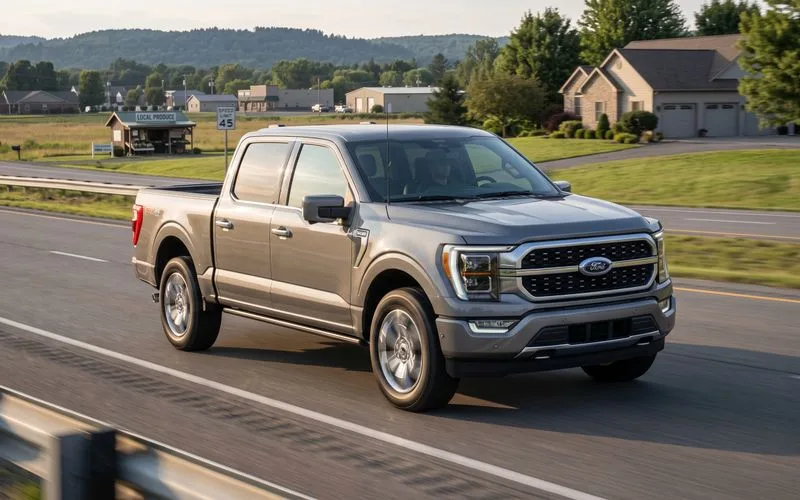 Ford F-150Full-Size TruckBetter at: Efficiency and resale
It matches or beats the Silverado on payload and work features, adds a PowerBoost hybrid at 23-25 MPG combined plus 7.2 kW of onboard jobsite power, and holds its value better.
Compare 2.42C+
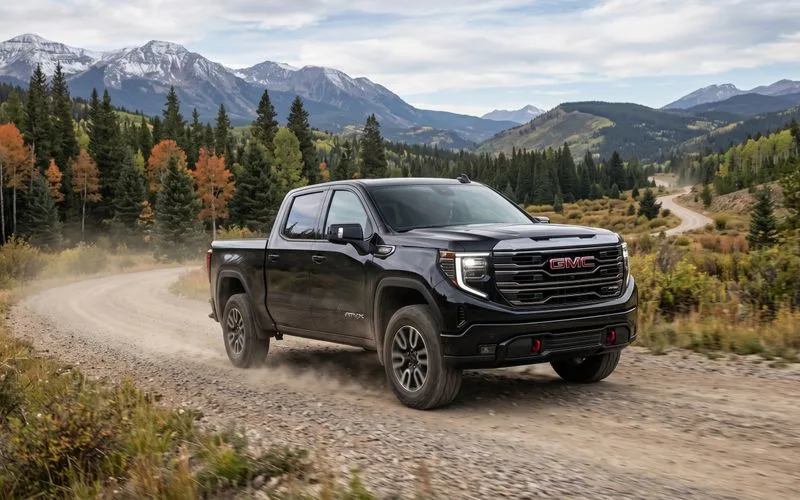 GMC Sierra 1500Full-Size TruckBetter at: Interior quality
Mechanically the same truck with a nicer cabin, the standard MultiPro tailgate on SLT and up, and slightly stronger residuals — worth the $3,000-$6,000 premium if the interior matters more than the invoice.
Compare 2.42C+
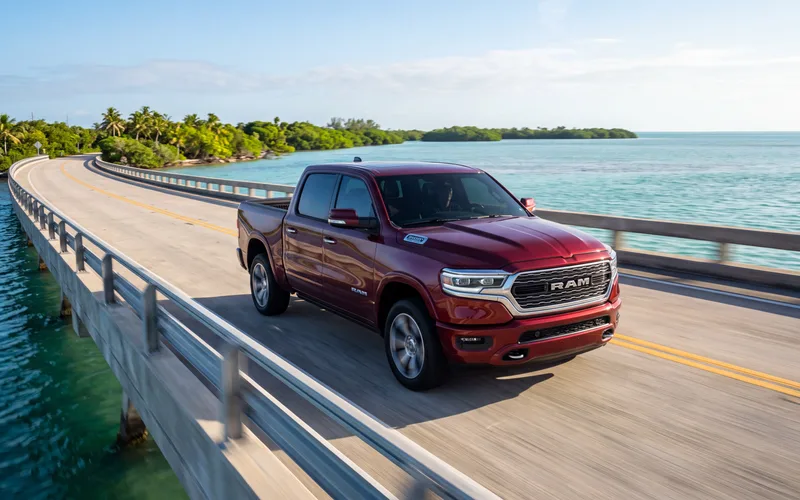 Ram 1500Full-Size TruckBetter at: Ride comfort
Its coil-sprung rear axle rides noticeably better unladen and its interiors are the segment's most comfortable, with a 33-gallon tank for longer legs between fills.
CompareHow it's evolved
10 scored model years · 2017–2026
Subject scores by year
Hover or tap a score to see what moved it versus the year before. A corner mark flags a big swing.
| Year | Performance | Efficiency | Safety | Space | Cost | Reliability | Tech | Use-case | Driving | Value |
|---|---|---|---|---|---|---|---|---|---|---|
| 2026 | 61 | 33 | 62 | 71 | 45 | 61 | 73 | 69 | 62 | 74 |
| 2025 | 61 | 29 | 61 | 73 | 45 | 66 | 73 | 67 | 62 | 74 |
| 2024 | 62 | 29 | 60 | 73 | 48 | 62 | 74 | 65 | 63 | 71 |
| 2023 | 61 | 31 | 64 | 70 | 45 | 59 | 69 | 66 | 62 | 73 |
| 2022 | 60 | 24 | 65 | 70 | 46 | 60 | 69 | 66 | 61 | 70 |
| 2021 | 59 | 37 | 43 | 68 | 56 | 50 | 54 | 65 | 60 | 64 |
| 2020 | 59 | 37 | 42 | 71 | 56 | 56 | 57 | 62 | 62 | 67 |
| 2019 | 59 | 37 | 37 | 68 | 56 | 53 | 55 | 60 | 59 | 66 |
| 2018 | 54 | 40 | 35 | 71 | 53 | 59 | 43 | 58 | 65 | 67 |
| 2017 | 54 | 40 | 36 | 69 | 61 | 56 | 43 | 61 | 65 | 67 |
Compare two years
Best fit & conditions
Higher scores mean a better fit for that use case. Learn more about use-case fit →
Subject profile
Trims & configurations
8 trimsScores above reflect the volume trim. Per-trim specs and scores are rolling out — the full lineup:
Detailed scoring by subject
1Performance & PowertrainMid-pack among this car's ten categories.1.94C-
2019 is the launch year of the fourth-generation (T1XX) Silverado 1500, and the volume configuration — LT crew cab 4WD with the 5.3L EcoTec3 V8 — is rated 355 hp. The 2019 range runs from the 285-hp 4.3L V6 on work trims through the newly introduced 310-hp 2.7L Turbo four to the 420-hp 6.2L V8.
The volume 5.3L V8 peaks at 383 lb-ft — mid-pack for a half-ton and clear of the 2.7L Turbo's 348 lb-ft, but well behind the 6.2L V8's 460 lb-ft, which is the only 2019 Silverado engine with real torque headroom now that the diesel has slipped to 2020.
Edmunds' instrumented test of a 2019 Silverado LTZ crew cab short bed with the 5.3L V8 and 4WD returned 7.0 seconds to 60 mph — adequate for a half-ton and typical of the class, but a full second off the 6.2L V8 and far from the sub-4-second electric trucks that anchor the top of the truck band.
The 5.3L and 6.2L small-block V8s give the lag-free, linear low-end torque that defines a half-ton, and both gained Dynamic Fuel Management for this launch year. What keeps 2019 in the middle of the upper band is the brand-new 2.7L Turbo four — reviewers consistently found it strong off idle but coarse and buzzy when worked — plus DFM's audible cylinder transitions at light throttle and the plain manners of the carry-over 4.3L V6 on work trims.
2019 spreads three automatics across the range and puts the best one almost out of reach: the dated 6-speed still carries the 4.3L V6 and the non-DFM 5.3L (L82), the 8-speed handles the 2.7L Turbo and the volume DFM 5.3L, and the 10-speed is fitted only to the 6.2L V8. The 8-speed in the volume truck is competent but the least polished of the three, and the 6-speed on work trims is a clear step behind the class — a year later GM began extending the 10-speed to 5.3L trucks, which is exactly the gap this year has.
Properly equipped, the 2019 Silverado 1500 tows 12,200 lbs — high in the truck normalization band and competitive for a half-ton in its launch year, though a step below the 13,400 lbs GM certified for 2020. The volume 5.3L V8 tops out at 11,400 lbs in 4WD crew cab short box with the Max Trailering Package and around 10,100 lbs without it; the new 2.7L Turbo is the weak point of the range at 6,700–7,000 lbs.
Chevrolet quoted a maximum payload of 2,543 lbs for the 2019 Silverado 1500 — a genuine strength of the new fourth-generation platform, which is up to 450 lbs lighter than the truck it replaced and raised crew cab payload by as much as 340 lbs. Real-world crew cabs land nearer 2,000–2,200 lbs, and published maxima vary between the round 2,500-lb marketing figure and the 2,543-lb certified number, so this sits at MEDIUM.
The Advanced Trailering System debuted with this generation and made 2019 the most tech-forward towing package in the half-ton class: an in-vehicle trailering app with stored trailer profiles, a pre-departure checklist with tire-pressure and lighting diagnostics, Hitch Guidance with Hitch View and dynamic backing guidelines, an industry-first Auto Parking Brake Assist that holds the truck while you line up the hitch, an available integrated proportional Spectrum trailer brake controller with per-trailer brake gain memory, and a trailering camera system using both mirror cameras plus the rear camera for 270 degrees of coverage with an optional trailer-mounted fourth camera. It stops short of the top of the band because the brake controller and the camera provisions are extra-cost on the volume trims, and the wider multi-view and see-through trailer functions arrived in later model years.
Four-wheel drive is offered on every 2019 Silverado 1500 trim from Work Truck to High Country and is standard on both Trail Boss models, with a genuine two-speed transfer case and 4-Low, an available Autotrac automatic 4WD mode on higher trims, and an automatic locking rear differential in the trailering and Z71 packages. It falls just short of the top band because 4WD remains an extra-cost option on mainstream trims rather than standard equipment.
2019 launched the generation with two credible off-road trims — Custom Trail Boss and LT Trail Boss — carrying a factory 2-inch front / 1-inch rear suspension lift on Rancho monotube dampers, the Z71 Off-Road Package with steel skid plates and hill descent control, an automatic locking rear differential, a deleted front air dam for a better approach angle, and 275/65R18 Goodyear Wrangler DuraTrac all-terrains. That is genuine light-to-mid off-road credibility, but short of the top band: 2019 predates the ZR2 (2022), so there are no Multimatic DSSV dampers, no front locker and no factory 33-inch mud-terrains.
2019 offers four distinct gas engines — a 4.3L V6, the new 2.7L Turbo four, the 5.3L V8 in DFM and non-DFM calibrations, and the 6.2L V8 — a wide conventional menu, but narrower than the year that follows and with nothing outside gasoline. The 3.0L Duramax inline-six was announced for this model year and shown on Chevrolet's own site, then postponed to 2020, so a 2019 buyer has no diesel option and no electrified option of any kind; the battery-electric Silverado EV was five model years away.
2Efficiency & RangeOne of the Silverado 1500's weakest categories.0.46F
The volume 5.3L V8 4WD configuration returns 18 MPG combined — thirsty in absolute terms but at the better end of what a V8 half-ton managed in 2019, thanks to Dynamic Fuel Management and the new 8-speed. With the diesel postponed to 2020, the only economy step available to a 2019 buyer is the 2.7L Turbo at 20–21 MPG.
16 MPG in town is mid-pack for a V8 half-ton in 2019 — Dynamic Fuel Management keeps the DFM 5.3L clear of the 14–15 MPG the older 6-speed L82 trucks return, but stop-and-start driving is still where this configuration costs the most to run.
22 MPG on the highway is respectable for a 4WD V8 half-ton and sits in the lower-middle of the truck band, which runs to 31 MPG. With no diesel offered for 2019, nothing in the lineup breaks past the 24 MPG the 2WD XFE 5.3L manages — the transformative 33-MPG Duramax figure belongs to the following model year.
A 24-gallon tank and 18 MPG combined give the volume configuration roughly 430 miles between fills — adequate for a half-ton and mid-band, but 2019 has no diesel option to stretch it toward 600 miles. The figure is derived from the EPA combined rating and the published tank size rather than quoted directly by EPA.
EPA puts annual fuel spend for the volume 5.3L V8 4WD configuration at $3,400 — high in absolute terms and in the upper half of the truck band. The 6.2L V8's premium-fuel requirement pushes the trucks above it past $4,450, more than $1,000 a year over the volume engine.
The volume 5.3L V8, the 4.3L V6 and the new 2.7L Turbo all make their rated output on regular 87-octane unleaded, and several 5.3L 6-speed configurations are additionally E85 flex-fuel capable, which adds a cheap-fuel option where E85 is sold. The score is held just below the top of the band because the 6.2L V8 — the engine fitted to the trucks at the top of the range — requires premium, a penalty EPA prices at more than $1,000 a year over the 5.3L.
3SafetyThe Silverado 1500's lowest-graded category.0.42F
The all-new 2019 T1XX Silverado 1500 Crew Cab — the volume body style and the configuration this scorecard describes — takes 4 stars overall in both 2WD and 4WD, pulled down by a 4-star frontal result (4 stars driver and 4 stars passenger). The Extended (Double) Cab and Regular Cab both earn 5 stars overall on a 5-star driver frontal. This is a step back from the outgoing 2018 truck, which rated 5 stars overall on every cab.
The 2019 Crew Cab is Good in driver-side small overlap, moderate overlap front, the original side test, roof strength and head restraints, but only Marginal in passenger-side small overlap — IIHS singled the truck out publicly for allowing significant structural intrusion on that side — and only Acceptable in the updated side test. With Poor headlights on all five configurations there is no Top Safety Pick and no configuration that could earn one, which keeps it just under the 'mostly Good with some Acceptable' band.
Standard active safety on a 2019 Silverado is a Rear Vision Camera, Teen Driver, Rear Seat Reminder and StabiliTrak — nothing else, on any trim. Automatic emergency braking (and it is only Low Speed Forward Automatic Braking), forward collision alert, front pedestrian braking, lane keep assist and IntelliBeam all sit in Safety Package II, which the catalog marks not-available on WT, Custom, Custom Trail Boss, LT, RST and LT Trail Boss — so the volume LT Crew Cab cannot be ordered with autobrake at any price. Adaptive cruise is not offered on the 2019 truck at all, so one of the five features the top band asks for simply does not exist here. The one bright spot is blind-zone and cross-traffic breadth: those are standard on High Country and orderable on WT through LTZ.
When the truck is equipped, the hardware performs above its billing: IIHS rates the 2019 front crash prevention Superior vehicle-to-vehicle, with the collision avoided outright in both the 12 mph and 25 mph tests, even though Chevrolet only markets the system as Low Speed Forward Automatic Braking. What holds it to the middle band is that IIHS published no pedestrian front crash prevention rating for 2019 — and Chevrolet's own catalog concedes of Front Pedestrian Braking that 'performance is limited at night' — plus the system being optional equipment on the top two trims rather than something most 2019 Silverados carry.
This is the part of the 2019 redesign that actually widened access: Lane Change Alert with Side Blind Zone Alert and Rear Cross Traffic Alert are standard on High Country and orderable on WT (WT Safety Package) and on LT, RST, LT Trail Boss and LTZ (Safety Package), leaving only Custom and Custom Trail Boss locked out — the previous-generation truck offered neither feature at any price. Coverage is still alert-only with no steering or braking intervention, it costs a $940 package on the volume trim, and there is no trailer-aware blind-zone function, which is the version that matters on a full-size pickup.
Lane Keep Assist with Lane Departure Warning exists only inside Safety Package II, so it is unavailable below LTZ — a volume LT Crew Cab has no lane assistance of any kind. Where fitted it is a reactive torque nudge applied as the truck drifts across a line without a signal, not a centering system that holds the vehicle mid-lane; GM's actual lane-centering system, Super Cruise, is three model years away from this truck.
The 2019 Silverado 1500 has fixed-speed cruise control and nothing more — adaptive cruise is not offered on any trim, in any package, at any price, which is a conspicuous omission for a ground-up redesign launching against an F-150 and Ram 1500 that both had full-speed-range ACC with stop-and-go. The closest thing on the order sheet is the Following Distance Indicator, a Safety Package II readout that displays the gap and does nothing about it. There is correspondingly no highway assist. Chevrolet adds ACC for 2020 on LTZ and High Country.
No hands-free option exists on the 2019 Silverado 1500 at any trim or price. Super Cruise was still effectively a Cadillac exclusive in 2019, expanded to the full-size Chevrolet and GMC SUVs for 2021, and did not reach the Silverado 1500 until the 2022 model year — and this truck lacks both the adaptive cruise and the lane-centering hardware such a system would be built on.
IIHS rates all five 2019 headlight configurations Poor — the halogen reflectors on WT/Custom/Custom Trail Boss, the LED units on LT/RST/LT Trail Boss/LTZ, the High Country LEDs, and both Safety Package II variants with high-beam assist — citing excessive glare and inadequate illumination on curves. No trim, package or price buys out of it, and IntelliBeam auto high beam is itself Safety Package II content restricted to LTZ and High Country, so the volume truck gets Poor headlights with no beam assist to offset them.
Class-typical full-size pickup sightlines, and the T1XX redesign trades in both directions: Chevrolet raised the front seating position 1.5 inches for a more commanding view, but the taller, blockier body and long flat hood leave a large forward blind zone and thick A- and B-pillars. A Rear Vision Camera with dynamic guiding lines is standard on every trim, which is the meaningful baseline, but every aid beyond it is gated — front and rear park assist need the Safety Package (standard only on High Country), and HD Surround Vision and the Rear Camera Mirror are Technology Package content that LTZ can only get after adding Safety Package II. 2019 also predates the power-extending vertical trailering mirrors added for 2020.
The Crew Cab supplies the space — 43.4 in of rear legroom, 40.1 in of rear headroom, a near-square door opening and a flat floor, so rear-facing seats and multiple installs fit more easily than in most family vehicles, and it is a real gain over the 40.9 in the outgoing 2018 Crew Cab offered. The hardware is the weak part: IIHS rates LATCH ease of use Marginal, faulting lower anchors buried too deep in the seat, hard-to-find tether anchors, and other hardware that can be mistaken for an anchor. Only the two outboard positions carry complete LATCH hardware — the center gets a tether alone — so a true three-across install means belting the middle seat. The Double Cab gives up a lot of this at 35.2 in of rear legroom.
4Space & ComfortThe Silverado 1500's best-graded category.2.62C+
The volume 2019 Silverado 1500 LT Crew Cab ships with a 40/20/40 split-bench front seat, so it seats six — the top of the truck band. Trims fitted with bucket seats and a floor console drop to five.
43.0 inches of front headroom sits at the very top of the full-size truck band. 2019 is the launch year of the fourth-generation T1 cab, which gained roughly an inch of front headroom over the outgoing K2 truck and raised the front seating position by 1.5 inches.
44.5 inches of front legroom is near the top of the truck band and ahead of the 2019 F-150's 43.9 in and the Ram 1500's 40.9 in — the front seating package is common to all three cab styles.
40.1 inches of second-row headroom sits in the upper half of the 38–41 in truck band, level with the 2019 F-150 SuperCrew's 40.4 in and clear of the Ram 1500 Crew Cab's 39.8 in.
The Crew Cab's 43.4 inches of rear legroom is limousine space for a pickup — near the top of the 33–45 in truck band and among the best in the half-ton class for 2019, one of the clearest wins of the new fourth-generation cab. Buyers who take the Double Cab give up more than eight inches of it.
The volume Crew Cab pairs with the 5'8" Short Box at 69.9 inches of floor length — mid-band for the segment, and the trade a buyer makes for that 43.4-inch rear seat. Longer boxes are available but only with a smaller cab or the longer 157-inch wheelbase.
The Durabed is the headline of the 2019 redesign: cargo volume rose from 53 to 63 cu ft in the short box, 62 to 72 in the standard box and 75 to 89 in the long box, making it the largest bed in the full-size class at launch. Volume rather than length is where this truck's box wins — the 2019 F-150's 5.5-ft box holds only 52.8 cu ft.
Solid, conventional storage with no headline trick. The 40/20/40 bench's fold-down centre section doubles as an armrest bin and work surface, door pockets are large, and the Crew Cab's flip-up rear bench opens a flat load floor with under-seat storage. The new Durabed adds 12 fixed tie-downs rated 500 lbs each — nine more than the outgoing truck and double the per-point strength — plus nine optional movable tie-downs, larger CornerStep bumper footwells, available LED cargo lighting and an available 120-volt bed outlet. What holds it mid-band is the absence of genuine innovation: no in-bed trunk, no multi-function tailgate (the corporate twin's MultiPro was a GMC exclusive in 2019), no fold-flat front work surface and no Pro Power-style onboard generator.
The weakest part of the 2019 truck's comfort case. The volume LT gets cloth and four-way manual front seats as standard — a 10-way power driver's seat with lumbar only arrives with the Convenience Package — and reviewers testing this generation consistently describe the front cushions as firm, flat and short on support over long stints. The Crew Cab's rear bench benefits from 43.4 inches of legroom and is genuinely fine for adults, and the LTZ/High Country buckets are better padded, but the seats a typical 2019 buyer sits in are mediocre, and both Car and Driver and Edmunds singled out cheap interior execution in placing the truck last in their three-way comparisons.
This is the specific thing GM went back and retuned after the 2019 launch, and it is the clearest 2019-versus-2020 difference in the whole scorecard. Consumer Reports states plainly that the ride 'was stiff and choppy for 2019 models but it improved for 2020,' and Car and Driver's comparison test faulted a harsh ride and a chassis it called feeble. Z71-equipped trucks are harsher still, and there is no air suspension or adaptive damping anywhere in the 2019 range while the Ram 1500's coil-and-air rear end clearly out-rides it.
The strongest element of this truck's comfort case and one of the few things the harsh 2019 launch reviews did not attack — road and engine noise are well suppressed at highway speed, and even Consumer Reports' otherwise critical assessment of this generation pairs the stiff ride with a 'very quiet' cabin. It stays out of the top band because the volume LT has no active noise cancellation and no laminated side glass, the V8's Dynamic Fuel Management transitions change the exhaust note audibly at cruise, and the alternative 2.7L Turbo four is genuinely coarse under load.
Every comfort feature that matters exists, and almost none of it is standard on the trim people buy. On the 2019 LT, heated front seats, a heated steering wheel, dual-zone automatic climate control, remote start, a 10-way power driver's seat and keyless open/start are all bundled into the Convenience Package rather than being standard equipment — a base LT has manual climate and no heated anything. Ventilated front seats and heated rear outboard seats are restricted to LTZ and High Country, and there is no separate rear climate zone anywhere in the range; second-row occupants get vents and a fan setting only. Most LT buyers did get the content, via the All Star Edition package that folded the Convenience Package in, but they paid for it.
5Cost of OwnershipMid-pack among this car's ten categories.1.75C-
The launch year of the fourth-generation T1XX Silverado opened at $28,300 for the 2WD Regular Cab long-box Work Truck, plus GM's $1,595 destination charge — a genuinely cheap entry point that anchors the lineup well below the truck band's midpoint, though almost nobody buys this configuration.
For 2019 the LT Crew Cab 4WD started at roughly $44,095 delivered, but the volume truck is not the base LT: the 2.7L Turbo was standard on LT and the 5.3L V8 this scorecard describes was a $1,395 option, with the All Star Edition package (listed at $2,815) fitted to a large share of LT crew cabs. A realistically equipped V8 LT Crew Cab 4WD lands near $46,900, between the 2018 K2XX equivalent and the 2020 carry-over.
Estimates diverge widely because they count different things: CarEdge's model puts scheduled maintenance and repairs at $3,491 over the first five years, while RepairPal's $714/yr average repair cost is repairs alone and excludes scheduled service, and Edmunds-class truck TCO figures for a V8 half-ton run toward $7,500. A ~$6,900 figure covering both scheduled service and unscheduled repair on a V8 four-wheel-drive crew cab is the defensible middle, and matches the sibling 2018 and 2020 Silverado estimates.
The 2019 truck reached its five-year mark in 2024, when full-size pickup used values had eased off the 2022 peak but were still historically strong — better than the nameplate's long-run average. Industry aggregates for the Silverado 1500 bracket 57–61% retention, and KBB's 2019 LT Crew Cab valuations imply a figure a little above that for this specific year; ~63% sits between the 2020 model year's estimate and those aggregates.
GM's standard 3-year/36,000-mile new-vehicle limited warranty, unchanged for the fourth-generation launch and identical to Ford's and Ram's coverage — which is exactly why it sits at the floor of the framework's 3–5 year band.
Five years or 60,000 miles on the powertrain is the Detroit-three baseline and the bottom of the framework's 5–10 year band; nothing about the all-new T1XX platform bought buyers extra coverage in its launch year.
2019 is the model year GM cut the perk: Chevrolet Complete Care had covered two oil changes and tire rotations over 2 years/24,000 miles, and starting with 2019 models it covers only the first required maintenance visit — one oil change, tire rotation and multi-point inspection — within the first year. What keeps this mid-band rather than low is the surrounding coverage: 5 years/60,000 miles of roadside assistance and courtesy transportation, and Chevrolet Connected Access basic connectivity standard for 10 years, plus the usual short OnStar Safety & Security and 4G LTE Wi-Fi trials.
$46,900 volume-trim price minus its estimated resale value after 5 years (63% retained, or about $29,547) leaves about $17,353 in depreciation. Add the projected $6,900 in 5-year maintenance and repairs, and owning this vehicle for 5 years costs about $24,253 in total.
6Reliability & QualityOne of the Silverado 1500's weakest categories.1.57D
2019 is the launch year of the fourth-generation T1XX Silverado, and it reads like one. Consumer Reports rates it less reliable than other vehicles of the same model year, flagging engine (valve lifter failure, engine rebuild/replacement), oil cooler line leaks, 8-speed rough shifting and torque-converter faults, rear window seal leaks, and infotainment/electrical trouble spots. Owner-reported volume is the highest of any Silverado model year, and the two headline defects are expensive rather than cosmetic. Nothing in the data supports an average call, so this sits in the below-average band rather than the mixed-signals band the 2018 K2XX truck earned.
The cohort-matched data point is better than Chevrolet's general reputation: J.D. Power's 2022 Vehicle Dependability Study surveys three-year-old 2019 vehicles — exactly this build — and put Chevrolet at 171 PP100, comfortably better than the 192 PP100 industry average and only a few points behind Cadillac. Chevrolet also posted 85 PP100 as a brand in the 2019 Initial Quality Study. Consumer Reports' brand rankings pull the other way and have kept Chevrolet in the lower third of mainstream brands through this period. Net of the two, a solidly mid-pack brand with a genuine 2019-cohort result supporting the better side of it, short of Toyota or Honda.
Ten NHTSA campaigns reach the 2019 Silverado 1500, and the severity is worse than the count suggests — four of them are fleet-wide actions of 350,000 units or more, and three involve fire, stalling or loss of a primary safety system. Front seat-belt pretensioners can vent hot gas and ignite carpet fibers (556,399 units), an alternator battery-cable connection can arc and cause a stall or fire (350,371), an Electronic Brake Control Module software fault can disable stability control and ABS without warning the driver (463,995), a second EBCM campaign can cost brake assist (148,055), and front-center seat-belt brackets may not be secured to the seat frame (624,216). On top of the campaigns sit the generation's two long-running bulletin families: 8L45/8L90 torque-converter shudder, with 13 TSBs and a class action alleging none of them fixed it (18-NA-355, January 2019), and the DFM lifter-collapse bulletins covering these 5.3L trucks. Repeated safety-critical recalls plus systemic driveline bulletins land this well below mid-band.
The scored 2019 volume configuration is the 5.3L EcoTec3 V8 (355 hp / 383 lb-ft) with the 8-speed automatic — the L84 with Dynamic Fuel Management, which arrived on LT and RST for 2019 while WT and Custom kept the older AFM L82 and a six-speed. That is the generation's least fortunate pairing and 2019 is its debut year, before any of GM's later mitigations. The small-block architecture itself is proven over decades, but DFM deactivates any cylinder in any combination, so every one of the 16 lifters is a deactivation lifter — a broader failure surface than the eight-lifter AFM system it replaced, and collapse takes pushrods and the camshaft with it. The 8L90 carries a documented torque-converter shudder and hard-shift defect that drew class-action litigation and a long bulletin trail. Two known weak points on the same truck, both in their first model year of this application, outweigh the architecture's underlying pedigree. Only the 4.3L V6 and six-speed builds escape the pairing; the 3.0L Duramax was postponed to 2020 and is not part of the 2019 lineup.
The cabin was the single most criticized aspect of the all-new 2019 truck and is the interior the 2022 refresh was created to replace. Edmunds found that next to the Ram 1500 and F-150 some of the Silverado's plastics feel cheap and the cabin is less modern than top rivals, reserving its praise for the seat materials and for the LTZ and High Country trims. The volume LT is largely hard plastic with a small standard screen and carry-over switchgear cues. Chevrolet spent the redesign's budget on the bed, the frame and the powertrains rather than on perceived cabin richness, and it shows against a Ram that had just raised the segment's bar in the same model year.
Structural assembly is sound — Edmunds reported construction quality fine with no squeaks or rattles, and Chevrolet's brand-level 85 PP100 in the 2019 Initial Quality Study is respectable. What drags this down is launch-year component and sealing quality: Consumer Reports' 2019 trouble spots include rear window leaks and wind noise traced to defective seals, oil cooler line leaks, tire-pressure monitor faults, and infotainment screen and Bluetooth failures, and NHTSA carries 169 electrical complaints for the model year. A water leak and a screen that freezes read as build defects from the driver's seat regardless of how tight the panel gaps are. Generally solid bones with a persistent band of first-year assembly and electronics complaints.
Chevrolet runs one of the two largest franchised dealer networks in the United States at roughly 2,900-3,000 locations, so factory service for a Silverado is within reach almost anywhere — a real advantage over the smaller Buick-GMC channel that supports the mechanically identical Sierra, and decisive in the rural markets where full-size pickups sell hardest. For a 2019 truck carrying ten recall campaigns, four of them fleet-wide, that network is also what made the remedies practically obtainable at no cost. Service satisfaction sitting at or modestly above the mainstream average rather than at the top of it is what keeps this out of the highest band.
The Silverado 1500 is the second-best-selling vehicle in America and the 5.3L small-block is the powertrain every independent shop in the country already knows, so parts depth trails only the F-150. Seven model years on, the 2019 truck also has what a current-year truck does not: a mature used, reman and aftermarket channel, plus parts commonality across the T1XX family — Sierra, Tahoe, Suburban, Yukon and Escalade. Routine maintenance runs at or below the full-size-pickup average. The reason this is not higher is that the repairs this particular year actually needs are the expensive ones: a DFM lifter and camshaft job or a torque-converter replacement outside warranty, not a set of pads.
7Technology & InfotainmentMid-pack among this car's ten categories.1.71C-
Eight inches is the maximum centre screen available on any 2019 Silverado 1500 — the 13.4-inch display does not arrive until the 2022 refresh. That puts it at the floor of a truck band calibrated against today's 12-to-17-inch pickups, even though it matched the 2019 F-150 exactly and only the Ram 1500's 12.0-inch Uconnect was bigger in the class at the time.
Chevrolet Infotainment 3 launched with this generation and was among the better-liked systems in the segment: quick to respond, plainly organised tile menus, and — unusually even for 2019 — a full complement of physical controls, with real volume and tune knobs plus separate hard-key HVAC controls beneath the screen. Reviewers who savaged the 2019 truck's ride and cabin materials left the infotainment alone. It sits below the top band because the graphics already looked plain next to the Ram's 12-inch Uconnect 4C, the 8-inch panel limits how much can be shown at once, and this was the system's debut year rather than a settled one.
Wired Apple CarPlay and Android Auto are standard on every 2019 Silverado 1500 including the base WT, which is the good half of the story. The wireless versions are simply not offered on this model year at any trim or price — the underlying hardware supports it and GM enabled factory wireless projection from the 2021 model year, but a 2019 buyer plugs in. That is squarely the 'wired standard, no wireless' middle band.
Functional and unremarkable. The built-in voice recognition is a command-and-menu system rather than a natural-language assistant, and most owners default to Siri or Google through phone projection. Embedded navigation is extra-cost: LT and above can be optioned with Chevrolet Infotainment 3 Premium with Navigation — bundled with the Bose premium audio system in a package — with Connected Navigation delivering live traffic over the OnStar connection, but the volume LT as commonly built ships without it. There is no native Google Maps integration on this generation.
A competent but unambitious spread, and slightly thinner than the year that follows. Six speakers are standard on the volume LT Crew Cab, with the Bose seven-speaker premium system including a Richbass woofer reserved for LTZ and High Country or bundled with navigation in a package. The Bose setup is a mid-tier branded system rather than a flagship — nothing matches the 14-speaker Harman Kardon or Bang & Olufsen systems appearing elsewhere in the class — and SiriusXM with 360L, which broadens the source list on later trucks, is not available until the 2020 model year.
There is no full digital cluster on any 2019 Silverado 1500 — every trim uses analog gauges with a driver information display set between them. The volume LT gets a 4.2-inch colour DIC, WT and Custom make do with a 3.5-inch monochrome display, and the 8-inch colour DIC comes only inside the Technology Package on LTZ and High Country. That is partial-digital on the volume trim with no full-digital option at any price, which belongs at the top of the low band rather than in the middle band.
Real but bounded, and this is the year the capability arrived rather than the year it matured. The 2019 Silverado 1500 is enrolled in GM's OnStar over-the-air software update programme — updates ride on the truck's built-in OnStar data connection or a home Wi-Fi access point, install while parked, and do not require a paid OnStar plan — but the scope is infotainment and adjacent modules (radio, Bluetooth, phone projection, driver information centre), not the whole vehicle. The truck predates GM's VIP/Ultifi electrical architecture, so propulsion, chassis and driver-assistance modules still need a dealer visit and no OTA update has added a feature to the truck.
The myChevrolet app plus OnStar covers the core set competently — remote start with climate, remote lock/unlock, vehicle locate, fuel level and oil life, plus a built-in 4G LTE Wi-Fi hotspot and OnStar emergency services. Two things hold it mid-band: the remote commands ride on the OnStar Remote Access Plan, which lapses into a paid subscription after the included trial rather than being free for life, and there is no digital key or phone-as-key on the 2019 truck. The app was reliable but plain next to FordPass and the Uconnect offerings of the period.
Adequate rather than generous, and thinner than the same truck a year later. Two USB ports (a USB-A/USB-C mix on the new T1 cab) are standard from LT up, but the second-row charging-only pair is Convenience Package content, and wireless phone charging is far more restricted than on later model years — for 2019 it requires the LTZ Convenience Package II and is standard only on High Country, so no LT buyer can order it at any price. Household power is available in the form of a 120-volt cabin outlet and an available 120-volt Durabed outlet for tools, and a 12-volt rear auxiliary outlet comes with the Convenience Package.
Mid-band, for a reason specific to this model year: Keyless Open and Keyless Start are not standard on the volume LT for 2019 — they sit inside the Convenience Package alongside remote start and the EZ Lift power tailgate — and WT and Custom hand over a conventional key. What 2019 does have that 2020 loses is keyless-access buttons on the rear doors, so proximity unlock works at all four doors rather than just the front pair. There is no phone-as-key of any kind, and the power tailgate, while available, is a lock-and-release assist rather than a hands-free system.
Excellent camera hardware if you can reach it, and most 2019 buyers cannot. Only the rear vision camera is standard across the range; HD Surround Vision, the full-display Rear Camera Mirror and the bed-view camera all live in the Technology Package restricted to LTZ and High Country, and front and rear ultrasonic park assist sits in the optional Safety Package. Buyers who do pay get the best camera suite in the 2019 class — up to 15 distinct views for hitching, driving and parking, with provision for a trailer-mounted camera. No automated parking system of any kind is offered. Strong ceiling, thin floor.
A head-up display is offered and it is a good one — a large 15-inch diagonal multicolour projection carrying speed, navigation and driver-assist information onto the windshield — but it can only be had inside the Technology Package on LTZ and High Country. A volume LT Crew Cab buyer cannot order it at any price, which is exactly the 'HUD limited to top trims' definition and places it at the bottom of the middle band.
8Use-Case FitOne of the Silverado 1500's strongest categories.2.03C
The Crew Cab's raw space is the best part of the family case: a near-square rear door opening, a flat floor, 43.4 inches of rear legroom that swallows a rear-facing seat without pushing the front seat forward, and a flip-up rear bench that clears a wide load floor for strollers. The hardware and the geometry are the compromises — IIHS rates LATCH ease of use Marginal, with only the two outboard positions carrying complete anchors and the centre offering a tether alone, the lower anchors sit too deep in the seat, and the 7.8–8.1 inch ride height means small children get lifted into the cab rather than climbing in.
The worst standard-safety position in the full-size segment for 2019, and it lands hardest exactly where families shop. Automatic emergency braking, forward collision alert, front pedestrian braking and lane keep assist are all Safety Package II content restricted to LTZ and High Country, so the volume LT Crew Cab cannot be ordered with AEB at all. Adaptive cruise control does not exist anywhere in the 2019 range — the catalog's safety grid contains no forward-sensing cruise entry on any of the eight trims. Underneath that, the Crew Cab rates only 4 stars overall with NHTSA, IIHS finds Marginal passenger-side small overlap protection, every one of the five headlight configurations is rated Poor, and there is no rear-seat reminder.
Genuinely quiet and genuinely spacious — second-row occupants get more legroom than in most large SUVs, and road and engine noise are well muted at highway speed. The subtractions are real for 2019 specifically: the ride was stiff and choppy before GM's 2020 retune, the front seats are firm and flat with minimal support, there is no rear climate zone, no rear-seat entertainment and no rear window shades, the second-row USB ports are Convenience Package content, and family luggage either rides in an open bed exposed to weather and theft or gets stacked on the rear floor.
Undemanding in some ways and tiring in others. The 5.3L V8 pulls cleanly from idle with no turbo lag, the steering is light and accurate at parking speeds, the commanding seating position helps in queues, and Infotainment 3's retained physical knobs mean less fumbling on the move. Against that, 2019 is the year before GM softened the suspension and the ride is stiff and choppy over city pavement, Dynamic Fuel Management's cylinder transitions are audible at light throttle, the column-mounted shifter is agricultural in daily use, and the single most fatigue-reducing commuting feature — adaptive cruise control — is not offered on any 2019 Silverado 1500 at any price.
Expensive per mile even by half-ton standards. The volume 5.3L V8 4WD returns 16/22/18 MPG city/highway/combined with an EPA estimated $3,400 a year in fuel at 15,000 miles — and 2019 has no diesel to escape into, since GM postponed the 3.0L Duramax to the 2020 model year. Regular unleaded, cheap consumables and the sheer commonality of small-block parts help at the margin, but 18 MPG combined in stop-and-go traffic is the dominant cost and nothing in the volume configuration mitigates it.
A full-size crew cab is a poor urban tool and this one does little to soften it: 231.7 inches long on the 147.4-inch wheelbase with a roughly 46-foot curb-to-curb turning circle, rising to 49.5 feet for the buyer who orders the standard box, plus a tall flat hood with a large forward blind zone and thick pillars. Camera help beyond the standard rear view is optional and trim-gated — HD Surround Vision is in the LTZ/High Country Technology Package and front and rear park assist sits in the Safety Package — so the volume LT parks on mirrors and a single rear camera. No self-parking system is offered.
This is what the truck is for and the launch-year numbers deliver with headroom to spare. Properly equipped the 2019 Silverado 1500 tows 12,200 lbs, the volume 5.3L V8 is rated up to 11,400 lbs in 4WD crew cab short box with the Max Trailering Package and about 10,100 lbs without it, and maximum payload reaches 2,543 lbs on a platform up to 450 lbs lighter than the truck it replaced. The Durabed is the largest box in the class at 62.9 cu ft in the short configuration, and the V8's low-end torque is unbothered under load. It sits just below the 2020 truck because GM raised the ceiling to 13,400 lbs a year later, the 2.7L Turbo entry engine is a weak 6,700–7,000 lbs, and there is no diesel torque option this year.
The bones are as fleet-proven as anything in the class — a fully boxed high-strength-steel frame, a small-block V8 lineage with decades of commercial service behind it, WT trims with vinyl flooring and wipe-down surfaces, and a parts and service network in every town. What costs it more than the following model year is that 2019 is the launch year of both of this generation's documented weak points: the L84 5.3L's Dynamic Fuel Management, which has a well-established record of collapsed lifters and camshaft damage, and the 8-speed automatic paired with it, which drew widespread torque-converter shudder and harsh-shift complaints. A fleet buyer who orders the 4.3L V6 with the 6-speed avoids both and gets a genuinely bulletproof truck; the volume configuration is less certain, and first-year build quality adds risk on top.
Well-provisioned out of the box and effectively unlimited after. The new Durabed ships with 12 fixed tie-downs rated 500 lbs each — nine more points than the outgoing truck, at double the per-point strength — with nine optional movable tie-downs on top, larger CornerStep bumper footwells sized for work boots, an available 120-volt bed outlet, available LED cargo-area lighting, an available EZ Lift power tailgate and available bed steps, and enough width between the wheelhouses to take plywood flat. Behind it sits the deepest upfit ecosystem in North America — service bodies, ladder racks, toolboxes, plow prep — plus a long-box Double and Regular Cab for contractors. It falls short of the top band for lacking onboard generator-grade power in the Pro Power vein, and because a launch-year truck's accessory and upfit catalogue is still filling in.
A mediocre mile-eater in its launch year. The quiet cabin is the real asset and the 24-gallon Crew Cab tank at 18 MPG combined is good for roughly 430 miles between fills. Against that: front seats that reviewers found very firm and flat with minimal support are the wrong seats for a ten-hour day, the pre-retune 2019 ride is stiff and choppy over broken interstate concrete, and the driver-assist help that reduces highway fatigue is essentially absent — there is no adaptive cruise control anywhere in the 2019 range, lane keep assist is Safety Package content on upper trims, and lane centering does not arrive until Super Cruise for 2022.
A capable adventure platform without being a specialist, and 2019 is the year the credible off-road trims arrived. Four-wheel drive with a genuine two-speed transfer case and 4-Low is available on every trim, and the new Custom Trail Boss and LT Trail Boss add a factory two-inch front / one-inch rear lift on Rancho monotube dampers, the Z71 Off-Road Package with steel skid plates and hill descent control, an automatic locking rear differential, a deleted front air dam for approach angle and Goodyear Wrangler DuraTrac all-terrains. Tow ratings handle any boat or camper a family owns, and camping is supported by the available 120-volt cabin and bed outlets and the flip-up rear seat. It is short of the top band because 2019 predates the ZR2 — no front locker, no DSSV dampers, no factory 33-inch tires — and standard trims sit on only 7.8–8.1 inches of clearance.
The open bed is the whole argument and in 2019 it became the strongest version of it in the class — 62.9 cubic feet in the short box, up from 53 on the outgoing truck, wide enough between the wheelhouses for plywood or a dirt bike, with 12 fixed tie-downs, an available power tailgate and CornerStep access. Inside, the Crew Cab's flip-up rear bench clears a flat load floor for anything that should not ride outside, and hitch and roof-rack accessories are freely available. The one real limit is that a pickup bed is open: weather, dust and theft all get in unless the buyer adds a tonneau or cap, which no configuration includes from the factory.
9Driving ExperienceMid-pack among this car's ten categories.1.96C-
Secure and predictable rather than engaging, and 2019 is the year the chassis took its worst reviews. The fourth-generation truck shed up to 450 lbs versus its predecessor on a stiffer fully boxed frame, and it corners flatly for its mass with little body lean — but Car and Driver placed the Silverado last in its three-way full-size comparison and called the chassis feeble, with Edmunds' equivalent test reaching the same ranking. There is no adaptive damping or air suspension anywhere in the 2019 range, grip from the standard all-seasons is modest, and the Trail Boss trades on-road composure for wheel travel.
Better than the class average for accuracy and weighting — the wheel responds smoothly and precisely, and the Sport driving mode available on RST and above adds usefully more heft — but the electric assist filters out essentially all road texture. Light and easy in parking lots, straight and untiring on the highway, and short of the top band because there is genuinely no feedback coming back through it.
Adequate and unremarkable. Stopping distances from 60 mph land in the high-130s to low-140s feet typical of a 5,000-lb half-ton on all-season tires, and this generation's weight reduction helps a little. Pedal feel is the soft spot reviewers keep returning to — long travel and a numb initial bite that makes smooth stops take practice, particularly with a trailer behind. Tow/haul mode and trailer sway control are standard support, and the new Advanced Trailering System's integrated proportional Spectrum trailer brake controller is available with per-trailer gain memory.
The volume 5.3L EcoTec3 V8 is the good part — naturally aspirated, linear, no turbo lag, immediate off idle, 355 hp and 383 lb-ft delivered without drama. Three things keep it out of the upper band, and all three are sharpest in this launch year. Dynamic Fuel Management, new for 2019 and able to run the V8 in any of 17 cylinder patterns, is perceptible at light throttle as the mode changes; the 8-speed automatic paired with the volume DFM 5.3L is the least polished of the three transmissions in the range, with the smoother 10-speed reserved for the 6.2L V8 alone and the dated 6-speed still carrying the 4.3L V6 and non-DFM 5.3L; and auto stop/start restarts are noticeable through the cab.
Well isolated for a body-on-frame pickup — engine noise is impressively muted, the small-block V8's character under throttle is a pleasant burble rather than an intrusion, and vibration through the wheel and pedals is low. It stays below the top band because the DFM mode transitions produce an audible change in exhaust note at cruise, the stop/start restart shudders through the cab, and the alternative 2.7L Turbo four — not the volume engine, but the one a shopper might sample — is genuinely thrashy at higher revs.
Mid-band for a full-size truck and better than the 2019 F-150 SuperCrew's 47.8 ft, though the buyer who orders the longer box pays for it with a 49.5-foot circle that makes three-point turns routine. Published figures for the short-box Crew Cab disagree slightly — spec databases list 46.3 ft while KBB publishes 46.9 ft — a spread too small to move the score materially in a 40–54 ft band.
The fundamentals are good: a commanding upright seating position raised 1.5 inches over the outgoing truck, tall door openings, and — increasingly rare even in 2019 — real volume and tune knobs with separate hard-key climate controls rather than everything buried in the screen. The subtractions are the flat, under-supportive front seats on the volume LT, which gets only four-way manual adjustment and a manual tilt/telescoping column unless the Convenience Package is fitted, the column-mounted gear selector reviewers found clunky and old-fashioned, and a long flat hood that hides a large area of pavement directly ahead.
Pleasant but forgettable, and in 2019 the enthusiast press was actively unimpressed. The 5.3L small-block has genuine character — an old-fashioned V8 rumble and effortless mid-range that makes merging and towing satisfying — and the truck's lightness for its size means it corners more willingly than the segment average. But Car and Driver and Edmunds both ranked it last against the Ram 1500 and F-150, with Car and Driver calling the design phoned in and faulting the chassis and ride, the steering is numb, the plastic-heavy cabin works against the experience, and nothing in the 2019 range plays the halo role the Ram TRX or Raptor did.
10Value & Market PositionOne of the Silverado 1500's strongest categories.2.43C+
The weakest part of the 2019 truck's commercial case, and the one reviewers hit hardest. Ford made forward-collision warning and automatic emergency braking standard across the F-150 for 2019; on the Silverado they lived in an optional Driver Alert Package, blind-spot warning was not offered at all on lower trims, and the volume LT crew cab left the line with a 7-inch screen, cloth seats and little else. Reviewers repeatedly noted how much more it cost to reach safety and comfort content that cheaper vehicles included as standard.
On list price the launch-year Silverado gave away content and cabin quality to both direct rivals: Car and Driver found even a $60,000-plus High Country using plastics that looked and felt cheap next to a Ram 1500 that felt like a genuine luxury package. What holds the score up is real capability per dollar — segment-competitive tow and payload ratings, an aluminum-panel body that shed weight, and four engine choices — but the money bought less truck than the same money at a Ram or Ford dealer.
Close to the widest configurable range in the industry: eight trims — Work Truck, Custom, Custom Trail Boss, LT, LT Trail Boss, RST, LTZ and High Country — across three cab styles and three bed lengths, spanning $28,300 to $56,600 before options, with two off-road-specific Trail Boss variants new for this generation. The one gap is powertrain: the 3.0L Duramax inline-six was announced for 2019 but slipped to 2020, so the launch year offered four engines rather than the promised five.
Enormous absolute volume paired with the worst trajectory signal in the nameplate's history. GM delivered 575,600 Silverados in calendar 2019 — still one of the three best-selling vehicles in America — but the total fell 1.7% in the launch year of an all-new truck, and Ram outsold the Silverado in every quarter of 2019 to take second place in the segment for the first time ever. A UAW strike that ran over a month into late October cost fourth-quarter volume, but the deficit was established well before it.
Chevrolet carries genuine full-size truck credibility and unusually deep repeat-buyer loyalty, and the bowtie is a mainstream household brand. But 2019 was a bad year for how the market regarded this specific truck: the new front-end styling was widely called polarizing, the interior became the standing criticism of the generation, and losing the segment's number-two position to Ram in the same year dented the halo rather than building one.
Scored as buyer benefit, 2019 was close to the best year on record to buy this truck. Chevrolet ran five-figure discounts on an all-new pickup within months of launch: over $7,000 off in February, $8,760 on a Crew Cab LT in June, roughly 20 percent — near $10,000 — in July, and employee pricing extended to all buyers in December worth nearly $12,000 on some configurations. That reflects a truck that was not selling to plan, but for a shopper it converted a content deficit into a genuine price advantage.
The best freshness position available: 2019 is the first model year of the fourth-generation T1XX Silverado, an all-new platform with a new body structure, a new 2.7L Turbo four, Dynamic Fuel Management on the V8s and the first Trail Boss variants. A buyer faced essentially no redesign risk, and the only near-term product news — the 3.0L Duramax deferred to 2020 — was an addition rather than a replacement.
A competent truck that lost, publicly and repeatedly, in the year it most needed to win. It finished last in Car and Driver's and Edmunds' three-way tests against the Ram 1500 and F-150, and was a North American Truck of the Year finalist that lost to the Ram 1500, which also took MotorTrend's Truck of the Year. Reviewers consistently rated the powertrains and towing highly while marking down ride, refinement and interior quality — well-reviewed on capability, bottom of the class on the comparisons that decide the segment.