

The verdict
A struggling full-size truck, strong on space and held back by efficiency.
The 2021 Silverado 1500 is a genuinely capable half-ton — up to 13,300 lbs of towing, the widest bed in the class at 62.9 cu ft in the short box, five engines including a 27-MPG diesel, and an entry price of $30,195 — wrapped in the last year of a cabin nobody liked. Two things should give a used buyer pause: no collision-avoidance hardware is standard on any trim (a volume LT leaves the lot with a backup camera and little else), and 2021 is the worst reliability year of this generation, with Consumer Reports scoring it 13/100 and the 5.3L V8's cylinder-deactivation lifters at the peak of their failure window. If you want this truck, the argument for shopping a 2022 or newer — refreshed interior, 13.4-inch screen, standard safety tech — is strong. If the 2021 price is right, buy one with the safety packages ticked and full service records on the engine.
Jump to scoresStrengths
- Tows and hauls with the best of the half-tons
- The most versatile bed and tailgate in the segment
- Five engines and eight trims — you can build exactly the truck you want
What holds it back
- Safety equipment you have to pay extra for — and headlights you can't fix at any price
- The worst reliability year of this generation
- Expensive to feed
Top alternatives
Cars shoppers cross-shop with the Chevrolet Silverado 1500 2.66C+
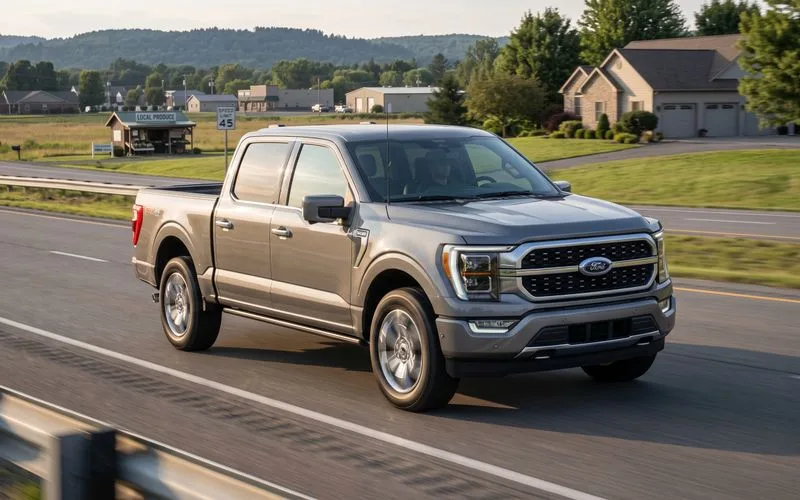 Ford F-150Full-Size TruckBetter at: Efficiency and resale
It matches or beats the Silverado on payload and work features, adds a PowerBoost hybrid at 23-25 MPG combined plus 7.2 kW of onboard jobsite power, and holds its value better.
Compare 2.42C+
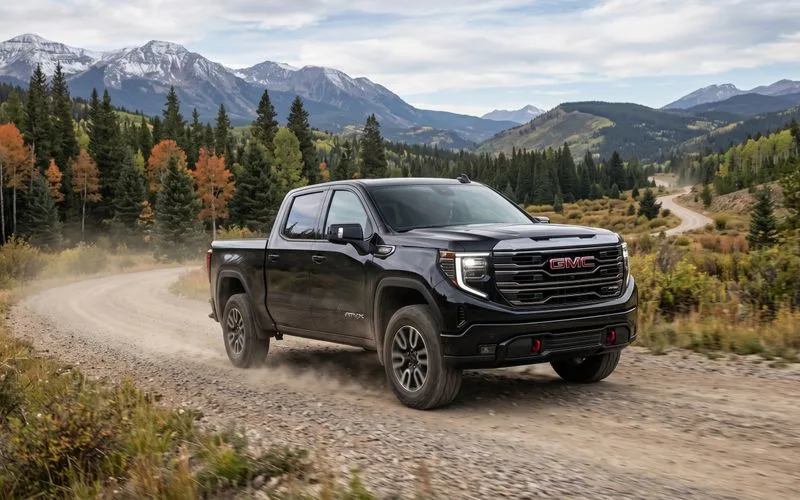 GMC Sierra 1500Full-Size TruckBetter at: Interior quality
Mechanically the same truck with a nicer cabin, the standard MultiPro tailgate on SLT and up, and slightly stronger residuals — worth the $3,000-$6,000 premium if the interior matters more than the invoice.
Compare 2.42C+
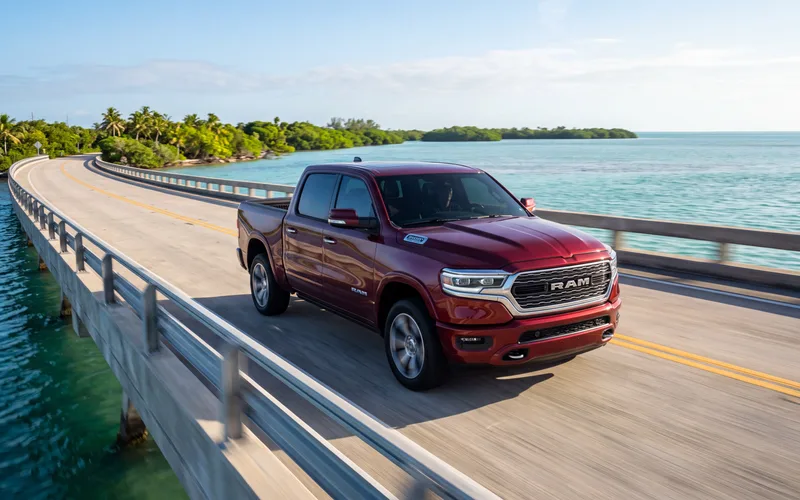 Ram 1500Full-Size TruckBetter at: Ride comfort
Its coil-sprung rear axle rides noticeably better unladen and its interiors are the segment's most comfortable, with a 33-gallon tank for longer legs between fills.
CompareHow it's evolved
10 scored model years · 2017–2026
Subject scores by year
Hover or tap a score to see what moved it versus the year before. A corner mark flags a big swing.
| Year | Performance | Efficiency | Safety | Space | Cost | Reliability | Tech | Use-case | Driving | Value |
|---|---|---|---|---|---|---|---|---|---|---|
| 2026 | 61 | 33 | 62 | 71 | 45 | 61 | 73 | 69 | 62 | 74 |
| 2025 | 61 | 29 | 61 | 73 | 45 | 66 | 73 | 67 | 62 | 74 |
| 2024 | 62 | 29 | 60 | 73 | 48 | 62 | 74 | 65 | 63 | 71 |
| 2023 | 61 | 31 | 64 | 70 | 45 | 59 | 69 | 66 | 62 | 73 |
| 2022 | 60 | 24 | 65 | 70 | 46 | 60 | 69 | 66 | 61 | 70 |
| 2021 | 59 | 37 | 43 | 68 | 56 | 50 | 54 | 65 | 60 | 64 |
| 2020 | 59 | 37 | 42 | 71 | 56 | 56 | 57 | 62 | 62 | 67 |
| 2019 | 59 | 37 | 37 | 68 | 56 | 53 | 55 | 60 | 59 | 66 |
| 2018 | 54 | 40 | 35 | 71 | 53 | 59 | 43 | 58 | 65 | 67 |
| 2017 | 54 | 40 | 36 | 69 | 61 | 56 | 43 | 61 | 65 | 67 |
Compare two years
Best fit & conditions
Higher scores mean a better fit for that use case. Learn more about use-case fit →
Subject profile
Trims & configurations
8 trimsScores above reflect the volume trim. Per-trim specs and scores are rolling out — the full lineup:
Detailed scoring by subject
1Performance & PowertrainMid-pack among this car's ten categories.2.00C
The volume 2021 Silverado 1500 configuration — LT/RST crew cab with the 5.3L L84 EcoTec3 V8 — makes 355 hp, carried over unchanged within the fourth generation. 2021 offers five engines, the widest menu the nameplate has had, topping out at the 420-hp 6.2L V8.
The volume 5.3L V8 peaks at 383 lb-ft, mid-pack for a half-ton. The 2021 torque leaders are the 6.2L V8 and the 3.0L Duramax diesel, both at 460 lb-ft — note the 2021 2.7L Turbo makes 348 lb-ft, before the 430-lb-ft TurboMax revision arrived for 2022.
Edmunds' instrumented test of a 5.3L V8 4WD crew cab on the eight-speed automatic — the volume drivetrain for 2021 — returned 7.0 seconds to 60 mph, adequate for a half-ton but nowhere near the top of a truck band anchored by sub-4-second electric pickups. The 5.3L is materially quicker on the 10-speed, and the 6.2L is the pace car of the range.
The 5.3L and 6.2L small-block V8s deliver the lag-free low-end torque that defines a half-ton, and the 3.0L Duramax is notably quiet and vibration-free for a diesel. Two things keep 2021 out of the top band: the pre-TurboMax 2.7L four is strong off idle but coarse and buzzy when worked, and the V8s' Active/Dynamic Fuel Management cylinder deactivation is audible and occasionally rough at light throttle — a complaint sharpened in 2021 because the semiconductor shortage forced GM to ship many mid-year 5.3L trucks with cylinder deactivation deleted entirely.
2021 is the most transmission-fragmented year of this generation: the 5.3L V8 alone is sold behind a six-speed, an eight-speed and a ten-speed depending on trim, and the volume eight-speed is the weakest of the three — reviewers report low-speed indecision and occasional harsh part-throttle shifts. The 10-speed on the 6.2L, the Duramax and the Trail Boss/High Country 5.3L is smooth and keeps the engine in its band, but the carry-over 6L80 six-speed on Work Truck and Custom models is plainly dated against a segment that had largely moved to eight and ten ratios.
Properly equipped, the 2021 Silverado 1500 tows 13,300 lbs — at the top of the half-ton class and near the ceiling of the truck normalization band. The volume 5.3L V8 is rated up to 11,500 lbs with the Max Trailering Package, and 2021's increased trailering ratings were among the year's advertised improvements.
Maximum payload for 2021 is 2,280 lbs in a work-oriented configuration — competitive but not exceptional for a half-ton, and well short of the 3,400-lb top of the truck band. Popular crew cab trims land closer to 1,800–2,100 lbs once cab, drive and equipment are accounted for.
GM's Advanced Trailering System was already the most complete factory towing suite in the segment for 2021: an available integrated trailer brake controller (included with the Max Trailering Package), tow/haul mode with trailer sway control, trailer profiles and a pre-departure checklist in the in-vehicle trailering app, hitch guidance with hitch view, and up to 15 camera views — including a Transparent Trailer view that renders a compatible trailer effectively see-through. It sits just below the very top because the brake controller, the trailer camera provisions and the accessory camera itself are all extra-cost items rather than standard equipment, and because 2021 predates the more integrated camera packaging of the refreshed trucks.
Four-wheel drive is offered on every 2021 Silverado 1500 trim from Work Truck to High Country and is standard on both Trail Boss models, using a genuine two-speed transfer case with a low range; Autotrac automatic 4WD is available on higher trims and the G80 locking rear differential is widely offered. It stops short of the top of the band only because 4WD remains an extra-cost option on the mainstream trims.
2021's off-road answer is the Trail Boss, offered in Custom and LT form, which pairs the Z71 package with a factory 2-inch suspension lift, Rancho monotube dampers, skid plates, an automatic locking rear differential, hill descent control and all-terrain tires — genuinely capable light-duty hardware with improved approach and departure angles. It falls short of the top band because 2021 has no halo off-road trim: the Multimatic-damped ZR2, with its front and rear lockers and 33-inch mud-terrains, does not arrive until 2022, so nothing in this model year answers a Raptor or a TRD Pro.
Five genuinely distinct engines — a 4.3L V6, a 2.7L turbo four, two displacements of small-block V8 and an inline-six turbo-diesel — give the 2021 Silverado 1500 the broadest conventional powertrain menu in the half-ton segment, and the widest the nameplate itself would offer (the 4.3L V6, the 5.3L AFM engine and the six-speed are all deleted within two model years). It cannot reach the top band because none of them is electrified: there is no hybrid or plug-in half-ton Silverado for 2021, and the battery-electric Silverado EV is a separate nameplate on its own platform, still two years from sale.
2Efficiency & RangeThe Silverado 1500's lowest-graded category.0.46F
The volume 5.3L V8 4WD returns 18 MPG combined — thirsty even by full-size truck standards and the main drag on this category. A 2021 buyer chasing economy had to move to the 2.7L Turbo (20 MPG) or, far more dramatically, the 3.0L Duramax, which at 27 MPG combined in 2WD is the most efficient half-ton powertrain of the year.
16 MPG in town is mid-pack for a V8 half-ton; Active/Dynamic Fuel Management cylinder deactivation is what keeps it off the bottom of the class, which is exactly why the 2021 chip-shortage builds that shipped without it dropped to 15 MPG city. Stop-and-start use is where this truck costs the most to run.
22 MPG on the highway is respectable for a 4WD V8 half-ton but still sits in the lower third of the truck band, which runs to 31 MPG. The 3.0L Duramax is the only 2021 Silverado powertrain that changes the highway picture, and in 2WD form its 33 MPG rating clears the top of the band outright.
A 24-gallon tank and 18 MPG combined give the volume configuration roughly 430 miles between fills — usable but short of the 500-plus miles a diesel half-ton delivers, and the Duramax 2WD's ~648-mile theoretical range is the standout of the 2021 lineup. The figure is derived from the EPA combined rating and the published tank capacity rather than quoted directly by EPA.
EPA puts annual fuel spend for the volume 5.3L V8 4WD configuration at $3,400 — high in absolute terms and in the upper half of the truck band. The 6.2L V8's premium-fuel requirement is the real penalty in this lineup, pushing LTZ and High Country buyers past $4,200 a year, while the diesel is the cheapest to feed at $2,950.
The volume 5.3L V8, the 4.3L V6 and the 2.7L Turbo all make their rated output on regular 87-octane unleaded, and several 5.3L builds are additionally E85 flex-fuel capable, which adds a cheap-fuel option where E85 is sold. The score is held below the top of the band because the 6.2L V8 requires premium — a genuine running-cost penalty on LTZ and High Country — and the Duramax brings diesel plus DEF requirements.
3SafetyOne of the Silverado 1500's weakest categories.0.85F
NHTSA rated the 2021 Silverado 1500 Crew Cab at 4 stars overall in both 2WD and 4WD form — 5 stars in the side barrier and side pole tests but only 4 stars frontal (4 driver, 4 passenger), which holds the composite below the 5-star mark. The rollover result is 4 stars, better than the 3 stars typical of a tall full-size 4WD pickup.
The 2021 Silverado 1500 Crew Cab earns Good in driver-side small overlap, moderate overlap front, the original side test, roof strength and head restraints — but it drops to Marginal in the passenger-side small overlap front test, a structural result on the side a family passenger sits, and no better than Acceptable in the updated side test. That Marginal in a key crashworthiness test, combined with Poor headlights across every variant tested, keeps it well clear of any Top Safety Pick award; the Double Cab was never crash tested at all.
This is the 2021 Silverado's biggest safety weakness: no collision-avoidance hardware is standard on any trim. Automatic emergency braking, front pedestrian braking, forward collision alert, lane keep assist and IntelliBeam are all package content — 2021 was the year Chevrolet made them merely *orderable* down to Work Truck and Custom (they were LTZ/High Country-only for 2020, after Consumer Reports publicly criticized the $16,835 premium that entailed), not standard. Adaptive cruise remains a Safety Package II item. A volume LT leaves the lot with a rear camera and Teen Driver and nothing else, while the 2021 Ford F-150 shipped Co-Pilot360 with AEB, blind-spot monitoring and lane keeping standard on every trim.
When fitted, the system performs well: IIHS rates the optional front crash prevention Superior — the top grade — in the vehicle-to-vehicle track tests. What holds the score short of the top band is that IIHS published no vehicle-to-pedestrian rating for the 2021 truck, so the front pedestrian braking function is unverified and nighttime pedestrian performance is entirely unmeasured, exactly the scenario where a tall-hooded full-size pickup is most dangerous.
Side Blind Zone Alert with Lane Change Alert and Rear Cross Traffic Alert are alert-only — no steering or braking intervention — and are option-package content on Work Truck, Custom and LT rather than standard, becoming standard equipment only on LTZ and High Country. The trailer-length blind-spot coverage that later Silverados offer is not available on the 2021 1500, which matters on a truck bought to tow.
Lane Keep Assist with Lane Departure Warning is optional package content and is a reactive nudge system by design — the owner's manual states outright that it is not intended to keep the vehicle centered in the lane, and it only operates between roughly 37 and 112 mph, so it does nothing on secondary roads. No lane centering of any kind is offered on the 2021 Silverado 1500.
Full-speed-range adaptive cruise is competent when equipped, and 2021 widened its reach from LTZ/High Country to LT, RST and LT Trail Boss — but it stays a $1,095 Safety Package II line item that also requires Safety Package I, so the great majority of 2021 Silverados left the factory with plain cruise control. There is no highway-assist layer combining ACC with steering support at any price this model year.
Super Cruise is not offered on the 2021 Silverado 1500 at any trim or price. GM kept hands-free driving in Cadillac through this period and did not extend it to the Silverado 1500 until the 2024 model year, by which point Ford had been selling BlueCruise on the F-150 since 2021.
IIHS rated every one of the five 2021 Silverado 1500 headlight variations Poor — the worst possible result, and uniform across the range, so there is no trim a buyer can move up to in order to escape it. IntelliBeam automatic high beams are available but arrive only inside the optional safety packages, and better auto-dimming does not fix a low-beam pattern this weak.
The commanding seating position does not translate into good sightlines: reviewers single out the tall, broad hood that hides the road ahead and thick forward pillars that cut into the view left and right, and Cars.com flags over-the-left-shoulder visibility on the Crew Cab as a specific drawback. The camera systems that would compensate are optional, and Edmunds found this generation's cameras less useful than Ford's or Toyota's because of poor image resolution.
IIHS rates the 2021 Silverado 1500's LATCH ease of use Marginal — the second-worst grade — with anchors that are hard to reach and maneuver around. The Crew Cab's own dimensions work in the buyer's favor once a seat is in (wide near-square door openings, a flat floor and stretch-out rear legroom make the installation itself less cramped than in most rivals), which is the only reason this lands mid-40s rather than lower.
4Space & ComfortThe Silverado 1500's best-graded category.2.59C+
The volume 2021 Crew Cab LT/RST configuration seats 5 with front buckets and a floor console; the 40/20/40 split bench that makes it a six-seater is standard on WT/Custom and available at LT. Cab and seat architecture is unchanged from the fourth generation's 2019 launch.
Chevrolet-published front headroom for the 2021 Crew Cab, unchanged since the fourth generation launched for 2019 and carried through the 2022 interior overhaul. It sits at the very top of the 38–43 in truck band.
44.5 in of front legroom is generous even by full-size truck standards and identical to the mechanically twinned GMC Sierra 1500. Front-row space is not a compromise in any 2021 Silverado cab.
Second-row headroom of the volume Crew Cab is comfortable for adults but a step behind the tallest-roofed half-tons, landing about two-thirds up the 38–41 in truck band. Unchanged from the 2019 generation launch.
43.4 in of second-row legroom makes the Crew Cab a genuine four-adult vehicle and is effectively level with the F-150 SuperCrew and Sierra 1500. Reviewers consistently call the rear seat spacious; the criticism is cushion padding, not room.
The volume Crew Cab pairs with the 5'8" Short Box, which sits low in the 54–98 in truck band — the price of the long cab. Buyers who need bed length can order the 6'6" box on the Crew Cab or the 8'2" box on Double and Regular Cabs.
GM's wide, tall Durabed extracts more volume from the short box than any half-ton rival's comparable bed — 62.9 cu ft from a bed that is barely longer than the F-150's 5.5-ft box or the Ram 1500's 5'7" box.
2021 is the year the Multi-Flex Tailgate arrived — six functions and a 375-lb rating, genuinely clever — alongside 12 fixed Durabed tie-downs, the CornerStep bumper and an available lockable rear-underseat organizer. It stays mid-band because the pre-refresh cabin's console and door bins are ordinary, there is no RamBox-style in-bed trunk, and 120V outlets are package content (Convenience Package II on LT) rather than standard.
Front seats are broad and supportive enough for long stints, and the Crew Cab rear bench is roomy, but 2021 predates the 2022 interior overhaul: reviewers single out four-way manual front seat adjustment even on the mid-grade LT, and a rear bench that 'could use more padding'. It is a step behind the F-150 and clearly behind the Ram 1500.
The leaf-sprung rear axle is tuned for load robustness and unladen ride is the acknowledged weak point of the 2021 truck — smooth enough on good highway, jostled and unsettled by large bumps, and by 2021 the redesigned F-150 and coil-sprung Ram 1500 had moved clearly ahead. Adaptive Ride Control was new for 2021 but restricted to High Country models on 22-inch wheels.
The 5.3L V8 falls quiet at a steady cruise and owners describe the Crew Cab as well isolated, but 2021 predates the acoustic glass and active noise cancellation the 2022 overhaul spread through the range, and wind rush around the big mirrors plus coarse-surface tire roar are audible. Cabin noise recurs in owner complaints for this model year.
For 2021 the LTZ absorbed the prior Convenience Package as standard — heated and ventilated front buckets and a power rear window — and remote start became standard on Custom and Custom Trail Boss, so the middle of the range is decently equipped. It stays mid-band because heated seats and a heated wheel on the volume LT are package content, ventilated seats remain LTZ/High Country only, and the WT gets single-zone manual air.
5Cost of OwnershipMid-pack among this car's ten categories.1.80C-
The 2021 Silverado 1500 Work Truck opened the ladder at $30,195 delivered, among the lowest entry points in the full-size class and $800 below the equivalent 2021 F-150 XL. The 4.3L V6 was standard at this trim.
LT Crew Cab 4WD is the Silverado 1500's volume cab/drivetrain/trim combination, and while the 2.7L Turbo was standard on LT for 2021, the 5.3L V8 remained the volume engine among retail buyers. Base LT Crew Cab 4WD ran about $46,900 delivered; adding the 5.3L V8 and the popular Convenience package lands a typically-equipped truck near $49,500.
Two independent estimators land within $80 of each other for the Silverado 1500, which benefits from commodity parts, the widest dealer service network in the country, and simple pushrod V8 hardware. RepairPal ranks it better than the F-150 on frequency of unscheduled repairs, though it flags repair severity as above average when problems do occur.
Full-size truck residuals are strong in absolute terms and the Silverado sits mid-pack within the class — behind Toyota Tundra and roughly level with the F-150, ahead of Ram 1500. The pre-refresh 2021 interior is a modest residual headwind on used lots now that the 2022 refresh cabin exists as the comparison point.
GM's standard bumper-to-bumper term, identical across every 2021 Silverado 1500 trim and identical to Ford, Ram and Toyota — the segment floor, and well behind Hyundai/Kia's 5/60,000 coverage in the wider market.
GM's standard powertrain term and the segment floor, matched by Ford and Ram. The optional 3.0L Duramax diesel's emissions components carry the federally mandated 8-year/80,000-mile coverage, but that does not extend the base powertrain term on the gas trucks scored here.
Chevrolet Complete Care on a 2021 Silverado covered exactly one scheduled maintenance visit (oil change, tire rotation, multi-point inspection) in the first year, plus 5-year/60,000-mile roadside assistance and 3-year/36,000-mile courtesy transportation, with a short OnStar and Connected Services trial. That is a token maintenance package next to Toyota's 2-year/25,000-mile ToyotaCare on the Tundra, but it is one visit more than Ford bundled with the 2021 F-150.
$49,500 volume-trim price minus its estimated resale value after 5 years (59% retained, or about $29,205) leaves about $20,295 in depreciation. Add the projected $3,530 in 5-year maintenance and repairs, and owning this vehicle for 5 years costs about $23,825 in total.
6Reliability & QualityOne of the Silverado 1500's weakest categories.1.38D
2021 is the worst-graded year of this generation and one of the worst predicted-reliability results Consumer Reports has published for any vehicle: 13 out of 100, placing the Silverado 1500 at the very top of CR's 2021 '10 Least Reliable Cars' list, with the mechanically identical GMC Sierra alongside it. CR's trouble spots were brakes and in-car electronics, with secondary transmission and power-accessory complaints — and the owner-complaint record backs it, with 983 total complaints logged for the model year and 368 NHTSA engine complaints leading the field. The one genuine counterweight is J.D. Power, whose consumer quality-and-reliability rating for the 2021 Silverado 1500 sits at 83/100 in the 'great' band, so the sources disagree sharply rather than converging. The item lands in the below-average band but not at its floor, because the JDP result and the truck's average RepairPal repair frequency argue the CR figure is the harsher end of a real spread.
Chevrolet's brand standing around the 2021 model year is genuinely mid-pack rather than bad, and the two major studies split the same way they do for the truck itself. J.D. Power's 2021 Vehicle Dependability Study put Chevrolet at 115 PP100 against a 121 PP100 industry average — better than average, with three segment awards (Camaro, Silverado HD, Tahoe), the most of any brand, though behind stablemates Buick and Cadillac and far behind Lexus at 81. Consumer Reports' 2021 brand rankings placed Chevrolet 17th of 26 with a score of 42, characterized as average for a domestic brand. Mid-pack from both angles, and the same standing that applies to the GMC-badged Sierra built on the same line.
The 2021 build year carries eight NHTSA campaigns — nearly triple the three logged against the 2023 truck — and two of them are safety-restraint defects on the volume configuration: a driver's airbag module missing the metal tabs that hold the cover to the housing (21V495000) and incorrect seat-belt bolts (20V811000), alongside an unsecured front-row center seat-belt bracket (20V792000). Two more are supplier tire campaigns (overcured Continentals, 20V684000; an incompatible 17-inch spare, 21V985000). Three of the eight miss the scored gas 5.3L truck entirely — the 6.2L connecting-rod/crankshaft defect (25V274000) and the diesel transmission control valve programs (24V797000 and its 2026 re-do, 26V083000) — which is what keeps this out of the bottom band. What holds it down rather than up is the bulletin record: GM issued a valve-lifter service update covering 2019–2021 V8s, and 10-speed and 8-speed shift-quality bulletins run through the generation, so the elevated recall count sits on top of an already busy TSB history.
The scored volume configuration is the 355-hp 5.3L L84 EcoTec3 V8, and 2019–2021 is the window in which GM's Dynamic Fuel Management lifter failures were at their worst — bent pushrods, collapsed lifters and lifters coming apart, in documented cases at mileages as low as 585, with owners reporting multi-week dealer waits on parts. GM named 2019–2021 5.3L L84 trucks explicitly in its valve-lifter service update, and engine complaints are the single largest category in the 2021 truck's owner-complaint record. Two things stop this falling further: the small-block architecture underneath is proven and universally serviceable, and from March 2021 the semiconductor shortage had GM shipping 5.3L trucks under RPO YK9 with cylinder deactivation deleted outright — those specific trucks sidestep the DFM failure mode entirely, at a cost of about 1 MPG combined. The 8-speed on the volume 5.3L carries its own shudder and shift-quality bulletins; only the 3.0L Duramax inline-six, outside the scored gas class, has a clean record here.
2021 is the last full model year of the pre-refresh fourth-generation cabin, and it is the most consistently criticized part of the truck. Reviewers describe hard, glossy plastics throughout, large panel joints, an inelegant control layout, small infotainment screens and a design that reads a decade old next to the Ram 1500's class-leading interior and the F-150's better-executed one — and Edmunds notes the Silverado asked more money than its rivals without a materials or style advantage to justify it. Consumer sentiment tracked the same way, with quality rated the Silverado's weakest attribute. This is exactly the deficiency the 2022 overhaul was built to fix, which is why the 2023 truck sits a clear band above this one.
Structural assembly of the third-year fourth-generation body at Fort Wayne, Silao and Oshawa is segment-normal — panel gaps and sheetmetal alignment are not what owners complain about. The problems are electronic and functional: Consumer Reports flagged brakes and in-car electronics as the 2021 truck's persistent trouble spots, and the complaint record carries 94 NHTSA electrical complaints plus ECM warning lights, multiple simultaneous trouble codes and extended crank-before-start among the highest-severity individual concerns, with average repair costs of $2,500–$3,500. 2021 is also a compromised build year in its own right: the semiconductor shortage forced mid-year content deletions and shipping changes across GM's truck plants. Below the segment midpoint, and below the 2023 truck's more settled record.
Chevrolet runs one of the two largest franchised networks in the country at roughly 3,000 US locations, so factory service for a Silverado is close at hand almost anywhere — a real advantage over the Buick-GMC channel supporting the mechanically identical Sierra, and decisive in the rural markets where these trucks sell hardest. For a 2021 truck the network is also the warranty backstop for the lifter and restraint campaigns above, and it matters more here than on a cleaner model year. What keeps it out of the top band is service satisfaction rather than reach: J.D. Power's Customer Service Index places Chevrolet around the mainstream-brand average, and 2021 owners reporting multi-week waits for lifter repairs are a concrete instance of the network's capacity limits.
The Silverado 1500 is the second-best-selling vehicle in America and the 5.3L small-block in the volume truck is the most familiar powertrain in any independent shop in the country, so aftermarket depth trails only the F-150's. RepairPal puts average annual repair and maintenance at $714 against a $936 full-size-pickup average — materially cheaper than the class — while noting that individual repairs skew more severe than average even though they are infrequent, which is a fair description of the DFM lifter exposure. Parts commonality with the Sierra, Tahoe, Suburban, Yukon and Escalade keeps OEM supply deep, and at five years old this truck now has a mature used- and reman-parts channel a current-year truck lacks. The 2021-specific caveat is supply rather than price: chip-shortage-era components and lifter parts were genuinely backordered during the warranty period.
7Technology & InfotainmentGrades below the middle of the scale.1.60D
2021 is the last year before the 2022 interior overhaul brought the 13.4-inch screen, so the biggest display any Silverado 1500 could be ordered with was 8.0 inches — the floor of the 8–18.5 in truck band in a catalog anchored on 2026.
Chevrolet Infotainment 3 is one of the better-liked systems of its era — quick to respond, logically laid out, and backed by real knobs and hard climate buttons rather than menu-diving. What holds it below the top band in 2026 terms is the small 8-inch canvas, dated graphics, and reviewers noting that several controls are an awkward reach from the driver's seat.
2021 is the year wireless phone projection arrived on the Silverado, but not evenly: it is standard only on LTZ and High Country and is optional package content on the volume LT, LT Trail Boss and RST. Wired CarPlay and Android Auto are standard across the whole range including the 7-inch WT system.
Voice recognition is the pre-natural-language GM system — command-driven, workable for radio and phone, and comfortably outclassed by the Siri or Google assistant a projected phone brings in. Built-in connected navigation is not standard on the volume LT; it is package or upper-trim content, so most buyers navigate through CarPlay.
A seven-speaker Bose system is available across LT, RST, LTZ and standard on High Country and is a clear step up, but it is a mid-tier branded system rather than a showpiece, and the base setup — six speakers on most trims, a two-speaker arrangement on the stripped WT — is thin. Competent rather than notable.
No 2021 Silverado 1500 offers a full-digital cluster. Instruments are analog speedometer and tachometer around a Driver Information Center — 3.5-inch monochrome at the bottom of the range, 4.2-inch colour on most trims (newly added to WT/Custom with the 2021 Safety Confidence package), and an 8-inch colour DIC at the top. The 12.3-inch configurable cluster is a 2022 arrival.
The 2021 Silverado 1500 predates the VIP/Global B electrical architecture that the 2022.5 refresh brought to this nameplate, so over-the-air work is limited to infotainment and map/software refreshes pushed through the connected system rather than whole-vehicle module programming. Real capability, but narrow.
The myChevrolet app covers the core set well — remote start and climate, lock/unlock, vehicle locate, diagnostics and fuel level, plus a longer effective range than the fob — and 2021 made remote start standard as far down as Custom. It is held to mid-band because the useful remote functions depend on an OnStar Remote Access plan after the trial and there is no phone-as-key on this generation.
The Crew Cab carries USB ports in both rows — a mix of USB-A and USB-C rather than the all-C, high-wattage layouts newer trucks use — and a 120V household outlet in the cab plus one in the bed is available on LT and up. Wireless phone charging is not available on the volume LT for 2021; it is LTZ package content and standard only on High Country.
Keyless Open and push-button start are standard from LT upward and remote start reaches down to Custom for 2021, which covers the trims most buyers actually order. It stops short of the top band: there is no phone-as-key on this generation, the WT still uses a conventional key, and 2020 had already deleted the rear-door keyless access buttons.
This is the truck's strongest technology suit. A rear camera is standard, HD Surround Vision gives a bird's-eye view, and with the trailering camera provisions Chevrolet offered up to 15 camera views for 2021 — more than any rival pickup — joined by new trailer length indicator, jack-knife alert and a bed view for gooseneck hookup. Surround view and the rear camera mirror remain upper-trim/package content, which keeps it out of the top band.
A head-up display is offered but only at the very top of the range, inside the High Country Technology Package — nowhere near the volume LT or RST a typical buyer orders. Offered, but effectively out of reach.
8Use-Case FitOne of the Silverado 1500's strongest categories.2.36C+
The Crew Cab's 43.4 in of rear legroom and wide-opening rear doors make seat installation and buckling genuinely easy, and the rear bench cushions flip up for a flat floor big enough for strollers and bags. It is pulled down by the high step-in that small children cannot manage without running boards, LATCH anchors buried in the seat bight, and a cargo bed that is open to the weather unless a tonneau is fitted.
This is the 2021 truck's clearest weakness for a family buyer. Forward collision warning and automatic emergency braking are not standard — they sit in the new-for-2021 Safety Confidence package on WT/Custom and in optional packages further up, a full model year before Chevy Safety Assist became standard for 2022. Combined with a 4-star NHTSA overall result and poor-rated headlights, families pay extra for equipment rivals already included.
Space is not the problem — four adults plus gear travel easily, with rear vents in the Crew Cab and a bed that swallows everything the cabin cannot. The limits are comfort rather than capacity: an unladen ride that gets jostled by big bumps, rear cushions reviewers say need more padding, no rear entertainment or rear USB fast-charging of note, and heated rear seats reserved for LTZ and High Country.
The 5.3L V8 pulls smoothly from low revs, the automatic shifts unobtrusively and outward vision forward is commanding, so the truck is undemanding in traffic once you accept the size. Working against it: adaptive cruise control is restricted to LTZ and High Country for 2021, the auto stop/start restart is a common owner complaint, and the sheer footprint makes stop-and-go a chore compared with anything smaller.
The volume 5.3L V8 4WD Crew Cab returns 18 MPG combined and an EPA-estimated $3,400 a year in fuel, among the most expensive per-mile propositions any commuter could choose short of a heavy-duty. Consumables are cheap and regular fuel is fine, and the 3.0L Duramax option is genuinely thrifty at 24–27 MPG combined, but that is not what the volume buyer drives.
A 231.7-inch-long, 81.2-inch-wide Crew Cab that needs roughly 46 ft to turn around is a genuine liability in a garage or a city lot, and it overhangs a standard parking bay. The camera suite is the mitigation — a rear camera is standard and HD Surround Vision is available — but the volume LT often leaves the lot without surround view.
This is what the truck is built for. The volume 5.3L V8 tows 11,500 lbs, the range tops out at 13,300 lbs with the 6.2L and the Max Trailering Package — improved for 2021 over 2020 — and payload reaches 2,280 lbs properly equipped. The Durabed is the widest and highest-volume half-ton bed on sale, and the powertrain does not run out of breath under load.
A fully boxed frame, the small-block V8 and GM's 8- and 10-speed automatics are as fleet-proven as anything in the segment, and the WT's vinyl floor and rubber-friendly cabin are built to be hosed out. The reservation is specific rather than general: the 5.3L's Dynamic/Active Fuel Management cylinder-deactivation lifters have a documented failure reputation in this era, which is a real cost exposure for a hard-worked truck.
2021 is a strong year for this specifically: the new Multi-Flex Tailgate offers six configurations including a standing workstation and second-tier load stop at a 375 lb rating, the Durabed carries 12 fixed tie-downs, the CornerStep bumper and available bed lighting make loading easy, and 120V outlets in the cab and bed are available from LT. Behind that sits the largest accessory and upfit ecosystem in the segment.
A 24-gallon tank and 18 MPG combined give roughly 430 miles between stops — around 600 with the Duramax — and the truck tracks straight and quietly at a highway cruise with a commanding view out. What keeps it mid-band is that adaptive cruise is LTZ/High Country-only for 2021 so most buyers get no fatigue-reducing assist, and the ride gets busy the moment the surface deteriorates.
4WD is available across essentially the entire range, and the Trail Boss trims — Custom Trail Boss and LT Trail Boss — pair a factory 2-inch suspension lift with the Z71 package's locking rear differential, skid plates, Rancho monotube shocks and Goodyear Duratrac tires. It is a capable gravel-road and trailhead vehicle with plenty of hitch and bed capacity for toys; short of a Raptor or a Power Wagon in articulation and clearance.
A 62.9 cu ft open bed with 12 tie-downs, a flip-up rear bench giving a flat load floor inside, a lockable under-seat organizer and a hitch on almost every build make this one of the most flexible shapes on sale for bulky gear. It is not a perfect score because the bed is uncovered without an accessory tonneau, so secure weatherproof space is limited to the cab.
9Driving ExperienceMid-pack among this car's ten categories.2.03C
The fourth-generation T1 platform — fully boxed frame, independent front suspension, rear leaf axle — tracks straight and turns in more willingly than a 231-inch truck has any right to, and reviewers rate maneuverability as a strength. The leaf-sprung rear is the ceiling: mid-corner bumps skip the axle and unsettle the truck where the coil-sprung Ram 1500 stays planted.
The electric rack is accurate and naturally weighted enough to place the truck confidently on a highway lane and reviewers credit its response and precision, but it passes essentially nothing back through the rim. Precise, stable, and entirely numb — squarely mid-band.
Four-wheel discs haul the 5,000-plus-pound Crew Cab down adequately and there is no regen blending to complicate modulation, but pedal quality is a genuine criticism for this model year — long travel and poor feedback at the top of the stroke. Sufficient for daily use and towing, short of confidence-inspiring.
The 5.3L EcoTec3 V8 delivers smooth, abundant low-end torque with crisp tip-in, and the 3.0L Duramax is unusually refined for a diesel six. It lands below the 10-speed-equipped later model years because the volume 2021 5.3L pairing is still the six- or eight-speed automatic, Dynamic Fuel Management transitions are audible at light throttle, and the auto stop/start restart is one of the most-cited owner complaints for this year.
The small-block V8s make a pleasant muted rumble under throttle and recede at cruise, and the Duramax stays civil. The mid-band placement reflects the base 2.7L turbo four, which reviewers consistently describe as coarse at the revs a loaded truck actually uses, and faint driveline shudder some owners report at light-throttle cylinder-deactivation transitions.
Roughly 46 ft to swing around is mid-band for a full-size truck and unchanged across the fourth generation — tighter than an F-150 SuperCrew's 47.8 ft and effectively level with the Ram 1500. The longer-wheelbase Crew Cab Standard Box pushes toward 50 ft and is noticeably harder to place.
The commanding H-point and clear forward sightlines are genuine assets, and Chevrolet kept real knobs and hard climate buttons. But 2021 is the last year of the criticized pre-refresh cabin: reviewers find several controls an awkward reach, climate and seat buttons 'unnecessarily small,' and four-way manual front seat adjustment persists even on the mid-grade LT, with a high step-in without running boards.
The volume LT/RST 5.3L is a competent, comfortable workhorse rather than a truck anyone takes the long way home in — the V8 soundtrack is the main source of character. The 420-hp 6.2L is genuinely quick at 5.4–5.5 seconds to 60 mph and the Trail Boss has off-road charm, but neither is what most 2021 buyers drove home, and 2021 predates the Multimatic-damped ZR2.
10Value & Market PositionOne of the Silverado 1500's strongest categories.2.35C+
2021 improved the low end — Custom and Custom Trail Boss made the Convenience and Infotainment packages standard (EZ Lift tailgate, bed lighting, remote start), and LT upward carried an 8-inch touchscreen with wireless Apple CarPlay/Android Auto. But active safety stayed optional: forward collision alert, automatic emergency braking and front pedestrian braking were merely made *available* on the lower six trims for 2021, where the rival F-150 shipped Co-Pilot360 standard fleet-wide. That gap is the main drag here.
Strong hardware-per-dollar — a $30,195 entry point, five engines including a 2.7L Turbo that gained thousands of pounds of trailering capacity for 2021, a 13,300-lb max tow rating, and the new six-position Multi-Flex tailgate offered on every trim from WT to High Country. Cabin materials and the optional-only driver aids are where the money visibly stops, which is why reviewers kept sending buyers to the Ram 1500 for interior quality.
One of the widest configurators in the segment: eight trims spanning $30,195 to $54,895 delivered, three cab styles, three bed lengths, and five engines from the 4.3L V6 work-truck motor to the 6.2L V8 and 3.0L Duramax diesel. Only the F-150 offered more.
Still a top-five US vehicle by volume and, with the mechanically identical GMC Sierra, part of a GM full-size pair that outsold the F-Series in 2021. On its own badge, though, the Silverado finished third in the segment and its light-duty volume fell 12.7% year over year — partly chip-shortage supply, partly Ram's continued rise.
Chevrolet carries genuine full-size truck heritage and deep repeat-buyer loyalty, but it is positioned as GM's mainstream badge by design — the premium halo inside GM belongs to the mechanically identical GMC Sierra Denali, so the Silverado gets none of that lift on image or residuals.
A tale of two halves for 2021 buyers. Early in the model year Chevrolet was stacking real money on the hood — up to $7,000 off in April, 0% APR for 72 months on crew cabs, $2,500 down-payment assistance — but the semiconductor shortage idled the truck plants and by the second half discounts across the industry hit 20-year lows, with $4,000–$4,500 the practical ceiling.
Third model year of the fourth generation launched for 2019, and a genuine content year rather than a pure carry-over — Multi-Flex tailgate, the 10-speed automatic spread to every engine except the base 4.3L, higher trailering ratings, more trailering cameras. But the heavily criticized interior was carrying into its third year, and GM announced the 2022 refresh (new cabin, 13.4-inch screen) in September 2021, so a late-2021 buyer was knowingly taking the outgoing dashboard.
Solidly reviewed and consistently third — praised for towing capability, ride refinement and projected ownership costs, but marked down for cabin materials and design in nearly every comparison. No significant 2021 awards; the North American Truck of the Year that season went to the redesigned F-150.