

The verdict
A mixed-report mid-size luxury sedan, strong on efficiency and held back by performance.
The 2019 Lexus ES 300h launched an all-new seventh-generation car and remains one of the smartest used luxury buys on the road: 44 MPG combined on regular 87-octane, a 5-star NHTSA rating, an IIHS Top Safety Pick+ body, and a ride quality reviewers called outstanding even on crumbling pavement. It has held its value better than almost anything in the class — a $42,335-delivered car still trades near $27,000 at seven years — and RepairPal puts its annual upkeep at $524 against $739 for the luxury mid-size average. What you give up is pace and gadgetry: 215 total system horsepower means 8.1 seconds to 60 mph, there is no all-wheel drive at any price this year, and the console touchpad driving a non-touch 8-inch screen is the single most-criticized thing about the car. Buy it to be comfortable and to spend nothing; look elsewhere if you want to be entertained or need to handle snow.
Jump to scoresStrengths
- Reliability and dealer support that justify the badge
- 44 MPG combined — on regular gas
- Ride and quiet that lead the class
What holds it back
- Slow, and not interested in pretending otherwise
- Front-wheel drive only — no AWD at any price
- The infotainment is the car's worst feature
Top alternatives
Cars shoppers cross-shop with the Lexus ES 3.21B+
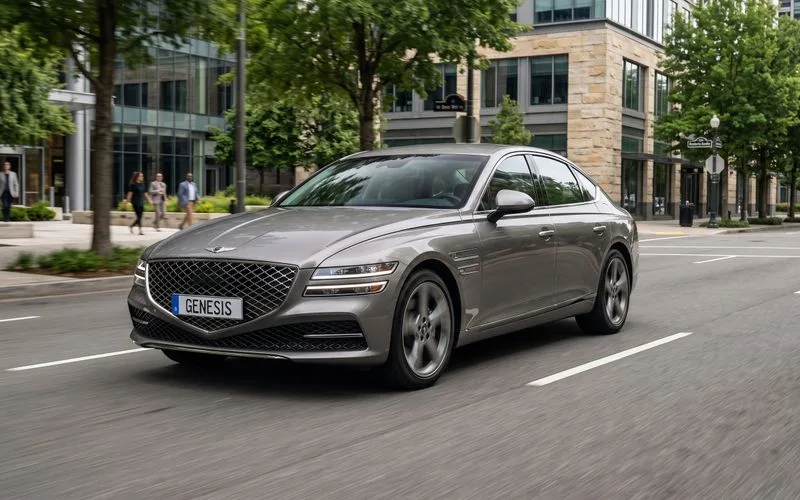 Genesis G80Mid-Size Luxury SedanBetter at: Warranty & power
For roughly $10K more it delivers 300 hp, rear-drive polish and a 10-year/100,000-mile powertrain warranty with three years of included maintenance — the strongest content-per-dollar case against the ES.
Compare 2.80B-
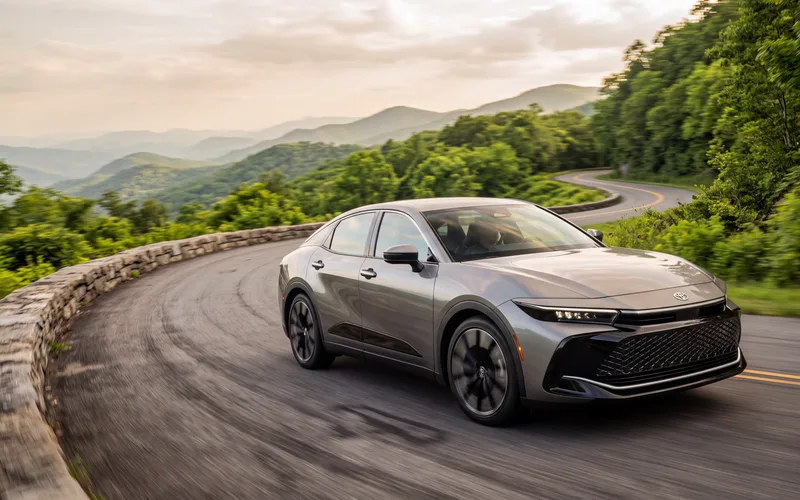 Toyota CrownFull-Size SedanBetter at: Price
Nearly the same hybrid hardware and resale performance for thousands less, if you can live without the Lexus cabin isolation and dealer experience.
Compare 3.27B+
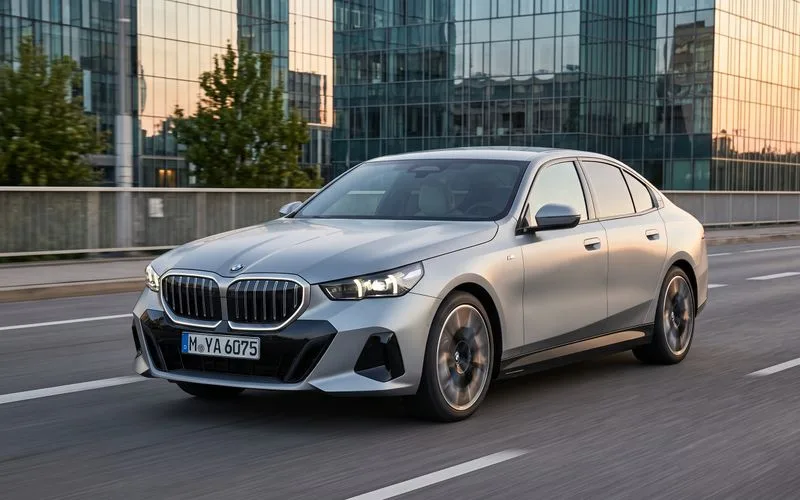 BMW 5 SeriesMid-Size Luxury SedanBetter at: Driving dynamics
The obvious pick if the drive matters — rear-wheel drive, high-5-second 0–60, real steering feel and an optional hands-free highway system the ES doesn't offer.
CompareHow it's evolved
10 scored model years · 2017–2026
Subject scores by year
Hover or tap a score to see what moved it versus the year before. A corner mark flags a big swing.
| Year | Performance | Efficiency | Safety | Space | Cost | Reliability | Tech | Use-case | Driving | Value |
|---|---|---|---|---|---|---|---|---|---|---|
| 2026 | 46 | 88 | 80 | 81 | 48 | 85 | 80 | 64 | 69 | 83 |
| 2025 | 39 | 90 | 76 | 71 | 56 | 89 | 68 | 53 | 65 | 77 |
| 2024 | 37 | 90 | 78 | 71 | 56 | 89 | 67 | 60 | 68 | 80 |
| 2023 | 35 | 90 | 77 | 71 | 58 | 88 | 66 | 53 | 61 | 73 |
| 2022 | 36 | 90 | 81 | 70 | 58 | 89 | 53 | 53 | 61 | 74 |
| 2021 | 39 | 90 | 77 | 75 | 64 | 88 | 54 | 54 | 63 | 73 |
| 2020 | 36 | 90 | 76 | 73 | 62 | 85 | 53 | 55 | 60 | 77 |
| 2019 | 36 | 91 | 75 | 73 | 64 | 81 | 50 | 55 | 60 | 77 |
| 2018 | 34 | 90 | 69 | 68 | 63 | 89 | 33 | 51 | 58 | 68 |
| 2017 | 33 | 90 | 73 | 65 | 63 | 89 | 34 | 50 | 56 | 70 |
Compare two years
Best fit & conditions
Higher scores mean a better fit for that use case. Learn more about use-case fit →
Subject profile
Academic Probation · NHTSA safety recalls
Nov 4, 2020Fuel system, gasoline: delivery: fuel pumpThe low-pressure fuel pump inside the fuel tank may fail.
Defect
Toyota Motor Engineering & Manufacturing (Toyota) is recalling certain 2018-2019 4Runner, 2019-2020 Avalon, 2019 Corolla Hatchback, 2017-2019 Highlander, 2018-2020 Camry, 2020 Corolla, 2018-2019 Land Cruiser, 2017-2020 Tacoma, 2019-2020 RAV4, 2019-2020 Sequoia, 2017-2020 Sienna, 2019-2020 Tundra, 2018-2020 Lexus ES350, 2017 Lexus GS200t, 2017-2019 Lexus GS350, 2019 Lexus GS300, 2018-2020 Lexus LC500h, 2019-2020 Lexus LS500, 2018-2019 Lexus GX460, 2017 Lexus IS200t, 2019 Lexus IS300, 2019 Lexus IS350, 2018-2020 Lexus LC500, 2018 Lexus LS500, 2019 Lexus LS500h, 2018-2019 Lexus LX570, 2017 Lexus RC200t, 2019 Lexus RC300, RC350, 2017 and 2019-2020 Lexus RX350, 2018-2020 RX350L, 2019 Lexus UX200, 2018-2019 Lexus NX300 vehicles. The low-pressure fuel pump inside the fuel tank may fail.
Risk
If the fuel pump fails, the engine can stall while driving, increasing the risk of a crash.
Remedy
Toyota will notify owners, and dealers will replace the fuel pump assembly with an improved one, free of charge. Owners of specific models were notified that remedy parts were available starting January 21, 2021. Owners of other models will be notified as remedy parts become available. Remedy parts should be available for all affected vehicles by late March 2021. Owners may contact Toyota customer service at 1-888-270-9371 or Lexus customer service at 1-800-255-3987. Note: This recall is an expansion of recall 20V-012. Toyota's number for this recall is 20TA02. Lexus' number for this recall is 20LA01.
NHTSA campaign 20V682000 ↗Manufacturer no. 20TA02, 20LA011,525,742 vehicles potentially affected (all models in the campaign)Owners notified Jan 21, 2021Filed by Toyota Motor Engineering & ManufacturingFiled as ES350Jan 13, 2020Fuel system, gasoline: delivery: fuel pumpToyota Motor Engineering & Manufacturing (Toyota) recalled certain 2018-2019 4Runner, Highlander, Camry, Land Cruiser, Sequoia, Sienna, Tacoma and Tundra, and Lexus RC 300, RC 350, GS 350, GX 460, IS 300, LC 500, LS 500, LX 570, RX 350L, and 2019 Toyota Avalon and Corolla, and certain Lexus NX 300, and ES 350 vehicles on January 13, 2020. On March 4, 2020, Toyota expanded the recall to include certain 2014-2015 Toyota 4Runner and Land Cruiser, 2018 Avalon, Corolla, 2014 FJ Cruiser, 2017 Sienna and Lexus 2018 ES 350, 2018-2019 GS 300, 2013-2014 GS350, 2014-2015 GX 460, IS 350 and LX 570, 2014 IS F, 2018-2019 IS 350, LC 500H and LS 500H, 2013-2015 LS 460, 2015 NX 200T and RC350, 2017 RC 200T and RX 350. Toyota also removed the 2018-2019 Toyota 4Runner and Land Cruiser and 2018-2019 Lexus GX 460 and LX 570 and 2019 NX300 from inclusion in this recall. On March 19, 2020, Toyota expanded the recall to include 2015 Lexus GS350 vehicles. The low-pressure fuel pump inside the fuel tank may fail.
Defect
Toyota Motor Engineering & Manufacturing (Toyota) recalled certain 2018-2019 4Runner, Highlander, Camry, Land Cruiser, Sequoia, Sienna, Tacoma and Tundra, and Lexus RC 300, RC 350, GS 350, GX 460, IS 300, LC 500, LS 500, LX 570, RX 350L, and 2019 Toyota Avalon and Corolla, and certain Lexus NX 300, and ES 350 vehicles on January 13, 2020. On March 4, 2020, Toyota expanded the recall to include certain 2014-2015 Toyota 4Runner and Land Cruiser, 2018 Avalon, Corolla, 2014 FJ Cruiser, 2017 Sienna and Lexus 2018 ES 350, 2018-2019 GS 300, 2013-2014 GS350, 2014-2015 GX 460, IS 350 and LX 570, 2014 IS F, 2018-2019 IS 350, LC 500H and LS 500H, 2013-2015 LS 460, 2015 NX 200T and RC350, 2017 RC 200T and RX 350. Toyota also removed the 2018-2019 Toyota 4Runner and Land Cruiser and 2018-2019 Lexus GX 460 and LX 570 and 2019 NX300 from inclusion in this recall. On March 19, 2020, Toyota expanded the recall to include 2015 Lexus GS350 vehicles. The low-pressure fuel pump inside the fuel tank may fail.
Risk
If the fuel pump fails, the engine can stall while driving, increasing the risk of a crash.
Remedy
Toyota will notify owners, and dealers will replace the fuel pump, free of charge. The recall began May 4, 2020. Owners may contact Toyota customer service at 1-888-270-9371 or Lexus customer service at 1-800-255-3987. Toyota's numbers for this recall are 20TB02 and 20TA02 for Toyota vehicles and 20LB01 and 20LA01 for Lexus vehicles.
NHTSA campaign 20V012000 ↗Manufacturer no. 20TB02/20TA02/20LB011,830,752 vehicles potentially affected (all models in the campaign)Owners notified May 1, 2020Filed by Toyota Motor Engineering & ManufacturingFiled as ES350Jul 24, 2019Electronic stability control (esc) · Service brakesThe brake booster pump may fail causing a deactivation of the Vehicle Stability Control system and a loss of braking assist. As such, these vehicles fail to comply with the requirements of Federal Motor Vehicle Safety Standard (FMVSS) number 126, "Electronic Stability Control Systems."
Defect
Toyota Motor Engineering & Manufacturing (Toyota) is recalling certain 2019 Lexus LS500, LC500, ES300h, UX250h, LS500h, Toyota Prius, RAV4 HV, 2019-2020 Toyota Prius Prime, and 2020 Corolla HV vehicles. The brake booster pump may fail causing a deactivation of the Vehicle Stability Control system and a loss of braking assist. As such, these vehicles fail to comply with the requirements of Federal Motor Vehicle Safety Standard (FMVSS) number 126, "Electronic Stability Control Systems."
Risk
Deactivation of the vehicle stability control system or a loss of braking assist increases the risk of a crash.
Remedy
Toyota will notify owners, and dealers will inspect and, if necessary, replace the brake booster pump, free of charge. The recall began September 20, 2019. Toyota owners may contact Toyota customer service at 1-888-270-9371 and Lexus owners may contact Lexus customer service at 1-800-255-3987. Toyota's numbers for this recall are K1L/K0L. Lexus' numbers for this recall are K2F/KLF.
NHTSA campaign 19V544000 ↗Manufacturer no. K1L/K0L, K2F/KLF6,925 vehicles potentially affected (all models in the campaign)Owners notified Sep 20, 2019Filed by Toyota Motor Engineering & ManufacturingFiled as ES HYBRIDApr 10, 2019Air bags: knee bolsterThese vehicles are equipped with a driver knee air bag assembly mounted to the lower instrument panel (IP) that may have been improperly installed, possibly affecting the deployment of the knee air bag in the event of a crash.
Defect
Toyota Motor Engineering & Manufacturing (Toyota) is recalling certain 2019 Lexus ES vehicles. These vehicles are equipped with a driver knee air bag assembly mounted to the lower instrument panel (IP) that may have been improperly installed, possibly affecting the deployment of the knee air bag in the event of a crash.
Risk
In the event of a crash, there is an increased risk of injury if the knee air bag does not deploy properly.
Remedy
Toyota will notify owners, and dealers will inspect and replace the driver knee air bag assembly, if necessary, free of charge. The recall began May 8, 2019. Owners may contact Toyota customer service at 1-800-255-3987. Toyota's numbers for this recall are KLD and KLE.
NHTSA campaign 19V288000 ↗Manufacturer no. KLD, KLE564 vehicles potentially affected (all models in the campaign)Owners notified May 8, 2019Filed by Toyota Motor Engineering & ManufacturingFiled as ES
5 recalls on other model years of the ES (2017, 2020–2025)
Oct 30, 2025Back over prevention: display functionPlease see the recall report for a complete list of models. A software error may cause the rearview camera to freeze or display a blank screen when the vehicle is in reverse. As such, these vehicles fail to comply with the requirements of Federal Motor Vehicle Safety Standard (FMVSS) number 111, "Rear Visibility."
Defect
Toyota Motor Engineering & Manufacturing (Toyota) is recalling certain 2022-2026 Toyota, Lexus, and Subaru Solterra vehicles equipped with a Panoramic View Monitor (PVM) system. Please see the recall report for a complete list of models. A software error may cause the rearview camera to freeze or display a blank screen when the vehicle is in reverse. As such, these vehicles fail to comply with the requirements of Federal Motor Vehicle Safety Standard (FMVSS) number 111, "Rear Visibility."
Risk
A rearview camera that fails to display an image can reduce the driver's view behind the vehicle, increasing the risk of a crash.
Remedy
Dealers will update the parking assist software, free of charge. Owner letters were mailed January 2, 2026. Owners may contact Toyota's customer service at 1-800-331-4331. Toyota's numbers for this recall are 25TB13 and 25LB06. Subaru's number for this recall is WRE25.
NHTSA campaign 25V744000 ↗Manufacturer no. 25TB13/25LB06/WRE251,024,407 vehicles potentially affected (all models in the campaign)Owners notified Dec 5, 2025Filed by Toyota Motor Engineering & ManufacturingFiled as ES, ES HYBRIDFeb 21, 2024Back over prevention: display functionDue to incorrect programming of the parking-assist electronic control unit (ECU) software, the rearview camera image may not immediately display within a couple of seconds after the shifter is placed into reverse. As such, these vehicles fail to comply with the requirements of Federal Motor Vehicle Safety Standard number 111, "Rear Visibility."
Defect
Toyota Motor Engineering & Manufacturing (Toyota) is recalling certain 2023 Mirai, Lexus LS500, LS500H, 2023-2024 Lexus ES250, ES300H, ES350, 2024 Lexus LC500, and LC500H vehicles equipped with a Panoramic View Monitor (PVM) system. Due to incorrect programming of the parking-assist electronic control unit (ECU) software, the rearview camera image may not immediately display within a couple of seconds after the shifter is placed into reverse. As such, these vehicles fail to comply with the requirements of Federal Motor Vehicle Safety Standard number 111, "Rear Visibility."
Risk
A rearview camera that fails to display an image can reduce the driver's rear view, increasing the risk of a crash.
Remedy
Dealers will update the parking assist ECU software, free of charge. Owner notification letters were mailed April 10, 2024. Owners may contact Toyota customer service at 1-800-331-4331. Toyota's numbers for this recall are 24TA01 and 24LA01.
NHTSA campaign 24V124000 ↗Manufacturer no. 24TA01 / 24LA0118,616 vehicles potentially affected (all models in the campaign)Owners notified Apr 10, 2024Filed by Toyota Motor Engineering & ManufacturingFiled as ES, ES HYBRIDDec 20, 2023Air bags: sensor: occupant classificationA short circuit may develop in the Occupant Classification System (OCS) sensor, preventing the front passenger air bag from deploying.
Defect
Toyota Motor Engineering & Manufacturing (Toyota) is recalling certain 2020-2021 Avalon, Avalon Hybrid, Corolla, Highlander, Highlander Hybrid, RAV4, RAV4 Hybrid, Lexus ES350, Lexus RX350, Lexus RX450H, 2021 Sienna Hybrid, Lexus ES250, 2020-2022 Camry, Camry Hybrid, and ES300H vehicles. A short circuit may develop in the Occupant Classification System (OCS) sensor, preventing the front passenger air bag from deploying.
Risk
An air bag that does not deploy during a crash increases the risk of injury.
Remedy
Dealers will inspect and replace the sensor as necessary, free of charge. Interim letters notifying owners of the safety risk were mailed in February 2024. Some final remedy owner letters were mailed October 31, 2024. Letters will continue to be mailed in phases through January 2026. Owners may contact Toyota customer service at 1-800-331-4331. Toyota's number for this recall is 23TB15/23TA15 Lexus 23LB03/23LA03.
NHTSA campaign 23V865000 ↗Manufacturer no. 23TA15, 23LA03999,901 vehicles potentially affected (all models in the campaign)Owners notified Oct 31, 2024Filed by Toyota Motor Engineering & ManufacturingFiled as ES, ES HYBRIDFeb 6, 2020Engine and engine coolingPorosity in the engine castings may result in cracks than can allow coolant to leak internally and/or externally.
Defect
Toyota Motor Engineering & Manufacturing (Toyota) is recalling certain 2020 Toyota Avalon Hybrid, Camry, Camry Hybrid and Lexus ES300h and 2019-2020 RAV4 and RAV4 Hybrid vehicles equipped with 2.5L 4-Cylinder engines. Porosity in the engine castings may result in cracks than can allow coolant to leak internally and/or externally.
Risk
A coolant leak can cause the engine to overheat and cause a vehicle stall in conventional gasoline vehicles, increasing the risk of a crash. Additionally, for all involved vehicles, the engine may get damaged mechanically, possibly resulting in an engine oil leak, increasing the risk of a fire.
Remedy
Toyota will notify owners, and dealers will inspect and replace the engine including the engine block, as necessary, free of charge. The recall began April 3, 2020. Owners may contact Toyota customer service at 1-888-270-9371 or Lexus at 1-800-255-3987. Toyota's number for this recall is 20TA04. Lexus' number for this recall is 20LA02.
NHTSA campaign 20V064000 ↗Manufacturer no. See report44,191 vehicles potentially affected (all models in the campaign)Owners notified Apr 3, 2020Filed by Toyota Motor Engineering & ManufacturingFiled as ES HYBRIDJun 29, 2017Steering: linkages: tie rod assemblyThe right-hand side tie rod lock nut may loosen over time.
Defect
Toyota Motor Engineering & Manufacturing (Toyota) is recalling certain 2017 Lexus ES350 vehicles. The right-hand side tie rod lock nut may loosen over time.
Risk
If the lock nut loosens, the tie rod may separate causing a loss of steering and increasing the risk of a crash.
Remedy
Toyota will notify owners, and dealers will inspect the lock nut and, if it is found loose, replace the lock nut, steering gear assembly, and tie rod assembly, free of charge. The recall began on July 26, 2017. Owners may contact Toyota customer service at 1-800-331-4331. Toyota's number for this recall is HLC.
NHTSA campaign 17V415000 ↗Manufacturer no. HLC1,761 vehicles potentially affected (all models in the campaign)Owners notified Jul 26, 2017Filed by Toyota Motor Engineering & ManufacturingFiled as ES350
Source: NHTSA Office of Defects Investigation recall database, model years 2017–2026. Recalls are listed by model year as the manufacturer filed them; whether a specific car is affected depends on its VIN — check a VIN at nhtsa.gov ↗. NHTSA model names matched to this page: ES, ES HYBRID, ES350.
Detailed scoring by subject
1Performance & PowertrainThe ES's lowest-graded category.0.35F
2019 launched the seventh-generation ES (XZ10), and the 300h's new Atkinson-cycle 2.5-liter four (176 hp on its own) plus Lexus Hybrid Drive totals 215 hp — modest for a mid-size luxury sedan where rivals start near 250 hp.
Lexus publishes 163 lb-ft for the ES 300h's gas engine and quotes no combined hybrid torque figure; the traction motor adds instant low-speed pull the number does not capture.
The hybrid is tuned for economy rather than urgency — roughly two seconds behind the 302-hp ES 350 and well off the turbocharged German rivals in this segment.
Gas-to-electric transitions are essentially imperceptible and the car is exceptionally quiet at cruise, but the four-cylinder gets audibly strained at full throttle — the classic Toyota hybrid trade-off, refined at 80% effort and coarse at 100%.
The planetary eCVT delivers seamless, step-free power and never hunts for a gear, but it flares to high revs under hard acceleration; reviewers call it smooth and capable rather than engaging.
The 2019 ES is front-wheel drive only across every trim and both powertrains — AWD did not reach the nameplate until the 2022 facelift, a real gap against E-Class, A6 and G80 rivals that offer or standardize it.
Two distinct powertrains at launch — a 302-hp 3.5L V6 and this 215-hp 2.5L hybrid — covering the mainstream split between performance and economy with an electrified option, but there is no turbo four (the ES 250 arrived for 2022), no PHEV and no EV.
2Efficiency & RangeThe ES's best-graded category.4.00A+
44 MPG combined is outstanding for a mid-size luxury sedan — 18 MPG better than the V6 ES 350 and unmatched by any non-plug-in European rival in the class in 2019.
Typical of a Toyota/Lexus full hybrid, city economy nearly matches highway — the electric motor does most of the low-speed work and regenerative braking recovers stop-and-go energy.
45 MPG highway is exceptional for a 3,700-lb luxury sedan and, unusually for a hybrid, exceeds the city figure — helped by the ES's low drag and Atkinson-cycle engine.
A modest 13.2-gallon tank keeps total range below what the economy figure suggests, but 581 miles still means roughly 40% more distance per fill than the V6 ES 350.
EPA's standard 15,000-mile estimate puts the ES 300h at $1,400 a year, and the real-world gap to rivals is wider still because the hybrid drinks regular where most luxury sedans take premium.
The ES 300h runs on regular 87-octane unleaded — unusual for a luxury-badged sedan, where premium is the norm — with no plug, no charging infrastructure and no special energy needs.
3SafetyGrades above the middle of the scale.3.11B
NHTSA rated the 2019 ES 300h 4DR FWD 5 stars overall in the launch year of the XZ10 generation, with a 5-star side score and 4-star frontal and rollover sub-scores.
Good in every crashworthiness test IIHS ran on the new seventh-generation body — small overlap both sides, moderate overlap, side, roof and head restraints — and a Top Safety Pick+, but the award carries the "with specific headlights" qualifier, so the volume car as ordinarily equipped does not itself meet the plus criteria.
The seventh-generation ES launched with Lexus Safety System+ 2.0 standard on every grade — AEB with low-light pedestrian and daytime bicyclist detection, all-speed adaptive cruise, lane departure alert with steering assist, lane tracing, road sign assist and auto high beams — but Blind Spot Monitor with Rear Cross-Traffic Alert is bundled into a $1,900 option pack on the volume ES 300h rather than standard, the exact gap the middle band describes.
IIHS front crash prevention is Superior vehicle-to-vehicle and Advanced for pedestrians on the standard LSS+ 2.0 hardware — a strong daytime result — but the nighttime pedestrian test IIHS added in 2022 did not exist for this model year, so there is no verified dark-conditions performance to credit.
Blind Spot Monitor with Rear Cross-Traffic Alert is alert-only and has to be bought on the volume ES 300h, bundled into a $1,900 pack rather than offered standard; the pack's rear pedestrian detection with auto braking is the only active rear intervention, and there is no rear cross-traffic braking or safe-exit assist.
Lane Departure Alert with Steering Assist and the then-new Lane Tracing Assist are standard on every grade and hold the car between clear highway markings, falling back to following the car ahead when markings drop out, but the correction is deliberately gentle — an attention backstop rather than confident centering.
All-Speed Range Dynamic Radar Cruise Control with full stop-and-go is standard on every grade and pairs with Lane Tracing Assist as a competent highway duo that launch reviewers rated highly; it lacks the curve-speed deceleration Lexus added to the ES later in the generation, and there is no named highway-assist mode above it.
No hands-free highway driving is offered on the 2019 ES at any grade or in any package; the suite tops out at hands-on Lane Tracing Assist.
The volume ES 300h leaves the factory with LED projectors IIHS rates only Acceptable; the Good rating — and with it the Top Safety Pick+ award — requires the optional curve-adaptive triple-beam LEDs, which is the textbook "Good on upper trims, Acceptable on volume trims" case.
Forward and side sightlines are decent for a low-slung luxury sedan, but the steeply raked rear glass and thick C-pillars of the new XZ10 body leave a real over-the-shoulder blind zone, and the two things that would compensate — blind-spot monitoring and the Panoramic View Monitor — are both inside the same $1,900 option pack rather than standard.
Straight A's in the Cars.com Car Seat Check and a Good IIHS LATCH ease-of-use rating — lower anchors under easy removable covers, three clearly marked top tethers on the rear shelf, and enough rear legroom to install rear- and forward-facing seats without pushing the front occupants forward; three-across is the one thing it cannot do, as with any mid-size sedan.
4Space & ComfortGrades above the middle of the scale.2.97B-
The seventh-generation (XZ10) ES launched for 2019 as a conventional five-seat sedan; the ES 300h's nickel-metal hydride pack sits under the rear bench rather than in the cabin, so seating is identical to the ES 350.
37.5 in of front headroom is mid-pack for a mid-size sedan — the all-new 2019 body sits 0.2 in lower than the ES it replaced, and Lexus recovered head space with a lower hip point and a reshaped headliner rather than roof height.
42.4 in of front legroom is generous for the class, and the new-for-2019 LS-derived steering column adds 1.2 in of tilt and 1.6 in of telescoping range over the old ES, widening the range of drivers the car fits.
37.4 in of second-row headroom is solid for a low-roofed sedan, and because the hybrid pack moved under the seat the ES 300h gives up nothing to the ES 350 here; published figures split between 37.4 and 37.8 in depending on whether the moonroof is fitted.
The two-inch-longer GA-K wheelbase pushes rear legroom to 39.2 in for 2019, enough for adults on long trips and a clear strength against compact luxury rivals.
Putting the NiMH pack beneath the rear seat lets the hybrid keep the full 16.7 cu ft trunk, a large figure for the segment and a genuine advantage over hybrid rivals that surrender trunk space to the battery.
Everyday storage is competent — a deep console bin, usable door pockets, underfloor trunk side pockets and an optional $75 Qi charging tray — but nothing here is innovative, and on the hybrid the rear seatback is fixed, leaving only a small centre pass-through for long items.
Long-haul comfort in both rows is the ES's core competence: firm, supportive perforated-leather front chairs without aggressive bolsters, 10-way power standard, and available heating plus a new suction-type ventilation system; testers grade room and comfort at the top of the class.
Isolation is the point of this car and the 2019 redesign delivers it — a well-damped, unruffled ride over broken pavement that leads the mid-size luxury field for plushness, on the comfort-tuned suspension the hybrid always wears since F SPORT is ES 350-only.
The 2019 redesign roughly doubled the body's sound-deadening coverage and the hybrid runs silently at town speeds, so most testers call the cabin bank-vault quiet; Consumer Reports was the dissenting voice, finding it no quieter than the class benchmark rather than better.
Dual-zone climate, available heated and ventilated front seats, a heated leather wheel, a power rear sunshade and app-based remote climate cover the important bases, but nearly all of it is option content rather than standard, and US cars get no rear climate controls or heated rear seats.
5Cost of OwnershipMid-pack among this car's ten categories.2.34C+
Entry price of the hybrid configuration this scorecard describes — $41,310 before the $1,025 delivery, processing and handling fee. Notably, Lexus cut the hybrid's entry price by $510 against the outgoing sixth-generation car even though 2019 is an all-new generation; prices crept to $41,560 pre-DPH later in the model year.
The plain ES 300h is the volume hybrid grade, but it is rarely retailed stripped — heated and ventilated front seats, blind spot monitoring, the 12.3-inch navigation display and wireless charging all sit behind packages and standalone options, which puts a typical 2019 transaction around $44,000 delivered, just under the Luxury grade's $45,240.
Projected on the dealer-rate basis this catalog applies across vehicles — scheduled service plus wear items and unscheduled repairs. The ES 300h is one of the cheapest luxury sedans to keep: a naturally-aspirated Atkinson-cycle four, no turbos, and a planetary hybrid transaxle with no conventional automatic to service, so owner-facing trackers land far below this and the figure should be read as a conservative ceiling.
Resale is the ES's single strongest ownership attribute, and for the 2019 cars it is largely observed rather than projected — they passed the five-year mark in 2024 and still transact near $27,000 retail at seven years against a $42,335 delivered MSRP. The 2019 cohort also rode the 2021–2023 used-price spike through its middle years, so this sits at the upper end of the model's long-run average.
Standard Lexus basic coverage — a year longer than mainstream 3/36 terms and level with Cadillac and the German luxury brands in 2019, but short of Genesis and Jaguar's 5/60.
The 6-year powertrain term is unremarkable and well behind Hyundai/Kia and Genesis's 10/100. The 2019 hybrid buyer is also on the short side of a real dividing line: the battery pack is covered 8 years / 100,000 miles, and the extension to 10 years / 150,000 miles applies only from model year 2020 — a 2019 ES 300h does not get it.
Included maintenance is short — the first two scheduled visits inside the first year — but the connected-services package on the all-new 2019 ES is unusually long-dated: Enform Safety Connect and Service Connect are complimentary for ten years rather than the one-year trials most rivals offered, and roadside assistance runs four years with no mileage cap. It lands above Cadillac's single free visit and below the multi-year included-maintenance programs at Genesis, BMW and Volvo, and one notch under the 2020 car, which added the decade-long hybrid battery cover.
$44,000 volume-trim price minus its estimated resale value after 5 years (62% retained, or about $27,280) leaves about $16,720 in depreciation. Add the projected $4,700 in 5-year maintenance and repairs, and owning this vehicle for 5 years costs about $21,420 in total.
6Reliability & QualityOne of the ES's strongest categories.3.53A-
The 2019 ES is graded on real three-year field data, and it is strong: the J.D. Power 2022 Vehicle Dependability Study surveyed original owners of 2019 model-year vehicles at three years and placed Lexus 6th of 32 brands at 159 PP100 against a 192 industry average, Consumer Reports' owner survey rates the 2019 ES more reliable than the average car of its model year, and RepairPal puts the ES300h 3rd of 31 luxury midsize cars at 4.5/5.0. Held below the 2020 car because this is the launch year of the seventh generation (XZ10): Lexus did not top the dependability study covering this model year, CR's owners report in-car electronics as the leading trouble spot, and 2019 carries more hardware recall activity than the settled years that follow.
Lexus is a consistently top-tier dependability brand across the window relevant to a 2019 car — 6th of 32 overall and 2nd among premium brands in the study that surveyed this exact model year at three years, and a perennial top finisher in Consumer Reports' brand rankings. Scored below the 2020 car's mark because Lexus placed second rather than first in that dependability study, and its 2019 initial-quality standing was only modestly above average: one of just three Japanese brands to clear the 93 PP100 industry mean, in a year the Korean brands swept the podium.
Three NHTSA campaigns touch the 2019 ES and all three are hardware, not software — a brake booster pump whose failure deactivates vehicle stability control and removes braking assist (an outright FMVSS 126 noncompliance), the Denso low-pressure fuel pump that can stall the engine while driving, and an improperly installed driver knee airbag. That is more, and more safety-critical, activity than the later years of this generation, which is the expected pattern for the launch year of a new platform; it lands in the middle of the 'typical activity' band rather than the clean-record band, since none of the three is a systemic design defect and all had free remedies.
The ES 300h pairs the A25A-FXS 2.5-liter Atkinson-cycle four (176 hp) with Toyota's planetary hybrid transaxle for 215 total system horsepower — the architecture with the longest high-mileage track record in the industry, shared with the high-volume Camry and Avalon hybrids, and free of the clutch packs or torque converter that wear in conventional automatics. Marked a little below the mature years of this generation only because the A25A engine family was barely two model years old in 2019 and this specific year drew a fuel-delivery recall that can stall it; the defect is a Denso supplier issue rather than a flaw in the engine or the hybrid system, and no chronic failure mode has emerged since.
2019 brought an all-new cabin with the seventh generation and reviewers judged it a step up even by Lexus standards — cut-and-stitch leather, detailed grooved metal trim, supple upholstery and tasteful color combinations, in a car reviewers describe as quiet as 'a library at midnight'. It stays short of the segment's material benchmarks because the Camry-derived GA-K architecture still shows in harder plastics in low-touch areas and the German rivals push harder on visual richness and metal content.
Assembly quality is good in absolute terms — reviewers report tight panel gaps, damped button action and no flimsy trim — but 2019 is the first model year of an all-new generation built on a new platform, which is when early-production variation is highest, and this year's recalls include a mis-installed knee airbag assembly, a literal assembly defect. Lexus's contemporary initial-quality standing was above average rather than class-leading (9th, modestly better than the 93 PP100 mean), and the pre-facelift Remote Touch touchpad is the single most-criticized element of the car, surfacing as in-car electronics complaints in owner surveys.
Lexus ran roughly 240 US rooftops in 2019 — thinner on the ground than BMW or Mercedes-Benz and far thinner than parent Toyota — but it finished second among luxury brands for dealer-service satisfaction in the study contemporary with this model year, ahead of Cadillac, Infiniti and Mercedes-Benz, and has stayed at or near the top ever since. That service record outweighs the modest density and puts it above the German rivals in this segment; it sits a point under the 2020 car only because Porsche displaced Lexus from first that year.
The ES 300h shares its GA-K platform, 2.5-liter Atkinson four and hybrid transaxle with the high-volume Camry Hybrid and Avalon Hybrid, so mechanical parts are abundant, cheap by luxury standards and serviceable by independent shops — a structural advantage over the dealer-dependent German rivals in this class. It sits below a mainstream Toyota because luxury-specific trim, glass, lighting and body panels still carry premium pricing, and at seven model years old the hybrid battery and the widely criticized Remote Touch multimedia head unit are the two components with real replacement exposure.
7Technology & InfotainmentOne of the ES's weakest categories.1.37D
The volume ES 300h leaves the factory with the 8.0-inch Electro Multi Vision display; the 12.3-inch widescreen arrives only with navigation. Neither is a touchscreen in 2019 — both are driven by the console Remote Touch pad, and touch capability did not reach the ES until the 2021 facelift.
The display is crisp and Lexus keeps separate physical climate controls, but the Remote Touch trackpad is the most criticized thing about the car — imprecise on the move and distracting to use, with the screen mounted too far away to touch instead.
2019 is the year Lexus finally adopted phone projection — the ES was the brand's first CarPlay car — but only half of it: Apple CarPlay is wired-only and Android Auto is not offered at all, arriving on ES models built from October 2019 as a 2020 feature.
The embedded voice system is command-word driven rather than natural language, and native navigation is a package option, not standard — most buyers on the 8-inch display run Maps through CarPlay instead. Nav-equipped cars do get cloud-blended Enform Dynamic Navigation with a three-year trial.
The standard 10-speaker Pioneer system is a decent listen in an unusually quiet cabin, and the optional 17-speaker, 1,800-watt Mark Levinson system with Clari-Fi is among the better factory setups at any price — though it is bundled with navigation in a $2,900 package.
A 7-inch LCD meter is standard and shows hybrid system information, speed and driver-assist data clearly, but its layout is largely fixed rather than reconfigurable; the 8-inch LFA-style display with the movable centre ring is F SPORT content, and no 2019 ES 300h can be ordered as an F SPORT.
There is no whole-vehicle over-the-air software updating on a 2019 Lexus — the only cloud-delivered content is map, route and POI data through Enform Dynamic Navigation, which requires the optional navigation system, so base-display cars receive nothing over the air.
The connected-services split is unusual for 2019: Safety Connect emergency assistance and Service Connect maintenance alerts are complimentary for ten years, but Enform Remote — the part that actually does remote start, climate, lock/unlock and vehicle finder — is free for only the first year and then a paid subscription. There is no phone-as-key.
Port provision is dated rather than sparse: three USB-A ports and standard Verizon-powered Wi-Fi, nothing in USB-C, a Qi wireless pad that is a $75 option rather than standard, and no household AC outlet anywhere in the car.
Smart Key proximity entry with push-button start is standard and remote start/climate runs through the Lexus app, but only for the first year before it becomes a subscription; there is no digital or phone key, and a sedan gets no hands-free trunk.
A backup camera is standard as federally required, but everything beyond it is expensive option content — blind-spot monitoring with rear cross-traffic alert and Intuitive Parking Assist arrive in a $1,900 package, the four-camera Panoramic View Monitor sits higher still, and there is no automated parking manoeuvre.
Lexus offers a 10.2-inch colour head-up display it claims has the largest viewable area in the luxury class, showing speed, speed limits, shift position, lane warnings and navigation — and at $500 it is cheap as HUDs go, but it is still option content tied to upper packages rather than fitted to the volume car.
8Use-Case FitOne of the ES's weakest categories.1.73C-
Car-seat installation is genuinely easy — Cars.com gave the 2019 ES straight A grades, helped by lower anchors under removable covers and clearly marked top tethers — and the 16.7 cu ft trunk swallows a stroller, but a low-slung sedan means more bending to buckle a toddler and the hybrid's fixed rear seatback removes the fold-through trick for bulky gear.
Crash performance is top-tier and Lexus Safety System+ 2.0 — pre-collision with pedestrian and cyclist detection, lane departure with steering assist, lane tracing, all-speed radar cruise and road sign assist — is standard on every 2019 ES including the base hybrid. The gaps are blind-spot monitoring, which costs $1,900 in a package, and a Top Safety Pick+ award that requires the upgraded triple-beam headlights.
Four adults travel well — 39.2 in of rear legroom, comfortable rear cushions, rear vents, an available power sunshade, a quiet cabin and a full-size trunk the hybrid does not shrink. What is missing is rear-seat amenities: no rear climate controls, no rear entertainment, no rear fast charging.
This is what the ES 300h is built for: silent electric creep in stop-and-go, a hybrid transaxle with no shift shock, light controls, outstanding isolation and standard all-speed radar cruise with lane tracing for the crawling commute. Fatigue is about as low as a car gets.
44 MPG combined on regular unleaded is extraordinary for a mid-size luxury sedan — about $1,400 a year at 15,000 miles, where premium-fuel German rivals run close to double — and the Toyota hybrid system is gentle on brakes and consumables.
At 195.9 in long with a 38 ft turning circle the ES is a big car to thread through a city, though thin pillars help the view out; a backup camera is standard, but the parking sonar and surround-view camera that would really help are option-package items costing $1,900 and up.
Lexus publishes no tow rating for the US-market ES, the 300h is front-wheel drive with a 215 hp hybrid system sized for economy rather than load, and the payload is a trunk. There is no work mission this car serves.
The mechanical package is the exception here — Toyota's hybrid transaxle and A25A-FXS four have a long taxi and livery record for surviving high mileage cheaply. Everything around it is wrong for work: leather and soft-touch surfaces, no washable trim, no fleet grade, and a luxury body that punishes abuse.
No onboard AC power, no tie-downs beyond a trunk net, no roof rails, no factory hitch and no upfit ecosystem — and on the hybrid not even a folding rear seat to pass long material through, just a small centre hatch.
A 581-mile EPA range on regular fuel, seats good for hours in both rows, a body with 93% sound-deadening coverage and standard all-speed radar cruise with lane tracing make this one of the best interstate tools in the segment; the marks against it are a small 13.2-gallon tank and a cabin that Consumer Reports found only class-average for quiet.
The 2019 ES is front-wheel drive only — AWD did not reach the ES until the 2021 facelift — with sedan ground clearance, no roof rails, no tow rating and no camping provisions. It is a pavement car.
The trunk itself is excellent — 16.7 cu ft with underfloor side pockets and no hybrid penalty — but flexibility is close to zero: the rear seatback is fixed, leaving only a narrow centre pass-through, so skis fit and flat-pack furniture or a bike does not.
9Driving ExperienceMid-pack among this car's ten categories.2.03C
The all-new GA-K platform made the 2019 ES a genuinely stiffer, better-balanced car than its predecessor — reviewers note reduced body lean and sharper turn-in, helped on the hybrid by a battery moved under the rear seat — but it is tuned for comfort and, unlike the ES 350, the 300h cannot be had as an F SPORT with adaptive dampers.
The 2019 redesign switched to rack-mounted electric assist and it is accurate enough to place the car precisely, but the effort is light with little build-up off centre and essentially no feedback; Sport mode adds weight without adding information. This is the weakest part of how the ES 300h drives.
Stopping power and initial pedal modulation are fine — force builds gradually with no grabbiness at the top of the stroke — but the regenerative-to-friction handover is poorly blended, which testers describe as a harsh jolt that makes smooth stops harder than they should be in a car this refined.
The 215 hp hybrid transaxle — up 15 hp for the 2019 redesign — delivers seamless, shift-free progress with clean electric pull-away and an engine that can stay shut down to 75 mph; its limits are the CVT flaring under hard throttle and a lack of urgency rather than any roughness in daily use.
Near-silent at town speeds and unobtrusive at a cruise, with no vibration through the controls and a body carrying far more sound deadening than the old ES; the four-cylinder still makes itself heard when the eCVT holds revs for a hard merge, so it falls short of the V6's polish.
A 38-foot curb-to-curb circle is ordinary for a 195.9-inch front-drive sedan — workable but no better than the class, and it makes three-point turns in tight urban parking a real manoeuvre.
The 2019 ES took the LS steering column with 1.2 in more tilt and 1.6 in more telescoping travel and pairs it with standard 10-way power seats, thin pillars and good sightlines — a driving position that suits a wide range of body sizes. The console-mounted Remote Touch pad is the ergonomic blemish.
The ES 300h is deliberately an appliance in the best sense — quiet, effortless and undemanding — but there is no reward in taking the long way home: 8.3 seconds to 60 mph, numb steering, no soundtrack, and no F SPORT option on the hybrid.
10Value & Market PositionOne of the ES's strongest categories.3.25B+
Every 2019 ES ships with the full Lexus Safety System+ 2.0 suite, a 10-airbag system, LED headlamps, a moonroof, NuLuxe upholstery, power front seats, an 8-inch display, 10-speaker audio and ten years of complimentary Safety Connect and Service Connect — content the German midsize rivals bundled into option packages on cars starting well above $42,335. What is missing is real: blind spot monitoring, heated and ventilated seats, the 12.3-inch navigation screen and wireless charging are all extras, Apple CarPlay only arrived on cars built from October 2018, and there is no Android Auto at all this model year.
This is the ES's defining strength and 2019 is its high-water mark: an all-new GA-K platform, a quiet and properly finished luxury cabin and 44 MPG combined for $42,335 delivered — and Lexus launched the hybrid $510 CHEAPER than the outgoing car while a comparable E-Class or 5 Series started roughly $12,000 higher. What the money does not buy is pace or involvement; 215 system horsepower through a CVT makes this a cruiser.
The hybrid lineup is the narrowest part of the 2019 ES proposition: three grades — base, Luxury and Ultra Luxury — spanning $42,335 to about $46,235 delivered, with no F SPORT variant for the hybrid and no all-wheel drive anywhere in the 2019 ES range at any price. Package flexibility on the base car partly compensates, but buyers wanting a sportier hybrid or AWD had to look elsewhere or wait several model years.
2019 was the generation's high-water mark in the US — 51,336 deliveries, up 5.9% on 2018 and the strongest ES year since 2017, making it the best-selling luxury sedan in the country and the volume backbone of the Lexus car line while the segment as a whole was shrinking toward SUVs.
Lexus carries real equity in dependability, dealer experience and resale — the qualities that make an ES easy to own and easy to sell — and the residual data bears that out directly. It is less aspirational than Mercedes or BMW, and the ES in particular reads as the conservative, comfort-first choice rather than an object of desire.
This is the ES's weakest value lever in 2019 and the year works against the buyer: the seventh-generation car was barely six months old at the start of the model year, launch pricing had already been cut $510, and a fresh, in-demand design with no direct hybrid rival at the price gave dealers little reason to discount. Lexus ran its usual subvented lease and low-APR programs rather than cash on the hood — real help, but nothing like the 0% / 60-month relief financing the same car attracted in 2020.
2019 is the launch year of the seventh-generation (XZ10) ES — a clean-sheet car on the then-new GA-K platform with a new 8-speed automatic for the gas model, the fourth-generation hybrid system, a new body and the newest Lexus safety suite. No redesign risk whatever, and the mid-cycle facelift was still three model years away.
The all-new 2019 ES collected the recognition that matters to a mainstream luxury buyer — KBB's Luxury Car Best Buy, U.S. News's Best Luxury Midsize Car for the Money, IIHS Top Safety Pick+ and a five-star NHTSA overall rating — and reviewers consistently praised the ride, quietness and cabin. They stop short of calling it the class pick: the Remote Touch trackpad and uninvolving handling are marked down in almost every review, and U.S. News ranked it only 4th in its class.