

The verdict
A struggling compact hatchback, strong on driving and held back by performance.
The 2017 Leaf is the last of the original electric Nissan, and on the used market today it is a cheap, quiet, genuinely roomy city runabout — 23.6 cubic feet of cargo, standard heated front seats on every trim, and about $650 a year in electricity. It is also defined by one number: 107 miles of EPA range from a battery with no active cooling, which is why a car that stickered at $35,065 as an SV now books around $6,600 private party. There is no automatic emergency braking, no blind-spot warning and no CarPlay at any price, and IIHS rates the structure Poor in the driver-side small-overlap crash test. Buy it as a second car for short, predictable trips — and only after a battery health check, because the 8-year capacity warranty has expired on every one of them.
Jump to scoresStrengths
- Costs almost nothing to run
- Far more cargo room than the shape suggests
- Silent, effortless around town
What holds it back
- 107 miles of range, and less than that in practice
- No modern driver-assistance features at any price
- A Poor crash-test result that was never fixed
Top alternatives
Cars shoppers cross-shop with the Nissan Leaf 2.56C+
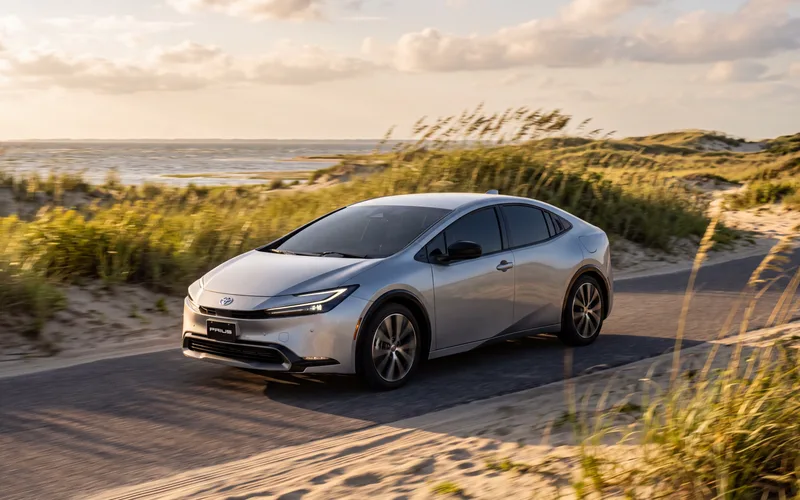 Toyota PriusCompact HatchbackBetter at: Resale value
It delivers most of the Leaf's fuel savings with none of the charging dependency, plus available AWD and the resale value the Leaf has never had.
Compare 2.46C+
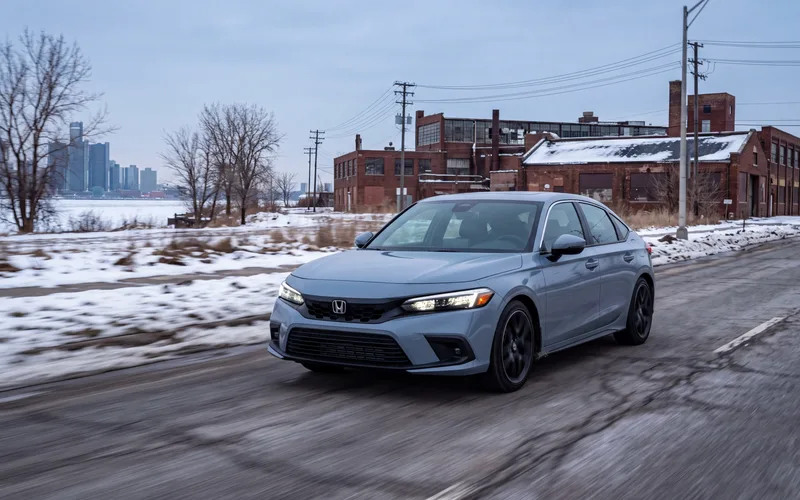 Honda Civic HatchbackCompact HatchbackBetter at: Rear-seat space
If you actually use the back seat or want proven crash ratings today, the Civic gives you 3.4 more inches of rear legroom, 24.5 cu ft of cargo and a Top Safety Pick+ award.
Compare 1.14D
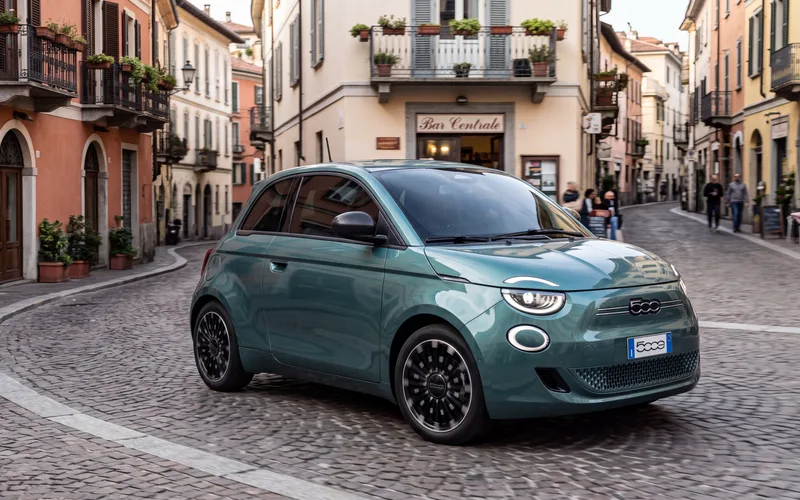 Fiat 500eSubcompact HatchbackBetter at: City parking
For a purely urban second car where 140 miles is plenty, the 500e is cheaper to buy and insure and easier to squeeze into a city parking space.
CompareHow it's evolved
10 scored model years · 2017–2026
Subject scores by year
Hover or tap a score to see what moved it versus the year before. A corner mark flags a big swing.
| Year | Performance | Efficiency | Safety | Space | Cost | Reliability | Tech | Use-case | Driving | Value |
|---|---|---|---|---|---|---|---|---|---|---|
| 2026 | 40 | 62 | 62 | 61 | 54 | 60 | 74 | 59 | 71 | 68 |
| 2025 | 41 | 51 | 66 | 63 | 53 | 63 | 45 | 46 | 62 | 47 |
| 2024 | 42 | 52 | 63 | 63 | 46 | 67 | 43 | 43 | 66 | 51 |
| 2023 | 34 | 53 | 60 | 61 | 54 | 61 | 38 | 46 | 67 | 52 |
| 2022 | 34 | 53 | 61 | 63 | 48 | 57 | 41 | 46 | 66 | 56 |
| 2021 | 34 | 53 | 65 | 63 | 47 | 60 | 44 | 45 | 66 | 58 |
| 2020 | 34 | 54 | 65 | 63 | 46 | 52 | 44 | 47 | 66 | 61 |
| 2019 | 34 | 53 | 48 | 62 | 55 | 53 | 39 | 44 | 64 | 59 |
| 2018 | 32 | 54 | 52 | 66 | 51 | 54 | 46 | 47 | 67 | 66 |
| 2017 | 21 | 58 | 25 | 62 | 52 | 62 | 33 | 38 | 63 | 49 |
Compare two years
Best fit & conditions
Higher scores mean a better fit for that use case. Learn more about use-case fit →
Subject profile
Academic Probation · NHTSA safety recalls
Apr 26, 2023Equipment: other: owners/service/other manual · Visibility: defroster/defogger/hvac systemThe Owner's Manual instructions for defroster operation are incorrect and may result in reduced defroster performance under specific conditions. As such, these vehicles fail to comply with the requirements of Federal Motor Vehicle Safety Standard number 103, "Windshield Defrosting and Defogging Systems."
Defect
Nissan North America, Inc. (Nissan) is recalling certain 2013-2017 LEAF vehicles. The Owner's Manual instructions for defroster operation are incorrect and may result in reduced defroster performance under specific conditions. As such, these vehicles fail to comply with the requirements of Federal Motor Vehicle Safety Standard number 103, "Windshield Defrosting and Defogging Systems."
Risk
Reduced defroster performance can limit visibility out of the windshield, increasing the risk of a crash.
Remedy
Nissan will mail an addendum with updated instructions on how to operate the defroster, free of charge. Owner notification letters are expected to be mailed May 26, 2023. Owners may contact Nissan's customer service at 1-800-867-7669. Nissan's number for this recall is R23A1.
NHTSA campaign 23V296000 ↗Manufacturer no. R23A194,343 vehicles potentially affected (all models in the campaign)Owners notified May 30, 2023Filed by Nissan North America, Inc.Filed as LEAFApr 13, 2017Air bagsDue to a manufacturing error within the air bag inflators, the passenger frontal air bag may not properly deploy in the event of a crash.
Defect
Nissan North America, Inc. (Nissan) is recalling certain 2015-2017 LEAF and 2014, 2016 and 2017 Sentra vehicles. Due to a manufacturing error within the air bag inflators, the passenger frontal air bag may not properly deploy in the event of a crash.
Risk
In the event of a crash, if the front passenger air bag doesn't deploy properly, it can increase the risk of injury to passengers.
Remedy
Nissan will notify owners, and dealers will replace the front passenger air bag inflator, free of charge. The recall began June 7, 2017. Owners may contact Nissan customer service at 1-800-647-7261.
NHTSA campaign 17V253000 ↗30,038 vehicles potentially affected (all models in the campaign)Owners notified Jun 7, 2017Filed by Nissan North America, Inc.Filed as LEAF
11 recalls on other model years of the Leaf (2018–2023, 2026)
Jul 1, 2026Seat belts: rear/other: retractorThe outer rear seat belt automatic locking retractors (ALR) may deactivate early, which can prevent a child restraint system (CRS) from securing properly. As such, these vehicles fail to comply with the requirements of Federal Motor Vehicle Safety Standard number 208, "Occupant Crash Protection."
Defect
Nissan North America, Inc. (Nissan) is recalling certain 2026 LEAF vehicles. The outer rear seat belt automatic locking retractors (ALR) may deactivate early, which can prevent a child restraint system (CRS) from securing properly. As such, these vehicles fail to comply with the requirements of Federal Motor Vehicle Safety Standard number 208, "Occupant Crash Protection."
Risk
An improperly secured child restraint system may not restrain an occupant as intended, increasing the risk of injury during a crash.
Remedy
Dealers will replace the rear outboard seat belt assemblies, free of charge. Interim letters, notifying owners of the safety risk, were mailed July 28, 2026. Additional letters will be sent once the remedy is available, anticipated October 28, 2026. Owners may contact Nissan's customer service at 800-647-7261. Nissan's number for this recall is R26A7. Vehicle Identification Numbers (VINs) involved in this recall became searchable on NHTSA.gov on July 7, 2026.
NHTSA campaign 26V425000 ↗Manufacturer no. R26A73,788 vehicles potentially affected (all models in the campaign)Filed by Nissan North America, Inc.Filed as LEAFMar 25, 2026Electrical system: propulsion system: traction batteryThe high voltage battery may have internal damage that can cause a short circuit within the battery module.
Defect
Nissan North America, Inc. (Nissan) is recalling certain 2026 LEAF vehicles. The high voltage battery may have internal damage that can cause a short circuit within the battery module.
Risk
A short circuit in a high voltage battery module increases the risk of a fire.
Remedy
Owners are advised to park outside and away from structures and should not charge their vehicles until the remedy is completed. Dealers will inspect and replace the battery modules, as necessary, free of charge. Owner letters were mailed September 2, 2026. Owners may contact Nissan's customer service at 800-647-7261. Nissan's number for this recall is R25F1. Vehicle Identification Numbers (VINs) involved in this recall became searchable on NHTSA.gov on March 27, 2026.
NHTSA campaign 26V188000 ↗Manufacturer no. R25F151 vehicles potentially affected (all models in the campaign)Owners notified Aug 28, 2026Filed by Nissan North America, Inc.Filed as LEAFSep 30, 2025Electrical system: propulsion system: charging: module: software · Electrical system: propulsion system: traction batteryThe lithium-ion battery may overheat during Level 3 charging.
Defect
Nissan North America, Inc. (Nissan) is recalling certain 2021-2022 LEAF vehicles equipped with a Level 3 quick charging port. The lithium-ion battery may overheat during Level 3 charging.
Risk
A quick charging battery that overheats increases the risk of a fire.
Remedy
Owners are advised not to use Level 3 quick charging until the remedy is completed. Dealers will update the battery software, free of charge. Owner letters were mailed June 16, 2026. Owners may contact Nissan's Customer Service at 1-800-867-7669. Nissan's number for this recall is R25C8. Vehicle Identification Numbers (VINs) involved in this recall will be searchable on NHTSA.gov beginning October 4, 2025.
NHTSA campaign 25V655000 ↗Manufacturer no. R25C819,077 vehicles potentially affected (all models in the campaign)Owners notified Jun 10, 2026Filed by Nissan North America, Inc.Filed as LEAFSep 19, 2024Electrical system: propulsion system: charging: module: software · Electrical system: propulsion system: traction batteryThe lithium-ion battery may overheat during Level 3 charging.
Defect
Nissan North America, Inc. (Nissan) is recalling certain 2019-2020 LEAF vehicles equipped with a Level 3 quick charging port. The lithium-ion battery may overheat during Level 3 charging.
Risk
A quick charging battery that overheats increases the risk of a fire.
Remedy
Dealers will update the battery software, free of charge. Owner letters were mailed June 3, 2026. This is a phased recall. Owners may contact Nissan Customer Service at 1-800-867-7669. Nissan's numbers for this recall are R24B2, P4A38, and P5A22.
NHTSA campaign 24V700000 ↗Manufacturer no. R24B2, P4A38, P5A2225,704 vehicles potentially affected (all models in the campaign)Owners notified May 27, 2026Filed by Nissan North America, Inc.Filed as LEAFFeb 2, 2024Back over prevention: sensing system: cameraDamage to the camera harness can cause distortion or loss of the rearview camera display image. As such, these vehicles fail to comply with the requirements of Federal Motor Vehicle Safety Standard number 111, "Rear Visibility."
Defect
Nissan North America, Inc. (Nissan) is recalling certain 2018-2022 LEAF vehicles. Damage to the camera harness can cause distortion or loss of the rearview camera display image. As such, these vehicles fail to comply with the requirements of Federal Motor Vehicle Safety Standard number 111, "Rear Visibility."
Risk
A rearview camera that does not properly display an image can reduce the driver's rear view, increasing the risk of a crash.
Remedy
Dealers will inspect the rearview camera and harness for damage and replace them as necessary. If no damage is found, the dealer will apply protective tape and reroute the rearview camera harness. Repairs will be performed free of charge. Owner notification letters were mailed August 9, 2024. Owners may contact Nissan customer service at 1-800-867-7669. Nissan's number for this recall is R23D7.
NHTSA campaign 24V071000 ↗Manufacturer no. R23D757,914 vehicles potentially affected (all models in the campaign)Owners notified Aug 9, 2024Filed by Nissan North America, Inc.Filed as LEAFJul 17, 2023Vehicle speed controlThe vehicle may accelerate unintentionally if the driving mode is changed ("D" to "B"; e-Pedal "On"; or "ECO" mode) after disengaging the cruise control.
Defect
Nissan North America, Inc. (Nissan) is recalling certain 2018-2023 LEAF vehicles. The vehicle may accelerate unintentionally if the driving mode is changed ("D" to "B"; e-Pedal "On"; or "ECO" mode) after disengaging the cruise control.
Risk
Unintentional acceleration can increase the risk of a crash.
Remedy
Dealers will reprogram the vehicle control module (VCM), free of charge. Owner notification letters are expected to be mailed August 30, 2023. Owners may contact Nissan's customer service at 1-800-867-7669. Nissan's number for this recall is R23A6.
NHTSA campaign 23V494000 ↗Manufacturer no. R23A666,159 vehicles potentially affected (all models in the campaign)Owners notified Aug 30, 2023Filed by Nissan North America, Inc.Filed as LEAFMay 22, 2023Service brakes, hydraulic: foundation components: hoses, lines/piping, and fittingsThe right-hand brake tubes may have been damaged during production and could corrode, possibly causing a hole in the brake line and a brake fluid leak.
Defect
Nissan North America, Inc. (Nissan) is recalling certain 2023 LEAF vehicles. The right-hand brake tubes may have been damaged during production and could corrode, possibly causing a hole in the brake line and a brake fluid leak.
Risk
A brake fluid leak can reduce braking performance and extend the distance required to stop, increasing the risk of a crash.
Remedy
Dealers will inspect and replace the right-hand brake tube, as necessary, free of charge. Owner notification letters are expected to be mailed July 7, 2023. Owners may contact Nissan's customer service at 1-800-867-7669. Nissan's number for this recall is PC976.
NHTSA campaign 23V362000 ↗Manufacturer no. PC976758 vehicles potentially affected (all models in the campaign)Owners notified Jul 7, 2023Filed by Nissan North America, Inc.Filed as LEAFFeb 2, 2023Equipment: other: owners/service/other manual · Visibility: defroster/defogger/hvac systemThe Owner's Manual instructions for defroster operation are incorrect, and may result in reduced defroster performance under specific conditions. As such, these vehicles fail to comply with the requirements of Federal Motor Vehicle Safety Standard number 103, "Windshield Defrosting and Defogging Systems."
Defect
Nissan North America, Inc. (Nissan) is recalling certain 2018-2023 LEAF vehicles. The Owner's Manual instructions for defroster operation are incorrect, and may result in reduced defroster performance under specific conditions. As such, these vehicles fail to comply with the requirements of Federal Motor Vehicle Safety Standard number 103, "Windshield Defrosting and Defogging Systems."
Risk
Reduced defroster performance can limit visibility out of the windshield, increasing the risk of a crash.
Remedy
Nissan will mail an addendum with updated instructions on how to operate the defroster, free of charge. Owner notification letters are expected to be mailed April 1, 2023. Owners may contact Nissan's customer service at 1-800-867-7669. Nissan's number for this recall is R22C5.
NHTSA campaign 23V048000 ↗Manufacturer no. R22C564,732 vehicles potentially affected (all models in the campaign)Owners notified Mar 30, 2023Filed by Nissan North America, Inc.Filed as LEAFSep 22, 2020Visibility: glass, side/rearThe rear window glass may not remain properly secured to the vehicle.
Defect
Nissan North America, Inc. (Nissan) is recalling certain 2020 Altima, Maxima and Leaf vehicles. The rear window glass may not remain properly secured to the vehicle.
Risk
Rear window glass that separates from the vehicle can increase the risk of a crash.
Remedy
Nissan will notify owners, and dealers will replace the back window glass, free of charge. The recall began November 4, 2020. Owners may contact Nissan customer service at 1-800-867-7669. Nissan's number for this recall is PC752.
NHTSA campaign 20V570000 ↗Manufacturer no. PC752150 vehicles potentially affected (all models in the campaign)Owners notified Nov 4, 2020Filed by Nissan North America, Inc.Filed as LEAFJul 17, 2020Back over prevention: sensing system: cameraUnder certain circumstances, the images for the back-up camera can disappear while in reverse. As such, these vehicles fail to comply with Federal Motor Vehicle Safety Standard (FMVSS) number 111, "Rear Visibility."
Defect
Nissan North America, Inc. (Nissan) is recalling certain 2020 LEAF electric vehicles. Under certain circumstances, the images for the back-up camera can disappear while in reverse. As such, these vehicles fail to comply with Federal Motor Vehicle Safety Standard (FMVSS) number 111, "Rear Visibility."
Risk
The lack of an image in the back-up camera display increases the risk of a crash.
Remedy
Nissan will notify owners, and dealers will update the back-up camera software, free of charge. This recall began August 31, 2020. Owners may contact Nissan customer service at 1-800-867-7669.
NHTSA campaign 20V412000 ↗6,157 vehicles potentially affected (all models in the campaign)Owners notified Aug 31, 2020Filed by Nissan North America, Inc.Filed as LEAFSep 12, 2019Back over prevention: sensing system: cameraAdditionally included are 2019 Nissan GT-R and Taxi and Infiniti QX50, QX60, Q70, Q70L vehicles. The back-up camera and display settings can be adjusted such that the rear view image is no longer visible and the system will retain that setting the next time the vehicle is placed in reverse. As such, these vehicles fail to comply with the requirements of Federal Motor Vehicle Safety Standard (FMVSS) number 111, "Rear Visibility."
Defect
Nissan North America, Inc. (Nissan) is recalling certain 2018-2019 Nissan Altima, Armada, Frontier, Kicks, Leaf, Maxima, Murano, NV, NV200, Pathfinder, Rogue, Rogue Sport, Sentra, Titan, Titan Diesel, Versa Note and Versa Sedan vehicles, as well as Infiniti Q50, Q60, QX30 and QX80 vehicles. Additionally included are 2019 Nissan GT-R and Taxi and Infiniti QX50, QX60, Q70, Q70L vehicles. The back-up camera and display settings can be adjusted such that the rear view image is no longer visible and the system will retain that setting the next time the vehicle is placed in reverse. As such, these vehicles fail to comply with the requirements of Federal Motor Vehicle Safety Standard (FMVSS) number 111, "Rear Visibility."
Risk
The lack of an image in the back-up camera display increases the risk of a crash.
Remedy
Nissan will notify owners in phases, having dealers update the back-up camera settings software, free of charge. The recall began November 11, 2019 and all affected VINs should be activated. Owners may contact Nissan customer service at 1-800-867-7669 or INFINITI customer service at 1-800-662-6200.
NHTSA campaign 19V654000 ↗1,228,830 vehicles potentially affected (all models in the campaign)Owners notified Nov 11, 2019Filed by Nissan North America, Inc.Filed as LEAF
Source: NHTSA Office of Defects Investigation recall database, model years 2017–2026. Recalls are listed by model year as the manufacturer filed them; whether a specific car is affected depends on its VIN — check a VIN at nhtsa.gov ↗. NHTSA model names matched to this page: LEAF.
Detailed scoring by subject
1Performance & PowertrainThe Leaf's lowest-graded category.0.00F
The first-generation LEAF's 80-kW EM61 motor makes 107 hp in every 2017 trim — there is no more powerful version to step up to, and the figure sits well below the 130-hp floor of the compact-hatchback band.
Torque is the better half of this powertrain: 187 lb-ft from a standstill is why the LEAF feels brisk away from a light despite only 107 hp. It still lands in the bottom quarter of the 120–450 lb-ft hatchback band.
Nissan publishes no 0–60 figure for the 2017 LEAF. Edmunds' instrumented test of the 30-kWh car returned 10.2 seconds; simulation-based sources put it nearer 9.7 s. Either figure falls outside the slow end of the 3–9.5 s hatchback band, and the car's brisk 0–30 mph response does not carry past about 50 mph.
Silent, lag-free single-motor delivery with instant torque and no combustion coarseness — reviewers consistently rate refinement a LEAF strength, calling it smooth and calm even at highway speed. Kept out of the top band because 80 kW genuinely runs out of thrust above roughly 50 mph, so overtaking requires planning, and the passively air-cooled pack cuts output when hot.
A single-speed reducer with a shift-by-wire palm shifter: no gears to mistime, no hunting, no CVT drone, and three drive modes (Normal, Eco, B-mode) give useful control over regen. Short of the very top only because 2017 predates the e-Pedal one-pedal system Nissan introduced with the second generation, so regen is mode-selected rather than finely modulated.
Front-wheel drive is the only configuration offered on all three 2017 grades — no AWD at any price, and no e-4ORCE equivalent existed for this generation. Bottom of the band alongside the other FWD-only compact hatchbacks.
2017 is the year Nissan collapsed the LEAF's only powertrain choice: the 30-kWh pack that had been reserved for SV and SL in 2016 became standard on every grade, so all three trims share one 80-kW motor, one battery and one 107-mile range. There is no gas, hybrid, AWD or long-range alternative — the only drivetrain-adjacent option left is the S trim's Charge Package, which upgrades the onboard charger rather than the powertrain.
2Efficiency & RangeMid-pack among this car's ten categories.1.91C-
One EPA rating covers the whole 2017 line now that every grade carries the 30-kWh pack. 112 MPGe combined is a strong efficiency figure even by later EV standards — the LEAF is small, light at ~3,386 lb and slippery at Cd 0.28 — and it is graded against other EVs, not the gas fleet.
City is the LEAF's best case: regenerative braking, Eco mode and B-mode recover most of the energy of stop-and-go driving, which is exactly the commute this car was engineered around and the one its 107-mile range can actually serve.
Highway MPGe drops about 19% from the city figure, the usual EV pattern. The aerodynamic package — 0.28 drag coefficient, underbody cover and rear diffuser — limits the loss, but the tall hatchback body still gives back more at speed than a lower EV would.
107 miles is the defining limitation of this car and falls far below the floor of the EV range band — a strictly local, second-car figure even in 2017, and one that degrades further with pack age because this generation has no active battery thermal management. The 2017 change was to give the base S the same 30-kWh pack as SV and SL, so the whole line moved up to 107 miles; there was no longer-range option at any price.
The volume SV carries the quick-charge port as standard, but it is a 50-kW CHAdeMO connection — below the 70-kW floor of the band, on a plug the US networks were already abandoning for CCS, and in practice the 30-kWh pack peaks in the mid-40s kW and tapers from there. On the cheaper LEAF S the port is not fitted at all unless the buyer ticks the Charge Package, so a used 2017 S may have no DC charging capability whatsoever.
Nissan's quoted 30 minutes to 80% looks competitive, but it is a small 30-kWh pack being filled — about 21 kWh added, against 40-plus kWh for a modern EV in a similar window. The passively air-cooled battery also throttles hard on repeated fast charges, the 'Rapidgate' behaviour this generation is known for, so the figure holds for the first stop of a day and not the second.
Energy cost is where the LEAF wins outright — roughly a third of what a comparable gas compact hatchback burns over the same 15,000 miles, and the cheapest single line in owning one. The catch is that 15,000 miles a year on a 107-mile car means a great many charging stops.
Electricity at $650/yr is as cheap as motoring gets, and the volume SV's 6.6-kW onboard charger refills the small 30-kWh pack in about six hours on 240V — an easy overnight. Three things keep it mid-band: the base S ships with a 3.6-kW charger (7 hours on 240V) and gains 6.6 kW only through the Charge Package; the only cable supplied on any trim is a 110V trickle lead quoted at ~26 hours, so a home wallbox is effectively mandatory; and 107 miles of range means the charging routine is a daily obligation rather than a weekly one.
3SafetyOne of the Leaf's weakest categories.0.00F
NHTSA ran a fresh frontal test on the 2017 LEAF but never retested it in side impact, so the 2017 entry carries no overall Vehicle Score. The latest overall-rated year of this same 2011-2017 generation is 2016 at 4 stars, and the 2017 frontal result matches that year's, so 4 stars is the applicable figure rather than an estimate.
The LEAF posts Good in four of the five legacy crashworthiness tests, but IIHS rates it Poor in the driver-side small overlap front test — a key test, which puts it in the prompt's bottom band regardless of the Good results elsewhere. No Top Safety Pick award, and the generation ran to its 2017 finale without the structural fix. Scored just above the structurally comparable 2017 Fiat 500e (32) because the LEAF's ratings come from tests of actual LEAFs rather than being inherited from a gasoline sibling.
None of the five functions this item measures existed on any 2017 LEAF trim. Nissan's own 2017 spec sheet lists 'Active Safety' as ABS, Vehicle Dynamic Control, Traction Control and TPMS — stability and braking hardware, not driver assistance — and NHTSA records the car as offering neither forward collision warning nor lane departure warning. Credit above zero is for the RearView Monitor being standard on all three grades, a year before the federal backup-camera mandate.
There is no AEB system to evaluate — not standard, not optional, not on the top trim. Automatic emergency braking did not reach the US LEAF until the 2018 model year, and nothing in the 2017 order guide offers forward collision warning either.
No blind spot warning, rear cross-traffic alert or safe-exit function was offered on any 2017 LEAF grade. The only mitigation is the optional Around View Monitor on SV and SL — a four-camera bird's-eye parking aid that helps at walking pace and is explicitly documented as having its own corner blind spots, not a moving-traffic detection system. That optional camera is why this sits slightly above the 500e's total absence.
The 2017 LEAF has no lane-departure warning, no lane-keep assist and no lane centering on any trim — there is no camera-based lane function in the car at all. ProPILOT Assist arrived with the second generation for 2018.
Conventional fixed-speed cruise control is standard on every grade with steering-wheel switches, but there is no adaptive following, no stop-and-go, and no highway-assist mode. This is exactly the prompt's 'basic cruise only' case; the small credit over a car with nothing is for cruise being standard rather than a trim-walk item.
No hands-free highway driving system was available, and the car lacks every prerequisite for one — it has neither adaptive cruise nor any lane-centering steering function.
IIHS published no headlight evaluation for the 2017 LEAF, so there is no measured result either way. What is documented is unfavorable for the volume trim: the S and SV run 'aerodynamic halogen' lamps, and LED low beams plus automatic on/off headlights and fog lights are exclusive to the top SL — meaning the representative SV buyer gets basic halogens with no automatic activation, no automatic high beam and no adaptive function. Scored near the 500e's halogen baseline, a shade higher only because a better lamp exists in the range.
The LEAF's tall, upright greenhouse, high seating position, low beltline and deep side glass give genuinely easy forward and quarter sightlines for a compact hatchback, and the RearView Monitor is standard on all three grades — unusual for a 2017 economy car and a year ahead of the federal mandate. It falls short of the top band because the heavily raked, split A-pillars are a recurring owner complaint, the rear spoiler and short, high tailgate glass cut the mirror view, and the 360-degree camera that would compensate is a package option on SV and SL only.
IIHS rates the LEAF's child seat anchors MARGINAL: two complete LATCH positions plus a third tether-only position, but the lower anchors are buried in the seat bight and take real force to find and clip. Four doors and a 60/40 bench make access far easier than in a two-door EV of the era, which is why this lands above the 500e, but 33.3 in. of rear legroom and a narrow center position make three-across or a rear-facing seat behind a tall front occupant a genuine squeeze.
4Space & ComfortOne of the Leaf's strongest categories.2.21C
Five seats across a 60/40 rear bench on every grade, the top of the 4–5 hatchback band. The Leaf was engineered on a dedicated EV platform with the pack in the floor rather than the cabin, so unlike the two-door 500e it gives up no seating to its battery.
41.2 inches clears the top of the 36–40 in hatchback band outright, and the figure is honest because Nissan never offered a sunroof on the first-generation LEAF — even the SL's photovoltaic spoiler sits on the tailgate, not over the occupants. The tall 61.0-inch roofline on a 175.0-inch car is doing the work.
42.1 inches lands mid-band (40–44 in) — genuinely adequate for tall drivers, but the number flatters the driving position: the seat is mounted high over the battery and the wheel is tilt-only with no telescope, so the useful range of the measurement is narrower than in a conventional compact hatch.
37.3 inches sits comfortably above the middle of the 35–39 in hatchback band, a direct dividend of the upright 61.0-inch roof. It is the one rear-seat dimension the LEAF wins on — the space it lacks in back is legroom, not height.
33.3 inches is the LEAF's weakest interior dimension, only 1.3 in above the bottom of the 32–42 in band and 0.2 in tighter than the second-generation car. Two adults fit for a town run; behind a tall front occupant, or three abreast on the 50.0-inch hip width, it is a genuine squeeze on anything longer.
23.6 cubic feet puts the LEAF in the top quarter of the 8–28 cu ft hatchback band and is the car's standout practicality figure — a deep well behind a tall tailgate, roughly double what the contemporary Focus Electric or Volt managed. The catch is shape, not volume: the seats fold over a step rather than flat, and the SV/SL's optional Bose amplifier raises the load floor.
The basics are all present and nothing more: two console cupholders, four door bottle holders, a covered console bin, a glovebox, visors with extensions, and a deep cargo well. What is missing is everything the guidance calls clever — there is no frunk, no underfloor bin (the charger and, on Bose cars, the amplifier occupy that space), no fold-flat load floor, a single 12-volt outlet and no household power, and the front passenger seatback pocket is deleted on the base S.
Front seats draw consistent mild praise — well padded, better than reviewers expect at the price, and heated as standard on every grade including the base S, which is rare for a 2017 economy car. They are pulled back into the middle band by a driver's cushion mounted high over the battery with a tilt-only wheel to meet it, and by a rear bench where the same packaging raises the hip point and leaves short thigh support over long stints.
A floor-mounted pack gives the LEAF an unusually low centre of gravity for a tall hatch, so it stays flat and soaks up isolated bumps without the float or the crash of a light economy car. It stops short of the upper band because the rear end is a torsion beam and the ride turns busy over repeated broken surfaces — and the volume SV's 17-inch wheels are firmer over sharp edges than the base S's 16s.
Deleting the engine removes the dominant noise source outright, and reviewers describe the LEAF as calm even at highway speed — a 0.28 drag coefficient and an aerodynamic underbody cover keep wind noise in check. It is short of library-quiet because the silence exposes what a mainstream compact's insulation leaves in: tyre roar on coarse pavement and some inverter whine, with no acoustic glass or active noise cancellation on any grade.
Unusually strong for a 2017 mainstream compact, and deliberately so — an EV that heats the occupants instead of the whole cabin saves range, so Nissan made heated front seats and automatic temperature control standard on every grade, added rear HVAC ducts and a charging/climate timer, and gave the SV and SL a heat-pump heater, heated wheel, heated mirrors and remote preconditioning from the phone. It misses the top band because the volume trim still has no ventilated seats, no separate rear climate zone, and heated rear seats are reserved for the SL.
5Cost of OwnershipGrades below the middle of the scale.1.50D
Nissan's 2017 US pricing announcement set the LEAF S at $30,680 plus an $865 destination charge. For 2017 the S finally carried the 30-kWh pack that had been an SV/SL exclusive, so the entry price bought the full 107-mile rating rather than the old 84-mile 24-kWh car.
The SV is the representative 2017 configuration: it adds the 6.6-kW onboard charger, the quick-charge port, 17-inch alloys, NissanConnect with Navigation on a 7-inch touchscreen, NissanConnect EV telematics and a heated steering wheel over the S, without the SL's leather and solar spoiler. Worth noting that the deeply subsidised lease programs of 2017 skewed a large share of actual volume onto the stripped S.
The single-speed EV drivetrain removes oil changes, plugs, belts and most friction-brake wear, and published nameplate estimates are very low — CarEdge models $219/yr, about $1,095 over five years, which counts scheduled maintenance only. Adding tires, cabin filters, brake-fluid and coolant service, a 12V battery and the out-of-warranty odds and ends that start after the 3 yr/36,000 mi basic coverage lapses puts a realistic all-in figure near $3,300, still well under the $4,000–$5,200 typical of a gas compact hatchback. Nissan offered no included scheduled maintenance in 2017 — EV Carefree+ did not launch until November 2022 — so every dollar falls on the owner.
This model year has long since passed its five-year mark, and the result is poor even after an unusually kind timing accident: 2022 was the peak of the pandemic used-car bubble, which propped a 2017 LEAF SV up to roughly $11,000–$13,000 against a $35,065 sticker. Two things drove the collapse — the $7,500 federal credit that every original buyer took has to unwind out of the used price, and 107 miles of range aged badly against a used market that by 2022 was full of 200-mile cars. The floor has kept falling since: KBB now values a 2017 SV at $6,625 private party and $2,250 trade-in, about 19% of MSRP at nine years, and Cars.com's nationwide average asking price for any 2017 LEAF is $7,076.
Nissan's 2017 new-vehicle limited warranty is 36 months / 36,000 miles — the segment floor, and the same coverage Nissan still offered a decade later, while Hyundai and Kia covered directly comparable 2017 cars for 5 yr / 60,000 miles.
On an EV the coverage that matters is the pack, and 2017 is the year that got materially better for the entry car: making the 30-kWh battery standard across S, SV and SL also moved every 2017 LEAF onto the 8 yr / 100,000 mi capacity guarantee, where the outgoing 24-kWh cars had only 5 yr / 60,000 mi against capacity loss below nine of twelve bars. The motor, inverter and reduction gear sit under a separate 5 yr / 60,000 mi powertrain and EV-system warranty. The capacity clause is the one first-generation owners genuinely lean on, because the AZE0 pack is passively air-cooled with no thermal management.
No included scheduled maintenance at all — Nissan's EV Carefree+ was five years away — but 2017 sits inside the best window the LEAF ever had for a free-charging perk. 'No Charge to Charge' gave every new LEAF buyer two years of unlimited complimentary public charging on the EZ-Charge card (unlimited 30-minute DC fast sessions and 60-minute Level 2 sessions across ChargePoint, EVgo, Blink and AeroVironment) across more than 50 US markets covering the large majority of LEAF sales, which on a 107-mile commuter car is worth real money. Add the 3 yr / 36,000 mi roadside assistance bundled with the basic warranty and the no-charge NissanConnect EV telematics subscription on SV and SL. That is basic roadside plus a genuinely substantial energy benefit and no maintenance coverage — upper half of the middle band, and clearly better than the $250 one-off EVgo credit a 2020 buyer received, but short of a Toyota-style multi-year included-service program.
$35,065 volume-trim price minus its estimated resale value after 5 years (32% retained, or about $11,221) leaves about $23,844 in depreciation. Add the projected $3,300 in 5-year maintenance and repairs, and owning this vehicle for 5 years costs about $27,144 in total.
6Reliability & QualityOne of the Leaf's strongest categories.2.17C
The two major sources genuinely disagree about this exact model year, which puts it in the mixed-signals band rather than the top one. J.D. Power's 2020 Vehicle Dependability Study — a three-year-ownership survey of 2017 cars, so it is about this car and no other — made the 2017 LEAF the top compact car at 83 PP100 and the first battery-electric vehicle ever to win a VDS segment award. Consumer Reports, surveying the same fleet, calls the 2017 LEAF less reliable than other cars of its model year. RepairPal's repair-frequency data sides with J.D. Power. The upper half of the band reflects how specific and favourable the strongest evidence is, while the CR verdict and the 30 kWh pack's capacity-loss record (see 6.1.4) stop it going higher.
Brand-level item, held in line with the rest of the Nissan scorecards. Nissan sits lower-middle rather than bottom-third: Consumer Reports has ranked it around 12th of 22 brands — the lowest-placed Japanese marque — while J.D. Power's initial-quality and dependability work generally puts it at or near industry average for a mass-market brand. In the era that matters for a 2017 car, Nissan's weak point was the Jatco CVT fitted across the gas range; the LEAF has no CVT and does not inherit that liability, which is why this lands mid-band rather than lower.
Only two NHTSA campaigns have reached the 2017 LEAF in nine years of exposure, and one of them is a paperwork fix. The airbag-inflator recall is a real safety defect but a discrete supplier issue affecting one part, not a systemic pattern, and the defroster campaign is an Owner's Manual wording correction filed as an FMVSS 103 non-compliance. Nothing touches the battery, motor, charging or braking systems. For a nine-year-old vehicle that is an unusually clean sheet, and it is the cleanest recall record of any LEAF model year. The offset that keeps it out of the 90s is the service-campaign side: Nissan's 2018 battery-controller software update for 2016–17 30 kWh cars was a substantial fleet-wide fix, delivered as a reflash rather than a recall.
The motor half of this drivetrain is exemplary and the battery half is the LEAF's defining liability. The EM61 motor, inverter and single-speed reduction gear were seven years into production by 2017 with no systemic failure pattern and essentially nothing to wear out. The pack is the problem, and for 2017 specifically it is the worse of the two first-generation packs: every 2017 trim carries the 30 kWh battery, which is air-cooled with no thermal management and which owners and independent fleet data showed losing capacity far faster than the 24 kWh pack it replaced — fast enough that Nissan shipped a battery-controller reflash for 2016–17 cars. Part of the reported loss was instrumentation error the software corrected, but not all of it. On a 2017 car the 8-year/100,000-mile capacity warranty has now lapsed, so that exposure is the owner's.
A 2011-vintage economy-car cabin in its final model year, and reviewers were consistent about it: hard plastics dominate, the cupholders and lower console are unambiguously cheap, and the overall impression is plain rather than premium. The recycled-content upholstery and the front door-panel trim are the bright spots, and the SL's leather lifts things somewhat, but the S and SV trims most buyers take do not read as worth their pre-incentive sticker. It sits below the middle of the band because the price point invites a comparison it loses.
Seventh and final model year of the generation on mature Smyrna, Tennessee tooling, and assembly consistency is not what this car gets criticized for — the complaints are about what the interior is made of and how the battery behaves. Consumer Reports rated the fit and finish as competitive with more expensive cars. The early-build exterior-trim and panel-gap criticisms that dogged the 2011–13 cars had largely been engineered out by 2017, and the J.D. Power dependability result at 83 PP100 is itself evidence that things-gone-wrong were rare in three years of ownership. A solid mark rather than a notable one.
Coverage is the strong half — roughly a thousand US Nissan franchises put routine service within reach almost anywhere, and the LEAF had been in those showrooms for six model years by 2017. The discount is bigger here than for a gas Nissan and bigger than for a newer LEAF: high-voltage work is restricted to EV-certified stores, a subset of the network, and nine years on, first-generation-specific expertise and replacement-pack supply have thinned as dealers concentrate on newer EVs. An owner needing pack diagnosis on a 2017 car today is often better served by an independent LEAF specialist than by the franchise.
Routine running costs are genuinely low — no oil, plugs, belts or transmission service, and regenerative braking stretches friction-brake life — and RepairPal's annual figure confirms it in practice. The first-generation LEAF is also the most numerous affordable used EV in the US, which has produced the deepest salvage and specialist supply of any EV of its era: used donor packs and third-party capacity upgrades are a real market, not a theoretical one. What holds the score at the middle of the band is the one repair that matters. An out-of-warranty pack replacement is a four-figure bill on a car now worth less than that, and OEM new-pack supply for the 30 kWh unit is increasingly scarce, which pushes owners toward used or rebuilt packs of uncertain remaining life.
7Technology & InfotainmentOne of the Leaf's weakest categories.0.16F
Seven inches is exactly the floor of the 7–15.5 in hatchback band, and there is no larger screen anywhere in the 2017 range to step up to. The base S is smaller still at 5.0 inches, so the volume SV's 7.0-inch unit is the best case, not a compromise.
NissanConnect on the SV and SL keeps real knobs and hard buttons flanking the screen, and its EV-specific screens — charging-station map, range circle, energy-use history, charge timer — are genuinely useful and were ahead of most rivals when the generation launched. By 2017 the hardware was seven years old: reviewers call the display small and hard to read and the system slow to respond, and the base S has no touchscreen at all.
Neither Apple CarPlay nor Android Auto was offered on the 2017 LEAF in any form — not wireless, not wired, not on the top SL. Phone projection did not reach the car until the second generation arrived for 2018, which is the bottom band by definition; the small credit is for Bluetooth streaming and a USB port being standard so a phone is at least usable as a source.
The volume SV gets real built-in navigation with voice recognition for both nav and audio, plus SiriusXM Traffic and Travel Link and EV-aware routing that maps charging stations and draws a reachable-range circle — the right feature set for a car with 107 miles of range. It sits mid-band because the voice system is rigid command-and-response rather than natural language, the map data ages without an over-the-air path, and the base S has no navigation whatsoever.
A competent middle: the volume SV runs six speakers with HD Radio and SiriusXM standard, and the optional Bose Energy Efficient Series seven-speaker system is a real branded upgrade engineered to draw less power so it costs less range. What keeps it from the upper band is that the Bose is bundled rather than standalone, it raises the cargo load floor, and the base S makes do with four speakers.
Full digital instrumentation is standard on every 2017 LEAF including the base S — a two-tier layout with a digital speedometer above and a display below carrying the power meter, state-of-charge percentage, battery capacity and temperature gauges, distance-to-empty, eco indicator and energy-consumption history. It is held out of the top band by dated low-resolution graphics and very little genuine configurability: the driver chooses between a handful of trip readouts rather than reshaping the display.
There is no over-the-air update path of any kind. The LEAF carries a telematics unit, but it is a one-way remote-control and reporting channel — it can report charge state and switch on the heater, not install software. Navigation map updates were sold as dealer or mail-order media, and vehicle or infotainment firmware required a service visit.
The NissanConnect EV app covered the functions that actually matter on an electric car in 2017 — check state of charge, start or stop a charge, set a charging timer, and pre-heat or pre-cool the cabin on shore power — and the subscription was free at purchase. It stays mid-band because there is no digital key or remote start of the vehicle itself, it is unavailable on the base S, owners widely reported the app as slow and flaky, and Nissan's reliance on a 2G/3G telematics modem for this generation later stranded early cars when the networks were retired.
Thin even by 2017 standards and the weakest item in this category: one USB-A port and one auxiliary jack on the dash, a single 12-volt outlet, and nothing at all for the rear seat. There is no USB-C on any grade, no wireless phone charging, and no household outlet or vehicle-to-load capability — the irony being that a car carrying 30 kWh cannot power a laptop.
Better than the price suggests: Nissan Intelligent Key proximity entry with push-button start is standard on all three grades — including the base S — and the fob also pops the charge port door, a small touch that matters daily on an EV. It stops mid-band because there is no conventional remote start (cabin preconditioning runs through the app or timer instead), no hands-free tailgate, and no phone-as-key.
The RearView Monitor is standard on every grade — a full year ahead of the federal backup-camera mandate — and the Around View Monitor bird's-eye system is genuinely useful when fitted. It lands only mid-band because Around View is an option on SV and SL bundled with the Bose audio rather than available on its own, there are no front or rear parking sensors on any trim, and no automated parking is offered.
No head-up display was offered on the 2017 LEAF at any trim level or in any option package — the first generation never had one, and Nissan did not add it later in the nameplate's life either.
8Use-Case FitGrades near the bottom of the scale.0.51F
The shape is right for family logistics — four doors, a tall roof that lets you stand a child up rather than bend into the car, a 60/40 bench, rear HVAC ducts standard and 23.6 cubic feet behind it for a stroller. The execution drags it to mid-band: IIHS rates the LATCH hardware Marginal because the lower anchors are buried in the seat bight, only two positions have complete hardware, the centre seat is narrow, and 33.3 inches of rear legroom makes a rear-facing seat behind a tall driver a real negotiation.
This is the 2017 LEAF's worst family argument and the item that most separates it from its own successor. No trim — not even the $36,790 SL — offers automatic emergency braking, forward collision warning, lane departure warning, blind spot warning or rear cross-traffic alert, and IIHS rates the structure Poor in the driver-side small overlap test. Credit above the floor is for a standard rear camera, full curtain airbags and a 4-star NHTSA generation rating.
A 107-mile EPA range with a 30-minute CHAdeMO stop at the end of each leg rules out the multi-hour family trip this item measures, and the cabin is provisioned to match: no rear USB or 12-volt outlet, no separate rear climate zone, no sunshades or entertainment, and heated rear seats only on the SL. Rear occupants sit high on a short cushion with 33.3 inches of legroom, and loading four people's luggage eats most of the cargo advantage.
Commuting is the mission this car was designed around and it is very good at it: 187 lb-ft from rest makes it brisk in the 0–30 mph band that traffic actually uses, there are no gearshifts, no idle, no vibration and no warm-up, the steering is light, and B-mode plus Eco give strong lift-off regen that removes most brake-pedal work. It sits just below the top band because 2017 predates e-Pedal, so true one-pedal driving is not available, and 107 miles of range means the commute has to be planned rather than forgotten.
Among the cheapest cars in the catalog to commute in: EPA puts annual energy cost at roughly $650 and $1.12 to cover 25 miles, and the consumables list is nearly empty — no oil, no filters, no belts, no spark plugs, and regenerative braking that leaves friction pads largely unworn. A 107-mile range comfortably covers the US average commute several times over, and home overnight charging avoids public-charging premiums entirely.
A 175.0-inch, 69.7-inch-wide hatchback with a 35.4-foot curb-to-curb circle on the volume SV (34.1 ft on the base S's 16-inch wheels), light speed-sensitive steering, a tall upright glasshouse and a standard rear camera is easy to place in a city. It falls short of the top band because the heavily raked split A-pillars are a long-standing owner complaint, there are no parking sensors on any trim, and the 360-degree camera that would settle it is an option bundled with Bose audio.
Not a work vehicle in any sense this item measures. Nissan publishes no towing capacity for the US LEAF and fits no hitch provision; there is no bed; payload is limited by a 4,431-lb GVWR against a 3,386-lb curb weight, and much of that margin goes to five occupants. The 80-kW motor is geared for efficiency and the pack has no active cooling to survive sustained load.
The mechanical package is actually simple and long-lived — one motor, one reduction gear, no clutch or transmission to abuse — but the car around it is not built for punishment: a light unibody economy hatch with cloth or Bio-PET trim, no washable surfaces and no fleet work reputation. The decisive weakness is the passively air-cooled battery, whose capacity loss under heat and repeated fast charging is the best-documented durability issue of this generation.
Essentially nothing here. One 12-volt outlet on the instrument panel is the entire onboard power provision — no inverter, no 110-volt socket, and no vehicle-to-load export in the US market despite the CHAdeMO port being bidirectional in principle. There are no factory roof rails, no hitch, no bed features, no washable liner and no upfitter ecosystem around the car.
The single worst use-case fit for this car. 107 miles EPA falls further at highway speed, where a compact hatch pushing air at 70 mph typically returns well under the rated figure, so real legs are roughly an hour. Recharging means a 50-kW CHAdeMO station — a network that was thin in 2017 and has shrunk since — for 30 minutes to 80%, and the air-cooled pack throttles its own charge rate on consecutive stops. There is no adaptive cruise and no lane assist to reduce fatigue on the stretches it can manage.
Pavement-bound by design. Front-wheel drive only with no AWD at any price, 6.3 inches of ground clearance, low-rolling-resistance Michelin Energy Saver or Bridgestone Ecopia tyres chosen for range rather than grip, no tow rating for a bike or kayak trailer, no factory roof rails for a box, and no household outlet to run a campsite. A graded forest road is within reach; nothing beyond it is.
The strongest of the four adventure items and the one place the LEAF's hatchback shape genuinely pays: 23.6 cubic feet behind the rear seat, 30.0 with the 60/40 bench down, and a deep well under a tall tailgate that swallows bulky boxes other compacts cannot. It stays mid-band because the flexibility stops there — the seats fold over a pronounced step rather than flat (the pack occupies the floor), the lift-over lip is high, the load floor rises again on Bose-equipped cars, and with no roof rails and no hitch there is no way to expand beyond the hatch.
9Driving ExperienceThe Leaf's best-graded category.2.22C
The floor-mounted pack gives the LEAF a centre of gravity well below any conventional tall hatch, and reviewers note it turns in willingly with little body roll and a balanced feel up to the limit. It stays in the middle of the band because that limit arrives early: 3,386 lb on low-rolling-resistance Michelin Energy Savers, a torsion-beam rear axle and 57/43 nose-heavy weight distribution mean roll builds and the front tyres squeal long before anything sporting happens.
Exactly the prompt's 'precise enough but numb' case. The vehicle-speed-sensitive electric rack is accurate and responds cleanly to inputs, and its lightness at parking speeds is a genuine daily asset, but it transmits nothing back about grip and weights up artificially rather than progressively. The tilt-only column, with no telescoping adjustment on any grade, compounds the disconnected feel.
The hardware is adequate — four-wheel vented discs, ABS with EBD and brake assist, and stopping distances that reviewers call reassuring. The tuning is what holds this mid-band: Nissan's electrically driven intelligent brake blends regeneration into the first part of pedal travel before the friction brakes engage, which reviewers repeatedly describe as fuzzy and non-linear and hard to modulate smoothly in routine stops. B-mode adds useful lift-off deceleration, but 2017 predates the e-Pedal calibration that made the second generation's blending far more natural.
The category's high point and an EV's structural advantage: 187 lb-ft available from zero through a single-speed reducer means no shifts to mistime, no torque-converter slur, no stop/start shudder and no idle vibration, with tip-in calibrated smoothly rather than snappily. It is kept out of the very top band because 80 kW genuinely runs out of thrust beyond roughly 50 mph, so the seamlessness gives way to a flat, effortful feel when a highway merge asks for more.
Near-silent under load with no combustion coarseness and nothing transmitted through the pedals or wheel — reviewers describe the propulsion as utterly silent. It sits just below the ceiling because the quiet is not total: a faint inverter and reduction-gear whine is audible under hard acceleration precisely because nothing masks it, and the low-speed pedestrian warning tone is present outside the car.
35.4 feet on the volume SV sits in the better half of the 34–40 ft hatchback band, helped by a short 175.0-inch body and no engine to package between the front wheels. The base S is tighter still at 34.1 ft — the 17-inch wheels and wider tyres of the SV and SL cost 1.3 ft of turning circle.
The cabin is easy to live with — a tall roof makes getting in and out simple, the high hip point gives a commanding forward view, and climate and audio keep physical knobs and buttons. Adjustability is where it falls down: a six-way manual driver's seat that reviewers say sits too high, a wheel that tilts but does not telescope on any grade, and no power seat anywhere in the range, so a tall driver ends up reaching. The heavily raked split A-pillars are a persistent owner complaint.
Appliance-like in the most literal sense, and largely on purpose. The instant torque makes the first 30 mph genuinely satisfying, and the silence is a pleasure of its own, but there is no soundtrack, no gearchange, no rear-drive balance and no grip to lean on — performance tapers hard above 50 mph and enthusiast reviews treat the LEAF as competent transport rather than a car to take the long way home in.
10Value & Market PositionGrades below the middle of the scale.1.27D
2017's headline act of generosity is the battery: the 30-kWh pack and its 107-mile rating became standard on the base S, where 2016 buyers had to climb to SV. Comfort content is genuinely good for the money too — heated front and rear seats on every trim, automatic climate control, a rearview camera and Bluetooth on the S, with navigation on a 7-inch touchscreen, a heated steering wheel and NissanConnect EV telematics standard from SV up. What drags it down is that by 2017 the rest of the market had moved and the AZE0 had not: there is no automatic emergency braking, blind-spot warning or lane-departure warning available at any price, no Apple CarPlay or Android Auto anywhere in the lineup, and the S ships with a 3.6-kW onboard charger and no DC quick-charge port unless the buyer adds the Charge Package. A 2017 Bolt EV had CarPlay and Android Auto standard and offered the driver aids the LEAF could not.
On sticker this is a bad deal and 2017 is the year that became obvious: $35,065 buys an SV with 107 miles of range and a passively air-cooled pack, against a 2017 Chevrolet Bolt EV at $37,495 with 238 miles, CCS fast charging and CarPlay — $2,400 more for more than twice the range. What rescues the score is the transaction price rather than the list price. Nissan was nowhere near the 200,000-unit federal cap, so the full $7,500 credit was intact, and the company layered $10,000 of manufacturer and utility incentives on top to clear first-generation inventory, taking a LEAF S from $31,545 to roughly $14,000 all-in. Judged as content-for-price across the range it is below average for the segment; judged as dollars a real buyer handed over in 2017, it was one of the cheapest new cars in America.
Three well-spaced grades — S, SV and SL — covering $31,545 to $37,655 delivered, with a Charge Package on the S (6.6-kW charger plus quick-charge port) and a Premium Package on SV and SL (Around View Monitor, Bose audio) to fill the gaps. That is a coherent ladder for a single-model EV line, but it is also the whole story: one battery size, one body, front-wheel drive only, no long-range variant and no performance version. The later second-generation car's five grades across two battery sizes is a visibly wider lineup.
US LEAF sales fell to 11,230 units in calendar 2017, down 19.8% from 14,006 in 2016 and down 63% from the 2014 peak of 30,200 — the nameplate's worst year since its launch period, and it happened while the US EV market was growing sharply around it. Buyers were plainly waiting: the Bolt EV was shipping with 238 miles, the Model 3 entered production in July, and Nissan unveiled the second-generation LEAF on 5 September 2017. A sharply declining seller in an expanding segment.
Nissan in 2017 was a high-volume mainstream brand leaning hard on incentives and fleet, with some of the weakest residuals in the industry and no halo to lend the LEAF. The nameplate's own equity was still real — it was the best-selling electric car in history at the time, with roughly 280,000 sold globally — but by 2017 the association an EV shopper actually carried was first-generation battery degradation on a pack with no thermal management, which is the opposite of desirability in a used-EV market. That reputation is visible directly in the resale numbers.
Scored on buyer benefit, and 2017 is very probably the single best year in the LEAF's history to transact. Nissan ran $10,000 manufacturer-and-utility incentives through partners across the country — Baltimore Gas & Electric, Constellation Energy, EVgo, Hawaiian Electric, Kaua'i Island Utility Cooperative, Salt River Project — stacking on top of the full $7,500 federal credit that GM and Tesla shoppers would shortly lose, for $17,500 off a $31,545 car, with state and utility rebates and two years of free public charging still on top of that. The transparent motive was clearing first-generation stock before the 2018 redesign, so this is distress pricing rather than healthy negotiability, which is the only thing keeping it off a perfect score.
This is the last model year of the first-generation LEAF, a car launched for 2011 — a seven-year-old design in its run-out year, and the only meaningful 2017 change was making the existing 30-kWh pack standard on the base trim. Redesign risk was not a risk but a certainty: Nissan unveiled the second-generation LEAF on 5 September 2017, while 2017 cars were still on lots, with 150 miles of range, ProPILOT Assist and e-Pedal. A 2017 buyer knew exactly what was replacing their car and when, which is the bottom band by definition.
Respectfully reviewed as a cheap, pleasant commuter and it did collect cost-and-value nods — Kelley Blue Book listed it among the 5 Best Electric Cars Under $40,000 and Edmunds later named it a Best Used Car — but in 2017 it was comprehensively beaten in every head-to-head that mattered. The Chevrolet Bolt EV swept the year, taking North American Car of the Year, MotorTrend Car of the Year and a Car and Driver 10Best place with 238 miles of range against the LEAF's 107. Reviewers were consistent on the reservations: Car and Driver called out interior materials that 'seem more fitting for a car priced at half its actual cost', US News ranked its safety among the lowest in the hybrid-and-electric class, and the IIHS handed the 2017 Leaf a Poor rating in the driver-side small-overlap front test despite top scores in its other four evaluations. Never the pick of the class, and by 2017 not close.