

The verdict
A struggling compact hatchback, strong on driving and held back by performance.
The 2018 Civic Hatchback is the used compact to buy if you want one car to do everything: 25.7 cubic feet of cargo space behind the back seat (46.2 with it folded), 34 MPG combined on regular gas, and a chassis good enough that Car and Driver put this exact body style on its 2018 10Best list. It was also a $20,775-to-$29,375 car when new that has held value better than almost anything else in the class, so it is rarely the cheap option on a used lot. The catch is a 2018-specific one: the touchscreen is a 7-inch panel with no volume knob (Honda put the knob back for 2019), and Honda Sensing was a $1,000 option that could not be ordered on the volume Sport trim at all — so many used examples have no adaptive cruise, no lane keeping, and no automatic braking. Add IIHS Poor headlights on every version and no blind-spot monitor at any price, and this is a car whose driving and practicality age far better than its safety tech.
Jump to scoresStrengths
- Cargo space that embarrasses small crossovers
- Genuinely fun to drive, not just competent
- 40 MPG highway on regular unleaded
What holds it back
- The 2018 infotainment is the worst year of this generation
- Driver assistance was optional — and unavailable on the volume trim
- Poor headlights and no blind-spot monitor at any price
Top alternatives
Cars shoppers cross-shop with the Honda Civic Hatchback 2.25C
2.25C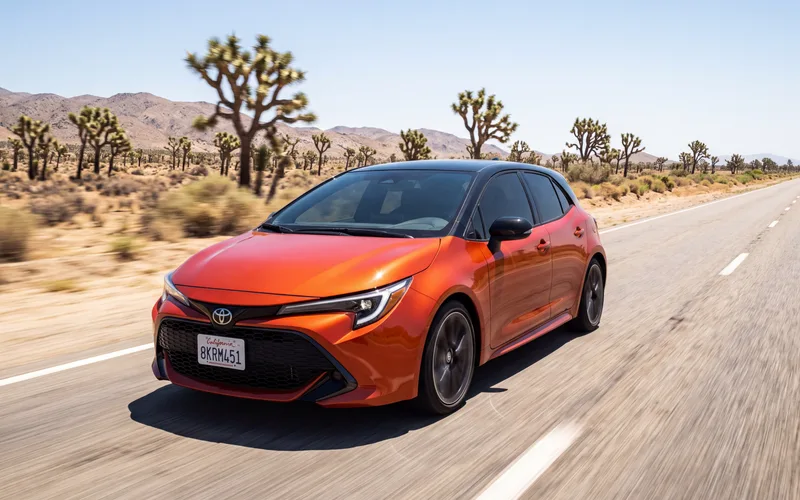 Toyota Corolla HatchbackCompact HatchbackBetter at: Value
Costs less, discounts more freely, and gives you wireless CarPlay on mid trims — worth a look if budget and tech convenience outrank cargo space.
Compare 2.57C+
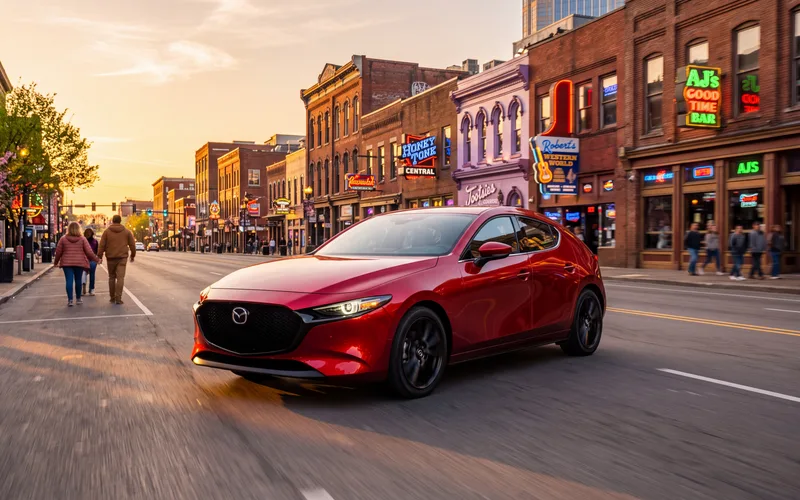 Mazda Mazda3 HatchbackCompact HatchbackBetter at: Interior quality
Offers AWD and a genuinely premium-feeling interior with a head-up display, for buyers who'd trade cargo volume for polish and all-weather traction.
Compare 2.14C
2.14C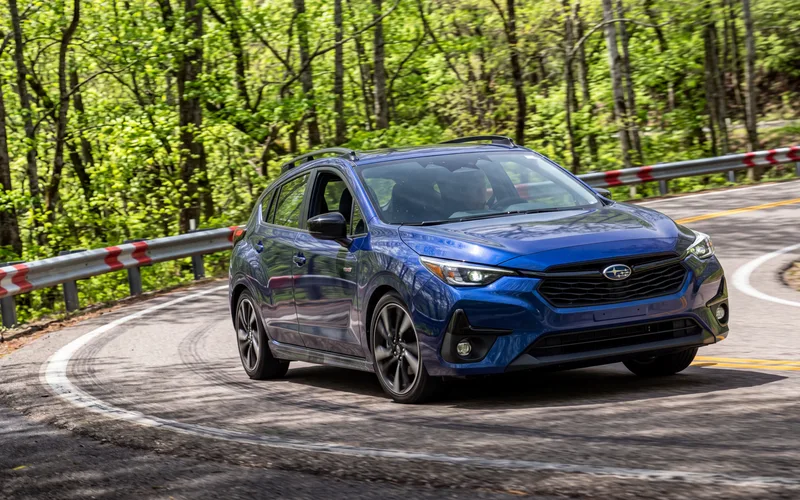 Subaru ImprezaCompact HatchbackBetter at: All-weather traction
Standard all-wheel drive at a lower price makes it the default choice for snow-belt buyers the FWD-only Civic can't serve.
CompareHow it's evolved
10 scored model years · 2017–2026
Subject scores by year
Hover or tap a score to see what moved it versus the year before. A corner mark flags a big swing.
| Year | Performance | Efficiency | Safety | Space | Cost | Reliability | Tech | Use-case | Driving | Value |
|---|---|---|---|---|---|---|---|---|---|---|
| 2026 | 30 | 59 | 76 | 69 | 68 | 80 | 51 | 65 | 72 | 75 |
| 2025 | 25 | 59 | 78 | 65 | 68 | 80 | 48 | 60 | 66 | 72 |
| 2024 | 27 | 54 | 73 | 68 | 69 | 77 | 45 | 55 | 70 | 73 |
| 2023 | 25 | 53 | 77 | 69 | 77 | 79 | 43 | 56 | 68 | 79 |
| 2022 | 25 | 54 | 81 | 69 | 78 | 78 | 43 | 56 | 68 | 80 |
| 2021 | 34 | 46 | 68 | 66 | 72 | 77 | 40 | 53 | 69 | 67 |
| 2020 | 35 | 45 | 69 | 66 | 75 | 74 | 39 | 53 | 70 | 77 |
| 2019 | 34 | 46 | 67 | 65 | 76 | 71 | 30 | 51 | 69 | 75 |
| 2018 | 32 | 60 | 58 | 74 | 76 | 65 | 34 | 58 | 77 | 75 |
| 2017 | 31 | 60 | 63 | 69 | 78 | 64 | 36 | 52 | 69 | 80 |
Compare two years
Best fit & conditions
Higher scores mean a better fit for that use case. Learn more about use-case fit →
Subject profile
Detailed scoring by subject
1Performance & PowertrainThe Civic Hatchback's lowest-graded category.0.09F
The volume EX trim's 1.5-liter turbocharged four makes 174 hp at 6,000 rpm with the CVT; the center-exhaust Sport and Sport Touring get 180 hp from the same engine.
Peak torque for the volume EX CVT is 162 lb-ft, available from 1,700 rpm — a broad, flat curve that makes the car feel stronger than the number suggests.
Independent instrumented tests of the 10th-generation Civic Hatchback with the CVT cluster around 6.6–7.0 seconds; the 174-hp EX sits at roughly 7.0 sec, quick for a mainstream compact hatch.
The 1.5-liter turbo is one of the better small forced-induction fours of its era — torque arrives from 1,700 rpm with little perceptible lag and throttle response is crisp — but it turns coarse and thrashy near redline and lacks the sweetness of Honda's old naturally aspirated engines.
Honda's CVT is among the better executions — it holds simulated ratios under hard throttle and responds well in normal driving — but it still drones under sustained load; the LX and Sport can be had with a genuinely excellent 6-speed manual, which lifts the range.
The 2018 Civic Hatchback is front-wheel drive only — no all-wheel-drive option exists on any trim, unlike segment rival Subaru Impreza.
One engine across the whole hatchback range — the 1.5-liter turbo in 174-hp and 180-hp tunes — with a choice of 6-speed manual or CVT. No hybrid, plug-in or electric option existed for the 2018 model year.
2Efficiency & RangeMid-pack among this car's ten categories.2.06C
The volume EX with the CVT is EPA-rated 34 MPG combined — near the top of the gas compact-hatchback field for 2018.
EPA city rating for the volume EX CVT is 31 MPG, helped by the turbo engine's low-rpm torque and the CVT's tall effective ratios.
40 MPG highway is a strong figure for a non-hybrid compact hatchback and the main reason the Civic's combined rating leads most gas rivals.
EPA lists 422 miles of total range on the 12.39-gallon tank; the economy is excellent but the small tank keeps absolute range mid-pack rather than exceptional.
EPA's standard-assumption annual fuel cost for the 34-MPG CVT hatchback is $1,850, low for the class and lower still because the volume trims take regular fuel.
The volume LX, EX and EX-L Navi trims run on regular unleaded with no premium recommendation; only the 180-hp Sport and Sport Touring carry a 'premium recommended' note, and even there regular is permitted.
3SafetyOne of the Civic Hatchback's weakest categories.1.93C-
NHTSA gave the 2018 Civic 5-door hatchback a clean sweep of 5 stars — overall, frontal, side barrier, side pole and rollover — with a 9.5% rollover risk, the best result available in the program.
Every crashworthiness test IIHS ran on the 10th-generation hatchback came back Good, but it carries no Top Safety Pick award for 2018 — the Poor headlights disqualify it — and the passenger-side small overlap test was never run on this body style.
Nothing beyond a rearview camera and stability control is standard on the volume trims: Honda Sensing is a paid option on LX, EX and EX-L Navi, standard only on the $28,650 Sport Touring, and cannot be ordered on the Sport at all. Blind-spot monitoring and rear cross-traffic alert are absent from the entire range.
The Collision Mitigation Braking System earns IIHS's top Superior rating for vehicle-to-vehicle work — a clean avoidance at 25 mph and near-avoidance at 12 mph — but it is optional equipment on the trims most buyers take, and IIHS ran no pedestrian test on this car, so nighttime pedestrian capability is unproven.
There is no blind-spot monitoring and no rear cross-traffic alert at any price on the 2018 hatchback. Honda substitutes LaneWatch on EX and above — a passenger-mirror camera that throws the right-side lane onto the center screen with the turn signal — which covers one side only, does nothing at the driver's left shoulder, and requires the driver to look away from the mirror to use it.
LKAS is genuine lane centering rather than a bounce-off-the-line nudge, and Road Departure Mitigation backs it up, which puts it ahead of most 2018 compacts — but it arrives only with the optional Honda Sensing package, needs roughly 45 mph to engage, and owners report the electric steering feeling stiff and reluctant to self-center while the system is tracking a curve.
Adaptive Cruise Control with Low-Speed Follow on the CVT cars is a full-speed-range system that will creep and stop in traffic — well ahead of the radar cruise rivals sold at this price in 2018 — and pairing it with LKAS gives a rudimentary highway assist. It loses ground for being optional, for dropping Low-Speed Follow on manual cars, and for a following algorithm owners describe as braking hard for vehicles slowing in adjacent lanes.
No hands-free highway driving system was offered on the 2018 Civic Hatchback at any trim, and Honda marketed nothing comparable to Super Cruise or BlueCruise anywhere in its US lineup in this era.
IIHS rated every headlight configuration on the car Poor — including the Sport Touring's LEDs — which is what costs the hatchback its Top Safety Pick despite a clean sweep of Good crash results. The base halogen projectors leave curves inadequately lit and the LED reflectors throw excessive glare.
Forward and quarter sightlines are a strength — the 10th-generation Civic's low cowl and pulled-back A-pillars give an unusually open view out — but the fastback tail undoes it behind: massive C-pillars, a shallow rear window, and a rear spoiler that cuts across it. A rearview camera is standard (multi-angle on EX and up) and LaneWatch covers the right flank, but there is no surround-view option and nothing watches the left blind spot.
IIHS rates LATCH ease of use Acceptable, not Good: the two outboard positions have complete hardware and take little force, but the lower anchors sit too deep in the seat bight, and the center position gets a tether only. Conventional rear doors and a compact bench make two seats routine and three-across a squeeze.
4Space & ComfortGrades above the middle of the scale.3.02B
Every 2018 Civic Hatchback trim seats five, with a 60/40-split folding rear bench — the maximum the compact-hatchback band recognizes.
Honda publishes the two figures separately, so the no-sunroof measurement is the one scored: 39.3 inches is generous for a compact and a direct benefit of the tenth generation's low seating position.
42.3 inches of front legroom is mid-pack for the class — enough that tall drivers fit easily, but short of the 43-inch-plus figures the roomiest compacts quote.
37.4 inches in the back is respectable for a fastback-roofed hatchback and is unaffected by the moonroof, since the glass panel sits over the front seats only.
The hatchback gives up rear legroom to its shorter body: 36.0 inches is below average for a compact and the clearest space compromise against the sedan, which shares the 106.3-inch wheelbase but measures 37.4 inches.
25.7 cubic feet behind the rear seats is the largest hold in the 2018 compact class — closer to a small crossover than a hatchback — and the single strongest element of this car's space argument.
The tenth-generation Civic's center console is a genuine design standout — a sliding armrest over a deep bin with a removable tray and a reconfigurable front pass-through that swallows a phone, a wallet and a large cup at once — and the hatchback adds an under-floor cargo well and a reversible side-pull cargo cover behind it. What it lacks is a headline trick on the order of Honda's own Magic Seat or an onboard power outlet beyond the single 12-volt socket.
Reviewers consistently rate these among the better seats in the class front and rear — well-judged cushion give with real support that holds up over hours — though the volume EX makes do with manual height adjustment and no lumbar control, with 8-way power reserved for EX-L Navi and above.
The independent multi-link rear end gives the Civic a ride that damps impacts like a larger car while keeping tight body control — a class strength — but the hatchback body is tuned a touch firmer than the sedan, and the Sport and Sport Touring's 235/40R18 tires firm it up further.
This is the hatchback's weakest comfort trait and the clearest penalty for the body style: with no sealed trunk between the cargo hold and the cabin, road roar carries through at highway speed, and the 1.5-liter turbo adds drone under CVT load. Owners running long highway stints describe it as noisy rather than merely audible.
From the EX up the comfort kit is solid for a 2018 compact — dual-zone automatic climate, heated front seats, heated mirrors, a power moonroof, and heated rear outboard seats on the Sport Touring — but there is no heated steering wheel, no ventilated seats and no factory remote start on any trim, and the two cheapest trims get single-zone climate with no heated seats at all.
5Cost of OwnershipOne of the Civic Hatchback's strongest categories.3.14B
2018 was a pure carry-over year for the hatchback with a $200 price increase over 2017, holding the entry LX under $21,000 delivered for a turbocharged compact with a six-speed manual. That sits below the bottom of the 22,000–55,000 hatchback band, which is stretched upward by luxury and performance five-doors.
The Sport is the best-represented 2018 Civic Hatchback trim in the used market by a wide margin, and it is the cheapest way into the 180-hp tune of the 1.5-liter turbo, the 18-inch wheels and the center-exit exhaust. The CVT is the $800 option and the majority take rate on mainstream Hondas, so the volume car is a Sport CVT at $23,175 delivered — still under the bottom of the 24,000–58,000 hatchback band.
The Civic is one of the cheapest compacts in the class to keep running — RepairPal puts it 3rd of 36 compact cars at $368 a year against a $526 class average — but this estimate is budgeted above the raw RepairPal and CarEdge figures because the volume Sport rides on 235/40R18 tires, which are expensive to replace, and because five years takes the car two full years past the 3/36 warranty with no included maintenance to absorb the routine services. The figure is unchanged from the mechanically identical 2020 Sport: five-year-from-new service costs do not move with the calendar.
This is a realized figure rather than a forecast, and the 2018 model year's five-year mark landed in 2023 — the peak of the pandemic used-vehicle price spike — so the retention is genuinely this high but is inflated by market conditions the car did not earn. Back-derived from Kelley Blue Book's current valuation and its stated three-year depreciation, a Sport hatchback was worth roughly $19,200 in 2023; against a steady-state model the same car projects nearer 59%. Either figure clears the top of the 35–65% hatchback band outright.
Honda's New Vehicle Limited Warranty is the mainstream floor and sits at the bottom of the 3-to-5-year band — level with Toyota and Mazda, but well short of the 5-year/60,000-mile coverage Hyundai and Kia gave 2018 buyers.
The 2018 hatchback carries Honda's standard 5-year/60,000-mile powertrain term, the bottom of the 5-to-10-year band and half the mileage of the Korean brands' 10-year/100,000-mile coverage. No hybrid or electrified Civic was sold in the US for 2018, so no high-voltage battery coverage applies to this car.
A 2018 Civic Hatchback buyer got no complimentary scheduled maintenance at all — Honda Service Pass, the brand's 2-year/24,000-mile included-maintenance program, did not arrive until the 2023 model year — so every oil change and rotation was out of pocket from mile one. What is included is 24-hour Honda Roadside Assistance for the full 3-year/36,000-mile warranty term, with towing, jump-starts, flat-tire changes, fuel delivery and lockout assistance. It rates a shade below the otherwise-identical 2020 car because the volume Sport trim for 2018 had no Display Audio and therefore no HondaLink connected-services trial to go with the roadside cover. That is roadside-only coverage, the bottom of the middle band, and it trails ToyotaCare's 2-year/25,000-mile plan on the direct rival Corolla.
$23,175 volume-trim price minus its estimated resale value after 5 years (82% retained, or about $19,004) leaves about $4,172 in depreciation. Add the projected $3,900 in 5-year maintenance and repairs, and owning this vehicle for 5 years costs about $8,072 in total.
6Reliability & QualityMid-pack among this car's ten categories.2.42C+
Sources conflict and neither is strong: J.D. Power rates the 2018 Civic three out of five for predicted reliability (average), while Consumer Reports rates it less reliable than other vehicles of the same model year. The hatchback body style carries slightly more exposure than the sedan because every trim uses the 1.5-liter turbo that drew the oil-dilution service campaigns, so it lands in the lower half of the average band.
Honda's long-term record is above the industry average but was not consistently top-five in the period around this model year — Consumer Reports placed the brand ninth in its 2018 annual reliability ranking, and J.D. Power dependability results for Honda have moved between mid- and upper-pack since. The brand advantage is real but short of the top band.
Recall volume for the 2018 Civic nameplate is heavier than ideal (five to six NHTSA campaigns), though the hatchback's own body-style-specific campaign — replacing incorrect or missing owner's guides on 7,016 2017-2018 Hatchback and Type R cars — is trivial in severity, and the widely reported fuel-pump impeller campaign was scoped to 4-door Civic bodies. What keeps this mid-pack rather than good is the service-action load behind the 1.5-liter turbo: TSB 19-039 plus the cold-weather calibration and climate-control bulletins that covered roughly 143,000 2016-2018 Civics in 21 northern states.
Unlike the sedan, the hatchback has no naturally aspirated escape hatch — Honda's own launch release confirms the 1.5-liter turbo (174 hp LX/EX/EX-L Navi, 180 hp Sport/Sport Touring) is the only engine, so the volume configuration is exactly the L15B7/CVT combination that drew the fuel-in-oil dilution campaigns and a warranty extension to six years/unlimited miles on camshafts, rocker arms and spark plugs. The engine family has since accumulated high-mileage service without systemic failures and the CVT is durable, but a defect pattern serious enough to trigger a class action and a nationwide warranty extension caps this below the average band's midpoint.
Materials were a genuine class strength for a mainstream compact — reviewers single out the upscale cabin and high-quality touch points relative to price. Harsher plastics remain visible low in the cabin, which keeps it just short of the exceptional band.
The Swindon-built hatchback was praised at launch as feeling "very well screwed together," with road and wind noise notably better contained than in previous Civic generations. Owner reports of squeaks, rattles and window-seal complaints accumulating over years in service keep it in the solid-but-not-top band.
Honda runs a dense, genuinely nationwide dealer footprint and a mature parts-distribution system, so routine service and campaign work are easy to obtain almost anywhere in the US. Individual dealer service satisfaction varies enough that network density alone does not justify a near-perfect score.
The Civic is one of the highest-volume nameplates in the country with enormous OEM and aftermarket coverage, and RepairPal's annual maintenance estimate is low even for a compact. A small deduction relative to the sedan reflects the hatchback's UK-only production and lower US volume, which makes some body-specific panels and trim slower and dearer to source than the sedan equivalents.
7Technology & InfotainmentOne of the Civic Hatchback's weakest categories.0.26F
Seven inches is the largest screen offered anywhere in the 2018 hatchback range and sits at the very bottom of the band the framework uses — and the two cheapest trims do not get a touchscreen at all.
The 2018 car is the low point of this generation's infotainment: an electrostatic capacitive panel with a touch volume slider instead of a knob, slow to wake and fiddly on the move, criticized by essentially every outlet that drove it. Honda conceded the point and put the physical volume knob back for 2019, which dates this specific model year.
Wired Apple CarPlay and Android Auto are standard from the EX up — which in 2018 was ahead of much of the class and the single biggest reason to skip the cheaper trims — but nothing wireless was offered, and the LX and Sport get no phone projection at all.
The volume EX has no built-in navigation at all — Honda's Garmin-based Satellite-Linked system with voice recognition is reserved for EX-L Navi and Sport Touring — and the on-board voice control below that is a rigid command-word system for phone and audio that owners bypass in favor of Siri or Google Assistant through CarPlay.
The EX's 180-watt eight-speaker system is a clear step up from the 160-watt four-speaker unit in the LX and Sport and is adequate for the class, and a 540-watt, 12-speaker system with subwoofer tops the range — but none of it carries a name-brand audio partner, and the 2018 hatchback's high road-noise floor works against whatever is fitted.
From the EX up the Civic runs Honda's Driver Information Interface — a color TFT cluster with a digital speedometer, trip computer, audio and phone pages, customizable settings and a turbo boost meter — which was genuinely modern for a 2018 compact, though the resolution and graphics are a step behind a true configurable full-digital cluster and the LX without Honda Sensing drops to a basic multi-information display.
Nothing on the 2018 Civic Hatchback updates over the air — head-unit firmware and navigation map updates are USB or dealer operations, and Honda offered no vehicle-wide software update mechanism anywhere in its 2018 US lineup.
HondaLink arrives with the Display Audio head unit on EX and above, but in 2018 it was a thin proposition: vehicle info, maintenance reminders and dealer scheduling, with the genuinely useful remote functions subscription-gated and no factory remote engine start to control in the first place. LX and Sport buyers get no app integration at all.
Two USB-A ports at best — a 1.5-amp port up front and a 1.0-amp port in the console on EX and above — plus a single 12-volt outlet. There is no rear-seat power of any kind, no wireless charging and no household outlet, which leaves back-seat passengers with nothing to plug into.
Smart Entry with push-button start is standard from the EX up and remote keyless entry with hatch release is standard on every trim, which covers the everyday convenience case — but there is no factory remote engine start, no hands-free or power hatch, and no phone-as-key, and the LX and Sport still turn a physical key.
The standard multi-angle rearview camera — normal, wide and top-down views, with dynamic guidelines from the EX up — is better than the single fixed view most 2018 compacts offered, and LaneWatch throws the right-hand lane onto the screen. Against that there are no parking sensors at any price, no surround view, and no automated parking, which matters more than usual given the fastback's poor over-the-shoulder view.
No head-up display was offered on the 2018 Civic Hatchback at any trim level, including the $29,375 Sport Touring.
8Use-Case FitMid-pack among this car's ten categories.1.93C-
The everyday family logistics are good for a compact: conventional wide-opening rear doors, two complete outboard LATCH positions that IIHS rates easy to attach, and a 25.7-cubic-foot hold that takes a full-size stroller without folding anything — the best cargo answer in the class. The limits are the lower anchors sitting too deep in the seat bight, a center position with a tether only, and 36.0 inches of rear legroom that a rear-facing seat eats into.
The crash structure is not the problem — five NHTSA stars across the board and Good in every IIHS crashworthiness test — but the trims families actually buy have to pay $1,000 extra for Honda Sensing, the Sport cannot be ordered with it at any price, there is no blind-spot monitoring anywhere in the range, and Poor-rated headlights on every configuration cost the car its Top Safety Pick.
Four adults travel in genuine comfort on seats reviewers rate as among the class's best, and the hatch means luggage does not have to come out of the cabin. What thins the case is rear amenities — heater ducts but no rear vents or controls, no rear USB or 12-volt outlet, no sunshades — plus 36.0 inches of rear legroom and a cabin that gets loud on the highway.
This is the Civic's home ground: light, accurate controls, a turbo that pulls from 1,700 rpm so the CVT rarely has to hunt, an exceptionally open forward view from the low cowl and pulled-back A-pillars, and automatic brake hold standard. The caveats are CVT drone under load and adaptive cruise with low-speed follow being an option rather than standard equipment.
34 MPG combined on regular unleaded puts running costs near the top of the non-hybrid compact field, and the EPA's $1,850 annual fuel bill is among the lowest of any gas car in the class. Only the Sport and Sport Touring give ground, dropping to 32 MPG combined with a premium-fuel recommendation.
A 35.7-foot curb-to-curb circle on 17-inch wheels, a 177.9-inch body and quick variable-ratio steering make this an easy car to thread through a city, and the multi-angle camera helps. Two things hold it back: the fastback tail with its thick C-pillars and spoiler-bisected rear glass, and the total absence of parking sensors — and the 18-inch Sport trims widen the circle to 37.8 feet.
There is no towing capacity published for the US Civic and no factory hitch, and a 2,950-pound front-drive compact has no payload headroom to speak of. The one thing it does offer a tradesperson is 46.2 cubic feet of enclosed, lockable load space with the seats folded — more than a small crossover — which lifts it slightly above a sedan but nowhere near work-tool territory.
The Civic's mechanical reputation is a genuine asset — high-mileage durability is the nameplate's calling card — but the 1.5-liter turbo of this era carries a documented oil-dilution issue in cold-climate short-trip use, and the interior is cloth-and-soft-trim with no rubber-floor or vinyl-seat work configuration on offer.
Effectively nothing for a jobsite: one 12-volt outlet, no onboard AC power, no roof rails from the factory, no hitch, no bed of any kind, and carpeted surfaces throughout. Cargo hooks, a cargo area light and a reversible side-pull cargo cover are the extent of the load-area provisions.
Seats that hold up over hours, a well-damped ride and 422 miles between fills make it a competent tourer, and adaptive cruise with low-speed follow plus lane keeping is available. Against that: the fuel tank is only 12.39 gallons so the range comes entirely from economy, the driver assistance is a paid option rather than standard, and highway noise is the thing owners complain about most after a long stint.
Front-wheel drive only, low ground clearance, low-profile all-seasons on the Sport trims and no tow rating make this a pavement car — the segment rival Subaru Impreza offers standard all-wheel drive and the Civic has no answer. What redeems it slightly is the fold-flat cargo hold for gear and camping loads and an accessory roof carrier for bikes or a box.
The strongest use-case argument the car has: 25.7 cubic feet behind the rear seats and 46.2 with them folded, through a wide hatch opening with a low load lip, plus an under-floor well and a reversible cargo cover — more usable space than most compact crossovers of the year. It stops short of the top band only because the seats fold 60/40 rather than flat-and-level, and there are no factory roof rails or hitch for overflow.
9Driving ExperienceThe Civic Hatchback's best-graded category.3.24B+
The tenth-generation Civic's stiff platform and independent multi-link rear end make this one of the best-handling mainstream compacts of its era — flat, balanced and genuinely eager to change direction — and Car and Driver put the Sport Hatchback on its 2018 10Best list on exactly that basis. The 18-inch Sport trims sharpen it further; the 16- and 17-inch cars trade a little grip for ride.
Honda's variable-ratio electric rack is quick — 2.11 to 2.22 turns lock to lock — accurate off center and better at communicating grip than almost anything else in the class, which is a large part of why the car rewards being driven hard. It is still electric assist, so the last layer of texture is filtered out.
Four-wheel discs with a firm, progressive pedal and short measured stops — Car and Driver recorded 159 feet from 70 mph in the Sport on 18-inch summer-biased rubber, an excellent figure for a compact. The volume EX on 215/50R17 all-seasons will not match that, and Honda fits the same 11.1-inch front rotors across the range regardless of tire.
The 1.5-liter turbo is one of the better small forced-induction fours of its generation — 162 lb-ft from 1,700 rpm with very little perceptible lag, so tip-in is crisp and the car feels stronger than 174 hp suggests — and Honda's CVT holds simulated ratios under load instead of flaring. It loses ground for the CVT's slur under sustained throttle and for an engine that turns coarse in the upper half of the rev range.
Quiet and smooth in light-throttle commuting, but the combination of a small turbo four and a CVT produces the class's characteristic drone when you ask for a sustained climb or a highway pass, and the hatchback body does less than the sedan's sealed trunk to keep it out of the cabin. The Sport's center-exit dual exhaust adds character rather than refinement.
35.7 feet curb-to-curb is tight for a 177.9-inch car and makes U-turns and parking-garage work easy; the wider 235/40R18 tires on the Sport trims cost more than two feet of it.
The low cowl, deeply raked windshield and pulled-back A-pillars give an unusually commanding forward view for a low-slung compact, and the tilt-and-telescoping column plus manual height adjustment suit a wide range of drivers. It is marked down for the fastback's poor over-the-shoulder view, the absence of power seat adjustment or lumbar support below EX-L Navi, and an infotainment stack that puts common functions behind a touch panel.
Few mainstream compacts of 2018 were as genuinely enjoyable: quick steering, a chassis that stays composed when pushed, a 180-hp tune with a center-exit exhaust on the Sport, and a six-speed manual reviewers rate as a class benchmark. The 10Best nod was for this body style by name.
10Value & Market PositionOne of the Civic Hatchback's strongest categories.3.07B
This is the 2018 car's weakest value argument and the clearest gap against its own later model years: Honda Sensing was a $1,000 option on LX, EX and EX-L Navi (CVT only), standard only on the $29,375 Sport Touring, and not orderable at any price on the volume Sport trim — while the direct rival Corolla iM shipped Toyota Safety Sense-P standard on every car. The 7-inch Display Audio touchscreen with Apple CarPlay and Android Auto likewise starts at EX, so both the LX and the Sport make do with a 5-inch non-touch display, and no 2018 Civic Hatchback offered blind-spot monitoring at all (EX and above substitute the LaneWatch right-mirror camera). What the Sport does include for the money is real — 180 hp, 18-inch alloys, center-exit exhaust, fog lights, leather-wrapped wheel and shifter — but a volume trim with neither driver assistance nor smartphone integration cannot rate above mid-band.
At $23,175 delivered the volume Sport pairs 180 hp, mid-30s combined economy, the largest cargo hold in the compact class and the best resale value in the segment — Kelley Blue Book gave the Civic its Small Car Best Buy for a third consecutive year on exactly that arithmetic, and Edmunds called the 1.5T 'one of the best cars in its class for delivering both impressive acceleration and high fuel economy.' It is held below the 2020 car's rating because the two cheapest ways into the range come without smartphone integration and the volume trim cannot be optioned with driver assistance, so the best-value configuration is really the $23,875 EX rather than the trim buyers actually bought.
Five mainstream trims — LX, Sport, EX, EX-L Navi and Sport Touring — span $20,775 to $29,375 delivered, with a no-cost six-speed manual on LX and Sport, an $800 CVT, a standalone $1,000 Honda Sensing package on three of them, and the Type R sitting above the range in the same body, which is unusually wide choice for a mainstream compact. Against that it is a one-engine car: the 1.5-liter turbo in two states of tune, front-wheel drive only, with no AWD and no electrified option anywhere in the 2018 US Civic range, and the manual is unavailable on the trims that carry the good equipment.
2018 was close to the high-water mark for the nameplate: 325,760 US Civics, the #1 retail car in America for a third straight year and the compact retail leader for a ninth, well ahead of the 261,225 the model managed two years later. The hatchback is the minority body style within that total — Honda reports Civic sedan, coupe and hatchback as one nameplate — and US hatchback demand was shrinking throughout the generation, which is the only thing holding this out of the top band.
Honda carries unusually strong mainstream equity built on durability, efficiency and class-leading residuals, and the 10th-generation hatchback shell in particular inherits enthusiast credibility from the Civic Si and the FK8 Type R that share it — for 2018 that halo is at its brightest, with the Type R barely a year old and the whole hatchback body on the 10Best list. The ceiling is capped only by Honda not being an aspirational luxury marque.
2018 was a buyer-friendly year in the abstract — industry incentives averaged $3,820, about 11% of transaction price, and manufacturers were loading discounts onto cars specifically as demand migrated to crossovers — but the Civic was the exception that needed the least help, selling as the country's #1 retail car with healthy but not bloated inventory. In practice that meant real negotiability off sticker and subvented lease and low-APR programs on the Civic rather than large hood cash, which is solidly middle-band buyer benefit: better than a car that transacts at MSRP, short of the desperation pricing on slower compacts.
The tenth generation arrived for 2016 and the hatchback body only reached the US for 2017, so a 2018 buyer was in the second year of a genuinely current car with a turbocharged engine and a modern platform, four model years clear of the eleventh-generation replacement. What keeps it mid-band is that 2018 itself brought nothing: it is a pure carry-over year whose only change was a $200 price increase, with the mid-cycle refresh not reaching the hatchback until 2020.
This body style was named by name on Car and Driver's 2018 10Best list — the award went to the Civic Sport Hatchback, Si and Type R, the Civic's sixth 10Best appearance — alongside Kelley Blue Book's Small Car Best Buy for a third straight year and an Edmunds verdict of 'it's hard to overstate how much we like the 2018 Honda Civic.' It sits below the very top band because U.S. News scored it 8.4/10 and ranked it only #6 among an unusually strong 2018 compact field, and because reviewers were consistent about two real faults: an infotainment interface that is 'far from the easiest system to use' and a forward collision alert 'prone to overreaction.'