

The verdict
A mixed-report compact hatchback, strong on reliability and held back by performance.
The 2021 Civic Hatchback is the last year of a generation that was very good at the things that matter over a decade of ownership and dated at the things you notice on the test drive. It hauls 22.6 cu ft behind the rear seats and 46.2 with them folded, drives better than any mainstream compact of its era, and holds roughly 73% of its $24,855 delivered price after five years — but the biggest screen Honda ever put in it is 7 inches, there is no blind-spot monitor at any price, and the volume Sport trim wants premium fuel for its 32 mpg. Buy it used as a cheap, tough, genuinely fun runabout with a big trunk. Skip it if you want modern tech, all-wheel drive, or a quiet highway cruiser.
Jump to scoresStrengths
- Cheap to buy, cheap to keep, and it barely depreciates
- Crash-test scores and driver aids you don't have to pay extra for
- Honda-cheap repairs and a dealer on every corner
What holds it back
- The technology is a generation behind, and there's no way to option around it
- Short warranty on a run-out model year
- Front-wheel drive only, and it can't tow
Top alternatives
Cars shoppers cross-shop with the Honda Civic Hatchback 2.25C
2.25C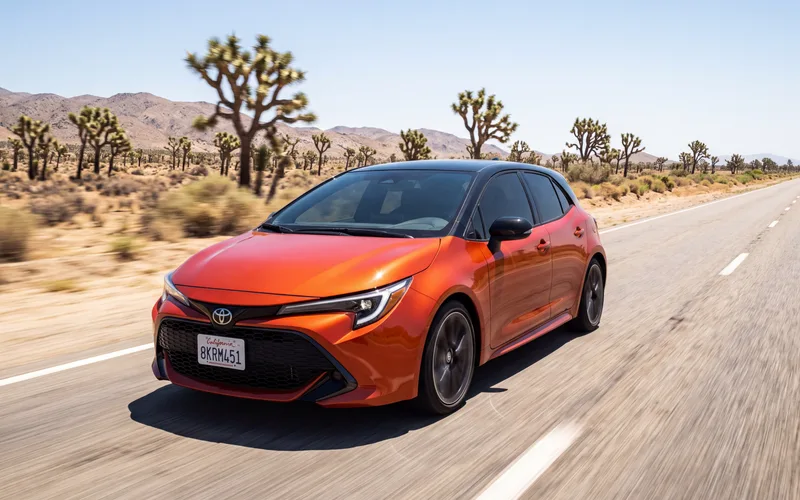 Toyota Corolla HatchbackCompact HatchbackBetter at: Value
Costs less, discounts more freely, and gives you wireless CarPlay on mid trims — worth a look if budget and tech convenience outrank cargo space.
Compare 2.57C+
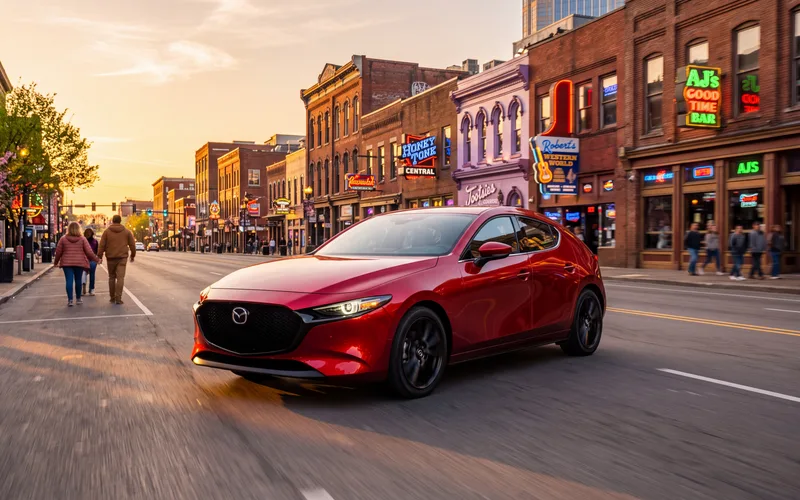 Mazda Mazda3 HatchbackCompact HatchbackBetter at: Interior quality
Offers AWD and a genuinely premium-feeling interior with a head-up display, for buyers who'd trade cargo volume for polish and all-weather traction.
Compare 2.14C
2.14C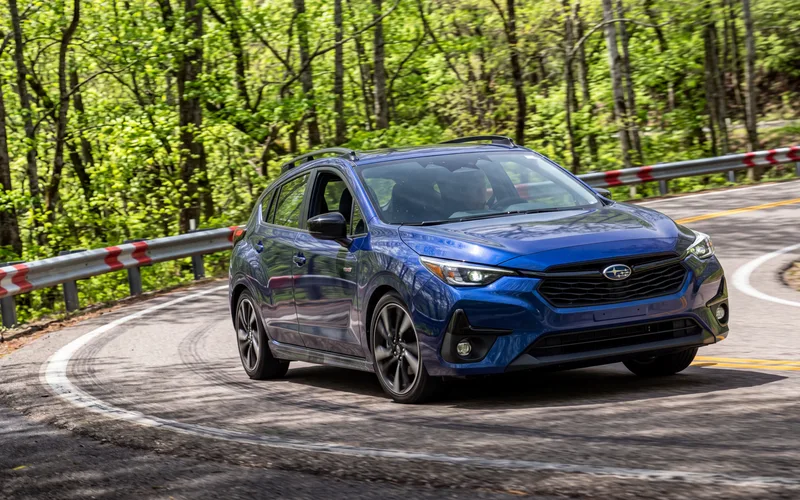 Subaru ImprezaCompact HatchbackBetter at: All-weather traction
Standard all-wheel drive at a lower price makes it the default choice for snow-belt buyers the FWD-only Civic can't serve.
CompareHow it's evolved
10 scored model years · 2017–2026
Subject scores by year
Hover or tap a score to see what moved it versus the year before. A corner mark flags a big swing.
| Year | Performance | Efficiency | Safety | Space | Cost | Reliability | Tech | Use-case | Driving | Value |
|---|---|---|---|---|---|---|---|---|---|---|
| 2026 | 30 | 59 | 76 | 69 | 68 | 80 | 51 | 65 | 72 | 75 |
| 2025 | 25 | 59 | 78 | 65 | 68 | 80 | 48 | 60 | 66 | 72 |
| 2024 | 27 | 54 | 73 | 68 | 69 | 77 | 45 | 55 | 70 | 73 |
| 2023 | 25 | 53 | 77 | 69 | 77 | 79 | 43 | 56 | 68 | 79 |
| 2022 | 25 | 54 | 81 | 69 | 78 | 78 | 43 | 56 | 68 | 80 |
| 2021 | 34 | 46 | 68 | 66 | 72 | 77 | 40 | 53 | 69 | 67 |
| 2020 | 35 | 45 | 69 | 66 | 75 | 74 | 39 | 53 | 70 | 77 |
| 2019 | 34 | 46 | 67 | 65 | 76 | 71 | 30 | 51 | 69 | 75 |
| 2018 | 32 | 60 | 58 | 74 | 76 | 65 | 34 | 58 | 77 | 75 |
| 2017 | 31 | 60 | 63 | 69 | 78 | 64 | 36 | 52 | 69 | 80 |
Compare two years
Best fit & conditions
Higher scores mean a better fit for that use case. Learn more about use-case fit →
Subject profile
Detailed scoring by subject
1Performance & PowertrainThe Civic Hatchback's lowest-graded category.0.25F
Every 2021 Civic Hatchback runs the same 1,498 cc turbo four; the volume Sport gets the 180-hp tune (rated on premium) while LX and EX are held to 174 hp. That is genuinely strong for a mainstream compact hatch — ahead of the Corolla Hatchback's 169 hp and the Impreza's 152 — but 180 hp still sits near the floor of the 130–520 hp hatchback band, which spans premium and performance hatches.
The turbo's real advantage is the shape of the curve rather than the peak: 162 lb-ft is available from 1,700 rpm and holds to 5,500, so the car pulls without being revved — the opposite of the naturally aspirated 2.0L that replaced it as the volume hatchback engine in the eleventh generation. The absolute figure is still modest against a 120–450 lb-ft band, and buyers who want the 177 lb-ft peak have to take the manual.
Instrumented testing of the mechanically identical 2020 Sport Touring hatchback (1.5T, CVT) returned 7.15 s to 60 mph and 15.3 s in the quarter mile, with the manual Sport at 6.99 s; the Sport CVT is 65 lbs lighter than that Sport Touring at 2,947 lbs, so ~7.2 s is a conservative read. That is comfortably the quick end of the mainstream compact hatch field and roughly two seconds ahead of the naturally aspirated eleventh-generation Civic Hatchback, though it lands mid-band against the 3.0–9.5 s hatchback range that includes hot hatches.
The 1.5T is one of the better small turbo fours of its era: direct injection with variable timing on both cams, a flat torque plateau from 1,700 rpm and little perceptible lag, so ordinary-speed throttle response is prompt and the engine rarely has to be worked hard. Reviewers consistently call it smooth and quiet at cruise — Consumer Reports singles out the refinement and the subdued road noise — and it earns a clear margin over the naturally aspirated engine that took over this body style later, though it turns audibly coarse approaching the 6,600-rpm redline and never feels special.
Honda's LL-CVT is among the class's better belt automatics — it steps under hard throttle instead of pinning the revs, is unobtrusive around town, and pairs with a 3-Mode Drive System and available dual-mode paddle shifters on the Sport. More to the point, 2021 is a year when the hatchback still offered a genuine alternative: a 6-speed manual on Sport and Sport Touring, widely praised for its light, accurate action. It loses points because sustained hard acceleration still brings the familiar CVT flare, and enthusiasts consistently note the transmission masks what the turbo is doing.
The 2021 Civic Hatchback is front-wheel drive on every trim, with no all-wheel-drive option at any price anywhere in the Civic range. That is bottom-of-band 'FWD only' territory, and it is a real competitive gap against the Subaru Impreza, which makes Symmetrical AWD standard, and the Mazda3 Hatchback, which offers it.
For 2021 the hatchback body offered exactly one engine — the 1.5L turbo — in two states of tune (174 and 180 hp), which is a trim distinction rather than a second powertrain. What lifts it off the floor of the single-powertrain band is real transmission choice, a CVT or a 6-speed manual on the Sport trims, and the 306-hp Type R sold in the same shell as a separate nameplate. There is no electrification of any kind: no hybrid, PHEV or EV Civic existed in the US in 2021, and Honda would not offer a Civic hybrid until 2025.
2Efficiency & RangeOne of the Civic Hatchback's weakest categories.1.05D
The volume Sport's 18-inch wheels and 235/40 tires cost it two combined mpg against the otherwise identical LX and EX, which reach 34 — the best figure in the 2021 hatchback range and strong for a gas-only compact. No electrified Civic existed for 2021, so 34 mpg is the ceiling here; a Corolla Hybrid on a comparable platform was rated 52.
29 mpg in town is a respectable non-hybrid result helped by the turbo's low-rpm torque and the CVT keeping revs down, and the LX/EX tune does better still at 31. Stop-and-go running is where the total absence of any electrified Civic for 2021 shows most plainly.
35 mpg is the weakest highway figure in the 2021 hatchback lineup — the Sport's wider, lower-profile rubber and its higher-revving 180-hp calibration give up five mpg to the LX and EX at 40, and even the Sport's own manual gearbox rates two mpg better at cruise. Mid-band for a 24–45 mpg hatchback range, and behind the Corolla Hatchback.
The 12.39-gallon tank is small for the class — roughly a gallon under the Corolla Hatchback's 13.2 — so even good economy only buys about 396 miles between fills on the Sport, low in the 300–650 mile hatchback band. It covers a long day's driving, but the Civic asks for a stop sooner than most compact rivals, and the more efficient LX and EX stretch that to about 421 miles on the same tank.
The EPA rates the Sport and Sport Touring on premium, the grade Honda recommends for their 180-hp tune, and that assumption plus the two-mpg economy penalty costs $550 a year against the LX and EX — a real and often-overlooked ownership difference between two trims of the same car. An owner who runs regular unleaded, which Honda permits, would land nearer the LX figure at the cost of a few horsepower, so treat $2,400 as the rated ceiling rather than the inevitable outcome.
Honda's own spec sheet lists 'Regular Unleaded (Premium Recommended)' for the Sport and Sport Touring and plain 'Regular Unleaded' for the LX and EX — the textbook mixed-requirement case: nothing is mandatory, no engine damage results from 87 octane, and there is no charging hardware to install, but the volume trim's published 180 hp and its EPA ratings both assume the more expensive grade. Well short of the 80+ band that a straight regular-unleaded lineup earns, and clearly better than a hard premium requirement.
3SafetyMid-pack among this car's ten categories.2.61C+
NHTSA rates the 2021 Civic at 5 stars overall with 5 stars in every subtest; the agency publishes a single Civic entry rather than separate sedan and hatchback ratings, so the hatchback carries the line rating on a shared 10th-gen platform.
Good in all six IIHS crashworthiness tests including both driver- and passenger-side small overlap, earning 2021 Top Safety Pick — but only TSP, not TSP+, because the award is restricted to the LED-headlight trim while the halogen volume trims rate Poor.
Honda Sensing is standard on every 2021 Civic Hatchback trim — CMBS/forward collision warning, road departure mitigation, lane departure warning, LKAS and adaptive cruise with Low-Speed Follow on CVT cars — which is broad for a 2021 compact, but blind-spot monitoring and rear cross-traffic alert are absent from the entire lineup.
IIHS rates the Civic's front crash prevention Superior for both vehicle-to-vehicle and daytime pedestrian scenarios, with collisions avoided outright at every test speed; the nighttime pedestrian protocol did not exist for this model year, so night performance is unverified rather than proven.
No blind-spot monitoring and no rear cross-traffic alert are offered on any 2021 Civic Hatchback trim; Honda substitutes LaneWatch, a passenger-side-only camera view triggered by the right turn signal, and even that is limited to EX and Sport Touring.
LKAS plus lane departure warning and road departure mitigation are standard on every trim, and the system will centre in a marked lane, but reviewers of this Honda Sensing generation consistently describe corrections as reactive and prone to bouncing between markings on gentle curves.
Adaptive cruise with Low-Speed Follow is standard on CVT cars and handles stop-and-go, but the 6-speed manual LX and Sport get ACC without Low-Speed Follow, and there is no combined highway-assist mode — ACC and LKAS operate as separate aids with noticeably conservative following gaps.
No hands-free highway driving system is offered on the 2021 Civic Hatchback at any trim; Honda had no BlueCruise/Super Cruise equivalent in the mainstream lineup for this model year.
The projector-beam halogen headlights fitted to LX, Sport and EX — the volume trims — rate Poor from IIHS; only the Sport Touring's LEDs earn Good, which is exactly why the car takes Top Safety Pick rather than TSP+. Auto high-beam is at least standard across the range.
The low cowl and deep side glass give good forward and over-shoulder sightlines for a compact, but the hatchback's split rear spoiler bisects the rearview mirror and the heavily raked C-pillars create real rear-quarter blind zones, with only a multi-angle backup camera and passenger-side LaneWatch to compensate — no surround view is offered.
IIHS rates LATCH ease of use Acceptable, with two outboard positions carrying complete hardware and a third tether-only position; the rear doors open wide for the class and rear legroom is generous for a compact, but only two seats install cleanly and the anchors sit recessed in the seat bight.
4Space & ComfortMid-pack among this car's ten categories.2.46C+
Every 2021 Civic Hatchback trim seats five with a 60/40 split fold-down rear seatback — the top of the 4–5 seat hatchback band, and the ordinary answer for a compact five-door.
The volume Sport goes without a moonroof, so it keeps the full 39.3 inches — near the top of the 36–40 in hatchback band and a genuinely airy compact cabin. Buyers who step up to the EX or Sport Touring trade 1.7 inches of it for the glass roof, which is also why passenger volume drops from 97.2 to 94.8 cu ft on those trims.
42.3 inches is mid-band for the 40–44 in hatchback range and unchanged across the lineup — comfortable for tall drivers, but the 10th-generation Civic's front-seat stretch-out room is ordinary rather than a selling point; the car's space advantage is behind the front seats.
37.4 inches sits comfortably above the middle of the 35–39 in hatchback band, and unusually the figure does not change with the moonroof: the glass panel only costs front headroom, so a Sport Touring rear passenger has the same space as one in an LX. The liftback roofline is high enough over the rear bench that adults sit upright.
36.0 inches is only 40% of the way up a 32–42 in band that is stretched by large hatchbacks and liftback sedans, but it is a strong number against the compact five-doors this car actually competes with — the Corolla Hatchback of the same era publishes 29.9 in. The hatchback gives up about an inch and a half to its own sedan sibling because of the shorter rear overhang and the reshaped seatback.
Even the Sport's reduced 22.6 cu ft is a large hold for a compact — better than most mid-size sedan trunks and roughly a third more than the Corolla Hatchback's 17.8 — and the LX and EX reach 25.7 because they skip the Sport trims' cargo-area hardware. Folding the 60/40 bench takes any trim to 46.2 cu ft, which is why this body style, not the sedan, is the practical choice in the range.
The 10th-generation Civic's centre console is one of the better-thought-out designs in the class: a deep bin under a sliding armrest, a removable divider tray that reconfigures the space, an open pass-through shelf ahead of the shifter sized for a phone, and unusually large bottle-holding door pockets. Under the cargo floor there is a shallow covered well as well. What keeps it out of the top band is the absence of anything genuinely innovative — no onboard AC power, no underfloor system with removable bins, and the 46.2 cu ft load bay does not fold truly flat.
Reviewers of this generation consistently rate the seats a strength front and rear — Edmunds calls them pleasant with the rear bench 'well cushioned', and the Sport adds a more heavily bolstered cloth seat with red stitching. The limit is adjustment rather than shape: the volume Sport gets a manual driver's seat with height adjustment only, with the 8-way power seat reserved for EX and above, and there is no lumbar adjustment at all on the passenger side.
The multi-link rear suspension gives the Civic better primary ride and body control than most compacts on a torsion beam, and Edmunds found rough-road impacts 'very well damped' without float. The volume Sport gives some of that back: its 18-inch wheels on 235/40 rubber make the ride noticeably firmer than the LX's 16s, and Consumer Reports' summary judgement on the 2021 Civic is that the ride is 'a bit too firm'.
Noise is the clearest weakness of this car. Consumer Reports flags pronounced road noise, and the complaint is structural to the body style — a hatchback has no sealed trunk between the load bay and the cabin, so tire roar from the 235/40 R18s comes straight through the cargo area on coarse pavement. Honda fits acoustic windshield glass and active noise cancellation, but this generation was never quiet at highway speed and reviewers say so repeatedly.
The volume Sport is thin here: single-zone automatic climate control, no heated seats, no heated steering wheel, no heated mirrors and no rear vents. Heated front seats and dual-zone climate arrive only on the EX, heated outboard rear seats only on the $30,000 Sport Touring, and ventilated seats are not offered on any 2021 Civic at any price. Remote engine start does at least pre-warm the cabin on CVT Sport trims and above.
5Cost of OwnershipOne of the Civic Hatchback's strongest categories.2.88B-
Honda's own launch release puts the 2021 Civic Hatchback LX CVT at $22,000 plus $955 destination, and Honda reissued the pricing table on July 7, 2021 with a $200 MSRP bump and a $1,015 destination charge. Both figures sit near the bottom of the $22,000–$55,000 hatchback band — this is one of the cheapest ways into a turbocharged compact hatch.
Sport CVT is the volume configuration of the 2021 hatchback — the 180-hp tune, 18-inch wheels and centre-exit exhaust that define the body style, without the Sport Touring's $4,500 jump to leather and the Bose system. At $24,855 delivered it undercuts a comparably equipped Mazda3 2.5 S Select hatchback and lands well inside the lower third of the segment band.
Estimators disagree sharply on method, so this figure is a considered midpoint rather than a single retrieved number: CarEdge's model, which counts scheduled service and repair probability but not wear items, puts the Civic Hatchback at $1,726 over five years, while the Edmunds True Cost to Own method folds in tires, brakes and batteries at 15,000 miles a year and lands near $6,500 for the mechanically comparable Civic Sport. The Sport's 235/40R18 tires are the single biggest swing item and are noticeably dearer to replace than the LX's 16s.
This is a settled result rather than a projection: KBB's current resale value for a 2021 Civic Sport Hatchback 4D is $18,300 against the $24,855 it was delivered for, or 73.6%, and iSeeCars puts five-year Civic depreciation at 22.7% (77.3% retained) versus 29.6% for compact cars generally. The figure clears the top of the 35–65% hatchback band outright, though it is flattered by the 2021–22 used-car shortage that lifted every three-to-five-year-old compact; CarEdge's more conservative model implies closer to 59%.
Honda's standard new-vehicle limited warranty for 2021 is 3 years or 36,000 miles, whichever comes first — the industry floor, and the bottom of the 3–5 year band. Hyundai and Kia rivals in the same showroom bracket cover 5 years/60,000 miles.
Honda covers the 1.5-litre turbo and CVT for 5 years or 60,000 miles, which is the base of the 5–10 year band and half the coverage Hyundai and Kia extend to original owners. Honda's reliability record largely offsets the short term in practice, but the paper coverage is minimal.
A 2021 Honda buyer got no complimentary scheduled maintenance at all — Honda Service Pass, which covers oil changes, tire rotations and multi-point inspections for 2 years/24,000 miles, was introduced with the 2023 model year and does not reach back to this car. What is included is 24-hour roadside assistance for the 3-year/36,000-mile warranty term plus a HondaLink connected-services trial on Sport Touring, which is thin next to ToyotaCare (2 years/25,000 miles, standard on the rival Corolla Hatchback) and Hyundai's 3-year/36,000-mile plan.
$24,855 volume-trim price minus its estimated resale value after 5 years (73% retained, or about $18,144) leaves about $6,711 in depreciation. Add the projected $6,300 in 5-year maintenance and repairs, and owning this vehicle for 5 years costs about $13,011 in total.
6Reliability & QualityThe Civic Hatchback's best-graded category.3.23B+
2021 is the sixth and final year of the tenth-generation Civic, so the design was long since debugged, and J.D. Power puts Quality & Reliability at 82/100 (its "Great" band). Consumer Reports is more reserved, calling the 2021 Civic only "about average" against its model year, with owner-reported trouble in in-car electronics (Android Auto and Bluetooth dropouts), the climate system (A/C compressor leaks and failures) and suspension/steering (uneven tire wear and cupping) — good but genuinely mixed signals rather than the top-tier verdict a mature Honda compact might be expected to earn.
Honda is a consistent top-five brand in Consumer Reports' reliability rankings and its mainstream models cluster at or above the model-year average in CR's own surveys, but J.D. Power's dependability and initial-quality studies have repeatedly placed the brand mid-pack or lower — Honda finished 18th in the 2021 U.S. Initial Quality Study — so the reputation is strong without being uniformly confirmed across the major studies.
Four NHTSA recalls cover the 2021 Civic and three reach the hatchback: two front passenger seat weight sensor airbag campaigns and the industry-wide Denso fuel pump campaign that spans 2013-2023 Hondas rather than anything specific to this car (the fourth, a brake master cylinder tie-rod fastener, is sedan-only). Nothing is engine, transmission or fire related, and owner complaint volume is modest for the year — roughly 150 reports against the 900-plus logged for the redesigned 2022 — so this reads as typical late-generation recall activity, with the steering-feel complaints that dog this nameplate concentrated on the following generation.
Every 2021 Civic Hatchback runs the 1.5L L15B7 turbo with Honda's LL-CVT (or the 6-speed manual on Sport trims), a combination in its sixth year of high-volume production with no systemic failure pattern and Honda's CVT among the more durable belt automatics in the class. What holds it to the middle band is that this is the exact engine family behind the well-documented cold-climate oil-dilution episode — fuel washing past the rings on short cold-weather trips, which drew Honda software updates and warranty extensions on 2016-2018 cars — mitigated by calibration changes from 2019 and redesigned for the eleventh generation, but a real mark on the record rather than a clean high-mileage reputation.
The tenth-generation cabin is well finished for a mainstream compact — soft-touch dash and door tops, matte surfaces and switchgear reviewers say don't betray economy-car roots even on base trims — but it sits a clear step below both the Mazda3 and the eleventh-generation Civic that replaced it, with hard plastics through the lower cabin and a busier design that reviewers rate as good-for-the-price rather than class-leading.
North American Civic Hatchbacks were built at Honda's Swindon, England plant through the end of production on 30 July 2021 — a mature line running the same body in its final model year, and assembly complaints are correspondingly scarce: no rattle, squeak or panel-fit pattern shows up in the model year's trouble spots, and total owner complaints are roughly a sixth of what the following year's US-built redesign logged. Scattered A/C compressor and power-window faults keep it out of the top band, but those are component failures rather than assembly defects.
Honda runs one of the densest mainstream franchised networks in the US at roughly a thousand stores, and the Civic is one of the two highest-volume nameplates in it, so technician familiarity, parts stocking and warranty access are broad almost anywhere in the country. Service satisfaction is solid mainstream rather than luxury-tier, which keeps it short of the very top of the band.
The Civic is close to a best case for running costs and parts supply: RepairPal puts average annual repair cost at $368 against a $526 compact-car average and $652 across all vehicles, with 0.2 unscheduled shop visits a year, and the tenth generation in particular is one of the most heavily supported platforms in the country for OEM, aftermarket, performance and salvage parts.
7Technology & InfotainmentOne of the Civic Hatchback's weakest categories.0.66F
Seven inches is the largest screen Honda offered in any 2021 Civic Hatchback, and it sits exactly on the floor of the 7–15.5 in band — this generation launched in 2016 and was never given a bigger display, so the final model year shipped with a screen half the size of what the eleventh-generation replacement would offer a year later. The base LX is worse still, dropping to a non-touch 5-inch LCD with no phone projection.
The 2019 refresh fixed this system's most-criticised failing by restoring a real volume knob and hard shortcut buttons alongside the touchscreen, which makes daily use far less irritating than the 2016–2018 slider-only version. What remains is a dated platform: 800x480 is low resolution by 2021 standards, menu transitions lag noticeably, and the home screen is cluttered with tiles most owners never use. Usable rather than good, and comfortably behind the 8.8-inch Mazda3 and the Corolla Hatchback's newer software.
Apple CarPlay and Android Auto are both supported but wired only — no wireless projection was offered on any 2021 Civic Hatchback trim — and the base LX gets neither, because projection rides on the 7-inch Display Audio that starts at the Sport. So the volume trim lands squarely on 'wired standard' with no wireless path at any price, and the trim below it has nothing.
Built-in navigation is a Sport Touring exclusive — the volume Sport has no native maps at all and depends entirely on a plugged-in phone, and there is no way to option navigation onto it. The on-board voice control is the older command-word type (recognised phrases for audio and phone, not natural language), so most owners simply route voice through Siri or Google Assistant over CarPlay/Android Auto.
The volume Sport's 180-watt, 8-speaker setup is a reasonable mainstream system and a real step up from the LX's 160-watt four-speaker arrangement, which is genuinely poor. The top of the range is stronger than the class norm: the Sport Touring's 540-watt, 12-speaker premium audio with subwoofer is well regarded and unusual at this price, though it is not a branded system from an audio marque the way a Bose or Harman Kardon option would be.
The tenth-generation Civic runs a largely digital cluster as standard on every trim — a central colour TFT with a digital speedometer, a bar-graph tachometer across the top and a driver information interface that mirrors turn-by-turn directions, CarPlay/Android Auto data and Bluetooth information. It reads clearly and was ahead of the class in 2016, but it is fixed rather than configurable: there are no selectable layouts or full-screen map views, which is what separates it from the fully reconfigurable clusters that define the top band.
There is no over-the-air update capability of any kind on the 2021 Civic Hatchback — not vehicle software, not infotainment firmware, not even maps on the navigation-equipped Sport Touring, whose map data is updated from a dealer or a downloaded file. Honda did not begin shipping OTA-capable vehicles in the US mainstream lineup until later in the decade, so this is a whole-brand gap for the model year rather than a Civic-specific omission.
HondaLink covers the core remote set — lock/unlock, remote engine start, vehicle locator, maintenance minder and stolen-vehicle tracking — but it is tiered and subscription-gated after the trial, the paid Remote package is what unlocks the useful functions, and the app was widely criticised in this era for slow connections and dropped commands. There is no digital key: the phone cannot substitute for the fob on any 2021 Civic.
Sparse and dated. The volume Sport carries two front USB-A ports — a 1.5-amp smartphone/audio interface and a 2.5-amp charge-only socket — and that is the whole provision: no USB-C anywhere in the car, no wireless phone charging on any trim, no second-row ports as standard (a rear USB charger existed only as a dealer-installed accessory, part 08U57-TBA-100), and no household AC outlet. The base LX drops to a single 1.0-amp port.
The volume Sport does well here: Smart Entry with Walk Away Auto Lock and push-button start are standard, and remote engine start is included on CVT cars, so the everyday keyless experience is complete from the second trim up. Two things hold it below the top band — the base LX still uses a conventional key with remote entry, and there is no phone-as-key or hands-free power liftgate offered anywhere in the range.
A multi-angle rearview camera with guidelines is standard, and that is essentially the entire parking suite on the volume trim: no front or rear parking sensors are offered on any 2021 Civic Hatchback, there is no surround-view camera at any price, and no automated parking. Honda's substitute is LaneWatch, a passenger-side blind-zone camera that appears only on EX and Sport Touring and does nothing for the driver's side or for reversing.
No head-up display was offered on the 2021 Civic Hatchback on any trim, at any price, as any option — including the $30,000 Sport Touring. Honda did not fit a HUD to a mainstream Civic in this generation.
8Use-Case FitGrades below the middle of the scale.1.53D
For a compact, the logistics are good: rear doors that open wide, 36.0 in of rear legroom and 37.4 in of rear headroom, and a hatch opening that swallows a stroller into 22.6 cu ft without folding anything. The ceiling is set by IIHS rating the LATCH hardware only Acceptable — two outboard positions with complete anchors recessed in the seat bight, plus a tether-only centre position — and by the plain fact that this is a compact car, so a rear-facing seat behind a tall driver is a squeeze and three across is not happening.
The crash credentials are genuinely strong and the driver aids are not paywalled — 5 stars overall from NHTSA, Good in all six IIHS crashworthiness tests, and Honda Sensing standard on every trim including the $23,000 LX, which is exactly the trim a budget-conscious family buys. Two real gaps pull it out of the top band: the halogen headlights on LX, Sport and EX rate Poor from IIHS, which is why the car takes Top Safety Pick rather than TSP+, and no 2021 Civic offers blind-spot monitoring or rear cross-traffic alert at any price.
Four adults travel in reasonable comfort on well-cushioned seats with 22.6 cu ft of luggage space still behind them, but the second row is short of amenities on the trim families would buy: no rear climate vents, no rear USB ports as standard, single-zone climate control on the Sport, and no rear-seat entertainment of any kind. Add the pronounced road noise on coarse pavement and it is a competent medium-distance family car rather than a comfortable long-haul one.
This is what the car is best at. Light, accurate controls, a turbo that produces its 162 lb-ft from 1,700 rpm so it never has to be revved in traffic, a CVT calibrated to be unobtrusive at low speed, a low cowl and deep glass for excellent forward sightlines, and adaptive cruise with Low-Speed Follow standard on every CVT trim to handle stop-and-go. The deductions are minor and specific: the split rear spoiler bisects the rearview mirror, and the Sport's firm 18-inch setup makes broken city pavement more noticeable than it needs to be.
Cheap to run in absolute terms but not the cheapest version of itself: the volume Sport is EPA-rated 32 mpg combined on premium fuel at $2,400 a year, while the mechanically identical LX and EX manage 34 mpg on regular for $1,850 — a $550 annual gap created entirely by the Sport's 18-inch wheels and its 180-hp tune. Consumables are Honda-cheap apart from the 235/40 R18 tires, which cost meaningfully more than the LX's 16s. No electrified Civic existed for 2021, so a Corolla Hybrid commuter costs roughly half as much per mile.
A 177.9-inch, 70.8-inch-wide compact is easy to place in city traffic and the multi-angle rearview camera is standard, but two things keep this from being a top-band city car. The volume Sport's turning circle is 37.8 ft curb-to-curb — a full 2.1 ft worse than the LX and EX at 35.7, purely because of the 18-inch wheels — and there are no parking sensors and no surround-view camera on any trim, so tight parallel parking is done on the mirrors and one rear camera.
Honda publishes no towing rating for the 2021 Civic in the US market — the car is not approved to tow at all here — and there is no bed, no meaningful payload headroom on a 2,947 lb unibody compact, and front-wheel drive only. The one work-adjacent asset is the load bay: 22.6 cu ft behind the seats and 46.2 cu ft folded will take a courier's parcels or a tradesperson's hand tools, which is why this is not a floor score, but it is not a work vehicle in any serious sense.
Honda's compact-car durability reputation is real and the tenth-generation Civic is a well-proven design by its final year, so a high-mileage delivery or sales-route Civic is a common and sensible thing. Against that, the 1.5L turbo drew a documented oil-dilution complaint history in cold climates that led to a Honda service campaign, the cloth interior is not a wear-friendly work surface, and no fleet-oriented package exists — this is a retail compact, not a vehicle with a fleet toughness record behind it.
Essentially nothing here. Four cargo-area tie-down anchors and a 12V accessory socket are the extent of the work provisions: there is no onboard AC power, no washable or rubberised load-floor option, no factory roof rails to mount a rack to (crossbars must be clamped to the bare roof by an aftermarket kit), no hitch approved for the US market, and no upfit ecosystem of any kind around this car.
A decent rather than a great mile-eater. In its favour: comfortable, well-cushioned seats front and rear, adaptive cruise with Low-Speed Follow standard, and a supple multi-link rear end that damps highway expansion joints well. Against it: the 12.39-gallon tank is small for the class, giving the Sport only about 396 miles between fills where most compacts manage more, and cabin noise on coarse pavement is this car's loudest, most-cited flaw — precisely the thing that tires people out over six hours.
Pavement-bound by design. No all-wheel drive is offered on any 2021 Civic at any price — a real competitive gap against the Subaru Impreza, which makes AWD standard, and the Mazda3 Hatchback, which offers it — and the Sport rides on 235/40 R18 tires with the lowest ride height in the range. There is no US tow rating for a bike or teardrop trailer, no factory roof rails for a box or kayak, and no camping-oriented provisions beyond a 12V socket. A graded forest-service road is about the limit.
The single best reason to choose this body over the Civic sedan. A 60/40 split bench opens 46.2 cu ft on every trim, the hatch aperture is wide and square so bulky items go straight in, and even seats-up the Sport's 22.6 cu ft (25.7 on LX and EX) beats most mid-size sedan trunks. It falls short of the top band because the folded floor is not truly flat, there is no adjustable load floor or underfloor bin system, and the absence of factory roof rails means anything longer than the car needs an aftermarket clamp-on rack.
9Driving ExperienceOne of the Civic Hatchback's strongest categories.2.69C+
The tenth-generation Civic's chassis is the reason enthusiasts kept recommending this car to people who were not enthusiasts: a stiff platform with a genuine multi-link rear suspension where most compacts of the era used a torsion beam, a low centre of gravity, and body control that stays flat where rivals lean. The volume Sport adds 235/40 R18 rubber and the shortest sidewalls in the range, so it grips and turns in harder than the LX. It is not a hot hatch — the Type R shares the shell and scores far higher — but among ordinary compacts it was near the top of the class.
A consistently praised element of this generation. The dual-pinion electric rack is quick, accurately weighted and — unusually for an electrically assisted compact — actually communicates something about the front tires, which reviewers of the era repeatedly singled out as better than the class norm. It stops short of the top band because the assistance is still calibrated light around centre for parking ease and there is no adjustable steering effort mode on the volume Sport.
Edmunds' testers found the pedal 'pleasantly firm and easy to modulate' and the car stops quickly — a straightforward, well-tuned hydraulic system with no regen blending to complicate it, and the Sport's 12.3-inch front discs behind 18-inch wheels have plenty of authority for a sub-3,000 lb car. It falls short of the top band on fade resistance rather than everyday feel: the standard Civic's brakes are sized for road use and heat-soak on repeated hard stops, which is exactly what the Type R's larger package exists to fix.
The 1.5T's flat torque plateau from 1,700 to 5,500 rpm means tip-in is prompt and there is very little of the off-boost hesitation that afflicted small turbos of this era, and Honda's LL-CVT is one of the better belt automatics — it steps under load rather than pinning the revs and is genuinely unobtrusive around town. What keeps it mid-band is what the CVT does under sustained hard acceleration: the familiar rubber-band flare that separates engine speed from road speed and masks what the turbo is doing.
Quiet and inoffensive at light throttle, but the engine turns audibly coarse and thrashy as it approaches its 6,600 rpm redline, and because the CVT holds revs there under hard acceleration the unpleasant part of the range is the part you hear most when you actually need the performance. The Sport's centre-outlet exhaust adds a low-frequency boom at part throttle that the LX does not have. Active noise cancellation is fitted, which helps at cruise, not under load.
The volume Sport's 18-inch wheel and tire package costs it 2.1 ft of turning circle against the otherwise identical LX and EX — 37.8 ft is poor for a 177.9-inch compact and lands in the bottom half of the 34–40 ft hatchback band, where lower is better. It is a real, felt difference in a parking structure or a three-point turn, and it is the clearest everyday penalty the Sport's wheels impose.
The low hip point, deep side glass and low cowl give a genuinely sporting driving position with excellent forward and over-shoulder sightlines for a modern car, the tilt-and-telescoping wheel has good range, and the 2019 refresh restored physical volume and shortcut controls to the dash. Two things hold it back on the volume trim: the Sport's driver seat is manual with height adjustment only — the 8-way power seat with lumbar starts at the EX — and the split rear spoiler bisects the view in the rearview mirror, a design quirk reviewers of this hatchback flagged consistently.
In 2021 this was the mainstream compact that enthusiasts actually recommended: sharp steering, a keen chassis, a torquey little turbo, and — uniquely among its direct rivals by that point — a 6-speed manual still on the order sheet for the Sport and Sport Touring, praised for its light, accurate action. The volume configuration scored here is the CVT, which damps the character considerably, and no version of the standard car has the sound or the drama to reach the top band; that is what the Type R in the same shell is for.
10Value & Market PositionMid-pack among this car's ten categories.2.56C+
Honda Sensing — adaptive cruise with low-speed follow, collision mitigation braking, road departure mitigation and lane keeping — is standard on every 2021 Civic Hatchback including the $22,955 LX, which is genuinely generous and matches Toyota Safety Sense on the Corolla Hatchback. Infotainment is where it falls behind: the LX gets a 5-inch non-touch display with no Apple CarPlay or Android Auto, so a buyer has to step to the Sport for the 7-inch touchscreen and smartphone mirroring, while the rival Corolla Hatchback SE and Mazda3 2.5 S both ship phone integration at base.
For $22,955 the LX delivers a 174-hp turbocharged engine, 34 mpg combined, the largest cargo hold in the compact-hatch class and a full active-safety suite — a combination the naturally aspirated Corolla Hatchback (169 hp, markedly less cargo space) cannot match at the price, and the volume Sport adds the 180-hp tune and 18-inch wheels for under $25,000. Points come off because the content is unevenly distributed: the cheapest CarPlay-equipped Civic Hatchback costs $1,900 more than the cheapest car in the range, and the Sport's premium-fuel rating and two-mpg penalty erode the running-cost advantage.
Four trims across a $22,955–$30,155 spread, with a genuine six-speed manual offered on both Sport and Sport Touring, is respectable breadth for a compact hatch and better than the automatic-only Corolla Hatchback lineup. The gaps are real, though: the EX-L was dropped for 2021, leaving a $4,000 jump from EX to Sport Touring with nothing in between, and there is no AWD or electrified option anywhere in the range.
The Civic moved 263,787 units in the US in calendar 2021 and was America's best-selling retail passenger car for the sixth straight year, taking roughly one in four retail sales in the compact class — about as strong a market position as a passenger car held that year. The hatchback is a minority of that mix and the tenth generation was in run-out, so the nameplate's strength rather than this body style's own momentum carries the score.
Honda carries one of the strongest mainstream reputations in the US for reliability and resale, and the Civic specifically has a devoted enthusiast following that few compacts enjoy — the brand actively helps the car rather than merely not hurting it, which is what the 73% five-year retention reflects. It stops short of the aspirational top band because Honda is a value brand, not a premium one, and this particular car was a run-out model of an outgoing generation.
The model year split in two for buyers: through late 2020 and early 2021 Honda supported the Civic with 1.9% APR for 60 months and around $1,000 in dealer cash, which was a real if unspectacular benefit, but once the semiconductor shortage bit in the second half of 2021 inventory evaporated, incentives were pulled and Civics transacted at or above sticker. Averaged across the year the buyer benefit was modest and heavily dependent on timing.
2021 is the final year of the tenth generation launched for 2016, and Honda's own launch release says the Civic Hatchback 'is unchanged for 2021' — every update it has dates from the 2020 refresh. Worse for a buyer, the replacement was public before the car went on sale: Honda revealed the eleventh-generation prototype in November 2020 and the production Civic Hatchback on June 23, 2021, so this is an aging generation with a known, imminent successor.
The Civic remained a critical favourite in 2021 — a KBB Best Buy winner and ranked at the top of U.S. News's compact-car aggregate, beating the Corolla on space, performance and value — but it was no longer the automatic class pick. Car and Driver left the Civic off its 10Best list for 2021 (as it had for 2020 and would again for 2022, breaking the streak the tenth generation began in 2016), with reviewers by this point flagging the dated infotainment and the imminent redesign.