

The verdict
A mixed-report compact hatchback, strong on ownership and held back by technology.
The 2019 Civic Hatchback is the used-car bargain hiding in plain sight: 22.6 cu ft of cargo behind the rear seat (46.2 with the seats down), a five-star NHTSA rating, the full Honda Sensing safety suite standard on every trim for the first time, and running costs RepairPal pegs at about $365 a year against a $512 compact-car average. It drives better than a $24,000 commuter has any right to — Car and Driver named this exact trim, the Hatchback Sport, to its 2019 10Best list. The catch is the dashboard: the volume Sport trim has no touchscreen at all, just a 5-inch non-touch LCD with no Apple CarPlay or Android Auto, and IIHS rated the headlights Poor on every single 2019 trim. If those two things matter to you, the 2020 refresh fixed both — and it's the single strongest reason to spend a little more.
Jump to scoresStrengths
- Cargo space that embarrasses the sedan
- Genuinely cheap to own
- A crash-test sheet with one asterisk
What holds it back
- The volume trim has no touchscreen and no CarPlay
- Poor headlights on every single trim
- No blind-spot monitoring at any price
Top alternatives
Cars shoppers cross-shop with the Honda Civic Hatchback 2.25C
2.25C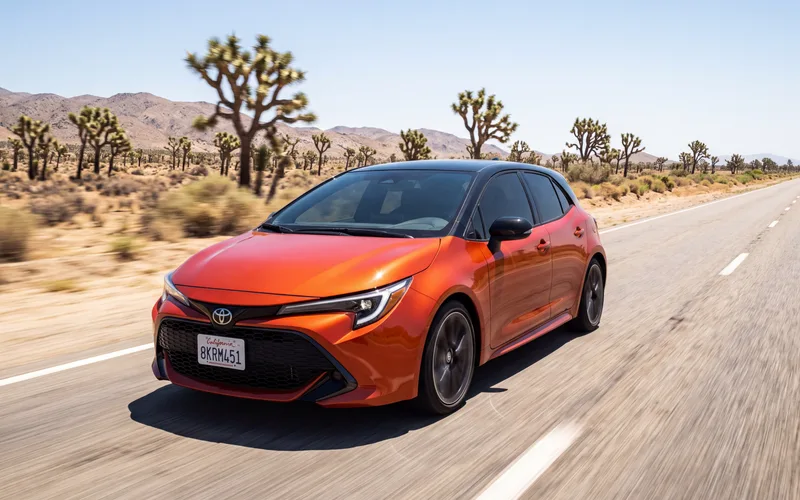 Toyota Corolla HatchbackCompact HatchbackBetter at: Value
Costs less, discounts more freely, and gives you wireless CarPlay on mid trims — worth a look if budget and tech convenience outrank cargo space.
Compare 2.57C+
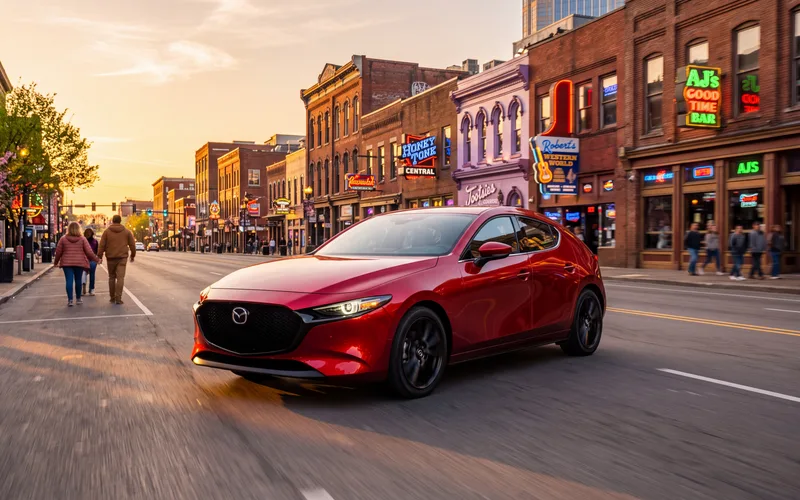 Mazda Mazda3 HatchbackCompact HatchbackBetter at: Interior quality
Offers AWD and a genuinely premium-feeling interior with a head-up display, for buyers who'd trade cargo volume for polish and all-weather traction.
Compare 2.14C
2.14C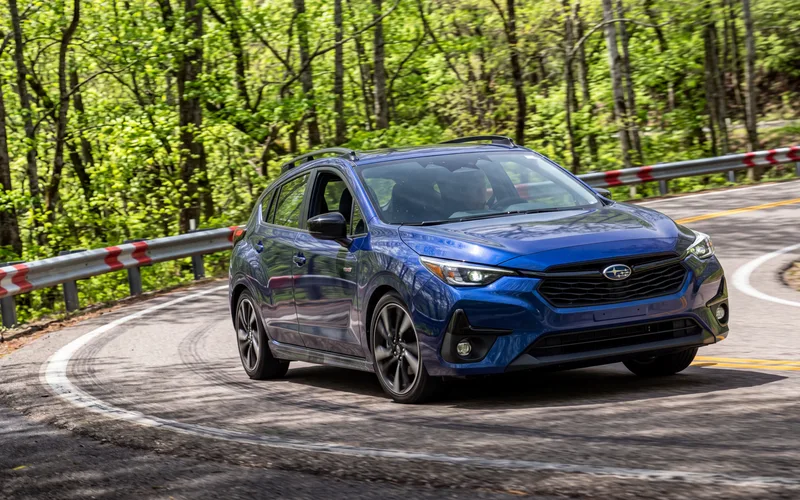 Subaru ImprezaCompact HatchbackBetter at: All-weather traction
Standard all-wheel drive at a lower price makes it the default choice for snow-belt buyers the FWD-only Civic can't serve.
CompareHow it's evolved
10 scored model years · 2017–2026
Subject scores by year
Hover or tap a score to see what moved it versus the year before. A corner mark flags a big swing.
| Year | Performance | Efficiency | Safety | Space | Cost | Reliability | Tech | Use-case | Driving | Value |
|---|---|---|---|---|---|---|---|---|---|---|
| 2026 | 30 | 59 | 76 | 69 | 68 | 80 | 51 | 65 | 72 | 75 |
| 2025 | 25 | 59 | 78 | 65 | 68 | 80 | 48 | 60 | 66 | 72 |
| 2024 | 27 | 54 | 73 | 68 | 69 | 77 | 45 | 55 | 70 | 73 |
| 2023 | 25 | 53 | 77 | 69 | 77 | 79 | 43 | 56 | 68 | 79 |
| 2022 | 25 | 54 | 81 | 69 | 78 | 78 | 43 | 56 | 68 | 80 |
| 2021 | 34 | 46 | 68 | 66 | 72 | 77 | 40 | 53 | 69 | 67 |
| 2020 | 35 | 45 | 69 | 66 | 75 | 74 | 39 | 53 | 70 | 77 |
| 2019 | 34 | 46 | 67 | 65 | 76 | 71 | 30 | 51 | 69 | 75 |
| 2018 | 32 | 60 | 58 | 74 | 76 | 65 | 34 | 58 | 77 | 75 |
| 2017 | 31 | 60 | 63 | 69 | 78 | 64 | 36 | 52 | 69 | 80 |
Compare two years
Best fit & conditions
Higher scores mean a better fit for that use case. Learn more about use-case fit →
Subject profile
Detailed scoring by subject
1Performance & PowertrainOne of the Civic Hatchback's weakest categories.0.23F
Every 2019 Civic Hatchback runs the 1,498 cc turbocharged L15 — there is no naturally aspirated base engine in this body style, unlike the 2019 sedan and coupe, whose new Sport trims make just 158 hp from the 2.0L — and the Sport and Sport Touring trims take a center-exit exhaust that lifts output to 180 hp on premium, six more than the 174 hp the LX/EX/EX-L Navi make. That is competitive for a mainstream compact hatch (Corolla Hatchback 168 hp, Impreza 152 hp) but still near the floor of the 130–520 hp hatchback band, which is stretched by luxury and performance five-doors.
162 lb-ft is modest in absolute terms and sits low in the 120–450 lb-ft hatchback band, but the shape of the curve matters more than the peak here: the turbo holds it flat from 1,700 rpm all the way to 5,500, so the car pulls from just off idle in a way no naturally aspirated compact of the era does. Buyers who take the Sport's 6-speed manual get a meaningfully torquier tune at 177 lb-ft, and for 2019 that manual is the only way to get it — the Sport Touring is CVT-only this year.
The 2019 Sport hatchback is mechanically identical to the 2020 and 2021 cars in this configuration — same 180-hp L15, same AV-S7 CVT, same 12.39-gallon tank — and instrumented testing of that combination clusters around 7.1 seconds to 60 mph, roughly a second and a half quicker than the naturally aspirated compact hatchbacks it is cross-shopped against. No publication appears to have instrumented a 2019 Sport hatchback specifically, so the figure is carried from tests of the unchanged hardware rather than claimed as year-exact. It lands mid-pack in the 3.0–9.5 s hatchback band, which is anchored at the fast end by six-figure performance cars.
The L15 turbo is the strong suit of this car: direct injection plus VTC on both cams and a small single-scroll turbo give it a broad, flexible mid-range with only a slight pause off idle, and reviewers of the 2019 hatchback consistently describe merging and passing power that flatters the car's size. It is marked down from the 80+ band because there is real, if brief, turbo lag from a standstill and the four grows coarse and boomy when held near its redline — and because the engine's requirement for premium to reach its headline 180 hp is a refinement caveat of its own.
Honda's G-Design Shift CVT is one of the better belt automatics of its generation — it steps through simulated ratios under load rather than pinning the engine at one droning rpm, and the Sport trims add paddle shifters and a Sport mode that holds those steps. Scored a notch below the 2020 car because manual availability is narrower in 2019: the excellent 6-speed manual is confined to the Sport trim, and the range-topping Sport Touring is CVT-only until Honda extended the manual to it for 2020. Held below 80 because the CVT can still be slightly jerky settling into a ratio and flares audibly at wide-open throttle.
The 2019 Civic Hatchback is front-wheel drive on every trim — Honda offered no all-wheel-drive Civic in any body style in the US market for 2019, at any price. That puts it at the bottom of the 0–49 'FWD/RWD only' band, behind the Subaru Impreza (Symmetrical AWD standard) and the Mazda3 hatchback, which added optional i-Activ AWD for 2019.
The hatchback is a one-engine car: the 1.5L turbo in two states of tune (174 hp on regular, 180 hp on premium with the sport exhaust), which is a calibration difference rather than a second powertrain. The only real choice is transmission — CVT across the range, 6-speed manual on the Sport alone — and there is no electrification anywhere in the 2019 US Civic range; no hybrid Civic reached America until 2025. That lands it in the 0–49 'single powertrain' band, marginally below the 2020 car because the manual is available on one trim rather than two.
2Efficiency & RangeOne of the Civic Hatchback's weakest categories.1.07D
EPA rates the Sport hatchback's AV-S7 CVT at 32 MPG combined — good for a 180-hp turbocharged compact, but the sport exhaust, 18-inch wheels and premium-fuel calibration cost it two combined MPG against the 34 MPG the mechanically similar LX/EX/EX-L Navi manage. Well clear of the 18 MPG floor of the hatchback gas band, though a full class behind the hybrid hatchbacks it shares showroom space with.
30 MPG in the EPA city cycle is respectable for a turbocharged compact with no electric assist, helped by the CVT keeping revs low and by the small 1.5-liter displacement — and a touch better than the 29 MPG the same Sport CVT carries from 2020 on, after the mid-cycle refresh. It remains the weakest part of the car's economy story relative to the hybrid compacts of the era, which roughly double it in stop-and-go use.
36 MPG highway is mid-band for a compact hatchback and is where the Sport trim gives up the most — four MPG behind the same car in LX/EX form, a penalty that comes from the wider wheel-and-tire package and the freer-flowing exhaust rather than from any difference in the engine's hardware. Notably, the 6-speed manual Sport beats the CVT on the highway cycle at 38 MPG, the only cycle where the manual wins.
Honda fits every 2019 Civic Hatchback the same small 12.39-gallon tank, so even respectable economy only buys about 396 miles between fills on the Sport — enough for a long day but short of the 500-mile-plus reach of larger-tanked sedans and hybrids, and low in the 300–650 mi band. The frugal LX/EX/EX-L Navi trims stretch the same tank to roughly 421 miles.
The Sport's premium-fuel rating is what drives this figure: 32 combined MPG on 91-octane costs EPA-estimated $2,400 a year, $550 more than the LX/EX/EX-L Navi pay to cover the same 15,000 miles on regular at 34 MPG. That is the single largest running-cost gap inside the 2019 hatchback lineup and it lands the Sport in the weaker half of the $1,000–3,200 band despite genuinely good economy.
This is the textbook 50–79 case: Honda lists the Sport and Sport Touring as 'Regular Unleaded (Premium Recommended)' — the car runs and drives safely on 87 octane, but its advertised 180 hp is only available on premium and the EPA rated it as a premium vehicle. That splits the lineup, since the LX, EX and EX-L Navi are plain regular-unleaded cars with no such caveat, so the same nameplate can be either an unrestricted or a costly fill depending on the trim chosen.
3SafetyMid-pack among this car's ten categories.2.51C+
NHTSA rates the 2019 Civic hatchback body style separately from the sedan and coupe, and the 5 HB FWD car takes the full five stars overall with five stars in each of the three subtests — frontal barrier, side (both the barrier and pole runs) and rollover resistance. That is the top of the 3–5 star hatchback band and matches what the 10th-generation Civic has posted since 2016; the structure is unchanged for 2019, which had no exterior or body revisions.
Every crashworthiness test IIHS ran on the 2019 hatchback came back Good — driver-side small overlap front, moderate overlap front, side, roof strength and head restraints/seats — which is a clean sweep of the structural battery. Two things hold it out of the top band: the passenger-side small overlap rating does not apply to the hatchback until the 2020 model year (the sedan's Good carries no weight for this body), and the car earns no Top Safety Pick award for 2019 because its headlights are Poor on every trim tested. The hatchback picked the award up for 2020–21 once the lighting was addressed, which is the clearest evidence the structure was never the problem.
2019 is the year Honda Sensing became standard on every Civic Hatchback trim rather than an EX-and-above option, so even the base LX carries collision mitigation braking with forward collision warning, road departure mitigation, lane departure warning, lane keeping assist, adaptive cruise with low-speed follow and — new for 2019 — automatic high beams. That is a genuinely complete active-safety set for a mainstream compact of the period and better than most 2019 rivals at the base price. What keeps it out of the top band is a hard gap rather than a trim-walk one: no Civic Hatchback trim offers blind-spot monitoring or rear cross-traffic alert at any price this year, and Honda's LaneWatch camera on EX and above is not a substitute.
IIHS rates the Civic's front crash prevention Superior in the vehicle-to-vehicle track tests, avoiding collisions outright in both the 12 mph and 25 mph runs, and for 2019 that hardware is standard rather than optional. The ceiling here is what was never measured: IIHS only began pedestrian front-crash-prevention testing in early 2019 and did not rate the Civic, and nighttime pedestrian evaluation did not exist until 2022 — so the radar-and-camera CMBS of this generation earns credit for what it demonstrably does to cars ahead but cannot claim the pedestrian and low-light performance the top band asks for.
This is the 2019 hatchback's weakest safety area. There is no blind-spot monitoring and no rear cross-traffic alert on any trim, optional or standard — the LX and Sport have nothing at all, and EX, EX-L Navi and Sport Touring get Honda LaneWatch, a mirror-mounted camera that throws a passenger-side view onto the center screen when the right turn signal is on. It covers one side only, does nothing when merging left, and asks the driver to look away from the road at exactly the moment a mirror-mounted amber icon would not. Rivals that scored above this in the segment offered real radar-based BSM with rear cross-traffic braking.
LKAS is standard on every 2019 hatchback trim and is a true centering system rather than a bounce-off-the-line warning, holding the car in the middle of a marked lane above roughly 45 mph and pairing with road departure mitigation for unmarked shoulders. Reviewers of this generation consistently describe it as usable but not confidence-inspiring: it wanders between the lines on wide or crowned lanes, hands back abruptly when markings fade or a lane opens for an exit, and the electric rack's on-center vagueness makes each correction more noticeable than it is in a Mazda3 or Impreza. Functional with occasional wander places it squarely in the middle band.
Adaptive Cruise Control with Low-Speed Follow is standard across the CVT trims, which is the volume configuration, and it will bring the car to a stop and resume in traffic — full-range capability that plenty of 2019 compacts still charged for or lacked. The rough edges are the known ones for this generation: it brakes earlier and harder than a driver would, closes gaps slowly after a cut-in, and even the shortest of the four following distances leaves a gap that invites merges. There is no combined highway-assist mode layering ACC and centering into a single engagement — LKAS and ACC are switched on separately — and the Sport's 6-speed manual gets ACC without the Low-Speed Follow function.
No hands-free highway driving system is offered on the 2019 Civic Hatchback at any trim. Honda Sensing is a hands-on suite throughout — LKAS nags and then disengages if it detects no steering input — and Honda had no BlueCruise/Super Cruise equivalent in the US market in 2019.
IIHS rated every 2019 Civic Hatchback headlight variant Poor — there is no trim that buys out of it. The halogen projectors on LX, Sport and EX simply do not throw enough light down the road, and the Sport Touring's LED reflectors, while they see further, were marked down for excessive glare toward oncoming drivers. Poor lighting across the whole range is what cost this car a Top Safety Pick it otherwise qualified for on crashworthiness, and it is the single clearest reason to prefer the 2020 refresh over this year. The one credit is that automatic high beams became standard for 2019 with Honda Sensing, which at least makes better use of what is there on dark roads.
Forward and three-quarter visibility is a genuine strength of this generation — a low cowl, a deep windscreen and comparatively slim A-pillars give the driver an unusually clear view out for a modern compact. Rearward is the compromise the hatchback body imposes: the steeply raked rear glass is bisected by the tailgate spoiler, so the upper half of the mirror view is cut by a black bar, and the thick C-pillars over the rear shoulders leave real blind zones. The standard multi-angle rearview camera covers parking well and LaneWatch helps on the passenger side from EX up, but with no blind-spot monitoring on any trim there is no electronic compensation for the over-the-shoulder gaps.
IIHS rates the Civic's LATCH hardware Acceptable — two complete sets of lower anchors in the outboard rear positions plus three top tethers, with the anchors set deeply enough in the seat bight to need a deliberate push through the upholstery rather than clipping on by feel. The rear doors open wide and the flat floor helps, and at 36.0 inches of rear legroom there is room to sit a rear-facing seat behind an average-height driver, but the compact-hatchback cabin is about 55 inches across at the rear hips, so three seats abreast is not realistic. Workable with some digging, and a step behind a minivan or midsize SUV without being a problem car.
4Space & ComfortMid-pack among this car's ten categories.2.38C+
Every 2019 Civic Hatchback trim seats five, which is the top of the 4–5 seat hatchback band. The centre rear position is a properly belted seat — Honda lists 3-point belts at all five positions — but at 55.0 inches of rear shoulder room a third adult back there is a short-trip proposition rather than a real seat.
The volume Sport has no moonroof — Honda does not offer one below the EX for 2019 — so it keeps the full 39.3 inches, near the top of the 36–40 inch hatchback band and a real dividend of this generation's low cowl and low hip point. Moving up to EX or above trades 1.7 inches of that away, which a tall driver notices.
42.3 inches is mid-band for the 40–44 inch hatchback range and unremarkable on paper, but the packaging flatters it: the pedals sit well forward and the seat rails are long, and reviewers of this generation repeatedly note six-footers stretching out in a car of this footprint. The Sport's 97.2 cubic feet of passenger volume is also the larger of the two figures in the range, because it skips the moonroof headliner.
37.4 inches sits mid-band in the 35–39 inch hatchback range and is a quiet advantage of the liftback body over the Civic Sedan on the same wheelbase: the roof runs flat further back, so rear headroom does not fall away. Unlike the front figure it is the same number whether or not the car has a moonroof.
36.0 inches lands low in the 32–42 inch hatchback band — adequate for a compact but 1.4 inches behind the Civic Sedan built on the identical wheelbase, because the hatchback's bench sits slightly further forward to buy cargo depth. Two adults fit without complaint; three abreast across 55.0 inches of rear shoulder room does not.
This is the whole argument for the body style. Even the smaller Sport figure of 22.6 cubic feet scores well up the 8–28 cu ft hatchback band and holds roughly half again what the Civic Sedan's 15.1-cu-ft trunk does, with a low, wide liftgate aperture instead of a trunk lip. The LX, EX and EX-L Navi give up the Sport's sport-tuned rear packaging and gain 3.1 cubic feet back.
2019 is the model year Honda fixed the one weak spot in an already strong storage layout: the centre console gained larger beverage holders, joining the deep reconfigurable bin with its sliding armrest, a big glovebox, and door and map pockets. The hatchback body adds an underfloor cargo well, 60/40 seatbacks that drop near-flat and a reversible side-pull cargo cover standard on every trim, which rolls aside during loading instead of having to be lifted out. It stays out of the top band because there is no household outlet or genuinely novel feature — a single front 12-volt socket is the extent of onboard power.
Edmunds' testing of this hatchback describes seats that are 'comfortable and supportive' with a good balance of compliance and support that holds up on longer drives, and owners report untroubled 500-mile stints. What keeps it out of the top band is the volume trim's hardware rather than its shape: the Sport's driver's seat is manual with height adjustment but no lumbar control, the 8-way power seat does not appear until the EX-L Navi, and heated front seats start at the EX — so the trim most buyers take has the least adjustable and the least equipped seat in the range.
The multi-link independent rear suspension gives this car genuinely good body control — Edmunds found big midcorner undulations 'handled with impeccable control' and impacts well damped, saying it rides like a bigger car. The offset is the trim most buyers take: the Sport runs 235/40R18 rubber where the LX gets 215/55R16, and Consumer Guide's 2019 verdict still lists a ride that 'can get a bit stiff over rough pavement' among the car's cons. Good primary control with a busy secondary ride is a mid-band result.
The weakest thing about living with this car, and 2019 is the year before Honda did anything about it — the extra floor, trunk and fender sound insulation arrived with the 2020 hatchback, so the 2019 has the generation's original acoustic package. Consumer Guide names the Civic 'noisier than many compact-car rivals' outright for this model year. The liftback layout compounds it by leaving the cargo bay open to the cabin, so rear tire roar reaches occupants without a trunk bulkhead in the way. The one mitigation is that reviewers judge the intrusion wearing rather than intolerable — Edmunds notes road and engine noise is 'never far away' but 'never enough to be distracting.'
The 2019 volume Sport is the thinnest-equipped version of this trim in the generation. It gets single-zone automatic climate control and rear-seat heater ducts, and that is the list: no heated seats, no heated steering wheel, no rear air vents, and — unlike the 2020 Sport CVT — no remote engine start, which Honda restricts to EX and above for 2019. Dual-zone automatic climate and heated fronts start at the EX, heated outboard rear seats are exclusive to the Sport Touring, and no 2019 Civic Hatchback offers ventilated seats at any price.
5Cost of OwnershipThe Civic Hatchback's best-graded category.3.16B
The entry 2019 Civic Hatchback LX lists at $21,450 plus a $920 destination charge, putting a turbocharged compact with the full Honda Sensing suite newly standard under $22,500 delivered. That sits near the bottom of the 22,000–55,000 hatchback band, which is stretched upward by luxury and performance five-doors.
The Sport CVT is the volume configuration — it is the cheapest route to the 180-hp tune of the 1.5-liter turbo, and the 18-inch wheels and body kit that come with it are what the hatchback sells on. Note that 2019 is the year Honda deleted the 6-speed manual from the LX, so the Sport is the only way into a manual below the $28,750 Sport Touring.
The Civic is among the cheapest compacts in the class to keep running — RepairPal records $365 a year in combined repair and maintenance against a $512 compact-car average, with severe repairs an 8% probability versus 10% for the class. The estimate is budgeted above that raw annual figure because the Sport rides on 235/40R18 tires, which are expensive to replace, and because five years takes the car two years past the 3/36 warranty with no included-maintenance program to absorb the routine services.
This is an estimate of a realized figure, not a forecast: the 2019 model year completed its five years in 2024, and that window happened to contain the entire post-pandemic used-car price spike, so retention came in abnormally high even by Civic standards. The sources disagree on method — iSeeCars puts Civic Hatchback five-year depreciation at 23.2% (76.8% retained) against 29.6% for compact cars, while CarEdge's more aggressive model says 41% (59% retained); KBB's current value for this exact trim implies 69% retained at seven years, which brackets the five-year figure above that. 74% is set between the optimistic market-realized and pessimistic modelled figures, and clears the top of the 35–65% band outright either way.
Honda's New Vehicle Limited Warranty is the mainstream floor and sits at the bottom of the 3-to-5-year band — level with Toyota and Mazda, but well short of the 5-year/60,000-mile coverage Hyundai and Kia gave 2019 buyers.
The 2019 hatchback carries Honda's standard 5-year/60,000-mile powertrain term, the bottom of the 5-to-10-year band and half the mileage of the Korean brands' 10-year/100,000-mile coverage. No hybrid or electrified Civic was sold in the US for 2019, so no high-voltage battery coverage applies to this car.
A 2019 Civic Hatchback buyer got no complimentary scheduled maintenance at all — Honda Service Pass, the brand's 2-year/24,000-mile included-maintenance program, did not arrive until the 2023 model year — so every oil change and tire rotation was out of pocket from mile one. What is included is 24-hour Honda Roadside Assistance for the full 3-year/36,000-mile warranty term, with towing, jump-starting, flat-tire and lockout assistance, plus HondaLink and a SiriusXM trial on the upper Display Audio trims. That is roadside-only coverage, the bottom of the middle band, and it trails the ToyotaCare 2-year/25,000-mile plan that came with the directly rival Corolla Hatchback launched the same year.
$23,970 volume-trim price minus its estimated resale value after 5 years (74% retained, or about $17,738) leaves about $6,232 in depreciation. Add the projected $3,900 in 5-year maintenance and repairs, and owning this vehicle for 5 years costs about $10,132 in total.
6Reliability & QualityOne of the Civic Hatchback's strongest categories.2.79B-
The sources split hard on this model year: Consumer Reports rates the 2019 Civic below average and folds it into a below-average verdict for the whole 2016-2019 run, flagging the transmission, the climate system and build noises/leaks, while RepairPal, J.D. Power and aggregate owner indices all read average-to-good. That contradiction is the definition of the mid band, and the hatchback sits at the lower edge of it because every trim carries the 1.5-liter turbo and CVT rather than the simpler naturally aspirated 2.0-liter that serves the sedan's volume trims.
Honda's multi-year dependability standing is good but has been genuinely volatile rather than consistently top-five, and this car's own model year fell in the weaker stretch: Honda sat below the industry average in the 2019 J.D. Power dependability study before climbing into Consumer Reports' top five the following year and holding a top-five position since. Cheap, infrequent repairs across the brand keep the floor high even in the down years.
Four NHTSA campaigns name the 2019 Civic Hatchback and the substance is consequential rather than administrative. Three are the same low-pressure in-tank fuel-pump defect that can stall the engine in traffic — and the 2019 hatchback was in the original 2020 campaign, not just its later expansions — while the fourth can allow an unintended passenger-airbag deployment. A separate 10-year/unlimited-mile A/C condenser warranty extension explicitly covering the 2017-21 Civic 5-Door points to a generation-wide component defect outside the recall system, and matches the climate-system complaints in Consumer Reports' owner data. Free remedies exist for all of it, which keeps this out of the bottom band.
Unlike the sedan, every 2019 Civic Hatchback trim uses the 1.5-liter L15B7 turbo, so this engine family's fuel-in-oil dilution history applies to the entire range with no naturally aspirated alternative to fall back on. The 2019 build sits just outside the affected-vehicle list of Honda's dilution warranty extension and carries the revised engine/CVT warm-up calibrations that were the fix, and the CVT and six-speed manual are otherwise proven, which lands this mid-band rather than low.
The 2019 model year is pre-refresh for the hatchback — the new interior trim arrived for 2020 — but 2019 is where Honda fixed the cabin's most-criticized interface, adding a Driver Information Interface across the range, refined steering-wheel controls and a Display Audio unit with hard buttons and a real power/volume knob. Reviewers rate the material quality as better than the price point suggests, while hard plastics through the rear compartment and plain base cloth keep it short of class-leading.
Assembly of the Swindon-built hatchback reads as solid in reviews and owner reports, but this year predates the extra floor, trunk and fender sound insulation Honda added for 2020, so the Civic's longstanding road-noise complaint is still live and reviewers note it rising over coarse surfaces. Consumer Reports' own 2019 owner data names build quality — noises and leaks — as a problem area alongside the documented A/C condenser defect, which caps this below the top band.
Honda's dense nationwide dealer footprint and the Civic's very large US installed base make routine service, warranty work and recall remedies easy to source anywhere in the country — which matters for this model year specifically, given four open campaigns and two warranty extensions to redeem. Service satisfaction is strong without being the mass-market benchmark, so this lands high rather than at the top.
Measured repair spending is far below compact-car norms and the Civic has exceptional dealer, independent and aftermarket parts depth, which is the strongest part of this car's ownership case. It scores marginally below the sedan only because some hatchback-specific body and trim parts were built in lower volume at a plant that has since closed.
7Technology & InfotainmentThe Civic Hatchback's lowest-graded category.0.00F
The 2019 Sport carries the LX's audio hardware, so the volume trim has no centre touchscreen at all — just a 5-inch colour LCD driven by hard buttons. That is the single biggest difference between this car and the 2020 Sport, which is the year Honda pushed the 7-inch Display Audio unit down onto the trim. Either figure scores zero here: the hatchback band starts at 7.0 inches and even the top-trim screen only reaches the floor of it.
Two different verdicts collide in this car and the volume trim gets the duller one. The Display Audio trims are where 2019's real progress landed — Honda finally added an array of hard buttons and a power/volume knob down the left side, refined the steering-wheel controls and gave dual-zone cars physical fan-speed buttons, addressing the touch-slider complaint that dogged this generation, though Consumer Guide still rated the touchscreen awkward to work while driving. The Sport's 5-inch unit sidesteps all of that by being a button-driven radio display: quick and unconfusing, but feature-poor and visibly basic for a $23,000 car in 2019. Bottom of the middle band on that balance.
No 2019 Civic Hatchback offers wireless phone projection, and the volume Sport has no projection of any kind — Apple CarPlay and Android Auto require the Display Audio head unit, which begins at the EX, so only three of five trims have it and the two cheapest do not. This is the clearest capability gap in the car and a documented source of buyer confusion, since the Sport looks like the sporting trim but carries LX infotainment. Honda closed it for 2020 by making CarPlay and Android Auto standard on the Sport.
The volume Sport buyer has neither route: no native navigation — Honda's Satellite-Linked system is confined to the EX-L Navi and Sport Touring — and no CarPlay or Android Auto to fall back on for phone maps, so there is no map on the centre display at all. Embedded voice control is a command-word system for phone and audio only. 2019 did improve it, extending the microphone's directional pickup to the front passenger and revising Bluetooth pairing, but that raises the ceiling on a narrow function rather than adding one.
The Sport shares the LX's 160-watt, four-speaker system for 2019 — the bare minimum in the class and a full step behind the 180-watt, eight-speaker setup the EX and EX-L Navi get, which is where Honda moved the Sport for 2020. The range does contain a genuinely good option in the Sport Touring's 540-watt, 12-speaker system with subwoofer, but nothing about the volume configuration benefits from it.
2019 is the year the Driver Information Interface became standard across the whole hatchback range, fitted line-wide so that every trim could display Honda Sensing status — so even the Sport gets a central colour display carrying a digital speedometer, trip computer, turbo boost meter and customisable settings. It stops at partial: LX and Sport pair that display with a conventional tachometer dial rather than rendering the whole binnacle digitally, and the map and turn-by-turn layers belong to the two navigation trims. Textbook 'partial digital, full digital above.'
None, at any trim. There is no over-the-air path for vehicle or infotainment software on the 2019 Civic Hatchback — Display Audio firmware is a dealer or USB job and the navigation trims' maps update from purchased media. Honda had no whole-vehicle OTA capability anywhere in its US mainstream range for this model year; that arrived with the eleventh-generation platform.
The volume trim is cut off from this entirely for 2019: HondaLink is tied to the Display Audio head unit and so begins at the EX, and remote engine start is likewise an EX-and-above feature, leaving the Sport with a conventional key fob that locks, unlocks and pops the tailgate and nothing else. Even on the trims that do have it, HondaLink of this era is the weak link — core remote functions behind a paid subscription after the trial, widely criticised command reliability, and no digital key on any trim. The 2020 car at least gave the Sport CVT factory remote start; this one does not.
One USB port, rated 1.0 amp, in the front of the volume trim — the EX and above get a faster 1.5-amp front port plus a second 1.0-amp port in the console, and neither configuration has a rear-seat USB anywhere. Every port is USB-A, there is no factory wireless charging pad on any trim (Honda sold one only as a dealer-installed accessory for this generation), and onboard power stops at a single front 12-volt socket. The 2019 improvement here is a cable, not a port: Honda began including an extension lead to run the lower-deck USB connection up to the upper deck.
The 2019 Sport is a turn-the-key car: Smart Entry proximity access and pushbutton start both begin at the EX, so the two cheapest of five trims — including the volume one — use a conventional key and ignition barrel with a remote-entry fob for locking and tailgate release. There is no power tailgate of any kind, hands-free or otherwise, no remote start below the EX and no phone-as-key. Honda moved Smart Entry and Smart Start onto the Sport for 2020, which is exactly the gap this year leaves open.
A multi-angle rearview camera is standard on every trim and that is where the parking hardware ends — no front or rear parking sensors on any 2019 Civic Hatchback, no surround-view camera, no automated parking. The volume Sport is a notch below even its own siblings: its camera draws static guidelines where the EX and above get dynamic ones that swing with the wheel. LaneWatch, the passenger-mirror camera, also starts at the EX, and it is a lane-change aid rather than a parking one.
No head-up display is offered on the 2019 Civic Hatchback on any trim or as any factory option — Honda fitted none to the Civic in this generation.
8Use-Case FitGrades below the middle of the scale.1.43D
The liftback body is the family argument: a low, wide tailgate opening and 22.6 cubic feet behind the seat take a stroller without the lift-over a sedan trunk demands, the rear doors open wide onto a flat floor, and the Sport gains a rear centre armrest the LX does without. What holds it mid-band is size and hardware — IIHS rates the LATCH anchors only Acceptable because the lower anchors sit deep in the seat bight, three seats across a 55.0-inch rear bench is not realistic, and a rear-facing seat behind a tall driver eats into the 42.3 inches of front legroom.
2019 is the year the good part became free: Honda Sensing — collision-mitigation braking, adaptive cruise with low-speed follow, lane keeping, road departure mitigation and newly added automatic high beams — became standard on every hatchback trim from the $21,450 LX up, on a car NHTSA gives five stars overall and IIHS rates Good in every crashworthiness test it ran. Two gaps keep it well out of the top band and both bite hardest on the affordable trims families buy: IIHS rated the headlights Poor on every 2019 variant, which is why the car earns no Top Safety Pick this year despite the clean crash sheet, and no trim at any price offers blind-spot monitoring or rear cross-traffic alert.
Four people fit and the cargo bay still swallows the luggage with everyone aboard, which is more than most compacts manage. The rear cabin is where it thins: floor-level heater ducts but no rear air vents, no rear USB ports, and no rear amenity above them until the Sport Touring's heated outboard cushions. The two traits reviewers flag for 2019 are precisely the ones that wear on passengers over four hours — a cabin Consumer Guide calls noisier than the compact-class norm, this being the year before Honda added the extra sound insulation, and a ride that firms up over rough pavement on the Sport's 18s.
This is what the car is best at. Light steering, a low cowl that gives one of the clearest forward views in the class, an electric parking brake with automatic brake hold standard on every trim, and adaptive cruise with low-speed follow standard for 2019 on the CVT trims mean stop-and-go traffic is genuinely handled rather than merely survived. Honda's G-Design Shift CVT is among the least objectionable belt automatics of its era. It stays off the top band for two reasons that show up daily: real turbo lag from a standstill, and the road noise that makes a long commute tiring in a car of this year.
Cheap to run, with an asterisk that lands squarely on the volume trim. The Sport CVT is EPA-rated 32 MPG combined and is rated on premium fuel for its full 180 hp, which EPA costs at about $2,400 a year — while the LX, EX and EX-L Navi rate 34 MPG combined on regular for roughly $1,850. That $550 gap is the largest running-cost spread inside the lineup. Consumables are otherwise compact-car cheap, with RepairPal recording well-below-average annual spend, except that the Sport's 235/40R18 tires cost meaningfully more to replace than the LX's 16-inch all-seasons.
The footprint is genuinely urban-friendly at 177.9 inches long and 70.8 wide — about seven inches shorter than the Civic Sedan — and a multi-angle rearview camera is standard on every trim. Three things cost it the top band, all of them Sport-specific or range-wide gaps: the Sport's 18-inch wheels stretch the curb-to-curb circle to 37.8 feet where the LX, EX and EX-L Navi turn in 35.7, the Sport's camera draws only static guidelines, and no trim offers parking sensors to compensate for the liftback's obstructed over-the-shoulder view.
Honda publishes no trailer-towing rating for the US-market 2019 Civic Hatchback — it is not a tow vehicle — and there is no bed, no payload headroom worth naming and no work-oriented drivetrain behind a 1.5-litre turbo driving the front wheels. What keeps it off the floor is the one real capability it has: 46.2 cubic feet with the seats folded behind a low, wide tailgate makes it a credible small-parcel and materials runner in a way a compact sedan simply is not.
Honda's compact-car reputation is real and the chassis is well proven three years into the generation, but nothing here is built for abuse: cloth or leather rather than wipe-clean surfaces, no fleet or commercial variant, and a 1.5-litre turbo whose fuel-in-oil dilution history in cold-climate short-trip running describes exactly the duty cycle a work vehicle sees. Mid-band at best, and only because it will probably survive being treated as a commuter workhorse rather than because it is designed to be one.
Essentially nothing. There is no 120-volt outlet — onboard power is a single front 12-volt socket — no bed or bed-access hardware, no factory roof rails, no tie-down system beyond basic cargo hooks, and no upfitter ecosystem: roof and hitch hardware for this car exists only in the aftermarket, and the hitches offered are Class I 1-1/4-inch receivers intended for bike racks rather than work trailers.
Roughly 396 miles between fills on the Sport's 12.39-gallon tank is respectable touring reach, the front seats draw praise for holding up over 500-mile stints, and Honda Sensing's adaptive cruise with low-speed follow plus lane keeping — standard on every trim for the first time this year — does real fatigue work on the interstate. It is pulled below the 2020 car by the two things a highway tourer can least afford: this is the model year before the extra sound insulation, so tire roar over coarse surfaces is at its worst, and the volume Sport has no heated seats for a cold early start.
Pavement-bound by design. Every 2019 Civic Hatchback is front-wheel drive — Honda sold no all-wheel-drive Civic in the US that year in any body style at any price — on roughly 5.5 inches of ground clearance, with no published tow rating, no factory roof rails and no onboard power for camping. Folding the 60/40 seatbacks gives a long, flat-ish load floor you could sleep across in a pinch, and that is the extent of its adventure credentials.
The strongest of the four adventure sub-items and the reason to choose this body over the sedan: 22.6 cubic feet behind the seat on the Sport (25.7 on LX, EX and EX-L Navi) expanding to 46.2 with the 60/40 seatbacks folded near-flat, an underfloor storage well, a reversible side-pull cargo cover standard on every trim that rolls aside during loading rather than needing to come out, and a tailgate aperture wide enough for bulky boxes. It falls short of the top band only for what it cannot mount — with no factory roof rails or hitch, bikes and cargo boxes need aftermarket hardware.
9Driving ExperienceMid-pack among this car's ten categories.2.67C+
The multi-link independent rear suspension is what separates this car from the strut-rear compacts it is cross-shopped against, and it shows in the way reviewers describe it: Consumer Guide lists 'crisp handling' among the 2019 Civic's pros, and Edmunds found big midcorner undulations 'handled with impeccable control' in a car that 'rides like a bigger, more refined car.' The Sport adds 235/40R18 rubber and a quicker rack than the rest of the range. It sits just below the top band because grip and composure outrun the driver involvement the segment's best hot hatches deliver.
Accurate and notably quick — the Sport takes a faster variable-ratio rack than the rest of the range at 2.11 turns lock-to-lock against the LX and EX's 2.22, so it points exactly where it is aimed and feels smaller than it is. What it does not do is talk back: the weighting is calibrated for parking-lot ease and there is little road texture returning through the rim, which reviewers of this generation record as light-but-responsive rather than communicative. Precise, not feelsome.
Hardware and reviewer consensus both point the right way: 11.1-inch ventilated front and 10.2-inch solid rear discs with ABS, electronic brake distribution and brake assist on every trim, the Sport's wider 18-inch rubber underneath, a firm and consistent pedal with no regen blending to muddy it, and testers who single out 'strong brakes' in this model year. It sits at the bottom of the top band rather than inside it because no publication appears to have instrumented a 2019 hatchback specifically — the 70–0 mph figures circulating for this car trace back to an aggregator that publishes estimates rather than measurements, so they are not cited here — and there is no repeated-stop fade data either way.
The 1.5-litre turbo's torque plateau from 1,700 rpm and Honda's G-Design Shift CVT combine into a drivetrain that is unusually easy to modulate for the genre — it steps through simulated ratios under load instead of pinning the engine at one droning speed, and the Sport adds paddles and a Sport mode that holds those steps. The deduction is the pause: there is a measurable off-idle turbo lag testers describe as something to wait out before the car pulls, and the CVT can be abrupt settling into a ratio when left alone. Consumer Guide's 'so-so acceleration' verdict for the 2019 Civic is about that delay more than the eventual thrust.
Inoffensive when cruising, unlovely when worked, and worse here than in later years of the same car. The small turbo four is quiet and vibration-free at part throttle, but held near its limit it turns abrasive and boomy, and the CVT's habit of flaring to high revs under wide-open throttle keeps it there longer than a stepped automatic would. The Sport's centre-outlet dual exhaust adds volume without much character, and 2019 is the model year before Honda added the extra floor, trunk and fender insulation, so less of any of it is kept out of the cabin.
The volume Sport's 18-inch wheel package costs it more than two feet of turning circle against its own siblings — 37.8 feet versus 35.7 for the LX, EX and EX-L Navi — which drops it into the bottom half of the 34–40 ft hatchback band despite a compact 106.3-inch wheelbase. It is the clearest case in this car of the sporting trim charging a usability tax, and the quicker rack the Sport gets in exchange does not buy it back.
The low cowl, deep side glass and slim A-pillars of this generation give one of the best forward views in the compact class, the seating position is low and car-like in the way enthusiasts prefer, and a tilt-and-telescopic column is standard on every trim. Two things keep it mid-band. The volume Sport's driver's seat is manual with height adjustment but no lumbar control — the 8-way power seat does not arrive until the EX-L Navi for 2019 — and the liftback's thick rear pillars and spoiler-bisected rear glass genuinely obstruct the over-the-shoulder view, with no blind-spot monitor available on any trim to compensate.
For a mainstream compact at roughly $24,000 delivered this is a genuinely entertaining car, and the strongest evidence is that Car and Driver's 2019 10Best citation names the Civic Hatchback Sport by trim, alongside the Si and Type R — the sporting credential is not an inference. Sharp turn-in, real grip from the 18s, the quickest rack in the range and a no-cost 6-speed manual on this very trim all count. It stops short of the top band because the CVT most buyers take blunts the involvement and the engine gives nothing back acoustically: the joy is in the chassis, not the drivetrain.
10Value & Market PositionOne of the Civic Hatchback's strongest categories.3.11B
2019 is the year Honda made the full Honda Sensing suite — collision-mitigation braking, adaptive cruise with low-speed follow, lane keeping, road departure mitigation and now auto high beams — standard on every Civic Hatchback trim including the $22,370 LX, which put it ahead of the mainstream-compact norm for the year. Two gaps hold the volume trim out of the upper band: the Sport still made do with a 5-inch non-touch display and no Apple CarPlay or Android Auto (those reached the Sport only with the 2020 refresh), and no 2019 Civic Hatchback offered blind-spot monitoring at any price — EX and above substitute the passenger-side-only LaneWatch camera.
At $23,970 delivered the volume Sport CVT pairs 180 hp, EPA 30/36/32 MPG, the largest cargo hold in the compact class, a newly standard ADAS suite and the best resale value in the segment — and Kelley Blue Book gave the Civic its Compact Car Best Buy for a fifth consecutive year on exactly that reasoning. It is held below the top band because the volume trim itself lacks a touchscreen and smartphone integration, which means the $23,750 EX is arguably the smarter buy, and because the hatchback body asks a premium of roughly $1,000 over the equivalent sedan.
Five trims — LX, Sport, EX, EX-L w/Navigation and Sport Touring — spread across a $22,370–$29,670 delivered range, which is reasonable choice for a mainstream compact, and the separate Type R tops the same body shell at $36,300. But 2019 narrowed the configuration count rather than widening it: Honda deleted the LX's 6-speed manual, leaving the Sport as the only manual below $28,750 (the Sport Touring did not get one until 2020). It is also a one-engine car — the 1.5-liter turbo in two states of tune, front-wheel drive only, with no AWD and no electrified option anywhere in the 2019 US Civic range.
2019 was close to the nameplate's commercial peak in this generation: roughly 326,000 Civics sold in the US, a fourth straight year as the retail number-one car in America and a tenth straight year as the number-one compact car. The only thing holding it short of the top of the band is body-style mix — Honda reports Civic sedan, coupe and hatchback as a single nameplate, and the hatchback is the minority share of that total in a US hatchback pool that was shrinking throughout the generation.
Honda carries unusually strong mainstream equity built on durability, efficiency and class-leading residuals, and the 10th-generation hatchback shell in particular has genuine enthusiast credibility — Car and Driver's 2019 10Best citation named the Civic Hatchback Sport, Si and Type R specifically, so the halo attaches to this exact body rather than to the sedan. The ceiling is capped only by Honda not being an aspirational luxury marque.
2019 was a healthy-inventory, pre-pandemic buying year with the tenth generation late in its cycle, and the hatchback in particular carried real captive-finance support: Edmunds' forum record for the 2019 Civic Hatchback Sport shows $1,200 lease cash with a heavily subvented .00089 money factor (roughly 2.1% APR), alongside regional Civic lease cash running $300–$1,200 through the model year. That is meaningful buyer benefit without desperation pricing, which is the middle-to-upper part of the band rather than the top — Honda's headline 0% APR Civic financing did not appear until the pandemic disruption of early 2021.
2019 is squarely mid-to-late cycle for this body. The tenth generation dates to 2016 and the US hatchback to model year 2017, and while the sedan and coupe received a styling refresh for 2019, the hatchback did not — its new grille, headlights and fascias waited for 2020. What 2019 did bring was substantive rather than cosmetic: Honda Sensing standardized across the line and a Display Audio head unit finally given hard buttons and a volume knob, fixing the generation's most-criticized flaw. Against that, the eleventh-generation hatchback arrived for 2022, so a 2019 buyer was three model years from replacement.
The hatchback carried Honda's 2019 Car and Driver 10Best win by name — the citation is the Civic Hatchback Sport, Si and Type R, the Civic's seventh appearance on the list — and the Civic also took Kelley Blue Book's Compact Car Best Buy for a fifth consecutive year. Two things keep it out of the top band, and both are 2019-specific rather than generic: IIHS rated the 2019 hatchback's headlights Poor across all trims, which cost it the Top Safety Pick the 2020 car earned, and U.S. News ranked it 8.2/10 and only #6 among 2019 compact cars as the all-new 2019 Mazda3 raised the interior-quality bar. The CVT's drone under load remains a consistent criticism.