

The verdict
A mixed-report compact hatchback, strong on reliability and held back by performance.
The 2023 Civic Hatchback is the sensible compact done unusually well: 24.5 cu ft of cargo behind the rear seats — more than many small SUVs — a cabin and chassis that critics rated best in class, five NHTSA stars, and the strongest resale in the segment at about 77% retained after five years. The catch is the volume Sport trim you'll actually find on the lot: its 158-hp 2.0-liter needs roughly 9.2 seconds to reach 60 mph, and the 7-inch screen, single USB-A port, wired-only CarPlay and missing blind-spot monitor make it feel a generation behind on tech. There's no AWD and no hybrid anywhere in the 2023 hatchback lineup, so 32 mpg combined and front-wheel drive are the ceiling. Buy it for the space, the build quality and the resale; step up to the 1.5-liter turbo trims — or add the no-cost 6-speed manual — if you want the drive to match the chassis.
Jump to scoresStrengths
- Cargo space that embarrasses small SUVs
- Best-in-class resale and low cost to own
- Five-star crash results and standard Honda Sensing
What holds it back
- The volume engine is genuinely slow
- Infotainment and device charging feel a generation old
- Front-wheel drive only, and no rough-road ability
Top alternatives
Cars shoppers cross-shop with the Honda Civic Hatchback 2.25C
2.25C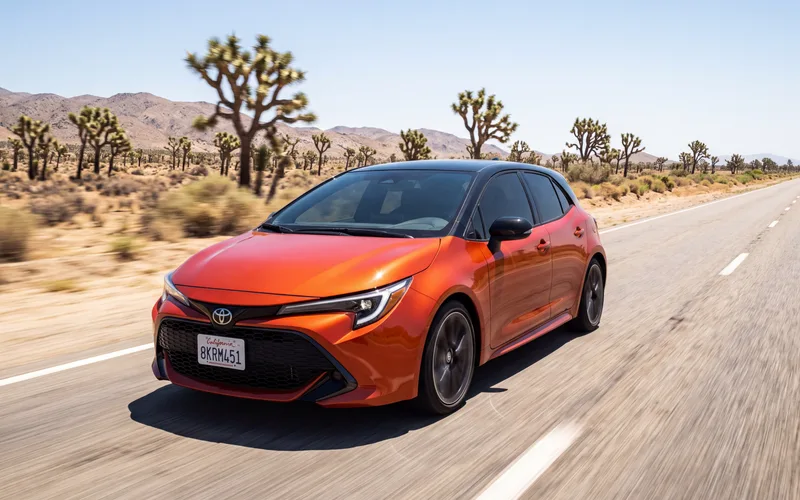 Toyota Corolla HatchbackCompact HatchbackBetter at: Value
Costs less, discounts more freely, and gives you wireless CarPlay on mid trims — worth a look if budget and tech convenience outrank cargo space.
Compare 2.57C+
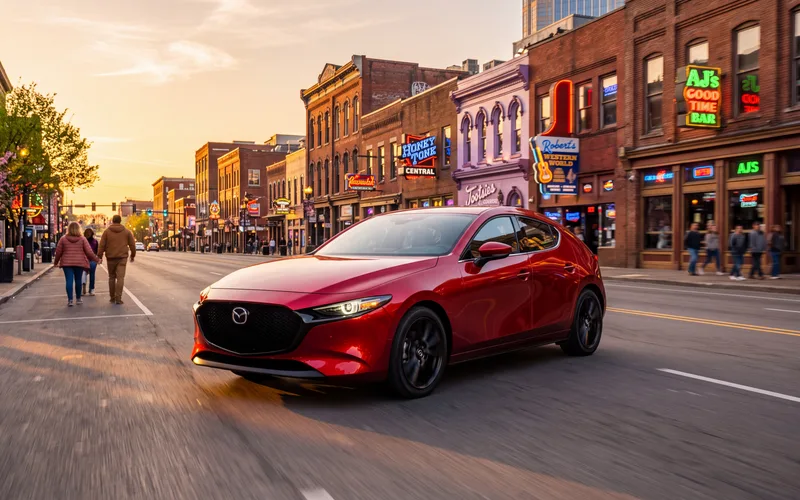 Mazda Mazda3 HatchbackCompact HatchbackBetter at: Interior quality
Offers AWD and a genuinely premium-feeling interior with a head-up display, for buyers who'd trade cargo volume for polish and all-weather traction.
Compare 2.14C
2.14C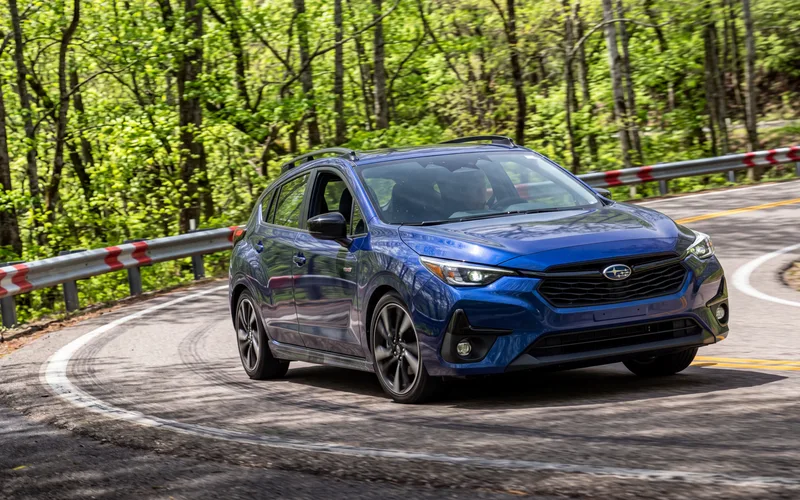 Subaru ImprezaCompact HatchbackBetter at: All-weather traction
Standard all-wheel drive at a lower price makes it the default choice for snow-belt buyers the FWD-only Civic can't serve.
CompareHow it's evolved
10 scored model years · 2017–2026
Subject scores by year
Hover or tap a score to see what moved it versus the year before. A corner mark flags a big swing.
| Year | Performance | Efficiency | Safety | Space | Cost | Reliability | Tech | Use-case | Driving | Value |
|---|---|---|---|---|---|---|---|---|---|---|
| 2026 | 30 | 59 | 76 | 69 | 68 | 80 | 51 | 65 | 72 | 75 |
| 2025 | 25 | 59 | 78 | 65 | 68 | 80 | 48 | 60 | 66 | 72 |
| 2024 | 27 | 54 | 73 | 68 | 69 | 77 | 45 | 55 | 70 | 73 |
| 2023 | 25 | 53 | 77 | 69 | 77 | 79 | 43 | 56 | 68 | 79 |
| 2022 | 25 | 54 | 81 | 69 | 78 | 78 | 43 | 56 | 68 | 80 |
| 2021 | 34 | 46 | 68 | 66 | 72 | 77 | 40 | 53 | 69 | 67 |
| 2020 | 35 | 45 | 69 | 66 | 75 | 74 | 39 | 53 | 70 | 77 |
| 2019 | 34 | 46 | 67 | 65 | 76 | 71 | 30 | 51 | 69 | 75 |
| 2018 | 32 | 60 | 58 | 74 | 76 | 65 | 34 | 58 | 77 | 75 |
| 2017 | 31 | 60 | 63 | 69 | 78 | 64 | 36 | 52 | 69 | 80 |
Compare two years
Best fit & conditions
Higher scores mean a better fit for that use case. Learn more about use-case fit →
Subject profile
Detailed scoring by subject
1Performance & PowertrainThe Civic Hatchback's lowest-graded category.0.00F
The volume Sport hatchback carries the naturally aspirated 1,996 cc 2.0L i-VTEC rated 158 hp — the lowest output among its direct compact-hatch rivals (Corolla Hatchback 169 hp, Impreza 152 hp) and near the floor of the 130–520 hp hatchback band. Stepping up to EX-L or Sport Touring buys the 1.5L turbo's 180 hp; the 315-hp Type R shares this body but is a separate nameplate and does not lift this lineup.
138 lb-ft peaking at 4,200 rpm is the naturally aspirated compromise — there is almost no low-end pull, so the engine has to be revved for any real thrust, and the figure sits just above the 120 lb-ft floor of the hatchback band. The turbo trims are transformed by comparison, holding 177 lb-ft from 1,700 rpm.
Instrumented testing of the 2.0L hatchback returns about 9.2 seconds to 60 mph, with Consumer Reports measuring an even slower 9.7 s — the hatchback body's extra mass over the sedan costs it roughly a second against the same engine, and 9.2 s sits essentially at the slow end of the 3.0–9.5 s hatchback band. Buyers who want the quick version of this car have to move to the 1.5T trims or the Type R.
Honda's 2.0L is smooth, linear and genuinely quiet at part throttle with no turbo lag to manage, and direct injection plus the 10.8:1 i-VTEC head give predictable throttle response — but it gets buzzy and audibly strained when worked hard, which with only 138 lb-ft on tap happens often. Rated a touch above the similarly-engined Corolla Hatchback (58) because reviewers find the Honda's four less thrashy near redline and because the lineup also offers the smoother, torquier 1.5T; well short of the 80+ band that seamless or effortless powertrains earn.
The Sport's LL-CVT is one of the better belt automatics in the class — step-programmed to mimic upshifts under hard throttle rather than droning at a fixed rpm, paired with a 3-Mode Drive System (ECON/Normal/Sport) on CVT trims, and unobtrusive in normal driving. It still flares under sustained load, but the hatchback also offers a genuine alternative the Corolla Hatchback dropped for 2023: a 6-speed manual, available on Sport and Sport Touring and widely praised for its light, precise shift action.
The 2023 Civic Hatchback is front-wheel drive on every trim — AWD is not offered at any price, on this body style or anywhere in the Civic range. That puts it at the bottom of the 0–49 'FWD/RWD only' band alongside the Corolla Hatchback, and behind rivals like the Impreza (Symmetrical AWD standard) and the Mazda3 Hatchback (AWD optional).
Two distinct engines (158-hp 2.0L NA, 180-hp 1.5L turbo) each pairable with a CVT or a 6-speed manual gives the hatchback buyer real choice — noticeably broader than the single-engine, CVT-only Corolla Hatchback — and the 315-hp 2.0T Type R is sold in the same body. But there is no electrification of any kind for 2023: no hybrid, PHEV or EV Civic existed in the US until the hybrid arrived for 2025, which caps this at the bottom of the 50–79 'two or three powertrain choices' band.
2Efficiency & RangeOne of the Civic Hatchback's weakest categories.1.56D
EPA rates the volume Sport hatchback with the 2.0L and LL-CVT at 32 mpg combined — solid for a gas-only compact but the weakest of the mainstream automatic hatchback configurations, since the Sport's wheel and tire package costs a point against the LX and the 1.5T EX-L is more efficient still at 35. No hybrid was offered in this body style for 2023, so 35 mpg is the ceiling of the range.
29 mpg city is respectable for a non-hybrid compact and is helped by standard idle-stop, but stop-and-go running is exactly where the absence of any electrified Civic for 2023 shows — a Corolla Hybrid sedan on a comparable platform rates 53 mpg city.
37 mpg highway is this powertrain's best EPA number and is realistic in practice thanks to the CVT's tall cruising ratios, though it trails the Corolla Hatchback's 41 mpg and the Civic's own 1.5T EX-L at 39.
The 12.4-gallon tank is small — a gallon less than the Corolla Hatchback's 13.2 — so decent economy still only yields about 397 miles between fills, well below the segment leaders and low in the 300–650 mi hatchback band. Enough for a long day's drive, but the Civic asks for a stop sooner than most compact rivals.
EPA's standard 15,000 mi/yr basis puts the Sport at about $1,950 a year on regular — inexpensive in absolute terms and comfortably better than the fleet average, but $200/yr behind the Corolla Hatchback SE and a few hundred more than any hybrid compact would cost to run.
Honda specifies regular unleaded for every 2023 Civic Hatchback trim — including the 1.5L turbo, which many rivals would ask premium for — so there is no fuel-grade penalty anywhere in the lineup and nothing to install at home. Squarely in the 80–100 band.
3SafetyOne of the Civic Hatchback's strongest categories.3.26B+
NHTSA rated the 2023 Civic Hatchback separately from the sedan and awarded the maximum overall vehicle score, with a four-star frontal result pulling down an otherwise perfect card.
The 2023 Civic 4-door hatchback is a 2023 Top Safety Pick (non-Type R trims), the second year of the eleventh generation launched for 2022 and a carry-over year. Good results across small overlap driver and passenger, original moderate overlap, roof strength and head restraints, but an Acceptable updated side result keeps it a rung below TSP+.
Honda Sensing is standard on every 2023 hatchback trim — CMBS with forward collision warning, ACC with Low-Speed Follow, LKAS, lane departure warning, Road Departure Mitigation, Traffic Jam Assist, traffic sign recognition, auto high-beams and a driver attention monitor. Blind-spot monitoring does not appear until EX-L and cross-traffic monitoring is Sport Touring-only, so the volume Sport goes without either.
The standard CMBS system posts top marks against both vehicles and daytime pedestrians, with strong but not class-leading nighttime pedestrian avoidance.
Blind-spot information is absent from the LX and the volume Sport and only arrives on EX-L, while rear cross-traffic monitoring is restricted to the top Sport Touring. Both are warning-only systems with no steering intervention or rear automatic braking.
Standard LKAS with lane departure warning, Road Departure Mitigation and Traffic Jam Assist gives usable centering at highway and crawling speeds, but the camera-based system can lose faded markings and intervene more abruptly than the smoothest rival systems.
Full-speed-range ACC with Low-Speed Follow — genuine stop-and-go — is standard on every trim and pairs with LKAS via Traffic Jam Assist for competent hands-on highway assistance. It can brake abruptly for cut-ins and lacks the polish of premium-brand systems.
No 2023 Civic Hatchback trim offered hands-free highway driving; Honda Sensing is a hands-on system throughout and LKAS disengages if the driver releases the wheel.
IIHS rates the hatchback's headlights Good with no trim split — the same LED reflector units with high-beam assist are fitted from LX to Sport Touring, avoiding the trim-dependent lighting penalty common in the compact class.
The eleventh-generation low cowl, slim A-pillars and door-mounted mirrors give an unusually clear forward view, and the hatch's upright rear glass beats the sedan's fastback backlight over the shoulder. Thick rear pillars and the roof-edge spoiler still cut into the rearward view, and only a multi-angle rearview camera is offered — no surround-view system, and no blind-spot monitoring on the volume Sport.
Two outboard seating positions carry complete, easily reached lower-anchor hardware and the center position adds a tether anchor with the ability to borrow lower anchors — an IIHS Good-tier evaluation carried over from the mechanically identical sedan rear seat. Compact-car rear width still makes three seats across a squeeze.
4Space & ComfortMid-pack among this car's ten categories.2.67C+
Every 2023 Civic Hatchback trim seats five — two up front and a three-across 60/40 split bench behind — which is the maximum the compact-hatch band recognizes.
The volume Sport goes without a moonroof and keeps a full 39.3 in of front headroom — near the top of the 36–40 in hatchback band and a genuinely airy compact cabin. Buyers who step up for the moonroof give back 1.7 in.
42.3 in of front legroom sits mid-band for the segment — enough for tall drivers thanks to the 11th generation's long seat travel, but no more than the compact-hatch norm.
37.1 in in the second row is squarely mid-band and, unusually, does not shrink on moonroof-equipped trims because the glass panel sits over the front seats only. Adults sit upright back there without ducking.
37.4 in of rear legroom is mid-band for the hatchback class but a real advantage over the direct compact-hatch rivals — the 2023 Corolla Hatchback offers roughly 30 in and the Mazda3 hatch about 35 in, so the Civic is one of the few in this body style where two adults sit behind two adults in comfort.
24.5 cu ft behind the second row is the headline number for this car and near the top of the 8–28 cu ft hatchback band — it comfortably beats the Corolla Hatchback (about 17.8 cu ft), the Mazda3 hatch (about 20.1) and the Golf GTI (about 19.9), and it is the single strongest practicality argument for choosing the hatch over the Civic sedan.
The 11th-generation console is a genuinely good piece of design — a sliding armrest over a deep bin, a configurable open tray with a pass-through beneath, and a phone shelf — and the hatch adds a reversible side-pull cargo cover, a cargo-area light and a flat load floor with the 60/40 seatback down. What it lacks is a signature trick: there is no Magic Seat, no underfloor cargo well of consequence and no onboard AC power, and the volume Sport gets front beverage holders only, with rear cupholders arriving with the EX-L's center armrest.
The Sport's front seats are supportive enough for a commute but the trim gets only a manual height-adjusting driver's seat with no lumbar adjustment at all, and that omission is the recurring complaint in owner reports — stiff cushions and unsupported lower backs on drives past an hour or two. Power adjustment (8-way driver) and heated leather arrive only on EX-L and above; the rear bench is flat but has the legroom to make up for it.
The 11th-generation chassis — MacPherson struts up front, a multi-link rear — is widely praised for balancing composure with compliance, and it rides better than the Civic's reputation as a compact suggests. The volume Sport works against itself, though: its 235/40R18 all-seasons on 18-inch wheels introduce a choppiness over broken pavement that the EX-L's taller 215/50R17 sidewalls smooth out.
Honda quieted a longstanding Civic weakness with this generation and Consumer Reports credits the improvement, but road noise remains the most-cited gripe from 2023 hatchback owners — coarse surfaces come through clearly, and owners report wind noise from the top of the door seal building from about 40 mph. Owner sound-meter readings of roughly 67–72 dB at 70–75 mph are ordinary rather than class-leading, and the hatch's open cargo bay behind the rear seats gives tire roar a clearer path into the cabin than the sedan's sealed trunk.
The volume Sport is thin here: single-zone automatic climate control, rear-seat heater ducts and nothing else — no heated seats, no heated mirrors, no moonroof. Dual-zone climate and heated front seats do not appear until the EX-L, ventilated seats are not offered at any price, and no 2023 Civic of any trim can be had with a heated steering wheel. The saving grace is that the CVT trims include remote engine start, so the cabin can be pre-conditioned before you reach it.
5Cost of OwnershipGrades above the middle of the scale.3.20B+
Honda launched the 2023 hatchback without an LX and reinstated the trim midyear, so the entry price fell from the Sport's $26,945 to the LX's $25,545 delivered. Both sit well inside the lower half of the hatchback band.
The Sport was the hatchback's entry trim for most of the 2023 model year and remains its volume seller, carrying the 2.0-liter engine with either a CVT or a no-cost 6-speed manual at the same price. It runs about $500 above the equivalent 2023 Civic Sport sedan.
Edmunds' 2023 Civic Sport CVT projection covers the identical 2.0-liter/CVT drivetrain and 18-inch wheel package the hatchback Sport uses, so it transfers directly to this body. Edmunds' method runs conservative — it folds in tires, brakes and batteries at 15,000 miles a year — and other estimators put the Civic Hatchback below the class average.
The Civic Hatchback posts the strongest residuals in the compact-hatchback class, roughly eleven points above the segment average, and clears the top of the scoring band outright. More conservative residual models are less generous — CarEdge projects about 59% — so the figure is a best-case rather than a consensus.
Honda's standard new-vehicle limited warranty sits at the floor of the category band, matching Toyota and Mazda but trailing Hyundai and Kia's 5-year/60,000-mile coverage.
The gasoline hatchback carries Honda's mainstream 5-year/60,000-mile powertrain term, the bottom of the band and well behind Hyundai/Kia's 10-year/100,000-mile coverage. No Civic Hybrid was offered in the US for 2023, so no high-voltage battery coverage applies to this car.
2023 was the first model year of Honda Service Pass, which covers factory-scheduled oil changes, tire rotations and multi-point inspections for 2 years/24,000 miles — essentially level with ToyotaCare (2 years/25,000 miles) and paired with a longer 3-year/36,000-mile roadside term. It is genuine multi-year included maintenance, but short of Hyundai's 3-year/36,000-mile plan and the multi-year premium-brand programs.
$26,945 volume-trim price minus its estimated resale value after 5 years (76.8% retained, or about $20,694) leaves about $6,251 in depreciation. Add the projected $6,546 in 5-year maintenance and repairs, and owning this vehicle for 5 years costs about $12,797 in total.
6Reliability & QualityThe Civic Hatchback's best-graded category.3.37B+
The 2023 Civic posts a better-than-average owner-survey record and an above-average J.D. Power model-level result, and the hatchback shares the sedan's platform, powertrains and electronics. It stops short of the top tier because the J.D. Power rating is a carry-over from the prior year and the generation has accumulated meaningful recall activity.
Honda's multi-year dependability record is strong but not uniformly elite across methodologies. Consumer Reports placed Honda in its 2023 top five for brand reliability, while the 2023 J.D. Power Vehicle Dependability Study left Honda below the industry average, so a low-80s score reflects the split evidence.
Fewer campaigns reach the hatchback body style than the sedan, but the one that does is systemic rather than incidental — a steering-gearbox defect that ultimately swept in roughly 1.7 million Civics after an NHTSA investigation. No deaths or injuries were reported and remedies are free, which keeps this above the bottom band, but two safety recalls including an FMVSS non-compliance is heavy activity for a car this young.
The volume Sport hatchback uses the naturally aspirated 2.0-liter four with either a CVT or a six-speed manual — mature Honda hardware with a good high-mileage record and less complexity than the turbo. The 1.5-liter turbo fitted to EX-L and Sport Touring has a less spotless history, including oil-dilution concerns in earlier applications, so the family does not merit a top-decile score.
The eleventh-generation Civic cabin is a compact-class benchmark, and the hatchback Sport gets the same soft-touch dash and door tops, honeycomb mesh vent band and tactile physical controls. Hard plastic remains in low-touch areas, appropriate to the price, but reviewers consistently place the cabin near the top of the segment.
Assembly is solid and the second model year avoids launch-tooling risk, but this was only the second year Honda had built a Civic hatchback in the US at all, and owner reports of interior rattles and thin sound insulation are more than isolated. That combination lands it a little below the sedan.
Honda runs a dense nationwide US dealer network and the Civic's enormous installed base makes trained service support easy to find anywhere in the country. Service quality varies franchise to franchise, which caps the score short of the top.
Civic parts are exceptionally abundant through dealers, independent suppliers and one of the industry's largest aftermarkets, and the hatchback shares nearly everything mechanical with the sedan. Repair frequency and annual cost run well below compact-car averages.
7Technology & InfotainmentOne of the Civic Hatchback's weakest categories.0.85F
Two of the three 2023 hatchback trims, including the volume Sport, carry a 7-inch display — the floor of the 7–15.5 in band and visibly small next to a 2023 Corolla Hatchback's 8-inch standard unit or the Mazda3's 8.8-inch screen. The 9-inch screen is locked to the top Sport Touring.
Honda kept what matters most for daily use — a real volume knob, physical climate dials under the honeycomb vent strip, and a shallow menu structure that reviewers consistently call easy to learn. The 7-inch unit itself is the weak link: modest resolution, dated graphics, and no HondaLink connected services, which are tied to the 9-inch head unit.
Wired Apple CarPlay and Android Auto are standard on every trim, but wireless projection is a Sport Touring exclusive — so the buyer of the volume Sport plugs in every trip, at a point in the market where the rival Corolla Hatchback shipped wireless CarPlay as standard equipment for 2023.
There is no embedded navigation on the volume Sport at all — Honda's Satellite-Linked Navigation with voice recognition and RealTime Traffic is fitted only to the Sport Touring, and neither is SiriusXM or HD Radio available lower down. Voice control on the Sport reduces to basic Bluetooth HandsFreeLink commands plus whatever Siri or Google Assistant brings over the CarPlay/Android Auto cable, which is how most owners will navigate.
The Sport's standard 8-speaker system is a solid base setup for a compact — more speakers than most rivals' entry audio — and the Sport Touring's 12-speaker Bose with subwoofer is a genuinely good premium upgrade and one of the stronger reasons to move up. The gap is that there is no middle option: the EX-L still gets the 8-speaker system.
The Sport runs Honda's Driver Information Interface — a colour readout set in the middle of an otherwise conventional gauge cluster, carrying fuel economy, temperature, phone-projection and Bluetooth data with steering-wheel control. It is a partial-digital arrangement, legible and useful but not configurable in the modern sense; the fully digital 10.2-inch cluster is reserved for the Sport Touring.
The 2023 Civic has no meaningful over-the-air update capability: neither the 7-inch nor the 9-inch head unit receives feature-adding software remotely, and map and system updates go through the dealer or a USB drive. It is a straightforward generational gap against rivals — the 2023 Corolla Hatchback's Toyota Audio Multimedia supported OTA updates for the system and maps.
HondaLink covers the core remote set — lock/unlock, remote engine start on CVT cars, vehicle locator and alerts — but it is subscription-gated after the trial, the app's reliability draws routine owner complaints, and there is no phone-as-key or digital key of any kind on this generation. On the volume Sport the paired connected services are further limited because HondaLink rides with the 9-inch head unit.
This is the weakest technology point on the volume trim. The Sport gets exactly one 2.5-amp USB-A smartphone/audio port in the front console plus a 12-volt outlet — no second front port, nothing at all for rear passengers, no USB-C anywhere in the car, and no wireless charging pad. Only the Sport Touring adds a front charging port, two second-row ports and the Qi charger.
Keyless convenience is one place the Civic does not nickel-and-dime: Smart Entry with Walk Away Auto Lock, push-button start, a security system with remote entry and remote hatch release, and remote engine start on the CVT are all standard on the volume Sport. What is missing is the modern layer — no hands-free power tailgate and no phone-as-key.
A multi-angle rearview camera with dynamic guidelines is standard and gives three selectable views, which is more than the segment minimum. Beyond that the volume Sport has nothing: front and rear parking sensors are Sport Touring-only, there is no surround-view camera on any trim, and no automated parking of any kind — which stings more than usual given the Sport's wide 38.1-ft turning circle.
No head-up display is offered on the 2023 Civic Hatchback at any trim level, including the top Sport Touring — a feature gap it shares with most of the mainstream compact class.
8Use-Case FitMid-pack among this car's ten categories.1.78C-
For a compact, the family logistics are good: 37.4 in of rear legroom and 37.1 in of rear headroom make a rear-facing seat installable without shoving the front passenger forward, the LATCH provision is complete for the class (lower anchors at both outboard positions, tether anchors at all three), and the hatchback's square opening and 24.5 cu ft well swallow a stroller the sedan's trunk aperture would fight. The limits are the ones every compact has — three across is a squeeze — plus the volume Sport's lack of a rear center armrest or seatback pocket.
The crash credentials are strong and they apply to the trim families actually buy: five stars overall from NHTSA, an IIHS Top Safety Pick for the 2023 hatchback, and the full Honda Sensing suite — collision mitigation braking, road departure mitigation, lane keeping and adaptive cruise with low-speed follow on the CVT — standard on the entry Sport, along with a rear seat reminder. The deduction is that blind spot information and cross-traffic monitoring are Sport Touring exclusives, so the affordable trim goes without the two features parents notice most in a school-run parking lot.
The cargo hold is the strength — 24.5 cu ft means four people's luggage rides inside with the seats up, which is unusual at this size. The rear cabin is where a long trip gets thin on the volume Sport: heater ducts but no rear vents or rear climate control, no second-row USB ports of any kind, no rear center armrest or cupholders, and front seats without lumbar adjustment that owners flag on multi-hour stints.
This is the Civic's home ground. The 2.0-litre and CVT pull away smoothly and quietly at commuting speeds, the electric parking brake includes automatic brake hold, adaptive cruise with low-speed follow and traffic jam assist are standard on the CVT so stop-and-go traffic is handled, and the low cowl and deep glass give the outward visibility that makes city driving low-effort. The 158-hp engine only feels short of breath when merging hard.
29/37/32 mpg on regular unleaded is genuinely cheap to run and the consumables are as inexpensive as motoring gets — 235/40R18 all-seasons are the priciest item on the list, and Honda's parts and service network keeps routine costs low. It is short of exceptional only because the hybrids that define the top of this band, including the Civic's own later hybrid and the Prius, are 20 mpg clear of it.
At 179.0 in long and 70.9 in wide the hatchback is 5 in shorter than the Civic sedan and easy to place in a city space, with a low beltline and a multi-angle reversing camera to help. The catch is specific to the volume Sport: its 18-inch wheels bring a 38.1-ft curb-to-curb turning circle — two full feet wider than the EX-L's — and no parking sensors are available at all below the Sport Touring.
Honda publishes no US towing rating for the Civic in any configuration, so a trailer is off the table outright, and there is no bed, no payload headroom worth the name and a 158-hp naturally aspirated engine that is already working hard with five aboard. What it can do is carry 24.5 cu ft of tools or samples under a locking cargo cover — real utility for a courier or a trades estimator, but not work capability in the sense this item measures.
The mechanical package is about as durable as a small car gets — a naturally aspirated 2.0-litre i-VTEC and Honda's CVT are proven high-mileage units and the brand's reliability record backs them up, which is why Civics survive as delivery and rideshare hacks. But everything around the powertrain is passenger-car: cloth seats with no wear-resistant work trim offered, no rubber flooring option, low-profile 40-series tires on the Sport, and 5-odd inches of ground clearance that a rutted jobsite entrance will find.
There is essentially no work-focused provision: a single 12-volt front outlet, no AC inverter or onboard power, no factory hitch, no roof rails from the factory, and no upfit ecosystem beyond Honda's own accessory crossbars, all-season floor mats and cargo tray. Cargo tie-down anchors and a flat load floor with the 60/40 seat down are the extent of it.
Adaptive cruise with low-speed follow and lane keeping come standard on the CVT and take real strain out of an interstate day, and the hatch's cargo hold means the luggage does not compromise the passengers. Two things cap it: a 12.4-gallon tank yields only about 395 miles of highway-realistic range, so this car stops more often than most tourers, and the volume Sport's lumbar-less seats plus persistent road noise are exactly the complaints that surface on multi-hour drives.
The Civic Hatchback is front-wheel drive only — no AWD is offered on any 2023 trim, unlike the Impreza or a Corolla Hatchback shopper's crossover alternatives — and it sits on low-profile 235/40R18 rubber with hatchback ground clearance, which rules out anything past a maintained gravel road. It will carry bikes on accessory crossbars and camp comfortably enough with the rear seats folded flat, but there is no tow rating for a trailer and no drive mode beyond ECON/Normal/Sport.
This is what the hatchback body buys: a wide tailgate opening onto 24.5 cu ft with the seats up — more than most compact SUVs offer behind their rear seats — expanding to roughly 46 cu ft of flat floor with the 60/40 seatback down, under a reversible side-pull cargo cover that hides gear. What holds it short of the top band is the absence of factory roof rails or a hitch, so long or bulky items have to go inside.
9Driving ExperienceMid-pack among this car's ten categories.2.63C+
The 11th-generation Civic's chassis is the class benchmark and the hatchback inherits it whole — a stiffer structure than the car it replaced, struts up front and a multi-link rear, and 235/40R18 tires on the Sport that give it real grip for a commuter car. Instrumented skidpad results for this generation sit around 0.83 g, and reviewers consistently describe nimble, predictable, well-controlled cornering with body motions kept tight.
The variable-ratio electric rack is quick — 11.41:1 and 2.21 turns lock-to-lock on the Sport's setup — and reviewers single out the steering as precise and consistently weighted, with more of a sense of connection than a mainstream compact usually delivers. It stops short of the top band because the feedback is still filtered: accuracy and weighting are the strengths, genuine road texture through the rim is not.
Ventilated 11.1-inch front and solid 10.2-inch rear discs on a car under 3,000 lb give short, repeatable stops — instrumented testing of this generation returns about 174 ft from 70 mph, competitive for the class — and the pedal is firm and linear with no regen blending to muddy it. The rating is held at the upper-middle band because it is a conventional, unremarkable brake package rather than a standout one, and the volume Sport's low-profile tires do more of the work than the hardware.
Honda's calibration of the 2.0-litre and LL-CVT is one of the better examples of the type: tip-in is clean, the ratio changes are seamless in normal driving, and the CVT's stepped programming under hard throttle disguises much of the rubber-band effect. Idle-Stop restarts are the rough edge most owners notice, and the naturally aspirated engine's 138 lb-ft peaking at 4,200 rpm means the transmission has to hunt for revs whenever the car is asked for a quick response.
This is the 2.0-litre CVT combination's weakest trait. Because peak torque arrives at 4,200 rpm against a 6,800-rpm redline, any real acceleration parks the engine high in its range and holds it there, producing the flat drone that reviewers of the base Civic routinely flag; the engine is smooth and unobtrusive at a cruise but coarse and loud when worked. The turbocharged trims are noticeably better mannered under load.
The volume Sport's 18-inch wheels and wider 235-section tires cost it two feet of turning circle against the EX-L, leaving 38.1 ft curb-to-curb — poor for a 179-inch compact and near the wide end of the 34–40 ft hatchback band. It is the one everyday-drivability figure where this car is beaten by cars a size larger.
Honda designed this generation around sightlines — a low cowl, slim A-pillars and a deep glasshouse give the outward visibility that flatters the car in traffic — and it kept the controls physical, with climate dials, a volume knob and illuminated steering-wheel switches instead of touch panels. A tilt-and-telescopic column and 42.3 in of front legroom suit a wide range of drivers; the only real shortfall on the Sport is a manually height-adjusted driver's seat with no lumbar adjustment.
The chassis is genuinely entertaining — this is the platform enthusiasts recommend and the one that underpins the Si and Type R — and the hatchback body offers a proper six-speed manual on the Sport, which is most of what makes a car like this fun. What blunts it is the volume CVT drivetrain: 158 hp and roughly 9.2 seconds to 60 mph mean the car is far more enjoyable through corners than out of them.
10Value & Market PositionOne of the Civic Hatchback's strongest categories.3.34B+
Every 2023 hatchback includes the full Honda Sensing suite — adaptive cruise, lane keeping, forward collision warning and automatic emergency braking, traffic sign recognition — plus remote start, dual-zone automatic climate control, 18-inch alloys and smartphone integration on the volume Sport. It is a strong safety and essentials package, but the Sport keeps a small 7-inch head unit with wired CarPlay and no blind-spot monitoring, and the hatchback's entry price sits about $2,100 above the sedan LX, so the content-per-dollar lead over the sedan is narrower.
The hatchback pairs the Civic's award-winning chassis, cabin quality and standard safety tech with meaningfully more cargo utility and a no-cost 6-speed manual, all inside a $25,545–$32,045 delivered band. It asks a few hundred to a couple of thousand dollars more than the equivalent sedan and — for most of the model year — offered no cheap entry trim, which trims the bargain case slightly relative to the sedan.
Four trims (LX, Sport, EX-L, Sport Touring) across two engines — the 2.0-liter naturally aspirated and the 1.5-liter turbo — with a no-cost 6-speed manual on Sport and Sport Touring, which is rare choice for a mainstream compact and far broader than the three-trim 2026 lineup. Against that, the LX was absent from launch until a midyear reinstatement, and every hatchback is front-wheel drive and gas-only, with no hybrid or AWD option for 2023.
The Civic nameplate rebounded to 200,381 US sales in 2023, up 49.3% year over year, and the hatchback was supply-limited rather than demand-limited. Honda does not break the body styles out separately, and the hatchback is the minority share of Civic volume — roughly a fifth to a quarter — but within the shrinking US compact-hatch pool it is a segment leader alongside the Corolla Hatchback.
Honda carries unusually strong mainstream equity built on durability, efficiency and class-leading resale, and the hatchback body inherits extra enthusiast credibility from the Civic Si and the FL5 Type R that launched for 2023 on the same three-door-derived shell. It is not an aspirational luxury marque, which caps the ceiling.
Constrained Honda inventory and strong demand kept 2023 Civics transacting at or above sticker, with widespread dealer market adjustments and essentially no cash rebates; the hatchback's lower production volume made it tighter still. Occasional promotional APR support offered some buyer benefit, but this was not a car buyers could routinely negotiate below MSRP.
2023 was only the second model year of the eleventh-generation hatchback, which went on sale for 2022 and moved US production to Greensburg, Indiana. It is a carry-over year apart from the midyear LX reinstatement and the EX-L blind-spot option split, so the platform, cabin and safety technology were still current with no redesign risk for buyers.
The 2023 Civic took Car and Driver 10Best and Edmunds Top Rated Car honors and earned an IIHS TOP SAFETY PICK+ in hatchback form specifically, on top of the generation's 2022 North American Car of the Year win. Reviewers routinely picked this body as the better Civic for its cargo utility and available manual; the CVT's drone in 2.0-liter form is the recurring criticism.