

The verdict
A mixed-report compact hatchback, strong on value and held back by performance.
The 2020 Civic Hatchback is the practical, cheap-to-own end of the compact class: 22.6 to 25.7 cubic feet behind the rear seat (46.2 with the seats down), 32-34 MPG combined, a 5-star NHTSA rating, and resale so strong that a $24,480 Sport was still worth about $17,250 five years later. It drives better than a commuter car has to — 0.93 g of grip, a 160-foot stop from 70 mph, and a real 6-speed manual on Sport and Sport Touring — and Honda Sensing is standard even on the $22,580 LX. What you give up is refinement and gear: the cabin is noisy on coarse pavement, the halogen headlights on four of the five trims are rated Poor by IIHS, no trim at any price offers blind-spot monitoring, and the 7-inch screen was already the class floor in 2020. Buy it for the cargo hold, the running costs, and the chassis; don't buy it expecting a quiet, gadget-rich cabin.
Jump to scoresStrengths
- Best-in-class value retention and running costs
- Five-star crash results and a Top Safety Pick
- Honda dependability with cheap, easy service
What holds it back
- The screen and cabin tech are a generation behind
- Front-wheel drive only, with nowhere to go
- IIHS rates the headlights Poor on four of five trims
Top alternatives
Cars shoppers cross-shop with the Honda Civic Hatchback 2.25C
2.25C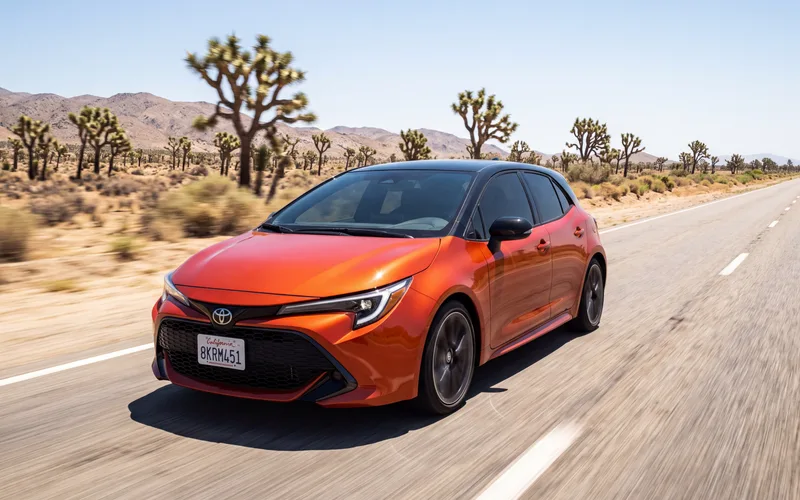 Toyota Corolla HatchbackCompact HatchbackBetter at: Value
Costs less, discounts more freely, and gives you wireless CarPlay on mid trims — worth a look if budget and tech convenience outrank cargo space.
Compare 2.57C+
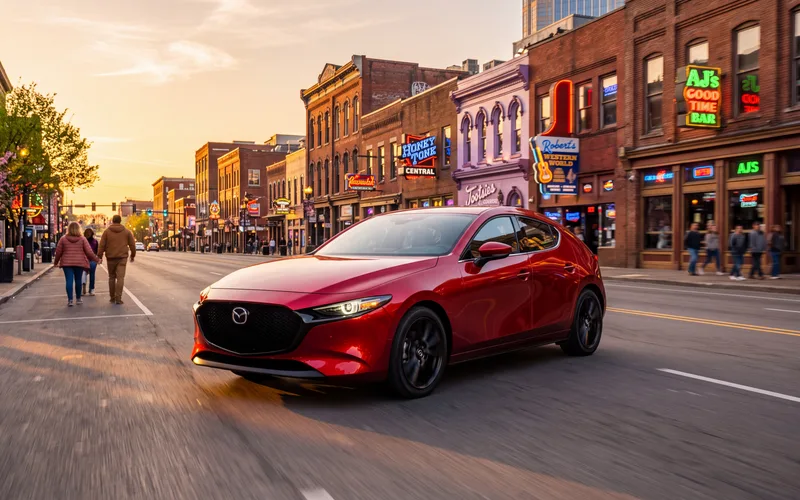 Mazda Mazda3 HatchbackCompact HatchbackBetter at: Interior quality
Offers AWD and a genuinely premium-feeling interior with a head-up display, for buyers who'd trade cargo volume for polish and all-weather traction.
Compare 2.14C
2.14C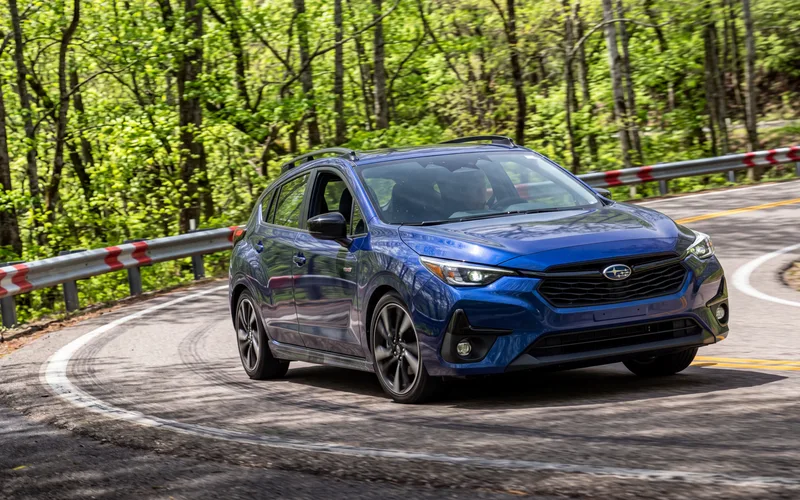 Subaru ImprezaCompact HatchbackBetter at: All-weather traction
Standard all-wheel drive at a lower price makes it the default choice for snow-belt buyers the FWD-only Civic can't serve.
CompareHow it's evolved
10 scored model years · 2017–2026
Subject scores by year
Hover or tap a score to see what moved it versus the year before. A corner mark flags a big swing.
| Year | Performance | Efficiency | Safety | Space | Cost | Reliability | Tech | Use-case | Driving | Value |
|---|---|---|---|---|---|---|---|---|---|---|
| 2026 | 30 | 59 | 76 | 69 | 68 | 80 | 51 | 65 | 72 | 75 |
| 2025 | 25 | 59 | 78 | 65 | 68 | 80 | 48 | 60 | 66 | 72 |
| 2024 | 27 | 54 | 73 | 68 | 69 | 77 | 45 | 55 | 70 | 73 |
| 2023 | 25 | 53 | 77 | 69 | 77 | 79 | 43 | 56 | 68 | 79 |
| 2022 | 25 | 54 | 81 | 69 | 78 | 78 | 43 | 56 | 68 | 80 |
| 2021 | 34 | 46 | 68 | 66 | 72 | 77 | 40 | 53 | 69 | 67 |
| 2020 | 35 | 45 | 69 | 66 | 75 | 74 | 39 | 53 | 70 | 77 |
| 2019 | 34 | 46 | 67 | 65 | 76 | 71 | 30 | 51 | 69 | 75 |
| 2018 | 32 | 60 | 58 | 74 | 76 | 65 | 34 | 58 | 77 | 75 |
| 2017 | 31 | 60 | 63 | 69 | 78 | 64 | 36 | 52 | 69 | 80 |
Compare two years
Best fit & conditions
Higher scores mean a better fit for that use case. Learn more about use-case fit →
Subject profile
Detailed scoring by subject
1Performance & PowertrainThe Civic Hatchback's lowest-graded category.0.27F
Every 2020 Civic Hatchback runs the 1,498 cc turbocharged L15 — there is no naturally aspirated base engine in this body style — and the Sport and Sport Touring trims take a center-exit exhaust that lifts output to 180 hp when fed premium, six more than the 174 hp the LX/EX/EX-L make. That is competitive for a mainstream compact hatch (Corolla Hatchback 168 hp, Impreza 152 hp) but still near the floor of the 130–520 hp hatchback band, which is stretched by luxury and performance five-doors.
162 lb-ft is modest in absolute terms and sits low in the 120–450 lb-ft hatchback band, but the shape of the curve matters more than the peak here: the turbo holds it flat from 1,700 rpm all the way to 5,500, so the car pulls from just off idle in a way no naturally aspirated compact of the era does. Buyers who take the 6-speed manual get a meaningfully torquier tune at 177 lb-ft.
Instrumented testing puts the 180-hp CVT hatchback at roughly 7.1 seconds to 60 mph — about a second and a half quicker than the naturally aspirated compact hatchbacks it is cross-shopped against, and quick enough that the Civic was the acceleration benchmark of the mainstream class in 2020 without a hot-hatch badge. It lands comfortably mid-pack in the 3.0–9.5 s hatchback band, which is anchored at the fast end by six-figure performance cars.
The L15 turbo is the strong suit of this car: direct injection plus VTC on both cams and a small single-scroll turbo give it a broad, flexible mid-range with only a slight pause off idle, and reviewers of the 2020 hatchback consistently describe merging and passing power that flatters the car's size. It is marked down from the 80+ band because there is real, if brief, turbo lag from a standstill and the four grows coarse and boomy when held near its 6,500 rpm limit — and because the engine's requirement for premium to reach its headline output is a refinement caveat of its own.
Honda's G-Design Shift CVT is one of the better belt automatics of its generation — it steps through simulated ratios under load rather than pinning the engine at one droning rpm, and the Sport trims add paddle shifters and a Sport mode that holds those steps. More importantly for 2020, this is the year Honda widened manual availability rather than killing it: the excellent 6-speed manual was already on Sport and became available on the range-topping Sport Touring for the first time, so the enthusiast option exists at both ends of the line. Held below 80 because the CVT can still be slightly jerky settling into a ratio and flares audibly at wide-open throttle.
The 2020 Civic Hatchback is front-wheel drive on every trim — Honda offered no all-wheel-drive Civic in any body style in the US market for 2020, at any price. That puts it at the bottom of the 0–49 'FWD/RWD only' band, behind the Subaru Impreza (Symmetrical AWD standard) and the Mazda3 hatchback, which added optional i-Activ AWD for 2019.
The hatchback is a one-engine car: the 1.5L turbo in two states of tune (174 hp on regular, 180 hp on premium with the sport exhaust), which is a calibration difference rather than a second powertrain. The choice that does exist is transmission — CVT throughout, 6-speed manual on Sport and Sport Touring — and there is no electrification anywhere in the 2020 US Civic range; no hybrid Civic reached America until 2025. That lands it in the 0–49 'single powertrain' band, though above the floor because two distinct tunes and a genuine manual give more real choice than a take-it-or-leave-it lineup.
2Efficiency & RangeOne of the Civic Hatchback's weakest categories.1.01D
EPA rates the Sport hatchback's AV-S7 CVT at 32 MPG combined — good for a 180-hp turbocharged compact, but the sport exhaust, 18-inch wheels and premium-fuel calibration cost it two combined MPG against the 34 MPG the mechanically similar LX/EX/EX-L manage. Well clear of the 18 MPG floor of the hatchback band, though a full class behind the hybrid hatchbacks it shares showroom space with.
29 MPG in the EPA city cycle is respectable for a turbocharged compact with no electric assist, helped by the CVT keeping revs low and by the small 1.5-liter displacement. It is the weakest part of the car's economy story relative to the hybrid compacts of the era, which roughly double it in stop-and-go use.
35 MPG highway is mid-band for a compact hatchback and is where the Sport trim gives up the most — five MPG behind the same car in LX/EX form, a penalty that comes from the wider wheel-and-tire package and the freer-flowing exhaust rather than from any difference in the engine's hardware. Notably, the 6-speed manual Sport actually beats the CVT on the highway cycle at 37 MPG.
Honda fits every 2020 Civic Hatchback the same small 12.39-gallon tank, so even respectable economy only buys about 396 miles between fills on the Sport — enough for a long day but short of the 500-mile-plus reach of larger-tanked sedans and hybrids, and low in the 300–650 mi band. The frugal LX/EX/EX-L trims stretch the same tank to roughly 421 miles.
The Sport's premium-fuel rating is what drives this figure: 32 combined MPG on 91-octane costs EPA-estimated $2,400 a year, $550 more than the LX/EX/EX-L pay to cover the same 15,000 miles on regular at 34 MPG. That is the single largest running-cost gap inside the 2020 hatchback lineup and it lands the Sport in the weaker half of the $1,000–3,200 band despite genuinely good economy.
This is the textbook 50–79 case: Honda lists the Sport and Sport Touring as 'Regular Unleaded (Premium Recommended)' — the car runs and drives safely on 87 octane, but its advertised 180 hp is only available on premium and the EPA rated it as a premium vehicle. That splits the lineup, since the LX, EX and EX-L are plain regular-unleaded cars with no such caveat, so the same nameplate can be either an unrestricted or a costly fill depending on the trim chosen.
3SafetyMid-pack among this car's ten categories.2.68C+
NHTSA tested the 2020 Civic Hatchback in its own right — not as a carry-over of the sedan result — and it swept every sub-test at five stars, including both frontal seating positions, the side barrier and pole tests, and a 9.5% rollover probability with no tip in the dynamic maneuver. That is the top of the 3–5 star hatchback band.
The 2020 Civic Hatchback posts Good in all six IIHS crashworthiness tests — driver- and passenger-side small overlap, moderate overlap, side, roof strength and head restraints — and earns Top Safety Pick. It stops short of TSP+ only because Good-rated headlights are confined to one late-build trim, and the award explicitly excludes the Type R.
Honda made Honda Sensing standard across the whole Civic range for 2019 and it carries into 2020, so even the $21,650 LX hatchback gets collision-mitigation braking, adaptive cruise with low-speed follow, lane keeping assist, road departure mitigation, auto high beams and a multi-angle rearview camera — genuinely ahead of the class norm for the year. What holds it out of the top band is the other half of the checklist: there is no blind-spot monitor and no rear cross-traffic alert on any 2020 Civic Hatchback trim, at any price.
IIHS rates the Civic's front crash prevention Superior in both the vehicle-to-vehicle and the daytime pedestrian evaluations, with full collision avoidance at 12 and 25 mph against a vehicle and against a crossing adult at 25 mph. It scores at the bottom of the top band rather than the middle of it because IIHS had no nighttime pedestrian protocol in 2020, so the system's after-dark behavior is simply unmeasured.
This is the car's clear safety gap. No 2020 Civic Hatchback trim offers a conventional radar blind-spot monitor or rear cross-traffic alert; EX and above get LaneWatch instead, a camera in the right mirror that throws a passenger-side view onto the center screen when you signal right. It covers one side only, does nothing when you don't signal, and asks the driver to look away from the mirror to use it — and it is absent altogether from LX and Sport.
LKAS is standard from the LX up and does real lane centering rather than bounce-off-the-line correction, backed by Road Departure Mitigation for unmarked edges. It is a mid-pack implementation for the era: reliable on well-marked interstate, but it hunts between the lines on gentle curves and hands back early when markings fade, and it requires more frequent torque at the wheel than Subaru's EyeSight of the same year.
Adaptive Cruise Control with Low-Speed Follow is standard on the volume CVT trims and will brake to a stop and resume in traffic, which was not a given in a $22,000 compact in 2020. It grades mid-band on refinement — Honda's radar tune of this generation brakes late and accelerates lazily when a car cuts in, there is no hands-off highway assist layered on top, and buyers who take the 6-speed manual on Sport or Sport Touring lose the low-speed-follow half of the system.
No hands-free highway system is offered on the 2020 Civic Hatchback at any trim. Honda Sensing is a hands-on assist suite; the brand had no BlueCruise/Super Cruise equivalent in the US market in 2020.
IIHS rates the halogen projectors fitted to LX, Sport, EX and EX-L — that is four of the five trims and effectively everything a normal buyer walks out with — as Poor. Only the LED-equipped Sport Touring built after December 2019 earns Good, and that late-build carve-out is the sole reason the car qualifies for Top Safety Pick at all. Auto high-beams are standard across the range, which lifts this out of the very bottom.
Forward and three-quarter vision are a strength of this generation — low cowl, deep side glass and slim A-pillars give a clearer view out than most compacts of the era. Rearward is the compromise: the hatch's rear glass is split by the spoiler bar and cut into by the high-mounted brake light and wiper, leaving a letterbox in the mirror. The standard multi-angle backup camera covers the reversing case and LaneWatch helps on the right from EX up, but there is no 360-degree camera and no blind-spot alert to compensate for the rest.
IIHS rates the Civic's LATCH hardware Acceptable rather than Good — the lower anchors sit far enough into the seat bight to need digging, and the top tethers are workable but not obvious. Two seats fit without drama and the rear doors open wide for the class, but at 106.3 inches of wheelbase this is still a compact hatch: three-across is a stretch and a rear-facing seat behind a tall driver costs front legroom.
4Space & ComfortMid-pack among this car's ten categories.2.43C+
Every 2020 Civic Hatchback trim seats five, with a 60/40-split three-place rear bench — the top of the 4–5 seat hatchback band. The middle rear position is a genuine belted seat with a head restraint rather than a token perch, though a third adult back there is a squeeze at 55.0 inches of rear shoulder room.
The volume Sport trim has no moonroof and posts 39.3 inches up front — near the top of the 36–40 inch hatchback band and a real advantage of this generation's low-cowl, low-hip-point packaging. Buyers who move up to EX and above trade 1.7 inches of it for the moonroof, which is a noticeable loss for a tall driver.
42.3 inches is mid-band for the 40–44 inch hatchback range and typical of the compact class, but the number understates the car: the pedals sit far forward and the seat travel is long, so reviewers repeatedly note that six-footers have room to spare in a car this size.
37.4 inches sits mid-band in the 35–39 inch hatchback range and is a quiet win for the liftback body: the roofline runs flat further back than the Civic Sedan's, so rear-seat headroom does not fall away, and unlike the front measurement it is the same figure whether or not the car has a moonroof.
36.0 inches lands low in the 32–42 inch hatchback band — competitive for a compact but 1.4 inches behind the Civic Sedan built on the same wheelbase, because the hatchback's rear bench sits slightly further forward. Reviewers of average height report fitting behind themselves without complaint; two adults are fine, three is a short-trip proposition.
This is the car's headline practicality argument. Even the smaller Sport figure of 22.6 cubic feet scores high in the 8–28 cu ft hatchback band and roughly doubles what the Civic Sedan's trunk holds, and Cars.com measured it as 'much more than' the Corolla Hatchback and Mazda3 hatchback offer. Choosing LX, EX or EX-L instead buys another 3.1 cubic feet.
The tenth-generation Civic's reconfigurable center console is one of the better small-item solutions in any compact — a deep bin with a sliding tray and removable dividers, sliding cupholders that MY19 reworked to hold large cups properly, a big glovebox, and useful door and seatback pockets. The hatchback adds an underfloor cargo well, 60/40 seatbacks that fold near-flat, and a side-reel retracting cargo cover that stows out of the way instead of needing to be lifted out. It stops short of the top band only because there is no household outlet or genuinely novel feature — this is excellent conventional storage, not innovation.
Front seats are consistently described as comfortable and supportive, with the Sport getting its own bolstered upholstery for 2020 and Consumer Guide scoring front-seat comfort a B even for big-and-tall occupants. The rear bench is competitive for the class with usable cushion length. It is held out of the top band by the volume trim's adjustment limits — the Sport still has a manual driver's seat with no lumbar adjustment, and the 8-way power seat Honda added for 2020 starts at EX.
The Civic's multi-link rear suspension gives it genuinely good body control, and reviewers call the ride firm but never punishing. The problem is the trim most buyers take: the Sport rides on 18-inch wheels while the LX and EX use 16s and 17s, and testers single out weathered pavement as where the ride 'can seem a little stiff.' That combination of good control and busy secondary ride puts it mid-band — better than the segment's worst, well short of the compliant leaders.
This is the weakest part of the car to live with. Honda specifically attacked it for 2020, adding sound insulation to the floor, trunk and both sets of fenders on every hatchback, and it was not enough: reviewers still flag tire roar on coarse highway surfaces and rate cabin noise worse than the competition. The liftback body compounds it by leaving the cargo bay open to the cabin, so road noise from the rear tires arrives unmuffled by a trunk bulkhead.
The volume Sport trim is thin here: single-zone manual air conditioning, no heated seats, no heated steering wheel and no rear air vents. Dual-zone automatic climate control and heated front seats do not appear until the EX, and heated rear outboard seats are exclusive to the $28,850 Sport Touring. Remote engine start — new to the Sport CVT for 2020 — is the one comfort convenience the volume buyer gets, and no 2020 Civic Hatchback offers ventilated seats at any price.
5Cost of OwnershipOne of the Civic Hatchback's strongest categories.3.07B
The 2020 refresh carried only a $200 increase on the entry LX hatchback, holding the delivered price under $23,000 for a car with a turbocharged engine and the full Honda Sensing suite as standard. It sits near the bottom of the 22,000–55,000 hatchback band, which is stretched upward by luxury and performance five-doors.
Edmunds identifies the Sport CVT as the most popular 2020 Civic Hatchback configuration, and it is the trim that got the biggest content upgrade in the 2020 refresh — Display Audio with Apple CarPlay/Android Auto, smart entry, push-button start and remote start all became standard. It is also the cheapest way into the 180-hp tune of the 1.5-liter turbo.
The Civic is one of the cheapest compacts in the class to keep running — RepairPal puts unscheduled shop visits at 0.2 a year against a 0.3 class average — so this estimate sits a little below the equally-sized 2020 Mazda3 hatchback. It is budgeted above the raw RepairPal and CarEdge figures because the Sport rides on 235/40R18 tires, which are expensive to replace, and because five years takes the car two years past the 3/36 warranty with no included maintenance to absorb the routine services.
This is a realized figure, not a forecast — the 2020 model year completed its five years at the end of 2025. Retention across the hatchback lineup runs from about 70% on the volume Sport to 77.6% on the LX, roughly ten points better than the compact-car average and clearing the top of the 35–65% band outright; the cheaper the trim, the better the percentage held, which is the usual pattern.
Honda's New Vehicle Limited Warranty is the mainstream floor and sits at the bottom of the 3-to-5-year band — level with Toyota and Mazda, but well short of the 5-year/60,000-mile coverage Hyundai and Kia gave 2020 buyers.
The 2020 hatchback carries Honda's standard 5-year/60,000-mile powertrain term, the bottom of the 5-to-10-year band and half the mileage of the Korean brands' 10-year/100,000-mile coverage. No hybrid or electrified Civic was sold in the US for 2020, so no high-voltage battery coverage applies to this car.
A 2020 Civic Hatchback buyer got no complimentary scheduled maintenance whatsoever — Honda Service Pass, the brand's 2-year/24,000-mile included-maintenance program, did not arrive until the 2023 model year — so every oil change and rotation was out of pocket from mile one. What is included is 24-hour Honda Roadside Assistance for the full 3-year/36,000-mile warranty term, with towing, lockout, fuel delivery and trip-interruption benefits, plus a SiriusXM trial on the upper trims. That is roadside-only coverage, which is the bottom of the middle band, and it trails ToyotaCare's 2-year/25,000-mile plan on the direct rival Corolla Hatchback.
$24,480 volume-trim price minus its estimated resale value after 5 years (70.5% retained, or about $17,258) leaves about $7,222 in depreciation. Add the projected $3,900 in 5-year maintenance and repairs, and owning this vehicle for 5 years costs about $11,122 in total.
6Reliability & QualityOne of the Civic Hatchback's strongest categories.3.01B
Owner-survey reliability for the 2020 Civic is about average for its model year while aggregate reliability indices place it in the good band, so the sources point above average rather than top tier. The hatchback sits slightly below the sedan because every trim uses the 1.5-liter turbo rather than the simpler naturally aspirated 2.0-liter that carries the sedan's volume trims.
Honda's multi-year dependability record is strong but not consistently top five across methodologies. Consumer Reports moved Honda into its top five around this period and it has since returned to fourth, while J.D. Power's dependability study placed the brand below the industry average.
Three NHTSA campaigns name the 2020 Civic Hatchback, and their substance is consequential rather than administrative: two are the same low-pressure fuel-pump defect that can stall the engine in traffic, and the third can allow an unintended passenger-airbag deployment. A separate 10-year/unlimited-mile A/C condenser warranty extension that explicitly covers the 2017-21 Civic 5-Door points to a generation-wide component problem outside the recall system, though remedies exist for all of it.
Unlike the sedan, every 2020 Civic Hatchback trim uses the 1.5-liter L15B7 turbo, so the engine family's fuel-in-oil dilution history applies to the whole range with no naturally aspirated alternative. The 2020 build benefits from Honda's revised warm-up calibrations and falls outside the affected-vehicle lists of the dilution warranty extension, and the CVT and six-speed manual are proven, which keeps this in the mid band rather than lower.
The 2020 refresh brought new interior trim and an upgraded Display Audio system, and reviewers describe the dash touch points as convincingly soft and a cut above the price point. Hard plastics throughout the rear compartment and plain base-trim cloth keep it short of the class-leading band.
Honda targeted perceived quality directly for 2020 with added sound insulation in the floor, trunk and both fender areas, and reviewers responded to the more solid, quieter result from the Swindon-built car. Recurring owner complaints about infotainment behavior and the A/C system, the latter documented by a warranty extension, keep assembly quality below the top band.
Honda's dense nationwide dealer footprint and the Civic's very large U.S. installed base make routine service, warranty work and recall remedies easy to source anywhere in the country. Service satisfaction is strong but not consistently the mass-market benchmark, so this lands high rather than at the top.
Measured repair spending is far below compact-car norms and the Civic has exceptional dealer, independent and aftermarket parts depth. It scores marginally below the sedan only because some hatchback-specific body and trim parts were built in lower volume at a plant that has since closed.
7Technology & InfotainmentOne of the Civic Hatchback's weakest categories.0.55F
Seven inches was already the compact-class baseline in 2020 and it is the floor of the 7–15.5 inch hatchback band, so this scores at zero on measurement alone — the Corolla Hatchback offered 8 inches that year. The screen is at least high-resolution for its size at WVGA 800×480, and 2020 is the year Honda pushed it down onto the Sport trim, which had made do with a four-speaker 5-inch setup before.
Honda spent MY19 and MY20 fixing this system's original sin — the volume slider is gone, replaced by a physical stand-up volume knob and hard buttons, with reworked steering-wheel controls and physical fan-speed buttons on dual-zone cars. What is left is a competent but visibly aging system: menus are logical, but the graphics are dated for 2020, there is still no tuning knob, and response is unhurried. Squarely mid-band — usable rather than good.
Wired only — no 2020 Civic Hatchback trim offers wireless phone projection, which lands it in the middle band by definition. The 2020 news is coverage rather than technology: Apple CarPlay and Android Auto became standard on the Sport for the first time this year, so four of the five trims now have it, but the base LX still has no projection of any kind.
The volume Sport trim has no native navigation at all — Honda's Satellite-Linked Navigation with voice recognition is exclusive to the $28,850 Sport Touring, more than $5,000 above it. Embedded voice control is limited to phone and audio commands; MY19 improved its recognition, but it is a command-word system rather than a natural-language assistant, and most owners simply use CarPlay or Android Auto for both jobs.
The volume Sport doubled its speaker count for 2020, going from four to eight on a 180-watt system, which puts it at class-average rather than behind it. Above that sits a genuinely strong option — the Sport Touring's 540-watt, 12-speaker system with subwoofer is among the better premium setups offered in a compact for the money. The floor drags the score down: the LX still ships with a 160-watt four-speaker system.
Partial on the trims most people buy, full on the ones they don't. Every 2020 Civic Hatchback has a Driver Information Interface in the middle of the binnacle with a digital speedometer and crisp graphics, but the LX and Sport pair it with a physical tachometer dial, while EX and above render the whole cluster on a full-color TFT panel. That is exactly the 'partial digital, full digital on upper trims' case, and the display's refresh rate drew criticism from owners of this generation.
None. The 2020 Civic Hatchback has no over-the-air update path for vehicle or infotainment software — Display Audio firmware is a dealer or USB-stick job, and the Sport Touring's navigation maps are updated from purchased media, not downloaded. Honda had no whole-vehicle OTA capability in its US mainstream range in 2020; that arrived with the eleventh-generation platform.
HondaLink of this era is the weak link: the core remote functions exist — remote lock/unlock, vehicle locator, remote start on subscription-equipped cars — but they sit behind a paid Remote package after the trial, the app was widely criticized for slow and unreliable command delivery, and there is no digital key. What the 2020 buyer actually gained was hardware, not software: key-fob remote engine start became standard on Sport CVT models for the first time this year.
Dated by 2020 and outright thin by today's standard: every port is USB-A, the volume Sport gets a 1.5-amp smartphone/audio interface up front (the LX makes do with a 1.0-amp), there are no rear-seat USB ports at all, and there is no household outlet. Factory wireless charging is not offered on any trim — Honda sells it only as a dealer-installed accessory tray that needs its own attachment kit.
2020 is the year this got good enough for the volume buyer: Smart Entry proximity access and pushbutton Smart Start became standard on the Sport, so four of five trims now have full keyless convenience, and the CVT versions add remote engine start. It stays mid-band because the LX still uses a conventional key and turn ignition, there is no hands-free power liftgate — indeed no power liftgate of any kind — and no phone-as-key.
A multi-angle rearview camera with guidelines is standard on every trim, and that is where the parking hardware stops. There are no front or rear parking sensors on any 2020 Civic Hatchback, no surround-view camera and no automated parking. The one extra is LaneWatch from EX up — a right-mirror camera that helps with lane changes rather than parking, and one the volume Sport does not get.
No head-up display is offered on the 2020 Civic Hatchback at any trim or as any option — Honda fitted no HUD to the Civic in this generation.
8Use-Case FitGrades below the middle of the scale.1.53D
The hatchback body is the family argument here: a wide, low liftgate opening and 22.6 cubic feet behind the seat swallow a stroller without the trunk-lip wrestling a sedan demands, the rear doors open wide, and Cars.com found child seats installed easily with accessible anchors. What holds it to mid-band is size and hardware — IIHS rates the LATCH anchors only Acceptable because the lower anchors sit deep in the seat bight, three seats across a 55.0-inch rear bench is a genuine squeeze, and a rear-facing seat behind a tall driver costs real front legroom.
The core proposition is strong and, unusually for 2020, costs nothing extra: Honda Sensing — collision-mitigation braking, adaptive cruise with low-speed follow, lane keeping and road departure mitigation — is standard from the $21,650 LX up, on a car with five NHTSA stars and an IIHS Top Safety Pick. Two gaps keep it out of the top band, and both land hardest on the affordable trims: IIHS rates the halogen headlights on LX, Sport, EX and EX-L Poor, and no trim at any price offers a blind-spot monitor or rear cross-traffic alert.
Four people fit and the cargo bay takes the luggage even with everyone aboard, which is more than most compacts manage. The rear cabin is where it thins out: there are no rear air vents, no rear USB ports and no rear-seat amenities of any kind below the Sport Touring's heated outboard cushions, and the two traits reviewers flag most — pronounced road noise and a firm ride on 18-inch wheels — are exactly the ones that wear on passengers over four hours.
This is what the Civic Hatchback is best at. The steering is light, forward visibility over the low cowl is among the best in the class, the CVT is one of the least objectionable belt automatics of its era — Cars.com noted it 'lacked the unnatural, dull feel of many CVTs' — and adaptive cruise with low-speed follow is standard on every CVT trim, so stop-and-go traffic is genuinely handled. Off the top band only because there is real turbo lag from a standstill and the coarse road noise makes a long commute wearing.
Cheap to run, with an asterisk that lands squarely on the volume trim. The Sport CVT is EPA-rated 32 MPG combined and wants premium fuel for its full 180 hp, which the EPA costs at roughly $2,400 a year — while the LX, EX and EX-L rate 34 MPG combined on regular for about $1,850. Consumables are compact-car cheap except that the Sport's 18-inch tires cost meaningfully more to replace than the LX's 16s.
The footprint is genuinely urban-friendly — 177.9 inches long and 70.8 wide, seven inches shorter than the Civic Sedan — and the multi-angle backup camera is standard on every trim. Two things cost it the top band: the Sport's 18-inch wheels stretch the curb-to-curb turning circle to 37.8 feet where the LX and EX turn in 35.7, and there are no parking sensors on any trim to make up for the hatchback's obstructed over-the-shoulder view.
Honda publishes no towing rating for the US-market Civic Hatchback — it is simply not a tow vehicle — and there is no bed, no payload headroom worth naming and no work-oriented drivetrain. What keeps it off the floor is the one real capability it has: 46.2 cubic feet with the rear seats folded and a low, wide liftgate opening make it a credible small-parcel and materials runner in a way a compact sedan is not.
Honda's compact-car reliability reputation is real and the chassis is well proven after four years in production, but nothing about this car is built for abuse: cloth or leather rather than wipe-clean surfaces, no fleet or commercial variant, and a 1.5-litre turbo whose fuel-dilution complaints in cold-climate short-trip use are exactly the duty cycle work vehicles see. Mid-band at best, and only because it will likely survive being treated as a commuter workhorse rather than because it is designed for it.
Essentially nothing here. There is no onboard AC power outlet, no bed or bed access hardware, no factory roof rails, no tie-down system beyond basic cargo hooks, and no upfitter ecosystem — roof and hitch hardware for this car exists only in the aftermarket, and the hitches available are Class I 1-1/4 inch receivers meant for bike racks rather than work trailers.
Roughly 400 miles between fills on a 12.39-gallon tank is a solid touring range, the front seats are praised as comfortable and supportive, and standard adaptive cruise with low-speed follow plus lane keeping does real fatigue work on the interstate. It is pulled back to mid-band by the two things a highway tourer can least afford: tire roar that reviewers single out at highway speed, and a firm ride over weathered pavement on the Sport's 18s.
Pavement-bound by design. Every 2020 Civic Hatchback is front-wheel drive — Honda offered no AWD Civic in the US that year at any price — with roughly 5.5 inches of ground clearance, no tow rating, no factory roof rails and no onboard power for camping. Folding the rear seats gives a flat-ish load floor long enough to sleep across in a pinch, which is the only adventure credential it can claim.
The strongest of the four adventure sub-items and the reason to buy this body style over the sedan: 22.6 to 25.7 cubic feet behind the rear seat expanding to 46.2 with the 60/40 seatbacks folded near-flat, an underfloor storage well, a retracting cargo cover that rolls aside instead of coming out, and a liftgate opening wide enough for bulky boxes. It falls short of the top band only for what it cannot mount — no factory roof rails or hitch, so bikes and boxes need aftermarket hardware.
9Driving ExperienceGrades above the middle of the scale.2.71B-
The tenth-generation Civic's independent multi-link rear suspension is what separates it from strut-rear compacts, and it shows: reviewers describe a car that combines nimbleness with a steady, predictable demeanour rather than trading one for the other, and Car and Driver's instrumented test of the mechanically identical Sport hatchback of this generation returned 0.93 g on the skidpad — a hot-hatch number from a mainstream trim. Short of the top band because grip and composure outrun the driver involvement the segment's best deliver.
Accurate and quick off-centre — the dual-pinion electric rack points the car exactly where you aim it and makes the Sport feel smaller than it is. What it does not do is talk: testers describe it as light but responsive, which is the polite way of saying the weighting is set for parking-lot ease and there is little road texture coming back through the rim. Upper-mid band: precise, not communicative.
Genuinely strong for a mainstream compact — Car and Driver stopped the same-generation Civic Hatchback Sport from 70 mph in 160 feet, which is sports-sedan territory and a good 10 to 15 feet inside the class norm, helped by the Sport's wider 18-inch rubber. The pedal is firm and consistent in normal use with no regen blending to muddy it. Held at the bottom of the top band because there is no year-specific 2020 instrumented figure to confirm it and no evidence of repeated-stop fade testing.
The 1.5-litre turbo's flat torque curve from 1,700 rpm and Honda's G-Design Shift CVT combine into a drivetrain that is unusually easy to modulate — Cars.com specifically credited the CVT with avoiding the dull, disconnected feel of the genre, delivering power 'in smooth, predictable blocks.' The deduction is the pause: there is measurable turbo lag from a standstill that testers describe as something you wait out before the car pulls, and the CVT can be slightly abrupt settling into a ratio when left to its own devices.
Inoffensive when cruising, unlovely when worked. The small-displacement turbo four is quiet and vibration-free at part throttle, but held near its limit it turns abrasive and boomy, and the CVT's habit of flaring to high revs under wide-open throttle keeps it there longer than a stepped automatic would. The Sport's centre-exit exhaust adds volume without adding much character.
The volume Sport trim's 18-inch wheels cost it more than two feet of turning circle against its own siblings — 37.8 feet versus 35.7 for the LX, EX and EX-L — which puts it in the bottom half of the 34–40 ft hatchback band despite the car's compact 106.3-inch wheelbase. It is the clearest case in this car of the sporting trim charging a usability tax.
The low cowl, deep side glass and slim A-pillars of this generation give one of the best forward views in the compact class, and the seating position is low and car-like in a way enthusiasts prefer. Two things keep it mid-band: the volume Sport still has a manual driver's seat with no lumbar adjustment — the 8-way power seat starts at EX for 2020 — and the liftback's rear pillars and spoiler-split glass genuinely obstruct the over-the-shoulder view.
For a $23,550 mainstream compact this is a genuinely entertaining car, and reviewers list 'fun to drive' among its outright pros — sharp turn-in, real grip, a torquey turbo and, uniquely for 2020, a proper 6-speed manual available on both the Sport and, for the first time, the line-topping Sport Touring. It stops below the top band because the CVT most buyers take blunts the involvement and the engine note gives nothing back; the joy is in the chassis, not the drivetrain.
10Value & Market PositionThe Civic Hatchback's best-graded category.3.25B+
Every 2020 Civic Hatchback, including the $22,580 LX, carries the full Honda Sensing suite — collision-mitigation braking, adaptive cruise with low-speed follow, lane keeping, road departure mitigation and auto high beams — which was genuinely ahead of the mainstream-compact norm for the year, and the 2020 refresh pushed Display Audio with Apple CarPlay/Android Auto, smart entry, push-button start and remote start down to the volume Sport trim. Two real gaps hold it out of the top band: the LX still made do with a 5-inch non-touch display and no smartphone integration, and no 2020 Civic Hatchback offered blind-spot monitoring or rear cross-traffic alert at any price.
At $24,480 delivered the volume Sport pairs 180 hp, 34 MPG combined, the class's largest cargo hold, a standard ADAS suite and the best resale value in the segment — a combination no direct rival matched in 2020, and Kelley Blue Book gave the Civic its Compact Car Best Buy for the Money award on exactly that basis. The hatchback asks roughly $900–$1,000 over the equivalent sedan, and the LX's 5-inch screen means the cheapest way in is not the smart buy, which keeps it short of the very top of the band.
Five trims — LX, Sport, EX, EX-L and Sport Touring — spread across a $22,580–$29,780 delivered range, with a no-cost 6-speed manual on Sport and, new for 2020, on the range-topping Sport Touring as well, which is unusually broad choice for a mainstream compact and wider than the three- and four-trim Civic Hatchback lineups that followed. Against that, it is a one-engine car: the 1.5-liter turbo in two states of tune, front-wheel drive only, with no AWD and no electrified option anywhere in the 2020 US Civic range.
The Civic led all US compact cars in 2020 at 261,225 units and remained Honda's best-selling model with millennial and first-time buyers, so the nameplate is unambiguously a segment leader. Two things temper it: volume fell about a fifth year over year in the pandemic-shortened market, and the hatchback is the minority body style within that total — Honda does not break it out, but it is roughly a fifth to a quarter of Civic volume in a US hatchback pool that was shrinking throughout the generation.
Honda carries unusually strong mainstream equity built on durability, efficiency and class-leading residuals, and the 10th-generation hatchback shell in particular inherits enthusiast credibility from the Civic Si and the FK8 Type R that share it. The ceiling is capped only by Honda not being an aspirational luxury marque.
2020 was the last normal buying year before the chip shortage inverted the market: inventory was healthy, the tenth generation was late in its cycle, and the Civic transacted below sticker with subvented lease programs widely available — a 2020 Civic LX leasing at $269/month with $269 due at signing is representative. Manufacturer cash rebates and promotional APR on the Civic stayed modest through the model year, though, with Honda's headline 0% financing not arriving until early 2021, so this is negotiability and lease support rather than heavy incentives.
2020 is the hatchback's mid-cycle refresh year — new grille, headlights and lower fascias, revised seat materials, extra sound insulation, and pushed-down technology — so the car was visibly and materially updated rather than carried over. But the underlying tenth generation dates to 2016, and the eleventh-generation hatchback arrived for 2022, meaning a 2020 buyer was two model years from replacement on a five-year-old platform.
The Civic took Car and Driver 10Best for 2020 — part of a run that made Honda the winningest brand in the award's history — alongside Kelley Blue Book's Compact Car Best Buy for the Money, a U.S. News score of 8.6/10 and #3 among compacts, and an IIHS Top Safety Pick for the hatchback body specifically. Cars.com's verdict on this exact car was 'Still King of Compacts.' It is held just below the top band because the Mazda3 outpointed it on interior quality in several 2020 comparisons and the CVT's drone under load is a consistent criticism.