

The verdict
A mixed-report compact hatchback, strong on reliability and held back by performance.
The 2025 Civic Hatchback is the practical, sensible half of a very good car — 24.5 cu ft of cargo space behind the back seat (nearly 10 cu ft more than the Civic sedan's trunk), an IIHS Top Safety Pick+ rating with five NHTSA stars, 34 MPG combined on regular gas, and the best resale value in the compact class. The catch is the engine: for 2025 the only non-hybrid hatchback is the $28,545 Sport, whose 150-hp four is down 8 hp from last year, tied to a CVT, and takes about nine seconds to reach 60 mph — and the six-speed manual is gone. Equipment is thin for the money too, with a 7-inch screen, wired-only CarPlay, cloth seats and no heated seats until you step up to the hybrid. Buy it for the space, the safety and the low running costs; if you want the Civic that's actually quick or well-equipped, the $31,045 Sport Hybrid is the smarter two grand you'll ever spend.
Jump to scoresStrengths
- Cargo space that embarrasses the sedan
- Safety content that starts at the cheapest trim
- Cheap to own and famously durable
What holds it back
- The gas engine is the weakest part of the car
- Dated infotainment, and the good stuff costs $5,500 more
- Noisy, firm, and short on comfort equipment
Top alternatives
Cars shoppers cross-shop with the Honda Civic Hatchback 2.25C
2.25C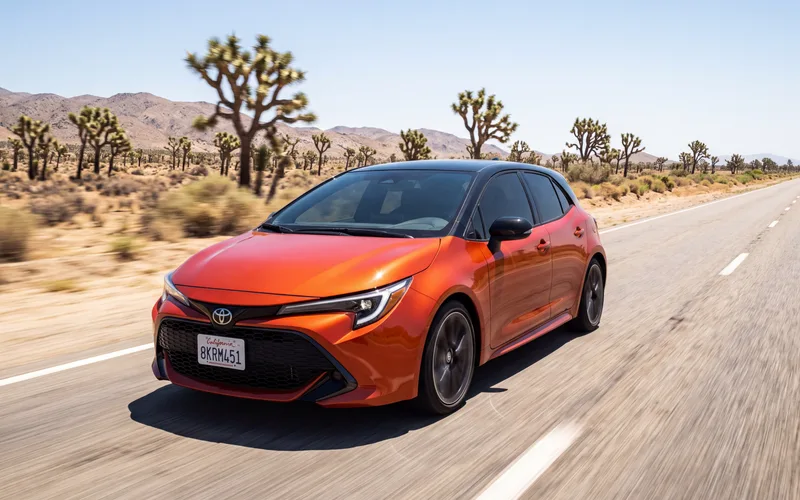 Toyota Corolla HatchbackCompact HatchbackBetter at: Value
Costs less, discounts more freely, and gives you wireless CarPlay on mid trims — worth a look if budget and tech convenience outrank cargo space.
Compare 2.57C+
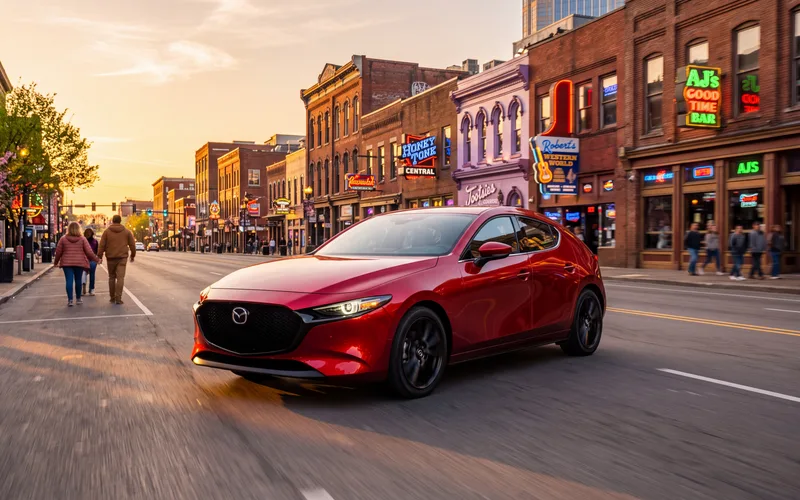 Mazda Mazda3 HatchbackCompact HatchbackBetter at: Interior quality
Offers AWD and a genuinely premium-feeling interior with a head-up display, for buyers who'd trade cargo volume for polish and all-weather traction.
Compare 2.14C
2.14C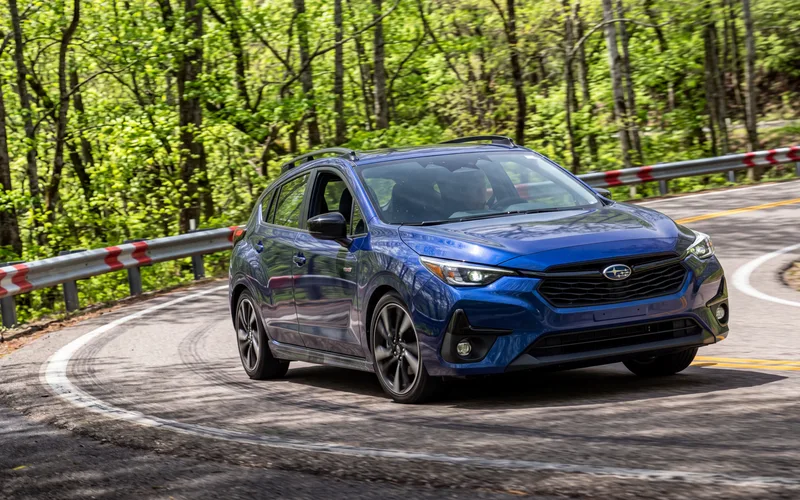 Subaru ImprezaCompact HatchbackBetter at: All-weather traction
Standard all-wheel drive at a lower price makes it the default choice for snow-belt buyers the FWD-only Civic can't serve.
CompareHow it's evolved
10 scored model years · 2017–2026
Subject scores by year
Hover or tap a score to see what moved it versus the year before. A corner mark flags a big swing.
| Year | Performance | Efficiency | Safety | Space | Cost | Reliability | Tech | Use-case | Driving | Value |
|---|---|---|---|---|---|---|---|---|---|---|
| 2026 | 30 | 59 | 76 | 69 | 68 | 80 | 51 | 65 | 72 | 75 |
| 2025 | 25 | 59 | 78 | 65 | 68 | 80 | 48 | 60 | 66 | 72 |
| 2024 | 27 | 54 | 73 | 68 | 69 | 77 | 45 | 55 | 70 | 73 |
| 2023 | 25 | 53 | 77 | 69 | 77 | 79 | 43 | 56 | 68 | 79 |
| 2022 | 25 | 54 | 81 | 69 | 78 | 78 | 43 | 56 | 68 | 80 |
| 2021 | 34 | 46 | 68 | 66 | 72 | 77 | 40 | 53 | 69 | 67 |
| 2020 | 35 | 45 | 69 | 66 | 75 | 74 | 39 | 53 | 70 | 77 |
| 2019 | 34 | 46 | 67 | 65 | 76 | 71 | 30 | 51 | 69 | 75 |
| 2018 | 32 | 60 | 58 | 74 | 76 | 65 | 34 | 58 | 77 | 75 |
| 2017 | 31 | 60 | 63 | 69 | 78 | 64 | 36 | 52 | 69 | 80 |
Compare two years
Best fit & conditions
Higher scores mean a better fit for that use case. Learn more about use-case fit →
Subject profile
Detailed scoring by subject
1Performance & PowertrainThe Civic Hatchback's lowest-graded category.0.00F
For 2025 the Civic Hatchback's only non-hybrid trim is the Sport, whose 2.0L naturally aspirated i-VTEC four makes 150 hp at 6,400 rpm — down 8 hp from the 2024 car's 158 hp as part of the mid-cycle refresh. That is near the bottom of the compact-hatch power band.
The 2.0L makes 133 lb-ft at 4,000 rpm, also down slightly for 2025 (from 138 lb-ft). Peak torque arrives high in the rev range, so real-world thrust is modest.
Instrumented tests of the mechanically identical 158-hp 2022–2024 Civic with the 2.0L and CVT returned 8.8–8.9 s; the 2025 car is 8 hp down and the hatchback body carries a little more weight (2,976 lb curb), so roughly 9.0 s is the realistic figure.
The naturally aspirated 2.0L has no turbo lag and responds cleanly off idle, but it is short on mid-range and gets coarse and loud when worked hard — reviewers consistently describe it as adequate and unremarkable rather than smooth-and-strong.
Honda's CVT is among the better-behaved units in the class, holding revs sensibly in normal driving and simulating step ratios in Sport mode, but it still drones at wide-open throttle — the characteristic CVT complaint in an underpowered application.
No Civic of any body style or trim offers all-wheel drive; the 2025 Hatchback is front-wheel drive only, with no AWD option anywhere in the lineup.
The 2025 refresh added a 200-hp two-motor hybrid to the hatchback for the first time while dropping the 1.5L turbo, so the body style offers two distinct powertrains — 2.0L gas and full hybrid — plus the 315-hp Type R above it. No PHEV or EV option.
2Efficiency & RangeOne of the Civic Hatchback's weakest categories.1.99C-
EPA rates the 2025 Civic 5Dr with the 2.0L and CVT at 34 MPG combined — strong for a gas-only compact hatchback, though the new hybrid trims are far ahead at 48 MPG.
30 MPG in the EPA city cycle is competitive for a non-hybrid compact, helped by the small naturally aspirated engine and the CVT keeping revs low.
38 MPG highway is solid for the class; the hatchback trails the sedan slightly on the highway cycle because of its taller, blunter tail.
EPA's total-range figure for the gas hatchback is 422 miles — respectable but held back by the small 12.4-gallon tank, and well short of the hybrid trims' 509 miles.
EPA estimates $1,850 a year to fuel the gas Sport at standard assumptions — cheap in absolute terms, but $550 a year more than the hybrid hatchback's $1,300.
The 2.0L runs on regular 87-octane unleaded with no premium recommendation, so there is no fuel-grade penalty; only the Type R and Si carry a premium requirement within the Civic family.
3SafetyOne of the Civic Hatchback's strongest categories.3.30B+
NHTSA NCAP rates the 2025 Civic Hatchback 5 stars overall, with 5 stars in frontal (driver and passenger), side and rollover; ratings are identical for sedan and hatchback bodies.
The refreshed 2025 Civic 4-door hatchback is a 2025 IIHS TOP SAFETY PICK+ with Good in the small overlap front, the updated moderate overlap front and the updated side test, plus Good headlights; a Marginal seat belt reminder rating is the only crashworthiness-adjacent blemish.
The hatchback line opens at Sport, so the volume gas trim carries the full set: Honda Sensing (CMBS/AEB with pedestrian detection, forward collision warning, adaptive cruise with low-speed follow, lane keeping assist with traffic jam assist, road departure mitigation, lane departure warning, traffic sign recognition, auto high-beam) plus Blind Spot Information with cross-traffic monitor — all five of the AEB/ACC/LKA/BSM/RCTA benchmark features standard. Only parking sensors and a surround camera are held back for the top Sport Touring Hybrid.
IIHS rates the 2025 Civic Acceptable — not Good — in both the updated vehicle-to-vehicle front crash prevention test and the pedestrian test. Nighttime pedestrian runs were mixed: collision avoided at 12 mph on high beams but only a 10 mph speed reduction on low beams, and 21-22 mph reductions in the 25 mph crossing test.
Blind Spot Information with rear cross-traffic monitor is standard on every 2025 Civic Hatchback trim, with an adaptive alert zone that extends up to about 82 ft rearward — but coverage is alert-only: no active steering or braking intervention and no safe-exit warning.
Lane Keeping Assist with Traffic Jam Assist, lane departure warning and road departure mitigation are standard, and the 2025 refresh retuned the system for more natural corrections; centering is competent on marked highway but still wanders and hands back more readily than the best-in-class systems.
Adaptive Cruise Control with Low-Speed Follow is standard and works to a full stop and resume, and combined with LKAS it forms Traffic Jam Assist; the 2025 update smoothed acceleration and braking, though there is no branded hands-on highway-assist tier above it.
No hands-free highway driving is offered on any 2025 Civic Hatchback trim; Honda Sensing Elite (Traffic Jam Pilot) is a Japan-market Legend feature and has never been offered on the US Civic.
IIHS rates the 2025 Civic hatchback's headlights Good — the rating applies across trims, which is what let the refreshed car take TOP SAFETY PICK+ — and auto high-beam is part of standard Honda Sensing.
The 11th-generation Civic's low cowl, low beltline and slim A-pillars give unusually good forward and three-quarter sightlines for a modern compact, but the hatchback's thicker C-pillars and shallow rear glass pinch the over-the-shoulder and rearward view, and no trim offers a surround-view camera to compensate.
Two outboard seating positions have complete LATCH hardware plus a third tether anchor with borrowable lower anchors, and rear doors open wide for the class, but the anchors sit in the seat bight and compact-car rear width makes three-across a struggle and rear-facing seats eat front legroom.
4Space & ComfortMid-pack among this car's ten categories.2.42C+
Five-passenger seating is standard across the entire 2025 Civic Hatchback line, at the top of the hatchback normalization band.
The gas Sport is the only 2025 hatchback trim without the power moonroof, so it keeps the full 39.3 in of front headroom — near the top of the hatchback band and a genuine advantage of the base trim.
42.3 in of front legroom is mid-pack for the compact hatchback band; the low seating position adds a feeling of space that the number alone does not capture.
37.1 in sits mid-band for a hatchback; the liftback roofline preserves more rear headroom than the sedan's fastback tail, and Consumer Reports calls the back seat reasonably roomy for the class.
37.4 in of second-row legroom is competitive for a compact hatchback and reviewers confirm adults fit in back without negotiation, though it is well short of the class leaders.
24.5 cu ft with the seats up is well above the hatchback band and roughly 10 cu ft more than the Civic sedan's trunk — the single biggest practical reason to choose this body. The wheel wells intrude little, so the usable shape matches the number.
Everyday storage is well judged but conventional — a large bin under the sliding center armrest, a phone tray beneath the front USB-C ports, adjustable-tab cupholders, big door pockets, a reversible side-pull cargo cover and a cargo area light. There is no bespoke innovation, and the gas Sport specifically goes without the passenger seatback pocket and rear-seat beverage holders the hybrid trims get.
Seats are the Civic's recurring weak point and the gas Sport gets the least help: cloth, firm, mounted low, with manual adjustment only — no power seat and no lumbar adjustment, which arrive two trims up on the Sport Touring Hybrid. Reviewers rate them fine around town and tiring on long stints, particularly the cushion bottoms.
The 2025 refresh retuned the suspension and Consumer Reports says the ride is now 'much more compliant' than the stiff, choppy 2022 car — but every 2025 hatchback trim rides on 18-inch wheels with 235/40 tires, and CR still calls the ride 'a bit too firm.' Body control is excellent; secondary ride over broken pavement is the compromise.
This is the gas Sport's worst comfort attribute. Honda reserves the acoustic laminate windshield, Active Sound Control and wheel resonators for the hybrid trims, so the Sport has the least NVH hardware in the range, and Consumer Reports reports highway road noise loud enough that occupants must raise their voices — tiring over distance. The 235/40R18 tires and open hatch cargo bay both work against it.
The gas Sport is close to bare on comfort equipment: single-zone automatic climate control, no heated front seats, no moonroof, no rear-seat center armrest, no auto-dimming mirror and no leather-wrapped wheel. Heated seats and dual-zone climate begin at the Sport Hybrid, and no 2025 Civic Hatchback of any trim offers a heated steering wheel, ventilated seats or rear climate vents — only rear-seat heater ducts.
5Cost of OwnershipMid-pack among this car's ten categories.2.60C+
The hatchback body opens at the gas Sport — there is no LX equivalent as on the sedan — so entry pricing runs roughly $3,100 above the cheapest Civic. Still comfortably below the hatchback band midpoint.
This scorecard describes the gas configuration, and for 2025 the Sport is the sole non-hybrid hatchback trim — base and volume price are therefore the same car, with no meaningful factory options beyond premium paint (the 6-speed manual was deleted for 2025).
Honda's cheap parts, 100k-mile no-tune-up interval and Maintenance Minder scheduling keep the naturally aspirated 2.0L cheap to run, but the 2025 car carries only 1 yr / 12,000 mi of complimentary service, so more of years one and two lands on the owner than with ToyotaCare-covered rivals. Slightly above the hybrid trims, which shed brake wear through regeneration.
Best-in-class residuals for a compact hatchback — the Civic is the segment's depreciation benchmark, and the refreshed 2025 styling plus scarce hatchback supply keep it near the top. The published estimates spread widely because MSRP-based (KBB, Edmunds) and used-listing-based (iSeeCars) methods differ; 61% is the consensus midpoint.
Standard Honda New Vehicle Limited Warranty, unchanged for 2025 — at the segment floor and two years behind Hyundai/Kia's 5/60k.
Standard Honda 5/60k powertrain coverage — level with Toyota and Mazda but half the term Hyundai/Kia offer. The gas Sport draws no battery coverage since it has no high-voltage system.
Honda Service Pass covers factory-scheduled maintenance for only 1 yr / 12,000 mi on 2025 models — cut in half from the 2 yr / 24,000 mi that 2024 Hondas carried, and roughly one oil change plus a tire rotation in practice. Roadside assistance runs the full 3 yr / 36,000 mi with the warranty, but there are no charging credits and the gas Sport gets no Google built-in data trial (that is Sport Touring Hybrid only), leaving it behind ToyotaCare's 2 yr / 25,000 mi and Hyundai's 3 yr / 36,000 mi.
$28,545 volume-trim price minus its estimated resale value after 5 years (61% retained, or about $17,412) leaves about $11,133 in depreciation. Add the projected $4,300 in 5-year maintenance and repairs, and owning this vehicle for 5 years costs about $15,433 in total.
6Reliability & QualityThe Civic Hatchback's best-graded category.3.46B+
Consumer Reports rates the 2025 Civic 78/100 for predicted reliability — 'well above average' and the fourth most reliable compact car of the 2025 model year, with 15 of 17 trouble spots clean and only electrical accessories and in-car electronics at average. The 2025 refresh touched styling, tech and the hybrid drivetrain rather than the gas Sport's carried-over 2.0L/CVT hardware, so the survey history transfers cleanly to this configuration.
Honda posted 139 PP100 in the J.D. Power 2025 U.S. Vehicle Dependability Study against a 202 PP100 industry average — a top-10 brand finish and far better than the mainstream norm — and the brand sits in Consumer Reports' upper tier alongside Toyota, Subaru and Mazda. Not quite Toyota/Lexus territory, which caps this short of the 90s.
The NHTSA database returns two campaigns against the 2025 Civic, and both are more than housekeeping: 24V744000 names the Civic Hatchback directly for a mis-manufactured steering gearbox that can cause excessive internal friction and difficulty steering, and 24V763000 covers a high-pressure fuel pump that may crack and leak (fire risk). Both are supplier/component campaigns with straightforward dealer remedies rather than systemic engine or transmission defects, but a steering and a fuel-leak recall inside one model year is heavier than a clean sheet.
For 2025 the gas Hatchback is Sport-only on the naturally aspirated 2.0L i-VTEC four with the CVT — Honda dropped the 180-hp 1.5L turbo (and the six-speed manual) from the hatchback when the hybrid arrived. That removes the one part of the Civic's powertrain history with a service-campaign record (1.5T oil dilution) and leaves the least-stressed, longest-running combination in the lineup: an unturbocharged Honda four and a mature Honda CVT with a long high-mileage track record and no NHTSA transmission complaint pattern on this generation.
The refreshed 2025 cabin is consistently called one of the best in the compact class — soft-touch material on the primary touchpoints, the metal honeycomb mesh strip concealing the vents, a scratch- and fingerprint-resistant console panel and a leather-wrapped wheel on Sport. Reviewers describe it as feeling a class above its price; the ceiling here is that Sport is a mid-trim with hard plastics still present in the lower door and console areas.
US-market Civic Hatchback assembly runs at Honda Manufacturing of Indiana in Greensburg, and reviewers report solid fit and finish with tight panel gaps and no widespread rattle or squeak reports on the 11th generation. Held below the 80s by the electronics side of initial quality: Consumer Reports' only non-perfect trouble spots for the 2025 Civic are electrical accessories and in-car electronics, and owners report infotainment lock-ups and false CMBS/road-departure alerts.
Honda runs one of the densest mainstream dealer networks in the US (roughly a thousand franchised outlets, with real rural as well as metro coverage), and service satisfaction is a genuine strength rather than merely adequate — Honda ranked second among mass-market brands in the J.D. Power 2025 U.S. Customer Service Index. Short of the top band only because the study's leaders and the luxury networks still edge it on wait times and communication.
The Civic is one of the cheapest cars in America to keep running and the Hatchback shares essentially all mechanical hardware with the far higher-volume sedan, so OEM parts are everywhere, independent shops know the car, and the aftermarket is among the largest of any US nameplate. RepairPal puts average annual repair and maintenance at $368 against $526 for compact cars and $652 fleet-wide.
7Technology & InfotainmentOne of the Civic Hatchback's weakest categories.1.22D
The gas Sport carries the 7-inch color touchscreen, which sits exactly at the bottom of the hatchback normalization band; the 9-inch unit is reserved for the top Sport Touring Hybrid, roughly $5,500 further up the range.
Honda's hardware-first layout is the strength — a real volume knob, physical climate dials with genuine detent feel, and menus Consumer Reports calls easy to use. The 7-inch panel's size and dated graphics are the ceiling, and it looks thin next to a Mazda3 or Corolla Hatchback on the same money.
Apple CarPlay and Android Auto are standard on the Sport but wired only — a cable every trip. Wireless projection is exclusive to the Sport Touring Hybrid, two trims and about $5,500 above the volume gas car, where several rivals offer it on mid trims.
The gas Sport has no built-in navigation at all and no connected assistant — voice is limited to basic Bluetooth HandsFreeLink commands, so owners rely entirely on a tethered phone for maps and dictation. Google built-in (Assistant, Maps, three years of data) and Alexa Built-In exist on this body but only on the Sport Touring Hybrid.
Because the hatchback line has no LX entry trim, the Sport starts on the 180-watt eight-speaker system rather than the sedan's four-speaker base — a solid, unremarkable setup. The well-regarded 12-speaker Bose with subwoofer is available in this body but only at the top of the range.
The Sport runs a 7-inch TFT meter — a partial-digital cluster paired with an analog-style tachometer, legible and configurable enough for daily use but not a full digital display. The 10.2-inch all-digital cluster is a Sport Touring Hybrid exclusive.
Honda offers no whole-vehicle over-the-air software updates on the 2025 Civic, and the one genuinely connected head unit — Google built-in, which does pull map and app updates over the air — is not fitted to the gas Sport. This trim is effectively a fixed-software car for its whole life.
HondaLink covers the core remote set — engine start, lock/unlock, vehicle locator, geofence and speed alerts — and the Sport does carry the Remote Engine Start hardware as standard, but the app's remote package is subscription-gated after the trial and there is no digital key or phone-as-key on any Civic.
Two front USB-C 3.0A ports are the whole story on the Sport: there is no rear-seat USB anywhere in the 2025 hatchback lineup, no household AC outlet, and the Qi wireless charger is a Sport Touring Hybrid item. Adequate for front occupants, thin for anyone in back.
Strongest tech item on the trim: because the hatchback has no LX, the entry Sport gets Smart Entry with Walk Away Auto Lock, push-button start, remote engine start and remote hatch release all standard. Only phone-as-key is missing, and Honda offers none on Civic.
A multi-angle rearview camera with dynamic guidelines is standard and gives three selectable views, but the Sport has no parking sensors at all — the eight-sensor front/rear array is a Sport Touring Hybrid exclusive — and no 2025 Civic Hatchback offers a surround-view camera or automated parking.
No head-up display is offered on any 2025 Civic Hatchback trim, factory or accessory — a straightforward gap against the Mazda3 Hatchback, which fits one on upper trims.
8Use-Case FitMid-pack among this car's ten categories.2.07C
The hatch body is what carries this: a wide, low-lift opening onto 24.5 cu ft swallows a stroller and a week's kid gear without folding anything, and the 60/40 split seatback is standard from the entry trim. LATCH hardware is complete on both outboard positions with three top tethers, though the lower anchors sit deep in the seat bight, and the gas Sport is the one trim without a rear center armrest.
Everything a family would want is on the cheapest trim: the 2025 hatchback is an IIHS TOP SAFETY PICK+ with NHTSA five stars overall, and Honda Sensing — AEB, adaptive cruise with low-speed follow, lane keeping, traffic jam assist, traffic sign recognition — plus blind-spot monitoring and rear cross-traffic alert are standard on the Sport. Held back only by IIHS rating the front crash prevention systems Acceptable rather than Good, and by a $28.5k entry price with no LX below it.
Luggage is solved — four people's bags fit behind the seats — but rear amenities on the gas Sport are thin: heater ducts instead of rear vents, no rear USB, no rear armrest, and single-zone climate. Consumer Reports' finding that highway road noise forces raised voices is the real limit on a full day in the car with kids.
The commuting case is where this trim is strongest: light quick steering, thin A-pillars and a low cowl for excellent sightlines, a CVT that never hunts in traffic, and adaptive cruise with low-speed follow plus Traffic Jam Assist standard for stop-and-go. The firm 18-inch-wheel ride and road noise are what keep it from the top band.
34 MPG combined on regular unleaded, about $1,850 a year in fuel at EPA assumptions, no scheduled tune-ups to 100k miles and the class's cheapest parts supply make this a genuinely low-cost commute. It is beaten within its own showroom, though — the Sport Hybrid's 48 MPG combined saves roughly $550 a year for $2,500 more up front.
At 179.0 in long the hatchback is nearly six inches shorter than the Civic sedan and the upright rear glass helps over-the-shoulder vision, but the Sport's 18-inch wheels give it a 38.1 ft curb-to-curb turning circle — a full two feet wider than the Sport Hybrid's 36.1 ft — and it has no parking sensors, only the rear camera.
No factory tow rating, no bed, no payload provision — the Civic Hatchback is not a work vehicle in any conventional sense. The 24.5–46.2 cu ft load bay is genuinely useful to a courier, mobile technician or trades apprentice hauling small tools and parts, which is the only reason this is not a bottom-band score.
The naturally aspirated 2.0L i-VTEC and CVT are proven high-mileage hardware and the Civic's reliability record suits hard rideshare or courier duty, but nothing about the car is built for abuse: cloth seats, carpeted floors, low ground clearance and no work-oriented interior or upfit package. Its fleet reputation is livery and service, not construction.
No 120V outlet, no washable surfaces, no factory hitch and no bed access features. What exists is modest: a flat-folding 60/40 rear seat with a low, wide hatch aperture, a reversible side-pull cargo cover with a wipeable face, a cargo area light, and a genuine Honda roof rack accessory plus a deep aftermarket rack ecosystem for this body.
Adaptive cruise with low-speed follow and lane keeping are standard and take real fatigue out of a highway day, but the two things that matter most over eight hours both go against this trim: seats reviewers call uncomfortable on long drives, and road noise Consumer Reports says forces raised voices. Range is only fair at about 420 miles from the 12.4-gallon tank — some 90 miles short of the hybrid.
Front-wheel drive only across the entire Civic line, a low body on 235/40R18 tires and no factory roof rails keep it firmly on pavement — a graded forest road is about the limit. It earns real credit as a gear hauler, though: a Honda Genuine roof rack is catalogued for this body and the wide, low hatch swallows camping and paddling kit the sedan cannot.
The headline strength of the body style: 24.5 cu ft behind the seats expanding to 46.2 cu ft with the 60/40 seatback down, through a wide, low-sill hatch, with shallow wheel-well intrusion so the usable shape matches the figure. Capped below the adventure-hatch benchmarks only by the lack of a factory hitch or roof rails.
9Driving ExperienceMid-pack among this car's ten categories.2.48C+
The chassis is the best thing about the car. MacPherson struts, a multi-link rear end, a light 2,976 lb curb weight and 235/40R18 all-season rubber give it composure and turn-in accuracy that Consumer Reports ranks among the sportiest in the compact class, with very little body roll.
Variable-ratio electric assist geared at 11.41:1 with 2.21 turns lock-to-lock gives quick, well-weighted responses and more genuine feedback than most mainstream compacts. Reviewers rate it at or near the top of the class, short only of a Mazda3's rack.
Ventilated 11.1-inch front and solid 10.2-inch rear discs on a sub-3,000 lb car, with a firm and easily modulated pedal; Consumer Reports counts braking among the 2025 Civic's strengths. Edmunds measured 131 ft from 60 mph in the Sport Touring Hybrid hatchback, and the gas Sport is 276 lb lighter on identical tires, so its stops should be shorter — but no instrumented figure for this trim has been published.
Calibration is clean — the naturally aspirated 2.0L has no turbo lag, tips in predictably, and Honda's CVT with G-Design Shift holds sensible ratios instead of hunting, with idle-stop that restarts without shudder. The limitation is thrust rather than polish: 150 hp and a 9.7-second 0-60 mean the driveline is often working near its limit.
Unobtrusive at a cruise, coarse when asked for anything. With only 150 hp the CVT sends the four to a sustained drone on every hill and merge, and the Sport is the trim Honda leaves out of the NVH package — no Active Sound Control, no wheel resonators and no acoustic laminate windshield, all of which the hybrids get.
38.1 ft curb-to-curb is wide for a compact hatchback and a real cost of the Sport's standard 18-inch wheels — the Sport Hybrid on the same wheelbase turns two full feet tighter at 36.1 ft.
The layout is a class benchmark — low cowl, thin A-pillars, real climate knobs and a physical volume control, tilt-and-telescoping column, and an unusually low, sporting seat height. What holds the Sport back is adjustment range: manual seats only with no lumbar adjuster, and Consumer Reports notes the low cabin takes some ducking to enter.
The chassis and steering deliver the goods and the Civic took Car and Driver 10Best again for 2025, but this specific trim lost the two things that made the gas hatchback an enthusiast pick: Honda dropped both the 180-hp 1.5L turbo and the six-speed manual from the hatchback for 2025, leaving a 150-hp engine and a CVT under a genuinely good set of underpinnings.
10Value & Market PositionOne of the Civic Hatchback's strongest categories.2.90B-
Safety content is genuinely generous — the full Honda Sensing suite plus Blind Spot Information and Rear Cross Traffic Monitor are standard on every 2025 hatchback trim, alongside 18-inch alloys, remote start and an 8-speaker/180-watt system. Comfort and infotainment content is thin for the money, though: the $28,545 gas Sport gets a 7-inch touchscreen with wired-only CarPlay/Android Auto, single-zone automatic climate, cloth seats and no moonroof, with heated seats and dual-zone climate reserved for the hybrids.
The gas Sport is the soft spot of the Civic range on price-per-content: $28,545 buys 150 hp and 34 MPG combined, roughly $3,700 more than a Corolla Hatchback SE that matches it on economy and beats it on screen size. The Civic answers with a markedly better cabin, more passenger and cargo room, sharper chassis and class-leading residuals, so it is fairly priced rather than a bargain — and the 2025 refresh trimmed output from 158 hp to 150 hp while pricing rose.
Three trims only — Sport, Sport Hybrid, Sport Touring Hybrid — all front-wheel drive, with no LX-style budget entry and no Si variant in this body (the Type R is a separate model line). Choice narrowed for 2025 rather than widening: the 6-speed manual that had been the hatchback's signature option was deleted, leaving the gas car CVT-only.
The Civic nameplate is a top-two US compact, selling roughly 239,000 units in calendar 2025 on a mid-single-digit year-over-year gain, and the refresh pushed hybrid mix past a third of volume. The hatchback body is the minority share of that total — around a fifth to a quarter — but within the shrinking US compact-hatch pool it leads alongside the Corolla Hatchback.
Honda's mainstream equity rests on exactly what this category measures — reliability reputation and residual strength — and the hatchback body carries extra enthusiast credibility through its direct visual lineage to the Type R. Not aspirational in the luxury sense, but among the most trusted badges a compact-car buyer can choose.
Demand and constrained hatchback supply mean 2025 Civics transact at or very near MSRP, with factory support limited to modest captive-lease cash, standard-rate Honda Financial APRs and a $500 college-graduate bonus. Buyers face little desperation pricing but also almost no discount headroom — meaningfully tighter than the Corolla Hatchback or Mazda3.
2025 is the refresh year itself, not a carry-over: the 11th generation launched for 2022 and this model year brought revised front and rear styling, the two-motor e:HEV hybrid to the hatchback for the first time, an updated Honda Sensing calibration and blind-spot monitoring made standard across the line. About as fresh as a mid-cycle car gets, with no redesign risk for a buyer.
The 2025 Civic swept the awards that matter in this class — Car and Driver 10Best for a third straight year and the nameplate's record 12th win, IIHS Top Safety Pick+ for the hatchback specifically, NHTSA five-star overall, and KBB's Best Resale Value award. Reviewers treat it as the compact benchmark; the main reservation is that the 150-hp gas Sport is the least-liked variant of an otherwise class-leading car.