

The verdict
A struggling compact sedan, strong on driving and held back by technology.
The 2018 Mazda3 is the last and best-sorted year of a generation that put driving feel first: sharp steering, an independent multi-link rear suspension the 2019 redesign gave up, a smooth six-speed automatic instead of a CVT, and a cabin reviewers called the nicest in the compact class. It backs that up with five NHTSA stars, an IIHS Top Safety Pick, and low running costs — about $338/yr in maintenance and $2,050/yr in fuel. The catch is technology: a 7-inch screen with no Apple CarPlay or Android Auto from the factory, no adaptive cruise or lane-keep unless you buy the top trim's $1,600 package, and Marginal-rated headlights on the trims most people bought. Back-seat and trunk space (35.8 in of rear legroom, 12.4 cu ft) are among the tightest in the class, so this is a driver's car first and a family car a distant second.
Jump to scoresStrengths
- Drives like something far more expensive
- A real automatic — and a real manual
- Cheap to own and holding its value
What holds it back
- No Apple CarPlay or Android Auto at any price
- Driver aids stop at low-speed braking on the trims people bought
- Marginal headlights on two of three trims
Top alternatives
Cars shoppers cross-shop with the Mazda Mazda3 2.44C+
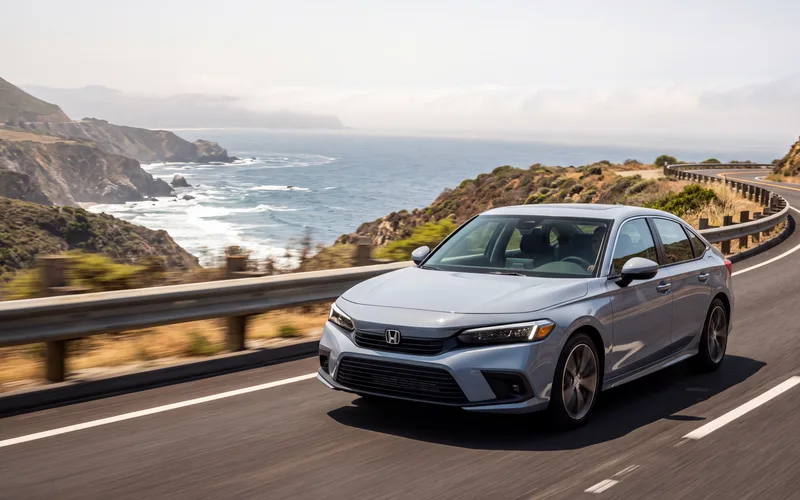 Honda CivicCompact SedanBetter at: Practicality
It delivers most of what makes the Mazda3 appealing while adding a usable back seat, a bigger trunk, a high-40s-MPG hybrid and the segment's best resale value.
Compare 2.40C+
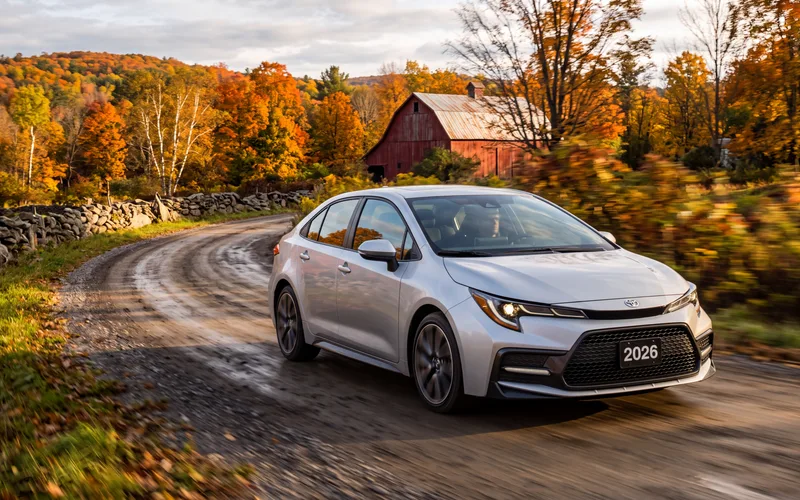 Toyota CorollaCompact SedanBetter at: Ownership cost
Lower running costs across the board — a hybrid near 50 MPG, top-of-class predicted reliability and more than twice as many dealers for service.
Compare 2.13C
2.13C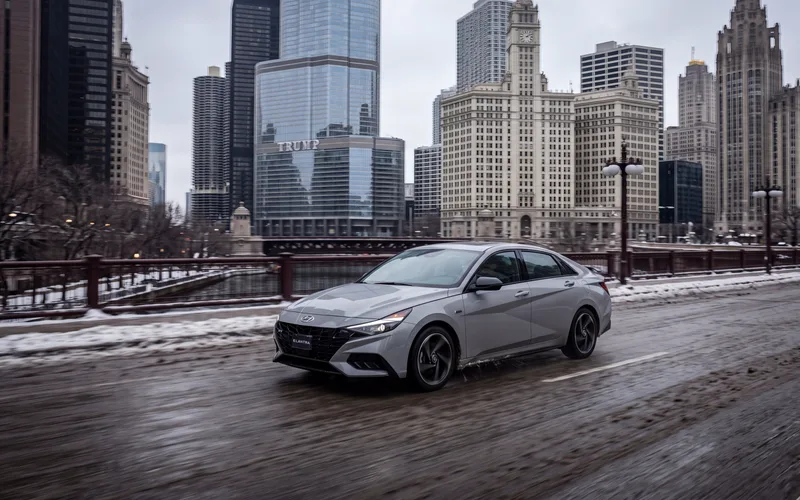 Hyundai ElantraCompact SedanBetter at: Space and warranty
Nearly three more inches of rear legroom, more standard tech, and a 10-year/100,000-mile powertrain warranty for similar money.
CompareHow it's evolved
10 scored model years · 2017–2026
Subject scores by year
Hover or tap a score to see what moved it versus the year before. A corner mark flags a big swing.
| Year | Performance | Efficiency | Safety | Space | Cost | Reliability | Tech | Use-case | Driving | Value |
|---|---|---|---|---|---|---|---|---|---|---|
| 2026 | 44 | 55 | 75 | 59 | 71 | 80 | 63 | 47 | 76 | 72 |
| 2025 | 43 | 51 | 77 | 58 | 69 | 80 | 51 | 46 | 77 | 70 |
| 2024 | 41 | 51 | 77 | 58 | 69 | 78 | 52 | 49 | 77 | 71 |
| 2023 | 43 | 52 | 73 | 59 | 70 | 80 | 52 | 46 | 76 | 71 |
| 2022 | 43 | 48 | 75 | 59 | 71 | 80 | 51 | 46 | 78 | 69 |
| 2021 | 44 | 48 | 75 | 59 | 73 | 73 | 51 | 47 | 78 | 73 |
| 2020 | 39 | 48 | 74 | 58 | 71 | 73 | 47 | 46 | 77 | 72 |
| 2019 | 39 | 48 | 70 | 59 | 70 | 66 | 49 | 49 | 77 | 67 |
| 2018 | 36 | 48 | 59 | 59 | 76 | 75 | 34 | 45 | 77 | 65 |
| 2017 | 29 | 55 | 61 | 59 | 77 | 82 | 37 | 46 | 79 | 71 |
Compare two years
Best fit & conditions
Higher scores mean a better fit for that use case. Learn more about use-case fit →
Subject profile
Trims & configurations
5 trimsScores above reflect the volume trim. Per-trim specs and scores are rolling out — the full lineup:
Academic Probation · NHTSA safety recalls
Jul 14, 2023Back over prevention: sensing system: cameraThe rearview camera image may not display properly by showing a flickering or distorted image.
Defect
Mazda North American Operations (Mazda) is recalling certain 2014-2018 Mazda3 and 2016-2021 CX-3 vehicles. The rearview camera image may not display properly by showing a flickering or distorted image.
Risk
A rearview camera that does not display properly can reduce the driver's rear view, increasing the risk of a crash or injury.
Remedy
Dealers will inspect and replace the rearview camera, as necessary. In addition, dealers will install a wiring harness fastening seal. All repairs will be performed free of charge. Interim notification letters, notifying owners of the safety risk, were mailed September 13, 2023. Final owner letters for affected models and model years in the states of CT, MA, MD, NJ, NY, PA and VA were mailed August 14, 2024. The remaining owner notification letters will be mailed at a future date, anticipated on or before May 1, 2025. Owners may contact Mazda customer service at 1-800-222-5500, Option 6. Mazda's number for this recall is 6023G.
NHTSA campaign 23V487000 ↗Manufacturer no. 6023G236,100 vehicles potentially affected (all models in the campaign)Owners notified Aug 14, 2024Filed by Mazda North American OperationsFiled as MAZDA3Nov 12, 2021Fuel system, gasoline: delivery: fuel pumpThe impeller inside the low-pressure fuel pump may crack and deform, potentially causing the fuel pump to fail.
Defect
Mazda North American Operations (Mazda) is recalling certain 2018 Mazda3, Mazda6, 2019 CX-3, 2018-2019 MX-5, CX-5, CX-9, and 2019-2020 Mazda2 vehicles. The impeller inside the low-pressure fuel pump may crack and deform, potentially causing the fuel pump to fail.
Risk
Fuel pump failure may cause an engine stall, increasing the risk of a crash.
Remedy
Dealers will replace the fuel pumps, free of charge. Owner notification letters were mailed July 18, 2022. Owners may contact Mazda customer service at 1-800-222-5500 Option 4. Mazda's number for this recall is 5321K.
NHTSA campaign 21V875000 ↗Manufacturer no. 5321K121,038 vehicles potentially affected (all models in the campaign)Owners notified Jul 18, 2022Filed by Mazda North American OperationsFiled as MAZDA3Apr 4, 2019Visibility: windshield wiper/washerA defective windshield wiper relay may cause the windshield wipers to become inoperative, reducing the driver's visibility.
Defect
Mazda North American Operations (Mazda) is recalling certain 2016-2018 Mazda3 vehicles. A defective windshield wiper relay may cause the windshield wipers to become inoperative, reducing the driver's visibility.
Risk
Reduced visibility while driving can increase the risk of crash.
Remedy
Mazda will notify owners, and dealers will replace the front body control module with a new module which uses an improved wiper relay design, free of charge. The recall began May 7, 2019. Owners may contact Mazda customer service at 1-800-222-5500, option 4. Mazda's number for this recall is 3219D.
NHTSA campaign 19V272000 ↗Manufacturer no. 3219D187,880 vehicles potentially affected (all models in the campaign)Owners notified May 7, 2019Filed by Mazda North American OperationsFiled as MAZDA3Nov 21, 2017Engine and engine cooling: exhaust systemThe incorrect exhaust valve spring may fail while driving, potentially causing an engine stall.
Defect
Mazda North American Operations (Mazda) is recalling certain 2018 Mazda3 vehicles, equipped with an incorrect exhaust valve spring. The incorrect exhaust valve spring may fail while driving, potentially causing an engine stall.
Risk
An engine stall can increase the risk of a crash.
Remedy
Mazda will notify owners, and dealers will inspect the engines and replace any incorrect exhaust valve springs, free of charge. The recall is expected to begin January 20, 2018. Owners may contact Mazda customer service at 1-800-222-5500. Mazda's number for this recall is 1717K.
NHTSA campaign 17V745000 ↗Manufacturer no. 1717K144 vehicles potentially affected (all models in the campaign)Owners notified Jan 22, 2018Filed by Mazda North American OperationsFiled as MAZDA3
11 recalls on other model years of the Mazda3 (2019–2021, 2024–2025)
May 29, 2025Air bags: air bag/restraint control module: softwareThe Sophisticated Air Bag Sensor (SAS) units may set an error code and deactivate the air bags, due to a low battery condition.
Defect
Mazda North American Operations is recalling certain 2024-2025 Mazda3 and CX30 vehicles. The Sophisticated Air Bag Sensor (SAS) units may set an error code and deactivate the air bags, due to a low battery condition.
Risk
Air bags that do not deploy in the event of a crash increase the risk of injury.
Remedy
Dealers will reprogram the SAS unit with improved software or replace the unit, free of charge. Owner notification letters were mailed July 24, 2025. Mazda's number for this recall is 7525E.
NHTSA campaign 25V357000 ↗Manufacturer no. 7525E171,412 vehicles potentially affected (all models in the campaign)Owners notified Jul 22, 2025Filed by Mazda North American OperationsFiled as MAZDA3Sep 3, 2024Exterior lighting: headlights · Forward collision avoidance: automatic emergency braking · Lane departure: sensing system: cameraA malfunction in the forward sensing camera (FSC) may prevent the automatic emergency braking system and the lane-keep assist system from functioning. In addition, the headlights will not automatically adjust from high beams to low beams as intended.
Defect
Mazda North American Operations (Mazda) is recalling certain 2024 Mazda 3, CX-30, and 2025 CX-50 vehicles. A malfunction in the forward sensing camera (FSC) may prevent the automatic emergency braking system and the lane-keep assist system from functioning. In addition, the headlights will not automatically adjust from high beams to low beams as intended.
Risk
Automatic braking, steering assist, and headlight control systems that do not function as intended can increase the risk of a crash.
Remedy
Dealers will inspect and replace the forward sensing camera as necessary, free of charge. Owner notification letters were mailed September 24, 2024. Owners may contact Mazda customer service at 1-800-222-5500, Option 6. Mazda's number for this recall is 6824H.
NHTSA campaign 24V649000 ↗Manufacturer no. 6824H672 vehicles potentially affected (all models in the campaign)Owners notified Sep 24, 2024Filed by Mazda North American OperationsFiled as MAZDA3Oct 26, 2023Back over prevention: sensing system: camera · Forward collision avoidance: sensing system: camera · Lane departure: sensing system: cameraDue to a software error, the rearview, front, and/or side camera images may not appear on the display. As such, these vehicles fail to comply with the requirements of Federal Motor Vehicle Safety Standard number 111, "Rear Visibility."
Defect
Mazda North American Operations (Mazda) is recalling certain 2024 CX-90 and MAZDA3 vehicles. Due to a software error, the rearview, front, and/or side camera images may not appear on the display. As such, these vehicles fail to comply with the requirements of Federal Motor Vehicle Safety Standard number 111, "Rear Visibility."
Risk
A camera that does not display an image can reduce the driver's view, increasing the risk of a crash or injury.
Remedy
Dealers will update the view monitor control module software, free of charge. Owner notification letters were mailed December 20, 2023. Owners may contact Mazda customer service at 1-800-222-5500 Option 6. Mazda's number for this recall is 6223J.
NHTSA campaign 23V718000 ↗Manufacturer no. 6223J11,903 vehicles potentially affected (all models in the campaign)Owners notified Dec 20, 2023Filed by Mazda North American OperationsFiled as MAZDA3Feb 22, 2021Tires: valveAir may suddenly leak from the tire air valve.
Defect
Mazda North American Operations (Mazda) is recalling certain 2021 Mazda3 and CX-30 vehicles. Air may suddenly leak from the tire air valve.
Risk
A sudden air leak from the tire air valve may cause a loss of vehicle control while driving, increasing the risk of a crash.
Remedy
Mazda will notify owners, and dealers will replace all four tire air valves with new parts, free of charge. The recall began April 6, 2021. Owners may contact Mazda customer service at 1-800-222-5500 Option 4. Mazda's number for this recall is 4721B.
NHTSA campaign 21V101000 ↗Manufacturer no. 4721B599 vehicles potentially affected (all models in the campaign)Owners notified Apr 6, 2021Filed by Mazda North American OperationsFiled as MAZDA3Jun 12, 2020Service brakes, hydraulic: foundation components: disc: caliperThe front brake caliper mounting bolts may not have been tightened properly during assembly, possibly allowing the calipers to loosen.
Defect
Mazda North American Operations (Mazda) is recalling certain 2020 CX-30 and Mazda3 vehicles. The front brake caliper mounting bolts may not have been tightened properly during assembly, possibly allowing the calipers to loosen.
Risk
Loose brake calipers can reduce braking performance or interfere with wheel rotation, affecting vehicle handling. Either of these scenarios can increase the risk of a crash.
Remedy
Mazda will notify owners, and dealers will inspect the front brake caliper bolts, tightening them as necessary. If bolts are missing, the affected brake caliper will be replaced. Repairs will be performed free of charge. The recall began July 24, 2020. Owners may contact Mazda customer service at 1-800-222-5500, Option 4. Mazda's number for this recall is 4420F.
NHTSA campaign 20V346000 ↗Manufacturer no. 4420F24,037 vehicles potentially affected (all models in the campaign)Owners notified Jul 24, 2020Filed by Mazda North American OperationsFiled as MAZDA3Dec 19, 2019Forward collision avoidance: automatic emergency brakingThe Smart Brake System (SBS) can falsely detect an obstacle while driving, activating the automatic emergency braking system and suddenly stopping the vehicle.
Defect
Mazda North American Operations (Mazda) is recalling certain 2019-2020 Mazda3 vehicles. The Smart Brake System (SBS) can falsely detect an obstacle while driving, activating the automatic emergency braking system and suddenly stopping the vehicle.
Risk
Stopping the vehicle unexpectedly increases the risk of a crash.
Remedy
Mazda will notify owners, and dealers will update the SBS software. In addition, vehicles with certain production dates will receive an instrument cluster software update or replacement and a replacement owner's manual. These repairs will be performed free of charge. The recall began February 14, 2020. Owners may contact Mazda customer service at 1-800-222-5500, Option 4. Mazda's number for this recall is 4219L.
NHTSA campaign 19V907000 ↗Manufacturer no. 4219L35,390 vehicles potentially affected (all models in the campaign)Owners notified Feb 14, 2020Filed by Mazda North American OperationsFiled as MAZDA3Jul 29, 2019Visibility: glass, side/rearThe adhesive between the interior rearview mirror and the housing may not be properly bonded, allowing the mirror to detach from the housing. Note: Vehicles equipped with auto dimming mirrors are not affected by this recall.
Defect
Mazda North American Operations (Mazda) is recalling certain 2019 Mazda3 vehicles equipped with manual dimming mirrors. The adhesive between the interior rearview mirror and the housing may not be properly bonded, allowing the mirror to detach from the housing. Note: Vehicles equipped with auto dimming mirrors are not affected by this recall.
Risk
Rearward visibility will be reduced without the rearview mirror, increasing the risk of a crash.
Remedy
Mazda will notify owners, and dealers will replace the interior rearview mirror assembly, free of charge. The recall began September 19, 2019. Owners may contact Mazda customer service at 1-800-222-5500, option 4. Mazda's number for this recall is 3919G.
NHTSA campaign 19V558000 ↗Manufacturer no. 3919G22,571 vehicles potentially affected (all models in the campaign)Owners notified Sep 19, 2019Filed by Mazda North American OperationsFiled as MAZDA3Jul 5, 2019Seats: front assembly: head restraintThe seat cover material on both front seats may interfere with the head restraint lock release button, causing it to stick in the release position and not allow the head restraint to lock into place.
Defect
Mazda North American Operations (Mazda) is recalling certain 2019 Mazda3 vehicles. The seat cover material on both front seats may interfere with the head restraint lock release button, causing it to stick in the release position and not allow the head restraint to lock into place.
Risk
Loose head restraints may increase the risk of injury in the event of a crash.
Remedy
Mazda will notify owners, and dealers will install spacers at the bottom of the lock release buttons on both front seat head restraints, free of charge. The recall began August 20, 2019. Owners may contact Mazda customer service at 1-800-222-5500, option 4. Mazda's number for this recall is 3819F.
NHTSA campaign 19V514000 ↗Manufacturer no. 3819F9,430 vehicles potentially affected (all models in the campaign)Owners notified Aug 20, 2019Filed by Mazda North American OperationsFiled as MAZDA3Jun 27, 2019Engine · Power train: automatic transmission: control module (tcm/pcm/tecm)A software error in the powertrain control module (PCM) may cause the engine to stall.
Defect
Mazda North American Operations (Mazda) is recalling certain 2018-2019 CX-5, Mazda6, and 2019 Mazda3 vehicles. A software error in the powertrain control module (PCM) may cause the engine to stall.
Risk
An unexpected stall increases the risk of a crash.
Remedy
Mazda will notify owners, and dealers will reprogram the PCM software, free of charge. The recall began August 20, 2019. Owners may contact Mazda customer service at 1-800-222-5500, option 4. Mazda's number for this recall is 3719F.
NHTSA campaign 19V497000 ↗Manufacturer no. 3719F262,220 vehicles potentially affected (all models in the campaign)Owners notified Aug 20, 2019Filed by Mazda North American OperationsFiled as MAZDA3Jun 7, 2019Wheels: lugs/nuts/bolts/studsThe lug nuts on all four wheels may loosen, potentially resulting in a wheel detaching from the vehicle.
Defect
Mazda North American Operations (Mazda) is recalling certain 2019 Mazda3 vehicles. The lug nuts on all four wheels may loosen, potentially resulting in a wheel detaching from the vehicle.
Risk
A wheel separating from the vehicle increases the risk of a crash.
Remedy
Mazda will notify owners, and dealers will tighten the front and rear wheel lug nuts to the correct specification, free of charge. The recall began July 9, 2019. Owners may contact Mazda customer service at 1-800-222-5500, Option 4. Mazda's number for this recall is 3519F.
NHTSA campaign 19V425000 ↗Manufacturer no. 3519F25,003 vehicles potentially affected (all models in the campaign)Owners notified Jul 9, 2019Filed by Mazda North American OperationsFiled as MAZDA3May 14, 2019Electrical system: instrument cluster/panel · Seat belts: front: warning light/devicesDue to incorrect programing, the passenger air bag deactivation indicator light may erroneously turn off although the passenger air bag is deactivated. In addition, the seat belt status indicators for both the front passenger seat and/or rear seats may erroneously turn off although the front passenger and/or rear seat belts are unfastened.
Defect
Mazda North American Operations (Mazda) is recalling certain 2019 Mazda3 vehicles. Due to incorrect programing, the passenger air bag deactivation indicator light may erroneously turn off although the passenger air bag is deactivated. In addition, the seat belt status indicators for both the front passenger seat and/or rear seats may erroneously turn off although the front passenger and/or rear seat belts are unfastened.
Risk
Incorrect indicator warning lights may lead the driver and/or passengers to be unaware of deactivated air bags or unfastened seat belts, increasing the risk of injury.
Remedy
Mazda will notify owners, and dealers will replace the passenger air bag/seat belt status indicator assembly, free of charge. The recall began July 9, 2019. Owners may contact Mazda customer service at 1-800-222-5500, Option 4. Mazda's number for this recall is 3319E.
NHTSA campaign 19V363000 ↗Manufacturer no. 3319E17,016 vehicles potentially affected (all models in the campaign)Owners notified Jul 9, 2019Filed by Mazda North American OperationsFiled as MAZDA3
Source: NHTSA Office of Defects Investigation recall database, model years 2017–2026. Recalls are listed by model year as the manufacturer filed them; whether a specific car is affected depends on its VIN — check a VIN at nhtsa.gov ↗. NHTSA model names matched to this page: MAZDA3.
Detailed scoring by subject
1Performance & PowertrainOne of the Mazda3's weakest categories.0.34F
2018 is the final year of the third-generation (BM/BN) Mazda3 and the year Mazda made the 184-hp 2.5L Skyactiv-G standard on Touring — previously only the Touring 2.5 hatchback and Grand Touring carried it — so the volume trim now has the larger engine. 184 hp is competitive for a naturally aspirated compact but sits below the turbocharged output the class was moving toward.
Peak torque arrives at 3,250 rpm — earlier than the 2.0L's 4,000 rpm but still high-revving by 2018 standards, the signature of a 13.0:1 naturally aspirated Skyactiv-G against turbo rivals making peak twist near 2,000 rpm.
Independent tests of the 2.5L automatic cluster tightly between 7.4 and 7.7 s, so 7.5 s represents the volume Touring/Grand Touring configuration; the 155-hp 2.0L Sport is roughly a second slower. Mid-pack for a 2018 compact sedan and clearly behind the turbocharged Civic and Elantra Sport it was priced against.
With no turbocharger there is nothing to lag or surge: throttle response is linear and honest, and reviewers repeatedly call the engine and transmission "incredibly responsive," especially in Sport mode. It is held out of the top band because the 2.5 has to be revved to deliver and turns buzzy and coarse in the upper third of the tach — exactly where the class's turbo fours are quiet.
The Skyactiv-Drive six-speed torque-converter automatic is a class advantage — decisive, quick to kick down, always in the right gear, and completely free of the drone that afflicts the CVT-equipped Civic, Corolla and Sentra — and unlike the 2019 sedan that replaced it, the 2018 also offers a genuinely good Skyactiv-MT six-speed manual with either engine. It loses points only for carrying six ratios where rivals were fielding eight.
The 2018 Mazda3 is front-wheel drive only — there is no AWD option at any trim or on either body style. i-Activ AWD did not reach the Mazda3 until the fourth generation arrived for 2019, so a buyer wanting all-wheel drive in 2018 had to leave the nameplate entirely.
Two real engine choices (155-hp 2.0L, 184-hp 2.5L) each with a manual or automatic gearbox is broader than the single-engine 2019 car that replaced it, but every option is a naturally aspirated gasoline four differing only in displacement — no turbo, no hybrid, no plug-in, and no diesel or Skyactiv-X for the US market.
2Efficiency & RangeGrades below the middle of the scale.1.24D
The volume 2.5L automatic sedan is EPA-rated 30 MPG combined; the smaller 2.0L Sport picks up 1 MPG and the 2.5L manual loses 1. Decent for a naturally aspirated engine with no electrification, but short of the CVT-equipped Civic and Corolla that were clearing 33–36 combined in 2018.
27 MPG city for the volume 2.5L automatic — the six-speed torque-converter automatic and 13.0:1 compression do well in stop-and-go for a non-hybrid, but there is no engine stop-start on US cars and no cylinder deactivation until 2019.
A tall 0.599:1 sixth gear and the sedan's low drag give 36 MPG highway on the larger engine, the strongest of this car's EPA figures and the one that most closely matches the class leaders.
A small 13.2-gallon tank holds total range just under 400 miles despite respectable economy — the weakest part of the car's efficiency case, since larger-tank compact rivals cleared 450 miles on similar or better MPG.
EPA's estimate at standard assumptions for the volume 2.5L automatic sedan. Cheap to run in absolute terms and materially better than the segment-wide average, but a hybrid compact of the same year undercuts it by roughly a third.
Regular 87-octane unleaded delivers the full rated 184 hp — no premium recommendation despite the 13.0:1 compression ratio, no plug, no special infrastructure, which is the cheapest and simplest arrangement a buyer can have. Held just short of the top because the 13.2-gallon tank means noticeably more frequent stops than rivals.
3SafetyMid-pack among this car's ten categories.2.00C
NHTSA tested the 2018 Mazda3 sedan directly and awarded the maximum five-star overall score, with five stars in both the frontal and side categories. Only the rollover result came in at four stars, on a 10.5% calculated rollover risk with no tip in the dynamic maneuver.
A Good result in every crashworthiness test IIHS ran on the car — driver-side small overlap, moderate overlap, side, roof strength and head restraints — and a 2018 Top Safety Pick award to go with it, which is genuinely strong for a compact sedan whose structure dates to the 2014 redesign. Held at the bottom of the top band for two reasons: the award applies only to cars with the Grand Touring's specific headlights, and IIHS never ran the passenger-side small overlap test on this model, so there is no evidence the far-side structure matches the driver side.
2018 was the year Mazda made Smart City Brake Support standard on every Mazda3 — real credit at an $18,095 base price, and on the volume Touring trim it comes alongside standard Advanced Blind Spot Monitoring with Rear Cross-Traffic Alert and a rearview camera. But that is where the suite stops: adaptive cruise, lane departure warning, lane-keep assist and the full-speed Smart Brake Support exist only inside the $1,600 Premium Equipment Package on the $23,145 Grand Touring, so a Touring buyer cannot obtain them at any price. Core items standard, ACC and lane assist locked to a top-trim option, puts this at the low end of the middle band.
The system the volume buyer actually gets is the standard Smart City Brake Support, and IIHS rated it only Advanced: it avoided the 12 mph impact but did not respond at all in the 25 mph run. The full-speed Smart Brake Support that earned Superior — avoiding both speeds — is confined to the Grand Touring's Premium Equipment Package. No pedestrian detection on either system for this model year, and IIHS had no nighttime protocol yet, so after-dark performance is simply unknown.
Coverage is available on every 2018 Mazda3 — Advanced Blind Spot Monitoring with Rear Cross-Traffic Alert is standard from Touring up and a $1,000 option on the base Sport — which is broader access than most compact sedans offered that year, and Edmunds credits it with offsetting the car's thick rear pillars. It is alert-only, though: no steering or braking intervention, no safe-exit warning, and no 360-degree camera on any trim to fill the remaining gaps.
There is no lane assistance of any kind on the volume trim. Lane Departure Warning and Lane-Keep Assist appear only inside the Grand Touring's $1,600 Premium Equipment Package, so a Sport or Touring buyer gets nothing — no warning, no nudge. Even when fitted it is edge-correction rather than lane centering, with no sustained assist function. Scored in the low band because the item measures what the car actually offers its typical buyer, and that is absent.
The volume Touring has conventional cruise control only — Mazda Radar Cruise Control is a Grand Touring Premium Equipment Package item. Where it is fitted, the third-generation system is the pre-Stop-&-Go version: settable from 19 to 90 mph and temporarily cancelled below about 16 mph, so it cannot follow traffic to a standstill, and there is no integrated highway assist tying it to steering. "Basic cruise only" describes the car most buyers took home, which is the low band.
No hands-free highway driving on any trim, and nothing close to it — Mazda offered no such system on any 2018 vehicle. The most capable configuration is a top-trim Grand Touring with radar cruise plus lane-keep assist, both requiring hands on the wheel and continuous supervision.
IIHS rated the halogen projectors on the Sport and Touring — two of the three trims, including the volume seller — Marginal, faulting inadequate illumination on the gradual left curve and only fair visibility on the left straightaway. Only the Grand Touring's self-levelling bi-LED setup with curve-adaptive lighting and High Beam Control reaches Acceptable, and even that requires the Premium Equipment Package for the adaptive function and auto high beams. Marginal on most trims with no variant rated Good is the low band; it sits above the floor only because the best available unit clears Acceptable and carries the award.
Better than the fourth-generation car that replaced it: forward sightlines are genuinely good, the door-mounted mirrors give a wide rearward view, and the notchback keeps a usable rear window. The weakness is the rear three-quarter, where very thick pillars run into a high rear deck — normal for the class rather than exceptional, and reasonably well covered by the standard rearview camera plus the blind-spot alerts that come on Touring and above. No 360-degree camera is offered on any trim, which caps it short of the top band.
Workable but fiddly, which is the middle band exactly. Two complete outboard LATCH positions plus a centre tether, but IIHS rated ease of use only Acceptable and Cars.com found the lower anchors recessed about an inch and a half into the cushions with thick leather impeding the connectors. Space is the other compromise: an infant carrier pushed the front passenger seat so far forward that an average-height adult had their knees in the glovebox. Forward-facing convertibles and boosters fit well, helped by seat belt buckles on short, stable stalks that children can work themselves.
4Space & ComfortMid-pack among this car's ten categories.1.96C-
Standard five-passenger compact-sedan layout on every 2018 Mazda3 sedan trim, with a 60/40 split fold-down rear bench and a rear seat button release.
Mazda publishes the with- and without-moonroof figures separately, and 38.6 in is the without-moonroof number that applies to a volume Touring ordered without the Bose/Moonroof/Satellite package. Reviewers consistently found ample front headroom even for tall adults.
Mid-pack on paper but generous in practice thanks to a long seat track, a tilt-and-telescopic column and a lever-type driver's seat lifter standard on every trim.
Respectable for a compact sedan — the notchback roofline treats back-seat heads far better than the Mazda3 hatchback's fastback tail — though the sloping rear pillar still catches passengers over about six feet.
The packaging weak point: 35.8 in trails most compact-sedan rivals, and Mazda's own published rear knee clearance of just 0.6 in quantifies how little margin there is behind a tall front occupant. It is, however, 0.7 in more than the fourth-generation car that replaced it.
12.4 cu ft is well below the 14–15 cu ft compact-sedan norm and one of the smallest trunks in the class; the 60/40 folding seatback recovers length for long items but not width. Buyers who need space are steered to the hatchback, which nearly doubles it.
Conventional and slightly thin, with no clever solutions at all: a covered console armrest bin, glovebox, front door pockets with bottle holders, rear door bottle holders (no rear storage pockets), a single passenger-side seatback map pocket, and on Touring up an overhead sunglasses holder and a rear armrest with cupholders. A single 12-volt outlet and two USB inputs serve the whole cabin, and the center console cubbies are small even by compact standards.
The front chairs are a genuine strength — supportive, well-bolstered and repeatedly praised for long drives, with a 6-way power driver's seat and manual lumbar standard on the volume Touring and heated leatherette surfaces to go with them. The rear bench is shaped well enough but the space around it is snug, which caps the score below the class leaders.
Firm but well damped and never floaty, helped by an independent multi-link rear axle that the fourth-generation car traded away for a torsion beam. The catch on the volume trim is the tire: 2018 made 18-inch alloys on 215/45R18 rubber standard on Touring, and reviewers felt sharp bumps through them.
The clearest weakness of the third-generation car and the one thing Mazda most obviously fixed for 2019: road and tire roar intrudes on most surfaces at highway speed and door wind noise is constant, which undercuts an interior that otherwise looks a class above.
Better than the fourth-generation car on the trims people buy: the volume Touring gets dual-zone automatic climate control and variable heated front seats as standard at about $22,000, and rear heater ducts are standard on every trim. What is missing is the top end — no ventilated seats on any trim, no rear-seat air vents, and a heated steering wheel only inside the Grand Touring's $1,600 Premium Equipment Package.
5Cost of OwnershipOne of the Mazda3's strongest categories.3.14B
The 2018 Mazda3 sedan opened at $18,095 for the Sport with the 6-speed manual, plus $875 destination — up $250 on 2017, and the cheapest way into the range since the automatic added $1,050. That is well under the floor of the sedan normalization band, which is calibrated to current-day pricing.
Touring with the automatic is the volume configuration: for about $2,000 over a base Sport it was the cheapest 2018 Mazda3 sedan with the 184-hp SKYACTIV-G 2.5 (newly standard on Touring for 2018), blind-spot monitoring with rear cross-traffic alert, 18-inch alloys, dual-zone automatic climate and heated front seats. Manuals were a small minority of US sales.
The third-generation Mazda3 is cheap to keep: a naturally aspirated SKYACTIV-G 2.5 with a conventional 6-speed automatic, low parts prices and low repair severity. The shop-visit trackers understate what an owner actually spends, so this figure adds realistic dealer-rate scheduled service, brakes and a set of tires across five years — a 2018 car is out of its 3/36 basic warranty from year four.
This is a realized figure, not a forecast — the 2018 model year passed its fifth birthday in 2023, and it did so in an unusually strong used market, which flattered it. Back out KBB's own three-year depreciation on the Touring sedan from today's value and the car was worth about $16,100 at five years old against $22,015 delivered. Forward-looking generic Mazda3 estimates are nearer 61%, so read 73% as 'held up very well, partly on timing'.
Mazda's New Vehicle Limited Warranty is the mainstream floor and sits at the bottom of the 3-to-5-year band — level with Honda and Toyota, but only three-fifths the term Hyundai and Kia offered on a 2018 Elantra or Forte.
Powertrain coverage also sits at the minimum of its five-to-ten-year band. Towing to the nearest dealer is included, but only for a warranted powertrain failure, and 60,000 miles is half the 100,000-mile term the Korean brands were advertising in 2018.
A 2018 Mazda3 buyer got no complimentary scheduled maintenance whatsoever — the warranty booklet's Scheduled Maintenance Record is a log for services the owner pays for — and no connected-services trial, since Mazda Connected Services did not reach the Mazda3 until the 2021 model year and this car had no smartphone mirroring at all. What is included is towing to the nearest dealer for warranted failures, the lifetime warranty on Genuine Mazda brake pads, and a short SiriusXM trial on satellite-equipped trims. That is towing-and-trinkets territory, and clearly behind ToyotaCare's 2 yr / 25,000 mi of free service on a 2018 Corolla.
$22,015 volume-trim price minus its estimated resale value after 5 years (73% retained, or about $16,071) leaves about $5,944 in depreciation. Add the projected $3,850 in 5-year maintenance and repairs, and owning this vehicle for 5 years costs about $9,794 in total.
6Reliability & QualityOne of the Mazda3's strongest categories.3.12B
2018 is the final, fully sorted year of the third-generation (BM/BN) Mazda3 — five model years into the body and two into the 2017 refresh — and it is the model year Consumer Reports actually endorses, concluding outright that the 2018 3 is MORE reliable than other cars from its model year (the 2019 redesign reversed that verdict). RepairPal agrees on cost, rating the nameplate 4.0/5.0, 9th of 36 compact cars, with low repair severity and $338/yr in maintenance on this specific year. The field record is mid-pack-to-good rather than spotless: 107 NHTSA complaints is far below the Civic's 598, Elantra's 280 and Sentra's 184 but above the 2019 car's 74, and the complaints cluster on real defects — infotainment display spider-cracking, premature rear brake wear, and fuel-pump stalling. Held out of the 80s because the contemporaneous three-year dependability wave for this exact model year disagrees with CR: J.D. Power's 2021 VDS, surveying original owners of 2018 vehicles, placed Mazda 14th at 145 PP100 against a 121 industry average.
Mazda was a top-three brand while this car was being sold and is a top-three brand for exactly the age cohort it now occupies. Consumer Reports' 2018 survey ranked Mazda 3rd of all brands at 69 points, behind only Lexus and Toyota; Mazda went on to take 1st outright in CR's 2020 survey, so the standing was a trend rather than a good year. More to the point for a 2018 buyer today, CR's current rankings put Mazda 3rd of 26 brands for used 5-to-10-year-old vehicles — precisely the bracket an eight-year-old Mazda3 sits in — and note the brand does better on its older cars than its new ones. The one real dissent is J.D. Power's 2021 VDS placing Mazda 14th and above the industry problem average, which is why this sits in the low 80s rather than higher.
Four NHTSA campaigns touch the 2018 Mazda3 — a third fewer than the six that landed on the 2019 redesign, and none of them a systemic powertrain-hardware defect, but two of the four carry a stall risk and one of those is large. The low-pressure fuel-pump impeller campaign covered 121,038 vehicles across seven Mazda lines and its consequence is engine stall; the wiper-relay campaign covered 187,880 2016-2018 Mazda3s and kills the wipers outright; the rearview-camera flicker campaign swept 236,100 2014-2018 Mazda3s and CX-3s and dragged on so long that final owner letters were still going out in 2024-25. The fourth, an incorrect exhaust valve spring that can fail and stall the engine, reads alarming but affected only 144 cars — a supplier mix-up caught almost immediately, not a design fault. On the bulletin side the recurring items are brake noise/judder/dragging and Mazda Connect center-display spider-cracking, the latter widely reported and only partly covered by goodwill. Mid band per the item's own guidance — typical recall activity for the volume, nothing systemic — with the two stall-risk campaigns keeping it in the lower half of that band.
The hardware is the most conservative combination in the compact class and it has aged well. The volume 2018 sedan is the Sport with the 2.0L Skyactiv-G (PE-VPS, in production since 2011) at 155 hp, with Touring and Grand Touring taking the 2.5L (PY, since the 2012 CX-5) at 184 hp; both drive either a six-speed Skyactiv-Drive torque-converter automatic or a six-speed manual. No turbo, no CVT and no dual-clutch anywhere in the range is a real durability edge over the Civic, Corolla, Sentra and Elantra, and owner reports past 200,000 miles on both engines are common. Crucially for this model year, cylinder deactivation had not yet reached the Mazda3 — Mazda's own technology page lists it on the 2018 CX-5 and Mazda6 only, and every Mazda bulletin on the resulting front-cover oil seepage, low-speed torque-converter surging and lock-up-clutch wear begins at the 2019 Mazda3 — so the 2018 car sits entirely outside that cluster. What keeps it out of the top band is fuel delivery: the low-pressure pump impeller recall (121,038 units, consequence engine stall) plus separate owner reports of high-pressure pump failure that no campaign covers, and the ordinary Skyactiv-G housekeeping items of a contamination-sensitive MAF sensor and direct-injection intake-valve carbon at high mileage.
This was the compact class's best cabin at the time and reviewers said so plainly — the hard plastics are textured rather than shiny, most touchpoints are soft-touch or better, and the switchgear and Commander-knob interface were repeatedly described as a cut above the segment. Edmunds went as far as calling it possibly the nicest cabin of any compact car, and owners describe the presentation as feeling European rather than economy-Japanese. It scores in the low 80s rather than higher because this is the pre-BP interior: the leap to genuinely near-premium materials came with the 2019 redesign, and on this generation the $18,095 Sport sedan gets cloth and a plainer door treatment, with harder plastics low in the cabin.
Assembly is genuinely good by hand and by ear — reviewers record tight panel gaps and no rattles or creaks in testing, and there is no rattle/squeak pattern in the NHTSA complaint file for this model year, which is not something that can be said of most compacts. Two things hold it out of the 80s. First, the contemporaneous initial-quality survey for this exact model year has Mazda slightly worse than the industry, at 100 PP100 against a 93 average, even while being the study's most-improved brand. Second, two durability-of-finish failures show up often enough to be characteristic rather than anecdotal: the Mazda Connect center display develops internal spider cracks from thermal cycling with the car otherwise undamaged, and rear brake pads and rotors wear or corrode far ahead of the fronts — one owner reporting rear pads at 2 mm against 6 mm front at 40,000 miles, another severe rear corrosion at 13,200. Those are execution problems on parts an owner sees and pays for.
Network thinness is the Mazda3's structural ownership weakness and it does not improve with the car's age. Mazda deliberately runs a small US store count — roughly 700 dealers across the US and Mexico when this car was new, and 548 US locations today against 1,246 Toyota and 1,074 Honda — so an owner outside a major metro drives materially further for warranty or recall work. That compounds here: four separate campaigns touch this model year, and the rearview-camera recall alone stretched owner notification into 2025, meaning trips to that store were still being scheduled seven years after purchase. Against it, service satisfaction once reached is reliably good in J.D. Power's CSI studies, where Mazda has repeatedly finished top-three among mass-market brands. Scored just above the middle rather than lower because the experience is good and the coverage is merely thin, not absent; MEDIUM confidence because the CSI wave that actually surveys 2018-2020 owners (2021 CSI) returns a 403 to automated requests and Mazda's placement in it was not retrieved.
Running costs are low and independently measured: RepairPal puts maintenance on this model year at $338/yr and the nameplate's average annual repair at $433 against $526 for compact cars, with low repair severity and major issues uncommon. Supply is helped by the BM/BN Mazda3 running five high-volume model years in the US, so wear parts and used components are plentiful and the enthusiast aftermarket for this chassis is one of the better ones in the class. It sits in the normal band rather than the 80+ band for two reasons: Mazda's US volume is an order of magnitude below Toyota's and Honda's, leaving a thinner independent parts catalogue than a Civic or Corolla owner enjoys; and the two failures this car is actually known for are both expensive relative to the vehicle — a dealer-only Mazda Connect display unit, quoted around $1,000 and up with warranty coverage contested when the fault is cracking rather than dead touch input, and rear brake service arriving unusually early at roughly $500.
7Technology & InfotainmentThe Mazda3's lowest-graded category.0.23F
MAZDA CONNECT's 7-inch tablet-style display is standard on every 2018 Mazda3 and there is no larger option at any price, leaving it at the very bottom of the current sedan range — the fourth-generation car jumped to 8.8 in a year later.
The Multi-function Commander rotary controller is the right idea — it keeps eyes up and hands anchored, and the touchscreen is locked out above walking pace by design — but the system underneath it is dated by 2018: small, slow to redraw, with plain fonts and a menu tree reviewers found unintuitive. Usable, not good.
Not offered from the factory when the 2018 Mazda3 went on sale — not wired, let alone wireless. Mazda later sold a $199 hardware retrofit kit (plus installation and a firmware update to v70.00.21) through dealers, and upgraded some late-build Touring and Grand Touring cars, but a buyer could not order phone projection on a 2018 Mazda3. It scores above zero only because an official upgrade path existed.
Voice command is standard but strictly command-and-menu rather than natural language, and native navigation is barely available: the SD-card Mazda Navigation System is confined to the Grand Touring's Premium Equipment Package or a dealer-installed accessory card, so the volume Touring buyer has no built-in maps at all and no CarPlay to substitute.
The strongest part of the tech package. The base six-speaker system with dedicated tweeters is competent, and a genuine branded upgrade — Bose 9-speaker surround with Centerpoint 2 and AudioPilot 2 — is reachable on the volume Touring through the Bose/Moonroof/Satellite radio package rather than being locked to the top trim. HD Radio is standard across the board.
Partial digital, not configurable. Sport and Touring run a digital tachometer with an analog speedometer; Grand Touring inverts it to an analog tach with a digital speedometer. Either way it is a fixed three-pod cluster with one digitally rendered dial and a small trip computer — there is no full-TFT display on any 2018 Mazda3.
None. The 2018 Mazda3 has no embedded modem, so nothing updates over the air: MAZDA CONNECT firmware is applied by USB stick or at a dealer, and navigation map data ships on a physical SD card. The CarPlay retrofit itself required a dealer firmware update, which is the clearest demonstration that no OTA path existed.
Effectively nothing. Mazda Connected Services — remote start/stop, remote lock/unlock, vehicle locate and status in the MyMazda app — launched with the 2019 Mazda3, one model year too late for this car. A 2018 owner's app does dealer service scheduling and manuals only, and the sole remote-start option is a dealer-fitted accessory operated from a key fob, not a phone.
Sparse and already outdated in 2018: two front USB-A audio inputs, one 12-volt outlet and an aux jack for the entire cabin. There is no USB-C anywhere, no wireless phone charging on any trim, no rear-seat ports at all, and no household outlet.
Solid for the price and the era. Push-button start is standard on every trim including the $18,095 Sport, and Mazda Advanced Keyless Entry adds proximity door access from Touring up, so the volume buyer gets the full walk-up-and-go experience. Factory remote start is absent (dealer accessory only) and phone-as-key did not exist for Mazda in 2018.
A rearview camera is standard on every trim, which was still worth credit in 2018, but that is the whole provision: rear parking sensors are a port/dealer-installed accessory rather than factory equipment, there are no front sensors, no surround-view camera and no automated parking on any Mazda3. Image quality from the low-resolution camera is ordinary.
Offered, but only at the top. The Active Driving Display is a flip-up combiner rather than a windshield-projected unit, upgraded to full color with the 2017 facelift and carried into 2018 as standard equipment on the Grand Touring alone — a Sport or Touring buyer cannot order it at any price, which is exactly the 'limited to top trims' case.
8Use-Case FitOne of the Mazda3's weakest categories.0.97F
The hardware is complete — two outboard LATCH positions with a center tether, clearly marked anchors, wide-opening rear doors and a 60/40 folding bench with a rear seat button release — but the dimensions fight daily family logistics: 35.8 in of rear legroom and just 0.6 in of published knee clearance means a rear-facing seat pushes the front passenger forward, and IIHS rated LATCH ease of use only Acceptable because the lower anchors sit recessed in the seat bight.
The crash credentials are excellent — NHTSA five stars overall and an IIHS Top Safety Pick — and 2018 was the year Smart City Brake Support became standard on every trim, with blind-spot monitoring and rear cross-traffic alert standard from Touring up. What families miss is everything above walking speed: the standard AEB rated only Advanced with IIHS (no response in the 25 mph run), lane-keep assist and radar cruise live exclusively in the Grand Touring's $1,600 Premium package, the Sport and Touring headlights were rated Marginal, and there is no rear-occupant reminder.
Comfortable in the front two seats and compromised everywhere behind them. There are no rear air vents (floor-level heater ducts only), no rear USB ports, tight knee room, and a cabin that measures 69 dBA at a 70 mph cruise — a wearing combination over several hours. The 12.4 cu ft trunk is the practical limiter: it will not take a full family's luggage with four aboard.
A genuinely easy car to commute in: the naturally aspirated 2.5 and Skyactiv-Drive six-speed torque-converter automatic are smooth and predictable in stop-and-go traffic with none of the CVT drone or dual-clutch shunt of rivals, the driving position is comfortable and the controls are light. It falls short of the fourth-generation car only because the volume Touring has conventional cruise control — radar cruise with stop-and-go is a Grand Touring package item — so nothing takes the strain out of a jam.
Cheap to run in absolute terms — 30 MPG combined on regular 87-octane, an EPA annual fuel bill of about $2,050, and a naturally aspirated engine with a conventional automatic that keeps consumables and repairs ordinary. It trails the class benchmarks rather than setting them: a hybrid Ioniq or Prius roughly halves the fuel cost, and the Touring's 215/45R18 tires cost meaningfully more to replace than the 16-inch rubber a base Sport rides on.
One of the car's strongest everyday traits. A 34.8 ft curb-to-curb turning circle, a compact 180.3 in by 70.7 in footprint and a quick 14:1 steering rack at 2.57 turns lock-to-lock make it easy to thread and park, and the notchback sedan's upright rear glass gives better over-the-shoulder visibility than the fastback hatchback. Held back only by the lack of factory parking sensors — the standard rearview camera is the sole electronic aid.
Not a work vehicle in any meaningful sense. Mazda publishes no US towing rating for the Mazda3, there is no bed or load bay, and useful capacity is five occupants plus a 12.4 cu ft trunk. The 184 hp naturally aspirated engine is willing but there is nothing here to load.
The mechanical package is the durable part: a naturally aspirated SKYACTIV-G 2.5 and a conventional six-speed torque-converter automatic are a low-stress, long-proven combination by the end of this generation's five-year run, and running costs stay low. Everything around it is oriented at a private owner rather than a fleet — leatherette or cloth trim with full carpeting, no washable surfaces, no work-spec option, and 6.1 in of ground clearance that punishes rough sites.
Essentially nothing. A single 12-volt outlet is the entire onboard power provision, there is no inverter or household socket, the sedan has no roof rails and no factory hitch, and the trunk offers no tie-down system beyond the accessory cargo net and mat that any dealer will sell. Thule racks exist in the accessory catalog but require fit kits and clamp to the doorframe.
The front seats and the chassis are up to a long day — supportive chairs, a firm but well-damped ride and 36 MPG highway — but three things wear on a road trip: the cabin is loud at cruise (69 dBA), the volume Touring has only conventional cruise control with no radar cruise or lane-keep available at any price below the Grand Touring package, and a small 13.2-gallon tank holds real-world range to roughly 400 miles.
Pavement-bound. The 2018 Mazda3 is front-wheel drive only — there is no AWD option on any trim or body style, since i-Activ AWD did not reach the nameplate until the fourth generation arrived for 2019 — and with 6.1 in of ground clearance, no tow rating, no roof rails and 215/45R18 all-seasons on the volume trim, gravel roads are about the limit. A set of winter tires is the only meaningful upgrade available.
Restrictive. A 12.4 cu ft trunk — small even by compact-sedan standards — is reached through a sedan aperture, and the only flexibility is a 60/40 folding seatback with a convenient rear-seat button release for long items like skis. There are no roof rails, no factory hitch, no underfloor storage (the well holds a temporary spare) and no fold-flat front passenger seat.
9Driving ExperienceThe Mazda3's best-graded category.3.26B+
The driver's choice of the compact class and the last Mazda3 to do it on an independent multi-link rear axle — the fourth-generation car traded that for a torsion beam a year later. G-Vectoring Control comes standard on every trim, shifting load onto the front tires on turn-in, and the volume Touring's 215/45R18 rubber returns real grip: 0.88 g on the skidpad is sports-sedan territory for a $22,000 economy car. Absolute limits are still modest against genuinely quick machinery.
The single best thing about how this car drives. Mazda's electric rack is accurately weighted, linear off-center and communicative in a way almost nothing else in the compact class managed in 2018, geared at a quick 14:1 with only 2.57 turns lock-to-lock so it feels alert without darting.
Strong and confidence-inspiring: choosing the 2.5L brings larger 11.61-inch ventilated front discs (up from 11.02 in on the 2.0L Sport), and instrumented testing returned 164 ft from 70 mph — a good result for a compact on all-season tires. Pedal feel is firm and progressive with no long travel.
Beautifully calibrated for drivability rather than headline numbers. With no turbocharger there is nothing to lag or surge — throttle response is linear and honest — and the Skyactiv-Drive six-speed torque converter is decisive, quick to kick down and free of the rubber-band drone that afflicts CVT rivals or the low-speed shunt of a dual-clutch. What caps it is capability: 184 hp arriving at 5,700 rpm means the engine must be revved to deliver.
Inoffensive in normal driving and free of vibration through the controls, but the 2.5-liter four turns coarse and boomy when worked toward its redline, and this generation's thin sound insulation lets more of it through than it should. Instrumented levels climb only modestly from cruise to full throttle, which reflects how loud the car already is at a steady 70 mph rather than how quiet it is under load.
Near the tight end of the sedan range, which combined with a compact 180.3 in length makes U-turns and parking structures easy. Mazda publishes the curb-to-curb figure as a 17.39 ft radius; doubled, that is the 34.8 ft diameter this item calls for.
Well sorted: a tilt-and-telescopic column, a lever-type seat lifter and a 6-way power driver's seat with manual lumbar on the volume Touring give a wide fit range, there is a proper dead pedal, and climate control stays on physical dials rather than migrating into the screen. Forward sightlines are genuinely good and better than the fourth-generation car's. The quirks are reaching down to the console-mounted Commander knob and thick rear pillars.
Routinely recommended to enthusiasts and deservedly so — the steering, the independent rear end and the eager chassis reward a good road well beyond what a $22,000 compact sedan implies, and Mazda still offered a six-speed manual on every single trim including the loaded Grand Touring, a flexibility almost nobody else in the class matched. It stops short of genuinely quick: 184 naturally aspirated horsepower and a 7.0-second 0-60 mean the car's appetite for corners outruns its thrust, and there was no turbo Mazda3 until 2021.
10Value & Market PositionMid-pack among this car's ten categories.2.40C+
2018 was a genuine content year — Smart City Brake Support low-speed automatic emergency braking became standard even on the base Sport, Touring got the 184-hp 2.5 as standard rather than optional, and Grand Touring gained self-levelling bi-LED headlights, LED tail lights and LED running lights at no charge. But the baseline still trailed the class on the two things buyers were starting to demand: the full i-ACTIVSENSE suite (radar cruise, lane-keeping, smart braking) stayed an option confined to the top trim while a 2018 Corolla shipped Toyota Safety Sense-P on every car, and no 2018 Mazda3 at any price could be had with Apple CarPlay or Android Auto.
For $22,015 delivered the Touring sedan bought 184 hp where a base Civic made 158 and a Corolla 132, a cabin reviewers routinely called near-luxury, chassis tuning nobody in the class matched, and 33 mpg overall in Consumer Reports testing — at a sticker at or below the equivalent Civic or Corolla. What you gave up for that was infotainment: a 7-inch MAZDA CONNECT screen with no phone mirroring, and driver aids locked behind the top trim. Strong bang-for-buck on the mechanical half of the car, mediocre on the electronic half.
Three grades across two body styles, with a 6-speed manual genuinely orderable on every one of them including the loaded Grand Touring — a flexibility almost nobody else in the class offered — plus two engines and three option packages to fill the gaps. The ceiling is that it is only three grades against the Civic's much longer ladder, and there was no AWD option at all on this generation, which the 2019 redesign would go on to add.
64,638 US units made the Mazda3 Mazda's second-best-selling model, but it was down 13.8% year over year and running out the last year of its generation, and 64,638 is roughly a fifth of what the Civic (~325k) and Corolla (~303k) were doing in the same class. Respectable for a low-volume brand; a clear also-ran in segment terms, and pointed the wrong way.
Mazda punched far above its volume on image in 2018: U.S. News named it Best Car Brand for the year, explicitly on the strength of the Mazda3, Mazda6 and MX-5, and the brand grew 3.7% in the US while carrying a reputation for driving enjoyment, above-average reliability and interiors pitched a class above the price. The drag is scale — a small dealer network and a nameplate most shoppers never cross-shopped.
A good car to buy at the right moment. 2018 was the run-out year: the fourth-generation Mazda3 was revealed in November 2018 and did not reach showrooms until spring 2019, so 2018 stock kept selling well into the changeover with a known replacement on the way and volume already down 13.8%. Mazda's usual playbook of customer cash, subvented APR and a $500 loyalty discount on the Mazda3, plus run-out dealer discounting, meant real money off — without the desperation pricing that signals a car nobody wants.
This is the weak spot of the 2018 car. It was the final model year of the third-generation (BM/BN) Mazda3 introduced for 2014 and facelifted for 2017, and its replacement was not a rumour — Mazda unveiled the all-new fourth generation on 28 November 2018, mid-model-year, with a bigger 8.8-inch display and a more powerful standard engine. A buyer signing in 2018 took a five-year-old design, without phone mirroring, one model year before a full redesign landed.
Consistently well regarded and decorated on safety, but no longer the outright class pick by 2018. It took IIHS Top Safety Pick in both body styles and five stars overall from NHTSA, KBB ranked it third among 2018 compacts, Consumer Reports put it near the top of the class, and it was one of the three models U.S. News credited for Mazda's Best Car Brand win. Against that, U.S. News itself ranked it only 6th of 2018 compacts at 8.4/10, and the Mazda3 had dropped off Car and Driver's 10Best — its last appearance was 2015, with the MX-5 carrying Mazda on the 2018 list.