

The verdict
A mixed-report compact sedan, strong on driving and held back by performance.
The 2020 Mazda3 sedan is the compact car you buy with your hands and your eyes rather than your spreadsheet: an interior that reviewers compared to a Mercedes A-Class, steering and chassis tuning no Civic or Corolla can match, a 5-star NHTSA rating with IIHS Top Safety Pick+, and available all-wheel drive nobody else in the class offered. The bill comes due in the back seat and the trunk — 35.1 inches of rear legroom (three inches less than an Elantra) and a 13.2 cu ft trunk that trails every mainstream rival — plus 30 MPG combined that lags the 33–35 MPG CVT crowd. The 186-hp 2.5-liter is the only engine, and there is no touchscreen at all: the 8.8-inch display is worked by a console knob, even inside CarPlay. As a used buy it holds up well, retaining 61% of its $22,420 sticker after five years, but check that recall 19V907000 (phantom automatic braking) was performed — owners kept filing complaints about it through 2023.
Jump to scoresStrengths
- A cabin that feels like it costs $10,000 more
- The compact sedan enthusiasts actually recommend
- Five stars, Top Safety Pick+, and driver aids on the cheapest car
What holds it back
- The back seat and trunk are the smallest in the class
- One engine, and it needs to be revved
- There is no touchscreen — at all
Top alternatives
Cars shoppers cross-shop with the Mazda Mazda3 2.44C+
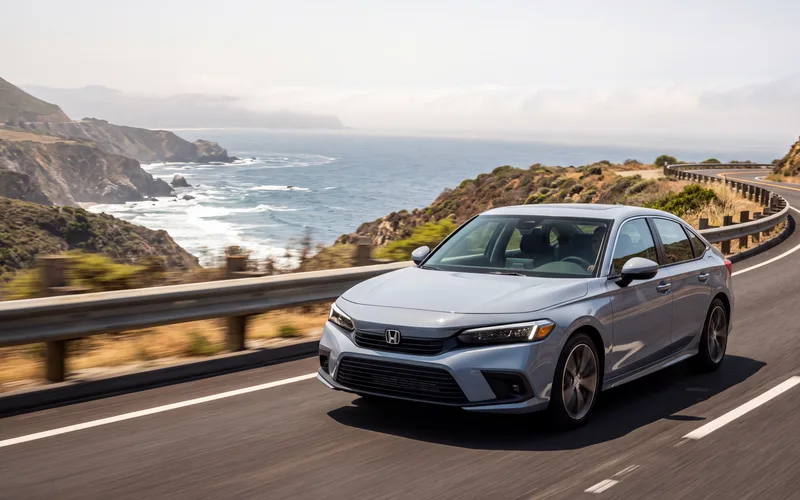 Honda CivicCompact SedanBetter at: Practicality
It delivers most of what makes the Mazda3 appealing while adding a usable back seat, a bigger trunk, a high-40s-MPG hybrid and the segment's best resale value.
Compare 2.40C+
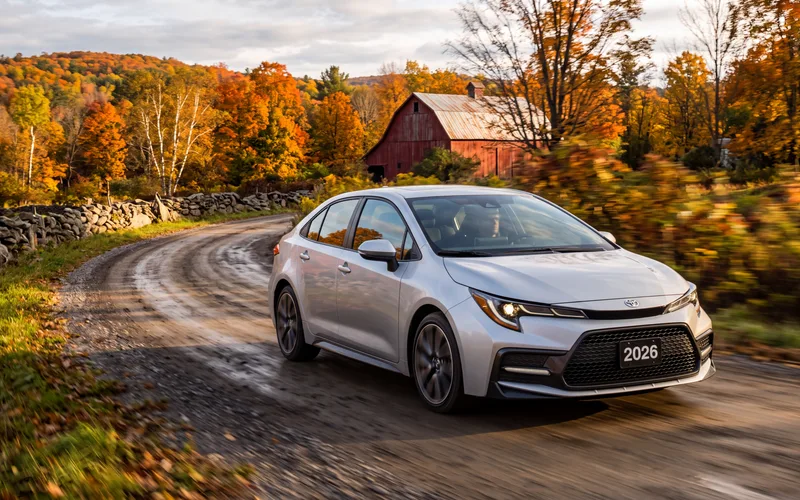 Toyota CorollaCompact SedanBetter at: Ownership cost
Lower running costs across the board — a hybrid near 50 MPG, top-of-class predicted reliability and more than twice as many dealers for service.
Compare 2.13C
2.13C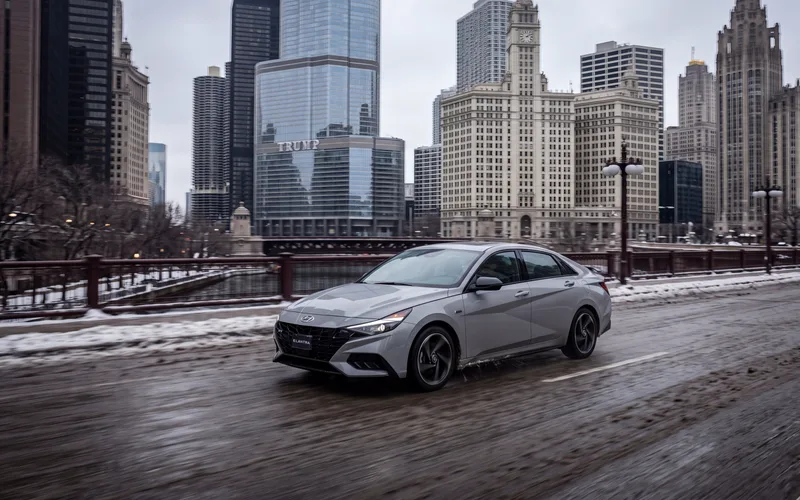 Hyundai ElantraCompact SedanBetter at: Space and warranty
Nearly three more inches of rear legroom, more standard tech, and a 10-year/100,000-mile powertrain warranty for similar money.
CompareHow it's evolved
10 scored model years · 2017–2026
Subject scores by year
Hover or tap a score to see what moved it versus the year before. A corner mark flags a big swing.
| Year | Performance | Efficiency | Safety | Space | Cost | Reliability | Tech | Use-case | Driving | Value |
|---|---|---|---|---|---|---|---|---|---|---|
| 2026 | 44 | 55 | 75 | 59 | 71 | 80 | 63 | 47 | 76 | 72 |
| 2025 | 43 | 51 | 77 | 58 | 69 | 80 | 51 | 46 | 77 | 70 |
| 2024 | 41 | 51 | 77 | 58 | 69 | 78 | 52 | 49 | 77 | 71 |
| 2023 | 43 | 52 | 73 | 59 | 70 | 80 | 52 | 46 | 76 | 71 |
| 2022 | 43 | 48 | 75 | 59 | 71 | 80 | 51 | 46 | 78 | 69 |
| 2021 | 44 | 48 | 75 | 59 | 73 | 73 | 51 | 47 | 78 | 73 |
| 2020 | 39 | 48 | 74 | 58 | 71 | 73 | 47 | 46 | 77 | 72 |
| 2019 | 39 | 48 | 70 | 59 | 70 | 66 | 49 | 49 | 77 | 67 |
| 2018 | 36 | 48 | 59 | 59 | 76 | 75 | 34 | 45 | 77 | 65 |
| 2017 | 29 | 55 | 61 | 59 | 77 | 82 | 37 | 46 | 79 | 71 |
Compare two years
Best fit & conditions
Higher scores mean a better fit for that use case. Learn more about use-case fit →
Subject profile
Trims & configurations
5 trimsScores above reflect the volume trim. Per-trim specs and scores are rolling out — the full lineup:
Academic Probation · NHTSA safety recalls
Jun 12, 2020Service brakes, hydraulic: foundation components: disc: caliperThe front brake caliper mounting bolts may not have been tightened properly during assembly, possibly allowing the calipers to loosen.
Defect
Mazda North American Operations (Mazda) is recalling certain 2020 CX-30 and Mazda3 vehicles. The front brake caliper mounting bolts may not have been tightened properly during assembly, possibly allowing the calipers to loosen.
Risk
Loose brake calipers can reduce braking performance or interfere with wheel rotation, affecting vehicle handling. Either of these scenarios can increase the risk of a crash.
Remedy
Mazda will notify owners, and dealers will inspect the front brake caliper bolts, tightening them as necessary. If bolts are missing, the affected brake caliper will be replaced. Repairs will be performed free of charge. The recall began July 24, 2020. Owners may contact Mazda customer service at 1-800-222-5500, Option 4. Mazda's number for this recall is 4420F.
NHTSA campaign 20V346000 ↗Manufacturer no. 4420F24,037 vehicles potentially affected (all models in the campaign)Owners notified Jul 24, 2020Filed by Mazda North American OperationsFiled as MAZDA3Dec 19, 2019Forward collision avoidance: automatic emergency brakingThe Smart Brake System (SBS) can falsely detect an obstacle while driving, activating the automatic emergency braking system and suddenly stopping the vehicle.
Defect
Mazda North American Operations (Mazda) is recalling certain 2019-2020 Mazda3 vehicles. The Smart Brake System (SBS) can falsely detect an obstacle while driving, activating the automatic emergency braking system and suddenly stopping the vehicle.
Risk
Stopping the vehicle unexpectedly increases the risk of a crash.
Remedy
Mazda will notify owners, and dealers will update the SBS software. In addition, vehicles with certain production dates will receive an instrument cluster software update or replacement and a replacement owner's manual. These repairs will be performed free of charge. The recall began February 14, 2020. Owners may contact Mazda customer service at 1-800-222-5500, Option 4. Mazda's number for this recall is 4219L.
NHTSA campaign 19V907000 ↗Manufacturer no. 4219L35,390 vehicles potentially affected (all models in the campaign)Owners notified Feb 14, 2020Filed by Mazda North American OperationsFiled as MAZDA3
13 recalls on other model years of the Mazda3 (2017–2019, 2021, 2024–2025)
May 29, 2025Air bags: air bag/restraint control module: softwareThe Sophisticated Air Bag Sensor (SAS) units may set an error code and deactivate the air bags, due to a low battery condition.
Defect
Mazda North American Operations is recalling certain 2024-2025 Mazda3 and CX30 vehicles. The Sophisticated Air Bag Sensor (SAS) units may set an error code and deactivate the air bags, due to a low battery condition.
Risk
Air bags that do not deploy in the event of a crash increase the risk of injury.
Remedy
Dealers will reprogram the SAS unit with improved software or replace the unit, free of charge. Owner notification letters were mailed July 24, 2025. Mazda's number for this recall is 7525E.
NHTSA campaign 25V357000 ↗Manufacturer no. 7525E171,412 vehicles potentially affected (all models in the campaign)Owners notified Jul 22, 2025Filed by Mazda North American OperationsFiled as MAZDA3Sep 3, 2024Exterior lighting: headlights · Forward collision avoidance: automatic emergency braking · Lane departure: sensing system: cameraA malfunction in the forward sensing camera (FSC) may prevent the automatic emergency braking system and the lane-keep assist system from functioning. In addition, the headlights will not automatically adjust from high beams to low beams as intended.
Defect
Mazda North American Operations (Mazda) is recalling certain 2024 Mazda 3, CX-30, and 2025 CX-50 vehicles. A malfunction in the forward sensing camera (FSC) may prevent the automatic emergency braking system and the lane-keep assist system from functioning. In addition, the headlights will not automatically adjust from high beams to low beams as intended.
Risk
Automatic braking, steering assist, and headlight control systems that do not function as intended can increase the risk of a crash.
Remedy
Dealers will inspect and replace the forward sensing camera as necessary, free of charge. Owner notification letters were mailed September 24, 2024. Owners may contact Mazda customer service at 1-800-222-5500, Option 6. Mazda's number for this recall is 6824H.
NHTSA campaign 24V649000 ↗Manufacturer no. 6824H672 vehicles potentially affected (all models in the campaign)Owners notified Sep 24, 2024Filed by Mazda North American OperationsFiled as MAZDA3Oct 26, 2023Back over prevention: sensing system: camera · Forward collision avoidance: sensing system: camera · Lane departure: sensing system: cameraDue to a software error, the rearview, front, and/or side camera images may not appear on the display. As such, these vehicles fail to comply with the requirements of Federal Motor Vehicle Safety Standard number 111, "Rear Visibility."
Defect
Mazda North American Operations (Mazda) is recalling certain 2024 CX-90 and MAZDA3 vehicles. Due to a software error, the rearview, front, and/or side camera images may not appear on the display. As such, these vehicles fail to comply with the requirements of Federal Motor Vehicle Safety Standard number 111, "Rear Visibility."
Risk
A camera that does not display an image can reduce the driver's view, increasing the risk of a crash or injury.
Remedy
Dealers will update the view monitor control module software, free of charge. Owner notification letters were mailed December 20, 2023. Owners may contact Mazda customer service at 1-800-222-5500 Option 6. Mazda's number for this recall is 6223J.
NHTSA campaign 23V718000 ↗Manufacturer no. 6223J11,903 vehicles potentially affected (all models in the campaign)Owners notified Dec 20, 2023Filed by Mazda North American OperationsFiled as MAZDA3Jul 14, 2023Back over prevention: sensing system: cameraThe rearview camera image may not display properly by showing a flickering or distorted image.
Defect
Mazda North American Operations (Mazda) is recalling certain 2014-2018 Mazda3 and 2016-2021 CX-3 vehicles. The rearview camera image may not display properly by showing a flickering or distorted image.
Risk
A rearview camera that does not display properly can reduce the driver's rear view, increasing the risk of a crash or injury.
Remedy
Dealers will inspect and replace the rearview camera, as necessary. In addition, dealers will install a wiring harness fastening seal. All repairs will be performed free of charge. Interim notification letters, notifying owners of the safety risk, were mailed September 13, 2023. Final owner letters for affected models and model years in the states of CT, MA, MD, NJ, NY, PA and VA were mailed August 14, 2024. The remaining owner notification letters will be mailed at a future date, anticipated on or before May 1, 2025. Owners may contact Mazda customer service at 1-800-222-5500, Option 6. Mazda's number for this recall is 6023G.
NHTSA campaign 23V487000 ↗Manufacturer no. 6023G236,100 vehicles potentially affected (all models in the campaign)Owners notified Aug 14, 2024Filed by Mazda North American OperationsFiled as MAZDA3Nov 12, 2021Fuel system, gasoline: delivery: fuel pumpThe impeller inside the low-pressure fuel pump may crack and deform, potentially causing the fuel pump to fail.
Defect
Mazda North American Operations (Mazda) is recalling certain 2018 Mazda3, Mazda6, 2019 CX-3, 2018-2019 MX-5, CX-5, CX-9, and 2019-2020 Mazda2 vehicles. The impeller inside the low-pressure fuel pump may crack and deform, potentially causing the fuel pump to fail.
Risk
Fuel pump failure may cause an engine stall, increasing the risk of a crash.
Remedy
Dealers will replace the fuel pumps, free of charge. Owner notification letters were mailed July 18, 2022. Owners may contact Mazda customer service at 1-800-222-5500 Option 4. Mazda's number for this recall is 5321K.
NHTSA campaign 21V875000 ↗Manufacturer no. 5321K121,038 vehicles potentially affected (all models in the campaign)Owners notified Jul 18, 2022Filed by Mazda North American OperationsFiled as MAZDA3Feb 22, 2021Tires: valveAir may suddenly leak from the tire air valve.
Defect
Mazda North American Operations (Mazda) is recalling certain 2021 Mazda3 and CX-30 vehicles. Air may suddenly leak from the tire air valve.
Risk
A sudden air leak from the tire air valve may cause a loss of vehicle control while driving, increasing the risk of a crash.
Remedy
Mazda will notify owners, and dealers will replace all four tire air valves with new parts, free of charge. The recall began April 6, 2021. Owners may contact Mazda customer service at 1-800-222-5500 Option 4. Mazda's number for this recall is 4721B.
NHTSA campaign 21V101000 ↗Manufacturer no. 4721B599 vehicles potentially affected (all models in the campaign)Owners notified Apr 6, 2021Filed by Mazda North American OperationsFiled as MAZDA3Jul 29, 2019Visibility: glass, side/rearThe adhesive between the interior rearview mirror and the housing may not be properly bonded, allowing the mirror to detach from the housing. Note: Vehicles equipped with auto dimming mirrors are not affected by this recall.
Defect
Mazda North American Operations (Mazda) is recalling certain 2019 Mazda3 vehicles equipped with manual dimming mirrors. The adhesive between the interior rearview mirror and the housing may not be properly bonded, allowing the mirror to detach from the housing. Note: Vehicles equipped with auto dimming mirrors are not affected by this recall.
Risk
Rearward visibility will be reduced without the rearview mirror, increasing the risk of a crash.
Remedy
Mazda will notify owners, and dealers will replace the interior rearview mirror assembly, free of charge. The recall began September 19, 2019. Owners may contact Mazda customer service at 1-800-222-5500, option 4. Mazda's number for this recall is 3919G.
NHTSA campaign 19V558000 ↗Manufacturer no. 3919G22,571 vehicles potentially affected (all models in the campaign)Owners notified Sep 19, 2019Filed by Mazda North American OperationsFiled as MAZDA3Jul 5, 2019Seats: front assembly: head restraintThe seat cover material on both front seats may interfere with the head restraint lock release button, causing it to stick in the release position and not allow the head restraint to lock into place.
Defect
Mazda North American Operations (Mazda) is recalling certain 2019 Mazda3 vehicles. The seat cover material on both front seats may interfere with the head restraint lock release button, causing it to stick in the release position and not allow the head restraint to lock into place.
Risk
Loose head restraints may increase the risk of injury in the event of a crash.
Remedy
Mazda will notify owners, and dealers will install spacers at the bottom of the lock release buttons on both front seat head restraints, free of charge. The recall began August 20, 2019. Owners may contact Mazda customer service at 1-800-222-5500, option 4. Mazda's number for this recall is 3819F.
NHTSA campaign 19V514000 ↗Manufacturer no. 3819F9,430 vehicles potentially affected (all models in the campaign)Owners notified Aug 20, 2019Filed by Mazda North American OperationsFiled as MAZDA3Jun 27, 2019Engine · Power train: automatic transmission: control module (tcm/pcm/tecm)A software error in the powertrain control module (PCM) may cause the engine to stall.
Defect
Mazda North American Operations (Mazda) is recalling certain 2018-2019 CX-5, Mazda6, and 2019 Mazda3 vehicles. A software error in the powertrain control module (PCM) may cause the engine to stall.
Risk
An unexpected stall increases the risk of a crash.
Remedy
Mazda will notify owners, and dealers will reprogram the PCM software, free of charge. The recall began August 20, 2019. Owners may contact Mazda customer service at 1-800-222-5500, option 4. Mazda's number for this recall is 3719F.
NHTSA campaign 19V497000 ↗Manufacturer no. 3719F262,220 vehicles potentially affected (all models in the campaign)Owners notified Aug 20, 2019Filed by Mazda North American OperationsFiled as MAZDA3Jun 7, 2019Wheels: lugs/nuts/bolts/studsThe lug nuts on all four wheels may loosen, potentially resulting in a wheel detaching from the vehicle.
Defect
Mazda North American Operations (Mazda) is recalling certain 2019 Mazda3 vehicles. The lug nuts on all four wheels may loosen, potentially resulting in a wheel detaching from the vehicle.
Risk
A wheel separating from the vehicle increases the risk of a crash.
Remedy
Mazda will notify owners, and dealers will tighten the front and rear wheel lug nuts to the correct specification, free of charge. The recall began July 9, 2019. Owners may contact Mazda customer service at 1-800-222-5500, Option 4. Mazda's number for this recall is 3519F.
NHTSA campaign 19V425000 ↗Manufacturer no. 3519F25,003 vehicles potentially affected (all models in the campaign)Owners notified Jul 9, 2019Filed by Mazda North American OperationsFiled as MAZDA3May 14, 2019Electrical system: instrument cluster/panel · Seat belts: front: warning light/devicesDue to incorrect programing, the passenger air bag deactivation indicator light may erroneously turn off although the passenger air bag is deactivated. In addition, the seat belt status indicators for both the front passenger seat and/or rear seats may erroneously turn off although the front passenger and/or rear seat belts are unfastened.
Defect
Mazda North American Operations (Mazda) is recalling certain 2019 Mazda3 vehicles. Due to incorrect programing, the passenger air bag deactivation indicator light may erroneously turn off although the passenger air bag is deactivated. In addition, the seat belt status indicators for both the front passenger seat and/or rear seats may erroneously turn off although the front passenger and/or rear seat belts are unfastened.
Risk
Incorrect indicator warning lights may lead the driver and/or passengers to be unaware of deactivated air bags or unfastened seat belts, increasing the risk of injury.
Remedy
Mazda will notify owners, and dealers will replace the passenger air bag/seat belt status indicator assembly, free of charge. The recall began July 9, 2019. Owners may contact Mazda customer service at 1-800-222-5500, Option 4. Mazda's number for this recall is 3319E.
NHTSA campaign 19V363000 ↗Manufacturer no. 3319E17,016 vehicles potentially affected (all models in the campaign)Owners notified Jul 9, 2019Filed by Mazda North American OperationsFiled as MAZDA3Apr 4, 2019Visibility: windshield wiper/washerA defective windshield wiper relay may cause the windshield wipers to become inoperative, reducing the driver's visibility.
Defect
Mazda North American Operations (Mazda) is recalling certain 2016-2018 Mazda3 vehicles. A defective windshield wiper relay may cause the windshield wipers to become inoperative, reducing the driver's visibility.
Risk
Reduced visibility while driving can increase the risk of crash.
Remedy
Mazda will notify owners, and dealers will replace the front body control module with a new module which uses an improved wiper relay design, free of charge. The recall began May 7, 2019. Owners may contact Mazda customer service at 1-800-222-5500, option 4. Mazda's number for this recall is 3219D.
NHTSA campaign 19V272000 ↗Manufacturer no. 3219D187,880 vehicles potentially affected (all models in the campaign)Owners notified May 7, 2019Filed by Mazda North American OperationsFiled as MAZDA3Nov 21, 2017Engine and engine cooling: exhaust systemThe incorrect exhaust valve spring may fail while driving, potentially causing an engine stall.
Defect
Mazda North American Operations (Mazda) is recalling certain 2018 Mazda3 vehicles, equipped with an incorrect exhaust valve spring. The incorrect exhaust valve spring may fail while driving, potentially causing an engine stall.
Risk
An engine stall can increase the risk of a crash.
Remedy
Mazda will notify owners, and dealers will inspect the engines and replace any incorrect exhaust valve springs, free of charge. The recall is expected to begin January 20, 2018. Owners may contact Mazda customer service at 1-800-222-5500. Mazda's number for this recall is 1717K.
NHTSA campaign 17V745000 ↗Manufacturer no. 1717K144 vehicles potentially affected (all models in the campaign)Owners notified Jan 22, 2018Filed by Mazda North American OperationsFiled as MAZDA3
Source: NHTSA Office of Defects Investigation recall database, model years 2017–2026. Recalls are listed by model year as the manufacturer filed them; whether a specific car is affected depends on its VIN — check a VIN at nhtsa.gov ↗. NHTSA model names matched to this page: MAZDA3.
Detailed scoring by subject
1Performance & PowertrainThe Mazda3's lowest-graded category.0.57F
Every 2020 US Mazda3 sedan trim uses the same naturally aspirated 2.5L Skyactiv-G; there was no turbo option in the US until the 2021 model year, so the volume Select/Preferred trim and the top Premium share one output figure.
Peak torque arrives high at 4,000 rpm, characteristic of the naturally aspirated Skyactiv-G — adequate but well short of the turbocharged compacts that make peak torque near 2,000 rpm.
Instrumented tests of the fourth-generation 2.5L car cluster at 7.0–7.4 s for FWD automatics; the heavier i-Activ AWD sedan tested slower. 7.2 s represents the volume FWD automatic sedan.
The naturally aspirated 2.5 has no turbo lag and a linear, honest throttle that reviewers consistently praise, but it needs revs to deliver and turns coarse and buzzy near the top of the tach, with thin midrange next to turbocharged rivals.
The Skyactiv-Drive six-speed torque-converter automatic is widely regarded as one of the best conventional autos in the compact class — quick, decisive, never hunting and with none of the drone of the CVTs used by Civic, Corolla and Sentra; it loses points only for having six ratios where rivals have eight or ten.
i-Activ AWD is optional on the Select, Preferred and Premium sedans — most of the range, and a genuine rarity among 2020 compact sedans — but it is unavailable on the base sedan and is a simple on-demand system with G-Vectoring Control Plus rather than low range, lockers or terrain modes.
One engine, take it or leave it: the 2.5L Skyactiv-G is the only powertrain in the 2020 US Mazda3 range, with no hybrid, no plug-in and no turbo option (the 2.5 Turbo did not arrive until 2021, and Skyactiv-X was never sold in the US). The only drivetrain choices are FWD/AWD and, on one hatchback trim, a manual gearbox.
2Efficiency & RangeGrades below the middle of the scale.1.17D
EPA rates every 2020 Mazda3 sedan FWD automatic at 30 MPG combined, whether or not it has the cylinder-deactivation engine; the AWD sedan drops to 28. A respectable naturally aspirated figure, but short of the CVT-equipped Civic and Corolla that clear 33–35 combined.
The volume Select/Preferred sedan FWD does not get cylinder deactivation — that is standard on Premium sedans, all hatchbacks and all AWD models — so it is EPA-rated 26 MPG city rather than 27.
Tall sixth gear and low drag give the FWD sedan a solid 35 MPG highway rating; the cylinder-deactivation Premium sedan gains 1 MPG and AWD costs 2.
A small 13.2-gallon tank caps range at just under 400 miles despite decent economy — mid-pack for the compact class, where larger-tank rivals clear 450 miles.
EPA's estimate at standard assumptions for the FWD automatic sedan; the same $2,050 applies to both the cylinder-deactivation and non-deactivation FWD engines, and the agency scores the car 7/10 on both fuel economy and greenhouse gas.
Runs on 87-octane regular unleaded with no premium recommendation and no plug or special infrastructure — the cheapest and simplest fuelling arrangement available. Not a perfect score only because the small tank means more frequent stops.
3SafetyOne of the Mazda3's strongest categories.3.03B
NHTSA gave the 2020 Mazda3 sedan a 5-star overall rating with 5 stars in every subtest, including the side pole test, and no dynamic tip in the rollover evaluation.
The 2020 Mazda3 sedan is an IIHS TOP SAFETY PICK+ with Good ratings in all six crashworthiness evaluations — a clean sweep; only the volume trims' Acceptable headlights keep it from the very top of the band.
Every 2020 Mazda3 sedan, including the $21,500 base car, carries Smart Brake Support, Mazda Radar Cruise Control with Stop & Go (0–90 mph), Lane Departure Warning, Lane Keep Assist, High Beam Control and Driver Attention Alert as standard — unusually generous for a compact sedan. Only Blind Spot Monitoring with Rear Cross Traffic Alert is package-gated, arriving with the Select package (so present on the volume trim but not the base sedan; the hatchback gets it standard).
IIHS rated the standard Smart Brake Support Superior in both the vehicle-to-vehicle and the daytime vehicle-to-pedestrian front crash prevention evaluations. IIHS had not yet introduced the nighttime pedestrian test in the 2020 model year, so after-dark performance is unverified.
Blind Spot Monitoring with Rear Cross Traffic Alert arrives with the Select package and carries up through Preferred and Premium, so the volume sedan has it — but the base sedan does not, it is alert-only, and for 2020 the sedan had no rear cross-traffic braking, no 360-degree View Monitor, no parking sensors and no safe-exit warning at any price.
Lane Departure Warning and Lane Keep Assist are standard on every 2020 trim, but Mazda's implementation is a corrective nudge at the lane edge rather than sustained centering, and the 2020 Mazda3 offered no lane-centering or traffic-jam function at all — Traffic Jam Assist did not appear on the car until 2021.
Mazda Radar Cruise Control with Stop & Go is standard on every automatic 2020 Mazda3 and works across the full 0–90 mph range — full-speed-range ACC on Mazda's cheapest car — and reviewers find it smooth, but it is never combined with lane centering into a true highway-assist mode, since no such system was offered for 2020.
Mazda offered no hands-free highway driving system on any 2020 Mazda3 trim, and had no such system anywhere in its US lineup; every i-Activsense function is hands-on.
IIHS rated the 2020 sedan's headlights Acceptable on base, Select and Preferred — the volume configurations — with Good reserved for the Premium package's adaptive front-lighting LED units, and even those rated only Acceptable on cars built before March 2020. High Beam Control is standard across the line.
Sightlines are the fourth-generation Mazda3's clearest safety weakness — a high beltline, thick rear pillars and a shallow rear window with small tinted quarter glass — and the 2020 sedan has no camera compensation beyond the standard rear-view camera, because neither a 360-degree View Monitor nor parking sensors were offered that year at any trim.
IIHS rates the LATCH hardware Good with extra anchor positions available, so installation itself is easy; the limit is compact-sedan rear-quarter space — 35.1 in of rear legroom and 0.7 in of rear knee clearance make three-across a struggle and rear-facing seats tight behind a tall front occupant.
4Space & ComfortMid-pack among this car's ten categories.1.90C-
The 2020 Mazda3 sedan is a conventional five-passenger compact — two front seats plus a three-place rear bench on every grade, with no alternate seating configuration offered.
Mid-band front headroom for a compact sedan — the BP generation's low, coupe-influenced roofline costs it against the Elantra while roughly matching the Corolla. The volume Select grade has no moonroof, so the larger figure applies.
Front legroom is squarely competitive for the class and level with the Civic and Elantra, so tall drivers are well accommodated even though the second row is not — the cabin is narrow rather than short up front.
Rear headroom lands mid-band and is roughly level with the Civic and Corolla — in the sedan the fastback-influenced roofline hurts rear sightlines more than it hurts headroom, and the sedan is marginally better here than the hatchback.
The Mazda3's defining packaging weakness: 35.1 in of rear legroom is several inches short of the Elantra (38.0 in) and Civic (37.4 in), and Mazda's own 0.7 in rear knee-clearance figure confirms how little margin there is behind a tall front occupant.
At 13.2 cu ft the trunk trails nearly every compact-sedan rival — the Civic (14.8), Elantra (14.2) and Jetta (14.1) all carry more — and the sedan's narrow trunk aperture compounds it.
Mazda prioritized a clean, driver-focused console over practicality: a covered console armrest bin, front door pockets with bottle holders, rear door bottle holders, one front-seatback map pocket and a single 12-volt outlet, with the rear armrest and cupholders only arriving at the Select grade. The one genuine cleverness is a 60/40 rear seatback that folds close to flush with the trunk floor — rare for a compact sedan — but there is no underfloor bin, no fold-flat front passenger seat and no factory wireless-charging provision on any 2020 trim.
Front seats are a genuine strength — Mazda's spine-alignment design draws repeated praise for long-haul support, and the volume Select package already fits leatherette-trimmed sport seats. It is held out of the top band because Select seats are manually adjusted (the 8-way power driver's seat with lumbar and memory only arrives with the Preferred package at $24,200) and because 35.1 in of rear legroom limits adult comfort in back regardless of cushioning.
Body control and damping are well judged, but the torsion-beam rear axle and firm tuning make the Mazda3 busier over broken pavement than the Civic or Corolla — composed and sporting rather than plush. The volume Select package swaps the base sedan's 16-inch wheels on 205/60 tires for 18s on 215/45s, which sharpens impacts.
Isolation is one of the Mazda3's clearer comfort advantages in the segment — extensive sound deadening plus a geared torque-converter automatic instead of a CVT keep wind and powertrain noise below the Civic, Elantra and Corolla at a cruise. It is marked down from the top band because the 5.5-inch-clearance body still admits noticeable road roar on the volume grade's 18-inch fitment, a recurring owner complaint.
2020 is the thinnest comfort-equipment year of this generation: dual-zone automatic climate control arrives with the volume Select package and three-level heated front seats only with Preferred, while the base sedan gets single-zone air conditioning. Critically, no 2020 Mazda3 sedan offers a heated steering wheel, ventilated seats, rear-seat air vents or factory remote pre-conditioning at any price — the heated wheel arrived with the 2021 Turbo grades, and Mazda Connected Services remote start was not sedan content for 2020.
5Cost of OwnershipGrades above the middle of the scale.2.80B-
The entry 2020 Mazda3 sedan was the unnamed "base" grade at $21,500 plus $920 destination. Unlike 2021 and later, there was no cheaper 2.0L sedan yet — every 2020 US Mazda3 used the 186-hp 2.5L, so the base car is unusually well-engined for its price.
Select is the value-sweet-spot and volume grade: for $1,200 over base it adds Apple CarPlay/Android Auto, blind-spot monitoring with rear cross-traffic alert, 18-inch alloys, leatherette, dual-zone automatic climate, keyless entry/start and the option of i-ACTIV AWD.
The Mazda3 is one of the cheaper compacts to keep: RepairPal puts average annual repair cost at $433 against a $526 compact-car average, with low repair severity. CarEdge's $1,891 five-year figure counts only a light scheduled-service interpretation, so this figure adds realistic dealer-rate scheduled maintenance, brakes and tires across five years of a 2020 car now well past its 3/36 warranty.
This is a realized figure rather than a forecast: the 2020 model year has now completed its five years, and the base sedan held 61% of its original delivered price. That is strong for a compact sedan, though the hatchback did better still at 65%.
Mazda's New-Vehicle Limited Warranty is the mainstream floor and sits at the bottom of the 3-to-5-year normalization band — no better than Honda or Toyota, and half the term Hyundai and Kia offered 2020 buyers.
Powertrain coverage also sits at the minimum of its five-to-ten-year band. It is transferable, but 60,000 miles is short against the 100,000-mile terms common among Korean rivals.
A 2020 Mazda3 buyer got no complimentary scheduled maintenance at all — every oil change and rotation was out of pocket from mile one — and no connected-services subscription trial either, since Mazda Connected Services did not reach the Mazda3 until 2021. What is included is 24/7 Emergency Roadside Assistance tied to the warranty terms, a lifetime brake-pad warranty and a short SiriusXM trial on satellite-equipped trims. That is roadside-only coverage at the bottom of the middle band, and worse than Honda's or Toyota's 2020 offering.
$23,620 volume-trim price minus its estimated resale value after 5 years (61% retained, or about $14,408) leaves about $9,212 in depreciation. Add the projected $3,950 in 5-year maintenance and repairs, and owning this vehicle for 5 years costs about $13,162 in total.
6Reliability & QualityOne of the Mazda3's strongest categories.2.93B-
This is the clearest case of genuinely mixed signals in the category, so it sits mid-band rather than near the nameplate's later years. Field data is outstanding — 32 NHTSA complaints against 306 for the 2020 Corolla and 220 for the 2020 Civic, the lowest count of any mainstream 2020 compact, with no crash or fire reports — and RepairPal rates the model 4.0/5.0 at $433/yr. Against that, Consumer Reports' own owner survey concludes the opposite for this exact model year, and Mazda finished 22nd of 32 in the J.D. Power IQS covering these cars' first 90 days. The divergence is explicable: NHTSA captures safety defects, while CR and IQS weight the infotainment, electronics and driver-assist complaints that dogged the second year of the new BP generation.
The brand standing behind this specific car is as strong as it has ever been: Consumer Reports' November 2020 reliability survey — published while the 2020 Mazda3 was on sale — ranked Mazda first of all brands at 83 of 100, ending a six-year run at the top by Toyota and Lexus. That result has held up rather than proving a one-off, with Mazda 3rd overall and 2nd among mass-market brands in the 2025 J.D. Power VDS and 3rd in CR's used-car reliability ranking for 5-to-10-year-old models, which is the cohort a 2020 car now sits in. Held just below the top of the band because the contemporaneous initial-quality picture was weaker than the dependability picture.
This is where the 2020 car separates sharply from the later BP years, which carry no recalls at all. Two campaigns cover it, and neither is trivial: a Smart Brake System defect that falsely detects obstacles and applies full automatic emergency braking, and front brake caliper mounting bolts left improperly torqued on the assembly line. The AEB campaign is the more serious of the two because the complaint record shows it was not fully cured by the February 2020 software remedy — phantom-braking reports against this model year continue through 2021, 2022 and into late 2023, and forward-collision-avoidance accounts for 15 of the car's 32 complaints. Two live TSBs add to the picture. It stays in the middle band rather than lower because both recalls were promptly remedied at no cost and nothing here is a fire, stall or structural defect.
The 2020 Mazda3 sedan's only powertrain is the 2.5L Skyactiv-G (186 hp/186 lb-ft), a PY-series engine in continuous production since the 2012 CX-5, driving a conventional Skyactiv-Drive six-speed torque-converter automatic. Having no CVT and no dual-clutch anywhere in the range is a real durability advantage over the Civic, Corolla, Sentra and Elantra and is why this still scores well. It is docked from the later years' level by one documented driveline weakness: Mazda's own bulletin describes the torque-converter lock-up clutch wearing enough to contaminate the transmission fluid with iron powder, and CarComplaints logs torque-converter failure on this model year at around 37,000 miles for roughly $2,800. The mitigating detail is that the bulletin is scoped to cars with cylinder deactivation, which on the 2020 sedan was fitted only to Premium and AWD models — so the volume front-drive Select/Preferred sedan falls outside it.
The cabin is the fourth-generation Mazda3's signature advantage and the widest gap it opens over anything else in the compact class — broad low-sheen soft-touch coverage across dash, doors and console, well-damped switchgear, and a restraint reviewers repeatedly compare to entry-luxury cars rather than to compacts. KBB puts it above the class leaders outright and notes that a top-trim Civic or Corolla feels like it should cost substantially less; Edmunds drew a Mercedes-Benz A-Class comparison. Kept out of the low 90s only by hard plastics low in the cabin and the high-gloss piano-black console trim that shows fingerprints.
Physical assembly is genuinely good — tight, consistent panel gaps and solid switchgear, with rattle and squeak complaints rare on this model year. What holds the score down is that the one hard measurement of this exact model year's build quality is below average: Mazda posted 184 PP100 in the 2020 J.D. Power IQS, 22nd of 32 brands and 18 points worse than the 166 industry average, in a study year whose redesigned methodology weighted infotainment heavily against Mazda's new commander-control system. Two documented assembly-process defects reinforce it rather than contradict it — the improperly torqued front brake caliper bolts that forced recall 20V346000, and the seat-back airbag harness routing flaw behind TSB 08-001/22.
Two findings pull hard in opposite directions and the score splits them. Coverage is the Mazda3's real ownership weakness: Mazda has deliberately shrunk its US store count from 635 in 2014 to roughly 548, less than half of Toyota's 1,246 and barely half of Honda's 1,074, so an owner outside a major metro can face a materially longer drive for warranty work — and this car needed two recall visits. But the quality of the service once reached is excellent and independently measured: Mazda ranked 2nd among all mass-market brands in J.D. Power's 2023 CSI, the wave contemporaneous with these cars at three years old. Sparse network, strong service — hence mid-band rather than the low band pure density would imply.
Routine running costs are genuinely low — RepairPal puts average annual repair and maintenance at $433 against $526 for compact cars and $652 across all vehicles, with low repair severity and 0.3 unscheduled shop visits a year. It sits in the normal band rather than the 80+ band because Mazda's US volume is a fraction of Toyota's or Honda's, leaving a thinner independent parts catalogue and aftermarket. It is docked below the later model years on one specific, documented shortage: Mazda's own torque-converter bulletin for this generation records that replacement units were on backorder and obtainable only through factory push orders, which is a long wait on a repair that requires dropping the transaxle.
7Technology & InfotainmentOne of the Mazda3's weakest categories.1.12D
Every 2020 Mazda3 sedan grade, from the $21,500 base car to Premium, carries the same 8.8-inch widescreen center display; no larger option exists. The display is also not touch-sensitive in any mode, which this size score does not capture — touch operation inside CarPlay/Android Auto and the larger 10.25-inch unit did not arrive until the 2024 refresh.
Mazda Connect is clean, quick and refreshingly physical — a rotary Commander dial, a real volume knob and separate climate controls make it genuinely low-distraction, and the graphics are crisp. But the 2020 car has no touch input at all, even inside CarPlay and Android Auto, so working a projected phone interface with a knob is slower than in any rival, and reviewers split sharply on whether the trade is worth it.
Both CarPlay and Android Auto are wired-only for 2020 — wireless connectivity did not arrive until the 2024 refresh — and they are not line-wide: the base sedan omits phone projection entirely, so coverage starts at the $22,700 Select grade. That combination puts it at the very bottom of the 'wired standard' band.
No 2020 Mazda3 sedan grade offers factory navigation — not even the $26,500 Premium package, which is where the Mazda Navigation System landed from 2021 onward. Maps are a dealer-installed SD card sold as a Genuine Mazda Accessory, and Mazda's 'Infotainment system voice command' is a fixed-command list rather than a natural-language assistant, so owners default to CarPlay or Android Auto for both search and guidance.
The standard eight-speaker system is respectable for a compact sedan and the 12-speaker Bose Centerpoint 2/AudioPilot upgrade is among the better premium setups in the class. 2020 is also the most accessible year for it: Bose comes with the $24,200 Preferred package, one grade lower than the 2021–2022 cars, which required Premium. It stays out of the top band because the volume Select grade still cannot be optioned with it.
A 7-inch LCD meter display is standard on every 2020 grade including the $21,500 base sedan — crisply rendered and set inside an otherwise conventional binnacle. It is small and only lightly configurable next to the wide clusters Hyundai and Volkswagen were fitting at the same money, so it lands mid-band.
The 2020 Mazda3 sedan has no meaningful over-the-air update capability, and it is worse off than the 2021 car: Mazda Connected Services is not listed as sedan content for 2020 at all, so there is not even a telematics channel as delivered, and map data is physically distributed on an SD card. Infotainment and TCU software updates are dealer USB-stick operations.
Mazda Connected Services and its MyMazda remote start / lock / locate / vehicle-status functions are not factory content on any 2020 Mazda3 sedan grade — the 2020 hatchback lists them as standard but the sedan does not, and it took until the 2021 model year for Mazda to make them standard line-wide. US cars of this vintage do carry the TCU hardware and many were activated retroactively, so a given 2020 sedan may work, but a buyer could not order it and there is no digital key.
Two front USB-A audio inputs and a single 12-volt outlet is the whole provision on every grade: no USB-C anywhere, no factory wireless charging pad at any price, no rear-seat charging port and no household outlet. Rivals at the same money were already shipping standard wireless charging and rear USB ports.
Push-button start is standard on every 2020 sedan including the base car — better than most compacts of the year — but full proximity entry (Mazda Advanced Keyless Entry) waits for the $22,700 Select package, below which it is a conventional remote-keyless-entry fob. It sits below the 2021 car because no factory remote start was available on the 2020 sedan (that arrives with Connected Services), there is no phone-as-key, and as a sedan there is no hands-free liftgate.
A rearview camera is standard on every grade and that is genuinely all a 2020 Mazda3 sedan buyer can get: no front or rear parking sensors, no 360-degree View Monitor and no automated parking were offered at any price that year — all three arrived on later model years. The gap matters more than usual because the gen-4 body's thick rear pillars already compromise rearward visibility.
A windshield-projected full-color head-up display is a genuine rarity in the 2020 compact class — Civic, Corolla, Elantra and Sentra offered none — but Mazda's Active Driving Display is confined to the $26,500 Premium package, two grades above the volume Select. Available and good, but trim-limited, so mid-band rather than the 80s.
8Use-Case FitOne of the Mazda3's weakest categories.1.05D
The LATCH hardware itself is easy to work with, but the surrounding space is the problem: 35.1 in of rear legroom and Mazda's own 0.7 in rear knee-clearance figure make a rear-facing seat tight behind a tall front occupant, three-across a struggle, and the 13.2 cu ft trunk swallows a stroller only grudgingly. The Select grade's 60/40 rear seatback adds some flexibility but the door apertures and low roofline make loading a toddler more of a stoop than in any compact SUV.
The crash credentials are excellent and, unusually for 2020, the driver-assist suite reaches the trims families actually buy: even the $21,500 base sedan carries automatic emergency braking, full-speed-range adaptive cruise, lane-departure warning and lane-keep assist. It stays out of the top band because blind-spot monitoring waits for the Select package, IIHS rated the volume grades' headlights only Acceptable, and there is no rear-occupant alert, rear cross-traffic braking or rear-seat reminder at any price.
With four aboard this is a medium-trip car at best: the rear bench is short on legroom and knee clearance, and there are no rear amenities at all for 2020 — no rear air vents, no rear USB or 12-volt outlet, no rear-seat entertainment and no rear window shades on any grade. Luggage for four has to fit in 13.2 cu ft, which forces a roof box on anything longer than a weekend.
A genuinely relaxing commuter for the money: the Skyactiv-Drive six-speed torque-converter automatic is smooth and decisive with none of the CVT drone of a Civic or Corolla, throttle response is linear, and full-speed-range radar cruise with stop-and-go is standard on every automatic grade, which takes the sting out of stop-go traffic. It falls short of the top band because the knob-only infotainment makes routine adjustments fiddly on the move and the Select grade's 18-inch wheels keep the ride busy on poor city pavement.
Running costs are reasonable rather than cheap: 30 MPG combined on regular unleaded works out to about $2,050 a year at EPA assumptions, and Mazda3 consumables and repairs are below the compact-car average. But 30 combined is 3–5 MPG behind the CVT-equipped Civic and Corolla that dominate this commute, and the 13.2-gallon tank means more frequent stops.
The footprint is modest and the 34.8 ft curb-to-curb turning circle is genuinely tight, so threading the car through a city is easy. What holds it back is camera and sensor support: the thick rear pillars badly limit the over-shoulder view, and for 2020 Mazda offered no parking sensors and no 360-degree View Monitor at any trim, leaving the standard low-resolution rearview camera to do all the work.
Not meaningfully work-capable: Mazda publishes no US tow rating for the Mazda3 sedan, there is no bed and no hitch provision, payload is limited to what a 3,071-lb compact sedan can carry in a 13.2 cu ft trunk, and 5.5 in of ground clearance rules out unimproved sites. The 186-hp naturally aspirated 2.5 also makes peak torque at 4,000 rpm, the wrong place for pulling under load.
The mechanicals are the reassuring part — a naturally aspirated Skyactiv-G 2.5 and a conventional torque-converter six-speed are simple, proven and cheap to keep, and Mazda3 repair costs run below the compact average. But this is a passenger compact with cloth or leatherette trim, carpeted surfaces and no wear-friendly or fleet-oriented options, and it has no commercial-duty track record to point to.
Essentially nothing here: a single 12-volt outlet is the only onboard power, there is no inverter or household socket, no bed or tie-down system beyond trunk hooks, no factory hitch and no upfit ecosystem. The only work-adjacent accessory Mazda sells for the sedan is a set of roof crossbars rated for 100 lb.
A competent rather than commanding tourer: the front seats are supportive for long stints, the cabin is quiet for the class at a cruise, and standard full-speed radar cruise reduces fatigue. But 2020 predates Mazda's lane-centering assist entirely, so the driver steers every mile; the 13.2-gallon tank caps range at about 396 miles; and the rear seat and 13.2 cu ft trunk limit how many people and how much luggage can come along.
The one real adventure credential is i-ACTIV AWD, available on Select, Preferred and Premium — an option no 2020 Civic, Corolla, Elantra or Sentra buyer had, and enough to make gravel roads and snowy trailheads routine. Everything else is pavement-bound: 5.5 in of ground clearance, no drive modes or terrain settings, no published tow rating, and only 100 lb of roof capacity for gear.
The 13.2 cu ft trunk is small for the class and reached through a narrow sedan aperture, and there is no underfloor bin, no hitch and no factory roof rails — only bolt-on crossbars. The redeeming detail is that the 60/40 rear seatback folds close to flush with the trunk floor, which Consumer Guide called a rarity among compact sedans and which makes long items like skis genuinely feasible.
9Driving ExperienceThe Mazda3's best-graded category.3.24B+
Chassis composure is the Mazda3's calling card and reviewers are near-unanimous about it: body control is tight, grip is good on the volume grade's 215/45R18 tires, and G-Vectoring Control Plus makes turn-in unusually tidy for a front-driver. It sits at the top of the mid-eighties rather than beyond because the torsion-beam rear axle limits what the car can do over mid-corner bumps, and the naturally aspirated 2.5 keeps it a sweet-handling compact rather than a genuine performance car.
Mazda's rack-and-pinion electric assist is a class benchmark — accurately geared, naturally weighted off-center and consistent as load builds, which is what makes the car feel eager at ordinary speeds. It stops short of a perfect score because the assist filters out much of the road-surface texture a rear-drive sports sedan would transmit.
Pedal feel is firm and progressive and reviewers consistently call the brakes responsive, but the instrumented numbers are merely par for the compact class rather than a strength, and the FWD sedan's 11.02-inch front rotors are modest hardware for repeated hard use.
The pairing is one of the better-calibrated conventional drivetrains in the class: the naturally aspirated 2.5 has no turbo lag and a linear, honest throttle, and the Skyactiv-Drive six-speed downshifts quickly and never hunts, avoiding the rubber-band feel of the CVT rivals. It is held below the top band because peak torque does not arrive until 4,000 rpm, so the midrange is thin and the engine must be worked, and the cylinder-deactivation engine fitted to AWD and Premium cars adds a faint transition.
At a cruise the geared automatic keeps engine speed low and the drivetrain effectively out of earshot, which is a real advantage over the droning CVTs in the Civic and Corolla. Worked hard toward the 6,500 rpm redline, though, the Skyactiv-G turns buzzy and coarse rather than tuneful, and there is no acoustic enhancement to dress it up.
A 34.8 ft curb-to-curb circle is near the tight end of the compact-sedan band and one of the car's quiet urban strengths. Mazda's 2020 spec deck publishes a single figure for the sedan rather than splitting it by wheel size, so it applies to the volume Select grade on 18s as well as the base car on 16s.
Mazda engineered this generation's driving position deliberately — a low cowl, straight-ahead pedal box and spine-aligned seat that suits a wide range of sizes, with the wheel and shifter falling naturally to hand and real knobs for volume and climate. Two things keep it out of the top band: the volume Select grade's driver's seat is manually adjusted (8-way power arrives only with Preferred), and the thick rear pillars pinch the over-shoulder view.
This is the compact sedan enthusiasts actually recommend: sharp steering, a chassis that rewards a good road and a transmission willing to play along, all in a car that feels a class above its price inside. It falls short of the highest band because the sedan offers no manual gearbox and no turbo for 2020, so the engine never quite matches the chassis's appetite.
10Value & Market PositionGrades above the middle of the scale.2.86B-
For 2020 Mazda made the i-Activsense driver-assist suite standard on the base sedan — radar cruise with stop-and-go, lane-departure warning, lane-keep assist, automatic emergency braking, driver-attention alert and automatic high beams — alongside the 186-hp 2.5L engine, LED headlights, rain-sensing wipers, an 8.8-inch center display and an eight-speaker stereo, which is more power and more active safety than a Civic LX or Corolla L delivered. The catch is the omissions a buyer notices daily: no Apple CarPlay or Android Auto, no blind-spot monitoring, no push-button start, single-zone manual air conditioning and a non-touch display driven by a console knob, all of which require the $1,200 Select step.
At $22,420 delivered the Mazda3 asked roughly $1,700–$2,000 more than a base Civic or Corolla, but bought a genuinely premium-feeling cabin, standard 186 hp where rivals offered 139–158, and — uniquely in the class — available i-ACTIV AWD for $1,400. Against that, the sedan gives up real practicality (13.2 cu ft trunk, 35.1 in of rear legroom), its 26/35/30 mpg trailed the class leaders, and the smartphone integration buyers expect at any price was a paid upgrade. Good value on quality-per-dollar, mid-pack on content-per-dollar.
Four well-spaced sedan grades — base, Select, Preferred and Premium — spanned $22,420 to $28,845 delivered, and i-ACTIV AWD was available from Select up, an option no Civic, Corolla, Elantra or Sentra buyer had. But choice stopped at the driveline: 2020 offered a single engine and a single transmission for the sedan (2.5L, six-speed automatic), with no manual, no hybrid and none of the 2.0L base or 2.5 Turbo variants that widened the lineup from 2021 onward. The manual was hatchback-only, and only on Premium FWD.
2020 was the fourth-generation Mazda3's worst US year by a wide margin: 30,352 units, down 40% from 2019's 50,741 and less than half of 2018's 64,638, in a year when Mazda's overall US volume actually rose slightly. The compact class contracted in 2020, but nothing like that — the Civic sold 261,225 and the Corolla well over 200,000, so the Mazda3 moved roughly one car for every nine Civics. This is a critically admired model the market largely declined to buy.
Mazda in 2020 carried an unusually favourable image for a small-volume mainstream brand: a reputation for driving enjoyment, above-average reliability, and an upmarket design and interior push that reviewers repeatedly described as near-premium, capped by the Mazda3's World Car Design of the Year win. It is still a niche badge with modest US share and no luxury halo, and the nameplate's own collapsing volume shows the image did not convert into desire at scale — so strong but not aspirational.
2020 was an excellent year to buy this car. Mazda's pandemic-response programs put 0.9% financing and a 90-day first-payment deferral on new 2020 vehicles, added a $1,500 loyalty reward for existing owners, and a Mazda3 sitting on lots at 30,352 annual units gave dealers every reason to discount below invoice. The score is high because the item rewards buyer benefit rather than model health — and the same weak demand that hurts 10.2.1 is exactly what created the leverage.
2020 was only the second model year of the all-new fourth-generation (BP) Mazda3 launched for 2019, and it was an improving year rather than a static one: i-Activsense became standard across the range. Redesign risk for a 2020 buyer was essentially nil — this generation was still on sale six years later — and its platform, interior and driver-assist hardware were current. It falls short of a perfect score only because the powertrain range was the narrowest of the generation, with the 2.5 Turbo and the 2.0L base still a year away.
The fourth-gen Mazda3 was one of the most decorated compacts of its era — World Car Design of the Year, an Automobile All-Stars nod, IIHS Top Safety Pick+ and a five-star NHTSA overall rating — and reviewers were near-unanimous about its cabin quality and chassis. It nonetheless kept losing head-to-head comparisons on the practical criteria that decide compact-sedan tests: rear-seat room, trunk volume, rear visibility and fuel economy, and it was not a Car and Driver 10Best winner. Widely admired, rarely the outright pick of the class.