

The verdict
A mixed-report compact sedan, strong on reliability and held back by performance.
The 2024 Mazda3 sedan is the compact car you buy because you actually like driving. For $25,855 delivered in the volume 2.5 S Select Sport, you get steering and a chassis that embarrass most of the class, an interior reviewers repeatedly compare to entry-luxury cars, 191 hp standard (a Civic LX makes 150), a real six-speed automatic instead of a CVT, an IIHS Top Safety Pick+ with 5-star NHTSA ratings, and blind-spot monitoring standard on every trim for 2024. The bill comes due on space and gadgets: 35.1 inches of rear legroom and a 13.2 cu ft trunk are the smallest numbers in the segment, the volume trim's 8.8-inch screen isn't even a touchscreen, and there's no hybrid Mazda3 at all while a Corolla Hybrid gets roughly 50 MPG. Buy it if the front two seats are where the people are; shop elsewhere if the back seat has to work every day.
Jump to scoresStrengths
- Drives like something twice the price
- An interior that doesn't belong in this price class
- Top-tier safety, and 2024 is the year the cheap trim got it too
What holds it back
- The back seat and trunk are the smallest in the class
- No hybrid, and the gas numbers can't keep up with one
- The volume trim's screen isn't a touchscreen
Top alternatives
Cars shoppers cross-shop with the Mazda Mazda3 2.44C+
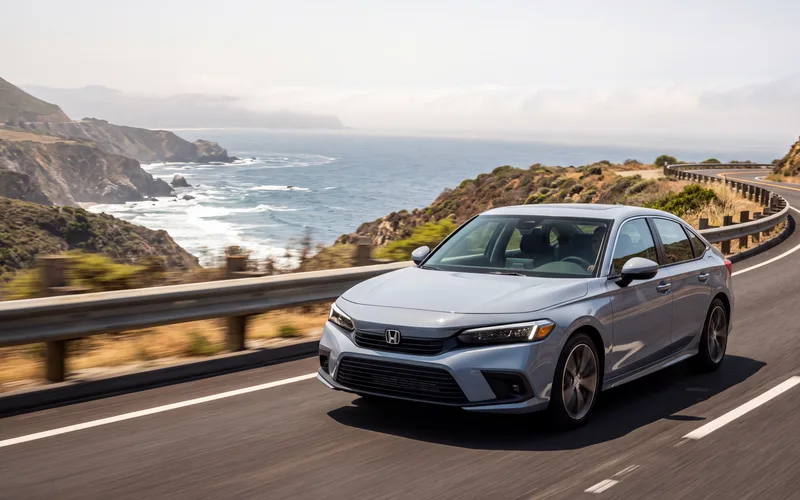 Honda CivicCompact SedanBetter at: Practicality
It delivers most of what makes the Mazda3 appealing while adding a usable back seat, a bigger trunk, a high-40s-MPG hybrid and the segment's best resale value.
Compare 2.40C+
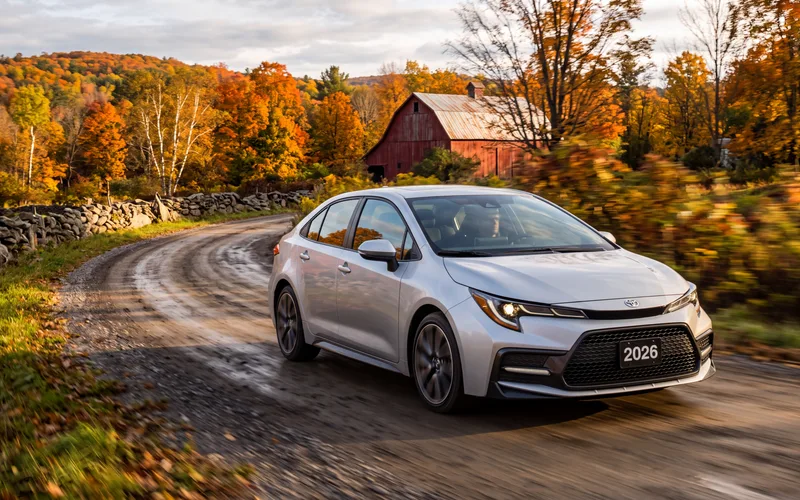 Toyota CorollaCompact SedanBetter at: Ownership cost
Lower running costs across the board — a hybrid near 50 MPG, top-of-class predicted reliability and more than twice as many dealers for service.
Compare 2.13C
2.13C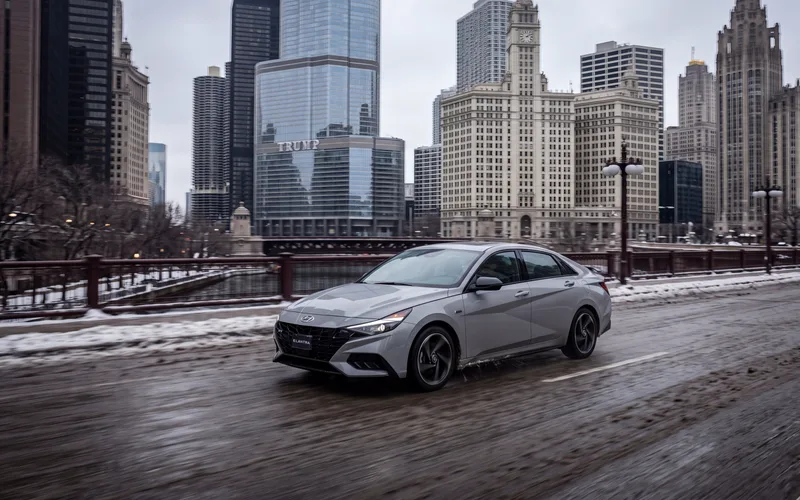 Hyundai ElantraCompact SedanBetter at: Space and warranty
Nearly three more inches of rear legroom, more standard tech, and a 10-year/100,000-mile powertrain warranty for similar money.
CompareHow it's evolved
10 scored model years · 2017–2026
Subject scores by year
Hover or tap a score to see what moved it versus the year before. A corner mark flags a big swing.
| Year | Performance | Efficiency | Safety | Space | Cost | Reliability | Tech | Use-case | Driving | Value |
|---|---|---|---|---|---|---|---|---|---|---|
| 2026 | 44 | 55 | 75 | 59 | 71 | 80 | 63 | 47 | 76 | 72 |
| 2025 | 43 | 51 | 77 | 58 | 69 | 80 | 51 | 46 | 77 | 70 |
| 2024 | 41 | 51 | 77 | 58 | 69 | 78 | 52 | 49 | 77 | 71 |
| 2023 | 43 | 52 | 73 | 59 | 70 | 80 | 52 | 46 | 76 | 71 |
| 2022 | 43 | 48 | 75 | 59 | 71 | 80 | 51 | 46 | 78 | 69 |
| 2021 | 44 | 48 | 75 | 59 | 73 | 73 | 51 | 47 | 78 | 73 |
| 2020 | 39 | 48 | 74 | 58 | 71 | 73 | 47 | 46 | 77 | 72 |
| 2019 | 39 | 48 | 70 | 59 | 70 | 66 | 49 | 49 | 77 | 67 |
| 2018 | 36 | 48 | 59 | 59 | 76 | 75 | 34 | 45 | 77 | 65 |
| 2017 | 29 | 55 | 61 | 59 | 77 | 82 | 37 | 46 | 79 | 71 |
Compare two years
Best fit & conditions
Higher scores mean a better fit for that use case. Learn more about use-case fit →
Subject profile
Trims & configurations
5 trimsScores above reflect the volume trim. Per-trim specs and scores are rolling out — the full lineup:
Academic Probation · NHTSA safety recalls
May 29, 2025Air bags: air bag/restraint control module: softwareThe Sophisticated Air Bag Sensor (SAS) units may set an error code and deactivate the air bags, due to a low battery condition.
Defect
Mazda North American Operations is recalling certain 2024-2025 Mazda3 and CX30 vehicles. The Sophisticated Air Bag Sensor (SAS) units may set an error code and deactivate the air bags, due to a low battery condition.
Risk
Air bags that do not deploy in the event of a crash increase the risk of injury.
Remedy
Dealers will reprogram the SAS unit with improved software or replace the unit, free of charge. Owner notification letters were mailed July 24, 2025. Mazda's number for this recall is 7525E.
NHTSA campaign 25V357000 ↗Manufacturer no. 7525E171,412 vehicles potentially affected (all models in the campaign)Owners notified Jul 22, 2025Filed by Mazda North American OperationsFiled as MAZDA3Sep 3, 2024Exterior lighting: headlights · Forward collision avoidance: automatic emergency braking · Lane departure: sensing system: cameraA malfunction in the forward sensing camera (FSC) may prevent the automatic emergency braking system and the lane-keep assist system from functioning. In addition, the headlights will not automatically adjust from high beams to low beams as intended.
Defect
Mazda North American Operations (Mazda) is recalling certain 2024 Mazda 3, CX-30, and 2025 CX-50 vehicles. A malfunction in the forward sensing camera (FSC) may prevent the automatic emergency braking system and the lane-keep assist system from functioning. In addition, the headlights will not automatically adjust from high beams to low beams as intended.
Risk
Automatic braking, steering assist, and headlight control systems that do not function as intended can increase the risk of a crash.
Remedy
Dealers will inspect and replace the forward sensing camera as necessary, free of charge. Owner notification letters were mailed September 24, 2024. Owners may contact Mazda customer service at 1-800-222-5500, Option 6. Mazda's number for this recall is 6824H.
NHTSA campaign 24V649000 ↗Manufacturer no. 6824H672 vehicles potentially affected (all models in the campaign)Owners notified Sep 24, 2024Filed by Mazda North American OperationsFiled as MAZDA3Oct 26, 2023Back over prevention: sensing system: camera · Forward collision avoidance: sensing system: camera · Lane departure: sensing system: cameraDue to a software error, the rearview, front, and/or side camera images may not appear on the display. As such, these vehicles fail to comply with the requirements of Federal Motor Vehicle Safety Standard number 111, "Rear Visibility."
Defect
Mazda North American Operations (Mazda) is recalling certain 2024 CX-90 and MAZDA3 vehicles. Due to a software error, the rearview, front, and/or side camera images may not appear on the display. As such, these vehicles fail to comply with the requirements of Federal Motor Vehicle Safety Standard number 111, "Rear Visibility."
Risk
A camera that does not display an image can reduce the driver's view, increasing the risk of a crash or injury.
Remedy
Dealers will update the view monitor control module software, free of charge. Owner notification letters were mailed December 20, 2023. Owners may contact Mazda customer service at 1-800-222-5500 Option 6. Mazda's number for this recall is 6223J.
NHTSA campaign 23V718000 ↗Manufacturer no. 6223J11,903 vehicles potentially affected (all models in the campaign)Owners notified Dec 20, 2023Filed by Mazda North American OperationsFiled as MAZDA3
12 recalls on other model years of the Mazda3 (2017–2021)
Jul 14, 2023Back over prevention: sensing system: cameraThe rearview camera image may not display properly by showing a flickering or distorted image.
Defect
Mazda North American Operations (Mazda) is recalling certain 2014-2018 Mazda3 and 2016-2021 CX-3 vehicles. The rearview camera image may not display properly by showing a flickering or distorted image.
Risk
A rearview camera that does not display properly can reduce the driver's rear view, increasing the risk of a crash or injury.
Remedy
Dealers will inspect and replace the rearview camera, as necessary. In addition, dealers will install a wiring harness fastening seal. All repairs will be performed free of charge. Interim notification letters, notifying owners of the safety risk, were mailed September 13, 2023. Final owner letters for affected models and model years in the states of CT, MA, MD, NJ, NY, PA and VA were mailed August 14, 2024. The remaining owner notification letters will be mailed at a future date, anticipated on or before May 1, 2025. Owners may contact Mazda customer service at 1-800-222-5500, Option 6. Mazda's number for this recall is 6023G.
NHTSA campaign 23V487000 ↗Manufacturer no. 6023G236,100 vehicles potentially affected (all models in the campaign)Owners notified Aug 14, 2024Filed by Mazda North American OperationsFiled as MAZDA3Nov 12, 2021Fuel system, gasoline: delivery: fuel pumpThe impeller inside the low-pressure fuel pump may crack and deform, potentially causing the fuel pump to fail.
Defect
Mazda North American Operations (Mazda) is recalling certain 2018 Mazda3, Mazda6, 2019 CX-3, 2018-2019 MX-5, CX-5, CX-9, and 2019-2020 Mazda2 vehicles. The impeller inside the low-pressure fuel pump may crack and deform, potentially causing the fuel pump to fail.
Risk
Fuel pump failure may cause an engine stall, increasing the risk of a crash.
Remedy
Dealers will replace the fuel pumps, free of charge. Owner notification letters were mailed July 18, 2022. Owners may contact Mazda customer service at 1-800-222-5500 Option 4. Mazda's number for this recall is 5321K.
NHTSA campaign 21V875000 ↗Manufacturer no. 5321K121,038 vehicles potentially affected (all models in the campaign)Owners notified Jul 18, 2022Filed by Mazda North American OperationsFiled as MAZDA3Feb 22, 2021Tires: valveAir may suddenly leak from the tire air valve.
Defect
Mazda North American Operations (Mazda) is recalling certain 2021 Mazda3 and CX-30 vehicles. Air may suddenly leak from the tire air valve.
Risk
A sudden air leak from the tire air valve may cause a loss of vehicle control while driving, increasing the risk of a crash.
Remedy
Mazda will notify owners, and dealers will replace all four tire air valves with new parts, free of charge. The recall began April 6, 2021. Owners may contact Mazda customer service at 1-800-222-5500 Option 4. Mazda's number for this recall is 4721B.
NHTSA campaign 21V101000 ↗Manufacturer no. 4721B599 vehicles potentially affected (all models in the campaign)Owners notified Apr 6, 2021Filed by Mazda North American OperationsFiled as MAZDA3Jun 12, 2020Service brakes, hydraulic: foundation components: disc: caliperThe front brake caliper mounting bolts may not have been tightened properly during assembly, possibly allowing the calipers to loosen.
Defect
Mazda North American Operations (Mazda) is recalling certain 2020 CX-30 and Mazda3 vehicles. The front brake caliper mounting bolts may not have been tightened properly during assembly, possibly allowing the calipers to loosen.
Risk
Loose brake calipers can reduce braking performance or interfere with wheel rotation, affecting vehicle handling. Either of these scenarios can increase the risk of a crash.
Remedy
Mazda will notify owners, and dealers will inspect the front brake caliper bolts, tightening them as necessary. If bolts are missing, the affected brake caliper will be replaced. Repairs will be performed free of charge. The recall began July 24, 2020. Owners may contact Mazda customer service at 1-800-222-5500, Option 4. Mazda's number for this recall is 4420F.
NHTSA campaign 20V346000 ↗Manufacturer no. 4420F24,037 vehicles potentially affected (all models in the campaign)Owners notified Jul 24, 2020Filed by Mazda North American OperationsFiled as MAZDA3Dec 19, 2019Forward collision avoidance: automatic emergency brakingThe Smart Brake System (SBS) can falsely detect an obstacle while driving, activating the automatic emergency braking system and suddenly stopping the vehicle.
Defect
Mazda North American Operations (Mazda) is recalling certain 2019-2020 Mazda3 vehicles. The Smart Brake System (SBS) can falsely detect an obstacle while driving, activating the automatic emergency braking system and suddenly stopping the vehicle.
Risk
Stopping the vehicle unexpectedly increases the risk of a crash.
Remedy
Mazda will notify owners, and dealers will update the SBS software. In addition, vehicles with certain production dates will receive an instrument cluster software update or replacement and a replacement owner's manual. These repairs will be performed free of charge. The recall began February 14, 2020. Owners may contact Mazda customer service at 1-800-222-5500, Option 4. Mazda's number for this recall is 4219L.
NHTSA campaign 19V907000 ↗Manufacturer no. 4219L35,390 vehicles potentially affected (all models in the campaign)Owners notified Feb 14, 2020Filed by Mazda North American OperationsFiled as MAZDA3Jul 29, 2019Visibility: glass, side/rearThe adhesive between the interior rearview mirror and the housing may not be properly bonded, allowing the mirror to detach from the housing. Note: Vehicles equipped with auto dimming mirrors are not affected by this recall.
Defect
Mazda North American Operations (Mazda) is recalling certain 2019 Mazda3 vehicles equipped with manual dimming mirrors. The adhesive between the interior rearview mirror and the housing may not be properly bonded, allowing the mirror to detach from the housing. Note: Vehicles equipped with auto dimming mirrors are not affected by this recall.
Risk
Rearward visibility will be reduced without the rearview mirror, increasing the risk of a crash.
Remedy
Mazda will notify owners, and dealers will replace the interior rearview mirror assembly, free of charge. The recall began September 19, 2019. Owners may contact Mazda customer service at 1-800-222-5500, option 4. Mazda's number for this recall is 3919G.
NHTSA campaign 19V558000 ↗Manufacturer no. 3919G22,571 vehicles potentially affected (all models in the campaign)Owners notified Sep 19, 2019Filed by Mazda North American OperationsFiled as MAZDA3Jul 5, 2019Seats: front assembly: head restraintThe seat cover material on both front seats may interfere with the head restraint lock release button, causing it to stick in the release position and not allow the head restraint to lock into place.
Defect
Mazda North American Operations (Mazda) is recalling certain 2019 Mazda3 vehicles. The seat cover material on both front seats may interfere with the head restraint lock release button, causing it to stick in the release position and not allow the head restraint to lock into place.
Risk
Loose head restraints may increase the risk of injury in the event of a crash.
Remedy
Mazda will notify owners, and dealers will install spacers at the bottom of the lock release buttons on both front seat head restraints, free of charge. The recall began August 20, 2019. Owners may contact Mazda customer service at 1-800-222-5500, option 4. Mazda's number for this recall is 3819F.
NHTSA campaign 19V514000 ↗Manufacturer no. 3819F9,430 vehicles potentially affected (all models in the campaign)Owners notified Aug 20, 2019Filed by Mazda North American OperationsFiled as MAZDA3Jun 27, 2019Engine · Power train: automatic transmission: control module (tcm/pcm/tecm)A software error in the powertrain control module (PCM) may cause the engine to stall.
Defect
Mazda North American Operations (Mazda) is recalling certain 2018-2019 CX-5, Mazda6, and 2019 Mazda3 vehicles. A software error in the powertrain control module (PCM) may cause the engine to stall.
Risk
An unexpected stall increases the risk of a crash.
Remedy
Mazda will notify owners, and dealers will reprogram the PCM software, free of charge. The recall began August 20, 2019. Owners may contact Mazda customer service at 1-800-222-5500, option 4. Mazda's number for this recall is 3719F.
NHTSA campaign 19V497000 ↗Manufacturer no. 3719F262,220 vehicles potentially affected (all models in the campaign)Owners notified Aug 20, 2019Filed by Mazda North American OperationsFiled as MAZDA3Jun 7, 2019Wheels: lugs/nuts/bolts/studsThe lug nuts on all four wheels may loosen, potentially resulting in a wheel detaching from the vehicle.
Defect
Mazda North American Operations (Mazda) is recalling certain 2019 Mazda3 vehicles. The lug nuts on all four wheels may loosen, potentially resulting in a wheel detaching from the vehicle.
Risk
A wheel separating from the vehicle increases the risk of a crash.
Remedy
Mazda will notify owners, and dealers will tighten the front and rear wheel lug nuts to the correct specification, free of charge. The recall began July 9, 2019. Owners may contact Mazda customer service at 1-800-222-5500, Option 4. Mazda's number for this recall is 3519F.
NHTSA campaign 19V425000 ↗Manufacturer no. 3519F25,003 vehicles potentially affected (all models in the campaign)Owners notified Jul 9, 2019Filed by Mazda North American OperationsFiled as MAZDA3May 14, 2019Electrical system: instrument cluster/panel · Seat belts: front: warning light/devicesDue to incorrect programing, the passenger air bag deactivation indicator light may erroneously turn off although the passenger air bag is deactivated. In addition, the seat belt status indicators for both the front passenger seat and/or rear seats may erroneously turn off although the front passenger and/or rear seat belts are unfastened.
Defect
Mazda North American Operations (Mazda) is recalling certain 2019 Mazda3 vehicles. Due to incorrect programing, the passenger air bag deactivation indicator light may erroneously turn off although the passenger air bag is deactivated. In addition, the seat belt status indicators for both the front passenger seat and/or rear seats may erroneously turn off although the front passenger and/or rear seat belts are unfastened.
Risk
Incorrect indicator warning lights may lead the driver and/or passengers to be unaware of deactivated air bags or unfastened seat belts, increasing the risk of injury.
Remedy
Mazda will notify owners, and dealers will replace the passenger air bag/seat belt status indicator assembly, free of charge. The recall began July 9, 2019. Owners may contact Mazda customer service at 1-800-222-5500, Option 4. Mazda's number for this recall is 3319E.
NHTSA campaign 19V363000 ↗Manufacturer no. 3319E17,016 vehicles potentially affected (all models in the campaign)Owners notified Jul 9, 2019Filed by Mazda North American OperationsFiled as MAZDA3Apr 4, 2019Visibility: windshield wiper/washerA defective windshield wiper relay may cause the windshield wipers to become inoperative, reducing the driver's visibility.
Defect
Mazda North American Operations (Mazda) is recalling certain 2016-2018 Mazda3 vehicles. A defective windshield wiper relay may cause the windshield wipers to become inoperative, reducing the driver's visibility.
Risk
Reduced visibility while driving can increase the risk of crash.
Remedy
Mazda will notify owners, and dealers will replace the front body control module with a new module which uses an improved wiper relay design, free of charge. The recall began May 7, 2019. Owners may contact Mazda customer service at 1-800-222-5500, option 4. Mazda's number for this recall is 3219D.
NHTSA campaign 19V272000 ↗Manufacturer no. 3219D187,880 vehicles potentially affected (all models in the campaign)Owners notified May 7, 2019Filed by Mazda North American OperationsFiled as MAZDA3Nov 21, 2017Engine and engine cooling: exhaust systemThe incorrect exhaust valve spring may fail while driving, potentially causing an engine stall.
Defect
Mazda North American Operations (Mazda) is recalling certain 2018 Mazda3 vehicles, equipped with an incorrect exhaust valve spring. The incorrect exhaust valve spring may fail while driving, potentially causing an engine stall.
Risk
An engine stall can increase the risk of a crash.
Remedy
Mazda will notify owners, and dealers will inspect the engines and replace any incorrect exhaust valve springs, free of charge. The recall is expected to begin January 20, 2018. Owners may contact Mazda customer service at 1-800-222-5500. Mazda's number for this recall is 1717K.
NHTSA campaign 17V745000 ↗Manufacturer no. 1717K144 vehicles potentially affected (all models in the campaign)Owners notified Jan 22, 2018Filed by Mazda North American OperationsFiled as MAZDA3
Source: NHTSA Office of Defects Investigation recall database, model years 2017–2026. Recalls are listed by model year as the manufacturer filed them; whether a specific car is affected depends on its VIN — check a VIN at nhtsa.gov ↗. NHTSA model names matched to this page: MAZDA3.
Detailed scoring by subject
1Performance & PowertrainThe Mazda3's lowest-graded category.0.72F
The volume 2.5 S sedan trims use the naturally aspirated Skyactiv-G 2.5, rated 191 hp; only the two AWD-only Turbo trims exceed that.
Peak torque of the volume trim's naturally aspirated 2.5 is 186 lb-ft, typical for a compact-sedan NA four and well short of the turbo trims.
Car and Driver's instrumented run of the identical 191-hp NA 2.5 / 6-speed automatic FWD sedan returned 7.5 seconds; the turbo trims are roughly two seconds quicker.
The naturally aspirated Skyactiv-G 2.5 is consistently praised for linear, lag-free throttle response and a smooth, willing character, though it is short on low-end thrust and gets buzzy near redline when asked for a quick pass.
Mazda's Skyactiv-Drive six-speed automatic is one of the better conventional autos in the class — decisive, quick to kick down, never hunting, with a genuinely useful manual mode and Sport mode; its only real limitation is having six ratios where rivals use eight or a CVT.
i-Activ AWD exists but is restricted to the upper half of the 2024 sedan range — the 2.5 S, Select Sport and Preferred are front-drive only, and AWD arrives at the $29,060 Carbon Edition and the two Turbo trims. It is a competent predictive on-road system with no low range, lockers or terrain modes.
Two distinct gas powertrains — the 191-hp NA 2.5 and the 250-hp 2.5 Turbo — cover mainstream and quick-sedan buyers, but the US Mazda3 offers no hybrid, PHEV or EV variant, and the six-speed manual is hatchback-only.
2Efficiency & RangeOne of the Mazda3's weakest categories.1.45D
EPA rates the volume front-drive 2.5-liter sedan at 31 MPG combined — competitive for a naturally aspirated compact sedan, though behind the hybridized Civic and Corolla the Mazda3 has no answer to.
27 MPG city for the front-drive 2.5 is mid-pack for the compact-sedan class; the six-speed automatic and cylinder deactivation help, but there is no electric assist for stop-and-go work.
Highway is the Mazda3's strongest economy figure at 37 MPG — the tall top gear and low drag of the sedan body work well at a steady cruise.
A small 13.2-gallon tank caps total range near 409 miles despite decent economy; AWD and Turbo trims carry a 12.7-gallon tank and go less far still.
EPA puts annual fuel cost at $2,000 for the volume front-drive trim on regular unleaded — moderate running costs, undercut only by hybrid rivals in the segment.
The volume 2.5 S runs on regular 87 octane with no premium requirement. Even the Turbo trims only recommend 93 octane to unlock full output and run safely on 87 at reduced power, so no version of the car carries a mandatory premium bill.
3SafetyOne of the Mazda3's strongest categories.3.21B+
The 2024 Mazda3 sedan was tested by NHTSA and earned a 5-Star Overall Vehicle Score with 5 stars in every subtest — frontal, side barrier, side pole and rollover — for both the FWD and AWD sedan. Scored on the volume 2.5 S Select Sport FWD sedan.
The 2024 Mazda3 sedan is an IIHS Top Safety Pick+ — the top award — with Good results in small overlap front on both driver and passenger sides, the original and updated moderate overlap front tests, and the updated side test. The single blemish is an Acceptable rather than Good rear-passenger restraint result in the updated moderate overlap test, which is why this sits just below the top of the band.
2024 is the year Mazda closed the last gap in this suite: Blind Spot Monitoring, Rear Cross-Traffic Alert and Rear Door Alert became standard on every trim including the $24,170 base 2.5 S, joining Smart Brake Support (AEB with pedestrian detection), Mazda Radar Cruise Control with Stop & Go, Lane Departure Warning, Lane-keep Assist, Driver Attention Alert and High Beam Control. That is the complete AEB/ACC/LKA/BSM/RCTA checklist standard line-wide, which several compact rivals still gate behind a mid-trim.
Standard Smart Brake Support rates Good — the top grade — in the IIHS vehicle-to-pedestrian front crash prevention evaluation, avoiding a collision in every scenario tested including both nighttime runs and the parallel-adult night test at 37 mph, which is where most systems in this class lose points. It stays out of the very top of the band only because the harder updated vehicle-to-vehicle front crash prevention test has not been published for this car.
Blind Spot Monitoring and Rear Cross-Traffic Alert are standard on all six 2024 trims, new for this model year on the three cheapest ones — well above par for a compact sedan. Coverage on the volume trim is alert-only, though: active rear braking (Smart Brake Support-Reverse), the 360-degree View Monitor and traffic sign recognition are confined to Turbo Premium Plus, so there is no intervention behind the warning.
Lane Departure Warning and Lane-keep Assist are standard line-wide, but Mazda does not pair a lane-centering steering assist with its adaptive cruise control on the 2024 Mazda3 — LKA is an edge-of-lane corrective nudge, not sustained centering. The only combined-operation mode, Traffic Jam Assist, is a low-speed system restricted to Premium trims, so the volume car has nothing like the highway centering rivals offer as standard.
Mazda Radar Cruise Control with Stop & Go is standard on every 2024 trim and is a genuine full-speed-range system that will bring the car to a halt and resume in traffic. Two things keep it mid-band: reviewers of the 2024 car report it braking abruptly in heavy traffic when a gentler response would do, and because there is no lane centering to pair with (Traffic Jam Assist aside, on Premium trims), it never becomes an integrated highway-assist mode.
Mazda offered no hands-free highway driving system anywhere in its 2024 US lineup, and the Mazda3 has no equivalent of BlueCruise, Super Cruise or Hyundai/Kia HDA at any trim or option level. Hands must stay on the wheel; the closest feature is low-speed Traffic Jam Assist on Premium trims, which is hands-on.
IIHS rates the 2024 Mazda3's headlights Good only on the 2.5 Turbo Premium, whose curve-adaptive LED projectors it credits; every other trim — including the volume 2.5 S, Select Sport, Preferred, Carbon Edition and Carbon Turbo — gets non-adaptive LED projectors rated Acceptable. That is textbook mid-band: good on the top trim, Acceptable on the car most buyers take. Automatic High Beam Control being standard line-wide keeps it in the upper half of that band.
Outward visibility is the Mazda3's most consistently criticized everyday-safety trait: the style-led fourth-generation body has thick C-pillars, a high beltline and a shallow rear window, and reviewers of the 2024 car flag the over-the-shoulder blind zones (the sedan is better than the hatchback, which is worse still). Compensation is partial — a reversing camera and, new-for-2024 standard, blind spot monitoring help, but the 360-degree View Monitor that would properly offset it is a Turbo Premium Plus item.
IIHS gives the 2024 Mazda3 sedan its best LATCH ease-of-use grade, Good+ — two outboard positions with complete lower anchors and tethers plus a center position with a tether that can borrow lower anchors, all three rated Good for accessibility and requiring little force. What keeps it out of the top band is space rather than hardware: rear legroom trails the Civic, Corolla and Elantra and the sloping roofline narrows the door aperture, so a rear-facing seat is awkward to maneuver in and eats into front-passenger room, and three-across is not realistic.
4Space & ComfortMid-pack among this car's ten categories.1.93C-
The 2024 Mazda3 sedan is a conventional five-passenger compact with a three-place 60/40-split rear bench on every trim; no other seating configuration is offered.
Mazda's own 2024 spec sheet publishes 965 mm front headroom without the moonroof, which is what the volume Select Sport carries; the low, coupe-like BP roofline leaves it mid-band and behind the Elantra (40.6 in).
Front legroom is squarely competitive at 42.3 in — level with the Civic and Elantra — so tall drivers are well served even though rear passengers are not.
Rear headroom lands mid-band and is roughly level with the Civic and Corolla; on the sedan the tapering roofline costs sightlines and head clearance on entry more than it costs seated headroom.
The Mazda3's defining packaging weakness: 35.1 in of rear legroom is nearly three inches short of the Elantra (38.0 in) and over two short of the Civic (37.4 in), and reviewers consistently call the rear bench tight for adults.
At 13.2 cu ft the trunk trails nearly every compact-sedan rival — Civic 14.8, Elantra 14.2, Jetta 14.1 — and is a recurring criticism of the sedan body style.
Mazda traded practicality for a clean, driver-focused console: a small glovebox, a shallow covered bin, modest door pockets and an overhead sunglasses holder. The 60/40 folding rear seatback with a center pass-through and (from Select Sport) a rear armrest with cupholders are the only real flexibility features — no underfloor bins, fold-flat surfaces or onboard power.
The front seats are a genuine class strength — Mazda's spine-alignment design draws repeated praise for long-haul support — but the volume Select Sport gets manual leatherette buckets (8-way power with lumbar and memory only from Preferred), and the cramped rear bench limits adult comfort no matter how the cushions are judged.
Damping and body control are well judged, but the torsion-beam rear axle and the 18-inch/215-45R18 rubber fitted from the volume Select Sport upward make the Mazda3 firmer and busier over broken pavement than a Civic or Corolla — composed and sporting rather than plush.
Sound deadening and a well-sealed body give the Mazda3 a near-premium hush at cruise that reviewers repeatedly single out as above the compact norm, but tire roar on coarse pavement through the 18-inch wheels is a consistent complaint, so it lands solidly mid-band rather than at the top.
The volume Select Sport gets dual-zone automatic climate control but no heated seats — those arrive on the $26,190 Preferred, with the heated steering wheel higher still. The 2024 Mazda3 offers no ventilated seats, no rear-seat air vents and no rear climate controls of any kind, a thinner comfort set than the Elantra's.
5Cost of OwnershipMid-pack among this car's ten categories.2.65C+
The 2024 Mazda3 sedan's entry point is the 2.5 S at $24,170 plus $1,165 destination. 2024 is the year Mazda dropped the 155 hp Skyactiv-G 2.0 entirely, so the cheapest Mazda3 sedan now comes with the 191 hp 2.5 — the base price rose but so did what the base car is.
The 2.5 S Select Sport, new for 2024, is the volume trim and an unusually small $520 step over the base 2.5 S — it adds advanced keyless entry, dual-zone automatic climate, leatherette seating, a leather-wrapped wheel and 18-inch wheels, which is why reviewers steer buyers straight to it. The next step up, the Preferred at $27,355 delivered, adds the moonroof and heated seats.
The naturally aspirated Skyactiv-G 2.5 with a conventional six-speed torque-converter automatic is about as simple as a modern compact drivetrain gets — no turbo on the volume trim, no CVT, no belt-in-oil or dual-clutch — and independent cost data puts the Mazda3 below the compact-car average. Scored a shade dearer than Corolla and Civic because Mazda's smaller US dealer network and parts pricing run slightly higher, and because Mazda includes no complimentary maintenance to absorb the early services.
Two independent residual datasets land on essentially the same number for the Mazda3 sedan — roughly 61–62% retained at five years, which is strong for a mainstream compact and reflects a decade of Mazda residual gains on the back of premium-leaning interiors and an above-average reliability record. It still trails the Corolla, the segment's residual benchmark.
Mazda's New Vehicle Limited Warranty is the industry-baseline 36 months/36,000 miles — the floor of the segment band and half the term of Hyundai's and Kia's coverage. That is a genuine ownership-cost disadvantage, not a scoring artifact.
Mazda covers the powertrain for 60 months/60,000 miles — again the bottom of the band, matching Honda, Toyota and Nissan but half the term of the Korean 10-year/100,000-mile original-owner coverage.
Mazda includes no factory complimentary scheduled maintenance on a 2024 Mazda3 — every oil change and tire rotation is out of pocket from mile one unless the buyer purchases a prepaid plan or happens on a dealer-level promotion. Roadside assistance is narrower than the segment norm too: Mazda's program covers towing only when a warranted part has failed, rather than the lockouts, jump starts and fuel delivery ToyotaCare-style plans include. The one real inclusion is a three-year Mazda Connected Services subscription, which is longer than most rivals' trials and is what lifts this above a bare-zero score.
$25,855 volume-trim price minus its estimated resale value after 5 years (61% retained, or about $15,772) leaves about $10,083 in depreciation. Add the projected $3,900 in 5-year maintenance and repairs, and owning this vehicle for 5 years costs about $13,983 in total.
6Reliability & QualityThe Mazda3's best-graded category.3.28B+
The three major predictors disagree in a narrow band rather than pointing one way. J.D. Power rates the 2024 Mazda3 74/100 for quality & reliability — squarely inside its own 70-80 "Average" band — while Consumer Reports rates the 2024 car above average and RepairPal places it 9th of 36 compacts at 4.0/5.0. CR's own trouble-spot detail is what keeps this out of the 80s: in-car electronics and noises/leaks are both flagged for this model year. Lands above the sedan median (71.6) on the strength of the CR and RepairPal reads, short of p75 because the JDP number is merely average.
Both major studies now place Mazda in the top tier, which is a change from the brand's older split reputation. J.D. Power's 2025 Vehicle Dependability Study ranked Mazda 2nd among mass-market brands at 161 PP100 — a 24 PP100 improvement and four positions gained — and Consumer Reports' 2025 brand rankings put Mazda 6th overall, immediately behind Subaru, Lexus, Toyota, Honda and Acura. Held just under the 85+ mark because Mazda's initial-quality standing is weaker than its dependability standing: it was not among the top mass-market brands in the 2024 IQS.
Three NHTSA campaigns touch the 2024 Mazda3, and two of the three disable a safety system rather than being cosmetic: 24V649 leaves automatic emergency braking and lane-keep assist inoperative via a forward-sensing-camera fault, and 25V357 can deactivate the airbags outright when the airbag sensor sees a low-battery condition. 23V718 is an FMVSS 111 rearview-camera display violation. All three are electronics/software remedies with nothing powertrain- or fire-related, and complaint volume is low (20 NHTSA complaints), but three campaigns — two of them on active safety — is above the "few, minor" band. TSB traffic is minor: a right-side dash rattle traced to the passenger airbag and a valve-train tapping noise.
The volume 2.5 S pairs the naturally aspirated 2.5L Skyactiv-G (191 hp / 186 lb-ft) with a conventional six-speed torque-converter automatic — no CVT and no dual-clutch, which is a genuine long-term durability edge over the Civic, Corolla, Sentra and Elantra transmissions this car is shopped against. The PY-series 2.5 has been in continuous production since 2012 with a strong high-mileage record. Kept out of the 90s by the cylinder-deactivation system fitted since 2018, which carries documented TSB history for oil seepage at the engine front cover, plus the valve-train noise bulletin on this model year.
This remains the Mazda3's clearest advantage over the compact class and the reason it reads as a segment outlier. Reviewers consistently describe generously padded surfaces, high-grade trim and well-damped switchgear, explicitly rating the cabin a step above the Civic and Corolla and comparable to entry-luxury interiors. Short of the 90s only because hard plastics persist in the lower door and console zones and the base 2.5 S ambience is plain.
Assembly is praised in the press — reviewers single out excellent fit and finish and tightly assembled panels — but 2024 owner data does not fully agree. Consumer Reports flags noises/leaks as a trouble spot for this exact model year, with window leaks needing repeat dealer visits and intermittent door rattles, and Mazda has an open bulletin for a right-side dash rattle originating at the passenger airbag. Solid construction with scattered, real, documented complaints puts this in the upper half of the middle band rather than the 80s.
Two opposed facts. Coverage is thin: roughly 550 Mazda stores nationwide against about 1,200 Toyota and roughly 1,000 Honda dealers, so a buyer outside a major metro can face a materially longer drive for warranty work than a Civic or Corolla owner would. But the service experience itself is genuinely good — Mazda ranked 3rd of the mass-market car brands in the J.D. Power 2024 Customer Service Index at 867, behind only MINI and Subaru — and the Retail Evolution program passed its 300th open-concept store in May 2024. Density sets the ceiling; satisfaction lifts it above the mid-band floor.
Running costs are a strength: RepairPal puts the Mazda3's average annual repair and maintenance cost at $433 — below both the compact-car and all-vehicle averages — with low repair severity and average frequency, meaning major bills are uncommon. What holds it just under the 80+ band is aftermarket breadth rather than price: Mazda's US volume is a fraction of Toyota's or Honda's, so the parts catalogue is thinner and some model-specific components remain effectively dealer-order with longer lead times than the Civic/Corolla equivalents.
7Technology & InfotainmentGrades below the middle of the scale.1.50D
For 2024 the larger 10.25-inch display was newly offered but confined to the two Turbo trims — the volume FWD 2.5 S trims, including the Select Sport, still carry the 8.8-inch widescreen. Screen size is also only half the story here: the native Mazda Connect interface is not touch-operated at all, being controlled by the rotary Commander dial.
Mazda Connect is crisp, quick and refreshingly physical — a rotary Commander dial, a real volume knob and separate climate controls make it among the least distracting systems in the class. The deliberate absence of touch input is the recurring complaint, and on the 2024 volume trim it bites harder than on later years because the 8.8-inch screen has no touch capability even inside CarPlay or Android Auto.
2024 is the year Mazda began rolling wireless phone projection down the Mazda3 range, but it stopped above the volume trims: the 2.5 S, Select Sport and Preferred are wired-only, with wireless Apple CarPlay and Android Auto arriving on the $29,060 AWD Carbon Edition and the Turbo trims. That is the textbook 'wired standard, wireless on upper trims' middle band — behind the Corolla, which made wireless CarPlay standard.
Factory navigation is reserved for the top 2.5 Turbo Premium Plus for 2024; lower trims are only 'navigation-ready' and require a dealer-sold SD card accessory. Mazda's voice recognition is a fixed command-list system rather than a natural-language assistant, so nearly all owners of a volume trim navigate via a tethered phone.
The base 2.5 S makes do with six speakers, the volume Select Sport and the mid trims step to eight, and the 12-speaker Bose Centerpoint system on the Turbo Premium Plus is one of the better premium setups in the compact class. A respectable spread, held out of the top band by a thin entry-level system and by Bose being locked to the $35,450 trim.
The Mazda3 uses a 7-inch TFT LCD panel set inside an otherwise conventional three-pod gauge binnacle — sharp and attractively rendered, but small and only lightly configurable, and nothing like the 10-to-12-inch reconfigurable clusters the Elantra and K5 offer at similar money.
Mazda had not extended meaningful over-the-air software delivery to the Mazda3 for 2024: infotainment firmware and map data are handled by dealer service or USB/SD card, and Mazda Connected Services covers telematics rather than software. This is the weakest single technology attribute on the car and the clearest gap against Hyundai, Kia and Toyota.
MyMazda with Mazda Connected Services covers the core set — remote engine start, remote lock/unlock, vehicle status, vehicle finder and service scheduling — on an included trial that then converts to a paid subscription. There is no phone-as-key, and the app is routinely criticized for slow command response.
Two front USB-C inputs cover the front row, but the volume Select Sport gets no wireless charging pad — Qi arrives with the Carbon Edition — and there is no rear-seat charging port and no household outlet anywhere in the range. The empty rear row is the main deduction.
Push-button start and remote keyless entry are standard on the base 2.5 S, and the volume Select Sport upgrades to Mazda Advanced Keyless Entry with proximity door handles; remote engine start is available through the MyMazda app. No phone-as-key, and as a sedan there is no hands-free liftgate, so it sits solidly mid-band.
A wide-angle reversing camera is standard and 2024 newly made Blind Spot Monitoring and Rear Cross-Traffic Alert standard on every trim, but parking sensors and the 360-degree View Monitor are locked to the $35,450 Turbo Premium Plus — so the volume Select Sport has no proximity sensors at all, and there is no automated parking on any trim.
The windshield-projected Active Driving Display with Traffic Sign Recognition is a genuine rarity in a compact — Civic, Corolla, Elantra, Sentra and Forte offer nothing like it — but for 2024 the sedan restricts it to the top 2.5 Turbo Premium Plus, so a volume buyer cannot get it at any price short of the range-topper.
8Use-Case FitOne of the Mazda3's weakest categories.1.29D
The hardware itself is good — IIHS rates the Mazda3's LATCH provision 'Good+', with two full sets of lower anchors plus a center tether and borrowable anchors — but the surrounding packaging fights family duty: 35.1 in of rear legroom makes rear-facing seats a squeeze against the front chairs, the 13.2 cu ft trunk is among the smallest in the class for a stroller, and the tapering roofline forces adults to duck when buckling a child in.
This is the Mazda3's strongest family argument: a 2024 IIHS Top Safety Pick+ and a five-star NHTSA overall rating, and for 2024 Mazda made Blind Spot Monitoring, Rear Cross-Traffic Alert and Rear Door Alert standard on the $24,170 base trim on top of an already-complete i-Activsense suite. Only the absence of the 360-degree camera and parking sensors below the range-topper keeps it out of the top band.
Four-up over several hours is where the Mazda3 sedan runs out of car: rear passengers get the least legroom in the mainstream compact class, no air vents, no USB port and no rear climate controls, and the trunk cannot hold four people's luggage. Front-seat comfort and cruising refinement are good, but they only serve two of the occupants.
Commuting is the Mazda3's natural habitat. The naturally aspirated 2.5 is lag-free off the line, the six-speed automatic is decisive rather than droning like a CVT, the physical climate and volume controls need no menu-diving, and Mazda Radar Cruise Control with stop-and-go is standard on every trim including the base car — unusual generosity at $24,170.
31 MPG combined on regular fuel and roughly $2,000/yr in fuel at EPA assumptions is respectable and the maintenance burden is low, but there is no hybrid Mazda3 in the US — the Corolla Hybrid and Elantra Hybrid both roughly halve the fuel bill, which caps this at merely average for the class.
A 183.5-inch footprint and a tight 34.8-foot curb-to-curb turning circle make the Mazda3 genuinely easy to thread and park, and the standard wide-angle reversing camera helps. The deductions are real though: thick rear pillars and a high beltline make over-the-shoulder vision poor, and the volume Select Sport has no parking sensors at all.
The Mazda3 sedan has no US tow rating, no bed, and a 13.2 cu ft sealed trunk with a narrow aperture. A 191-hp compact sedan is not a work tool in any sense the framework measures; the only work it does is carrying a laptop bag and a sample case.
The mechanical package is a point in its favor — the naturally aspirated Skyactiv-G 2.5 and the conventional six-speed automatic are long-serving, well-proven units with a good reliability record, and Mazda has no CVT or dual-clutch fragility to worry about. But the cabin is trimmed for a driver in office clothes: leatherette and carpet, no rubber-floor or vinyl-seat work option, and there is no fleet or commercial reputation behind the nameplate.
Effectively nothing here: no onboard AC power, no bed or tie-down system, no roof rails, no factory hitch, no upfit ecosystem, and a carpeted sealed trunk that is the opposite of a washable surface.
For one or two people the Mazda3 is a capable tourer: front seats that reviewers praise for long-haul support, an unusually well-isolated cabin for the class, radar cruise with stop-and-go standard, and roughly 400 miles between fills. Firm ride on 18-inch wheels, a fixed-command voice system, no lane centering below the Turbo's Traffic Jam Assist, and a rear seat nobody wants for eight hours keep it mid-band.
The volume Select Sport is front-wheel drive — i-Activ AWD does not appear until the $29,060 Carbon Edition — and even then the Mazda3 is a low-slung sedan with roughly 5.5 inches of clearance, no roof rails, no tow rating and no terrain modes. It will handle a graded gravel road to a trailhead and nothing beyond that.
A 60/40 folding rear seatback with a center pass-through is the whole toolkit, working through a 13.2 cu ft trunk and a sedan's small letterbox opening. Nothing bulky — a bike, a cooler stack, a load of lumber — goes in, and there are no roof rails or hitch to put it outside instead. Buyers who need this should be steered to the hatchback's 20.1 cu ft.
9Driving ExperienceOne of the Mazda3's strongest categories.3.26B+
The Mazda3 is the mainstream compact sedan enthusiasts point to: a neutral chassis with almost no built-in understeer, tightly restrained body roll, and G-Vectoring Control Plus quietly smoothing weight transfer. It earns a top-of-segment mark rather than an absolute one — a 191-hp front-driver on 215/45R18 tires with a torsion-beam rear axle has a real grip ceiling next to a rear-drive sport sedan.
Steering is the Mazda3's single best dynamic quality and the reason it out-drives its price. The electrically assisted column rack is weighted squarely mid-spectrum, builds effort naturally off-center, and — rare for a mainstream compact — passes back some genuine surface information.
Reviewers consistently describe the brakes as strong with a firm, progressive pedal, and the FWD 2.5 runs 280 mm ventilated front discs with solid rear discs — no rear drums as some rivals still use. No instrumented 70-0 figure for the naturally aspirated sedan was located, so this sits in the upper-middle band rather than the top.
The naturally aspirated Skyactiv-G 2.5 with cylinder deactivation is linear and completely lag-free — a real advantage over small turbos in traffic — and the Skyactiv-Drive six-speed is among the crispest conventional automatics in the class, quick to downshift and never hunting. It gives up ground only on outright thrust, needing revs where a turbo rival simply pulls.
At cruise and light throttle the four-cylinder is effectively absent, and cylinder deactivation transitions are unobtrusive. The mark is capped because the engine has to be worked to make its 191 hp, and reviewers consistently note it turns coarse and buzzy near the redline rather than sounding pleasing under load.
Mazda publishes a single minimum turning circle of 10.6 m curb-to-curb for the 2024 Mazda3 — 34.8 ft — with no wheel-size variant given, which is tight for the class and makes the car notably easy to turn around in city streets.
The driver's environment is a clear strength: a genuinely driver-focused cockpit with a well-placed wheel, real climate and volume knobs, tilt-and-telescoping steering and a supportive seat, plus paddle shifters and a Drive Selection switch within reach. The offsets are the low seating position, thick rear pillars and a high beltline that hurt over-the-shoulder vision — a documented weak point on this car.
Even in naturally aspirated form the Mazda3 is the compact sedan enthusiasts actually recommend — it rewards a good line, the controls are honest, and reviewers repeatedly describe ordinary errands in it as enjoyable. It stops short of the top band because 191 hp through the front wheels and a six-speed auto give it charm rather than genuine excitement.
10Value & Market PositionGrades above the middle of the scale.2.83B-
2024 is the year the base Mazda3 sedan got materially better equipped: the 155 hp 2.0-liter was deleted so every car now has the 191 hp Skyactiv-G 2.5, and blind spot monitoring, rear cross-traffic alert and rear door alert joined the already-standard i-Activsense suite (radar cruise with stop-and-go, smart brake support, lane departure warning, lane-keep assist, driver attention alert, high beam control) on the $25,335 2.5 S. Held out of the upper band because the base infotainment is still the 8.8-inch non-touch Commander-knob display with wired CarPlay/Android Auto — the 10.25-inch touch-capable screen, wireless mirroring and Qi charging arrived for 2024 only on the Carbon Edition and Turbo trims — and heated seats, moonroof, power driver's seat and the head-up display all still require Preferred or higher.
The 2024 car's value case is strong on the things you feel: 191 hp standard against the Civic LX's 150 and Corolla LE's 169, a torque-converter automatic rather than a CVT, an interior reviewers repeatedly call luxury-adjacent, and available i-Activ AWD that no direct front-drive rival offers — all for $25,335 delivered, essentially level with a Civic LX and about $1,300 under a Civic Sport. It is not a bargain leader, because the spec-sheet items go the other way: no hybrid at all when a Corolla Hybrid returns roughly 50 MPG for similar money, the tightest rear seat and smallest trunk in the class, an industry-floor 3-year/36,000-mile warranty, and no complimentary maintenance to offset it.
2024 is the broadest the Mazda3 sedan lineup has been — six trims spanning $25,335 to $36,615 delivered, two genuinely different engines (191 hp naturally aspirated 2.5 and the 250 hp 2.5 Turbo), and i-Activ AWD standard on the top three trims, which is more drivetrain choice than any front-drive-only compact rival offers. Mazda added two new sedan variants for the year: the value-focused 2.5 S Select Sport and the 2.5 Carbon Turbo. The gaps are electrification and transmission — nothing hybrid, plug-in or electric anywhere in the range, and the six-speed manual is a hatchback-only offering.
In pure volume the Mazda3 is a distinctly second-tier compact — 38,877 US sales across both body styles in calendar 2024, roughly a sixth of what the Corolla and Civic each move. What keeps this out of the bottom band is trajectory: the sedan specifically was one of the fastest-growing cars in the segment, up 39.8% year over year, inside a record Mazda US year, so this is a niche choice gaining ground rather than a slow seller in decline.
Mazda punches well above its volume on image — a decade of premium-leaning design and interiors has made it the mainstream brand enthusiasts recommend, it sits in the reliability top tier, and 2024 was a record US sales year, all of which supports both satisfaction and the strong residuals this car posts. It stops short of the top band because Mazda was not actually the top-ranked brand in 2024's headline surveys, the brand remains small with thinner awareness outside major metros, and resale still trails Toyota.
Buyers in 2024 got real but unspectacular help: Mazda ran subvented APR and advertised lease programs on the Mazda3 rather than large cash rebates, and the below-segment-leader volume left more transaction-price headroom than a Civic shopper faces. It sits mid-band because 2024 was a high-rate year in which even the subvented financing was mid-single-digit, and because Mazda3 sedan demand was up nearly 40% — a model selling that well does not get discounted hard.
2024 is the sixth model year of the fourth-generation BP Mazda3, which arrived as a 2019 US model — mid-to-late cycle by compact-class standards, and on a platform with no electrified variant while rivals were adding hybrids. But 2024 is a real change year rather than a carry-over: the base 2.0-liter engine was deleted in favour of the 191 hp 2.5 with cylinder deactivation, two new sedan trims arrived, key driver aids became standard line-wide, and the 10.25-inch touch-capable display with wireless mirroring and Qi charging entered the range. That earns a solid mid-band score — current, not cutting-edge, with no imminent replacement announced.
The 2024 Mazda3 is one of the best-credentialed compacts of its year: an IIHS Top Safety Pick+ in both body styles as part of a Mazda sweep that took more TSP+ awards than any other single brand, a Car and Driver Editors' Choice pick, and top-tier placement in the major buyer's-guide rankings. It earns the low 80s rather than higher because it is more often the critics' favourite than the outright comparison-test winner — the class-trailing rear seat and trunk, the missing hybrid option, and the non-touch Commander-knob infotainment on volume trims repeatedly cost it head-to-head verdicts against the Civic.