
The verdict
A struggling sports car, strong on reliability and held back by use-case.
The 2023 Camaro is a superb-driving, cheap-to-buy rear-drive coupe that asks you to live with a genuinely difficult cabin. Priced from $27,195 for a 275-hp turbo four and just $37,195 for the 455-hp V8, it undercuts a Mustang GT by thousands while out-handling it, and it holds its value better than almost anything in the segment. The price of that is 29.9 inches of rear legroom, a 9.1 cu-ft trunk, the worst outward visibility Consumer Reports has measured in a sporty car, and no automatic emergency braking at any price. Buy it as a second car or a weekend car you can drive daily — not as the only car in the driveway.
Jump to scoresStrengths
- Holds its value like almost nothing else in the segment
- The best-handling car in the muscle-car field
- Performance per dollar with a genuinely wide ladder
What holds it back
- No automatic emergency braking — at any trim, at any price
- Premium fuel on the base engine makes it expensive to feed
- The back seat and trunk barely count
Top alternatives
Cars shoppers cross-shop with the Chevrolet Camaro 2.47C+
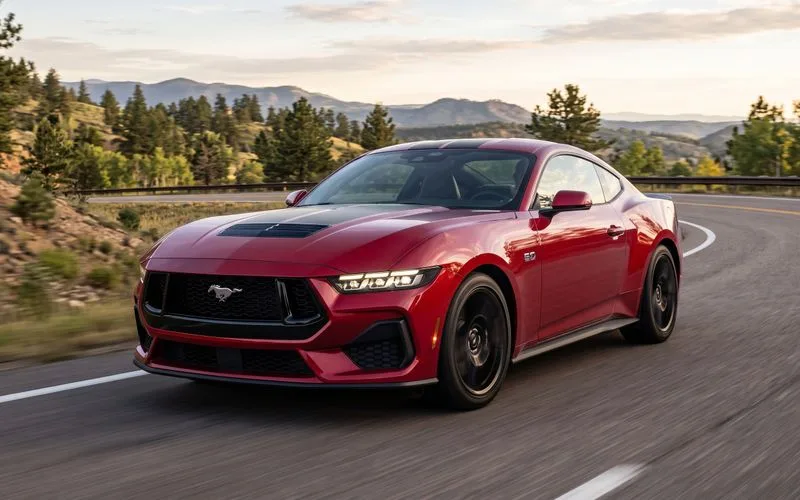 Ford MustangSports CarBetter at: Daily usability
Similar money buys a still-in-production coupe with standard automatic emergency braking, adaptive cruise, a modern digital cabin, a usable 13.3 cu ft trunk and a rear seat an adult can briefly sit in.
Compare 2.49C+
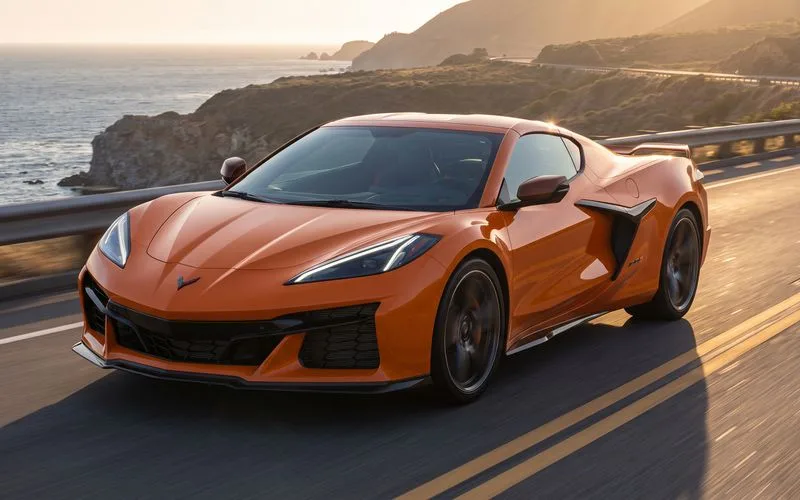 Chevrolet CorvetteSports CarBetter at: Outright performance
If the budget stretches past the SS, the mid-engine Corvette delivers a better interior, higher limits and two real cargo compartments while staying inside the same Chevrolet service network.
Compare 1.92C-
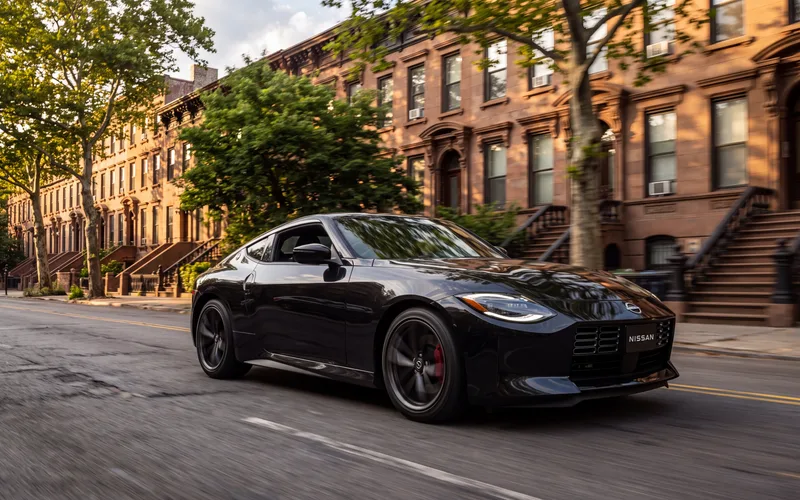 Nissan ZSports CarBetter at: Standard safety
A twin-turbo rear-drive coupe at similar money with the standard safety tech and modern cabin the Camaro never got, for buyers who do not need the back seat.
CompareHow it's evolved
8 scored model years · 2017–2024
Subject scores by year
Hover or tap a score to see what moved it versus the year before. A corner mark flags a big swing.
| Year | Performance | Efficiency | Safety | Space | Cost | Reliability | Tech | Use-case | Driving | Value |
|---|---|---|---|---|---|---|---|---|---|---|
| 2024 | 56 | 27 | 36 | 43 | 60 | 75 | 57 | 27 | 72 | 58 |
| 2023 | 49 | 31 | 36 | 43 | 64 | 75 | 57 | 27 | 67 | 62 |
| 2022 | 49 | 31 | 37 | 44 | 63 | 59 | 58 | 22 | 69 | 57 |
| 2021 | 49 | 31 | 36 | 45 | 64 | 69 | 53 | 31 | 69 | 59 |
| 2020 | 49 | 30 | 38 | 45 | 66 | 62 | 51 | 29 | 62 | 56 |
| 2019 | 51 | 34 | 38 | 48 | 61 | 59 | 49 | 28 | 70 | 54 |
| 2018 | 51 | 33 | 35 | 44 | 63 | 69 | 48 | 26 | 71 | 62 |
| 2017 | 51 | 31 | 38 | 44 | 78 | 65 | 43 | 25 | 65 | 71 |
Compare two years
Best fit & conditions
Higher scores mean a better fit for that use case. Learn more about use-case fit →
Subject profile
Academic Probation · NHTSA safety recalls
No NHTSA safety recall is on record for the 2023 Chevrolet Camaro. Other model years of the Camaro have 7 — listed below.
7 recalls on other model years of the Camaro (2017–2022)
Mar 20, 2025Steering: electric power assist systemThe electric power steering (EPS) assist may fail.
Defect
General Motors LLC (GM) is recalling certain 2016-2018 Cadillac CTS, 2017-2018 Cadillac ATS, Chevrolet Camaro, and Chevrolet Corvette vehicles. The electric power steering (EPS) assist may fail.
Risk
A loss of power steering assist can require greater steering effort, especially at low speeds, increasing the risk of a crash.
Remedy
Dealers will replace the power steering gear assembly, free of charge. Owner notification letters were mailed April 15, 2025. Owners may contact Cadilac customer service at 1-800-333-4223 or Chevrolet customer service at 1-800-222-1020. GM's number for this recall is N252497020.
NHTSA campaign 25V175000 ↗Manufacturer no. N252497020934 vehicles potentially affected (all models in the campaign)Owners notified Apr 15, 2025Filed by General Motors, LLCFiled as CAMAROMar 6, 2025Power train: automatic transmissionThe transmission may become damaged internally and cause the wheels to lock-up.
Defect
General Motors LLC (GM) is recalling certain 2019-2020 Cadillac CT6, 2020-2021 CT4, CT5, and 2020-2022 Chevrolet Camaro vehicles equipped with a 10-speed transmission. The transmission may become damaged internally and cause the wheels to lock-up.
Risk
Wheel lock-up while driving increases the risk of a crash.
Remedy
Dealers will install transmission control module monitoring software, free of charge. Owner notification letters were mailed April 7, 2025. Owners may contact Cadillac customer service at 1-800-333-4223 or Chevrolet customer service at 1-800-222-1020. GM's number for this recall is N242480630.
NHTSA campaign 25V148000 ↗Manufacturer no. N24248063090,081 vehicles potentially affected (all models in the campaign)Owners notified Apr 7, 2025Filed by General Motors, LLCFiled as CAMAROMar 25, 2021Air bags: frontalThe plastic "Camaro" emblem, located on the steering wheel air bag cover, may separate during deployment of the frontal driver air bag.
Defect
General Motors, LLC (GM) is recalling certain 2017-2021 Chevrolet Camaro vehicles. The plastic "Camaro" emblem, located on the steering wheel air bag cover, may separate during deployment of the frontal driver air bag.
Risk
In the event of a crash, plastic pieces of emblem may act as projectiles from deployment of the driver air bag can increase the risk of injury.
Remedy
GM will notify owners, and dealers will replace the frontal driver side air bag module, free of charge. The recall began April 14, 2021. Owners may contact Chevrolet customer service at 1-800-222-1020. GM's number for this recall is N212327220.
NHTSA campaign 21V211000 ↗Manufacturer no. N21232722030 vehicles potentially affected (all models in the campaign)Owners notified Apr 14, 2021Filed by General Motors, LLCFiled as CAMAROMar 18, 2021Power train: axle assembly: axle shaftThe left or right axle shaft may be missing a retaining ring, which could allow the axle shaft to separate while driving.
Defect
General Motors, LLC (GM) is recalling certain 2021 Chevrolet Camaro vehicles. The left or right axle shaft may be missing a retaining ring, which could allow the axle shaft to separate while driving.
Risk
A separated axle shaft can cause a loss of drive power, increasing the risk of a crash.
Remedy
GM will notify owners, and dealers will replace the left or right axle shaft as necessary, free of charge. The recall began April 21, 2021. Owners may contact Chevrolet customer service at 1-800-222-1020. GM's number for this recall is N212331000.
NHTSA campaign 21V188000 ↗Manufacturer no. N2123310008 vehicles potentially affected (all models in the campaign)Owners notified Apr 21, 2021Filed by General Motors, LLCFiled as CAMARODec 23, 2020Seat belts · Seat belts: critical fastenersIncorrect bolts may have been used at one or more fastening locations to secure the seat belts to the vehicle. If an incorrect bolt was used, the seat belt may not be properly attached to the vehicle.
Defect
General Motors, LLC (GM) is recalling certain 2020 Chevrolet Bolt EV and 2021 GMC Canyon and Sierra 1500, 2500 and 3500, Yukon, Yukon XL, Cadillac Escalade and Escalade ESV and Chevrolet Blazer, Camaro, Colorado, Equinox, Silverado 1500, 2500 and 3500, Suburban and Tahoe vehicles. Incorrect bolts may have been used at one or more fastening locations to secure the seat belts to the vehicle. If an incorrect bolt was used, the seat belt may not be properly attached to the vehicle.
Risk
If a seat belt assembly is not properly attached to the vehicle, the seat belt may not properly restrain an occupant in the event of a crash, increasing the risk of injury.
Remedy
GM will notify owners, and dealers will replace the suspect bolts, free of charge. The recall began January 29, 2021. Owners may contact GMC customer service at 1-800-462-8785, Cadillac customer service at 1-800-458-8006, or Chevrolet customer service at 1-800-222-1020. GM's number for this recall is N202322230.
NHTSA campaign 20V811000 ↗Manufacturer no. N202322230470 vehicles potentially affected (all models in the campaign)Owners notified Jan 29, 2021Filed by General Motors, LLCFiled as CAMARONov 21, 2019Fuel system, gasoline: delivery: fuel pumpThe fuel pump may be missing a pressure regulator, allowing for over-pressurization of the fuel system.
Defect
General Motors LLC (GM) is recalling certain 2020 Cadillac Escalade, Escalade ESV, Chevrolet Camaro, Silverado 1500, Suburban, Tahoe, GMC Sierra 1500, Yukon, and Yukon XL vehicles. The fuel pump may be missing a pressure regulator, allowing for over-pressurization of the fuel system.
Risk
Over-pressurization can crack the fuel pump and cause leaks, increasing the risk of a fire in the presence of an ignition source.
Remedy
GM will notify owners, and dealers will replace the fuel pump, free of charge. The recall began December 18, 2019. Owners may contact Cadillac customer service at 1-800-333-4223, Chevrolet customer service at 1-800-222-1020, or GMC customer service at 1-888-988-7267. GM's number for this recall is N192283991.
NHTSA campaign 19V837000 ↗Manufacturer no. N192283991502 vehicles potentially affected (all models in the campaign)Owners notified Dec 18, 2019Filed by General Motors LLCFiled as CAMAROFeb 7, 2019Steering: electric power assist systemThe electric power steering (EPS) assist system may fail.
Defect
General Motors LLC (GM) is recalling certain 2016-2018 Cadillac CTS, and 2017 Cadillac ATS, Chevrolet Camaro, and Chevrolet Corvette vehicles. The electric power steering (EPS) assist system may fail.
Risk
Loss of power steering assist would require a higher steering effort, especially at lower speeds, which may increase the risk of a crash.
Remedy
GM will notify owners, and dealers will replace the power steering gear assembly, free of charge. The recall began June 13, 2019. GM' number for this recall is N182182760.
NHTSA campaign 19V086000 ↗Manufacturer no. N18218276026,772 vehicles potentially affected (all models in the campaign)Owners notified Jun 13, 2019Filed by General Motors LLCFiled as CAMARO
Source: NHTSA Office of Defects Investigation recall database, model years 2017–2024. Recalls are listed by model year as the manufacturer filed them; whether a specific car is affected depends on its VIN — check a VIN at nhtsa.gov ↗. NHTSA model names matched to this page: CAMARO.
Detailed scoring by subject
1Performance & PowertrainGrades below the middle of the scale.1.29D
Scored on the volume configuration — the 2.0L turbo four that is standard on the 1LS/1LT/2LT/3LT line, with the 1LT the best-selling 2023 trim — not the 455 hp V8. 2023 is a mechanical carry-over year in the sixth generation: the only changes were two new colors (Radiant Red Tintcoat, Sharkskin Metallic) and two new 20-inch wheel designs, so the figure is unchanged from 2022. This rescore corrects a prior pass that headlined the LT1 V8, which invented a power surge the car never had between 2022 and 2024.
Volume-trim figure for the 2.0L turbo four. Its 295 lb-ft actually outranks the optional V6's 284 lb-ft and arrives at 3,000 rpm rather than 5,300, so the base engine is the more flexible of the two in daily driving — the V6 buys revs and noise, not low-end pull. Rescored off the V8 for volume-trim consistency with 2019–2022.
5.4 seconds for the turbo-four volume trim, corroborated across dealer and aggregator spec sheets and unchanged from 2019–2022 since the powertrain is identical. No Car and Driver instrumented test of a 2023 turbo-four coupe surfaced, so the figure rests on multiple secondhand sources agreeing rather than a single instrumented run — hence MEDIUM.
Judged on the volume 2.0L turbo four, which is quick enough on paper but is the least refined engine in the range: reviewers consistently flag uneven throttle tip-in, a perceptible boost-building pause off the line and a coarse, synthetic-sounding note under load that suits the car's muscle-car framing poorly. The optional V6 and the LT1 V8 are both markedly smoother and more characterful, which is why the 2024 car — where the V6 became the volume engine — rates higher on this item.
The volume 2.0T pairs a standard TR-3160 six-speed manual with the optional 8L45 eight-speed automatic. The manual has well-defined gates and is well-regarded; the eight-speed is smooth and decisive enough but is a clear step behind the 10-speed fitted to the V6 and V8 cars for ratio spacing and low-speed polish, and it will hold tall gears in the eco-oriented drive modes. Scored on that volume pairing rather than on the V8's TR-6060/10L80 combination.
Rear-wheel drive only across all eight 2023 trims from 1LS to ZL1, with no all-wheel-drive option anywhere in the sixth generation or in the Camaro's history. That is a deliberate rear-drive pony-car brief rather than an oversight, but this item measures availability and there is none — the same position as the Mustang and the Nissan Z. Aligned with the identical 2020–2022 cars.
Four genuinely distinct gasoline engines in 2023 — 275 hp 2.0L turbo I4, 335 hp 3.6L V6, 455 hp naturally aspirated 6.2L LT1 and 650 hp supercharged 6.2L LT4 — across eight trims, with six-speed manual, eight-speed and ten-speed automatic options. That is broader than the 2024 car, which dropped the turbo four and the 1LS, and matches the 2023 Mustang's spread. It stays mid-band because there is no electrification of any kind: no hybrid, no PHEV, no EV variant.
2Efficiency & RangeOne of the Camaro's weakest categories.0.01F
Rescored on the volume configuration — the 275 hp 2.0L LTG turbo four with the 8L45 eight-speed automatic, standard on the 1LS/1LT/2LT/3LT line — matching the rescored 2023 cat1 and the identically-equipped 2019–2022 cars. The prior pass headlined the 6.2L LT1 V8 at 20 MPG, which is a halo-engine figure and invented a five-MPG efficiency collapse the sixth generation never had. 2023 is a mechanical carry-over year (two new colors, two new 20-inch wheels), so 25 MPG combined is unchanged from 2022. It still sits only three above the 22 MPG floor of the coupe band, which is calibrated around four-cylinder and hybrid coupes rather than rear-drive pony cars.
22 MPG city clears the 20 MPG floor of the coupe band by two — the turbo four's small displacement is worth six city MPG over the V8 and four over the optional V6, the largest city-cycle spread anywhere in the 2023 lineup. It scores in single digits regardless, because a band reaching to 60 MPG is set by hybrids and the LTG has neither cylinder deactivation nor stop-start.
Highway is the volume Camaro's best efficiency showing: the eight-speed's tall top gears and the turbo four's light load at cruise return 30 MPG, four above the 26 MPG floor of the coupe band and the only figure in this category that reads as genuinely competitive rather than merely survivable. Unchanged from 2022; EPA rated the same powertrain at 31 in 2019–2020 before a test-cycle revision.
The 19.0-gallon tank is shared across every 2023 trim, so range tracks fuel economy directly: about 475 miles combined on the volume turbo-four automatic and close to 570 on a steady highway run. That lands comfortably in the upper half of the 280–650 mi coupe band and is the one item in this category the Camaro genuinely wins — the V8 SS gives back roughly 95 miles and the ZL1 about 170.
EPA puts the volume turbo-four automatic at $3,050 a year — past the top of the 600–2,800 $/yr coupe band despite 25 MPG combined, entirely because the LTG requires premium. The paradox of the 2023 lineup is that the optional 3.6L V6 automatic is the cheapest Camaro to fuel at $2,800, $250 less than the smaller engine, because it runs on regular; the V8 costs $3,800 and the ZL1 $4,750.
EPA classifies the volume 2.0L turbo I4 as Premium Gasoline, the same grade as the 6.2L V8 and the supercharged ZL1 — so the entry engine carries the full per-gallon surcharge with no E85, diesel or home-charging alternative anywhere in the range. It avoids the bottom of the band only because the optional 3.6L V6 (1LT/2LT/3LT) runs on regular 87 octane, giving a 2023 Camaro buyer one genuine regular-fuel path. Aligned with the identically-configured 2022 car; the prior 2023 pass scored this from the V8's perspective.
3SafetyOne of the Camaro's weakest categories.0.37F
NHTSA rated the 2023 Camaro 2-door coupe 5 stars overall — 4-star frontal (driver and passenger), 5-star side (barrier and pole), and a 5-star rollover rating helped by an 8.3% rollover probability, the benefit of a low, wide sports-coupe stance. Top of the coupe band, and a full star ahead of the 2023 Mustang's 4-star overall. The rating is unchanged from the identical 2024 car.
Good results on every crashworthiness test IIHS actually ran on the sixth-gen Camaro (driver-side small overlap, original moderate overlap, head restraints & seats), pulled down by an Acceptable roof strength result and by how little of the modern test regime the car ever faced — no passenger-side small overlap, no side test, no updated moderate overlap, no headlight evaluation. No Top Safety Pick award in any year of the generation. Mid-band per the guidance: mostly Good with an Acceptable and no award.
The Camaro was deliberately left out of Chevy Safety Assist, so the 2023 car ships with essentially no active safety content on the volume trims: no AEB at any price, no lane keeping, no adaptive cruise. The volume 1LT/2LT get only the federally mandated rear camera plus Teen Driver; Forward Collision Alert, Lane Change Alert with Side Blind Zone Alert, Rear Cross Traffic Alert, Rear Park Assist and head-up display are standard only on 3LT, 2SS and ZL1 and optional below. Bottom of the guidance band — the significant features are either locked to upper trims or simply not offered.
There is no automatic emergency braking on the 2023 Camaro at any trim or option price — the optional Forward Collision Alert is warning-only, which IIHS confirms in the plainest terms. Pedestrian front crash prevention was never even offered, so day and night pedestrian testing is not applicable. Only the presence of a functioning warning system keeps this off the floor.
Lane Change Alert with Side Blind Zone Alert and Rear Cross Traffic Alert are standard on 3LT, 2SS and ZL1 and available as an option below, so the volume 1LT/2LT buyer has to pay for them. Alert-only in both directions — no active steering or braking intervention, no safe-exit alert. Available on most trims but not standard on the volume trim, and given how bad the Camaro's natural sightlines are (see 3.3.2), this is the one assistance feature the car most needs and does not include.
No lane departure warning, no lane keep assist and no lane centering is offered on the 2023 Camaro on any trim — the omission of Chevy Safety Assist takes Lane Keep Assist with Lane Departure Warning off the sheet entirely. Floor of the guidance band for absent lane assistance.
Adaptive cruise control is unequipped across the entire 2023 lineup — 1LS, 1LT, 2LT, 3LT, LT1, 1SS, 2SS and ZL1 all get conventional fixed-speed cruise only, and there is no highway-assist mode of any kind. Chevrolet did not add ACC to the Camaro until the final 2024 model year on upper trims. Bottom of the band: basic cruise only.
Super Cruise was never offered on the Camaro. GM's hands-free system requires the radar and camera hardware plus adaptive cruise as its foundation, none of which the 2023 Camaro has; for 2023 Super Cruise was limited to Cadillac, the Silverado/Sierra, Tahoe/Suburban/Yukon and the Bolt EUV. No hands-free option at any price.
Full LED headlamps have been standard across every Camaro trim since the 2019 facelift, which is the right hardware, but IIHS never published a headlight rating for the car in any year of the generation so there is no independent measurement of reach or glare. IntelliBeam automatic high beams are not offered — they arrive with the Chevy Safety Assist package the Camaro was excluded from. Held just below mid-band: good hardware, unverified performance, no adaptive or automatic high-beam function.
The Camaro's sightlines are the worst in the segment, not merely below average — a steeply raked windshield, gun-slit side glass above a very high beltline, massive rear pillars and a letterbox backlight leave enormous blind zones in every direction, and the sixth-gen's over-shoulder view is compromised enough that lane changes are guesswork without electronics. Compensation is minimal: the rear camera is standard only because federal rules require it, there is no 360-degree surround view at any price, and blind-spot monitoring is optional on the volume trims. Placed below the Mustang, which shares the body-style problem but not the ranking.
IIHS rates the Camaro's LATCH hardware Marginal: both outboard rear positions have lower anchors buried too deep in the seat bight and requiring too much force to attach, with tether anchors on the rear deck. Layered on top of that is a two-door coupe with no rear doors, a folding front seat as the only way in, and a rear bench so short on legroom that a rear-facing seat is effectively unusable. Two LATCH positions exist on paper; in practice this is one of the hardest cars in the catalog to install a child seat in.
4Space & ComfortGrades near the bottom of the scale.0.88F
The 2023 Camaro is a sixth-generation 2+2 with four belted positions in every coupe trim from 1LS to ZL1. Four seats is the floor of the coupe normalization band, and because the Camaro is not a strict two-seater it is measured against rivals that offer genuinely usable rear seats — which it does not.
38.5 inches sits above the coupe band midpoint and is one of only two passenger-space figures the Camaro does well — a product of how low the driver sits rather than a tall cabin. The optional sunroof costs close to two inches and pushes the car toward the bottom of the band, which is why Cars.com lists "headroom with moonroof" as an explicit drawback for 2023.
43.9 inches is near the top of the coupe band and the Camaro's best space measurement — the front buckets slide far enough back for tall drivers, which is precisely why the rear seat behind them is as compromised as it is. Front shoulder room of 55.0 in and the high beltline and shallow glass still make the cabin feel tighter than the legroom number suggests.
At 33.5 inches the rear seat falls a full 1.5 inches below the floor of the coupe band, scoring zero. The chopped roofline that defines the sixth-generation profile lands directly on rear passengers' heads — adults sit with their skulls against the glass, and reviewers report the space is marginal even for children.
29.9 inches sits more than two inches below the floor of the coupe band and is emergency-only space — barely more than the Mustang's 29.0 in and far short of usable adult accommodation on any real trip. Paired with 33.5 in of rear headroom and no rear doors, the back seat functions as padded luggage space rather than seating.
9.1 cubic feet falls below the 10 cu ft floor of the coupe band, and the usable figure is worse than the number implies — the opening is a narrow slot with a tall liftover, so bulky items that would fit by volume cannot physically pass through. The Mustang's 13.3 cu ft clears this comfortably; the Camaro's trunk is the smallest in its segment.
In-cabin storage is sparse even by sports-coupe standards: a small under-armrest console bin, a shallow glovebox, and door pockets reviewers describe as tiny, with the wide center tunnel consuming the space a real console would use. There is no clever solution anywhere — no underfloor bin, no fold-flat surface, no onboard power beyond 12V and USB, and the wireless charging pad waits until 3LT. The two credits are usefully sized cupholders positioned clear of the shifter and a rear seatback that folds to extend the trunk. Bottom band, a step below the Mustang's more considered cabin.
The front seats are the good half of this item — well-shaped backrests with lateral support that holds without pinching, effectively padded door and center armrests, eight-way power adjustment for the driver from 2LT, and optional Recaro buckets on SS and ZL1. Against that: the bottom cushion is tight for larger occupants, the backrests do not recline as far as long-haul drivers want, and the rear seats are uncomfortable for anyone beyond a short hop. Because this item weighs front and rear together, a strong front row and a token rear one average to the middle of the band.
The Alpha platform gives the Camaro genuinely good body control and a ride that is firm but rarely harsh — the best-executed comfort attribute the car has, and Edmunds calls the ride "very good considering the Camaro's mission." Optional Magnetic Ride Control (standard on ZL1 and SS 1LE, available on SS) is the standout, filtering broken pavement in Tour mode while still controlling motions on track. The volume LT on passive dampers — and, new for 2023, an optional 20-inch wheel on LT, LT1 and SS — is noticeably stiffer over expansion joints and patched city pavement, which keeps this out of the upper band.
Mid-band, with the caveat that some of the noise is deliberate. All three 2023 powertrains — 2.0T, 3.6 V6 and the LT1/LT4 V8s — cruise quietly enough at a steady highway speed, and the small glass area that ruins outward visibility at least limits wind noise. What intrudes is road roar from wide performance tires on coarse pavement and, on the V8, exhaust drone the dual-mode system only partly tames in Tour mode. There is no active noise cancellation and no acoustic glass package, and the convertible gives up more again to its fabric roof.
The key comfort items exist but are stacked onto mid and upper trims, which is the middle of this band exactly. Heated and ventilated leather front seats and dual-zone automatic climate control with the signature ring-shaped vent controls are standard from 2LT; a heated steering wheel, driver memory, wireless charging and a head-up display wait until 3LT. Below that, 2023 still offered the stripped 1LS and the cloth-trimmed 1LT with single-zone air. Remote start is standard on automatic cars but there is no true pre-conditioning, and with no second row worth conditioning there are no rear vents or rear controls at all.
5Cost of OwnershipOne of the Camaro's strongest categories.2.31C+
2023 was the last model year with the 1LS trim and the 275-hp 2.0L turbo four in the lineup, so the Camaro's price of entry sits near the bottom of the coupe band — $5,300 below where 2024 started once Chevrolet deleted both. That cheap point of entry is this category's second-biggest asset after depreciation resistance, and it is the single largest cost-of-ownership difference between the 2023 and 2024 cars.
Built the same way as the 2024 scorecard's volume figure so the year-over-year series stays comparable: entry LT coupe plus the two options nearly every buyer took. For 2023 that is the 1LT with the 2.0L turbo at $27,695 delivered, the $1,495 8-speed automatic (four-cylinder price; the 6-speed manual is standard) and the $1,950 RS appearance package = $31,140. The 1LT is the trim reviewers and used-inventory counts both identify as the most popular. It sits ~$4,900 below the 2024 volume build purely because 2024 deleted the 1LS and the turbo four, pushing the V6 1LT to the bottom of the ladder — a lineup change, not a content change.
Estimates diverge by roughly 3.5x on methodology. CarEdge projects $2,453 in combined maintenance and repairs over five years and RepairPal puts the Camaro at $585 average annual repair cost with major repairs described as uncommon, while Edmunds' 2023 True Cost to Own folds performance tires and brakes in and reaches $8,593. The mechanical case for the low end is real — the LTG turbo four and LGX V6 run on cheap, universally stocked GM parts — and the case for the high end is the staggered summer tires and big brakes on the V8 cars, which the volume 2.0T build does not carry. Mid-band figure reflects both, and the four-cylinder-heavy 2023 mix sits marginally cheaper than the V6/V8-only 2024 car.
Depreciation resistance is by far this category's strongest item and the reason the Camaro out-earns most of the coupe set on cost of ownership. Forward-looking residual models put the Camaro around 62% retained; measured transactions on actual five-year-old cars run far better, in the low 70s and above. Scored a point below the 2024 car deliberately: 2024 is the nameplate's final model year with no successor and carries a last-call scarcity premium that 2023 — a carry-over year in the middle of the run — does not.
Chevrolet's standard 3-year/36,000-mile bumper-to-bumper coverage applies to the Camaro with no performance-model extension — exactly at the segment band floor, and no better than the Mustang's.
Chevrolet's 5-year/60,000-mile powertrain coverage is the industry floor and the bottom of the band — far short of Hyundai/Kia's 10-year/100,000-mile terms, and identical to the Corvette's.
Chevrolet includes exactly one complimentary scheduled maintenance visit in the first year of ownership — oil and filter change, four-tire rotation and a multi-point inspection. GM cut this from two visits starting with the 2019 model year, so the 2023 Camaro gets the reduced program (dealer sites still advertising "two visits over 2 years/24,000 miles" are quoting the retired pre-2019 terms). That is among the thinnest included-service offers in the segment, well behind Toyota's 2-year ToyotaCare on the GR86/Supra and the multi-year programs from BMW and Porsche. Roadside assistance and courtesy transportation matching the 5-year/60,000-mile powertrain term, plus the OnStar/Chevrolet Connected Services trial, are what keep this out of the bottom band. Scored level with the 2024 Camaro and the Corvette, which carry the identical corporate program.
$31,140 volume-trim price minus its estimated resale value after 5 years (61% retained, or about $18,995) leaves about $12,145 in depreciation. Add the projected $5,700 in 5-year maintenance and repairs, and owning this vehicle for 5 years costs about $17,845 in total.
6Reliability & QualityThe Camaro's best-graded category.3.08B
The sources split, and the split is the story. J.D. Power gives the 2023 Camaro 87/100 for Quality & Reliability — squarely in its "Great" band and typical of the sixth generation, which clusters at 85–87. Consumer Reports never published a predicted-reliability verdict or owner-satisfaction score for the 2023 model year (both listed NA on low sample), and its nearest statement — that the 2024 car should be about average, extrapolated from Chevrolet brand data — is a weaker, indirect signal. RepairPal is the dissent: 3.5/5.0 overall but ranked 21st of 24 midsize cars, with the note that Camaro repairs skew more severe than average even though they are infrequent. A carry-over eighth year of a mature generation with essentially no in-year field trouble justifies the upper half of the average band, but the CR silence and the RepairPal ranking keep it out of the 80s.
Chevrolet's standing depends entirely on which study you read, so this sits mid-pack-plus rather than in the top band. J.D. Power has the brand consistently strong: third among mass-market brands in the 2023 Vehicle Dependability Study at 162 PP100, fifth of 33 brands overall in the 2023 Initial Quality Study at 166 PP100 against a 192 industry average, and still third in mass market in the 2026 VDS. Consumer Reports is far less flattering — Chevrolet sits at the bottom edge of CR's brand rankings, level with Ford and Cadillac and below the CR average. Two respected houses landing on opposite sides of average is the definition of mixed signals; the J.D. Power record is the more consistent multi-year series, which is why this scores above the middle rather than at it. Chevrolet is a stronger brand bet than Dodge or Nissan here and a weaker one than Toyota, Lexus or Porsche.
The 2023 model year is remarkably clean in NHTSA's own records: zero safety recalls and zero owner complaints filed against it, three years after sale. That is not an artifact of a stale query — the same API returns four recalls for the 2021 Camaro, one for 2022, and 24 complaints for the 2023 Corvette. The surrounding years carried real campaigns that all stop short of 2023: 20V811 (incorrect seat-belt anchor bolts, 2021), 21V188 (missing axle-shaft retaining ring, 2021), 21V211 (steering-wheel "Camaro" emblem separating during driver airbag deployment, 2017–2021), and 25V148 (10-speed automatic internal damage causing wheel lock-up, 2020–2022 Camaro plus several Cadillacs). By the eighth year of the generation the production bugs had been worked out. Held below 90 because generation-level TSB volume is not zero — GM issued a long run of shift-quality bulletins across the 8-speed automatic family — and because the Camaro's low 2023 volume makes a zero-complaint record less statistically loaded than it would be on a high-volume model.
Scored on the volume configuration, which for 2023 is the 1LT with the 275-hp 2.0L turbo four and the 8L45 eight-speed — the weaker half of the Camaro's powertrain story. The LTG/LK9 Ecotec is a competent engine with a real record of elevated oil consumption and direct-injection carbon buildup on the intake valves, and the 8L45/8L90 eight-speed family is the subject of certified class litigation over shudder and hard shifts (2015–2019 vehicles, so this year sits outside the class but inside the design lineage). Against that, the V8 cars that make up a large minority of 2023 volume run the Gen V LT1 6.2 — a pushrod small block with a widely documented 250,000–300,000-mile reputation whose only common complaint is the same DI carbon issue — and the 10L80 ten-speed behind it had its one known defect closed out by a recall that ends at 2022. A drivetrain set whose halo option is genuinely proven and whose volume option is merely adequate belongs in the middle of the band, not the top.
The cabin is the Camaro's most consistently criticized attribute and the single item dragging this category down. Reviewers describe it as drab, dark, dated and cheap, with hard plastics across the dash, door panels and console; soft-touch material is confined to a small dash pad and parts of the center console. That is defensible on a $28,000 1LT and indefensible on a $41,000-plus SS, and this vehicle is classed Premium. For 2023 Chevrolet also deleted the optional interior trim kits, removing one of the few ways a buyer could dress the cabin up. Below-average rather than bottom-band because the switchgear works and the front seats are genuinely good — the complaint is material richness, not function.
Materials and assembly diverge sharply here — the plastics are cheap but they are screwed together well. Road tests of the 2023 car specifically call out strong construction with no creaks or squeaks, and the eighth year of a generation built on one line at Lansing Grand River is about as far down the learning curve as a vehicle gets. Chevrolet's brand-level initial quality supports it: fifth of 33 brands in the 2023 IQS at 166 PP100 against a 192 average. Zero NHTSA complaints filed for the model year means no pattern of build defects surfaced in the field either. Held short of the top band because there is no Camaro-specific IQS model award to point to and the sample supporting the model-year evidence is thin.
Network density is a straightforward win. Chevrolet runs roughly 3,000 franchised dealers in the United States — one of the two largest service footprints of any brand — so a Camaro owner is rarely far from warranty service, and that gap over the low-volume import sports cars in this segment is real rather than notional. Service satisfaction is good without being exceptional: J.D. Power's Customer Service Index has put Chevrolet at or slightly above the mass-market average across recent studies, including second among truck brands at 851 in 2023 and 868 against an 865 segment average in the 2026 study. Coverage is class-leading; the service experience itself is merely above average, which is what keeps this in the mid-80s rather than higher.
This is the Camaro's strongest reliability-side asset. The Alpha platform shares its major hard parts with the Cadillac ATS/CTS, the LT1 and LT4 are the same engines sold in the Corvette and across GM's truck line in related form, and the small-block V8 supports what is arguably the largest performance aftermarket in existence — parts are cheap, abundant, and available from independents rather than dealer-only. RepairPal measures $585 average annual repair cost, which it classes as average ownership cost, and notes major repairs are uncommon. The one genuine drag is severity: RepairPal flags Camaro repairs as more severe than average when they do happen, and the SS/ZL1 wear items — staggered summer tires, large brakes — are expensive consumables that no amount of aftermarket depth makes cheap.
7Technology & InfotainmentMid-pack among this car's ten categories.1.84C-
The volume LT-tier coupe carries Chevrolet Infotainment 3 with a 7-inch touchscreen; the 8-inch Infotainment 3 Plus screen is standard only on 3LT, 1SS, 2SS and ZL1, or a cost option on 1LT/2LT/LT1 inside the Technology Package. Even the 8-inch maximum was small for a 2023 car, and 2023 brought no infotainment change to the sixth generation.
Chevrolet Infotainment 3 is one of the better legacy-domestic systems — prompt response, crisp large-icon graphics, logical menus and a real complement of hard knobs and buttons for audio and climate — but the display is small and sits low at an awkward downward angle, and the architecture dates to the sixth generation's launch with nothing new for 2023.
RPO (PPW) Wireless Apple CarPlay / Wireless Android Auto is standard on every 2023 Camaro trim including the base 1LS — a genuine strength that partly offsets the small screen and absent native navigation, since most owners will run projection rather than the built-in interface.
The volume trim's base Infotainment 3 offers only voice-command pass-through to the phone and has no built-in navigation at all; true voice recognition arrives with Infotainment 3 Plus, and connected navigation is a separate paid option restricted to three trims. Functional at best, and bypassed by anyone running CarPlay.
The volume LT-tier car ships with a plain 6-speaker system; the Bose premium 9-speaker coupe system is standard only on 3LT, 2SS and ZL1 and reaches LT trims only bundled inside the Technology Package — and it cannot be ordered at all on the 1SS. Competent rather than notable, and working against a loud cabin.
The volume trims get analog gauges with a small color Driver Information Center between them; the 8-inch reconfigurable multi-color cluster is standard on 3LT, 1SS, 2SS and ZL1 and is not orderable on 1LS/1LT/2LT/LT1 at any price. A textbook partial-digital-on-the-volume-trim case.
Infotainment 3 supports over-the-air infotainment and map software updates delivered through OnStar data or home Wi-Fi, but the Camaro's Alpha-platform electrical architecture predates GM's whole-vehicle OTA stack (Global B / VIP) — there are no feature-adding vehicle-wide updates, so this sits at the bottom of the infotainment-only band.
The myChevrolet app with OnStar covers the core set — remote start/stop, lock/unlock, horn and lights, vehicle locate and diagnostics — and GM bundles a Remote Access Plan into the purchase price, but it lapses to a paid plan afterward, there is no phone-as-key, and remote start is unavailable entirely on manual-transmission cars.
Two front USB ports in the center console armrest are the whole story — nothing for the vestigial rear seat, no household AC outlet, and wireless charging is standard only on 3LT, 2SS and ZL1 with no way to add it to the volume LT trims or to the 1SS.
Keyless Open and Start with push-button ignition is standard on every trim including the base 1LS, which covers the fundamentals well, and remote start is orderable on automatic cars. Held to the middle band by the absence of phone-as-key, no powered or hands-free decklid, and remote start being off the table for manual buyers.
A rear vision camera is standard but renders in non-HD on the volume trim's Infotainment 3 head unit, and Rear Park Assist is standard only on 3LT/2SS/ZL1 — unorderable on the LT tier and on 1SS. Worse for 2023 specifically: early-build cars were force-configured without park assist for the chip shortage and needed a dealer retrofit. No surround-view camera, no front sensors, no parking automation, in a car with notoriously poor outward visibility.
The Camaro's HUD is a good one — speed, gear, g-force, tachometer, audio, turn-by-turn and phone data in color, and a feature the Mustang and Challenger did not offer — but it is standard on 3LT, 2SS and ZL1 only, cannot be ordered on the volume LT trims, and reaches the 1SS solely inside the 1LE track package.
8Use-Case FitThe Camaro's lowest-graded category.0.00F
A two-door 2+2 with no rear doors, 29.9 in of rear legroom and 33.5 in of rear headroom, so every child-seat installation means tilting and holding a front seat forward and reaching through a narrow aperture under a chopped roofline. IIHS rates the 2023 coupe's LATCH ease of use Marginal, faulting anchors that sit too deep in the seat and take too much force to attach at both rear positions; with only two rear positions, three-across is structurally impossible and a rear-facing seat needs the front passenger seat pushed well forward. The stroller half of this item is worse: the 9.1 cu ft trunk is the smallest in the segment and its opening is a narrow slot with a high liftover. Well above the strict two-seaters, which offer no rear capability at all, but clearly below the Mustang's 34.8 in of rear headroom and 13.3 cu ft trunk.
The crash credential is genuinely good — NHTSA gives the 2023 coupe five stars overall and IIHS rates small overlap front, moderate overlap front and head restraints Good — but this item measures what a family actually drives off the lot, and there the Camaro is a generation behind. There is no automatic emergency braking at any trim or price; the most the car offers is a warning-only Forward Collision Alert, and IIHS scores its vehicle-to-vehicle front crash prevention merely Basic on that optional system while pedestrian detection is not available at all. No lane keeping, no adaptive cruise, no rear-occupant alert. Forward Collision Alert, lane change alert with side blind zone alert and rear cross-traffic alert are bundled onto 3LT/2SS/ZL1, so the affordable 1LS/1LT/2LT/LT1 trims a family would actually shop go without every one of them.
Four belted seats exist, but only two of them work for a multi-hour drive. The rear bench is short on both legroom (29.9 in) and headroom (33.5 in), and there are no rear climate outlets, no rear USB ports and no rear amenities of any kind — with no second row worth conditioning, Chevrolet fitted none. Luggage space with all four seats occupied is the 9.1 cu ft trunk, which will not hold a long-weekend load for four. Ahead of the segment's two-seaters only because a child can be carried at all.
The mechanical side is good: the Alpha chassis gives real body control, the 10-speed automatic is smooth and decisive in traffic, and Magnetic Ride Control (available on SS, standard on ZL1) filters broken pavement well enough that reviewers call the car livable on long drives. Everything around that drags it down. Outward visibility is the Camaro's most-criticized everyday flaw — Edmunds calls rear visibility terrible and says the forward and side views are bigger problems still — and there is no adaptive cruise control at any price to take the edge off stop-and-go, no lane keeping, and Rear Park Assist cannot be ordered at all on the volume LT1. The 6-speed manual adds GM's skip-shift, and LT trims on passive dampers and 20-inch wheels are noticeably stiff over city pavement. Below every peer in this set, including the Mustang, which at least offers adaptive cruise.
The representative 6.2L LT1 V8 returns 20 MPG combined on required premium, which EPA costs at $3,800 a year — the double penalty of heavy consumption and a per-gallon surcharge, roughly $1,200 a year more than a Mustang EcoBoost on regular fuel. Insurance runs about $2,600 a year and the SS's staggered summer tires are an expensive consumable. Two things keep it off the floor: a pushrod V8 on cheap, universally stocked GM parts is genuinely inexpensive to service (RepairPal records 0.2 unscheduled shop visits a year against a 0.3 midsize average), and the 3.6L V6 LT trims are a real regular-fuel escape at 22 MPG combined and $2,800 a year — the cheapest per-mile route in the 2023 lineup, since the 2.0L turbo's better 25 MPG still requires premium and costs $3,050.
The footprint is competitive — 188.3 in long, 74.7 in wide, 53.1 in tall on a 110.7 in wheelbase, with a ~38.1 ft turning diameter carried over unchanged through the sixth generation, marginally tidier than a Mustang on all three. The problem is that the driver cannot see out of it: a high beltline, gun-slit side glass, thick A- and C-pillars and a tiny rear window leave large blind zones in every direction, and the chopped roofline makes over-the-shoulder checks close to useless in a parking structure. Camera help is thin where it matters — no surround-view camera and no front park sensors anywhere in the range, and Rear Park Assist and the Rear Camera Mirror are restricted to 3LT/2SS/ZL1. Worse for 2023 specifically: units built between SORP on 17 June 2022 and 24 July 2022 left the plant with Rear Park Assist physically fitted but non-functional (RPO 00Y) because of the semiconductor shortage, and needed a dealer retrofit — so a slice of the 2023 build had no working sensors even on the trims that pay for them. A point below the otherwise identical 2024 car for that reason.
There is no work capability to measure. Chevrolet publishes no towing capacity for the 2023 Camaro — the car appears nowhere in the MY23 Trailering Guide's conventional-trailering or GCWR tables, and the single chart it does appear in rates it "No" for even being dinghy-towed behind a motor home. There is no bed, no payload rating, and the entire cargo case is a 9.1 cu ft trunk reached through a narrow slot. The only thing separating it from a strict two-seater is a fold-down rear seatback that lets a long item pass into the cabin.
The hardware underneath is more robust than the car's mission suggests. The LT1 pushrod V8 and LGX V6 are extremely high-volume GM architectures with cheap, universally stocked parts behind the broadest dealer network in the country, RepairPal measures fewer unscheduled shop visits per year than the midsize average, and the Alpha platform is shared with the Cadillac ATS/CT4. But nothing about the car is configured for work duty: no wash-out surfaces, cloth or leather trim throughout, staggered low-profile summer tires on SS and ZL1, roughly 4 in of ground clearance, and no fleet, police or service variant in the sixth generation — the B4C package died with the fourth. Above the Z and Corvette on powertrain commonality, just below the Mustang.
Close to nothing, but not literally nothing. Chevrolet Accessories catalogs a 1.25-inch Hitch Carrier Mount Platform for the 2023 Camaro plus a two-bike hitch-mounted carrier that tilts away for trunk access, along with a trunk cargo net and a collapsible cargo organizer — a small but genuine factory accessory path the Mustang does not have. Against that: no 120V outlet, no roof rack or roof rails, no bed or bed substitute, no tie-down system beyond the net, and the platform is a carrier mount rather than a tow hitch, because the car has no tow rating to use one with.
Range is a real strength — a 19.0-gallon tank at 26 MPG highway gives roughly 490 miles between stops on the V8 automatic, comfortably more than a Mustang GT — and the front seats are well shaped with supportive backrests, while Magnetic Ride Control in Tour mode makes an SS a credible mile-eater. Three things hold it mid-band. The backrests do not recline as far as long-haul drivers want; the cabin takes real road roar from wide performance tires plus V8 exhaust drone with no active noise cancellation or acoustic glass; and there is no adaptive cruise control or lane centering at any price, so fatigue reduction on a multi-hour interstate leg is whatever the driver's right foot manages.
Pavement-bound by design. Rear-wheel drive only on every trim, with no AWD ever offered in any Camaro generation; roughly 4 inches of ground clearance, the lowest in this peer set; summer performance tires standard on SS and ZL1; no roof rails or roof-rack accessory; no tow rating for a trailer or toy hauler; and no camping provisions, since there is no 120V outlet and the rear seat folds to a stepped rather than flat surface. A gravel forest road will test the front fascia, and winter use depends entirely on a second set of tires. A notch below the Mustang on ground clearance; the only credit is the accessory hitch bike carrier.
The 9.1 cu ft trunk is the smallest in the segment on paper and worse than that in practice — Edmunds describes a tiny opening and a high liftover, so bulky items that would fit by volume will not physically pass through. The redeeming feature is that the rear seatback folds down to extend the trunk into the cabin, which handles skis or a golf bag, and the accessory hitch carrier platform opens a bike-rack path. But it is a one-piece fold rather than a 60/40 split, so there is no carry-a-passenger-and-a-long-item compromise, and there are no roof rails, no underfloor storage and no tow hitch. Below the Mustang's 13.3 cu ft split-folding arrangement and below even the Corvette's two usable compartments.
9Driving ExperienceOne of the Camaro's strongest categories.2.52C+
Re-scored on the volume 2.0L turbo four (1LS/1LT/2LT/3LT) rather than the SS. 2023 is a mechanical carry-over year in the sixth generation, so the chassis is the same GM Alpha structure shared with the Cadillac ATS — MacPherson struts with dual lower ball joints front, independent five-link rear — that reviewers rate the best in the pony-car class, and the turbo car is the lightest Camaro built at 3,353 lb with the least mass over the nose. What separates it from the SS is grip and adjustability, not composure: 0.89 g on the standard 245/50R18 all-seasons against 0.97–1.02 g for the V8 on summer rubber, Magnetic Ride Control is a V8-only fitment, and Chevrolet retired the Turbo 1LE and V6 1LE packages after model year 2021, so by 2023 the four-cylinder car had no track hardware available at all.
Identical hardware from 1LS to ZL1 — a ZF rack-mounted electric, variable-ratio rack-and-pinion — so the volume turbo four gives up nothing to the V8 here, and the lighter four-cylinder nose arguably makes it the most accurate-feeling rack in the range. It is quick just off-center with a natural build-up of effort, held honest by a very stiff body structure, and reviewers credit it with real road information; it is accurately weighted rather than genuinely feelsome, which keeps it clearly short of the 911.
Re-scored off the SS's Brembo hardware, which the volume trim does not have. The 1LS/LT's standard brakes are 12.6-inch front / 12.4-inch rear vented discs with sliding calipers on all-season tires — Brembo four-piston front hardware is a V8 fitment, and with the Turbo 1LE gone after 2021 there is no upgrade path on a four-cylinder car beyond the 13.6-inch front rotor option. Pedal feel is firm and progressive, but the instrumented result is only adequate for the class: 170 ft from 70 mph for the turbo four, against 158 ft for the V6 on the same kind of tire and roughly 102–107 ft for the SS on summer rubber. Solid and confidence-inspiring on the road, short of fade margin for repeated hard stops.
The volume 2023 engine is the 2.0L LTG turbo four (275 hp / 295 lb-ft) with a six-speed manual standard and the 8L45 eight-speed automatic optional — and it is the least satisfying powertrain in the range to drive. Torque arrives early and the midrange is genuinely strong in town, but there is a perceptible boost-building pause off idle, the engine resists revs at the top of the range, and the eight-speed is a step behind the 10-speed fitted to the V6 and V8 cars for ratio spacing and low-speed polish. Nothing is broken or rough — it is unremarkable calibration in a car whose other engines are its selling point, and it is consistent with this vehicle's cat1 powertrain-refinement score of 56.
This is where the volume trim gives up the most against the V8 card it replaces. The LTG's four-cylinder voice is coarse and gravelly under load and has none of the pushrod V8's character — the sound is the reason enthusiast press steers buyers up the range, and it is loud rather than quiet with it, so it does not even trade character for refinement. There is no driveline harshness through the controls and it is inoffensive at a cruise, and at least one reviewer rated its exhaust note above the EcoBoost Mustang's, which is what holds it mid-band rather than lower.
GM's own spec table publishes 38.1 ft for the LT — the volume trim scored here — with only the wide-tired ZL1 stretching to 38.4 ft, so unlike most items on this card the figure does not move with the correction to the four-cylinder trim, and it is unchanged for 2023 (a carry-over year). That sits near the wrong end of the 34–40 ft coupe band: the 111-inch wheelbase and 74.7-inch width make the car awkward in parking structures and three-point turns — an everyday-usability weakness rather than a dynamic one.
The sixth generation's defining flaw, never addressed in nine model years and no better on the volume trim: a high beltline, gun-slit side glass, a very low roof and enormous rear pillars leave the driver in a bunker with a letterbox rear view and severe over-shoulder blind spots — Consumer Reports rated the Camaro the worst sporty car on the market for visibility, and its 2023 road test still calls the view out dreadful. The 1LS/1LT the volume buyer actually gets has the least to compensate with: blind-zone alert and rear cross-traffic alert do not appear until 3LT, and the camera rearview mirror is an upper-trim item. Ingress over the wide sill is awkward and the parts-bin interior scatters controls at odd angles; the genuinely excellent front seats and good adjustment range are most of what keeps this out of the bottom band. Aligned with the 2024 card, which scores the same cabin 40.
Re-scored for the turbo four, and the honest verdict is that the chassis carries the car and the engine holds it back. Rear drive, the best-handling structure in the class, a light nose, an easy-shifting six-speed manual and 5.4 seconds to 60 add up to a car Consumer Reports calls a delight to drive — but the soundtrack and the bragging rights are half of why anyone buys a pony car, and this is the version enthusiast press actively steers buyers away from, Car and Driver going as far as to say a Camaro with the 2.0-liter turbo is "for no one." It sits below the 2024 card's V6 (82), which keeps the same chassis and adds a genuinely good noise, and well below the V8 figure it replaces.
10Value & Market PositionMid-pack among this car's ten categories.2.19C
Convenience content is genuinely competitive for the money — even the $27,195 1LS ships with Keyless Open and Start, a 7-inch Chevrolet Infotainment 3 screen with wireless Apple CarPlay/Android Auto, LED headlamps (standard since the 2019 facelift) and a rear vision camera, and the volume 1LT adds 18-inch alloys, automatic climate control and a power driver's seat. Driver assistance is the hole: IIHS records autobrake as not available on the 2023 Camaro at any trim or price, with only an optional warning-only Forward Collision Alert rated Basic, while the Mustang bundled Ford Co-Pilot360 in at base and the 2023 Z, GR86 and BRZ all offered AEB. Blind-spot and rear cross-traffic alert only become standard at 3LT/2SS/ZL1, and the semiconductor shortage cost some 2023 builds their Rear Park Assist. Re-scored up from 46: equipment content is unchanged from the 2022 car (2023 is a carry-over year — two paint colors and two wheel designs), so the prior score implied a content cut that never happened; the modest decline versus 2022 reflects the segment's rising standard-safety bar and an $800 price rise, not lost equipment.
Performance and capability per dollar is the strongest value case in the segment, and 2023 is the best version of it. The LT1 at $37,195 delivered was the cheapest route in America to a 455-hp naturally aspirated V8 RWD coupe running 4.0 seconds to 60 mph, undercutting the 450-hp 2023 Mustang GT by roughly $3,000–$5,000, and the Alpha-platform chassis was widely judged the better-handling car of the two. Below that, the 275-hp 2.0L turbo 1LS opened the range at $27,195 — thousands under a base Mustang or GR86 for more power. The offset is thin content for the money: a 7-inch screen and analog gauges on the volume trims, hard-plastic cabin materials, and no automatic emergency braking at any price, so it is a bang-for-buck standout on capability rather than on equipment.
2023 is the widest the sixth generation ever got and one of the broadest ladders in any segment: eight trims from 1LS to ZL1 spanning $27,195 to $68,095 delivered as a coupe, four genuinely distinct engines (275-hp 2.0L turbo four, 335-hp 3.6L V6, 455-hp naturally aspirated 6.2L LT1 V8, 650-hp supercharged LT4), a six-speed manual or 8/10-speed automatic across the range, a convertible body on every trim but the 1LS for about $6,000 more, and 1LE track packages on the V6, SS and ZL1. Scored above the 2024 car specifically because 2024 deleted the 1LS trim and the 2.0L turbo four and dropped the lowered-suspension and sway-bar options, lifting the bottom rung roughly $5,300.
2023 was the sixth generation's one good sales year in a decade of decline — 31,028 US deliveries, up about 26% on 2022's 24,652 — but the level is still poor in absolute terms and the ranking did not change: third of three in the muscle-car field behind the Mustang's 48,605 and the Challenger's 44,960, and well under half the generation's 72,705-unit 2016 peak. The uptick is best read as last-call demand after GM's March 2023 discontinuation announcement plus a supply-constrained Mustang changeover year, not as recovered market acceptance — deliveries collapsed to roughly 5,900 in 2024. Scored well above the 2024 car, which sold out of an empty pipeline, but still in the bottom half.
The badge carries 56 years of cultural presence — Trans-Am and NASCAR lineage, IROC, nine Indianapolis 500 pace-car appearances and the Bumblebee halo from the Transformers films — with a large enthusiast base and strong owner sentiment. GM's 22 March 2023 announcement that the nameplate would retire after 2024 landed mid-model-year and added last-call interest, which shows up in the unusually strong resale retention scored in cat5. Chevrolet as a corporate brand is solidly mainstream rather than aspirational, capping pull at the premium end of the coupe field; the Corvette absorbs most of GM's performance halo, and the Camaro sits a step behind the Mustang in cultural reach. Re-scored down from 68: the badge equity itself is identical to the 2022 car, so only the last-call effect separates them and a 14-point jump over 2022 over-weighted a single mid-year announcement. Still below the 2024 car, which carries the explicit Collector's Edition send-off and final-year scarcity.
A good year to buy one, and a sharp reversal from the incentive-free 2022 chip-shortage market. Factory cash was modest — GM Authority tracked a $750 Camaro cash allowance running through 2023 and into 2024 — but the subsidized leases were genuinely aggressive for a V8 coupe: a 2023 LT1 with the 455-hp V8 leasing at $279/month on 24 months against a 79% residual, and a turbo 1LT at $319/39 months, plus $2,000 in conquest cash for buyers coming off a non-GM lease. Dealer negotiability was real too, with the wider 2023 model-year glut pushing average discounts on '23 models to $4,147 industry-wide. Meaningful buyer benefit without the desperation pricing or the sold-out inventory that bracketed it, though the factory cash itself stays modest enough to hold this out of the top band.
Deep into terminal decline. 2023 is the eighth model year of a generation launched in May 2015 for MY2016, three years past its last styling update (the 2020 front-end revision), and the model year's only changes were two paint colors — Radiant Red Tintcoat and Sharkskin Metallic — and new 20-inch wheel designs. Worse for a 2023 buyer, GM announced on 22 March 2023, mid-model-year, that the nameplate would be retired after 2024, so the car was publicly a dead end from the spring onward. The Alpha electrical architecture also predates GM's modern software stack, which is why no adaptive cruise, lane keep, AEB or Super Cruise could be fitted at any price. Re-scored up from 15 to widen the gap to the 2024 car (10): production still had a full year to run, and for roughly the first third of the model year the discontinuation had not been announced.
The 2023 car has a real model-year award — J.D. Power named it the highest-ranked Midsize Sporty Car in the 2023 U.S. Initial Quality Study — on top of a generation record that includes MotorTrend 2016 Car of the Year, Car and Driver 10Best in 2016, 2017 and 2018, and J.D. Power Most Dependable Midsize Sporty Car in 2016, 2017 and 2021. Reviewer verdicts are consistently split the same way: near-universal praise for the Alpha chassis, steering, body control and V8, which reviewers rated the sharpest-handling car in the muscle-car field, against equally universal criticism of gun-slit outward visibility, hard-plastic interior materials, a token rear seat and a small trunk. Well-reviewed and occasionally the handling pick, rarely the outright pick of the class.