
The verdict
A struggling compact suv, strong on driving and held back by performance.
The 2017 CX-5 is the year Mazda's compact SUV became the one enthusiasts recommend — an all-new body with a cabin reviewers said belonged in a costlier car, the segment's best steering, and the cheapest running costs in the class at roughly $500 a year in maintenance. As a used buy it is also the smartest year of its generation: the single 187-hp 2.5-liter engine has no cylinder deactivation, so the cracked-cylinder-head problem that dogs 2018–2021 CX-5s simply doesn't exist here, and NHTSA lists just one recall (a trailer-wiring routing fix) against seven for the 2017 CR-V. The costs are real, though. It is slow (8.4 seconds to 60 mph with AWD), cargo space is among the smallest in the class at 30.9 cubic feet, and the tech is dated even for 2017 — a 7-inch screen with no Apple CarPlay or Android Auto at any price. Buy it if you drive the car; look elsewhere if you haul things or live on your phone.
Jump to scoresStrengths
- Drives like a car, not an appliance
- A cabin that reads a class above the sticker
- The safest engine year of this generation
What holds it back
- No CarPlay, no Android Auto, one small screen
- The engine can't keep up with the chassis
- One of the smallest cargo holds in the class
Top alternatives
Cars shoppers cross-shop with the Mazda CX-5 2.56C+
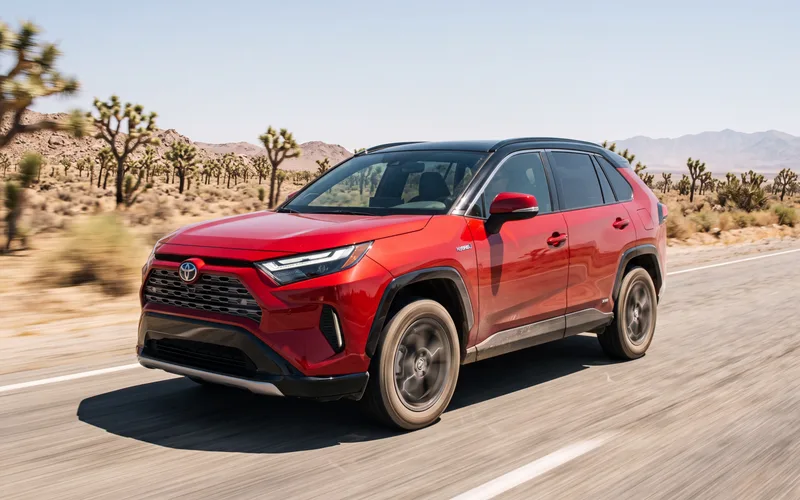 Toyota RAV4Compact SUVBetter at: Fuel economy and resale
If the CX-5's 26 MPG and 54% resale are what give you pause, the hybrid-only RAV4 answers both at once with 41-plus MPG combined and class-best value retention.
Compare 2.13C
2.13C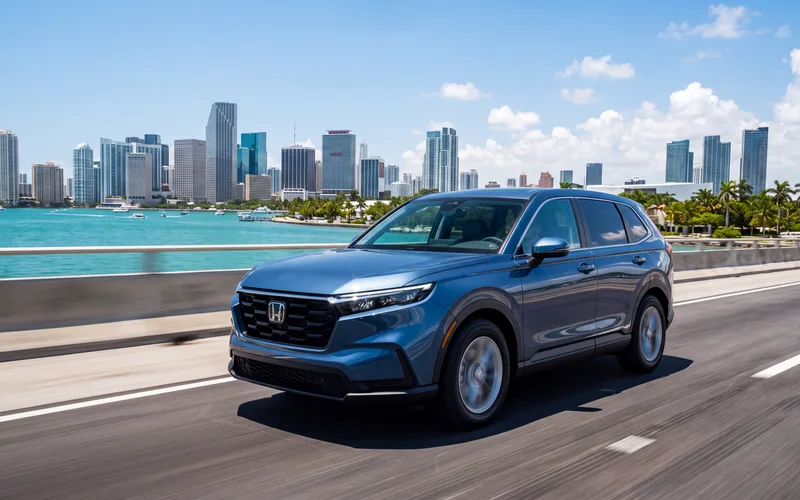 Honda CR-VCompact SUVBetter at: Hybrid efficiency
The CR-V matches the CX-5 on price and practicality while adding a 40-MPG-city hybrid option, more cargo room, and physical climate controls the redesigned Mazda gave up.
Compare 2.40C+
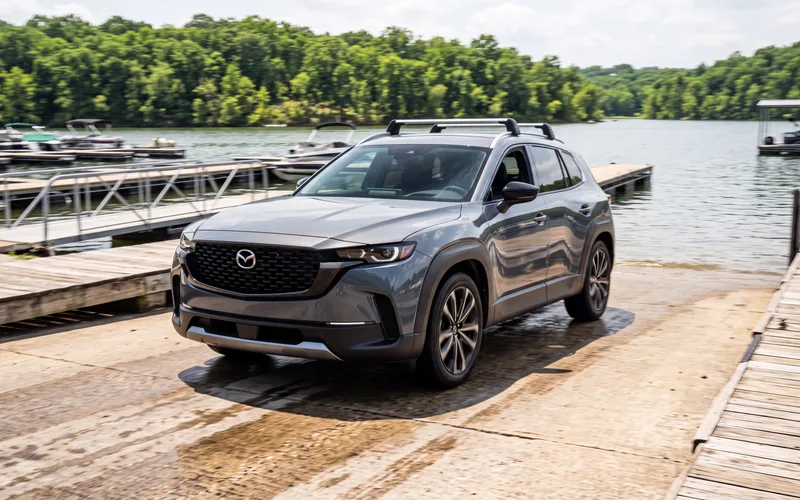 Mazda CX-50Compact SUVBetter at: Powertrain choice
Stay with Mazda's driving feel and interior quality but get the powertrain breadth and genuine dirt-road capability the 2026 CX-5 no longer offers.
CompareHow it's evolved
10 scored model years · 2017–2026
Subject scores by year
Hover or tap a score to see what moved it versus the year before. A corner mark flags a big swing.
| Year | Performance | Efficiency | Safety | Space | Cost | Reliability | Tech | Use-case | Driving | Value |
|---|---|---|---|---|---|---|---|---|---|---|
| 2026 | 31 | 55 | 77 | 55 | 63 | 75 | 77 | 63 | 73 | 70 |
| 2025 | 32 | 50 | 68 | 51 | 69 | 83 | 52 | 60 | 76 | 69 |
| 2024 | 34 | 64 | 75 | 51 | 66 | 82 | 56 | 60 | 79 | 73 |
| 2023 | 33 | 55 | 75 | 50 | 66 | 83 | 54 | 60 | 75 | 73 |
| 2022 | 33 | 55 | 74 | 50 | 68 | 77 | 54 | 60 | 75 | 73 |
| 2021 | 33 | 55 | 76 | 48 | 68 | 72 | 52 | 59 | 74 | 76 |
| 2020 | 32 | 55 | 77 | 48 | 67 | 68 | 41 | 58 | 75 | 76 |
| 2019 | 36 | 55 | 76 | 48 | 68 | 63 | 41 | 58 | 74 | 78 |
| 2018 | 29 | 56 | 74 | 47 | 70 | 62 | 34 | 57 | 74 | 77 |
| 2017 | 29 | 54 | 57 | 47 | 73 | 73 | 34 | 56 | 74 | 71 |
Compare two years
Best fit & conditions
Higher scores mean a better fit for that use case. Learn more about use-case fit →
Subject profile
Trims & configurations
5 trimsScores above reflect the volume trim. Per-trim specs and scores are rolling out — the full lineup:
Academic Probation · NHTSA safety recalls
Nov 21, 2017Electrical system: wiring · Trailer hitchesThis harness may be routed such that there is insufficient clearance between the harness and the exhaust muffler, allowing the wiring harness to contact the muffler.
Defect
Mazda North American Operations (Mazda) is recalling certain 2017 CX-5 vehicles equipped with an accessory trailer hitch wiring harness. This harness may be routed such that there is insufficient clearance between the harness and the exhaust muffler, allowing the wiring harness to contact the muffler.
Risk
Contact with the muffler may damage the trailer wiring harness, potentially resulting in the trailer lighting being inoperative, thereby increasing the risk of a crash.
Remedy
Mazda will notify owners, and dealers will reroute the trailer hitch harness away from the muffler, replacing the harness if it is damaged, free of charge. The recall is expected to begin January 20, 2018. Owners may contact Mazda customer service at 1-800-222-5500. Mazda's number for this recall is 1617K.
NHTSA campaign 17V744000 ↗Manufacturer no. 1617K1,076 vehicles potentially affected (all models in the campaign)Owners notified Jan 22, 2018Filed by Mazda North American OperationsFiled as CX-5
3 recalls on other model years of the CX-5 (2018–2019)
Nov 12, 2021Fuel system, gasoline: delivery: fuel pumpThe impeller inside the low-pressure fuel pump may crack and deform, potentially causing the fuel pump to fail.
Defect
Mazda North American Operations (Mazda) is recalling certain 2018 Mazda3, Mazda6, 2019 CX-3, 2018-2019 MX-5, CX-5, CX-9, and 2019-2020 Mazda2 vehicles. The impeller inside the low-pressure fuel pump may crack and deform, potentially causing the fuel pump to fail.
Risk
Fuel pump failure may cause an engine stall, increasing the risk of a crash.
Remedy
Dealers will replace the fuel pumps, free of charge. Owner notification letters were mailed July 18, 2022. Owners may contact Mazda customer service at 1-800-222-5500 Option 4. Mazda's number for this recall is 5321K.
NHTSA campaign 21V875000 ↗Manufacturer no. 5321K121,038 vehicles potentially affected (all models in the campaign)Owners notified Jul 18, 2022Filed by Mazda North American OperationsFiled as CX-5Jun 27, 2019Engine · Power train: automatic transmission: control module (tcm/pcm/tecm)A software error in the powertrain control module (PCM) may cause the engine to stall.
Defect
Mazda North American Operations (Mazda) is recalling certain 2018-2019 CX-5, Mazda6, and 2019 Mazda3 vehicles. A software error in the powertrain control module (PCM) may cause the engine to stall.
Risk
An unexpected stall increases the risk of a crash.
Remedy
Mazda will notify owners, and dealers will reprogram the PCM software, free of charge. The recall began August 20, 2019. Owners may contact Mazda customer service at 1-800-222-5500, option 4. Mazda's number for this recall is 3719F.
NHTSA campaign 19V497000 ↗Manufacturer no. 3719F262,220 vehicles potentially affected (all models in the campaign)Owners notified Aug 20, 2019Filed by Mazda North American OperationsFiled as CX-5Jun 25, 2018Air bags: side/windowIn the event of a side impact or rollover crash, the side curtain air bags may not properly unfold during deployment. As such, these vehicles fail to comply with the requirements of Federal Motor Vehicle Safety Standard (FMVSS) number 226, "Ejection Mitigation."
Defect
Mazda North American Operations (Mazda) is recalling certain 2018 Mazda CX-5 vehicles. In the event of a side impact or rollover crash, the side curtain air bags may not properly unfold during deployment. As such, these vehicles fail to comply with the requirements of Federal Motor Vehicle Safety Standard (FMVSS) number 226, "Ejection Mitigation."
Risk
If the air bags do not deploy properly in a crash, it can increase the risk of injury.
Remedy
Mazda will notify owners, and dealers will replace the curtain air bags, free of charge. The recall began July 31, 2018. Owners may contact Mazda customer service at 1-800-222-5500, Option 4. Mazda's number for this recall is 2718F.
NHTSA campaign 18V426000 ↗Manufacturer no. 2718F682 vehicles potentially affected (all models in the campaign)Owners notified Jul 31, 2018Filed by Mazda North American OperationsFiled as CX-5
Source: NHTSA Office of Defects Investigation recall database, model years 2017–2026. Recalls are listed by model year as the manufacturer filed them; whether a specific car is affected depends on its VIN — check a VIN at nhtsa.gov ↗. NHTSA model names matched to this page: CX-5.
Detailed scoring by subject
1Performance & PowertrainThe CX-5's lowest-graded category.0.00F
Every 2017 US CX-5 trim (Sport, Touring, Grand Touring, FWD or AWD) uses the same 2.5-liter Skyactiv-G, so the volume Touring figure is the whole-range figure. Output rose 3 hp for the KF redesign from the 184 hp of the outgoing 2016.5 car.
The 2.5 makes an identical 185 lb-ft peak in both drivetrains, but Mazda quotes it 750 rpm higher for AWD — the AWD car has to be revved further to reach it. This is the pre-cylinder-deactivation tune; 2018 raised the peak marginally to 186 lb-ft.
Seven verified instrumented runs of the 2017 AWD car spread from 8.1 s to 8.7 s and average 8.3 s, so 8.4 s is the honest central figure for the volume drivetrain. Reviewers consistently call the 2.5 adequate rather than quick — highway passing takes planning.
A naturally-aspirated port-and-direct-injected four with no turbo and no hybrid handoff is inherently linear — throttle response is immediate and predictable, and the KF redesign specifically targeted internal friction, knock and cabin noise. The ceiling is set by having to wring the engine out: it grows audibly coarse near its 6,000-rpm power peak, which is exactly where the AWD car spends its time when asked for a pass.
The Skyactiv-Drive 6-speed automatic is the best part of this powertrain — its wide-range lockup clutch gives it direct, quick, decisive shifts and it does not hunt, with manual-shift and Sport modes standard on all three trims. It loses points only for having six ratios where rivals were moving to eight or a CVT, which costs it both a taller cruising gear and a shorter first.
There is no towing package and no higher-rated configuration: 2,000 lbs is the ceiling regardless of trim or drivetrain, which is bottom-of-segment territory and enough for a small utility trailer or a pair of jet skis, not a boat.
i-ACTIV AWD is optional on all three 2017 trims — nothing is locked behind the top trim — and it is a genuinely clever system, reading 27 sensors to pre-emptively shift torque rather than waiting for slip. But it is a single-speed reactive/predictive coupling with no low range, no locking differential and no selectable terrain modes, which caps it in the middle band.
7.6 inches of unladen ground clearance is car-like for the class, and there is nothing else here: no skid plates, no hill-descent control, no terrain or off-road drive modes, no off-road trim, and 19-inch wheels with low-profile tires on the volume-plus Grand Touring. This is a road crossover that will handle a gravel forest road and a snowy driveway and no more.
2017 is the narrowest the CX-5 lineup ever got: the KF redesign dropped both the 2.0-liter engine and the Sport's 6-speed manual, leaving exactly one engine and one transmission across every US trim. The Skyactiv-D diesel was promised at the LA launch but did not reach US showrooms until 2019, and the 2.5T did not arrive until the 2019 model year — so a 2017 buyer had no powertrain choice at all beyond FWD or AWD.
2Efficiency & RangeGrades below the middle of the scale.1.65D
Mid-pack for a 2017 gas compact SUV — respectable for a naturally-aspirated engine with no hybrid assist and no cylinder deactivation, which Mazda did not add until 2018 (and which lifted the FWD car to 28 MPG combined that year).
A conventional automatic with no engine stop-start on the volume trim and no electric assist means stop-and-go driving is where this powertrain gives up the most ground to hybridized rivals.
The AWD car's 29 MPG highway trails its own FWD sibling by 2 MPG — the driveline drag and the extra 128 lbs of curb weight. Only six ratios means no tall overdrive gear to lean on at interstate speed.
Weak for the segment, and it is the tank rather than the engine that limits it — 15.3 gallons is small, so decent economy still only buys just under 400 miles. Mazda gives the AWD car the larger tank, which is why both drivetrains land at essentially the same range despite the FWD car's better MPG.
Middling running cost for the class: taking regular fuel keeps the per-gallon price low, but with no electrification the gallon count stays high, so the annual bill sits well above a hybrid compact SUV's.
Regular 87-octane unleaded on every 2017 CX-5 — there is only one engine and it asks for the cheapest fuel at the pump, with no premium recommendation, no diesel to hunt for and nothing to plug in. Marked just short of the top of the band only because the 15.3-gallon tank means more visits to make those fill-ups.
3SafetyMid-pack among this car's ten categories.1.86C-
The all-new second-generation (KF) CX-5 earned only four stars overall from NHTSA in its launch year — five in both frontal and side, but four for rollover resistance plus four on the passenger-side and combined rear-seat side components, which the weighted relative-risk calculation pulls down to a four-star composite. Every CX-5 from 2019 onward rates five stars overall, so this is a genuine launch-year deficit rather than a testing artifact.
Crashworthiness is uniformly Good — driver and passenger small overlap front, moderate overlap front, side, roof strength and head restraints — and the redesigned CX-5 took a 2017 Top Safety Pick+, its fifth straight top award. The one asterisk is that the award applies only to CX-5s with specific headlights, and the volume Touring's headlights rated Marginal, so a typical volume-trim car sold in 2017 was not itself an award-qualifying build.
2017 predates Mazda making i-Activsense standard fleet-wide by three model years. The $24,045 base Sport gets only a rearview camera and laser-based Smart City Brake Support, which operates at low speed only — no blind-spot monitoring, no lane keeping and no adaptive cruise at any price. The volume Touring adds BSM with rear cross-traffic alert as standard, but lane-departure warning, lane-keep assist, radar cruise and full-speed Smart Brake Support all sit behind a $625 optional i-Activsense package. The package is cheap, but optional is optional, and the 2017 RAV4 made Toyota Safety Sense P standard on every trim.
IIHS rates the standard low-speed Smart City Brake Support only Advanced for vehicle-to-vehicle front crash prevention, reaching Superior only when the optional Smart Brake Support radar system is fitted. There is no pedestrian result at all for 2017 — IIHS had not launched the pedestrian AEB program yet, and Mazda's laser-sensor city system was not designed to detect pedestrians — so a buyer gets solid daytime car-to-car coverage and nothing beyond it.
Blind Spot Monitoring with Rear Cross-Traffic Alert is standard from the volume Touring upward, which is respectable for 2017, but it is unavailable at any price on the base Sport. Coverage is alert-only — mirror icon plus chime, no steering or braking intervention, and no safe-exit warning — and no surround-view camera was offered on the 2017 CX-5.
Lane-Departure Warning with Lane-keep Assist is optional on every 2017 trim — part of the $625 i-Activsense package and not available on Sport at all — so most cars sold left the lot without it. Where fitted it is a departure-correction system rather than a centering one: a single brief steering nudge at the lane edge with markedly less torque than Honda's or Toyota's equivalents, and no lane-centering mode.
The KF redesign brought a genuinely modern full-speed Mazda Radar Cruise Control with Stop & Go — it will brake to a standstill and hold the car with stop-hold control, which was ahead of most compact SUVs in 2017. It is held back by availability rather than capability: optional via the $625 package, unavailable on Sport, no lane centering to pair with it, and owners report the system intermittently refusing to engage below about 20 mph.
No hands-free highway driving system was offered on any 2017 Mazda. i-Activsense is a hands-on driver-assist suite with no Level 2 centering mode, let alone a hands-off one, and 2017 predates Super Cruise's arrival on anything outside the Cadillac CT6.
This is the 2017 CX-5's clearest safety weakness: IIHS tested four headlight variants and rated none of them Good. Sport and Grand Touring managed Acceptable, while both Touring builds — with and without the i-Activsense package — came back Marginal, meaning the volume trim has the worst lights in the range. LED headlights are standard across the line and Grand Touring adds an adaptive front-lighting system, but automatic high-beam control is package-only.
Forward and side sightlines are a real strength of the KF redesign — an elevated seating position, tall side glass and slim A-pillars that reviewers singled out as making the car easy to place. The compromise is the rear three-quarter view, where the sloping roofline and thick rear pillars create a genuine blind zone, and 2017 offered no surround-view camera to compensate — just a standard rearview camera.
IIHS rates LATCH ease of use Acceptable rather than Good — two complete positions in the outboard rear seats with usable but recessed lower anchors that take some digging through upholstery, and a center position that requires borrowing hardware. Rear-door apertures are reasonable for the class and two seats fit comfortably, but the 72-inch-wide body makes three-across a struggle.
4Space & ComfortOne of the CX-5's weakest categories.1.15D
The all-new second-generation (KF) CX-5 is a strictly two-row compact SUV; Mazda's spec deck lists 5-passenger seating as standard equipment on all three trims with no seven-seat variant offered in the US. Buyers wanting a third row were pushed to the CX-9.
Mazda publishes both figures separately, so the no-moonroof number is the one used per the item definition. Even the moonroof figure stays generous for a compact crossover, though the KF's more steeply raked roofline gave up a little headroom versus the outgoing car.
41.0 in sits near the bottom of the SUV normalization band — adequate rather than roomy, and unchanged from the first-generation car despite the KF's redesign. Tall drivers get by because the seat travel and telescoping column are generous, but the raw number is a segment weak point.
39.0 in is strong for a compact crossover and unaffected by the moonroof, which only intrudes on the front row. Reviewers consistently found adult rear headroom ample in the redesigned car.
39.6 in is above average for the compact SUV class and the 2017 redesign added a two-position reclining rear seatback, so the space is genuinely usable rather than upright-only. The separately published 2.7 in knee clearance is the honest caveat — the number is good, the sense of space behind a tall front occupant is merely fine.
There is no third row at any price — the 2017 CX-5 is a five-seat compact SUV in every US configuration. Per the item's SUV rule this scores in the low band rather than being omitted; the 15 reflects a complete absence rather than token seating.
30.9 cu ft is a genuine weak spot — the KF actually gave up space to the outgoing car and trails the segment's cargo leaders by a wide margin, which is what pins it near the floor of the SUV band. Mazda prioritized the sleeker roofline and the sound-deadened body over outright volume.
59.6 cu ft is barely above the bottom of the SUV normalization band and well behind the class's cargo specialists. The 40/20/40 split with one-touch remote levers in the cargo bay makes the space easy to access, but there is simply not much of it.
Storage is conventional and slightly tight: a covered center console with tray, two 12V outlets, seatback map pockets, an overhead sunglass holder and a small glovebox, with no fold-flat front passenger seat, no underfloor bin on Bose-equipped cars and no onboard power of any kind. The cargo-bay one-touch seat-release levers and the flat load floor are the only genuinely clever touches.
Front seats are widely described as comfortable and well shaped though lightly bolstered, and the 2017 redesign added a reclining second-row seatback that noticeably improves rear comfort. The gap to the top of the class is adjustability on the trims people buy: the volume Touring gets a 6-way power driver's seat with manual lumbar and only a 6-way manual passenger seat, with the 8-way power driver's seat and power lumbar reserved for Grand Touring.
The KF redesign was aimed squarely at ride and it worked — reviewers rated it among the more comfortable compact SUVs, with most road imperfections filtered out and good body control thanks to G-Vectoring Control. It stops short of the top band because the tune remains firmer than the class softies, and the Grand Touring's 19-inch wheels on 225/55 tires make sharp impacts more noticeable than the Sport and Touring's 17s.
Noise isolation was the single biggest year-over-year improvement in the 2017 redesign — new door seals, thicker acoustic glass and substantially more sound deadening turned a cabin reviewers had called boomy into a genuinely calm one. It is quiet for the class rather than library-quiet: wind and tire noise are still audible at highway speed, and the 2.5 gets vocal under hard throttle.
The volume Touring does well on the basics — 2017 newly made dual-zone automatic climate control, rear A/C vents and heated front seats standard on that trim. The ceiling is low, though: heated rear seats, a heated steering wheel and a windshield de-icer live only in the Grand Touring Premium Package, ventilated seats are not offered at any price, and factory remote start does not exist (only the Mazda Mobile Start port accessory or a dealer-installed remote starter).
5Cost of OwnershipOne of the CX-5's strongest categories.2.97B-
The all-new second-generation (KF) 2017 CX-5 opened at $24,045 for the Sport FWD, below the bottom of the compact-SUV normalization band even after destination.
Touring is the mid-ladder volume trim and AWD is the majority configuration for a compact SUV in the snowbelt, so Touring i-ACTIV AWD is the representative build; every 2017 trim shares the same 2.5-liter engine, so trim choice is equipment only.
A nameplate-level industry estimate rather than a 2017-specific one, but the CX-5's naturally aspirated 2.5-liter Skyactiv-G with a conventional six-speed automatic is one of the simplest and cheapest-to-service powertrains in the segment, and RepairPal ranks the nameplate first for reliability among its SUV peers.
The CX-5 retains value above the compact-SUV average, though below the Toyota/Honda benchmarks; the figure is a nameplate residual estimate, and a 2017 car's actual 2022 resale was flattered by the pandemic used-vehicle market.
$28,155 volume-trim price minus its estimated resale value after 5 years (61% retained, or about $17,175) leaves about $10,980 in depreciation. Add the projected $2,502 in 5-year maintenance and repairs, and owning this vehicle for 5 years costs about $13,482 in total.
Mazda's New Vehicle Limited Warranty sits at the segment floor and has not moved for years — Hyundai and Kia offered 5 years/60,000 miles of basic coverage on their 2017 compact SUVs, so this is a genuine competitive weakness rather than a scoring artifact.
Five years / 60,000 miles on the engine, transmission and i-ACTIV AWD driveline is the bottom of the band; Hyundai/Kia doubled it at 10 years/100,000 miles in 2017, and the 2017 CX-5 offered no electrified powertrain carrying separate battery coverage.
Roadside assistance and nothing else: in 2017 Mazda had no factory complimentary scheduled-maintenance program (the 2-year/24,000-mile dealer-level plan only began with vehicles sold from July 2021), and the 2017 CX-5 predates Mazda Connected Services, so there was no connected-service or app trial to bundle either. That is the bottom of the basic-roadside-only band, against 2017 rivals like Toyota's 2-year/25,000-mile ToyotaCare, which was included on every RAV4.
6Reliability & QualityOne of the CX-5's strongest categories.2.92B-
The field record for this model year is the quietest of the KF generation and one of the quietest in the segment: 148 NHTSA filings against 304 for the RAV4, 271 for the Equinox, 398 for the Sportage, 582 for the Forester, 595 for the Rogue, 1,081 for the Tucson, 1,756 for the CR-V and 2,658 for the Escape. Only five of those 148 filings are logged against ENGINE, and none mentions a cracked cylinder head — the defect that dominates 2018-2021 — because cylinder deactivation did not reach the US CX-5 until the 2018 model year. RepairPal ranks the nameplate 1st of 26 midsize SUVs at 4.5/5.0, and when J.D. Power surveyed this exact model year at three years of ownership in the 2020 VDS, Mazda was named an above-average brand with the year's second-largest improvement. What holds this at 71 rather than higher is that Consumer Reports' owner returns land on 'about average reliability compared to other cars from the same model year' — CR rated the 2017 car below the 2016 it replaced — and 2017 is job one of an all-new generation, with the trouble spots to match: in-car electronics is the dominant complaint area, and rear differential failures on the i-ACTIV AWD driveline are the second. Above the segment median of 65 and clearly above the 66 the 2019 car earns, because neither the engine defect nor the recall load of the later years is present here.
Mazda's dependability standing in the era this car was sold was solidly upper-mid-pack and trending up, but not yet the top-tier reputation it earned later. Consumer Reports' 2016 Annual Auto Reliability Survey — the ranking in force when the 2017 CX-5 went on sale — placed Mazda 6th of all brands, behind Lexus, Toyota and Buick. The three-year verdict on this specific model year was better: in the 2020 VDS, which surveyed 2017-model-year owners, Mazda came in above the 134 PP100 industry average and posted a 29 PP100 improvement, and the long-run record has since validated the trajectory with Mazda 3rd overall and 2nd among mass-market brands in the 2025 VDS and 3rd at CR for used 5-to-10-year-old reliability. The counterweight is real and specific to this year: initial quality was the worst of the period. Mazda was the most-improved brand in the 2018 IQS at 25 PP100 better than 2017, against a 2017 industry average of 97 PP100 — which places the 2017 model year materially worse than average on the measure that covers cars built alongside this one. Slightly below the 75 the 2019 car earns, where CR's brand survey had risen to 2nd. Confidence is MEDIUM because Mazda's exact 2017 IQS figure is not published in an accessible source and is inferred from the reported year-over-year delta.
This is the cleanest recall year of the KF generation and one of the cleanest in the segment. NHTSA lists a single campaign against the 2017 CX-5, 17V744, and it covers only cars fitted with the accessory trailer-hitch wiring harness, whose remedy is to reroute the harness away from the muffler — a dealer-accessory routing error, not a vehicle defect. Peers over the same model year carry 7 campaigns (CR-V), 6 (Cherokee), 5 (Rogue), 4 (Escape, Sportage, Tiguan) and 3 (RAV4, Tucson). Just as important is what does not reach this year: the cracked-cylinder-head programme SA-031-21 is scoped to '2018-2021 CX-5 2.5 SKYACTIV G with cylinder deactivation only,' the CSP11 coolant-leak warranty extension covers only 2019-2020 cars with the 2.5T, and neither engine variant exists in the 2017 lineup. Two things keep this out of the top band. The Mazda Connect infotainment class-action settlement names the 2016-2020 CX-5, so this year is squarely inside a systemic electronics remedy — and Mazda's own ghost-touch service bulletins were written for 2014-2016 Mazda3 models, leaving 2017 CX-5 owners repeatedly told their car was not covered. Second, the low-pressure fuel-pump recall 21V875 stops at the 2018-2019 CX-5 while 2017 owners describe the identical impeller failure and highway stall without coverage, which is a scope gap rather than a clean record.
The 2017 CX-5 carries the simplest and best-proven configuration the KF generation ever offered: the naturally aspirated PY-series Skyactiv-G 2.5 (187 hp / 185 lb-ft), in continuous production since the 2012 CX-5, driving a Skyactiv-Drive six-speed torque-converter automatic — the only engine sold on any 2017 US CX-5, with no cylinder deactivation (2018+), no 2.5T (2019+) and no US diesel. That matters more than any other fact in this category, because the defect that defines this generation's reputation is a cracked cylinder head on the deactivation-equipped 2.5, and Mazda's own bulletin scopes the remedy to 2018-2021 cars only. The field record agrees: of 148 NHTSA filings for the year, five are logged against ENGINE and not one mentions a cylinder head. Against peer powertrains this is also the conservative choice, with a conventional torque-converter automatic where the 2017 CR-V, RAV4, Rogue and Forester all use CVTs — and the 2017 CR-V's 1.5T drew its own oil-dilution complaints. Two documented failure modes hold it below the top band rather than in it. Twelve filings describe highway stalls traced to the low-pressure fuel pump, the same impeller that was recalled on the 2018-2019 cars but not this one, and six describe rear differential failure on the i-ACTIV AWD driveline — the volume configuration scored here — between roughly 65,000 and 97,000 miles at $4,400 or more, which Consumer Reports independently ranks as the year's second trouble spot. Confidence is MEDIUM because the bulletin scoping and complaint distribution are documented facts while true failure rates for the pump and differential are not.
The cabin is the headline of this redesign and remains the CX-5's clearest advantage over the compact-SUV class. 2017 is the year Mazda reset the benchmark: reviewers read the interior as belonging to a more expensive vehicle, Edmunds describing a crossover that 'feels as if it should cost considerably more' and finding not a single cheap-feeling trim piece in the Grand Touring, with switchgear that feels expensive down to rarely used controls. None of this model year's electronics or driveline trouble touches the materials themselves. Held a point below the 87 the 2019 car earns for two reasons: 2019 raised the ceiling with the Grand Touring Reserve and the Nappa-leather-and-real-wood Signature trim, neither of which exists in the three-trim 2017 range, and the volume trim scored here is Touring, which is plainer than the Grand Touring most of the glowing copy actually describes.
Structural assembly is sound — every US CX-5 is built at Mazda's Ujina plant in Hiroshima, and the 148-filing NHTSA record contains no panel-gap or misalignment cluster — but this is the weakest reported-quality year of the generation and it lands below the segment median. 2017 is job one of an all-new platform and body, and the measure that covers cars built alongside this one is where Mazda did worst: the brand was the single most-improved in the 2018 IQS at 25 PP100 better than 2017, against a 2017 industry average of 97 PP100, so the 2017 build was materially worse than average in the first ninety days. The owner-survey detail matches the pattern rather than contradicting it. Consumer Reports flags squeaks and rattles, paint delamination on the display screen and rust around the sunroof — finish defects, not wear items — eleven filings describe the sunroof glass shattering spontaneously at speed with no impact, and twenty-one describe the Mazda Connect touchscreen registering phantom inputs, a digitizer defect large enough to be settled in court. Below the 71 the 2019 car earns because the launch-year initial-quality gap is wider and the glass and paint complaints are specific to this year.
Coverage density is the CX-5's standing ownership weakness in every model year, and no amount of good reliability data changes it: Mazda ran roughly 620 US stores in this era against about 1,246 Toyota and 1,076 Honda dealers, so a buyer outside a metro area faces a materially longer drive for warranty work than a RAV4 or CR-V owner. Facility quality was also at its low point for the generation — Mazda announced the ChangeUp partnership to roll out Retail Evolution in June 2017, and the 100th open-concept store did not open until March 2020, so effectively none of the network had been upgraded while this car was new. Two things put it a few points above the 53 the 2019 car earns rather than below it. The network was near its largest here and has contracted since to roughly 545 stores, and this model year has no equivalent of the 2019 car's five-figure cylinder-head repair that Mazda declined to cover on the volume engine — the service-experience complaints that do exist concern the fuel pump and the infotainment screen, where owners are told their year falls outside a bulletin or recall rather than being quoted the price of an engine.
Routine running costs are low and specifically documented for this model year — RepairPal puts the 2017 CX-5 at $447 average annual repair and maintenance against $573 for midsize SUVs and $652 across all vehicles, with low repair severity and below-average frequency, ranking it 1st of 26 in its class — and as Mazda's US volume leader the CX-5 has the deepest independent parts catalogue in the brand's range. This year also escapes the supply problem that defines the later ones: Mazda's cylinder-head bulletin put heads, gasket sets and partial engines on hotline-controlled release for 2018-2021 cars, and none of that applies here. What keeps it in the normal band rather than the top one is that the two failures this year does have are both expensive and unsupported. Rear differential replacement on the i-ACTIV AWD driveline runs $3,000-$5,000 and owners report it out of warranty at 65,000-97,000 miles with no goodwill; the low-pressure fuel pump was recalled on the 2018-2019 cars but not this one, so 2017 owners pay for the same part; and while the Mazda Connect settlement reimburses up to $1,750, it covers documented out-of-pocket expense rather than guaranteeing a screen repair. Mazda's US volume also remains an order of magnitude below Toyota's and Honda's, leaving a thinner aftermarket and salvage supply than a RAV4 or CR-V equivalent.
7Technology & InfotainmentOne of the CX-5's weakest categories.0.22F
Mazda fitted one screen size to the entire 2017 lineup and there was no larger option at any price. 7.0 in sits exactly at the floor of the SUV normalization band, which is anchored on a 2026 fleet where 10-to-12-inch displays are routine.
MAZDA CONNECT's rotary Commander control is the system's saving grace — it falls naturally to hand and is far safer to use on the move than poking at a screen, and Mazda locks out touch input above walking pace precisely so you use it. Against that: the graphics were already dated in 2017, menu depth is real, the processor is visibly slow redrawing maps, and the CD player was deleted for 2017 without anything modern replacing it.
Neither wireless nor wired phone projection was available on any 2017 CX-5 — Mazda's spec deck lists no CarPlay or Android Auto on Sport, Touring or Grand Touring, and rivals like the 2017 Honda CR-V had it standard on most trims. The only route is Mazda's later official retrofit kit (part 00008FZ34, roughly $400–500 installed at a dealer), and even that adds only wired projection.
Voice control is a rigid command-tree system for audio and phone, not a natural-language assistant, and reviewers routinely bypassed it. Native navigation is SD-card based and — a real 2017 regression — was deleted as standard equipment on Touring, becoming a Preferred Equipment Package item there and standard only on Grand Touring, so the volume car often shipped without maps at all.
The Bose 10-speaker system with Centerpoint 2 and AudioPilot 2 — up from nine speakers for 2017 — is a genuinely good premium option and is standard on Grand Touring. The base end drags the score: the Sport ships with a four-speaker system, which is thin even by 2017 standards, and the volume Touring's six speakers are merely adequate unless you buy the Preferred package.
The 2017 CX-5 has a conventional analog cluster — black-faced speedometer and tachometer with a small Multi-Information Display for trip data — on every trim. There is no configurable digital gauge display at any price; the closest thing to a reconfigurable readout is the optional windshield head-up display, which is a separate item.
No over-the-air updating of any kind. Mazda Connect firmware is updated by a dealer or by an owner-flashed USB stick, and navigation map updates are a purchased SD card — the opposite of an OTA model. The car has an embedded modem only for E911 automatic emergency notification.
There is no factory connected-car app in 2017 — Mazda's own app at the time was essentially a service-scheduling and owner's-manual tool with no vehicle control. The only remote functionality is Mazda Mobile Start, a port- or dealer-installed accessory that adds phone-based remote start and lock on a paid subscription, which is a long way from a polished built-in app with digital key.
Adding two rear USB ports for Touring and Grand Touring was a real 2017 improvement, taking the count to four, and there are two 12V outlets. But every port is legacy USB-A at low charging amperage, there is no wireless phone charging on any trim, and no household AC outlet — thin provision even against 2017 rivals, and very thin against the modern fleet the band is calibrated on.
Push-button start is standard on every trim and the volume Touring gets Mazda Advanced Keyless Entry, so the everyday experience is properly keyless. It falls short of the top band because the base Sport is limited to a conventional remote fob, the power liftgate is a Grand Touring item (or a Touring package) and is not hands-free, there is no phone-as-key, and factory remote start does not exist.
A rearview camera is standard on all trims and its image is unremarkable on the 7-inch screen. Beyond that the cupboard is bare: no 360-degree surround view at any price, no automated parking, and parking sensors are not even a factory option — they are a port or dealer accessory. Blind Spot Monitoring with Rear Cross-Traffic Alert (standard Touring and above) is the only genuine parking-adjacent help.
2017 upgraded the CX-5's Active Driving Display from the old flip-up plastic combiner to a proper full-color windshield-projected HUD with Traffic Sign Recognition, which is genuinely good hardware for the class. Availability is the problem: it is inside the Premium Package on Grand Touring only, so it is an option on the top trim and unreachable on the volume Touring at any price.
8Use-Case FitMid-pack among this car's ten categories.1.74C-
The daily logistics are decent — wide-opening rear doors, 39.6 in of rear legroom, and a 40/20/40 rear bench that for 2017 was extended to the base Sport and gained a reclining seatback, so a rear-facing seat can be angled sensibly. Two things hold it back: IIHS rates the LATCH hardware only Acceptable, and 30.9 cu ft behind the second row is among the smaller cargo holds in the class, which is exactly the space a stroller wants.
The crash structure is excellent — Good in every IIHS crashworthiness test and a 2017 Top Safety Pick+ — but the award applies only to cars with specific headlights, and the volume Touring's headlights rate Marginal, so the trim families actually buy is not itself an award-qualifying build. NHTSA gave it only four stars overall, and while low-speed Smart City Brake Support is standard fleet-wide, the full-speed Smart Brake Support, lane keeping and radar cruise are all optional in 2017 — Mazda did not make i-Activsense standard on Touring until 2018.
A family of four travels well: the 2017 redesign added rear A/C vents, two rear USB ports and a reclining rear seatback on Touring and above, and the newly quietened cabin makes conversation easy at highway speed. The limits are luggage and amenities — 30.9 cu ft with everyone aboard is tight for four people's bags, and there is no rear entertainment, no rear sunshade and no third-zone climate.
This is where the CX-5 is at its best in daily use: the Skyactiv-Drive six-speed is smooth and decisive at low speed rather than hunting like a CVT, the controls are light and consistent, sightlines are good, and Hill Launch Assist and the electronic parking brake take friction out of stop-start traffic. It does not reach the top band because the 187-hp 2.5 needs revs to move the car briskly and adaptive cruise — the single biggest fatigue reducer in traffic — is optional rather than standard.
Regular unleaded, no hybrid premium and cheap consumables make the CX-5 an inexpensive commuter in absolute terms, but 2017 is the year the numbers got worse on paper: the EPA's revised calculation dropped the FWD car from 26/33 to 24/31 and the AWD from 24/30 to 23/29. Against a compact-SUV field that increasingly offered hybrids, mid-20s combined is average rather than cheap.
The footprint is modest for the class at 179.1 in long and 72.5 in wide, and the 36.0 ft curb-to-curb turning circle is genuinely tight, so threading it through a city is easy. What costs it points is the parking hardware rather than the geometry: only a standard rearview camera, no surround view at any price, and rear parking sensors available solely as a dealer accessory.
A 2,000 lb tow rating with a 187-hp naturally aspirated four is enough for a small utility trailer or a pair of jet skis and nothing beyond that, and the gap between the 3,655 lb AWD curb weight and the 4,643 lb GVWR leaves under 1,000 lb of payload including occupants. With 30.9 cu ft of enclosed cargo and no bed, this is not meaningfully a work vehicle.
The Skyactiv-G 2.5 and the conventional six-speed torque-converter automatic are a proven, undramatic combination with a good durability reputation, and Mazda's brand reliability record is solid — a CX-5 used hard should hold together. It is not fleet-proven work equipment though: the cabin is trimmed for comfort with cloth or leatherette rather than wipe-clean surfaces, and there is no commercial or fleet-spec variant.
Provisions are consumer-grade: two 12V outlets and no AC inverter or onboard power, a carpeted cargo floor with basic tie-down hooks, and roof side rails, crossbars and a trailer hitch available only as accessories rather than factory equipment. The accessory catalog is broad enough to bolt on racks and a hitch, which is why this is not at the floor, but nothing here is aimed at a jobsite.
It is a pleasant tourer — the 2017 redesign's acoustic glass and added sound deadening made the cabin noticeably calm at highway speed, the seats are comfortable over long stints, and roughly 400 miles between fills is respectable. The drag is driver assistance: Mazda Radar Cruise Control and lane keeping are optional in 2017 rather than standard, so the volume Touring as commonly sold gives the driver no adaptive cruise on a six-hour drive.
i-ACTIV AWD is available on all three trims and is a genuinely capable predictive system on gravel and snow, and 7.6 in of ground clearance clears a rutted trailhead road. Beyond that it is a road car: no low range, no terrain modes, no skid plates, a 2,000 lb tow limit that rules out most trailers, and no onboard power for camping.
The 40/20/40 split — standard on every 2017 trim for the first time — with one-touch cargo-bay release levers is unusually flexible for the class, letting skis or lumber run down the middle with two passengers still aboard, and the 44.3 in tailgate opening loads easily. The raw volume is the constraint: 30.9 cu ft up and 59.6 cu ft folded are both near the bottom of the segment, and roof rails are an accessory rather than standard equipment.
9Driving ExperienceThe CX-5's best-graded category.3.02B
The CX-5 is the compact SUV segment's handling benchmark and 2017 sharpened it further with G-Vectoring Control, which trims engine torque on turn-in to load the front tires — a subtle system, but reviewers consistently found the redesigned car more composed and less nose-heavy through corners than its rivals. It is not in the top band because it is still a 3,655 lb crossover on all-season tires: the composure is real, the outright grip is ordinary.
Mazda deliberately weights the electric rack heavier than the class norm and it pays off — the steering is quick, accurate and builds effort naturally off center, which is the single clearest reason the CX-5 feels like a driver's car among compact crossovers. Genuine road-surface feedback through the rim is still limited, which is what keeps it below the 80s.
Pedal feel is the strong part — firm, progressive and easy to modulate to a smooth stop, helped by four-wheel discs and an electronic parking brake on every trim. The measured performance is merely par: Edmunds recorded 121 ft from 60 mph, which it called average for the class, so this earns a solid rather than outstanding mark.
The Skyactiv-Drive six-speed is a conventional torque-converter automatic with a tight lockup strategy, and it is well calibrated — crisp, decisive shifts, no CVT drone, sensible kickdown, and clean tip-in from the naturally aspirated 2.5. What holds it short of the top band is response rather than smoothness: with 187 hp and 185 lb-ft in a 3,655 lb AWD car, 0–60 takes 8.8 seconds and overtakes need a downshift and revs.
At cruise the 2017 redesign's acoustic glass and extra sound deadening keep the engine well isolated, but the 2.5 is the weak link in an otherwise refined car — because it makes its power high in the rev range it is worked hard on hills and merges, and it turns coarse and buzzy rather than sonorous at the top end. Vibration through the controls is not an issue.
36.0 ft curb-to-curb is tight for a 179.1-inch SUV and well inside the segment norm, making U-turns and parking-garage ramps easy. It is identical on the 17-inch Sport/Touring and the 19-inch Grand Touring.
Mazda's driver-centric layout is a real strength — a tilt-and-telescoping column standard on every trim, a low-set hip point that feels car-like, the Commander knob and shifter grouped naturally at the driver's right hand, and physical climate controls left alone. Two small costs: the base Sport makes do with a 6-way manual driver's seat with no lumbar adjustment, and the KF's thick rear pillars and rising beltline pinch over-shoulder visibility.
Among compact crossovers this is the one enthusiasts actually recommend — the steering, body control and Sport-mode transmission calibration give it a sense of purpose almost nothing else in the class has, and reviewers reliably single it out on that basis. The ceiling is the engine: 187 hp and a mid-8-second 0–60 mean the chassis is always writing cheques the powertrain cannot cash, which is precisely the hole Mazda filled with the turbo engine two years later.
10Value & Market PositionGrades above the middle of the scale.2.78B-
The $24,045 Sport is decently kitted for 2017 — 17-inch alloys, LED headlights (standard across the entire range, which most mainstream rivals reserved for top trims), low-speed autonomous braking, a 7-inch MAZDA CONNECT touchscreen with backup camera, and pushbutton start. Two things hold it below the segment's best: Apple CarPlay and Android Auto were unavailable on any 2017 CX-5, and the standard driver aid is only Smart City Brake Support, while every 2017 RAV4 included the full Toyota Safety Sense P suite (AEB, adaptive cruise, lane departure) at no cost — Mazda charged $625 for the i-ACTIVSENSE package on Touring. AWD is a $1,300 extra on every trim.
The KF redesign's central pitch was near-premium substance at mainstream money, and reviewers bought it: materials, noise isolation and chassis quality read a class above the price, and a loaded Grand Touring AWD topped out at $31,635 delivered. What it does not deliver per dollar is performance or capability — 187 hp and 3,500 lb of towing are mid-pack — so the value is in refinement rather than content volume.
A deliberately narrow ladder: three trims (Sport, Touring, Grand Touring) spanning roughly $25.0K–$31.6K delivered, one engine for all of them, and FWD or i-ACTIV AWD as the only drivetrain choice. The manual transmission that the first generation offered was dropped for the KF, and the Skyactiv-D diesel Mazda kept promising for the US never arrived. Adequate budget coverage, no configurability.
A clear riser on a fresh generation: 127,563 US sales in 2017 (up 13.7%) despite the new car only reaching dealers in late March, then 150,622 in 2018 — over half of Mazda's entire US volume. It is the brand's backbone and a durable top-ten compact SUV, but nowhere near leader scale, running roughly a third of the CR-V's and RAV4's ~400K-unit years.
Mazda punched well above its ~2% US market share on image in 2017 — Kodo design, an enthusiast reputation earned by the MX-5 and applied credibly to the crossovers, and the brand critics reliably nominated as the one that made driving matter. It drags on the practical side: a thin dealer network relative to Toyota/Honda and residuals that trail those two, so the halo doesn't fully convert into resale.
Weakest part of the 2017 buying case, exactly as you would expect of an all-new generation in its launch year: Mazda had no reason to discount a car it began delivering in March, and support stayed thin through the year. Some money did appear by mid-summer, so it was not a no-deals market, just a modest one.
2017 is year one of the all-new second-generation (KF) CX-5 — new body, new interior, substantially reworked chassis and NVH package on a platform that then ran nine model years. A buyer in 2017 carried essentially no redesign risk.
Very strongly received — reviewers treated it as the class benchmark for steering, ride and cabin quality, and the generation launched here took Car and Driver's Best Compact SUV on the 10Best Trucks and SUVs list at its first opportunity, alongside a fifth consecutive IIHS Top Safety Pick+. It falls short of the top band because it was rarely the outright comparison-test pick against the CR-V and RAV4, which won on rear-seat space, cargo volume and standard driver aids.