
The verdict
A mixed-report compact suv, strong on reliability and held back by performance.
The 2024 CX-5 is the compact SUV you buy because you still enjoy driving. It has the best steering and handling in the class, an interior that genuinely embarrasses cars costing $10,000 more, all-wheel drive standard on every trim, and a $30,675 starting price with heated seats, dual-zone climate and full-speed radar cruise already included. The price you pay is space and pace: 30.8 cu ft of cargo behind the rear seats trails the CR-V's ~39, the volume engine makes just 187 hp and needs 8.6 seconds to reach 60 mph, and there is no hybrid anywhere in the range. If you routinely fill the back with people and gear, look elsewhere; if the car is mostly you, a passenger and a commute, this is the segment's most satisfying pick.
Jump to scoresStrengths
- The best-driving compact SUV, by a clear margin
- Proven mechanicals and a spotless recall record
- An interior that punches two price classes above
What holds it back
- Cargo space is the smallest complaint you'll notice most
- The engine most buyers get is slow
- No hybrid — and rivals all have one
Top alternatives
Cars shoppers cross-shop with the Mazda CX-5 2.56C+
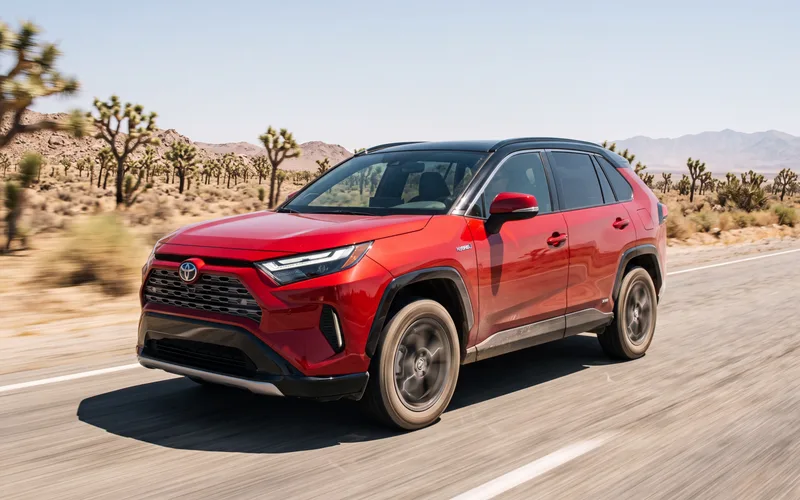 Toyota RAV4Compact SUVBetter at: Fuel economy and resale
If the CX-5's 26 MPG and 54% resale are what give you pause, the hybrid-only RAV4 answers both at once with 41-plus MPG combined and class-best value retention.
Compare 2.13C
2.13C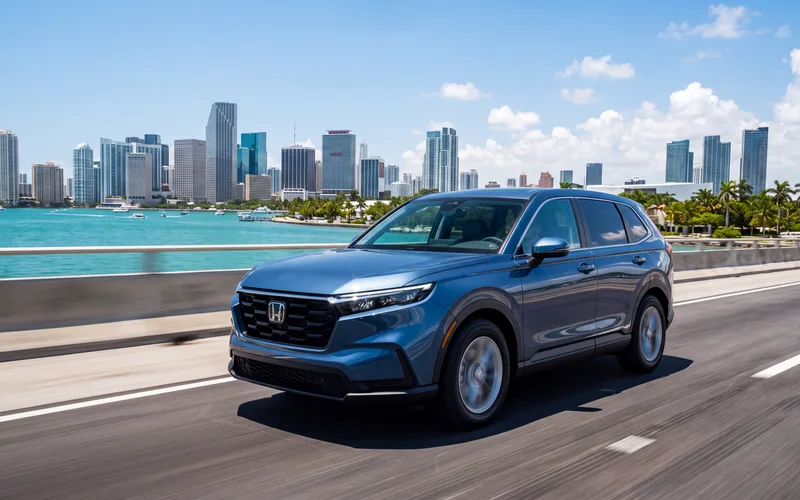 Honda CR-VCompact SUVBetter at: Hybrid efficiency
The CR-V matches the CX-5 on price and practicality while adding a 40-MPG-city hybrid option, more cargo room, and physical climate controls the redesigned Mazda gave up.
Compare 2.40C+
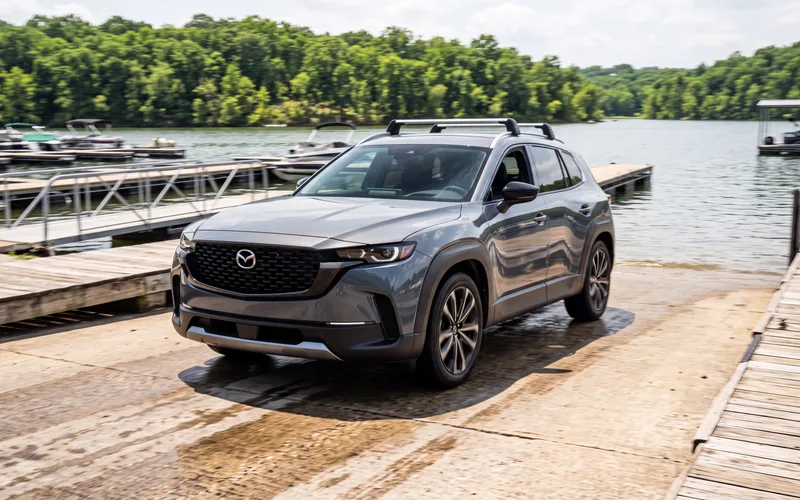 Mazda CX-50Compact SUVBetter at: Powertrain choice
Stay with Mazda's driving feel and interior quality but get the powertrain breadth and genuine dirt-road capability the 2026 CX-5 no longer offers.
CompareHow it's evolved
10 scored model years · 2017–2026
Subject scores by year
Hover or tap a score to see what moved it versus the year before. A corner mark flags a big swing.
| Year | Performance | Efficiency | Safety | Space | Cost | Reliability | Tech | Use-case | Driving | Value |
|---|---|---|---|---|---|---|---|---|---|---|
| 2026 | 31 | 55 | 77 | 55 | 63 | 75 | 77 | 63 | 73 | 70 |
| 2025 | 32 | 50 | 68 | 51 | 69 | 83 | 52 | 60 | 76 | 69 |
| 2024 | 34 | 64 | 75 | 51 | 66 | 82 | 56 | 60 | 79 | 73 |
| 2023 | 33 | 55 | 75 | 50 | 66 | 83 | 54 | 60 | 75 | 73 |
| 2022 | 33 | 55 | 74 | 50 | 68 | 77 | 54 | 60 | 75 | 73 |
| 2021 | 33 | 55 | 76 | 48 | 68 | 72 | 52 | 59 | 74 | 76 |
| 2020 | 32 | 55 | 77 | 48 | 67 | 68 | 41 | 58 | 75 | 76 |
| 2019 | 36 | 55 | 76 | 48 | 68 | 63 | 41 | 58 | 74 | 78 |
| 2018 | 29 | 56 | 74 | 47 | 70 | 62 | 34 | 57 | 74 | 77 |
| 2017 | 29 | 54 | 57 | 47 | 73 | 73 | 34 | 56 | 74 | 71 |
Compare two years
Best fit & conditions
Higher scores mean a better fit for that use case. Learn more about use-case fit →
Subject profile
Trims & configurations
5 trimsScores above reflect the volume trim. Per-trim specs and scores are rolling out — the full lineup:
Academic Probation · NHTSA safety recalls
No NHTSA safety recall is on record for the 2024 Mazda CX-5. Other model years of the CX-5 have 4 — listed below.
4 recalls on other model years of the CX-5 (2017–2019)
Nov 12, 2021Fuel system, gasoline: delivery: fuel pumpThe impeller inside the low-pressure fuel pump may crack and deform, potentially causing the fuel pump to fail.
Defect
Mazda North American Operations (Mazda) is recalling certain 2018 Mazda3, Mazda6, 2019 CX-3, 2018-2019 MX-5, CX-5, CX-9, and 2019-2020 Mazda2 vehicles. The impeller inside the low-pressure fuel pump may crack and deform, potentially causing the fuel pump to fail.
Risk
Fuel pump failure may cause an engine stall, increasing the risk of a crash.
Remedy
Dealers will replace the fuel pumps, free of charge. Owner notification letters were mailed July 18, 2022. Owners may contact Mazda customer service at 1-800-222-5500 Option 4. Mazda's number for this recall is 5321K.
NHTSA campaign 21V875000 ↗Manufacturer no. 5321K121,038 vehicles potentially affected (all models in the campaign)Owners notified Jul 18, 2022Filed by Mazda North American OperationsFiled as CX-5Jun 27, 2019Engine · Power train: automatic transmission: control module (tcm/pcm/tecm)A software error in the powertrain control module (PCM) may cause the engine to stall.
Defect
Mazda North American Operations (Mazda) is recalling certain 2018-2019 CX-5, Mazda6, and 2019 Mazda3 vehicles. A software error in the powertrain control module (PCM) may cause the engine to stall.
Risk
An unexpected stall increases the risk of a crash.
Remedy
Mazda will notify owners, and dealers will reprogram the PCM software, free of charge. The recall began August 20, 2019. Owners may contact Mazda customer service at 1-800-222-5500, option 4. Mazda's number for this recall is 3719F.
NHTSA campaign 19V497000 ↗Manufacturer no. 3719F262,220 vehicles potentially affected (all models in the campaign)Owners notified Aug 20, 2019Filed by Mazda North American OperationsFiled as CX-5Jun 25, 2018Air bags: side/windowIn the event of a side impact or rollover crash, the side curtain air bags may not properly unfold during deployment. As such, these vehicles fail to comply with the requirements of Federal Motor Vehicle Safety Standard (FMVSS) number 226, "Ejection Mitigation."
Defect
Mazda North American Operations (Mazda) is recalling certain 2018 Mazda CX-5 vehicles. In the event of a side impact or rollover crash, the side curtain air bags may not properly unfold during deployment. As such, these vehicles fail to comply with the requirements of Federal Motor Vehicle Safety Standard (FMVSS) number 226, "Ejection Mitigation."
Risk
If the air bags do not deploy properly in a crash, it can increase the risk of injury.
Remedy
Mazda will notify owners, and dealers will replace the curtain air bags, free of charge. The recall began July 31, 2018. Owners may contact Mazda customer service at 1-800-222-5500, Option 4. Mazda's number for this recall is 2718F.
NHTSA campaign 18V426000 ↗Manufacturer no. 2718F682 vehicles potentially affected (all models in the campaign)Owners notified Jul 31, 2018Filed by Mazda North American OperationsFiled as CX-5Nov 21, 2017Electrical system: wiring · Trailer hitchesThis harness may be routed such that there is insufficient clearance between the harness and the exhaust muffler, allowing the wiring harness to contact the muffler.
Defect
Mazda North American Operations (Mazda) is recalling certain 2017 CX-5 vehicles equipped with an accessory trailer hitch wiring harness. This harness may be routed such that there is insufficient clearance between the harness and the exhaust muffler, allowing the wiring harness to contact the muffler.
Risk
Contact with the muffler may damage the trailer wiring harness, potentially resulting in the trailer lighting being inoperative, thereby increasing the risk of a crash.
Remedy
Mazda will notify owners, and dealers will reroute the trailer hitch harness away from the muffler, replacing the harness if it is damaged, free of charge. The recall is expected to begin January 20, 2018. Owners may contact Mazda customer service at 1-800-222-5500. Mazda's number for this recall is 1617K.
NHTSA campaign 17V744000 ↗Manufacturer no. 1617K1,076 vehicles potentially affected (all models in the campaign)Owners notified Jan 22, 2018Filed by Mazda North American OperationsFiled as CX-5
Source: NHTSA Office of Defects Investigation recall database, model years 2017–2026. Recalls are listed by model year as the manufacturer filed them; whether a specific car is affected depends on its VIN — check a VIN at nhtsa.gov ↗. NHTSA model names matched to this page: CX-5.
Detailed scoring by subject
1Performance & PowertrainThe CX-5's lowest-graded category.0.22F
The volume 2.5 S trims use the naturally aspirated Skyactiv-G 2.5, rated 187 hp @ 6,000 rpm — modest output that lands near the bottom of the SUV band, in line with the CR-V's 190 hp and Forester's 180 hp.
Peak torque of 185 lb-ft arrives high at 4,000 rpm, so the volume trim leans on revs rather than low-end pull; the 2024 spec deck records a 1 lb-ft split between the CDA and non-CDA builds.
Published results for this drivetrain cluster between 8.2 s and 8.7 s, so ~8.6 s is the representative figure for the 2024 2.5 S AWD — mid-pack among naturally aspirated compact SUVs and well behind the turbo.
The naturally aspirated 2.5 delivers power linearly with no turbo lag and no hybrid handoffs to manage, which reviewers consistently rate as smoother and more predictable than the CVT-and-small-turbo rivals; the penalty is that it needs revs to move a 3,783 lb crossover, and throttle response is tuned relaxed rather than eager.
The Skyactiv-Drive 6-speed torque-converter automatic is a genuine strength in a segment that has largely moved to CVTs — it shifts crisply and decisively, holds gears sensibly and never drones, and adds paddle shifters plus a sport mode. Only six ratios is the cost, which keeps highway rpm and economy behind 8- and 10-speed rivals.
The CX-5 is rated at 2,000 lbs regardless of engine — the turbo adds no towing capability. That is low in absolute terms but still above the 1,500 lb ratings of the CR-V, Rogue and standard Forester.
i-Activ AWD is standard on every 2024 CX-5 trim — there is no front-drive version — which is a real differentiator against the CR-V, Rogue and RAV4, where AWD costs extra. Sophistication is mid-tier: predictive on-demand torque transfer with G-Vectoring Control Plus and a Mi-Drive Off-Road mode on upper trims, but no low range, locking differentials or terrain-mode suite.
The most road-biased entry in its segment: 7.6 in of ground clearance on the volume 2.5 S (7.9 in on turbo trims), no skid plates, no locking differentials, no all-terrain tires and no dedicated off-road trim analogous to a Forester Wilderness or CR-V TrailSport. The Mi-Drive Off-Road mode is a traction-software setting, not hardware.
Two genuinely distinct gas powertrains — the 187 hp naturally aspirated 2.5 and the 227/256 hp 2.5 Dynamic Pressure Turbo, the latter dual-rated by octane — but zero electrification in a segment where the RAV4, CR-V, Tucson, Sportage and Forester all offer hybrids and several offer plug-ins. That absence caps this at the bottom of the two-powertrain band.
2Efficiency & RangeMid-pack among this car's ten categories.2.30C+
2024 was a change year for CX-5 economy: adding i-Stop to the cylinder-deactivation engine lifted the naturally aspirated AWD car from 26 to 28 MPG combined. The figure is EPA-certified, but confidence is held at MEDIUM because Mazda deleted CDA and i-Stop from October/November 2023 production onward for parts supply, and that build is rated 25 MPG combined — so which rating a given 2024 volume-trim car carries depends on its build date.
City is where i-Stop and cylinder deactivation pay off most — a 3 MPG spread between the two 2024 builds, versus 2 MPG on the highway. Same build-date caveat as 2.1.1 applies.
31 MPG highway is respectable but trails the Forester (33) and Rogue (34), partly because the 6-speed automatic has fewer overdrive ratios than rivals' CVTs and 8-speeds to drop highway revs.
A relatively small 15.3-gallon tank caps range despite competitive economy — the Forester clears 480 miles on a 16.6-gallon tank with the same 29 MPG class of efficiency. Range therefore scores materially below the CX-5's MPG figures.
EPA puts annual fuel cost at $2,200 for the CDA/i-Stop car at standard 15k mi/yr assumptions — cheap to run in absolute terms and helped by taking regular fuel, but above the CR-V (~$1,700) and Rogue (~$1,600) because those rivals post higher combined MPG.
The volume 2.5 S runs on regular 87 octane and makes its full rated 187 hp on it — no premium consideration at all. Even the optional turbo only treats premium as a power upgrade (227 hp on 87, 256 hp on 93) rather than a requirement, so no CX-5 buyer is obliged to buy premium.
3SafetyOne of the CX-5's strongest categories.3.07B
NHTSA rated the 2024 CX-5 five stars overall, with five stars in frontal and side testing and four stars for rollover resistance — the best available result, and unchanged across the KF generation.
The 2024 CX-5 is an IIHS Top Safety Pick with Good in every crashworthiness test — driver and passenger small overlap front, moderate overlap front in both the original and updated (rear-passenger) protocols, side, roof strength, head restraints and seat belt reminders. That is the prompt's top band: TSP with all-Good crash results. It misses TSP+ purely on the crash-avoidance side of the criteria, not the structure — the Select, Preferred and Carbon Edition trims carry Acceptable rather than Good headlights, and Mazda's own year-end release lists eight TSP+ winners without the CX-5 among them. The updated moderate overlap Good dates from the 2023 model year, when Mazda added rear seat belt pretensioners and load limiters.
Every 2024 CX-5, from the $29,300 entry 2.5 S Select up, carries the full core i-Activsense set standard: Smart Brake Support and Advanced Smart City Brake Support with pedestrian detection (AEB), Mazda Radar Cruise Control with Stop & Go, Lane Departure Warning with Lane Keep Assist, Blind Spot Monitoring, Rear Cross-Traffic Alert and Rear Seat Alert — plus eight airbags and standard i-Activ AWD. Full-speed adaptive cruise and blind-spot monitoring on the cheapest trim is still unusual in the mainstream compact SUV class and puts this in the top band. The deduction: the 360-degree View Monitor with parking sensors, Smart City Brake Support Reverse and Driver Attention Alert remain locked to the $40,600 2.5 Turbo Signature.
The split is stark. Smart Brake Support earns Advanced in the daytime pedestrian evaluation, avoiding the 25 mph crossing-adult and 37 mph parallel-adult impacts outright — genuinely good work. But it rates Poor in the tougher updated vehicle-to-vehicle 2.0 test: it clears the 31 mph centered car target, then only sheds 32 mph of a 37 mph closing speed and 24 mph of a 43 mph one, and against a motorcycle target it managed a 1 mph reduction at 31 mph. No nighttime pedestrian result is published. Strong in daylight against pedestrians, weak at the speeds and target types the newer protocol emphasizes — the middle band, near its floor.
Blind Spot Monitoring and Rear Cross-Traffic Alert are standard on all eight trims rather than bundled into an upper-trim package, which beats most compact SUV rivals of the year and is why IIHS lists blind-spot detection as standard equipment. Coverage stays alert-only for the volume buyer, though: Smart City Brake Support Reverse — the braking intervention on a rear crossing threat — is confined to the 2.5 Turbo Signature, and there is no safe-exit warning, so it sits just under the fully active top band.
Lane Departure Warning with Lane Keep Assist is standard on every trim and reviewers found the warning half well judged — good at telling an intentional lane change from a drift — but the active assist itself is a corrective nudge that disappointed testers rather than continuous centering. True lane centering comes only with Traffic Jam Assist, which for 2024 broadened from Signature-only to the 2.5 Turbo Premium and above; that is real progress but still leaves every S-badged trim, i.e. the volume of the range, with warning and intervention and no centering at all.
Mazda Radar Cruise Control with full-speed Stop & Go is standard on every trim — generous at a $29,300 entry price — and it brings the car to a complete halt and resumes in traffic. Testers of the 2024 car found it detected traffic ahead quickly and reliably and adjusted speed appropriately, a better report than earlier years of this generation drew. What holds it to the middle band is integration: the lane-centering half of a proper highway assist (Traffic Jam Assist) starts at the 2.5 Turbo Premium, so the volume buyer gets good adaptive cruise operating on its own rather than a combined system.
Mazda offered no hands-free highway driving system on any US model in 2024, and the CX-5 is no exception. Its most advanced feature, Traffic Jam Assist on the Turbo Premium and Signature, is a hands-on low-speed Level 2 system that requires the driver to keep hold of the wheel.
IIHS rates the CX-5's curve-adaptive LED projectors Good, but those are fitted from the 2.5 S Premium ($33,900) up; the Select, Preferred and Carbon Edition trims that carry the volume run non-adaptive LED projectors rated only Acceptable, with low-beam visibility good on the right shoulder and merely fair on the left. That is the middle band exactly, and it is the reason the car is a Top Safety Pick rather than TSP+. Note this is a step back from 2023, when the discontinued base 2.5 S also rated Good — for 2024 every trim below Premium is Acceptable.
Forward and three-quarter sightlines are a real strength — an elevated seating position, tall side glass and relatively slim pillars make the CX-5 easy to place, and reviewers of the 2024 car describe visibility as good in all directions. The rear is where it gives ground: the three rear headrests intrude on the mirror view, the rear side glass is smaller than several class rivals, and the 360-degree View Monitor that would compensate is restricted to the 2.5 Turbo Signature, leaving every other trim with a reversing camera alone.
IIHS rates the CX-5's LATCH hardware Acceptable for ease of use: two outboard positions with complete lower-anchor plus tether attachment and three tether anchors across the bench, workable but with lower anchors set in the seat bight that take some digging. Rear-door openings are reasonable for the class, but a compact SUV bench of this width makes three seats across a squeeze, which keeps it in the middle band.
4Space & ComfortOne of the CX-5's weakest categories.1.40D
Every 2024 CX-5 is a strict two-row five-seater — no third-row option and no captain's-chair or six-seat variant exists, which places it at the bottom of an SUV band that runs to eight.
Front headroom is mid-band for the segment. The moonroof — standard on seven of eight trims — costs 0.4 in, so most CX-5 buyers actually sit under 39.3 in.
41.0 in sits near the bottom of the 40–44.5 in SUV band — adequate for the driver but noticeably short of the CR-V's 41.3 in and RAV4's 41.0 in class-average benchmark, and a reflection of the CX-5's cab-rearward, driver-focused packaging rather than maximum interior volume.
A genuine strength: 39.0 in of second-row headroom is near the top of the 36–40 in SUV band, and unusually the moonroof takes nothing away from it — the rear glass panel is fixed, so back-seat occupants keep full height on every trim.
39.6 in is a strong figure for a compact SUV and lands high in the 30–42 in band, helped by the reclining rear seatback. The 2.7 in of published rear knee clearance is the caveat — the number is generous, the sense of space behind a tall driver less so.
There is no third row on any 2024 CX-5 trim and none has ever been offered on this generation — buyers wanting a third row are pushed to the CX-90. Scored at the floor of the band because the seating simply does not exist, not because it is cramped.
Cargo room behind the rear seats is the CX-5's clearest packaging weakness — 30.8 cu ft trails the CR-V's ~39 cu ft and the RAV4's ~37 cu ft, and reviewers add that a high cargo floor and a liftgate opening only 29–31 in tall make the space harder to use than the number alone suggests.
Seats-down capacity of 59.3 cu ft sits at the bottom of the 55–100 cu ft SUV band and well behind the ~76 cu ft the CR-V and RAV4 offer — this is a compact SUV that gives up outright volume to keep its low roof and short overhangs.
Competent and thoughtfully finished rather than inventive: a two-level adjustable luggage board in the cargo floor, a 40/20/40 split rear seatback with one-touch fold levers, covered console bins front and rear, bottle holders in all four doors, seatback pockets and three 12-volt outlets are all standard on every trim. What is missing is the class's newer tricks — no underfloor bin of consequence, no fold-flat front passenger seat, no household AC outlet, and a centre console bin that reviewers find small next to the CR-V's cavernous one.
A clear front/rear split. The driver's seat is a genuine highlight — 8-way power with power lumbar and two-position memory from the 2.5 S Preferred up, leather from Preferred, heated cushions standard on every single trim including the base Select, and reviewers call the front chairs supportive and good for long drives. The rear bench is the compromise: it reclines and has a centre armrest, but its flat-bottomed cushion draws direct criticism for going numb after a couple of hours, which keeps this out of the top band.
The 2021-for-2022 chassis revision — retuned damper control structure and added frame rigidity, both aimed at vibration and road noise — left the CX-5 firm-edged but genuinely well damped: reviewers describe midcorner bumps barely upsetting it and road imperfections dealt with immediately rather than reverberating. It is body control ahead of plushness, and the 19-inch wheels on Carbon Edition and up sharpen the impacts, so it sits above the segment median without reaching the plush-and-controlled top band.
Quieter than the mainstream compact SUV average thanks to the same 2022 NVH package, with reviewers reporting noise only really becoming evident at highway speeds and never forcing occupants to raise their voices. It stops short of library-quiet: coarse pavement still comes through, and the naturally aspirated 2.5 goes noticeably buzzy when it has to rev to move a 3,783 lb crossover.
Unusually generous at the bottom of the range, which is what earns the top band: dual-zone automatic climate control with rear-seat vents and heated front seats with three levels are standard on the $29,300 2.5 S Select, where most rivals of the year charged for both. Remote engine start and climate pre-conditioning come through the standard Mazda Connected Services app. The ceiling is the limit — ventilated front seats start at 2.5 S Premium Plus, heated rear seats and a heated steering wheel are confined to Premium Plus, Turbo Premium and Signature, and there is no separate rear climate zone.
5Cost of OwnershipMid-pack among this car's ten categories.2.49C+
For 2024 Mazda dropped the old front-drive 2.5 S base car, so the range now opens at the 2.5 S Select Package AWD at $29,300 plus $1,375 destination. That delivered figure sits near the bottom of the compact-SUV field and is unusually strong on a like-for-like basis, because i-Activ AWD is standard where the Honda CR-V LX and Toyota RAV4 LE quote their base prices with front-wheel drive.
The 2.5 S Preferred is the CX-5's volume rung — it adds the power moonroof, leather-trimmed seats, an 8-way power driver's seat with lumbar and a programmable power liftgate for $1,350 over S Select, at $30,650 plus $1,375 destination. At just over $32,000 delivered with standard AWD it undercuts the CR-V EX-L and RAV4 XLE Premium by several thousand dollars.
The CX-5's upkeep case rests on mechanical conservatism: the volume 2.5 S trims use a naturally aspirated Skyactiv-G 2.5 with a conventional six-speed torque-converter automatic — no turbocharger, no CVT and no hybrid system, the three components that drive most out-of-warranty spend in this class. Published estimates run lower than the segment norm, and the figure here is set on the same maintenance-plus-repair basis used for the RAV4 ($5,200) and CR-V ($5,800) elsewhere in this dataset so the comparison is like-for-like.
The CX-5 holds value better than the average compact SUV — roughly 60% retained at five years against a segment average near 60% depreciation-adjusted parity — but it does not reach the Toyota and Honda benchmarks that anchor the top of this class. That is the ordinary Mazda residual story: comfortably ahead of Nissan and the Korean pair, a clear step behind the RAV4 and CR-V.
Mazda's New Vehicle Limited Warranty is the industry-baseline 3 years / 36,000 miles, which is the floor of the 3–5 year normalization band and therefore scores zero. It matches Toyota, Honda and Subaru but gives up two full years and 24,000 miles to the Hyundai Tucson and Kia Sportage, which set the compact-SUV coverage benchmark at 5 years / 60,000 miles.
The 5-year/60,000-mile powertrain term is likewise the baseline and the bottom of the 5–10 year band. Because the 2024 CX-5 is offered only with gasoline engines there is no supplementary 8-year/100,000-mile electrified-component coverage of the kind that accompanies the RAV4, CR-V and Forester hybrids, so this is the entirety of the vehicle's long-term mechanical protection.
Mazda runs no nationwide complimentary scheduled-maintenance program in the US — mazdausa.com's owner-service page offers only paid prepaid-maintenance plans, and any 'free maintenance' a CX-5 buyer sees is a promotion from an individual dealership, not a factory benefit. What is genuinely included is 24/7 roadside assistance for the 3-year/36,000-mile warranty term plus a Mazda Connected Services trial, which lands this squarely in the basic-roadside-only band and behind ToyotaCare (2 yr/25,000 mi), Honda Service Pass (2 yr/24,000 mi) and Hyundai's 3 yr/36,000 mi program.
$32,025 volume-trim price minus its estimated resale value after 5 years (60% retained, or about $19,215) leaves about $12,810 in depreciation. Add the projected $4,600 in 5-year maintenance and repairs, and owning this vehicle for 5 years costs about $17,410 in total.
6Reliability & QualityThe CX-5's best-graded category.3.60A-
2024 is the eighth model year of the second generation (2017-2025), a carry-over year on a thoroughly de-risked design, and the independent sources agree it is above average without reaching the top of the scale. Consumer Reports rates the 2024 car 4/5 for reliability and calls it 'more reliable than other cars from the same model year' — a step below the 'much more reliable' verdict CR gives the 2025 car, which is the main reason this scores 83 rather than the high 80s. Working the same direction: 2024 is the one year of this generation that introduced a new hardware item on the volume engine (i-Stop), and CR's trouble-spot detail for 2024 flags in-car electronics and electrical accessories rather than a wholly clean sheet.
Mazda's dependability standing is strong on both major studies rather than just one, which puts it in the top-5 band. J.D. Power's 2025 VDS placed Mazda 3rd overall and 2nd among mass-market brands at 161 PP100 — a 24 PP100 improvement and a four-position climb, ahead of Toyota (162) — and Consumer Reports separately ranks Mazda 6th of all brands for reliability. The 2026 VDS shows Mazda above the 204 PP100 industry average but off the published podium, so the record is consistently good rather than consistently elite; that plus the 6th-place CR finish is what holds it at 85 rather than the 90s. This is a brand-level judgment, so it is scored identically to the 2025 CX-5 and 2025 Mazda3 already in this dataset.
This is the strongest item in the category and it rests on primary data, not inference: NHTSA's own recall API returns zero recall campaigns for the 2024 CX-5, and zero for every model year of this generation from 2020 through 2025. The generation's only recall exposure came in 2018-2019 (side-airbag inflator, an engine campaign, and the cross-industry Denso low-pressure fuel-pump action) and none of it touches the 2024 car. Complaint volume is low and falling with the design's maturity — 41 NHTSA complaints for 2024 against 60 for 2023, with no dominant defect pattern. Held below 90 because the complaint file does show recurring exterior-lighting and engine entries, TSB traffic exists for a fail-safe thermostat (DTC P0126) and MyMazda connected-services enrollment, and a two-year-old model year can still attract a campaign later.
The volume 2.5 S trim's driveline is about as conservative as the segment offers, and that is the single biggest reason this category scores well. The 187-hp 2.5L Skyactiv-G (PY-series) has been in continuous production since the 2012 CX-5 and is paired with the Skyactiv-Drive six-speed torque-converter automatic — no CVT, no dual-clutch, no turbocharger and no hybrid system on this trim, which removes every high-wear driveline component the CR-V, RAV4, Rogue, Forester and Sportage each carry in some form. Twelve model years of field data support its high-mileage reputation. Scored two points under the 2025 car because 2024 is the year i-Stop was newly added to this engine in the US — a starter- and battery-duty change on an otherwise proven unit, with no first-year field record behind it — and because owner unease about the cylinder-deactivation system persists (discussion only; no recall or documented systemic failure).
Cabin materials are the CX-5's signature advantage and reviewers treat the 2024 car as the compact-SUV benchmark for them: broad soft-touch coverage, expensive-feeling switchgear and restrained trim detailing at a price where rivals default to hard plastic, with Nappa leather and genuine layered wood on Signature. 2024 also added the S Carbon Edition, which pushes real material content (19-inch wheels, red stitching, Bose audio) down into the mid-trims. It stays at 88 rather than the low 90s because the same reviews qualify it as near-entry-luxury rather than luxury, and the cargo area and lower rear cabin still carry unavoidable hard plastic.
Assembly consistency benefits from this being year eight of the generation — line tolerances at Mazda's Hiroshima operations are long settled, and reviewers describe 'excellent build quality,' tight panel gaps and a solid structure, the opposite of the first-year variance the 2026 redesign faces. What caps it below the mid-80s is a real cluster of quality-of-execution complaints specific to this model year rather than any structural defect: CR's 2024 trouble spots list paint chipping, automatic headlight failures and CarPlay/Android Auto dropouts, and exterior lighting is the single most-reported component in the NHTSA complaint file for 2024. Mazda's unremarkable initial-quality standing reinforces the same ceiling — the brand did not feature among the leaders in J.D. Power's 2024 IQS, a shortfall generally attributed to infotainment and controls rather than build defects.
Network density is the clear weakness in this category and the only item scoring below the segment median. Mazda runs roughly 545 US dealers against about 1,200-plus for Toyota and roughly 1,000 for Honda, and the company has explicitly chosen to grow volume through existing stores rather than add points — so the gap is deliberate strategy, not a lag that will close. For a buyer outside a major metro that means a materially longer drive for warranty work than a RAV4 or CR-V owner faces. Service satisfaction itself sits near the mainstream average and the Retail Evolution program has raised facility quality, but coverage is what sets the score. Brand-level, so scored identically to the 2025 and 2026 CX-5 and the 2025 Mazda3.
Running costs are genuinely low and independently measured: RepairPal puts the CX-5's average annual repair and maintenance at $447, well under the roughly $650 all-vehicle average, with low repair severity and below-average visit frequency. As Mazda's US volume leader in the eighth year of a nine-year generation, the 2024 car sits on the deepest parts ecosystem in the brand's lineup — mature aftermarket coverage plus a real salvage supply for body, lighting and trim, which matters given that paint and headlight items are what owners actually replace here. It stays in the high-normal band rather than the top band because Mazda's US volume is a fraction of Toyota's or Honda's, so the catalogue is thinner and some components remain effectively dealer-only.
7Technology & InfotainmentOne of the CX-5's weakest categories.1.73C-
One 10.25-inch widescreen display across the entire range — commendably standard on the base trim, but a mid-band figure in a segment where rivals had reached 12.3 in, and there is no step-up screen anywhere in the lineup.
Mazda Connect is deliberately not a touchscreen for its own menus — the display is driven by the console Commander rotary knob, and 2024's headline change was finally enabling touch inside Apple CarPlay and Android Auto on every trim, which fixes the long-standing complaint about panning a projected map. The knob is fast, low-distraction and liked by owners on the highway, and Mazda pairs it with real physical climate knobs. But it is slow for text entry and destination searching, the native graphics are dated, and there is no app ecosystem — a system whose ergonomic argument is sound and whose feature set is behind.
Textbook middle band: wired Apple CarPlay and Android Auto are standard on all eight trims, and wireless projection — new for 2024 — is restricted to 2.5 S Premium Plus and above, so the 2.5 S Select, Preferred and Carbon Edition trims that carry the volume still need a cable. Wireless charging follows the same trim line, so the trims with wireless projection are also the only ones that can run it cordless end to end.
The weakest corner of the CX-5's tech case. Voice control is a fixed-command system for audio and phone functions, not a natural-language assistant, and there is no Alexa or Google built-in. Native navigation is not standard on any trim except the $40,600 Turbo Signature — every other trim needs a dealer-fitted SD card accessory to get maps at all, and Traffic Sign Recognition is gated behind that same accessory. Most owners simply use phone projection instead, which is exactly the behaviour the middle band's floor describes.
Strong availability rather than standout sound. The Bose 10-speaker system with Centerpoint and AudioPilot is standard on six of the eight trims — from the 2.5 S Carbon Edition up, so a buyer does not have to reach the top of the range for it — while the two cheapest trims make do with a six-speaker setup that is merely adequate. The Bose unit is a solid mainstream premium system, not a Mark Levinson or Meridian-tier flagship, which caps this below the top band.
No CX-5 trim gets a full-width configurable digital cluster. The volume 2.5 S Select, Preferred and Carbon Edition run a 4.6-inch TFT panel flanked by physical analogue dials; 2.5 S Premium and above upgrade to a 7-inch TFT centre pod that renders a simulated tachometer between real gauges. Legible and well drawn, but partial digital on the upper half of the range and a small monochrome-era screen on the trims most people buy puts this at the top of the low band.
Real but narrow. Mazda Connect supports over-the-air firmware updates on vehicles from roughly the 2022 model year onward, provided the car is registered in the MyMazda app with an active Connected Services subscription and OTA is enabled in settings — so the 2024 CX-5 qualifies. The scope is infotainment software and map data, not whole-vehicle modules, and nothing in Mazda's programme adds vehicle features after purchase the way a Tesla, Rivian or Hyundai OTA push does. That is the infotainment-only band, at its floor.
Solid, complete on the core functions, and free for a long stretch: Mazda Connected Services is standard on every trim with three years complimentary on 2024 model-year cars, then $10/month, and covers remote engine start, remote lock/unlock, remote hazard lights, vehicle finder, send-to-car, vehicle health reports, recall and malfunction notifications, automatic 911 dialing and in-car Wi-Fi. What holds it under the top band is the absence of a digital key — no phone-as-key or key sharing on any 2024 CX-5 — and an app reputation for being functional rather than polished.
Dated on the trims that matter. The 2.5 S Select and Preferred still use two USB Type-A ports up front; Type-C arrives only from the Carbon Edition upward, and the rear centre console keeps two Type-A ports on every single trim — so no CX-5, at any price, offers USB-C to back-seat passengers. Wireless charging starts at 2.5 S Premium Plus and there is no household AC outlet anywhere in the range; three 12-volt sockets are the only other power provision.
The fundamentals are standard everywhere: Mazda Advanced Keyless Entry with a redesigned fob, push-button start, speed-sensitive power locks with two-stage unlocking and illuminated entry on all eight trims, plus app-based remote start and lock/unlock through the complimentary Connected Services. A power liftgate with programmable height adjustment covers seven of eight trims. Two gaps keep it in the middle band — there is no hands-free or kick-activated liftgate on any trim, and no phone-as-key.
The thinnest parking provision in the category. A reversing camera is standard on all eight trims and that is the whole story for seven of them — the 360-degree View Monitor, front parking sensors and rear parking sensors are all exclusive to the $40,600 2.5 Turbo Signature, so even a $37,000 Premium Plus buyer gets no proximity beeps at all. There is no automated parking system on any trim, and the three rear headrests already restrict the mirror view the camera has to compensate for.
Mazda's Active Driving Display is a proper full-colour windshield-projected head-up display — not a flip-up plastic combiner — and it is well regarded for crispness and placement. It is available on four of eight trims, but those are the upper four: it starts at 2.5 S Premium Plus, so no trim below roughly $37,000 can be had with it, and the Signature adds Traffic Sign Recognition to it. Genuinely good hardware, restricted to the top half of the range.
8Use-Case FitMid-pack among this car's ten categories.2.05C
Workable but not the class benchmark. The 40/20/40 split rear seatback with one-touch fold levers and recline is genuinely flexible for mixing a car seat with cargo, rear legroom of 39.6 in is strong, and there are rear bottle holders, seatback pockets and a centre armrest. Against that, IIHS rates the LATCH hardware only Acceptable with just two of three positions offering complete attachment, three-across seats is a real squeeze on a 54.8 in rear bench, and stroller-plus-groceries duty runs straight into the 30.8 cu ft cargo hold and its high load floor.
This is where the CX-5 earns its family case: NHTSA five stars overall, an IIHS Top Safety Pick with Good in every crashworthiness test, and the full core i-Activsense suite — AEB with pedestrian detection, radar cruise with full-speed Stop & Go, blind-spot monitoring, rear cross-traffic alert, lane departure warning with lane keep assist and Rear Seat Alert — standard on the $29,300 entry trim rather than packaged. Standard AWD on every trim helps too. Two deductions keep it out of the top band: IIHS rates the updated vehicle-to-vehicle AEB Poor, and the volume trims' non-adaptive headlights are only Acceptable, which is why the car is TSP and not TSP+.
Fine for medium hauls, compromised for the long ones. Rear-seat provision is decent for the class — standard rear air vents and heater ducts, two rear USB ports, a reclining seatback, centre armrest with cupholders and 39.0 in of rear headroom — and the cabin is quiet at cruise. The limits are specific: the flat-bottomed rear cushion draws direct criticism for going uncomfortable after a couple of hours, there is no rear entertainment, no rear sunshades and no third climate zone, and 30.8 cu ft of cargo with all five seats occupied does not swallow a family of four's luggage for a week.
One of the CX-5's two strongest use cases. The Skyactiv-Drive six-speed torque-converter automatic behaves like a conventional automatic should — no CVT drone or rubber-band response in stop-and-go — steering is light at parking speeds and accurate on the move, forward sightlines are good from an elevated seat, physical climate knobs mean no menu-diving, and full-speed radar cruise with Stop & Go plus heated front seats are standard on every trim including the base. The only real fatigue tax is that 187 hp needs revs to get a 3,783 lb crossover moving briskly, and reviewers note some lag between throttle and response.
Respectable for a gas AWD crossover, unremarkable against the field. EPA rates the volume 2.5 S AWD build with cylinder deactivation and i-Stop at 26/31/28 mpg on regular 87 octane, roughly $2,200 a year in fuel, and consumables are cheap and conventional — no hybrid battery, no CVT fluid service, standard-size 17-inch tires on the volume trims. What caps it in the middle band is the absence of any electrification: the RAV4 Hybrid, CR-V Hybrid and Tucson Hybrid all run high-30s to 40 mpg combined, so a CX-5 commuter pays roughly a third more per mile than the segment's efficiency leaders.
Easy to place and easy to thread. At 180.1 in long and 72.6 in wide it is compact by 2024 standards, the curb-to-curb turning circle is a tight 36.0 ft (18.0 ft radius) with only 2.7 turns lock-to-lock, and the low cowl and slim A-pillars give good forward and three-quarter sightlines from an elevated seating position. The deduction is entirely about aids rather than geometry: parking sensors and the 360-degree camera are Turbo Signature exclusives, so the volume buyer parks on a single reversing camera with three rear headrests in the mirror.
Not a work vehicle, and honest about it. The 2,000 lb tow rating does top the CR-V's, RAV4's and Rogue's 1,500 lb, but it is a unibody crossover with no bed, roughly 940 lb of payload from a 4,724 lb GVWR against a 3,783 lb curb weight, 30.8 cu ft of enclosed cargo and a 187 hp naturally aspirated engine that has to work hard unladen. It will carry a trades van's worth of tools nowhere near, and there is no heavy-duty or work-oriented configuration.
The mechanical package is about as robust as a compact crossover's gets: a naturally aspirated port-and-direct-injected Skyactiv-G 2.5 and a conventional six-speed torque-converter automatic, both in service since 2013 and free of the CVT and small-displacement-turbo failure modes that dog several rivals, on a body Mazda calls a unibody with Ring Structure. What it lacks is any work orientation — no fleet programme presence, no vinyl or rubber-floor trim option, leatherette or leather on every trim and carpet mats standard, so hard-use abuse falls on surfaces designed for commuters.
Barely provisioned. There is no onboard AC power of any kind — three 12-volt sockets are the entire electrical offering — no factory roof rails on any trim (they and the crossbars are dealer accessories, and the roof is rated for only 165 lb with rails fitted), no trailer hitch from the factory, and no washable interior surfaces. Cargo tie-downs and a two-level luggage board are the extent of the load-securing kit, and the aftermarket upfit ecosystem around a compact Mazda crossover is thin.
A better tourer than its size suggests. Front seats are supportive enough for long drives, the cabin is quiet enough at highway speed that occupants need not raise their voices, the chassis is composed and stable at a cruise, and full-speed radar cruise with Stop & Go is standard on every trim. Range is roughly 430 miles combined and closer to 470 on the highway from a 15.3-gallon tank at 31 mpg. Two things stop it reaching the top band: the flat rear cushion limits multi-hour comfort in the back, and lane centering (Traffic Jam Assist) starts at 2.5 Turbo Premium, so the volume buyer gets adaptive cruise working alone rather than a combined highway assist.
Gravel-road competent, trail-incapable. The one real differentiator is that i-Activ AWD is standard on every 2024 CX-5 — there is no front-drive version, unlike the CR-V, RAV4 and Rogue — and Mi-Drive adds an Off-Road traction mode from 2.5 S Premium up. Everything else is road-biased: 7.6 in of ground clearance on the volume trims, no skid plates, no locking differentials, no all-terrain tire option and no Wilderness- or TrailSport-style variant. Camping provision is thin too — no AC outlet, no factory roof rails, a 165 lb roof limit and a 2,000 lb tow rating that covers a small utility trailer or two dirt bikes.
Flexible in shape, short on volume. The 40/20/40 split rear seatback with one-touch remote fold levers is genuinely better than the usual 60/40 — long items pass through the centre while two passengers stay seated — and the two-level luggage board lets you choose a flat load floor or a deeper well. But 59.3 cu ft maximum is bottom-of-band for an SUV, the load floor sits 29.4 in off the ground behind a liftgate aperture only about 30 in tall, the space between the rear wheel houses is 39.5–41.3 in, and roof rails and a hitch are both dealer accessories rather than fitted equipment.
9Driving ExperienceOne of the CX-5's strongest categories.3.34B+
The CX-5 is the acknowledged handling benchmark of the mainstream compact SUV class, and has been for two generations. Edmunds states flatly that this is the best-handling small crossover; reviewers describe it as sharp and communicative enough to carry more corner speed than rivals without protest, with midcorner bumps barely upsetting it. A multi-link rear axle where several rivals use a simpler setup, G-Vectoring Control Plus modulating engine torque and brake force to settle the chassis, and standard i-Activ AWD on every trim underpin it. The gap to the 90s is that it is a tall, 3,783 lb crossover on 225-section tires — composed and precise, not sports-car quick to change direction.
The single best thing about driving a CX-5, and one of very few electric racks in any mainstream vehicle that reviewers credit with actual feedback rather than merely accuracy. A quick 15.5:1 overall ratio and 2.7 turns lock to lock make it responsive without being nervous, weighting builds naturally off centre, and it is precise enough to place the car confidently on a narrow road. Only genuine sports sedans and the segment's best luxury entries do better.
Reassuring and well calibrated. Ventilated 11.7-inch front discs and solid 11.9-inch rears (12.6-inch fronts on turbo trims) with an electronic parking brake give firm, progressive pedal travel and predictable modulation with no regen blending to muddy it, which is a real advantage over the hybrid rivals whose pedals reviewers criticise. Stopping distances are class-normal rather than outstanding and fade resistance is untested at the limit, so this sits comfortably in the upper part of the middle band rather than the top one.
The combination is old-fashioned in the best way. A naturally aspirated Skyactiv-G 2.5 paired to a six-speed torque-converter automatic delivers power linearly with no turbo lag to manage, no CVT flare, and no hybrid handoffs — the shifts are crisp and decisive, and the cylinder-deactivation transitions are imperceptible enough that Mazda has to put a display in the cluster to tell you they happened. Two calibration blemishes keep it out of the top band: the i-Stop restart is noticeable, and reviewers report a beat of lag between throttle input and acceleration in the relaxed default tune.
Inoffensive at a cruise, coarse when pushed. With 187 hp and 185 lb-ft peaking at 4,000 rpm moving 3,783 lb, the 2.5 has to be revved for merging and grades, and it turns buzzy and thrashy in the upper half of the tachometer — the standard penalty of a naturally aspirated four with no acoustic sweetening. In compensation it never drones the way a CVT-equipped rival does, and at steady highway speeds the powertrain recedes behind wind and road noise. Squarely mid-band.
Mazda publishes the curb-to-curb figure as an 18.0 ft radius, which is a 36.0 ft diameter — tight for the segment and helped by a quick 2.7-turn steering rack. Note the wall-to-wall diameter is separately quoted at 39.1 ft, so the figure a driver experiences in a parking structure is a little wider than the curb-to-curb number implies.
Deliberately car-like and very well judged. Mazda sets the driver low and centred with the pedals in line and the wheel close, tilt and telescopic adjustment is standard on every trim, and 8-way power with power lumbar and two-position memory arrives at the 2.5 S Preferred. Controls are where the hands already are — real climate knobs, steering-wheel audio/phone/cruise buttons, and the Commander knob at the wrist rather than a screen at arm's length. Sightlines forward and over the shoulder are good from an elevated hip point. The two deductions: the three rear headrests intrude on the mirror view, and the lower roofline makes stepping in less upright than a boxier CR-V or Forester.
The enthusiast's default recommendation in a segment of appliances — chassis, steering and gearbox all reward a driver who cares, and Car and Driver kept it on the 2024 Editors' Choice list. What holds the volume trim below the 80s is honesty about the engine: 187 hp and an 8.7-second 0–60 mean the CX-5 2.5 S is engaging in the corners and merely adequate on the straights. The 256 hp 2.5 Turbo, at 6.6 seconds, is the version that fully delivers on the chassis, and it is not what most buyers take home.
10Value & Market PositionGrades above the middle of the scale.2.97B-
The base 2.5 S Select is one of the best-equipped entry trims in the compact-SUV class: i-Activ AWD, heated front seats, dual-zone automatic climate with rear vents, leatherette upholstery, a 10.25-inch center display with Apple CarPlay/Android Auto, LED headlights with High Beam Control and auto-leveling, rain-sensing wipers, and a full i-Activsense suite including Blind Spot Monitoring, Rear Cross Traffic Alert, Smart Brake Support with pedestrian detection, lane departure warning, lane keep assist and radar cruise with stop-and-go — all standard at $30,675 delivered. Rivals charge real money for parity: the CR-V LX and RAV4 LE are front-drive at their base prices and Honda withholds BSM/RCTA on the LX entirely. It stops short of the top of the band only because the power liftgate, moonroof and power driver's seat wait for the S Preferred step.
Content-for-price is a genuine strength — a cabin widely judged the segment's nicest, standard AWD and a full driver-assist suite for $30,675 to open and $32,025 in the volume S Preferred, undercutting comparable CR-V and RAV4 trims while giving up nothing on equipment. The offset is what the money buys mechanically: 187 hp from a naturally aspirated 2.5 and a six-speed automatic, and no hybrid option at all in a segment where the RAV4 Hybrid and CR-V Hybrid post roughly 10–14 MPG more combined. Strong value on content, merely fair value on running cost, which keeps it out of the standout band.
Eight well-spaced trims spanning $30,675 to $41,975, split across two genuinely different engines — the 187-hp naturally aspirated 2.5 and the 256-hp turbo — is a wide ladder with a clear volume rung, two style-led Carbon variants and a properly loaded Signature at the top. What is missing is choice below the trim level: AWD is the only drivetrain, there is one transmission, and there is no hybrid, which is the configuration compact-SUV shoppers increasingly ask for first.
The CX-5 was Mazda's best-selling US nameplate in 2024 and a fixture in the compact-SUV top ten, but 2024 was a down year — volume fell about 13% to roughly 134,000 units as the seven-year-old generation aged and the newer CX-50 took some of its shoppers, even while Mazda as a brand set a US record. At roughly a third of the RAV4's and CR-V's volume it is a steady mid-pack seller with a large installed base rather than a segment leader or a riser.
Mazda punches well above its market share on image — it is the mainstream brand critics and enthusiasts routinely single out for steering feel and interior execution, and its deliberate premium-adjacent positioning gives the CX-5 a real halo against Nissan and Mitsubishi. It falls short of the top band because the US footprint and dealer network are far smaller than Toyota's or Honda's, and the resale that image translates into still trails those two benchmarks by several points.
This is a strong point of the 2024 buying case and the mirror image of the freshness score: a generation in its eighth model year is exactly when factory support is most generous, and Mazda ran 0% APR on the CX-5 for terms up to 60 months during the model year alongside stackable loyalty, conquest and military cash. That is meaningful buyer benefit without the desperation pricing that signals a model in trouble — the CX-5 was still selling in six figures while it was being discounted.
2024 is the eighth model year of a second generation that launched for 2017, and the last significant update was the September 2021 facelift that brought the restyled bumpers and lights, Mi-Drive selector and revised suspension. The 2024 changes are trim shuffles and detail items — a new Carbon Turbo, two paint colors, wireless CarPlay on Premium Plus — not platform work, and the third-generation CX-5 was revealed in July 2025, so a 2024 buyer was purchasing two model years ahead of a full redesign. An aging generation with a known replacement close behind.
The 2024 CX-5 collected the full set of credibility markers — Car and Driver Editors' Choice (one of five compact SUVs on the 2024 list), a Consumer Reports Recommended rating, an IIHS Top Safety Pick including a Good result in the updated moderate-overlap front test, and a five-star NHTSA overall rating — on the strength of steering, ride and cabin quality that reviewers still rated best-in-class. It sits below the top band because it rarely wins outright: comparison tests keep handing the class to the CR-V and RAV4 on cargo room, rear-seat space and fuel economy, and the 2024 car's mid-year loss of cylinder deactivation made the last of those worse.