
The verdict
A mixed-report compact suv, strong on reliability and held back by performance.
The 2023 Mazda CX-5 is the compact SUV you buy because you actually like driving. It has the nicest interior in the class by a wide margin, steering and handling nothing else at this price matches, all-wheel drive standard on all eight trims, a 5-star NHTSA rating, and a spotless recall record — zero NHTSA campaigns nearly four years in. The trade is space and power: 30.8 cu ft of cargo behind the seats is one of the smallest holds in the segment, the volume 187-hp engine needs 8.6 seconds to reach 60 mph, and there is no hybrid option, which shows up again in 26 MPG combined and resale roughly nine points behind a CR-V or RAV4. Buy it if you drive it more than you load it.
Jump to scoresStrengths
- The best interior in the class, and it isn't close
- Genuinely fun to drive in a segment of appliances
- Reliability with receipts — zero recalls, four years on
What holds it back
- One of the smallest cargo holds in the class
- The volume engine is slow
- No hybrid, and the fuel bill shows it
Top alternatives
Cars shoppers cross-shop with the Mazda CX-5 2.56C+
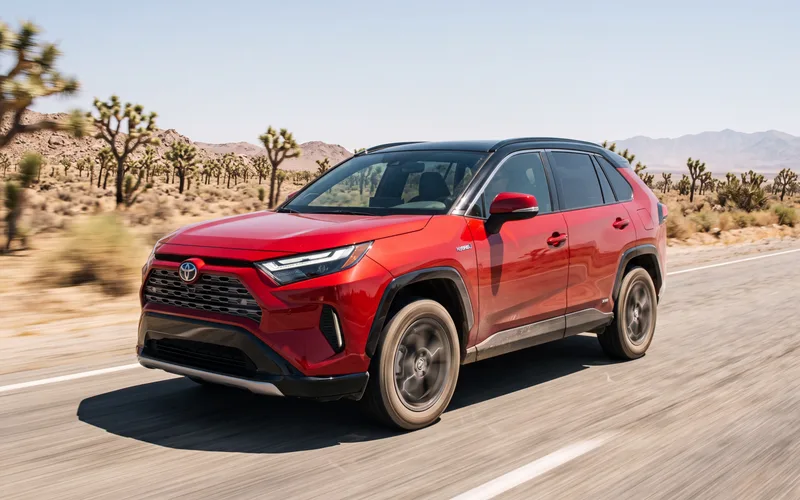 Toyota RAV4Compact SUVBetter at: Fuel economy and resale
If the CX-5's 26 MPG and 54% resale are what give you pause, the hybrid-only RAV4 answers both at once with 41-plus MPG combined and class-best value retention.
Compare 2.13C
2.13C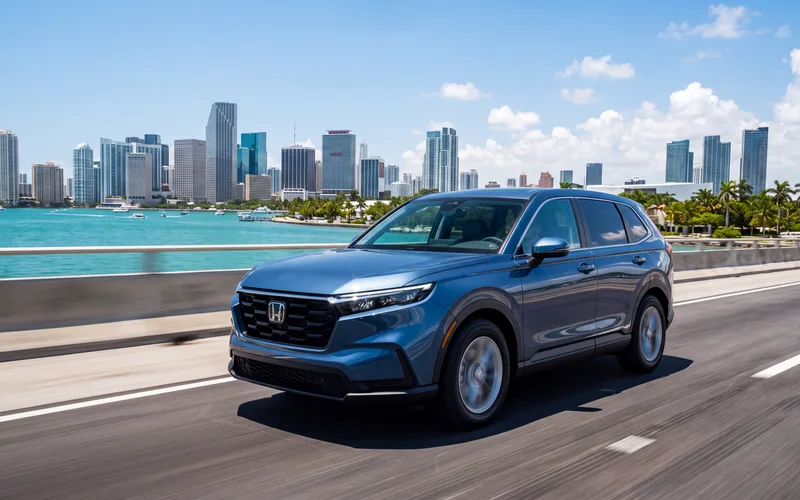 Honda CR-VCompact SUVBetter at: Hybrid efficiency
The CR-V matches the CX-5 on price and practicality while adding a 40-MPG-city hybrid option, more cargo room, and physical climate controls the redesigned Mazda gave up.
Compare 2.40C+
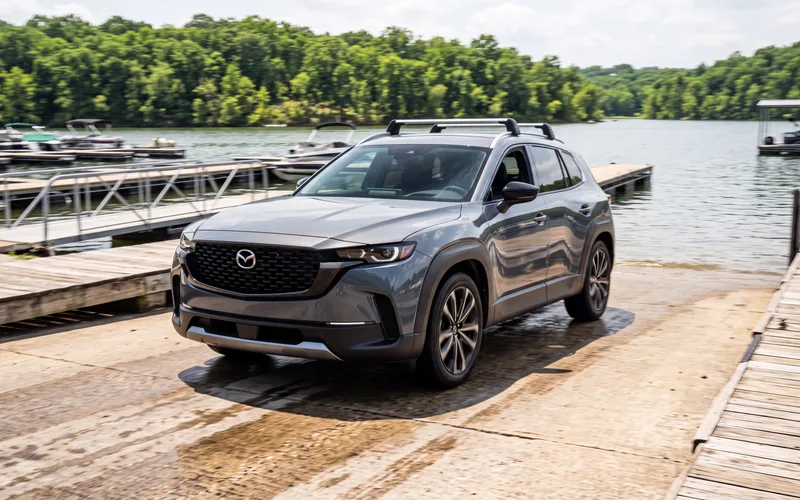 Mazda CX-50Compact SUVBetter at: Powertrain choice
Stay with Mazda's driving feel and interior quality but get the powertrain breadth and genuine dirt-road capability the 2026 CX-5 no longer offers.
CompareHow it's evolved
10 scored model years · 2017–2026
Subject scores by year
Hover or tap a score to see what moved it versus the year before. A corner mark flags a big swing.
| Year | Performance | Efficiency | Safety | Space | Cost | Reliability | Tech | Use-case | Driving | Value |
|---|---|---|---|---|---|---|---|---|---|---|
| 2026 | 31 | 55 | 77 | 55 | 63 | 75 | 77 | 63 | 73 | 70 |
| 2025 | 32 | 50 | 68 | 51 | 69 | 83 | 52 | 60 | 76 | 69 |
| 2024 | 34 | 64 | 75 | 51 | 66 | 82 | 56 | 60 | 79 | 73 |
| 2023 | 33 | 55 | 75 | 50 | 66 | 83 | 54 | 60 | 75 | 73 |
| 2022 | 33 | 55 | 74 | 50 | 68 | 77 | 54 | 60 | 75 | 73 |
| 2021 | 33 | 55 | 76 | 48 | 68 | 72 | 52 | 59 | 74 | 76 |
| 2020 | 32 | 55 | 77 | 48 | 67 | 68 | 41 | 58 | 75 | 76 |
| 2019 | 36 | 55 | 76 | 48 | 68 | 63 | 41 | 58 | 74 | 78 |
| 2018 | 29 | 56 | 74 | 47 | 70 | 62 | 34 | 57 | 74 | 77 |
| 2017 | 29 | 54 | 57 | 47 | 73 | 73 | 34 | 56 | 74 | 71 |
Compare two years
Best fit & conditions
Higher scores mean a better fit for that use case. Learn more about use-case fit →
Subject profile
Trims & configurations
5 trimsScores above reflect the volume trim. Per-trim specs and scores are rolling out — the full lineup:
Academic Probation · NHTSA safety recalls
No NHTSA safety recall is on record for the 2023 Mazda CX-5. Other model years of the CX-5 have 4 — listed below.
4 recalls on other model years of the CX-5 (2017–2019)
Nov 12, 2021Fuel system, gasoline: delivery: fuel pumpThe impeller inside the low-pressure fuel pump may crack and deform, potentially causing the fuel pump to fail.
Defect
Mazda North American Operations (Mazda) is recalling certain 2018 Mazda3, Mazda6, 2019 CX-3, 2018-2019 MX-5, CX-5, CX-9, and 2019-2020 Mazda2 vehicles. The impeller inside the low-pressure fuel pump may crack and deform, potentially causing the fuel pump to fail.
Risk
Fuel pump failure may cause an engine stall, increasing the risk of a crash.
Remedy
Dealers will replace the fuel pumps, free of charge. Owner notification letters were mailed July 18, 2022. Owners may contact Mazda customer service at 1-800-222-5500 Option 4. Mazda's number for this recall is 5321K.
NHTSA campaign 21V875000 ↗Manufacturer no. 5321K121,038 vehicles potentially affected (all models in the campaign)Owners notified Jul 18, 2022Filed by Mazda North American OperationsFiled as CX-5Jun 27, 2019Engine · Power train: automatic transmission: control module (tcm/pcm/tecm)A software error in the powertrain control module (PCM) may cause the engine to stall.
Defect
Mazda North American Operations (Mazda) is recalling certain 2018-2019 CX-5, Mazda6, and 2019 Mazda3 vehicles. A software error in the powertrain control module (PCM) may cause the engine to stall.
Risk
An unexpected stall increases the risk of a crash.
Remedy
Mazda will notify owners, and dealers will reprogram the PCM software, free of charge. The recall began August 20, 2019. Owners may contact Mazda customer service at 1-800-222-5500, option 4. Mazda's number for this recall is 3719F.
NHTSA campaign 19V497000 ↗Manufacturer no. 3719F262,220 vehicles potentially affected (all models in the campaign)Owners notified Aug 20, 2019Filed by Mazda North American OperationsFiled as CX-5Jun 25, 2018Air bags: side/windowIn the event of a side impact or rollover crash, the side curtain air bags may not properly unfold during deployment. As such, these vehicles fail to comply with the requirements of Federal Motor Vehicle Safety Standard (FMVSS) number 226, "Ejection Mitigation."
Defect
Mazda North American Operations (Mazda) is recalling certain 2018 Mazda CX-5 vehicles. In the event of a side impact or rollover crash, the side curtain air bags may not properly unfold during deployment. As such, these vehicles fail to comply with the requirements of Federal Motor Vehicle Safety Standard (FMVSS) number 226, "Ejection Mitigation."
Risk
If the air bags do not deploy properly in a crash, it can increase the risk of injury.
Remedy
Mazda will notify owners, and dealers will replace the curtain air bags, free of charge. The recall began July 31, 2018. Owners may contact Mazda customer service at 1-800-222-5500, Option 4. Mazda's number for this recall is 2718F.
NHTSA campaign 18V426000 ↗Manufacturer no. 2718F682 vehicles potentially affected (all models in the campaign)Owners notified Jul 31, 2018Filed by Mazda North American OperationsFiled as CX-5Nov 21, 2017Electrical system: wiring · Trailer hitchesThis harness may be routed such that there is insufficient clearance between the harness and the exhaust muffler, allowing the wiring harness to contact the muffler.
Defect
Mazda North American Operations (Mazda) is recalling certain 2017 CX-5 vehicles equipped with an accessory trailer hitch wiring harness. This harness may be routed such that there is insufficient clearance between the harness and the exhaust muffler, allowing the wiring harness to contact the muffler.
Risk
Contact with the muffler may damage the trailer wiring harness, potentially resulting in the trailer lighting being inoperative, thereby increasing the risk of a crash.
Remedy
Mazda will notify owners, and dealers will reroute the trailer hitch harness away from the muffler, replacing the harness if it is damaged, free of charge. The recall is expected to begin January 20, 2018. Owners may contact Mazda customer service at 1-800-222-5500. Mazda's number for this recall is 1617K.
NHTSA campaign 17V744000 ↗Manufacturer no. 1617K1,076 vehicles potentially affected (all models in the campaign)Owners notified Jan 22, 2018Filed by Mazda North American OperationsFiled as CX-5
Source: NHTSA Office of Defects Investigation recall database, model years 2017–2026. Recalls are listed by model year as the manufacturer filed them; whether a specific car is affected depends on its VIN — check a VIN at nhtsa.gov ↗. NHTSA model names matched to this page: CX-5.
Detailed scoring by subject
1Performance & PowertrainThe CX-5's lowest-graded category.0.19F
The volume non-turbo trims use the naturally aspirated Skyactiv-G 2.5 with cylinder deactivation at 187 hp, modest for the compact-SUV class where turbo rivals clear 250 hp.
186 lb-ft arriving at 4,000 rpm is typical for a naturally aspirated 2.5, but it means real thrust requires revs — the turbo's 310–320 lb-ft at 2,000–2,500 rpm is a different vehicle in traffic.
Every non-turbo CX-5 carries the weight of standard i-Activ AWD (3,717 lb curb) against 187 hp, putting it in the mid-8-second range — a half-second or more behind turbocharged compact-SUV rivals.
The naturally aspirated 2.5 is linear and lag-free with well-judged throttle calibration — no turbo hesitation to manage — but it is short on thrust and grows audibly strained when worked hard toward its 6,000-rpm power peak.
The Skyactiv-Drive 6-speed automatic is one of the better conventional torque-converter units in the segment — decisive, quick to kick down, no hunting or CVT drone, with a usable manual-shift and Sport mode — and the low gear count costs efficiency rather than driveability.
Mazda rates every 2023 CX-5 at 2,000 lbs regardless of engine, which is at the bottom of the compact-SUV range and well short of rivals rated at 3,500 lbs.
i-Activ AWD is standard on all eight trims for 2023 — there is no front-drive CX-5 in the US market — and it is a predictive system paired with G-Vectoring Control Plus, though it stops short of a low range or locking differential and terrain modes are limited to Premium and above.
The CX-5 is a pavement-oriented crossover: 7.6 in of ground clearance on the volume non-turbo trims, no skid plates, no low range and no locking differential, with the Mi-Drive Off-Road mode reserved for Premium and higher — Mazda points off-road buyers at the CX-50 instead.
Two genuine choices — the 187-hp naturally aspirated 2.5 and the 227/256-hp 2.5 Turbo — cover the mainstream span, but there is no hybrid, plug-in or electric CX-5 in the US for 2023, which is a real gap against RAV4, CR-V and Tucson lineups that all offer electrification.
2Efficiency & RangeMid-pack among this car's ten categories.1.72C-
26 MPG combined is solid for a non-hybrid compact SUV carrying standard AWD, though a 6-speed automatic rather than an 8-speed or CVT keeps it a step behind the class efficiency leaders.
Cylinder deactivation on the naturally aspirated 2.5 helps the city figure reach 24 MPG despite standard all-wheel drive, but with no hybrid assist it cannot approach the 40-plus MPG electrified rivals post in town.
30 MPG highway is a respectable cruising figure for an AWD compact SUV, and the tall top gear of the Skyactiv-Drive 6-speed keeps revs low at interstate speeds.
A modest 15.3-gallon tank caps total range near 400 miles — adequate but unremarkable, since rivals with larger tanks or hybrid powertrains routinely clear 450–500 miles between stops.
Running costs sit mid-pack for the class: regular fuel keeps the per-gallon price down, but 26 MPG combined means an electrified compact SUV will undercut it by several hundred dollars a year.
The volume non-turbo CX-5 is rated on regular 87 octane with no premium recommendation, so there is no fuel-grade penalty; only turbo buyers face the optional choice of paying for 93 octane to unlock the higher output.
3SafetyOne of the CX-5's strongest categories.3.07B
NHTSA rated the 2023 CX-5 five stars overall, with five stars in both frontal and side testing and four stars for rollover resistance — the top result available and consistent across the KF generation.
The 2023 CX-5 is an IIHS Top Safety Pick with Good in every crashworthiness test it was run through — driver and passenger small overlap, both the original and the updated moderate overlap front test, the updated side test, roof strength and head restraints. That is the prompt's top band (TSP with all-Good crash results); it misses TSP+ only because Select, Preferred and Carbon Edition headlights rate Acceptable rather than Good. Notably, the 2023 model year is where Mazda added rear seat belt pretensioners and load limiters, lifting the updated moderate overlap result from the 2021-2022 car's Poor to Good.
Every 2023 CX-5, down to the $26,700 base 2.5 S, carries the full core i-Activsense set standard: Smart Brake Support and Advanced Smart City Brake Support (AEB), Mazda Radar Cruise Control with Stop & Go, Lane Departure Warning with Lane Keep Assist, Blind Spot Monitoring and Rear Cross-Traffic Alert. Standard full-speed adaptive cruise and blind-spot on the cheapest trim is unusual in the mainstream compact SUV class and puts this in the top band; the deduction is that the 360-degree View Monitor, rear AEB, Traffic Jam Assist and Driver Attention Alert are all locked to the top 2.5 Turbo Signature.
Smart Brake Support earns Superior in the original IIHS vehicle-to-vehicle evaluation and Advanced in the daytime pedestrian test, avoiding the 25 mph crossing-adult impact outright. But it rates Poor in the tougher updated vehicle-to-vehicle 2.0 evaluation, where it only cleared the 31 mph passenger-car target and fell away at higher speeds, and no nighttime pedestrian result was published. Strong at low speed and in daylight, weak where the newer tests push it — squarely the middle band.
Blind Spot Monitoring and Rear Cross-Traffic Alert are standard on all eight trims rather than bundled into an upper-trim package, which beats most compact SUV rivals of the year. Coverage stays alert-only for the volume buyer, though: rear Smart City Brake Support — the braking intervention on a rear crossing threat — is confined to the 2.5 Turbo Signature, and there is no safe-exit warning, so it sits just below the fully active top band.
Lane Departure Warning with Lane Keep Assist is standard on every trim, but it is a corrective nudge rather than continuous centering, and Edmunds called the lane-keeping assistance disappointing in its testing of this car. True lane centering only arrives with Traffic Jam Assist on the 2.5 Turbo Signature, so a volume-trim buyer has warning and intervention but no centering at all.
Mazda Radar Cruise Control with full-speed Stop & Go is standard on every trim, which is generous for a $26,700 base price, and it will bring the car to a complete halt and resume in traffic. Edmunds found it slow to react, and there is no combined highway assist for the volume buyer — the lane-centering half of that equation is Signature-only — so it is a capable system with rough edges rather than a refined integrated one.
Mazda offered no hands-free highway driving system on any US model in 2023, and the CX-5 is no exception. Its most advanced feature, Traffic Jam Assist on the Signature, is a hands-on low-speed Level 2 system that requires the driver to keep hold of the wheel.
IIHS rates the CX-5's headlights Good on the base 2.5 S and on Premium and above, but only Acceptable on the Select, Preferred and Carbon Edition trims that make up much of the volume — the exact split the middle band describes, and the reason the car is a Top Safety Pick rather than TSP+. The Adaptive Front-lighting System that swivels with steering starts at 2.5 S Premium.
Forward and three-quarter sightlines are a genuine strength — an elevated seating position, tall side glass and relatively slim pillars make the CX-5 easy to place. The rear is the weak point: the side windows are smaller than class rivals and the rising beltline pinches the over-the-shoulder view, and the 360-degree View Monitor that would compensate is restricted to the 2.5 Turbo Signature, leaving every other trim with just a reversing camera.
IIHS rates the CX-5's LATCH hardware Acceptable for ease of use — two outboard lower-anchor positions plus three top tethers, workable but with anchors set in the seat bight that take some digging. Rear-door openings are reasonable for the class, but a compact SUV bench of this width makes three seats across a squeeze, which keeps it in the middle band rather than the top.
4Space & ComfortOne of the CX-5's weakest categories.1.32D
The CX-5 is a strictly five-seat two-row compact SUV across the entire 2023 range, with no six- or seven-seat configuration offered anywhere in the trim walk.
39.7 in of front headroom is mid-pack for a compact SUV, and the moonroof fitted from the Preferred package upward costs 0.4 in — a smaller penalty than most rivals impose.
41.0 in of front legroom is at the low end of the compact-SUV range — adequate in practice, but the CX-5's cabin is dimensionally tight against a CR-V or Tucson.
39.0 in is genuinely good second-row headroom for the class, and unusually the moonroof costs nothing in the back — Mazda quotes the same figure both ways.
39.6 in of rear legroom is solid for a compact SUV and reviewers find the back seat genuinely usable for adults, helped by open foot space under the front seats — though the 2.7 in of quoted knee clearance shows how little margin there is behind a tall driver.
There is no third row in any 2023 CX-5 — it is a five-seat two-row crossover in every trim, so this scores in the bottom band by definition rather than being omitted. Buyers wanting a third row are directed to the CX-9.
30.8 cu ft is among the smallest cargo holds in the compact-SUV class — a CR-V offers roughly a third more — and the two-position floor board trades 1.7 cu ft for a flatter load surface.
59.3 cu ft maximum is near the bottom of the compact-SUV band, well short of the 70-plus cu ft the class leaders manage, though the 66.8 in load length is long enough for genuinely bulky items.
The essentials are all present and neatly executed — covered console bin with tray, rear console bin, bottle holders in all four doors, front seatback pockets, overhead sunglass console, a two-position cargo floor board and three 12-volt outlets — but nothing is innovative and the console cubbies are small by class standards, with no wireless charging pad below the Turbo trims.
Mazda's front seats are well shaped and materials sit above the class norm — leatherette with suede inserts from Select, leather from Preferred, 8-way power with memory from Preferred up — and the rear bench reclines, but multiple reviewers report the cushions are too flat and firm, with numbness setting in after roughly an hour.
The CX-5 trades a little compliance for body control and reviewers consistently call it firm but never harsh or floaty — mid-corner bumps are absorbed and dispatched immediately — with the 19-inch tires on Carbon Edition and above costing a small amount of smoothness over the volume trims' 225/65R17s.
Sound insulation is a real strength of this generation after the 2022 refresh — reviewers rate the cabin among the quietest in the non-luxury compact class, with intrusion only appearing at highway speed — held below the top band because the naturally aspirated 2.5 turns droney when it has to be worked.
The important items land early in the trim walk: dual-zone automatic climate control with rear vents and three-level heated front seats from the $28,500 Select, one step above base. Heated steering wheel, ventilated front seats and heated rear seats wait for the Premium Plus package six trims up, and remote climate is only app-based remote engine start with no separate rear climate zone.
5Cost of OwnershipMid-pack among this car's ten categories.2.44C+
The base 2.5 S opens at $26,700 plus $1,275 destination, and unlike the front-drive base CR-V LX and RAV4 LE it includes i-Activ AWD, a 10.25-inch center display and the full i-Activsense driver-assist suite as standard. That makes the entry price genuinely comparable rather than a stripped loss-leader.
The 2.5 S Preferred is the CX-5's long-standing volume rung — it adds heated front seats, power liftgate, power driver's seat and upgraded audio without reaching Premium money — and lands at $30,865 delivered with AWD included. That undercuts a comparably equipped CR-V EX-L or RAV4 XLE Premium by roughly $3,000-$5,000.
Industry estimates bracket this figure widely, so it is a reconciliation rather than a single citation: the naturally aspirated 2.5 with a conventional six-speed torque-converter automatic has no turbocharger, no CVT and no hybrid system, and RepairPal ranks the CX-5 first of 26 in its class on reliability with low repair frequency and severity. That puts it comfortably below the segment's turbocharged and CVT-equipped rivals.
This is the category's soft spot. Mid-to-high-50s retention is respectable in absolute terms and better than the compact-SUV average, but it trails the two benchmarks this car is shopped against by roughly nine to eleven points — a gap worth about $3,000 in real money on a $31,000 vehicle, and the direct consequence of the CX-5 having no hybrid variant in a segment where electrified used demand sets the floor.
Mazda's new-vehicle limited warranty is the industry-baseline 36 months/36,000 miles — the floor of the 3-5 year normalization band, so it scores zero. It matches Toyota, Honda and Subaru but is two full years short of the Hyundai and Kia 5-year/60,000-mile coverage that sets the compact-SUV benchmark.
The 60-month/60,000-mile powertrain term is likewise the baseline and the bottom of the 5-10 year band. With no electrified powertrain offered on the 2023 CX-5 there is no supplementary 8-year/100,000-mile hybrid-component coverage of the kind that backs the CR-V, RAV4 and Forester hybrids, so this is the whole of the long-term mechanical protection.
Mazda includes no complimentary scheduled maintenance at all in the US — not one free oil change — so the first service visit is out of pocket and Mazda instead sells prepaid maintenance plans through Mazda Financial Services. What is included is genuine but thin: 24/7 roadside assistance for the warranty term and three years of Mazda Connected Services. That is squarely "basic roadside only," placing it at the bottom of the middle band and well behind ToyotaCare on a RAV4 (2 yr/25,000 mi) or Hyundai's 3-year/36,000-mile program.
$30,865 volume-trim price minus its estimated resale value after 5 years (58% retained, or about $17,902) leaves about $12,963 in depreciation. Add the projected $4,700 in 5-year maintenance and repairs, and owning this vehicle for 5 years costs about $17,663 in total.
6Reliability & QualityThe CX-5's best-graded category.3.62A-
Every independent signal on this exact model year points the same direction, which is what puts it in the top band rather than merely above average. J.D. Power rates the 2023 CX-5 82/100 for quality and reliability, top of its competitive set; Consumer Reports' owner survey places it 'much more reliable than other cars from the same model year'; RepairPal ranks the CX-5 1st of 26 midsize SUVs at 4.5/5.0. The hard field data agrees — zero NHTSA recall campaigns and 60 owner complaints against the 2023 model year, against 149 for the RAV4, 130 for the Tucson, 511 for the CR-V and 687 for the Rogue. Held short of the 90s because the complaint gap narrows once sales volume is accounted for, and because in-car electronics is a consistent trouble spot in the CR survey.
Mazda's multi-year dependability standing is genuinely near the top — 3rd overall and 2nd among mass-market brands in the 2025 J.D. Power VDS at 161 PP100 (a 24 PP100 year-over-year gain), and 3rd for used-car reliability among 5-to-10-year-old models at Consumer Reports. Two things keep it just under the 80+ band. On the 2026 VDS, which surveys owners of 2023-model-year cars specifically, Mazda beat the 204 PP100 industry average but finished outside the published top ten; and Consumer Reports' 2026 new-car brand ranking dropped Mazda eight places to 14th of 26. That fall traces to the new large-platform CX-70/CX-90 hybrid powertrains rather than to anything under the CX-5, so it is a caution about the brand's newer hardware, not about this car.
This is the standout item. As of August 2026 — nearly four years into the model year's life — there is not one NHTSA recall campaign covering the 2023 CX-5, and the clean streak runs the full 2020 through 2025 model years without a single campaign. The KF generation's recall record overall is light: one campaign on 2017 cars, a handful spanning 2018-2019, and nothing since. Kept out of the mid-90s by two non-recall patterns that are real if not systemic: the cracked-cylinder-head TSBs Mazda issued against 2018-2020 2.5 Skyactiv-G engines with cylinder deactivation (the same engine family this car uses, though the 2023 unit is not covered), and a persistent Apple CarPlay pairing/lockout complaint that shows up in both the CR survey and the NHTSA electrical filings.
The volume 2023 CX-5 runs the naturally aspirated 2.5L Skyactiv-G (187 hp / 186 lb-ft) through a conventional Skyactiv-Drive six-speed torque-converter automatic with standard i-Activ AWD. That is a PY-series engine in continuous production since the 2012 CX-5 with a well-established high-mileage record, and avoiding both a CVT and a dual-clutch is a genuine durability edge over the CR-V, RAV4, Rogue and Forester, all of which use a CVT. Two things keep it out of the 90s: the cylinder-deactivation system on the NA 2.5 drew cracked-cylinder-head service bulletins on 2018-2020 cars, and the alternative 2.5 Turbo (256 hp / 320 lb-ft on premium, 227 hp / 310 lb-ft on regular) adds forced-induction hardware with a shorter track record than the NA unit.
The cabin is the CX-5's signature advantage and the widest gap it opens over anything else in the compact-SUV class — reviewers consistently call it the nicest interior in the segment and describe finishes as near-luxury grade, arguably better than some entry-luxury badges. Soft-touch coverage is broad, switchgear is well damped, and even mid trims avoid the hard-plastic expanses that define a RAV4 or Rogue interior; the Turbo Signature adds Nappa leather and genuine layered wood. This is scored higher than the mechanically similar Mazda3 because the peer set it is judged against is plainer. Kept below the mid-90s by hard plastics low in the cabin and the gloss-black console trim that shows fingerprints.
Physical assembly is a strength. Every US CX-5 is built at Mazda's Ujina plant in Hiroshima rather than at a lower-volume overseas line, 2023 is the seventh year of the KF generation so the process is fully mature, and there is no notable rattle, squeak or panel-alignment complaint pattern in the owner record — the 60 NHTSA complaints for the year contain essentially none. What pulls this out of the 80s-plus band is the initial-quality survey for this exact model year: Mazda placed 26th of 33 brands in the 2023 J.D. Power IQS at 203 PP100, eleven worse than the 192 industry average. That deficit is widely attributed to infotainment and controls — the console-dial interface with touch disabled at speed registers as a 'problem' for many owners — so it is a reported-quality mark rather than a build-integrity one.
Network coverage is the CX-5's real ownership weakness and the one item dragging this category down. Mazda has deliberately shrunk its US store count from 635 in 2014 to roughly 548 today, against approximately 1,200 Toyota and roughly 1,000 Honda dealers — so a buyer outside a major metro can face a materially longer drive for warranty work than a RAV4 or CR-V owner would. The Retail Evolution program has genuinely improved facility quality and service throughput, but it upgrades existing stores rather than adding new ones, and in 2023 the program was still short of its 300th opening. Service satisfaction itself sits around the mass-market average; it is coverage density, not experience, that sets the score.
Running costs are genuinely low and better documented here than for almost anything else Mazda sells: RepairPal puts the CX-5's average annual repair-and-maintenance spend at $447 — inside its 'excellent ownership costs' band — with low repair severity, below-average repair frequency, and 0.3 unscheduled shop visits per year against 0.4 for midsize SUVs. As Mazda's US volume leader the CX-5 also has the deepest independent parts catalogue in the brand's lineup, so it is the least likely Mazda to strand an owner on a dealer-only order. It stays in the normal band rather than the 80+ one because Mazda's overall US volume is an order of magnitude below Toyota's or Honda's, so the aftermarket and salvage supply are thinner and some model-specific components still carry longer lead times than a RAV4 or CR-V equivalent.
7Technology & InfotainmentOne of the CX-5's weakest categories.1.66D
Every 2023 CX-5 gets the same 10.25-inch widescreen display with no larger option anywhere in the range, which is mid-pack for size — but it is a display rather than a touchscreen, driven entirely by the rotary Commander control, and that limitation is scored in 7.1.2 rather than by zeroing the diagonal here.
Mazda Connect is quick and logically laid out and the rotary Commander with real climate knobs and a volume dial demands far fewer glances than screen-first rivals — reviewers compare it favourably to BMW's iDrive — but the complete absence of touch in 2023 makes map panning and text entry in CarPlay awkward, the graphics are dated, and there is a genuine learning curve.
Apple CarPlay and Android Auto are standard on every trim including the $26,700 base, but both are wired over the front USB ports for 2023 — factory wireless projection did not reach the US CX-5 until the 2024 model year, by which point wireless was standard on most mainstream rivals. Scored at the floor of the wired-standard band.
Voice is command-word driven rather than natural language, and embedded navigation is fitted as standard only on the $39,650 Turbo Signature at the very top of an eight-trim range — every other CX-5 needs a dealer-installed SD card accessory to get maps, so most owners simply use phone projection.
The ceiling is respectable — a Bose 10-speaker Centerpoint system from the Premium package up, with SiriusXM — but the floor is poor: the base 2.5 S ships with just four speakers, and Select through Carbon Edition make do with six, which is thin for the class.
The volume trims get only a 4.6-inch TFT strip set between conventional analog dials — small even by 2023 mainstream standards — with the larger 7-inch TFT meter display reserved for the Premium package and above. Crisp, but nothing approaching a configurable full-digital cluster.
This is the CX-5's weakest technology dimension. Mazda Connect on this platform has no whole-vehicle over-the-air programme — the connected-services suite covers online map refresh and push/recall notifications, and anything touching vehicle software means a dealer visit or physical media.
MyMazda covers the core remote set — engine start, lock/unlock, hazard lights, vehicle finder, status alerts, health report, automatic 911 — and Mazda includes it free for three years on every trim, which is more generous than rivals' one-year trials. It is still subscription-gated after that, there is no phone-as-key, and the in-car Wi-Fi trial is only three months or 2 GB.
Port provision is adequate but dated: two front USB inputs standard and two more in the rear console from Select up, all USB-A rather than USB-C, three 12-volt outlets, and a wireless charging pad only on the two Turbo trims at the top of the range. No household outlet or onboard power.
Push-button start is standard on every trim and Mazda Advanced Keyless Entry (proximity) arrives one step up at Select, with a power liftgate offering programmable height from Preferred onward. It falls short of the top band because remote start is app-and-subscription based rather than on the key fob, there is no hands-free liftgate, and no phone-as-key exists.
A reversing camera is standard, but the 360-degree View Monitor and front/rear parking sensors are locked to the single $39,650 Turbo Signature at the top of an eight-trim range — seven of eight CX-5s have no parking sensors at all. Reviewers also flag that the rear camera lacks steering-responsive guide lines.
Mazda's Active Driving Display is one of the better mainstream head-up displays — full colour and projected onto the windshield rather than a pop-up combiner — but it starts at the $35,500 Premium Plus package, so the top three of eight trims only, leaving the volume Select and Preferred cars without it.
8Use-Case FitMid-pack among this car's ten categories.2.02C
Workable but tight. IIHS rates the LATCH hardware only Acceptable, the 40/20/40 bench with one-touch fold and standard rear recline helps, and rear doors open reasonably wide — but 30.8 cu ft behind the seats is one of the smallest holds in the class for a stroller plus groceries, and 2.7 in of quoted knee clearance means a rear-facing seat crowds the front passenger.
This is the CX-5's strongest family credential: 5-star NHTSA overall, IIHS Top Safety Pick with Good in every crashworthiness test, and the full i-Activsense set — AEB with pedestrian detection, radar cruise with stop-and-go, blind-spot monitoring, rear cross-traffic alert, lane-keep assist — standard on the $26,700 base trim rather than sold up the range. Held out of the highest band because there is no rear-seat occupant reminder and the 360-degree camera is top-trim only.
Solid for four: a quiet cabin, rear air vents, reclining rear seatback, rear center armrest with cupholders and two rear USB ports from the Select package up, with heated rear seats available on Premium Plus. What limits it is luggage — 30.8 cu ft with the seats occupied is short for four people's bags on a week's trip — plus no rear entertainment and flat seat cushions that tire occupants after an hour.
A relaxed and predictable commuter: the Skyactiv-Drive six-speed torque-converter automatic is crisp and never drones like the CVTs it competes with, radar cruise with stop-and-go is standard on every trim, controls are physical, and the driving position is excellent. The 187-hp naturally aspirated engine has to be revved to move the AWD-standard 3,717 lb body, which costs it the top band.
Average-at-best running costs for 2023: 26 MPG combined from the non-turbo with standard AWD and roughly $2,350 a year in fuel, against RAV4 and CR-V hybrids in the high 30s. Mazda recommends 91 octane but the engine makes its full rating on 87, and consumables are cheap and conventional — there is simply no electrified CX-5 to choose.
Compact on the road at 180.1 in long and 72.6 in wide with a genuinely tight 36 ft curb-to-curb turning circle, and forward sightlines are good from the elevated seat. What holds it back is parking hardware — no front or rear parking sensors on seven of eight trims, no 360-degree camera below the Turbo Signature, and a pinched over-the-shoulder view.
Not a work vehicle. Mazda rates every 2023 CX-5 at 2,000 lb towing regardless of engine, payload works out to roughly 1,000 lb, and there is no bed — 59.3 cu ft of enclosed cargo is the whole story. It clears a small utility trailer and a load of materials and nothing beyond that.
The mechanicals are the reassuring part — a naturally aspirated Skyactiv-G 2.5 and conventional torque-converter six-speed with a long, clean field record, backed by strong predicted reliability. But it is a comfort-oriented unibody crossover with carpeted floors and leather or leatherette from the second trim up, with no wear-friendly work interior and no fleet reputation to speak of.
Thin provisions: three 12-volt outlets and no AC inverter or onboard power, a carpeted cargo floor with a two-position board, and a 44.3 in tailgate opening that is usable but modest. Roof rails, crossbars and the 2,000 lb trailer hitch are all dealer accessories rather than factory equipment, and there is no work-focused upfit ecosystem.
A competent tourer: roughly 400 miles between fills, one of the quieter cabins in the class, and standard radar cruise with stop-and-go plus lane-keep assist on every trim to take the edge off long stints. Two things cap it — the flat seat cushions that reviewers say go numb inside an hour, and a 15.3-gallon tank that is small enough to keep range merely average.
Standard i-Activ AWD on all eight trims is a genuine advantage over rivals that charge for it, and the CX-5 handles gravel, snow and a trailhead parking lot without complaint. But 7.6 in of ground clearance, no skid plates, no low range, an Off-Road drive mode reserved for Premium and up, a 165 lb roof limit and 2,000 lb of towing put real limits on it — Mazda points adventure buyers at the CX-50.
The shapes are right even though the volume is not: a 40/20/40 split with one-touch fold levers, a near-flat 66.8 in load floor, a 44.3 in tailgate opening, a two-position cargo board over an underfloor cavity, and a power liftgate from Preferred up. Reviewers report swallowing genuinely bulky items — but 59.3 cu ft maximum is small for the class, and rails and a hitch have to be bought as accessories.
9Driving ExperienceOne of the CX-5's strongest categories.3.10B
Chassis dynamics are the CX-5's reason to exist and the clearest gap between it and the rest of the mainstream compact-SUV field. At 3,717 lb on a 106.2 in wheelbase with standard i-Activ AWD and G-Vectoring Control Plus, it turns in cleanly, resists roll and stays composed over mid-corner bumps — the segment's driver's choice, if short of a genuine sports car's grip.
The single most consistently praised thing about the car: Mazda's electric rack is quick and linear just off-center, naturally weighted as load builds, and communicative by class standards — well clear of the numb, over-assisted calibrations that define most mainstream compact SUVs.
A firm, progressive pedal that is easy to modulate is a durable Mazda trait and clearly better than the long-travel, soft pedals common in this class; hardware is conventional — 11.7 in ventilated front and 11.9 in solid rear discs on the volume trims, 12.6 in fronts on the Turbo. No standout instrumented stopping numbers to lift it higher.
Mazda's refusal to fit a CVT is a real drivability advantage — the Skyactiv-Drive torque-converter six shifts crisply and decisively with sensible ratios and no rubber-banding, and the naturally aspirated 2.5 is linear with no turbo hesitation to manage. Cylinder deactivation operates unobtrusively; the limit is thrust rather than calibration.
The geared automatic sidesteps the sustained high-rpm drone that penalizes nearly every CVT rival in the segment, and the engine is genuinely quiet at idle and at a highway cruise. It loses ground when worked, though — reviewers call the naturally aspirated 2.5 droney as it climbs toward its 6,000 rpm power peak, which is exactly where a loaded CX-5 spends its time.
36.0 ft curb-to-curb is tight for a compact SUV — a class where 37-38 ft is typical — and combines with a short 180.1 in body to make the CX-5 easy to turn around in a city street or a parking structure.
The fundamentals are a Mazda strength: a low cowl and driver-oriented dash, tilt-and-telescopic wheel standard, 8-way power seat with lumbar and memory from Preferred up, real climate knobs and a volume dial, and an elevated seat with slim pillars that makes the car easy to place. Deductions are for the pinched over-the-shoulder view and a shift lever reviewers call flimsy.
In a segment of appliances the CX-5 is one of the very few cars enthusiasts actually recommend — the steering and chassis reward a deliberate driver and the geared automatic lets you use them. It stops short of the highest band in this volume specification because 187 hp and an 8.6-second 0-60 mph mean the character is all cornering and no thrust; that is what the Turbo trims are for.
10Value & Market PositionGrades above the middle of the scale.2.93B-
The 2023 CX-5 is unusually well equipped at the bottom of the range: i-Activ all-wheel drive is standard on every trim, where both the CR-V LX and RAV4 LE are front-drive at their advertised base prices, and the full i-Activsense suite including blind-spot monitoring and rear cross-traffic alert is standard on the $27,975 2.5 S at a time when Honda still withheld BSM/RCTA from the LX. A 10.25-inch center display, LED headlights with high-beam control and three years of connected services are also standard. It stops short of the 80+ band because the comfort content buyers actually notice — heated seats, power liftgate, dual-zone climate — still waits for the S Preferred step.
This is the CX-5's strongest argument and it has third-party validation: U.S. News named it the 2023 Best Compact SUV for the Money, and it ranks #1 in that publication's Affordable Compact SUVs class at 8.6/10. A cabin that reviewers routinely describe as a class above, genuine chassis quality, and standard AWD for $27,975 to $30,865 delivered is real content per dollar. What holds it out of the top band is what the money does not buy: 26 MPG combined with no hybrid option in a segment that had largely electrified, plus a cargo hold and rear seat smaller than the CR-V's or RAV4's.
Eight well-spaced trims from $27,975 to $40,925 with two genuinely different engines — the 187-hp naturally aspirated 2.5 and the 227/256-hp 2.5 Turbo — is one of the broader ladders in the segment, letting the same nameplate serve a $28K value shopper and a $41K near-luxury buyer. The configuration menu behind the trims is narrower: one transmission, no drivetrain choice now that AWD is standard, and no hybrid or plug-in variant at all, which is the gap that matters most against the RAV4's hybrid/Prime split.
153,808 US sales in calendar 2023 made the CX-5 Mazda's volume backbone and a firm top-tier compact SUV, and it closed the year with a record December of 20,434 units. But it grew only 1.5 percent while the rest of Mazda's crossover line surged, and it operates at roughly a third of the RAV4's scale and 42 percent of the CR-V's. A strong, durable seller with a large installed base rather than a segment leader or a fast riser.
Mazda punches far above its market share on image — it is the mainstream brand critics and enthusiasts single out for steering feel and interior execution, and its deliberate premium-adjacent positioning gives the CX-5 a favorable halo against Nissan or Mitsubishi. It stays out of the top band on hard measures rather than sentiment: a small US footprint, a dealer network thinner than Toyota's or Honda's, and 5-year retention roughly nine points behind those two benchmarks.
The 2023 CX-5's buying case depended heavily on when in the model year you shopped. Mazda put real factory support behind the car from launch — subvented APR and advertised lease programs were live within weeks of the on-sale date — but the 2022-23 inventory shortage meant early buyers still transacted at or above sticker, and only by late 2023 had the market loosened enough for meaningful discounts. Modest, timing-dependent incentives rather than a car you could reliably buy below MSRP.
2023 is the seventh model year of the second-generation (KF) CX-5 that launched for 2017, which by then made it one of the oldest platforms in the compact SUV class. It sits one year after a substantial 2022 mid-cycle refresh — restyled front and rear, standard i-Activ AWD, retuned chassis and a larger standard display — so the car was current rather than stale, and redesign risk for a 2023 buyer was low since the third generation did not arrive until model year 2026. Squarely mid-cycle: the only change for 2023 was a new paint colour.
The 2023 CX-5 has an unusually strong award and review record for a seven-year-old platform: U.S. News ranked it #1 in Affordable Compact SUVs and gave it the Best Compact SUV for the Money award, Car and Driver kept it on the 2023 Editors' Choice list, and it earned a 2023 IIHS Top Safety Pick under the tightened side-crash protocol. It falls short of the consistent-comparison-winner band for a specific and repeated reason: reviewers who praise the steering, ride quality and cabin then dock it for cargo space, rear-seat room, fuel economy and road noise, which is exactly where head-to-head tests against the CR-V and RAV4 are decided.