
The verdict
A struggling compact suv, strong on value and held back by performance.
The 2018 CX-5 was the compact SUV critics loved — Car and Driver's Best Compact SUV, the only 2018 small SUV to earn IIHS Top Safety Pick+, with steering and an interior that punched well above its $28,490 volume-trim price. Eight years on, one problem overshadows all of that: 86 of the 117 NHTSA complaints filed against this model year describe the aluminum cylinder head cracking, typically around 53,500 miles — just past the 5-year/60,000-mile powertrain warranty — for a median $5,130 repair, and unlike the 2019-2020 turbo cars, no 2018 CX-5 qualifies for Mazda's extended coverage. It is also short on the practical stuff: 30.9 cu ft behind the rear seats is roughly 10-15% under a CR-V, and no 2018 trim offered Apple CarPlay or Android Auto at any price. Buy one only with documented proof the head has been replaced, or with a repair budget set aside.
Jump to scoresStrengths
- Drives like nothing else in the class
- A cabin that reads a class above
- The award-winning safety year
What holds it back
- The cracked cylinder head — the reason to walk away
- No CarPlay, no Android Auto, no way around it
- Cargo space is the class's smallest
Top alternatives
Cars shoppers cross-shop with the Mazda CX-5 2.56C+
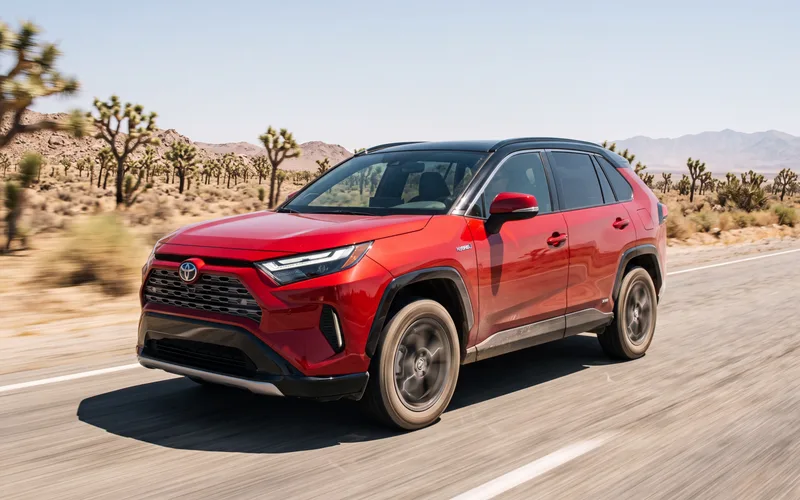 Toyota RAV4Compact SUVBetter at: Fuel economy and resale
If the CX-5's 26 MPG and 54% resale are what give you pause, the hybrid-only RAV4 answers both at once with 41-plus MPG combined and class-best value retention.
Compare 2.13C
2.13C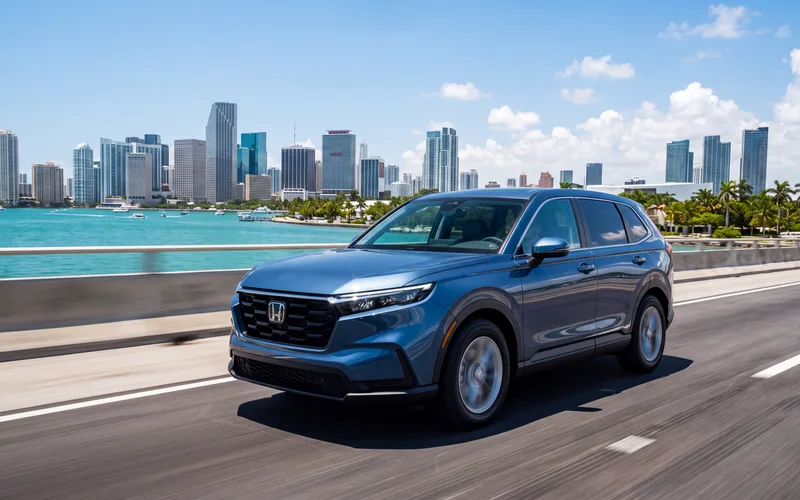 Honda CR-VCompact SUVBetter at: Hybrid efficiency
The CR-V matches the CX-5 on price and practicality while adding a 40-MPG-city hybrid option, more cargo room, and physical climate controls the redesigned Mazda gave up.
Compare 2.40C+
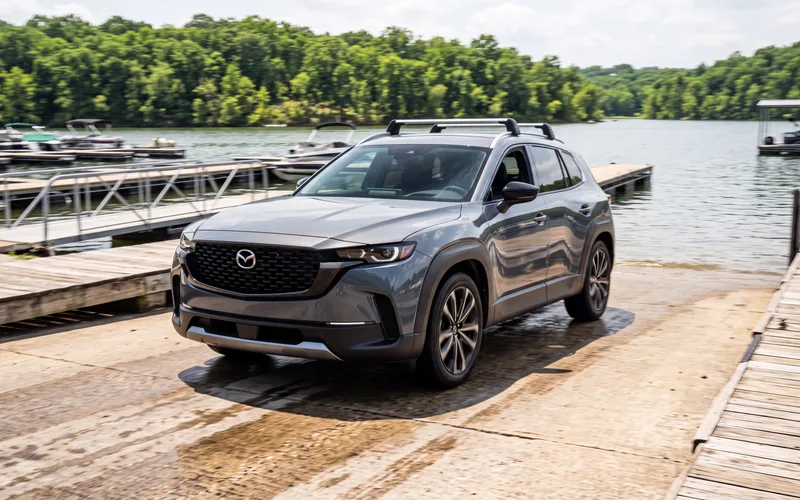 Mazda CX-50Compact SUVBetter at: Powertrain choice
Stay with Mazda's driving feel and interior quality but get the powertrain breadth and genuine dirt-road capability the 2026 CX-5 no longer offers.
CompareHow it's evolved
10 scored model years · 2017–2026
Subject scores by year
Hover or tap a score to see what moved it versus the year before. A corner mark flags a big swing.
| Year | Performance | Efficiency | Safety | Space | Cost | Reliability | Tech | Use-case | Driving | Value |
|---|---|---|---|---|---|---|---|---|---|---|
| 2026 | 31 | 55 | 77 | 55 | 63 | 75 | 77 | 63 | 73 | 70 |
| 2025 | 32 | 50 | 68 | 51 | 69 | 83 | 52 | 60 | 76 | 69 |
| 2024 | 34 | 64 | 75 | 51 | 66 | 82 | 56 | 60 | 79 | 73 |
| 2023 | 33 | 55 | 75 | 50 | 66 | 83 | 54 | 60 | 75 | 73 |
| 2022 | 33 | 55 | 74 | 50 | 68 | 77 | 54 | 60 | 75 | 73 |
| 2021 | 33 | 55 | 76 | 48 | 68 | 72 | 52 | 59 | 74 | 76 |
| 2020 | 32 | 55 | 77 | 48 | 67 | 68 | 41 | 58 | 75 | 76 |
| 2019 | 36 | 55 | 76 | 48 | 68 | 63 | 41 | 58 | 74 | 78 |
| 2018 | 29 | 56 | 74 | 47 | 70 | 62 | 34 | 57 | 74 | 77 |
| 2017 | 29 | 54 | 57 | 47 | 73 | 73 | 34 | 56 | 74 | 71 |
Compare two years
Best fit & conditions
Higher scores mean a better fit for that use case. Learn more about use-case fit →
Subject profile
Trims & configurations
5 trimsScores above reflect the volume trim. Per-trim specs and scores are rolling out — the full lineup:
Academic Probation · NHTSA safety recalls
Nov 12, 2021Fuel system, gasoline: delivery: fuel pumpThe impeller inside the low-pressure fuel pump may crack and deform, potentially causing the fuel pump to fail.
Defect
Mazda North American Operations (Mazda) is recalling certain 2018 Mazda3, Mazda6, 2019 CX-3, 2018-2019 MX-5, CX-5, CX-9, and 2019-2020 Mazda2 vehicles. The impeller inside the low-pressure fuel pump may crack and deform, potentially causing the fuel pump to fail.
Risk
Fuel pump failure may cause an engine stall, increasing the risk of a crash.
Remedy
Dealers will replace the fuel pumps, free of charge. Owner notification letters were mailed July 18, 2022. Owners may contact Mazda customer service at 1-800-222-5500 Option 4. Mazda's number for this recall is 5321K.
NHTSA campaign 21V875000 ↗Manufacturer no. 5321K121,038 vehicles potentially affected (all models in the campaign)Owners notified Jul 18, 2022Filed by Mazda North American OperationsFiled as CX-5Jun 27, 2019Engine · Power train: automatic transmission: control module (tcm/pcm/tecm)A software error in the powertrain control module (PCM) may cause the engine to stall.
Defect
Mazda North American Operations (Mazda) is recalling certain 2018-2019 CX-5, Mazda6, and 2019 Mazda3 vehicles. A software error in the powertrain control module (PCM) may cause the engine to stall.
Risk
An unexpected stall increases the risk of a crash.
Remedy
Mazda will notify owners, and dealers will reprogram the PCM software, free of charge. The recall began August 20, 2019. Owners may contact Mazda customer service at 1-800-222-5500, option 4. Mazda's number for this recall is 3719F.
NHTSA campaign 19V497000 ↗Manufacturer no. 3719F262,220 vehicles potentially affected (all models in the campaign)Owners notified Aug 20, 2019Filed by Mazda North American OperationsFiled as CX-5Jun 25, 2018Air bags: side/windowIn the event of a side impact or rollover crash, the side curtain air bags may not properly unfold during deployment. As such, these vehicles fail to comply with the requirements of Federal Motor Vehicle Safety Standard (FMVSS) number 226, "Ejection Mitigation."
Defect
Mazda North American Operations (Mazda) is recalling certain 2018 Mazda CX-5 vehicles. In the event of a side impact or rollover crash, the side curtain air bags may not properly unfold during deployment. As such, these vehicles fail to comply with the requirements of Federal Motor Vehicle Safety Standard (FMVSS) number 226, "Ejection Mitigation."
Risk
If the air bags do not deploy properly in a crash, it can increase the risk of injury.
Remedy
Mazda will notify owners, and dealers will replace the curtain air bags, free of charge. The recall began July 31, 2018. Owners may contact Mazda customer service at 1-800-222-5500, Option 4. Mazda's number for this recall is 2718F.
NHTSA campaign 18V426000 ↗Manufacturer no. 2718F682 vehicles potentially affected (all models in the campaign)Owners notified Jul 31, 2018Filed by Mazda North American OperationsFiled as CX-5
1 recall on other model years of the CX-5 (2017)
Nov 21, 2017Electrical system: wiring · Trailer hitchesThis harness may be routed such that there is insufficient clearance between the harness and the exhaust muffler, allowing the wiring harness to contact the muffler.
Defect
Mazda North American Operations (Mazda) is recalling certain 2017 CX-5 vehicles equipped with an accessory trailer hitch wiring harness. This harness may be routed such that there is insufficient clearance between the harness and the exhaust muffler, allowing the wiring harness to contact the muffler.
Risk
Contact with the muffler may damage the trailer wiring harness, potentially resulting in the trailer lighting being inoperative, thereby increasing the risk of a crash.
Remedy
Mazda will notify owners, and dealers will reroute the trailer hitch harness away from the muffler, replacing the harness if it is damaged, free of charge. The recall is expected to begin January 20, 2018. Owners may contact Mazda customer service at 1-800-222-5500. Mazda's number for this recall is 1617K.
NHTSA campaign 17V744000 ↗Manufacturer no. 1617K1,076 vehicles potentially affected (all models in the campaign)Owners notified Jan 22, 2018Filed by Mazda North American OperationsFiled as CX-5
Source: NHTSA Office of Defects Investigation recall database, model years 2017–2026. Recalls are listed by model year as the manufacturer filed them; whether a specific car is affected depends on its VIN — check a VIN at nhtsa.gov ↗. NHTSA model names matched to this page: CX-5.
Detailed scoring by subject
1Performance & PowertrainThe CX-5's lowest-graded category.0.00F
All three 2018 trims (Sport, Touring, Grand Touring) share a single naturally aspirated 2.5-liter making 187 hp — there is no turbo or diesel option this year, so the model-range maximum and the volume figure are the same number. Modest output against a 150–550 hp SUV band.
186 lb-ft peaking at 4,000 rpm means low-end pull is unremarkable and the engine has to be revved to merge — reviewers consistently note it takes patience to reach highway speed. The 2018 recalibration that brought cylinder deactivation nudged torque up by exactly 1 lb-ft over 2017 and moved the peak higher, so this is a change year rather than a carry-over, if only marginally.
Instrumented testing puts the 2018 CX-5 in the high-8-second range to 60 mph, slow-to-mid-pack for a 2018 compact SUV and unchanged from the mechanically identical 2019 non-turbo. Mazda publishes no 0–60 figure for the CX-5 — only top speed — so this necessarily comes from third-party tests.
The naturally aspirated 2.5 is linear and completely lag-free with clean, progressive throttle response — a real refinement edge over the small-displacement turbos most 2018 rivals fielded — and the new cylinder-deactivation transitions are unobtrusive. It is held to the low 70s because the engine is short on low-end torque and sounds strained when worked hard, and because 2018 owners reported a low-rpm upshift hesitation.
Mazda's Skyactiv-Drive six-speed automatic stands out in a class that had largely moved to CVTs and 8-to-9-speed units: it holds gears decisively, downshifts promptly and never hunts or drones, with a genuinely usable manual-shift and Sport mode standard on every trim. Only six ratios costs a little highway efficiency rather than driveability, and no 2018 trim offers paddle shifters.
2,000 pounds is enough for a small utility trailer or a pair of jet skis and no more, near the bottom of a 1,000–8,000 lb SUV band. Unlike 2019 — when the 3,500-lb Skyactiv-D Signature lifted the model's maximum — no 2018 CX-5 exceeds this figure in any configuration: the diesel appears on the spec deck's product-changes page as a planned addition but never reached US showrooms as a 2018 model.
i-Activ AWD can be ordered on every 2018 trim and is a genuinely sophisticated predictive system — it reads wheel, steering, brake, wiper and outside-temperature inputs to pre-empt slip rather than reacting to it — but it is standard on nothing, FWD being the default on all three trims. It rates a little below the 2019 car, which added two AWD-only trims at the top of the range, and 2018 has no Off-road Traction Assist anywhere in the lineup.
Firmly pavement-oriented: 7.5 inches of unladen ground clearance, no low range, no locking differentials, no skid plates, no terrain modes and no off-road trim. The Touring trim's new-for-2018 19-inch wheels on 225/55 R19 rubber move it further from any unpaved ambition, and the only traction provision beyond i-Activ AWD is standard stability/traction control plus Hill Launch Assist.
One engine, one transmission, take it or leave it — the 187-hp Skyactiv-G 2.5 and the six-speed automatic are the whole 2018 offering, with the only drivetrain decision being FWD or AWD. There is no turbo (the 2.5T arrives for 2019), no hybrid or PHEV in a segment where the RAV4 Hybrid was already established, and the promised Skyactiv-D diesel slipped out of the 2018 model year entirely.
2Efficiency & RangeMid-pack among this car's ten categories.1.75C-
26 MPG combined is competitive among gas-only compact SUVs — the 13.0:1 high-compression Skyactiv-G earns real economy from a naturally aspirated engine, and the cylinder deactivation added for 2018 is worth about 1 MPG city and highway over 2017 — but it trails the hybrid RAV4 and CR-V-class rivals that led the segment's efficiency ranking.
24 MPG in town is solid for a non-hybrid AWD compact SUV, helped by the new-for-2018 cylinder deactivation dropping to two cylinders at light load. There is no auto start/stop on the US-market 2018 CX-5, and stop-and-go commuting is exactly where the segment's hybrids pull decisively ahead.
30 MPG highway is a respectable cruising figure for an AWD compact SUV and matches what testers actually observe on the road. The Skyactiv-Drive six-speed's lack of a tall eighth or ninth ratio costs it a couple of MPG against rivals carrying more gears.
The 15.3-gallon tank caps range here rather than the engine — roughly 400 miles per fill falls short of the 450–500 miles the segment's hybrids and larger-tank rivals manage, so a long trip needs an extra stop. No 2018 CX-5 configuration clears 420 miles.
Mid-pack running cost for a gas compact SUV, and it takes regular-grade fuel throughout, but the EPA figure runs several hundred dollars a year above a hybrid rival over the same 15,000 miles. The FWD build saves about $150/yr, which is the real cost of choosing i-Activ AWD.
Mazda specifies regular 87-octane unleaded for the 2018 CX-5, and because there is exactly one engine in the lineup that applies to every trim without exception — no premium-hungry turbo, no diesel needing higher-cetane fuel at a pricier pump, no plug to manage. This is as simple and cheap as a fuel requirement gets, scoring above the 2019 car precisely because 2019's added turbo and diesel introduced fuel caveats.
3SafetyOne of the CX-5's strongest categories.3.00B
NHTSA tested the 2018 CX-5 twice. The later-release cars earned the maximum five-star overall rating with five stars in every frontal and side measure; the early-release cars scored four stars overall, held back by a four-star rear-seat side-barrier result. The definitive rating for the model year — and the one covering the majority of MY2018 production — is five stars.
The 2018 CX-5 earned Good in all six crashworthiness tests — including the then-new passenger-side small overlap front — and was the only 2018 small SUV to hold Top Safety Pick+ when the award was announced. The qualifier is narrow, though: TSP+ applied only to cars with the Adaptive Front-lighting System (Grand Touring) built after March 2018, so most 2018 CX-5s on the road are structurally identical but outside the awarded configuration.
2018 was the year Mazda pushed i-Activsense down the range: Blind Spot Monitoring with Rear Cross Traffic Alert became standard on the base Sport, and the volume Touring gained Smart Brake Support, Lane Departure Warning with Lane-Keep Assist, Mazda Radar Cruise Control and High Beam Control as standard equipment. A Touring buyer therefore gets AEB, ACC, LKA, BSM and RCTA without options — generous for a 2018 compact SUV. The base Sport still needs the i-Activsense package for AEB above city speeds, ACC and lane keeping, which keeps this out of the top band.
With Smart Brake Support — standard on the volume Touring for 2018 — IIHS rated vehicle-to-vehicle front crash prevention Superior, avoiding the collision outright at both 12 and 25 mph. The standard-only Smart City Brake Support fitted to a base Sport rates just Advanced: it stops the car at 12 mph but does not slow at all at 25 mph. IIHS rates pedestrian detection only Advanced in the daytime test, nighttime pedestrian evaluation did not exist yet, and Mazda's 2018 spec deck makes no pedestrian-detection claim for the year's SCBS, so pedestrian coverage on a 2018 build is the weakest part of the picture.
Blind Spot Monitoring with Rear Cross Traffic Alert became standard on every 2018 CX-5 including the base Sport — a genuine 2018 improvement and ahead of most compact-SUV rivals of the period, where blind-spot monitoring was still an upper-trim option. Both systems are alert-only: radar-and-chime warnings with no steering or braking intervention and no safe-exit function, so it stops short of the top band.
Lane Departure Warning with Lane-Keep Assist became standard on Touring and Grand Touring for 2018 but remains part of the optional i-Activsense package on the base Sport. Mazda's implementation applies a corrective steering torque when the car is judged to be crossing a lane marking — a departure backstop, not lane centering. It never attempts to hold the car in the middle of the lane the way the era's better systems did.
Mazda Radar Cruise Control is standard on Touring and above for 2018, but it is the plain MRCC — operating from roughly 19 mph up to about 90 mph, with no stop-and-go function. It cancels in the stop-start traffic where adaptive cruise earns its keep, and the stop-and-go version did not arrive on the CX-5 until 2019. There is no combined highway-assist mode pairing cruise with lane centering.
No 2018 CX-5 trim offered hands-free highway driving. i-Activsense is hands-on driver assistance throughout and requires continuous steering input; Mazda had no equivalent to Super Cruise in 2018 at any price.
IIHS rated eight separate 2018 CX-5 headlight configurations from Good down to Marginal, and only the Grand Touring's curve-adaptive Adaptive Front-lighting System built after March 2018 reached Good — the narrow configuration that carried the TSP+ award. The volume Touring and a Sport with the i-Activsense package rate Acceptable, and the base Sport's LED units without high-beam assist rate Marginal. Most 2018 buyers got second- or third-tier lighting.
The second-generation CX-5's slim windshield pillars, door-mounted mirrors and raised seating position give clear forward and quartering-forward sightlines, and reviewers of the era singled it out as easy to place. The rising beltline and small rear side glass pinch the over-the-shoulder view, and unlike later years there was no camera compensation available at any price — the 360-degree View Monitor did not reach the CX-5 until the 2019 Signature, so every 2018 trim makes do with a rear camera alone.
IIHS rates the CX-5's LATCH hardware Acceptable rather than Good — two complete anchor positions plus a third that can borrow anchors, with lower anchors set back in the seat bight so they need some digging. Rear doors open wide and second-row space is competitive for a compact SUV, but the roughly 55-inch rear width makes three seats across a squeeze.
4Space & ComfortOne of the CX-5's weakest categories.1.15D
The KF-generation CX-5 is a strictly two-row compact SUV and Mazda lists five-passenger seating as standard equipment on all three 2018 trims, with no third-row or captain's-chair option anywhere in the range.
Mazda publishes front headroom both ways and the 2018 volume Touring does not carry the moonroof as standard equipment, so 39.7 in is the representative figure for the trim being scored.
Front legroom is quoted as one figure for the whole 2018 range and sits near the bottom of the compact-SUV band on paper, though the low seating position and 57.1 in of front shoulder room make the cabin feel more generous than the number suggests.
Second-row headroom is a genuine strength and, unusually for the class, the power moonroof costs nothing in the back — Mazda quotes 39.0 in for both roof configurations.
The 39.6 in figure looks competitive on paper, but Mazda's own 2.7 in rear knee-clearance number and reviewers' consistent verdict that the back seat trails the CR-V and Forester show the raw legroom measurement flatters it.
The 2018 CX-5 is a two-row-only design with no third row offered on any trim, so it scores in the low band by definition; Mazda directed buyers needing seven seats to the larger CX-9.
Behind-seat cargo is the CX-5's clearest packaging weakness — 30.9 cu ft trails the class benchmarks by a wide margin and 2018 reviewers repeatedly named it the reason to shop elsewhere.
Seats-folded capacity of 59.6 cu ft is well short of the 70–80 cu ft the compact-SUV volume leaders offer, placing the 2018 CX-5 near the bottom of the segment band on maximum cargo.
Everyday storage is complete but entirely conventional — console armrest with tray, glove box, overhead sunglass console, seatback map pockets, a rear centre armrest with USB charging ports — and 2018 is thinner on power than the years that follow, with only two 12V sockets, no wireless charging pad on any trim and no underfloor cargo storage; the genuinely clever element is the 40/20/40 split seatback with its centre pass-through, which is rarer in the class than the 60/40 norm.
The volume Touring's heated leatherette seats with Lux Suede inserts and a 6-way power driver's seat are well shaped and generally praised, but the driver gets only manual lumbar until Grand Touring, front lateral support is modest, and the rear bench is flat-bottomed with just 2.7 in of knee clearance despite its two-position recline.
Firm but well damped and never floaty, with Consumer Reports crediting the KF generation's 'vastly improved ride comfort' — but 2018 is the model year Mazda made 19-inch wheels on 225/55 tires standard on the volume Touring rather than the 17s, and both reviewers and owners report the larger wheel rides harsher over broken and uneven pavement.
The KF redesign made noise abatement a headline engineering target and reviewers rated the result among the quietest cabins in the non-luxury compact SUV class, but the volume Touring's standard-for-2018 19-inch tires add road noise the Sport's 17s do not, and 2018 predates the across-the-range NVH revision Mazda applied for 2020.
The volume Touring covers the essentials — dual-zone automatic climate with rear vents and three-level heated front seats standard — but the heated steering wheel and heated rear seats are locked inside the Grand Touring-only Premium Equipment Package, no 2018 trim offers ventilated front seats at all (they arrive for 2019), and the car predates Mazda Connected Services so there is no factory remote pre-conditioning.
5Cost of OwnershipGrades above the middle of the scale.2.71B-
The 2018 CX-5 (second year of the KF generation) opened at $24,150 plus $975 destination for the Sport FWD, an entry price at the low end of the compact-SUV norm and well under the class-wide SUV band.
Touring AWD was the 2018 volume configuration — the trim that gained standard 19-inch wheels and the full i-ACTIVSENSE suite for 2018 while staying under $29,000 as delivered.
The naturally aspirated Skyactiv-G 2.5 — for 2018 revised with cylinder deactivation and reduced internal friction — is a simple chain-driven four paired with a conventional six-speed automatic, with no turbo, timing belt or CVT, and RepairPal ranks the CX-5 first of 26 in its class on repair cost.
The CX-5 is a consistently strong residual performer for a non-Toyota mainstream SUV, and 2018 cars hit their five-year mark in 2023, still inside the elevated post-pandemic used-vehicle market, so real-world retention landed at the top of the projected range.
Mazda's standard New Vehicle Limited Warranty — the segment floor, matching Toyota, Honda, Ford and Nissan but far behind Hyundai/Kia's 5-year/60,000-mile basic coverage on 2018 compact SUVs.
Mazda's 5/60 powertrain coverage is the mainstream minimum — half the 10-year/100,000-mile term Hyundai and Kia offered on comparable 2018 compact SUVs.
Mazda offered no complimentary scheduled-maintenance program on the 2018 CX-5 — owners pay from the first oil change, unlike ToyotaCare (2 yr/25k) on a class rival. What is included is 24-hour Emergency Roadside Assistance running with the warranties (3 yr/36,000 mi for warranted failures, 5 yr/60,000 mi for powertrain-related towing) and, on Grand Touring, a 4-month SiriusXM trial; that puts it just below the middle of the class rather than at the floor.
$28,490 volume-trim price minus its estimated resale value after 5 years (61% retained, or about $17,379) leaves about $11,111 in depreciation. Add the projected $4,400 in 5-year maintenance and repairs, and owning this vehicle for 5 years costs about $15,511 in total.
6Reliability & QualityMid-pack among this car's ten categories.2.19C
The two signals available for this model year point in opposite directions, and unlike most years the negative one is not diffuse. In the CX-5's favour, absolute complaint volume is the lowest in the competitive set by a wide margin — 117 NHTSA filings against 2,119 for the CR-V, 1,766 for the Escape, 609 for the Rogue, 492 for the Forester, 398 for the Equinox, 389 for the Tucson, 330 for the RAV4 and 162 for the Sportage — and J.D. Power still reads the car as slightly above average on predicted reliability. Against that, the 2018 file is the most concentrated of the whole KF generation: 86 of the 117 filings name a cracked cylinder head and 82 are filed against ENGINE, so 74% of everything owners reported is one defect, against 33% for the 2019 car. Consumer Reports likewise settled on 'about average reliability compared to other cars from the same model year' rather than the top-tier forecast the nameplate's reputation implies. A shade below the 66 the 2019 car earns: total volume is far lower here, but 2018 is the introduction year of the cylinder-deactivation hardware the defect lives in, and the file is still growing — 41 of the 117 filings were made in 2026, eight years after sale.
Judged in the era this car was sold, Mazda's brand standing was strong and improving faster than anyone else's. Consumer Reports' 2018 Annual Auto Reliability Survey placed Mazda 3rd of all brands at 69 points behind only Lexus (78) and Toyota (76), up from 12th the year before — the largest upward move in the survey. J.D. Power's 2018 IQS named Mazda the most-improved brand in the industry, 25 PP100 better than 2017. The long-run record has since held up: Mazda reached 3rd overall and 2nd among mass-market brands in the 2025 VDS at 161 PP100, and sits 3rd at CR for used 5-to-10-year-old reliability, so this is a durable reputation rather than a one-survey artifact. Marginally ahead of the 75 the 2019 car earns, for two reasons specific to this model year: Mazda's initial-quality shortfall was narrower here (100 PP100 against a 93 PP100 average, a 7.5% gap, versus 108 against 93 — 16% — for 2019), and when J.D. Power surveyed this exact model year at three years of ownership in the 2021 VDS, Mazda came in better than the industry average, a result the 2019 car did not get. Short of the top band because the brand was still below average on initial quality and outside the top two.
This year carries one more recall than the 2019 car and, unusually for the CX-5, sits mid-pack rather than best-in-class on recall count: three campaigns against five for the CR-V and Equinox, four for the Escape, three each for the RAV4, Forester, Rogue and Sportage, and one for the Tucson. None is a paperwork matter. 18V426 is unique to 2018 and is an outright FMVSS 226 non-compliance — side curtain air bags that may not unfold properly in a side impact or rollover, remedied by replacing the air bags rather than by reprogramming anything. 19V497 is a powertrain-control-module software error that can stall the engine, and 21V875 replaces a low-pressure fuel pump whose impeller can crack and cause a stall. What pushes this into the failing band is that two systemic remedy programs reach 2018 on top of those recalls, and the larger one leaves this model year paying. Service alert SA-031-21, superseding SA-058/20, establishes a new cylinder head assembly for 2018-2021 CX-5s with the naturally aspirated 2.5 and cylinder deactivation — every US 2018 CX-5 — and routes dealers through a hotline because heads, gasket sets and partial engines were on national backorder. The Duffy v. Mazda Connect settlement and CSP13 both name the 2016-2020 CX-5 for infotainment reboot, freeze and ghost-touch failures. A defect remedied fleet-wide by warranty extension or settlement is systemic in substance whether or not it was ever called a recall — and here, uniquely, the biggest one comes with no extension at all: CSP11's 10-year/120,000-mile coolant-leak coverage is restricted to 2019-2020 cars with the 2.5T, an engine the 2018 CX-5 was never offered with, so no 2018 owner qualifies.
The configuration scored is the naturally aspirated PY-series Skyactiv-G 2.5 (187 hp / 186 lb-ft) driving a Skyactiv-Drive six-speed torque-converter automatic — the only powertrain offered on the 2018 US CX-5, across Sport, Touring and Grand Touring; the 2.5T did not arrive until 2019. On architecture alone this should score well: the engine block family has been in continuous production since the 2012 CX-5, and the conventional six-speed sidesteps the CVTs fitted to the CR-V, RAV4, Rogue and Forester, which is exactly the conservatism Consumer Reports credited Mazda for in this era. It scores in the failing band regardless, because 2018 is the year Mazda added cylinder deactivation to that engine — new for 2018 and standard on every model — and that hardware is the first entry in the scope of the cylinder-head service alert. Eighty-six of the year's 117 filings describe the aluminium head cracking above the exhaust manifold and dumping pressurised oil onto hot exhaust; across the 36 filings that state a figure the median failure mileage is 53,500 (range 9,521 to 91,000), which lands just past the 5-year/60,000-mile powertrain warranty, and the 19 that quote a price run a median of $5,130 up to $9,500. Mazda's own documentation confirms the scope is 'with cylinder deactivation only', and this model year is worse off than 2019 in one specific way: there is no turbo variant to switch to and no CSP11 extension available at any trim, so every 2018 owner pays. CarComplaints also lists 'cylinder deactivation causes resistance' among the year's worst complaints, a debut-year drivability concern. Two things keep it from falling further: the file contains no transmission complaints at all and no turbo coolant-leak defect, so unlike 2019 the trouble is confined to one component. MEDIUM confidence because the bulletin scope and the absence of coverage are documented facts while the true failure rate is not — most of these engines do not crack, and RepairPal still ranks the nameplate first in its class.
The cabin is the CX-5's clearest advantage over everything else in the compact class, and none of this model year's engine trouble touches the materials. Reviewers read the 2018 interior as belonging to a more expensive car — Edmunds called out high-quality materials, interesting design and impeccable fit and finish as one of the best cabins in the segment, and the consensus was that the upscale materials plus standard equipment convey a vehicle that should cost considerably more. Held two points below the 87 the 2019 car earns and five below the post-refresh 2021-2022 cars for a concrete reason rather than a stylistic one: 2018's range tops out at Grand Touring, because the Grand Touring Reserve and the Signature trim with Nappa leather and genuine wood were not added until 2019, so the ceiling on material richness is simply lower this year. Reviewers were also explicit that the range is not uniform — materials are 'above average' in the Sport and Touring most buyers take and only class-leading in the Grand Touring, and the synthetic leather on Touring drew the one recurring criticism.
Assembly integrity is genuinely good here, and better documented than in the adjacent year. Every US CX-5 is built at Mazda's Ujina plant in Hiroshima, 2018 is the second year of the KF generation, and reviewers described the fit and finish as impeccable, with paint and general build quality rated as good or better than the segment benchmarks. The NHTSA file backs that up by omission: across 117 filings not one mentions a rattle or a squeak, and there is no panel-fit or body-assembly grouping at all. Reported quality is also better than 2019 on the measure that covers this exact build — Mazda posted 100 PP100 in the 2018 J.D. Power IQS against a 93 PP100 industry average, a 7.5% shortfall and the brand's most-improved result in the industry, against 108 versus 93 for 2019; and when this model year was surveyed at three years in the 2021 VDS, Mazda came in better than the industry average. What holds it out of the top band is component quality rather than assembly: Consumer Reports' owner survey names the infotainment system as the 2018 car's primary trouble spot, with the display freezing, disconnecting from CarPlay and switching functions unprompted — the same Mazda Connect digitizer defect that was ultimately settled in court for the 2016-2020 cars. Above the 71 the 2019 car earns and level with 2020, on the strength of the narrower IQS gap and the clean rattle record.
Coverage density is the CX-5's standing ownership weakness and 2018 is an unfavourable year for it. Mazda has deliberately contracted its US network from 635 stores in 2014 to roughly 548 today, against about 1,246 Toyota and 1,076 Honda dealers, so a buyer outside a metro area faces a materially longer drive for warranty work than a RAV4 or CR-V owner — a real cost on a model year whose signature defect requires dealer diagnosis, a hotline call for parts release and a cylinder-head replacement that Mazda's own bulletin gates behind mandatory video review. The Retail Evolution programme genuinely improves facility quality and throughput, but it upgrades existing stores rather than adding new ones, and it had not reached its 100th opening until March 2020 — so during the 2018 model year fewer than one store in six had been through it. A point below the 2019-2022 cars because the service experience on this year's defining repair is worse than the network alone would predict: with CSP11 restricted to 2019-2020 turbo cars, no 2018 owner has a coverage program to point a service adviser at, and the filings are full of out-of-warranty quotes met with no goodwill.
Routine running costs are low and well documented — RepairPal puts the CX-5's average annual repair-and-maintenance spend at $447 against $573 for midsize SUVs and $652 across all vehicles, with low repair severity, below-average frequency and 0.3 unscheduled shop visits a year versus 0.4 for the class, and a typical 2018 CX-5 visit running $305 to $373. As Mazda's US volume leader the nameplate also has the deepest independent parts catalogue in the brand's range. What holds this below the normal band's upper reaches, and a point below the 68 the 2019 car earns, is that this year's characteristic repair is expensive, poorly supplied and entirely uncovered. Mazda's own service alert put cylinder heads, gasket sets and partial engines on hotline-controlled release because of a national supply shortage; the 19 filings quoting a price run a median of $5,130 and up to $9,500, an order of magnitude above the routine figure; and alone among the affected years the 2018 car has no warranty-extension route at all, since CSP11 covers only 2019-2020 turbos. On the electronics side CSP13 and the Duffy settlement cover CMU diagnosis and replacement with reimbursement capped at $1,750, but not ghost-touch screen repair. Mazda's US volume also remains an order of magnitude below Toyota's and Honda's, leaving a thinner aftermarket and salvage supply than a RAV4 or CR-V equivalent.
7Technology & InfotainmentOne of the CX-5's weakest categories.0.24F
Every 2018 CX-5 runs the same 7-inch centre display with no larger option at any price, which puts the volume Touring exactly at the floor of the compact-SUV band; the 8-inch screen did not arrive until 2020 and the 10.25-inch unit not until the 2021 refresh.
Mazda Connect's rotary Commander knob on the console is a genuinely good idea that keeps the driver's eyes up and drew praise for sharp graphics and quick response, but the touchscreen locks out above low speed, the icons are poorly labelled and simple adjustments take several steps — and with no phone projection on any 2018 trim, owners are stuck inside this dated menu structure rather than able to bypass it.
No 2018 CX-5 left the factory with Apple CarPlay or Android Auto on any trim — the omission was the single most cited complaint in 2018 reviews — and the only route to it is Mazda's later dealer-installed Smartphone Screen Mirroring retrofit kit, which is wired-only, costs a few hundred dollars fitted and requires an infotainment firmware update first.
Voice control is a rigid fixed-command system rather than natural language, and the volume Touring has no built-in navigation unless the buyer ticks the Preferred Equipment Package — with no phone projection available in 2018 as a fallback, a Touring without that package has no mapping in the car at all.
The volume Touring's six-speaker system is merely adequate and the base Sport makes do with four speakers, but the Bose 10-speaker setup with Centerpoint 2 and AudioPilot 2 is a genuinely strong premium option for the class — available inside the Touring Preferred Equipment Package and standard on Grand Touring.
There is no digital cluster on any 2018 CX-5 — every trim runs conventional analog gauges on a black background with a small four-function trip-computer Multi-Information Display, and even the partial 7-inch LCD centre gauge that Grand Touring buyers got from 2019 does not exist for this model year.
The 2018 CX-5 has no over-the-air update capability of any kind: there is no embedded modem in the car, and Mazda Connect firmware and map updates require a USB stick flashed from Mazda's support site, a purchased navigation SD card or a dealer visit.
There is no factory connected-services app for the 2018 CX-5 — no remote lock/unlock, vehicle status, locate or digital key — because Mazda Connected Services and the MyMazda remote suite did not reach this nameplate until several model years later; the only remote capability is Mazda Mobile Start, a port- or dealer-installed hardware accessory costing several hundred dollars with an annual subscription on top, and it does little beyond start the engine.
Port provision is thin even by 2018 standards: four USB inputs on the volume Touring (two front audio ports plus two rear charging ports in the centre armrest) but only two on the base Sport, just two 12V sockets in the whole car, every port legacy USB-A, and no wireless charging pad or household AC outlet on any trim.
The volume Touring gets Mazda Advanced Keyless Entry with push-button start standard, and the power liftgate is a height-programmable unit operable from the key fob — but that liftgate is a Preferred Equipment Package item on Touring, there is no hands-free/kick-sensor operation, no phone-as-key, and no factory remote start anywhere in the 2018 range.
A rearview camera is standard on every 2018 trim and that is the whole of it — no 360-degree monitor is offered on any trim at any price for this model year, and even front or rear parking sensors are a port/dealer accessory rather than factory equipment, so the volume Touring leaves the line with no proximity sensing at all.
The Active Driving Display is a proper full-colour windshield-projected head-up display with traffic sign recognition rather than a flip-up plastic combiner, and it renders navigation and ADAS alerts at eye level — but it is confined to the Premium Equipment Package on the range-topping Grand Touring, so it cannot be had on the volume Touring at any price.
8Use-Case FitMid-pack among this car's ten categories.1.84C-
Full LATCH provision, wide-opening rear doors, a genuinely useful 40/20/40 one-touch folding and reclining rear seatback and a 44.3-inch tailgate opening make the daily loading routine easy, but 30.9 cu ft behind the seats is the constraint that decides families — a large stroller plus groceries does not fit, and reviewers documented buyers defecting to the CR-V over exactly that.
2018 is the model year Mazda pushed the safety content down the range: blind-spot monitoring with rear cross-traffic alert and Smart City Brake Support became standard on every trim including the base Sport, and the volume Touring gained radar cruise with stop-and-go, Smart Brake Support, lane-departure warning with lane-keep assist and high-beam control as standard equipment. Combined with a 5-star NHTSA result and the only Top Safety Pick+ in the small-SUV class that year, this is a strong family proposition on the trim families actually buy — the caveat being that the TSP+ headlight credit needs the Grand Touring's adaptive system.
Second-row amenities on the volume Touring are decent for the class — rear climate vents, two USB charging ports and a fold-down armrest in the centre, and a two-position reclining seatback — and the cabin is quiet, but there is no rear entertainment, no rear window shade, no heated rear seats below the Grand Touring Premium Package, and luggage space with all five seats occupied is the weakest part of the car.
Radar cruise control with true stop-and-go is standard on the volume Touring, which was ahead of most compact-SUV rivals in 2018 and is a real asset in stop-start traffic; the conventional six-speed torque-converter automatic is smooth and decisive rather than a droning CVT, and a 36-foot turning circle with light steering effort makes it easy in town. The 19-inch wheels standard on the 2018 Touring make it busier over city broken pavement than the Sport's 17s.
26 MPG combined for the volume AWD car (28 FWD) on regular 87-octane with cheap conventional consumables is unremarkable but inoffensive for a compact crossover; with no hybrid offered anywhere in the 2018 CX-5 range — and the promised diesel never actually reaching US showrooms for this model year — it is clearly beaten per mile by hybridized rivals.
A compact 179.1-inch footprint and 72.5-inch width, a tight 36.0-foot curb-to-curb circle and quick 2.7-turn steering make it genuinely easy to thread and park — but the driver gets no electronic help beyond the standard rearview camera, since no 2018 trim offers a 360-degree monitor and parking sensors are a dealer/port accessory only.
A 2,000 lb tow rating on every trim, roughly 980 lb of payload and 59.6 cu ft of maximum enclosed cargo make this a light-duty personal vehicle rather than a work tool — there is no bed, no heavy-duty variant, no factory tow package and no engine option beyond the 187 hp naturally aspirated 2.5, which is the least happy part of the car under load.
The Skyactiv-G 2.5 paired with a conventional six-speed torque-converter automatic is a proven, low-drama combination with no CVT or dual-clutch to worry about under repeated heavy use, but this is a car-based unibody crossover with carpeted floors and leatherette trim and effectively no commercial-fleet presence, so its toughness credentials are those of a durable commuter rather than a work vehicle.
Work-oriented provisions are minimal: two 12V sockets — one of them usefully placed in the cargo area — plus a switched cargo lamp, and that is the extent of onboard power; there is no AC inverter, no washable load floor, and roof rails, crossbars, a hitch, cargo trays and liners are all dealer or port accessories rather than factory options.
One of the quieter cabins in the non-luxury compact class thanks to the KF generation's sound-insulating glass and floor deadening, a composed if firm ride, and standard radar cruise with stop-and-go on the volume Touring make it a pleasant mile-eater with roughly 400 miles between fills — held back by a flat-bottomed rear bench, no power lumbar for the driver below Grand Touring, and the 19-inch tires that arrived on the Touring for 2018.
Optional i-Activ AWD, fold-flat seats and an unusually broad factory roof-rack accessory catalogue — bike, kayak, ski/snowboard, surfboard and cargo-box carriers — handle gravel roads, trailheads and bike racks without complaint, but 7.5 inches of ground clearance, a 2,000 lb tow limit, road-biased all-season tires on 19-inch wheels, no low range and no factory roof rails mean it is a capable trailhead shuttle rather than a genuine adventure enabler.
The 40/20/40 one-touch split seatback is unusually flexible for the class — long items pass through the centre section while two passengers stay seated — and a 44.3-inch tailgate opening with a 38-inch cargo floor and 32.4 inches to the roof loads easily, with a deep accessory catalogue for roof and hitch carriers; the hard limit is the volume itself, 30.9 cu ft seats-up and 59.6 cu ft folded, roughly 10–15% short of key rivals.
9Driving ExperienceOne of the CX-5's strongest categories.3.02B
The 2018 CX-5 was routinely called the sharpest-handling mainstream compact SUV, on independent suspension with stabilizer bars at both ends and G-Vectoring Control standard across the range; the 19-inch wheels newly standard on Touring and Grand Touring sharpen turn-in further. This is the year before GVC Plus, which added a corner-exit yaw moment through the brakes for 2019.
Steering is the standout control in the car — a quick 15.5:1 ratio needing only 2.7 turns lock-to-lock, with engine-speed-sensing variable assist — and reviewers credited it with genuine precision and feedback, a rarity among electrically assisted crossover racks.
An instrumented 182-foot stop from 70 mph for the AWD car is respectable for a compact SUV on all-season tires, and pedal feel from the ventilated-front/solid-rear disc setup is firm and progressive, with ABS, EBD and brake assist standard on every trim.
Mazda's decision to keep a conventional six-speed torque-converter automatic pays off in clean, decisive shifts and linear tip-in with none of the rubber-band drone of the CVTs most 2018 rivals used, and the cylinder deactivation new to the 2.5 for this model year transitions imperceptibly; 2018 predates both the paddle shifters and the 2.5T that arrived later in the generation.
The naturally aspirated 2.5 turns coarse and buzzy when worked hard — with 187 hp arriving at 6,000 rpm against a 6,500 rpm redline in a 3,693 lb AWD car, it has to be revved for real acceleration — and 2018 predates both Mazda's across-the-range NVH revision and the Engine Harmonics Enhancer that sweetened the engine note, each of which arrived for 2020.
A 36.0-foot curb-to-curb circle is genuinely tight for a compact SUV and pairs with quick 2.7-turn steering to make the car easy in car parks and on narrow streets.
Mazda's low-cowl, driver-centric layout with a tilt-and-telescopic column, a 6-way power driver's seat on the volume Touring and the Commander knob falling naturally to hand under the driver's palm is a segment strength that reviewers singled out; the compromises are manual-only lumbar below Grand Touring and a small 7-inch screen with poorly labelled icons.
Reviewers consistently named the 2018 CX-5 the compact SUV to buy if you actually enjoy driving, on the strength of its steering and chassis balance — but the 187 hp naturally aspirated 2.5 is the limiting factor at 8.1 seconds to 60 mph, and 2018 is the last model year before the 227 hp 2.5T gave the range an engine to match the chassis.
10Value & Market PositionThe CX-5's best-graded category.3.21B+
2018 was the year Mazda pushed content down the range: Advanced Blind Spot Monitoring with Rear Cross Traffic Alert and Smart City Brake Support became standard on the $24,150 Sport alongside LED headlights, push-button start, an electronic parking brake, a 7-inch Mazda Connect display and — new for 2018 — a leather-wrapped wheel and shift knob, while the volume Touring gained the full i-ACTIVSENSE suite (radar cruise with stop & go, lane-departure warning with lane-keep assist) and 19-inch alloys as standard. Blind-spot monitoring was still extra-cost on a 2018 CR-V LX or Rogue S, so the floor is genuinely high; what holds this short of the top band is the complete absence of Apple CarPlay and Android Auto anywhere in the 2018 lineup, which rivals had already standardized.
The CX-5's content-per-dollar case is qualitative rather than checklist-driven: for CR-V money it delivers a materials and refinement level reviewers repeatedly called near-premium, plus class-best steering and body control, and Car and Driver's editors singled out exactly that when naming it the best compact SUV of 2018. It gives back ground on raw utility — 30.9 cu ft behind the rear seats and 39.6 in of rear legroom trail a CR-V or RAV4 at the same price — and 2018 offers only the 187-hp naturally aspirated 2.5, with no turbo, diesel or hybrid to buy performance or economy per dollar.
Three trims spanning $24,150 to $30,945 — Sport, Touring and Grand Touring — with FWD or i-ACTIV AWD ($1,300) on every one, and package flexibility via the Sport's i-ACTIVSENSE Package, the Touring's Preferred Equipment Package and the Grand Touring's Premium Package. That is a narrow ladder by segment standards: one engine, one transmission, no manual, and no range-topper above $31k, all of which Mazda addressed for 2019 with the 2.5T, Grand Touring Reserve, Signature and the Skyactiv-D diesel.
2018 was the CX-5's strongest year to date at 150,622 US units, up 18.1% year over year — a fast riser on the strength of the new KF generation's first full sales year, and comfortably Mazda's number-one nameplate. It remains a clear second tier in absolute volume, roughly a third of the RAV4's and CR-V's numbers, so it is a strong performer rather than the segment leader.
By 2018 Mazda had a distinct, well-liked image as the enthusiast's mainstream brand, and the second-generation CX-5 was the vehicle carrying its move upmarket — a reputation that supports satisfaction and residuals above the mainstream norm. It sits below the 2019 car on this measure because the explicit premium push (the Signature trim, Nappa leather, real wood) had not yet reached the CX-5, and Mazda's small US dealer network and modest scale keep it short of the unquestioned trust Toyota and Honda carry here.
A normal pre-pandemic market: 2018 CX-5s transacted meaningfully below sticker, with dealer discounts commonly around $2,000 plus Mazda manufacturer rebates and subvented Mazda Financial Services APR and lease programs — real buyer leverage, but nothing like the clear-out rebates on an end-of-cycle rival, because the CX-5 was in its first full year of a new generation and selling at a record pace.
2018 is the second model year of the second-generation KF CX-5, launched for 2017, and it is a change year rather than a carry-over: the Skyactiv-G 2.5 gains cylinder deactivation and friction reductions, blind-spot monitoring goes standard fleet-wide, the Touring picks up full i-ACTIVSENSE and 19-inch wheels, and the leather-wrapped wheel and shifter become standard. A nearly new platform with immediate updates and no redesign in sight — the KF generation ran through 2025.
One of the most decorated compact SUVs of its year and arguably the CX-5's high-water mark for recognition: Car and Driver named it to the 2018 10Best Trucks and SUVs list as Best Compact SUV — the nameplate's first win in that category — and IIHS made it the only 2018 small SUV to earn Top Safety Pick+, with Top Safety Pick on cars without the adaptive front-lighting system. Reviewers routinely called it the best-driving and best-finished vehicle in the class; the reservations were cargo space, rear-seat room and the lack of smartphone mirroring, which is what keeps it from a clean sweep of comparison tests against the RAV4 and CR-V on pure practicality.