
The verdict
A mixed-report compact suv, strong on safety and held back by performance.
The 2020 CX-5 is the compact SUV you buy because you still like driving — the steering, chassis and cabin materials genuinely belong a class above the $26,190 entry price, and 2020 is the year Mazda made the entire i-Activsense safety suite standard on every trim, which earned it a 5-star NHTSA rating and IIHS Top Safety Pick+. What you give up is space and screen: 30.9 cu ft behind the rear seats is among the smallest in the class, the volume Touring runs a 7-inch display with no wireless anything, and the 187-hp non-turbo needs 8.7 seconds to reach 60 mph. Used-buyer caveat that matters more than any of that: the naturally aspirated 2.5 in this exact year has a documented cracked-cylinder-head problem — roughly $7,400 to fix — and unlike the turbo, Mazda never extended the warranty to cover it. Get a pre-purchase inspection with cooling-system and oil-leak checks before you sign.
Jump to scoresStrengths
- Drives like something that costs a lot more
- Full safety suite standard on every trim — including the cheapest
- A cabin that reads near-luxury
What holds it back
- The cracked-cylinder-head problem on this exact engine
- Infotainment that broke, and dated hardware even when it worked
- Smallest cargo hold in the class
Top alternatives
Cars shoppers cross-shop with the Mazda CX-5 2.56C+
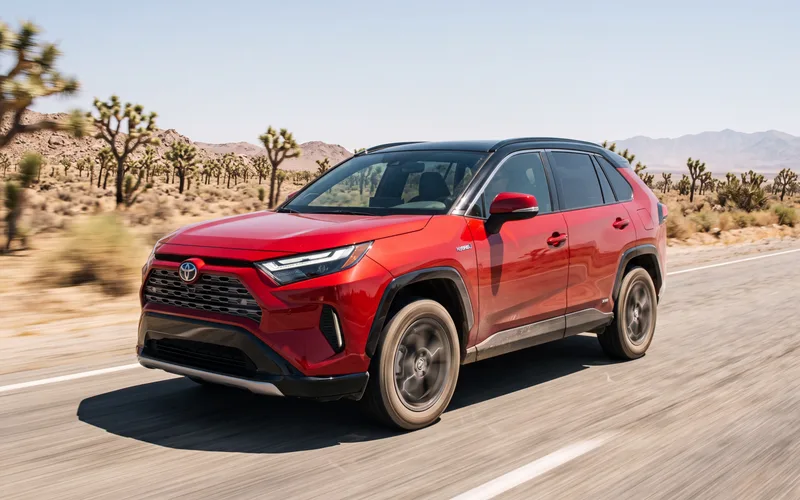 Toyota RAV4Compact SUVBetter at: Fuel economy and resale
If the CX-5's 26 MPG and 54% resale are what give you pause, the hybrid-only RAV4 answers both at once with 41-plus MPG combined and class-best value retention.
Compare 2.13C
2.13C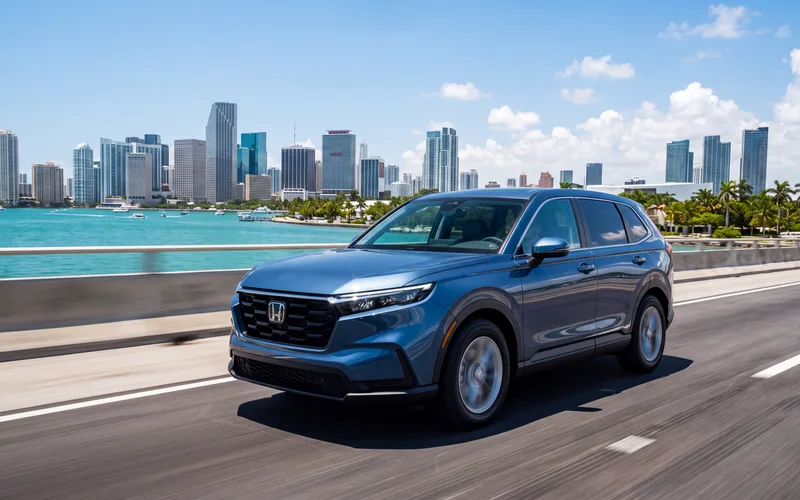 Honda CR-VCompact SUVBetter at: Hybrid efficiency
The CR-V matches the CX-5 on price and practicality while adding a 40-MPG-city hybrid option, more cargo room, and physical climate controls the redesigned Mazda gave up.
Compare 2.40C+
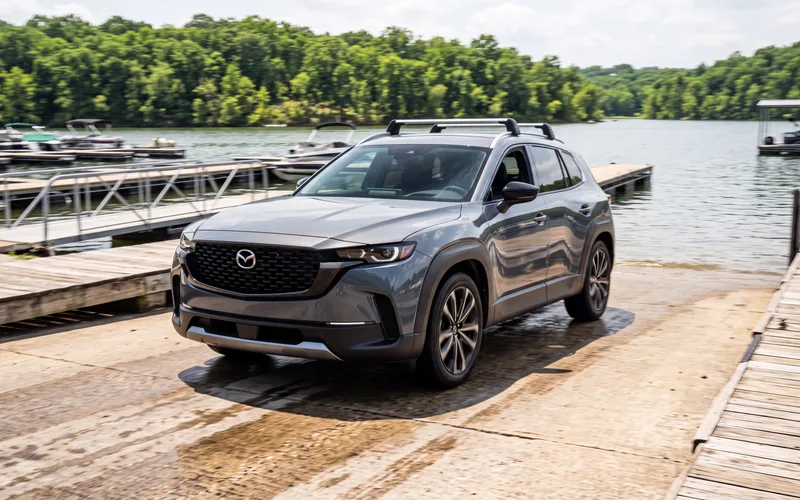 Mazda CX-50Compact SUVBetter at: Powertrain choice
Stay with Mazda's driving feel and interior quality but get the powertrain breadth and genuine dirt-road capability the 2026 CX-5 no longer offers.
CompareHow it's evolved
10 scored model years · 2017–2026
Subject scores by year
Hover or tap a score to see what moved it versus the year before. A corner mark flags a big swing.
| Year | Performance | Efficiency | Safety | Space | Cost | Reliability | Tech | Use-case | Driving | Value |
|---|---|---|---|---|---|---|---|---|---|---|
| 2026 | 31 | 55 | 77 | 55 | 63 | 75 | 77 | 63 | 73 | 70 |
| 2025 | 32 | 50 | 68 | 51 | 69 | 83 | 52 | 60 | 76 | 69 |
| 2024 | 34 | 64 | 75 | 51 | 66 | 82 | 56 | 60 | 79 | 73 |
| 2023 | 33 | 55 | 75 | 50 | 66 | 83 | 54 | 60 | 75 | 73 |
| 2022 | 33 | 55 | 74 | 50 | 68 | 77 | 54 | 60 | 75 | 73 |
| 2021 | 33 | 55 | 76 | 48 | 68 | 72 | 52 | 59 | 74 | 76 |
| 2020 | 32 | 55 | 77 | 48 | 67 | 68 | 41 | 58 | 75 | 76 |
| 2019 | 36 | 55 | 76 | 48 | 68 | 63 | 41 | 58 | 74 | 78 |
| 2018 | 29 | 56 | 74 | 47 | 70 | 62 | 34 | 57 | 74 | 77 |
| 2017 | 29 | 54 | 57 | 47 | 73 | 73 | 34 | 56 | 74 | 71 |
Compare two years
Best fit & conditions
Higher scores mean a better fit for that use case. Learn more about use-case fit →
Subject profile
Trims & configurations
5 trimsScores above reflect the volume trim. Per-trim specs and scores are rolling out — the full lineup:
Academic Probation · NHTSA safety recalls
No NHTSA safety recall is on record for the 2020 Mazda CX-5. Other model years of the CX-5 have 4 — listed below.
4 recalls on other model years of the CX-5 (2017–2019)
Nov 12, 2021Fuel system, gasoline: delivery: fuel pumpThe impeller inside the low-pressure fuel pump may crack and deform, potentially causing the fuel pump to fail.
Defect
Mazda North American Operations (Mazda) is recalling certain 2018 Mazda3, Mazda6, 2019 CX-3, 2018-2019 MX-5, CX-5, CX-9, and 2019-2020 Mazda2 vehicles. The impeller inside the low-pressure fuel pump may crack and deform, potentially causing the fuel pump to fail.
Risk
Fuel pump failure may cause an engine stall, increasing the risk of a crash.
Remedy
Dealers will replace the fuel pumps, free of charge. Owner notification letters were mailed July 18, 2022. Owners may contact Mazda customer service at 1-800-222-5500 Option 4. Mazda's number for this recall is 5321K.
NHTSA campaign 21V875000 ↗Manufacturer no. 5321K121,038 vehicles potentially affected (all models in the campaign)Owners notified Jul 18, 2022Filed by Mazda North American OperationsFiled as CX-5Jun 27, 2019Engine · Power train: automatic transmission: control module (tcm/pcm/tecm)A software error in the powertrain control module (PCM) may cause the engine to stall.
Defect
Mazda North American Operations (Mazda) is recalling certain 2018-2019 CX-5, Mazda6, and 2019 Mazda3 vehicles. A software error in the powertrain control module (PCM) may cause the engine to stall.
Risk
An unexpected stall increases the risk of a crash.
Remedy
Mazda will notify owners, and dealers will reprogram the PCM software, free of charge. The recall began August 20, 2019. Owners may contact Mazda customer service at 1-800-222-5500, option 4. Mazda's number for this recall is 3719F.
NHTSA campaign 19V497000 ↗Manufacturer no. 3719F262,220 vehicles potentially affected (all models in the campaign)Owners notified Aug 20, 2019Filed by Mazda North American OperationsFiled as CX-5Jun 25, 2018Air bags: side/windowIn the event of a side impact or rollover crash, the side curtain air bags may not properly unfold during deployment. As such, these vehicles fail to comply with the requirements of Federal Motor Vehicle Safety Standard (FMVSS) number 226, "Ejection Mitigation."
Defect
Mazda North American Operations (Mazda) is recalling certain 2018 Mazda CX-5 vehicles. In the event of a side impact or rollover crash, the side curtain air bags may not properly unfold during deployment. As such, these vehicles fail to comply with the requirements of Federal Motor Vehicle Safety Standard (FMVSS) number 226, "Ejection Mitigation."
Risk
If the air bags do not deploy properly in a crash, it can increase the risk of injury.
Remedy
Mazda will notify owners, and dealers will replace the curtain air bags, free of charge. The recall began July 31, 2018. Owners may contact Mazda customer service at 1-800-222-5500, Option 4. Mazda's number for this recall is 2718F.
NHTSA campaign 18V426000 ↗Manufacturer no. 2718F682 vehicles potentially affected (all models in the campaign)Owners notified Jul 31, 2018Filed by Mazda North American OperationsFiled as CX-5Nov 21, 2017Electrical system: wiring · Trailer hitchesThis harness may be routed such that there is insufficient clearance between the harness and the exhaust muffler, allowing the wiring harness to contact the muffler.
Defect
Mazda North American Operations (Mazda) is recalling certain 2017 CX-5 vehicles equipped with an accessory trailer hitch wiring harness. This harness may be routed such that there is insufficient clearance between the harness and the exhaust muffler, allowing the wiring harness to contact the muffler.
Risk
Contact with the muffler may damage the trailer wiring harness, potentially resulting in the trailer lighting being inoperative, thereby increasing the risk of a crash.
Remedy
Mazda will notify owners, and dealers will reroute the trailer hitch harness away from the muffler, replacing the harness if it is damaged, free of charge. The recall is expected to begin January 20, 2018. Owners may contact Mazda customer service at 1-800-222-5500. Mazda's number for this recall is 1617K.
NHTSA campaign 17V744000 ↗Manufacturer no. 1617K1,076 vehicles potentially affected (all models in the campaign)Owners notified Jan 22, 2018Filed by Mazda North American OperationsFiled as CX-5
Source: NHTSA Office of Defects Investigation recall database, model years 2017–2026. Recalls are listed by model year as the manufacturer filed them; whether a specific car is affected depends on its VIN — check a VIN at nhtsa.gov ↗. NHTSA model names matched to this page: CX-5.
Detailed scoring by subject
1Performance & PowertrainThe CX-5's lowest-graded category.0.09F
The three volume 2020 trims (Sport, Touring, Grand Touring) all use the naturally aspirated Skyactiv-G 2.5 at 187 hp; the 2.5T Dynamic Pressure Turbo is confined to the AWD-only Grand Touring Reserve and Signature. Modest output against a 150–550 hp SUV band, and unchanged from 2019.
The non-turbo 2.5's 186 lb-ft peaks high at 4,000 rpm, so low-end pull is unremarkable and the engine has to be revved for merging power. 2020 is the year the turbo gained +10 lb-ft on premium (310→320 lb-ft, moved from 2,000 to 2,500 rpm), but that is not the volume configuration.
Third-party testing of the mechanically unchanged non-turbo CX-5 clusters at 8.6–8.7 seconds to 60 mph, slow-to-mid-pack for a 2020 compact SUV; the turbo cuts that to about 7 seconds. Mazda publishes no 0–60 figure for the CX-5, only top speed, so this necessarily comes from instrumented tests.
The naturally aspirated 2.5 is linear and completely lag-free with clean, progressive throttle response — a real refinement edge over the small-displacement turbos most rivals fielded in 2020 — but it is short on low-end torque and gets audibly strained when wrung out for a highway merge. Cylinder deactivation transitions are unobtrusive, and 2020 added a road-noise NVH reduction across the whole lineup.
Mazda's Skyactiv-Drive six-speed automatic is a standout in a class that had largely moved to CVTs and 8-to-9-speed units: it holds gears decisively, downshifts promptly, never hunts or drones, and the manual-shift and Sport modes are genuinely usable. Only six ratios costs a little highway efficiency, not driveability; 2020 added paddle shifters on Grand Touring and above.
A flat 2,000-lb rating regardless of engine or drivetrain — enough for a small utility trailer or a pair of jet skis, but well short of the 3,500 lbs the Honda CR-V's rivals and several other 2020 compact SUVs offered.
i-Activ AWD is offered across the entire 2020 range — optional on Sport, Touring and Grand Touring, standard on the AWD-only Grand Touring Reserve and Signature — and it is a sophisticated predictive system that pre-empts slip rather than reacting to it. It sits below 2021's rating because FWD is still the default on the three volume trims AND, for 2020 only, Off-road Traction Assist is restricted to the two top trims rather than standard on every AWD build.
Firmly pavement-oriented: 7.5 inches of unladen ground clearance, no low range, no locking differentials, no skid plates and no off-road trim anywhere in the lineup. The one genuine provision, brake-based Off-road Traction Assist, arrived for 2020 but only on Grand Touring Reserve and Signature — so a volume Touring AWD, the configuration scored here, does without it entirely.
Two distinct gas powertrains — the 187-hp naturally aspirated 2.5 and the 227/250-hp 2.5T — which covers mainstream and quick-ish buyers, but there is no hybrid, no plug-in and effectively no diesel, in a segment where the RAV4 and CR-V both offered hybrids and the RAV4 a PHEV. The 2.2 Skyactiv-D that briefly appeared on the 2019 Signature is absent from Mazda's 2020 lineup and trim tables.
2Efficiency & RangeMid-pack among this car's ten categories.1.72C-
26 MPG combined for the volume non-turbo AWD build is competitive among gas-only compact SUVs — the 13.0:1 high-compression Skyactiv-G with cylinder deactivation does real work — but it sits well behind the hybrid RAV4 and CR-V variants that already dominated this segment's efficiency ranking in 2020.
24 MPG in town is solid for a non-hybrid AWD compact SUV, helped by cylinder deactivation and i-Stop auto start/stop, though a stop-and-go commute is exactly where the segment's hybrids pull far ahead.
30 MPG highway is a respectable cruising figure for an AWD compact SUV; the Skyactiv-Drive six-speed's lack of a tall eighth or ninth ratio costs it a couple of MPG against rivals with more gears.
The 15.3-gallon tank is what caps range here rather than the engine — roughly 400 miles per fill falls short of the 450–500 miles the segment's hybrids and larger-tank rivals manage, so a long trip needs an extra stop.
Mid-pack running cost for a gas compact SUV, and it is regular-grade fuel throughout — but the EPA figure runs roughly $700–800/yr above what a hybrid RAV4 or CR-V costs to feed over the same 15,000 miles.
Mazda specifies regular 87-octane unleaded for every 2020 CX-5, including the turbo — the 2.5T simply detunes from 250 hp / 320 lb-ft to 227 hp / 310 lb-ft on regular rather than requiring premium, so there is no mandatory fuel-cost penalty anywhere in the lineup. Shy of full marks only because turbo buyers who want the advertised output do have to pay for 93 octane.
3SafetyThe CX-5's best-graded category.3.25B+
NHTSA awarded the 2020 CX-5 its top 5-star overall rating, with 5 stars in both frontal and side crash and 4 stars for rollover resistance; the FWD and AWD bodies were tested separately and both returned the same result.
The 2020 CX-5 is an IIHS Top Safety Pick+ with Good in every crashworthiness test — driver- and passenger-side small overlap front, moderate overlap front, side, roof strength and head restraints — a clean sweep for the KF generation. It falls short of a perfect score only because the award depended on headlights that are Acceptable rather than Good on one trim.
2020 is the model year Mazda made the full i-Activsense suite standard on every US trim including the base Sport — AEB with pedestrian detection, radar cruise with stop & go, lane departure warning with lane-keep assist, high beam control, plus Advanced Blind Spot Monitoring and Rear Cross Traffic Alert. That is the whole AEB/ACC/LKA/BSM/RCTA set standard fleet-wide, which few compact SUVs matched in 2020; the standalone i-Activsense option package was deleted because nothing was left in it.
IIHS rated the standard system Superior for vehicle-to-vehicle front crash prevention and Advanced — not Superior — for daytime pedestrian detection, where it slowed but did not fully avoid one scenario. Mazda advertises nighttime pedestrian detection in Advanced Smart City Brake Support, but IIHS did not begin nighttime pedestrian testing until MY2022, so that capability is unverified by a third party and the item stays at the bottom of the top band.
Advanced Blind Spot Monitoring and Rear Cross Traffic Alert are standard on every 2020 trim, which is better coverage than most 2020 compact SUVs offered at base price. Both are alert-only — there is no steering or braking intervention and no safe-exit warning — and reviewers found the blind-spot monitor oversensitive, flagging cars several lengths back.
Lane Departure Warning and Lane-keep Assist are standard across the range, but this is a corrective nudge system, not lane centering — there is no continuous steering assist on the 2020 CX-5 — and Edmunds found the lane-keeping outright disappointing in testing.
Mazda Radar Cruise Control with full-speed-range stop & go is standard on all trims for 2020 — a genuine upgrade, since the prior base car had no adaptive cruise at all. Reviewers consistently describe it as slow to react with late braking and unhurried resume, and there is no combined highway assist tying it to the steering, so it sits mid-band.
No hands-free highway driving system is offered on the 2020 CX-5 at any trim, and Mazda had no equivalent to BlueCruise or Super Cruise anywhere in its 2020 US lineup.
IIHS tested three headlight variants: Good on Sport and on the curve-adaptive LED units fitted to Grand Touring, Grand Touring Reserve and Signature, but only Acceptable on the mid-range Touring — a high-volume trim. High Beam Control is standard across the line and the Adaptive Front-lighting System arrives on Grand Touring, so a buyer can get Good headlights cheaply or expensively but not in the middle.
The driver-focused cabin and low, well-placed seating give good forward and side sightlines, and reviewers single out the driving position as a strength. Working against it are the Kodo body's rising beltline and thick rear pillars, which pinch the over-shoulder view, and camera compensation is thin — the 360-degree View Monitor and front/rear parking sensors are new for 2020 but Signature-only, leaving the volume trims with a wide-angle backup camera and nothing else.
IIHS rates the CX-5's LATCH hardware Acceptable: two complete positions in the outboard seats plus a center position with a tether but no lower anchors, so a third seat has to borrow anchors or use a belt. Rear doors open wide and the outboard anchors are reachable, but the compact-SUV rear bench is too narrow to make three-across comfortable.
4Space & ComfortOne of the CX-5's weakest categories.1.24D
The KF CX-5 is a strictly two-row compact SUV; Mazda lists five-passenger seating as standard across all five 2020 trims with no third-row or captain's-chair option.
Mazda publishes front headroom both ways; the volume Touring does not include the moonroof as standard equipment, so the 39.7 in figure is the representative one.
Front legroom is a single published figure across the 2020 range and sits near the bottom of the compact-SUV band despite the cabin feeling roomy from the low seating position.
Second-row headroom is a strong point and, unusually, the power moonroof costs nothing in the back — Mazda quotes 39.0 in for both roof configurations.
The 39.6 in figure is competitive on paper, though Mazda's own 2.7 in knee-clearance number and reviewers' complaints about rear passenger space show the raw legroom number flatters the back seat.
The 2020 CX-5 is a two-row-only design with no third row offered on any trim, so it scores in the low band by definition; buyers needing seven seats were pushed to the CX-9.
Behind-seat cargo is the CX-5's clearest packaging weakness — 30.9 cu ft trails class leaders like the CR-V and RAV4 by a wide margin and reviewers single it out.
Seats-folded capacity of 59.6 cu ft is well short of the 70–80 cu ft typical of the compact-SUV benchmarks, placing it near the bottom of the segment band.
Everyday storage is complete but conventional — covered console bin with tray, a rear center console with its own tray and bin, bottle holders in all four doors, seatback pockets and three 12V outlets — with no standout innovation and, notably for 2020, no wireless charging pad anywhere in the range.
The volume Touring gets heated leatherette sport seats with a 6-way power driver's seat and manual lumbar, and the cabin is repeatedly called near-luxury, but owners and reviewers consistently ask for more thigh support and the rear bench is short on knee clearance.
Firm but well-damped, and the volume Touring's 17-inch wheels on 225/65 tires ride better than the 19s fitted from Grand Touring up; testers found it more supple than a Cadillac XT4 costing $10,000 more.
Reducing noise, vibration and harshness was one of the headline engineering changes for the 2020 model year specifically, and reviewers judged the result effective — quieter inside than a Cadillac XT4, with intrusion only really appearing at highway speed.
The volume Touring covers the essentials — dual-zone automatic climate with rear vents and heated front seats standard — but the heated steering wheel, heated rear seats and ventilated front seats are all packages on Grand Touring or standard only from GTR up, and the 2020 car has no remote pre-conditioning because it predates Mazda Connected Services.
5Cost of OwnershipMid-pack among this car's ten categories.2.51C+
Mazda's own 2020 CX-5 announcement lists the entry Sport FWD at $25,090, with destination raised to $1,100 for crossovers effective February 3, 2020 — an all-in entry price near the bottom of the compact-SUV band.
Touring with i-Activ AWD is the volume configuration for 2020 — it is the trim that first adds Apple CarPlay/Android Auto, heated front seats, leatherette/Lux Suede and dual-zone climate, and AWD take-rate is high on this nameplate (AWD did not become standard until 2022).
CarEdge's model-level 5-year figure of $2,502 covers scheduled service and wear items only; RepairPal's $447/yr average repair cost for the CX-5 adds roughly $2,000 of repairs across the same window, so ~$4,500 is the honest combined estimate — still well inside the cheap half of the compact-SUV band.
The 2020 car is now past the five-year mark, so retention is observed rather than projected, and two independent trackers land within half a point of each other; the CX-5 sits mid-pack for the segment — clearly behind the RAV4 and CR-V benchmarks but ahead of the Escape.
Mazda's New Vehicle Limited Warranty is the industry-baseline 3 years/36,000 miles — no better than the mainstream norm and two years short of the coverage Hyundai and Kia offered on 2020 vehicles.
The Powertrain Limited Warranty runs 60 months/60,000 miles — again the segment floor rather than a differentiator, against 10 yr/100,000 mi from the Korean brands.
Mazda ran no national complimentary scheduled-maintenance program on 2020 vehicles — free oil changes were dealer-level promotions only — leaving 24/7 roadside assistance as effectively the entire included package; unlike the 2021 car there was no Mazda Connected Services trial, and the volume Touring trim gets no subscription content at all, which puts this at the boundary between 'basic roadside only' and 'no complimentary coverage'.
$29,230 volume-trim price minus its estimated resale value after 5 years (58% retained, or about $16,953) leaves about $12,277 in depreciation. Add the projected $4,500 in 5-year maintenance and repairs, and owning this vehicle for 5 years costs about $16,777 in total.
6Reliability & QualityMid-pack among this car's ten categories.2.60C+
The raw field record is the best in the competitive set — 106 NHTSA complaints against 628 for the RAV4, 595 for the Forester, 347 for the CR-V, 301 for the Equinox and 1,511 for the Escape, with no peer lower — and J.D. Power still scores the 2020 car 82/100 for quality and reliability. What holds it well short of the 86 the same-generation 2023 car earns is that Consumer Reports has since walked its own forecast back: the 5/5 predicted reliability it issued when the car was new has been replaced, on actual owner-survey returns, by a verdict of 'about average reliability compared to other cars from the same model year.' Two model-year-specific defects sit behind that revision, and both reach the configuration being scored: an infotainment failure serious enough to be settled in a class action naming 2016-2020 CX-5s, and a cracked cylinder head on the naturally aspirated 2.5 that CarComplaints ranks as the year's worst problem at roughly $7,400 to repair, with no extended warranty behind it. Low complaint volume is real, but this is not the clean file the nameplate's general reputation implies.
Judged in its own era this is the strongest brand signal any CX-5 model year can claim: Consumer Reports' November 2020 survey ranked Mazda first of all brands for the first time in the study's history, ahead of Toyota, Lexus, Buick and Honda, and CR attributed it directly to Mazda's conservatism — sticking with six-speed torque-converter automatics instead of CVTs or nine- and ten-speeds. The counterweight is that the same brand posted below-average initial quality for this exact model year, 184 PP100 against a 166 industry average and 22nd of the ranked brands in the 2020 J.D. Power IQS, and that when J.D. Power surveyed 2020-model-year owners at three years in the 2023 VDS, Mazda was not among the five named mass-market leaders. The long-run standing has since caught up with the CR verdict — 3rd overall and 2nd mass market in the 2025 VDS at 161 PP100 — so the reputation is durable rather than a one-year artifact, which is what keeps this near the top of the mid band.
The recall record is spotless and unusually so — six years on, NHTSA lists zero campaigns against the 2020 CX-5, while the immediately preceding years carry two and three apiece (2018-2019 PCM software 19V497, 2018-2019 fuel pump 21V875, 2018 side airbags 18V426) and segment rivals ran to six for the RAV4, seven for the CR-V and twenty-three for the Escape. The TSB and goodwill record is the opposite, and it is the reason this lands mid-band rather than in the eighties: three separate systemic remedy programs converge on this single model year. Service alert SA-031-21 (superseding SA-058-20) establishes a new cylinder head assembly for 2018-2021 CX-5s with the naturally aspirated 2.5 and cylinder deactivation, and Mazda had to route dealers through a hotline because heads, gasket sets and partial engines were all on national backorder. CSP11 extends the powertrain warranty to 10 years/120,000 miles for coolant leaks at the cylinder head on 2019-2020 CX-5s with the 2.5T. And the Duffy v. Mazda infotainment settlement plus CSP13 both name the 2016-2020 CX-5 for Mazda Connect reboot, freeze and bootloop failures. A defect remedied fleet-wide by warranty extension or settlement is systemic in substance whether or not it was ever called a recall, and here there are three of them.
The configuration actually scored is the naturally aspirated Skyactiv-G 2.5 (187 hp/186 lb-ft) with cylinder deactivation, driving a Skyactiv-Drive six-speed torque-converter automatic — standard on Sport, Touring and Grand Touring, with the 2.5T reserved for Grand Touring Reserve and Signature. On architecture alone that should score well: the PY-series 2.5 has been in continuous production since the 2012 CX-5, and the conventional six-speed avoids the CVTs fitted to the CR-V, RAV4, Rogue and Forester — the very conservatism Consumer Reports credited for Mazda's first-place 2020 brand finish. What pulls this down to the bottom of the mid band is that Mazda's own service documentation restricts the cracked-cylinder-head remedy to '2.5 SKYACTIV G with cylinder deactivation only,' which is precisely this engine and not the turbo. Owners report heads cracking above the exhaust manifold at 26,000-53,000 miles and dumping pressurized oil onto hot exhaust, and unlike the 2.5T — which received a 10-year/120,000-mile extension under CSP11 — the naturally aspirated car got no warranty extension at all, leaving a roughly $7,400 repair with the owner. Secondary powertrain traffic reinforces the pattern: timing-cover and oil-seal leaks, a transaxle upshift-chirp TSB ending in transaxle replacement, and torque-converter debris complaints. Confidence is MEDIUM because the TSB's scope and the absence of NA coverage are documented facts while the actual failure rate is not — most of these engines do not crack, and RepairPal still ranks the nameplate first in its class.
The cabin is the CX-5's clearest advantage over everything else in the compact-SUV class, and none of this model year's mechanical or electronic trouble touches the materials themselves. Reviewers in 2020 read the interior as out of place at the price: Car and Driver credited 'first-rate materials and a fabulous layout' that make it 'feel especially upscale,' Edmunds led with the high-quality interior, and Signature layers on Nappa leather, genuine wood and a black headliner. Soft-touch coverage is broad and the switchgear is well damped even on mid trims, which is where a RAV4 or Rogue gives way to hard plastic. Held a couple of points under the 90 the post-refresh 2021-2023 cars earn because the 2021 model-year update pushed better trim content and the larger centre display further down the range, and because the Sport and Touring trims most buyers actually take are noticeably plainer than the Signature the glowing copy usually describes.
Structural assembly is not in question. Every US CX-5 is built at Mazda's Ujina plant in Hiroshima, 2020 is the fourth year of the KF generation so the line is mature, and the 106-filing NHTSA record contains no panel-gap, misalignment, squeak or rattle cluster at all. What keeps this in the mid-seventies is reported quality on the measure that covers this exact build — Mazda finished 22nd of the ranked brands in the 2020 J.D. Power IQS at 184 PP100, eighteen worse than the 166 industry average — compounded by an electronics-quality problem large enough to dominate the year's owner record: 33 of the 106 complaints describe Mazda Connect ghost touching, freezing or spontaneous rebooting, with the display layers separating and the screen placing calls and slamming the volume to maximum unprompted. Two smaller hardware-quality items sit alongside it, a spontaneously shattering sunroof reported by several owners in ordinary temperatures and a power liftgate opening on its own as early as 2,000 miles. This is a reported-quality and component-quality deduction rather than a build-integrity one, which is why it stays comfortably above the segment median.
Coverage density is the CX-5's standing ownership weakness, and 2020 is the least favourable year of the generation for it. Mazda has deliberately contracted its US network from 635 stores in 2014 to roughly 548, against about 1,246 Toyota and 1,076 Honda dealers, so a buyer outside a metro area faces a materially longer drive for warranty work than a RAV4 or CR-V owner — a real cost in a model year whose two signature defects both require dealer diagnosis, one of them a cylinder-head replacement. The Retail Evolution programme genuinely improves facility quality and throughput, but it upgrades existing stores rather than adding new ones, and in 2020 it had barely started: the 100th upgraded dealership opened in March 2020 and the 300th not until May 2024, so roughly one store in five had been through it when this car was new. Service satisfaction itself is around the mass-market average; density and programme immaturity, not the experience, set the score.
Routine running costs are low and well documented — RepairPal puts the CX-5's average annual repair-and-maintenance spend at $447 against $573 for midsize SUVs and $652 across all vehicles, with low repair severity, below-average frequency and 0.3 unscheduled shop visits a year versus 0.4 for the class — and as Mazda's US volume leader the CX-5 has the deepest independent parts catalogue in the brand's range. What holds this below the 78-80 the later model years earn is that both of this year's characteristic repairs are expensive and poorly supported. Mazda's own service alert put cylinder heads, gasket sets and partial engines on hotline-controlled release because of a supply shortage, and an owner reported the car sitting at the shop with the gasket kit and engine on backorder; the roughly $7,400 head repair carries no warranty extension on the naturally aspirated engine, unlike the 2.5T's 10-year/120,000-mile CSP11 coverage. On the electronics side CSP13 covers CMU diagnosis and replacement but explicitly not ghost-touch screen repair, and owners report a $244 diagnostic fee with display quotes from $800 to $1,700. Mazda's US volume also remains an order of magnitude below Toyota's and Honda's, leaving a thinner aftermarket and salvage supply than a RAV4 or CR-V equivalent.
7Technology & InfotainmentOne of the CX-5's weakest categories.0.74F
2020 is the last year before the 2021 refresh made a 10.25-inch display standard, so the volume trim runs the small 7-inch screen that sits at the floor of the segment band.
Mazda Connect's rotary Commander control plus low-speed touch input is logically laid out and Edmunds called the interface intuitive, but the 7-inch panel is small, the graphics were dated by 2020 and menu depth shows the platform's age.
Wired Apple CarPlay and Android Auto are standard on the volume Touring and above, but no wireless projection is offered on any 2020 trim and the base Sport does without phone projection entirely.
Voice control is a rigid command-word system rather than natural language, and factory navigation is standard only on the range-topping Signature — the volume Touring has no built-in nav at all, relying on an accessory SD card or phone projection.
The volume Touring's six-speaker system is merely adequate, but the Bose 10-speaker setup with Centerpoint and AudioPilot is a genuinely good premium option available as a package on Touring and standard from Grand Touring up.
The volume Touring uses analog gauges with only a small 4.6-inch TFT insert; even the upper trims' 7-inch TFT meter display is a partial-digital arrangement rather than a true configurable full-digital cluster.
The 2020 CX-5 has no over-the-air update capability of any kind — infotainment and map updates require a dealer visit or a purchased SD card, and there is no embedded modem on the volume trim.
Mazda Connected Services did not reach the CX-5 until the 2021 model year, so the 2020 car has no app-based remote start, lock/unlock, vehicle status or locate — only a dealer-installed key-fob remote start accessory, with the MyMazda app limited to service scheduling and owner information.
Port count is reasonable for 2020 — two front and two rear USB inputs on Touring and up, plus three 12V outlets — but every port is legacy USB-A, there is no wireless charging pad on any trim and no household AC outlet.
The volume Touring has Mazda's advanced keyless entry and start with push-button ignition and a redesigned 2020 key fob, but the power liftgate is a package on Touring, there is no hands-free liftgate, no phone-as-key and no factory remote start.
A rearview camera is standard, but the 2020 CX-5 restricts both the 360-degree view monitor and front/rear parking sensors to the single top Signature trim — the volume Touring gets no parking sensors at all, and there is no parking automation anywhere in the range.
The windshield-projected Active Driving Display is a proper colour HUD rather than a flip-up plate, but it is unavailable on the volume Touring — a package on Grand Touring and standard only from Grand Touring Reserve up.
8Use-Case FitMid-pack among this car's ten categories.1.93C-
Full LATCH provision, a genuinely useful 40/20/40 one-touch folding and reclining rear seatback and a low 29.4-inch load lip help daily family logistics, but 30.9 cu ft behind the seats is tight for a stroller plus groceries and Mazda's own 2.7-inch rear knee clearance makes rear-facing seats a squeeze.
2020 is the year Mazda made the full i-ActivSense suite standard on every trim including the base Sport, so families buying the cheap end get radar cruise with stop-and-go, pedestrian-detecting AEB with night detection, lane-keep assist, blind-spot monitoring and rear cross-traffic alert on top of a 5-star NHTSA result; only a rear-occupant reminder is missing.
Rear-seat amenities on the volume Touring are decent for the class — rear climate vents, two rear USB ports, a rear center armrest with storage and a reclining seatback — but there is no rear entertainment or rear window shade, and luggage space with four aboard is the car's weakest dimension.
Standard radar cruise with stop-and-go is a real traffic-jam asset at this price, the six-speed automatic is smooth and decisive rather than a droning CVT, and light steering effort plus a tight turning circle keep low-speed work easy; the 2.5 naturally aspirated engine is merely adequate rather than effortless.
26 MPG combined on regular unleaded with cheap conventional consumables is unremarkable but inoffensive for a compact AWD crossover; with no hybrid option anywhere in the 2020 CX-5 range it is well beaten per mile by hybridized rivals like the RAV4 Hybrid.
A compact 179.1-inch footprint, 72.5-inch width and a tight 36.0-foot curb-to-curb turning circle make it easy to thread and park, but the volume Touring is helped only by a rearview camera — parking sensors and the 360-degree monitor are Signature-exclusive for 2020.
A 2,000 lb tow rating regardless of engine, roughly 1,045 lb of payload and 59.6 cu ft of maximum enclosed cargo make this a light-duty personal vehicle rather than a work tool — there is no bed, no heavy-duty option and no towing package of consequence.
The Skyactiv-G 2.5 and conventional six-speed torque-converter automatic are a proven, low-drama combination that should hold up to hard commuting, but this is a car-based unibody crossover with carpeted floors and leatherette trim and effectively no commercial-fleet track record.
Provisions are limited to cargo tie-downs, a cargo lamp and three 12V sockets — there is no AC inverter or onboard power, no washable load floor, and roof rails and a hitch are dealer accessories rather than factory options, with a thin upfit ecosystem behind them.
A quiet cabin after the 2020 NVH work, a composed firm ride and standard radar cruise with stop-and-go make it a pleasant tourer with roughly 400 miles between fills, held back by seats criticized for thigh support and lane-keep assist that nudges rather than centers.
Optional i-Activ AWD and fold-flat rear seats handle gravel roads, trailheads and bike racks without complaint, but 7.5 inches of ground clearance, a 2,000 lb tow limit, road-biased all-season tires and no low-range mean it is not a genuine adventure enabler — and Off-road Traction Assist is restricted to the two turbo trims, not the volume Touring.
The 40/20/40 one-touch split is unusually flexible for the class — long items pass through the center while two passengers stay seated — and the 44.3-inch tailgate opening with a low 29.4-inch threshold loads easily, but 59.6 cu ft maximum is small for a compact SUV and roof rails and a hitch are accessories.
9Driving ExperienceOne of the CX-5's strongest categories.3.07B
The CX-5 was widely called the best-handling vehicle in the compact-SUV class in 2020 — sharp, communicative and unfazed by quick direction changes, with G-Vectoring Control Plus standard on every trim and independent suspension at both ends.
Steering is the standout control in the car — a quick 15.5:1 ratio and only 2.7 turns lock-to-lock, with reviewers describing the weighting as perfectly judged and genuinely enjoyable, a rarity among electrically assisted crossover racks.
Instrumented 70–0 mph stops of 182 ft for the AWD volume configuration (177 ft FWD) are respectable for a compact SUV on all-season tires, and pedal feel is firm and progressive — owners specifically praise the brakes.
Mazda's decision to keep a conventional six-speed torque-converter automatic pays off in clean, decisive shifts and linear tip-in with none of the rubber-band drone of the CVTs used by most rivals; the 2.5 with cylinder deactivation transitions imperceptibly.
The 2020 NVH revisions cut road and wind intrusion noticeably, but the naturally aspirated 2.5 in the volume Touring still turns coarse and buzzy when worked hard — and the Engine Harmonics Enhancer that sweetens the engine note was added for 2020 only on the 2.5T turbo trims.
A 36.0-foot curb-to-curb circle is genuinely tight for a compact SUV and pairs with quick 2.7-turn steering to make the car easy in car parks and on narrow streets.
Mazda's low-cowl, driver-centric layout with a tilt-and-telescopic wheel, a 6-way power driver's seat with lumbar on the volume Touring and the Commander knob falling naturally to hand is a segment strength; rearward visibility over the thick rear pillars is the main compromise.
Enthusiast reviewers routinely recommended the 2020 CX-5 as the compact SUV to buy if you actually enjoy driving, thanks to the steering and chassis; the 187 hp naturally aspirated engine in the volume trim is the limiting factor on outright entertainment.
10Value & Market PositionOne of the CX-5's strongest categories.3.13B
2020 is the year Mazda made the full i-Activsense suite standard on every CX-5 including the base Sport — radar cruise with stop-and-go, Smart City Brake Support with day AND night pedestrian detection, lane-departure warning with lane-keep assist, high beam control, auto headlights and rain-sensing wipers, on top of blind-spot monitoring with rear cross-traffic alert that was already standard — content a RAV4 LE or CR-V LX of the same year could not match at the price. The offset is infotainment: Sport is stuck with a 7-inch screen, four speakers and no Apple CarPlay/Android Auto, which does not arrive until Touring.
A $26,190 CX-5 delivers interior materials, chassis polish and a full active-safety suite that read a class above the price, and the $38,155 Signature undercuts entry luxury crossovers with Nappa leather, 360-degree camera and the 250-hp turbo; against that, the base car's four-speaker/no-CarPlay infotainment is thin for 2020 money, and there is no hybrid at any price while the RAV4 and CR-V both offered one.
Five well-spaced trims spanning roughly $26k to $38k, with FWD or AWD selectable on the lower three and two engines available — enough ladder to cover most budgets, but noticeably narrower than the 2021 car's nine price points, since 2020 lacks the Carbon Edition and Touring Preferred SV rungs and offers no diesel after the one-year 2019 Signature Diesel was dropped.
The CX-5 was comfortably Mazda's best-selling model in the US and globally in 2020, but volume slipped 5.3% to 146,420 units in the COVID-disrupted year and it remains a solid mid-pack player rather than a segment leader — roughly a third of the RAV4's volume, with the CR-V, Rogue and Equinox also ahead of it.
Mazda carries an enthusiast-flavored, quasi-premium image well above its price position, and by 2020 the CX-5 had a three-year 10Best streak reinforcing it, which supports both satisfaction and resale; against that, the brand has a much thinner dealer network and far less default mainstream trust than Toyota or Honda, and the CX-5's mid-pack 58% five-year retention shows the image only partly converts into residuals.
Mazda normally runs leaner incentives than domestic or Korean rivals, but 2020 was the exception: the pandemic sales collapse in spring pushed the brand to 0% APR financing on new vehicles plus a 90-day deferred first payment, and dealers carried heavy inventory through mid-year — a 2020 CX-5 buyer had materially more leverage than a 2021 buyer, who ran straight into the chip-shortage sticker-price market.
2020 is the fourth model year of the KF generation launched for 2017, so the platform sits squarely mid-cycle; the year brought real substance — standard i-Activsense, +10 lb-ft on the turbo, off-road traction assist and road-noise reduction work — but no visual refresh, and the facelift plus standard AWD were still two model years away, so a 2020 buyer was not on the edge of replacement but was ahead of a visible update.
The 2020 CX-5 took Car and Driver 10Best for a third consecutive year and was near-universally placed at or near the top of the compact-crossover class by Edmunds and the buyer guides, while also earning the IIHS's top crash award — the reference point for how a compact SUV should drive, with reviewers' only consistent reservations being rear space, cargo volume and fuel economy.