
The verdict
A mixed-report compact suv, strong on reliability and held back by performance.
The 2025 CX-5 is the driver's choice in a class of appliances: the best steering and handling of any mainstream compact SUV, one of the quietest and nicest-feeling cabins under $35,000, standard all-wheel drive on all eight trims, and a reliability record that ranks near the top of the segment. The catch is that it's the ninth and final year of a 2017 design, and it shows — 29.1 cubic feet of cargo space behind the rear seats is the smallest in the class (a RAV4 has 37.5), there's no hybrid at all while rivals sell them at 37–40 MPG, and the volume trim's 187-hp engine needs 8.7 seconds to reach 60 mph. Most seriously, the CX-5 rates Poor in the IIHS front-crash-prevention test — its automatic braking failed to intervene in five of six runs — which is why it's the one 2025 Mazda with no safety award. Buy it if you value how a car drives and feels over how much it holds, and use the roughly $2,500 in runout cash to your advantage.
Jump to scoresStrengths
- It actually steers — nothing else mainstream in this class does
- Reliability and repair costs near the top of the class
- A cabin that feels a class above the price
What holds it back
- Its automatic emergency braking failed the IIHS test outright
- The smallest cargo hold in the mainstream compact-SUV class
- No hybrid, and the volume engine is slow
Top alternatives
Cars shoppers cross-shop with the Mazda CX-5 2.56C+
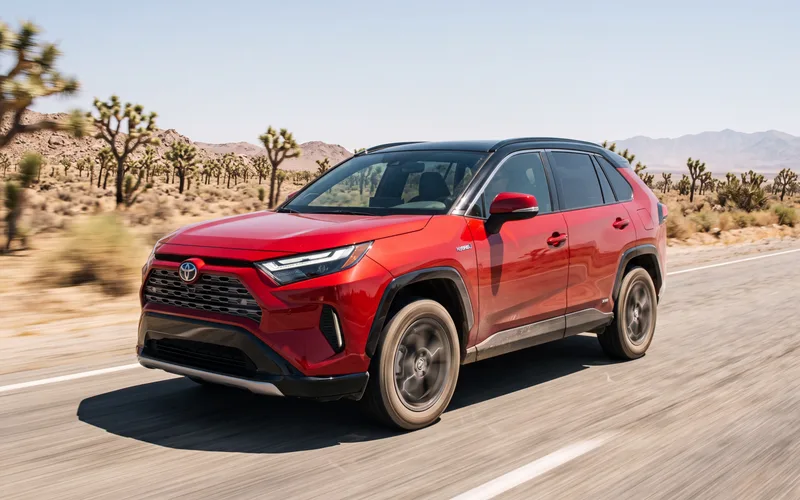 Toyota RAV4Compact SUVBetter at: Fuel economy and resale
If the CX-5's 26 MPG and 54% resale are what give you pause, the hybrid-only RAV4 answers both at once with 41-plus MPG combined and class-best value retention.
Compare 2.13C
2.13C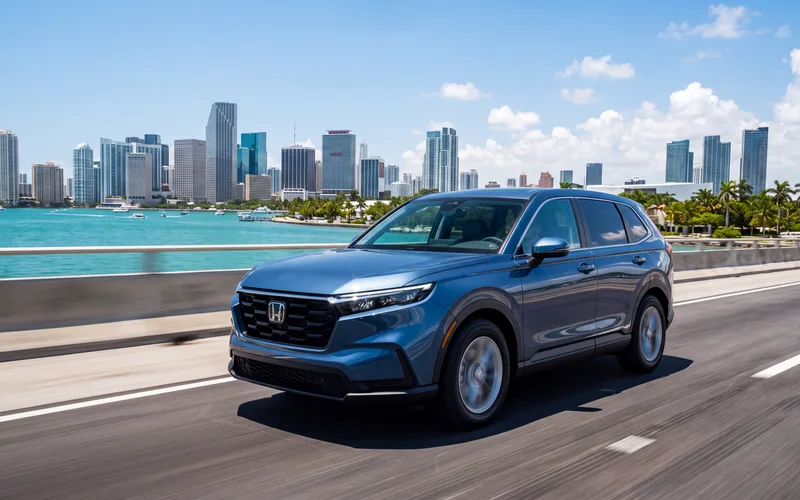 Honda CR-VCompact SUVBetter at: Hybrid efficiency
The CR-V matches the CX-5 on price and practicality while adding a 40-MPG-city hybrid option, more cargo room, and physical climate controls the redesigned Mazda gave up.
Compare 2.40C+
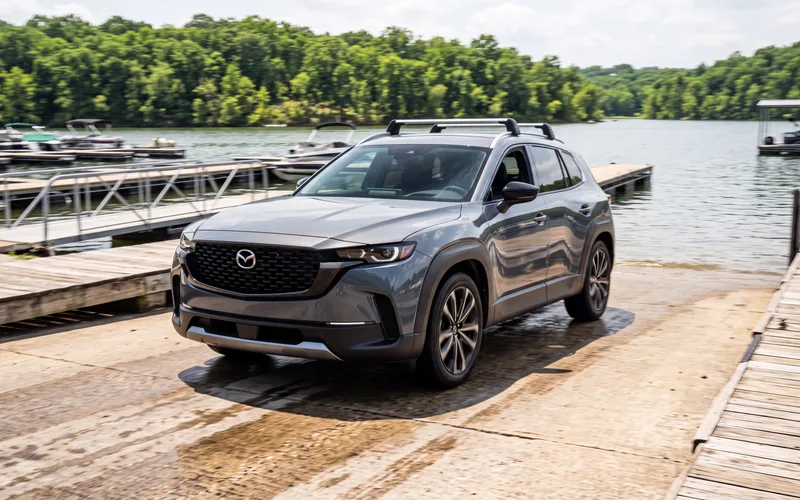 Mazda CX-50Compact SUVBetter at: Powertrain choice
Stay with Mazda's driving feel and interior quality but get the powertrain breadth and genuine dirt-road capability the 2026 CX-5 no longer offers.
CompareHow it's evolved
10 scored model years · 2017–2026
Subject scores by year
Hover or tap a score to see what moved it versus the year before. A corner mark flags a big swing.
| Year | Performance | Efficiency | Safety | Space | Cost | Reliability | Tech | Use-case | Driving | Value |
|---|---|---|---|---|---|---|---|---|---|---|
| 2026 | 31 | 55 | 77 | 55 | 63 | 75 | 77 | 63 | 73 | 70 |
| 2025 | 32 | 50 | 68 | 51 | 69 | 83 | 52 | 60 | 76 | 69 |
| 2024 | 34 | 64 | 75 | 51 | 66 | 82 | 56 | 60 | 79 | 73 |
| 2023 | 33 | 55 | 75 | 50 | 66 | 83 | 54 | 60 | 75 | 73 |
| 2022 | 33 | 55 | 74 | 50 | 68 | 77 | 54 | 60 | 75 | 73 |
| 2021 | 33 | 55 | 76 | 48 | 68 | 72 | 52 | 59 | 74 | 76 |
| 2020 | 32 | 55 | 77 | 48 | 67 | 68 | 41 | 58 | 75 | 76 |
| 2019 | 36 | 55 | 76 | 48 | 68 | 63 | 41 | 58 | 74 | 78 |
| 2018 | 29 | 56 | 74 | 47 | 70 | 62 | 34 | 57 | 74 | 77 |
| 2017 | 29 | 54 | 57 | 47 | 73 | 73 | 34 | 56 | 74 | 71 |
Compare two years
Best fit & conditions
Higher scores mean a better fit for that use case. Learn more about use-case fit →
Subject profile
Trims & configurations
5 trimsScores above reflect the volume trim. Per-trim specs and scores are rolling out — the full lineup:
Academic Probation · NHTSA safety recalls
No NHTSA safety recall is on record for the 2025 Mazda CX-5. Other model years of the CX-5 have 4 — listed below.
4 recalls on other model years of the CX-5 (2017–2019)
Nov 12, 2021Fuel system, gasoline: delivery: fuel pumpThe impeller inside the low-pressure fuel pump may crack and deform, potentially causing the fuel pump to fail.
Defect
Mazda North American Operations (Mazda) is recalling certain 2018 Mazda3, Mazda6, 2019 CX-3, 2018-2019 MX-5, CX-5, CX-9, and 2019-2020 Mazda2 vehicles. The impeller inside the low-pressure fuel pump may crack and deform, potentially causing the fuel pump to fail.
Risk
Fuel pump failure may cause an engine stall, increasing the risk of a crash.
Remedy
Dealers will replace the fuel pumps, free of charge. Owner notification letters were mailed July 18, 2022. Owners may contact Mazda customer service at 1-800-222-5500 Option 4. Mazda's number for this recall is 5321K.
NHTSA campaign 21V875000 ↗Manufacturer no. 5321K121,038 vehicles potentially affected (all models in the campaign)Owners notified Jul 18, 2022Filed by Mazda North American OperationsFiled as CX-5Jun 27, 2019Engine · Power train: automatic transmission: control module (tcm/pcm/tecm)A software error in the powertrain control module (PCM) may cause the engine to stall.
Defect
Mazda North American Operations (Mazda) is recalling certain 2018-2019 CX-5, Mazda6, and 2019 Mazda3 vehicles. A software error in the powertrain control module (PCM) may cause the engine to stall.
Risk
An unexpected stall increases the risk of a crash.
Remedy
Mazda will notify owners, and dealers will reprogram the PCM software, free of charge. The recall began August 20, 2019. Owners may contact Mazda customer service at 1-800-222-5500, option 4. Mazda's number for this recall is 3719F.
NHTSA campaign 19V497000 ↗Manufacturer no. 3719F262,220 vehicles potentially affected (all models in the campaign)Owners notified Aug 20, 2019Filed by Mazda North American OperationsFiled as CX-5Jun 25, 2018Air bags: side/windowIn the event of a side impact or rollover crash, the side curtain air bags may not properly unfold during deployment. As such, these vehicles fail to comply with the requirements of Federal Motor Vehicle Safety Standard (FMVSS) number 226, "Ejection Mitigation."
Defect
Mazda North American Operations (Mazda) is recalling certain 2018 Mazda CX-5 vehicles. In the event of a side impact or rollover crash, the side curtain air bags may not properly unfold during deployment. As such, these vehicles fail to comply with the requirements of Federal Motor Vehicle Safety Standard (FMVSS) number 226, "Ejection Mitigation."
Risk
If the air bags do not deploy properly in a crash, it can increase the risk of injury.
Remedy
Mazda will notify owners, and dealers will replace the curtain air bags, free of charge. The recall began July 31, 2018. Owners may contact Mazda customer service at 1-800-222-5500, Option 4. Mazda's number for this recall is 2718F.
NHTSA campaign 18V426000 ↗Manufacturer no. 2718F682 vehicles potentially affected (all models in the campaign)Owners notified Jul 31, 2018Filed by Mazda North American OperationsFiled as CX-5Nov 21, 2017Electrical system: wiring · Trailer hitchesThis harness may be routed such that there is insufficient clearance between the harness and the exhaust muffler, allowing the wiring harness to contact the muffler.
Defect
Mazda North American Operations (Mazda) is recalling certain 2017 CX-5 vehicles equipped with an accessory trailer hitch wiring harness. This harness may be routed such that there is insufficient clearance between the harness and the exhaust muffler, allowing the wiring harness to contact the muffler.
Risk
Contact with the muffler may damage the trailer wiring harness, potentially resulting in the trailer lighting being inoperative, thereby increasing the risk of a crash.
Remedy
Mazda will notify owners, and dealers will reroute the trailer hitch harness away from the muffler, replacing the harness if it is damaged, free of charge. The recall is expected to begin January 20, 2018. Owners may contact Mazda customer service at 1-800-222-5500. Mazda's number for this recall is 1617K.
NHTSA campaign 17V744000 ↗Manufacturer no. 1617K1,076 vehicles potentially affected (all models in the campaign)Owners notified Jan 22, 2018Filed by Mazda North American OperationsFiled as CX-5
Source: NHTSA Office of Defects Investigation recall database, model years 2017–2026. Recalls are listed by model year as the manufacturer filed them; whether a specific car is affected depends on its VIN — check a VIN at nhtsa.gov ↗. NHTSA model names matched to this page: CX-5.
Detailed scoring by subject
1Performance & PowertrainThe CX-5's lowest-graded category.0.09F
The volume non-turbo trims run the naturally aspirated Skyactiv-G 2.5 at 187 hp on either 87 or 93 octane, unchanged for 2025 — modest output for a compact SUV, with the turbo reserved for the top three trims.
Peak torque of the volume trim's naturally aspirated 2.5 is 186 lb-ft and arrives high at 4,000 rpm, so useful thrust demands revs — the turbo's 310–320 lb-ft at 2,000–2,500 rpm is a different car.
Instrumented testing puts the naturally aspirated CX-5 AWD at 8.7 seconds to 60 mph, near the back of the compact-SUV field; reviewers consistently describe the base engine as breathless for highway passing.
The naturally aspirated 2.5 is linear and lag-free with crisp throttle response — the upside of skipping a turbo — but it is short on thrust and turns coarse and buzzy when worked hard, which is where reviewers push back.
Mazda's Skyactiv-Drive 6-speed automatic is a standout for shift quality — decisive, quick and smooth, with a genuine manual mode and sport mode, and it never hunts the way a CVT drones. Only six ratios dates it on paper, but the item measures behavior, not gear count.
Mazda rates every 2025 CX-5 at 2,000 lbs regardless of engine, which covers a small utility or jet-ski trailer but sits at the bottom of the compact-SUV range — rivals with tow packages reach 3,500 lbs.
i-Activ AWD is standard on all eight trims — no FWD version is sold in the US — and it is a predictive system that reads wiper, wheel-speed and temperature inputs to pre-empt slip. It stays a single-speed on-demand setup with no low range or locking differential, so sophistication caps short of the top band.
The CX-5 is a pavement-first crossover: 7.6 inches of unladen ground clearance on the volume trims, no skid plates, no locking differential or low range, and no off-road trim in the lineup. Standard AWD plus a Mi-Drive Off-road mode on upper trims makes it competent on a snowy road or a gravel two-track and no more.
Two gas fours — the 187 hp NA 2.5 and the 227/256 hp turbo 2.5 — behind one 6-speed automatic, and nothing electrified anywhere in the 2025 range: no hybrid, no PHEV, no EV, in a segment where the RAV4 and CR-V both sell hybrids in volume. Two real choices earns the low end of the middle band.
2Efficiency & RangeOne of the CX-5's weakest categories.1.36D
EPA rates the volume naturally aspirated trims at 25 MPG combined; only the Carbon Edition and Premium Plus get the cylinder-deactivation-and-i-STOP version of the 2.5, which lifts the rating to 28. Standard AWD on every trim costs the CX-5 a few MPG against FWD-available rivals.
23 MPG city for the volume trim, which has neither cylinder deactivation nor engine stop-start — the two features that separate it from the 26 MPG city Carbon Edition and Premium Plus.
29 MPG highway is mid-pack for a compact SUV and the gap to the cylinder-deactivation trims narrows to 1 MPG at cruise, since CDA mostly pays off in light-load city driving.
A 15.3-gallon tank at the volume trim's 25 MPG combined works out to roughly 383 miles — adequate but short of the compact-SUV leaders, which is a tank-size limitation as much as an efficiency one.
EPA puts the volume trim's annual fuel bill at $2,450 — helped by the engine running happily on regular unleaded, hurt by 25 MPG combined and mandatory AWD.
Mazda specifies regular unleaded 87 octane for the CX-5 and the naturally aspirated 2.5 makes its full 187 hp on it — there is no power penalty for cheap fuel on the volume trim. Premium is optional across the line and only buys anything on the turbo, which climbs from 227 to 256 hp.
3SafetyMid-pack among this car's ten categories.2.61C+
NHTSA tested the 2025 CX-5 SUV AWD directly and awarded the maximum overall rating, with five stars in both frontal and side crash and four stars for rollover resistance (16.9% rollover probability, no tip in the dynamic test).
Crashworthiness is uniformly Good — driver and passenger small overlap front, the updated moderate overlap front (rear-passenger protection) and the updated side test, a clean sweep that several compact-SUV rivals still cannot match. But the 2025 CX-5 earned no IIHS award of any kind, because award eligibility now requires an acceptable front crash prevention result and this car rates Poor there (scored separately at 3.2.2). All-Good crash results without the award places it at the top of the no-award band rather than in it.
Every 2025 CX-5 including the $29,050 base 2.5 S carries the full i-Activsense suite standard: Smart Brake Support, Advanced Smart City Brake Support with pedestrian detection, Mazda Radar Cruise Control with Stop & Go, Lane Departure Warning, Lane-Keep Assist, Blind Spot Monitoring, Rear Cross Traffic Alert, Driver Attention Alert, High Beam Control and Rear Seat Alert — nothing from the AEB/ACC/LKA/BSM/RCTA core is paywalled to an upper trim. It falls short of the top of the band only because the 360-View Monitor with front and rear parking sensors is restricted to 2.5 S Premium Plus and above, rear automatic braking is optional, and no lane-centering system is offered at all.
The 2025 CX-5 rates Poor — the lowest grade IIHS issues — in the updated vehicle-to-vehicle front crash prevention test, and the underlying data is worse than the grade suggests: across six runs at three speeds from centered and offset approaches, the system never activated in five of them, and the one time it did it shaved a single mph off closing speed. At 37 and 43 mph it struck the target every time. The Advanced pedestrian-day result is from the older, easier protocol and does not offset a system that demonstrably fails to intervene at highway-adjacent speeds; there is no nighttime pedestrian result. This is the single finding that cost the car its safety award.
Blind Spot Monitoring and Rear Cross Traffic Alert are standard on all eight trims including the base 2.5 S, which is better availability than much of the segment. Coverage is alert-only, though: no blind-spot steering intervention, no rear cross-traffic braking as standard (rear automatic braking is optional), and no safe-exit warning for opening doors into traffic. Top of the alert-only band on availability, held out of the intervention band on capability.
Lane Departure Warning and Lane-Keep Assist are standard on every trim and IIHS lists lane departure warning and prevention as standard equipment, but the CX-5 offers no lane centering at all — Mazda's Cruising & Traffic Support is not available on this model, so the car nudges back off a lane marking rather than holding a line. Reviewers find the assist unobtrusive and free of ping-ponging, which is a virtue of a warning-and-nudge system rather than evidence of good centering. Functional keeping without centering sits mid-band.
Mazda Radar Cruise Control with Stop & Go is standard across the range and is genuinely full-speed-range, holding gap smoothly and resuming from a halt in traffic — reviewers consistently rate the ACC itself as one of the better mainstream implementations. What it is not is a highway assist: with no lane centering to pair with, there is no combined longitudinal-plus-lateral mode, so the driver steers throughout. Capable ACC, no integrated assist.
No hands-free highway driving system is available on the CX-5 at any trim or option level — Mazda offers nothing comparable to BlueCruise, Super Cruise or Highway Driving Assist anywhere in its 2025 US lineup, let alone on this model.
IIHS rates the CX-5's headlights Good on premium trims but only Acceptable on base trims, and the Acceptable units cover the high-volume lower and mid trims where most buyers shop. High Beam Control is standard across the range and the Adaptive Front-lighting System that earns the Good rating is reserved for upper trims. Textbook 'Good on upper trims, Acceptable on volume trims'.
Forward and over-the-shoulder sightlines are reasonable for a compact SUV — a relatively low cowl and slim A-pillars are among the things reviewers like about the driving position — but the rising beltline and thick C-pillars leave a real rear-quarter blind zone, and camera compensation is not democratic: the 360-View Monitor with front and rear parking sensors only appears from 2.5 S Premium Plus up, leaving the volume lower trims with a plain reversing camera. Standard BSM covers the worst of the gap. Average visibility with some blind zones, partially compensated.
IIHS rates LATCH ease of use Acceptable rather than Good, faulting lower anchors set too deep in the seat bight — usable once found, but they require digging through slits in the upholstery. The bigger constraint is space: the CX-5's rear seat is narrower than most compact-SUV rivals, so three car seats will not fit across, and testers ran short of front-seat legroom installing a rear-facing convertible. The reclining rear seatback helps a little. Workable with real space compromises.
4Space & ComfortOne of the CX-5's weakest categories.1.39D
The CX-5 is a strictly two-row, five-seat compact SUV on every trim — no third-row or six-seat configuration has ever been offered, which is normal for the class but scores at the bottom of a band that runs to eight seats.
Front headroom is mid-pack for a compact SUV, and the moonroof that is standard on six of eight trims — including the volume 2.5 S Preferred — costs another 0.4 inch.
41.0 inches of front legroom sits near the bottom of the compact-SUV range — the RAV4 matches it at 41.0 and the CR-V beats it at 41.3, while the Escape offers 42.4 — and reviewers describe the CX-5's cabin as snug and driver-focused rather than airy.
Rear headroom is a genuine strength at 39.0 inches and, unusually, the moonroof does not cost the second row any of it — the packaging penalty falls entirely on the front seats.
The published 39.6 inches reads well, but Mazda's own rear knee-clearance figure of 2.7 inches explains why reviewers call the back seat merely tolerable: the number depends on front occupants sitting forward, and the CR-V's 41.0 inches and Forester's packaging deliver more usable space.
There is no third row on any 2025 CX-5 — the model is two-row only, and Mazda covers three-row buyers with the CX-90. Scored in the low band as a missing feature rather than omitted.
This is the CX-5's single biggest practical weakness: 29.1 cubic feet behind the rear seats is among the smallest in the compact-SUV class, well short of the RAV4's 37.5, the Escape's 37.5 and the CR-V's 39.3, and it is what reviewers mean when they say the car 'drives small' but also packs small.
Maximum cargo volume is the smallest among mainstream compact SUVs — the RAV4 opens up to 69.8 cubic feet and the CR-V to 76.5 — so a CX-5 loaded for a move or a bulky-item run runs out of room a full class earlier than its rivals.
Everyday storage is competent but conservative — a covered center console armrest bin, usable door pockets, a two-position cargo load floor that trades volume for a flat surface, and a 40/20/40 rear seatback with a center pass-through for long items. There is no standout innovation: no underfloor bins of note, no onboard AC power, and the wireless charger is confined to the upper five trims, so the CX-5 sits mid-band where the CR-V's deep console and clever cargo packaging rate higher.
Front seats are a consistent CX-5 strength — supportive, well-bolstered, and on the volume 2.5 S Preferred an 8-way power driver's seat with power lumbar and two-position memory plus a 6-way power passenger seat, which is generous kit for the price. The rear bench is where reviewers push back: it sits low, reclines further than most people want, and feels cozy rather than roomy, so the car lands above average without reaching the long-haul-front-and-rear top band.
The 2021 facelift's revised damping and stiffer body structure gave the CX-5 one of the better rides in the class — supple over broken pavement without the float that softer rivals trade for it, and body control good enough that it never feels disconnected. It stops short of the top band because hard driving on undulating roads brings out ride chop and lateral weight toss, and the 19-inch wheels on turbo trims firm things up.
Noise isolation is the CX-5's clearest comfort win: reviewers repeatedly call it one of the quietest cabins in the non-luxury compact SUV segment, a direct result of the 2016 and 2021 updates that both targeted road noise. Only the coarse note of the naturally aspirated 2.5 under full throttle keeps it from the very top of the band.
Comfort kit is broadly spread rather than paywalled: dual-zone automatic climate control with rear-seat vents and three-level heated front seats are standard on seven of the eight trims, and the volume 2.5 S Preferred also gets the power moonroof and programmable-height power liftgate. Ventilated front seats appear on four trims and heated rear seats and a heated steering wheel only on selected upper trims, and remote pre-conditioning is subscription-gated after the first year — enough gaps to hold it in the upper middle band.
5Cost of OwnershipOne of the CX-5's strongest categories.2.68C+
The 2.5 S entry trim returned for 2025, putting the CX-5 in just above $30k delivered — mid-pack for a compact SUV, and every trim includes i-Activ AWD as standard rather than as a ~$1,400 option the way CR-V and RAV4 price it.
2.5 S Preferred is the mix-leading trim — it adds the moonroof, power liftgate, leather and power memory driver's seat most buyers want, without stepping up to the turbo. Delivered price lands near the compact-SUV segment average.
The naturally aspirated Skyactiv-G 2.5 with a conventional six-speed automatic is a simple, well-proven powertrain with no turbo, no CVT and no hybrid battery, and the second-generation CX-5 has an eight-year repair record behind it. Both major cost estimators put it at or below the low end of the compact-SUV band.
Two independent residual estimators agree at 61–62%, comfortably above the compact-SUV average and ahead of Tucson, Equinox and Escape — though still behind the RAV4 and CR-V, which retain roughly 71–72%. Being the runout year of a generation replaced for 2026 is a mild drag on the figure.
Industry-baseline bumper-to-bumper term — the same 3/36 Toyota, Honda, Subaru and Nissan offer, and half the 5-year coverage Hyundai and Kia bring to the same showroom price point.
Again the segment floor. Hyundai and Kia cover 10 years/100,000 miles on the powertrain, so the CX-5's coverage is worth materially less to a long-term owner even though its actual repair record is better than either.
Roadside assistance matching the basic-warranty term plus connected-services trials, but zero included scheduled maintenance — the owner pays for every oil change from the first one, which is the single largest gap versus Toyota in this segment. That places it at the bottom of the "basic roadside only" band rather than in the no-coverage band.
$33,650 volume-trim price minus its estimated resale value after 5 years (61% retained, or about $20,527) leaves about $13,124 in depreciation. Add the projected $2,502 in 5-year maintenance and repairs, and owning this vehicle for 5 years costs about $15,626 in total.
6Reliability & QualityThe CX-5's best-graded category.3.66A-
This is the CX-5 at its most de-risked: 2025 is the ninth and final model year of the second generation (2017-2025), a design with nothing new left to go wrong, sold immediately before the all-new 2026 third generation. Three independent sources land in the top band and none dissent — Consumer Reports rates the 2025 car much more reliable than the average 2025 model, RepairPal scores the nameplate 4.5/5.0 and ranks it 1st of 26 in its SUV set, and J.D. Power's 2025 Vehicle Dependability Study named the CX-5 a top-3 Compact SUV. Held below the 90s only because the CR figure itself sits behind a paywall and the JDP model award measures the 2022 car rather than this one.
Mazda's dependability standing is now strong on both major studies rather than just one, which is what lifts this into the top-5 band. J.D. Power's 2025 VDS placed Mazda 3rd overall and 2nd among mass-market brands at 161 PP100 — a 24 PP100 improvement year over year and a four-position climb, ahead of Toyota (162). Consumer Reports separately ranks Mazda 6th of all brands for reliability. Two top-6 finishes from studies that measure different things is a genuinely consistent record; only the fact that it is 6th rather than top-3 at CR keeps it off the 90s. This is a brand-level judgment, so it is scored identically to the 2025 Mazda3 already in this dataset.
The 2025 CX-5 has carried zero NHTSA safety recalls through roughly two years on sale — an unusually clean record, and a credible one rather than merely an unwritten one, because this is the final year of a body and powertrain that had already been in production for eight years. What TSB traffic exists is minor and non-structural: a fail-safe thermostat stuck open throwing DTC P0126, and a MyMazda app enrollment authorization-code fault. Scored in the 80s rather than the 90s because those bulletins are real and because a two-year-old model year can still attract a campaign later.
The volume 2.5 S trim's driveline is about as conservative as the segment offers, and that is the single strongest reason this category scores where it does. The 187-hp 2.5L Skyactiv-G (PY-series) has been in continuous production since the 2012 CX-5 and is paired with the Skyactiv-Drive six-speed torque-converter automatic — so the car carries no CVT, no dual-clutch, no turbocharger and no hybrid system on this trim, removing every high-wear driveline component the CR-V, RAV4, Rogue, Forester and Sportage each carry in some form. Thirteen model years of field data support a 200,000-mile reputation. Held under 90 by persistent owner unease about the cylinder-deactivation system, which has generated discussion but no documented widespread failure pattern.
Cabin materials are the CX-5's signature advantage and reviewers still treat the 2025 car as the compact-SUV benchmark for them — broad soft-touch coverage, well-damped switchgear and restrained trim detailing at a price where rivals default to hard plastic, with Nappa leather and genuine layered wood on Signature. Reviewers consistently qualify it the same way, though: close to entry-luxury, not actually luxury, and the cargo area and lower rear cabin still carry unavoidable hard plastic. That qualification is what keeps it at 88 rather than the low 90s.
Assembly consistency benefits directly from this being year nine of the generation: line tolerances at Mazda's Hiroshima operations are long settled, and reviewers and owners report tight panel gaps, a solid structure and minimal wind noise, squeaks or rattles — the opposite of the first-year-of-production variance the 2026 redesign faces. What caps it below the mid-80s is Mazda's unremarkable initial-quality standing: the brand did not feature among the leaders in J.D. Power's 2025 U.S. IQS, a shortfall widely attributed to infotainment and controls complaints rather than to build defects, and the 2025 CX-5's own TSB list includes exactly that kind of connected-services fault.
Network density is the clear weakness in this category and the only item scoring below the segment median. Mazda runs roughly 545 US dealers against about 1,200-plus for Toyota and roughly 1,000 for Honda, and the company has explicitly chosen to grow volume through the existing stores rather than add points — so the gap is a deliberate strategy, not a lag that will close. For a buyer outside a major metro that means a materially longer drive for warranty work than a RAV4 or CR-V owner faces. Service satisfaction itself is near the mainstream average and the Retail Evolution program has raised facility quality, but coverage is what sets the score. Brand-level, so scored identically to the 2025 Mazda3.
Running costs are genuinely low and independently measured: RepairPal puts the CX-5's average annual repair and maintenance at $447, well under the roughly $650 all-vehicle average, with low repair severity and below-average visit frequency. As Mazda's US volume leader in the ninth year of a generation, this specific car also enjoys the deepest parts ecosystem in the brand's lineup — mature aftermarket coverage plus a real salvage supply for body, lighting and trim, which is exactly what the 2026 redesign lacks. It stays in the high-normal band rather than the 80-100 band because Mazda's US volume is still a fraction of Toyota's or Honda's, so the catalogue is thinner and some components remain effectively dealer-only.
7Technology & InfotainmentGrades below the middle of the scale.1.50D
A single 10.25-inch display serves the entire range — no upgrade path and no larger option — which was competitive in 2017 and is small by 2025 standards; the redesigned 2026 car jumps to 15.6 inches.
Mazda Connect on the CX-5 is deliberately not a touch interface: the native system is driven entirely by the console Commander rotary controller and steering-wheel buttons, with touch enabled only inside Apple CarPlay and Android Auto. That yields low-distraction, physical-control-rich operation and the system itself is responsive, but the graphics are plain, only a little information fits on screen at once, and menu diving with a dial feels dated — Mazda ranks near the bottom of the J.D. Power 2025 U.S. Tech Experience Study, and it abandoned the whole approach for the 2026 redesign.
Wired Apple CarPlay and Android Auto are standard on all eight trims and, since 2024, touchscreen operation of both is standard too — but wireless projection is reserved for the upper five trims, so the volume 2.5 S Preferred still needs a cable. Textbook 'wired standard, wireless on upper trims', a step behind the CR-V and RAV4, which make wireless standard fleet-wide.
Voice control is a fixed-command system for audio and phone functions, not a natural-language assistant, and native navigation is not standard equipment on seven of the eight trims — it is an SD-card accessory, with only the Turbo Signature getting the Mazda Navigation System with Off-Road Navigation built in. Most owners simply use CarPlay or Android Auto maps, which is what pulls this into the low band.
The Bose 10-speaker system with Centerpoint and AudioPilot is standard on the upper five of eight trims and is well regarded for the money, but the base 2.5 S makes do with four speakers and the volume 2.5 S Preferred with six — so the good system is not on the trim most buyers take.
The CX-5 offers a 7-inch TFT LCD partial-digital cluster on the top four trims only; the base and mid trims — including the volume 2.5 S Preferred — get conventional analog speedometer and tachometer with a small information display. No fully digital cluster is available at any price.
There is no whole-vehicle over-the-air update capability. Mazda Connected Services carries vehicle health reports, recall and malfunction notifications and push messages, and map data can be refreshed — but Mazda's own documentation routes map updates through a PC or an SD card rather than the air, and no feature-adding software update has been delivered OTA to this generation of Mazda Connect.
The MyMazda app covers the core set — remote engine start, remote lock/unlock, vehicle finder, vehicle status — but Mazda moved remote start off the key fob entirely in 2021, so it is app-and-subscription-only, and for 2025 the complimentary trial was cut from three years to one, after which the Preferred plan runs about $10 a month. There is no digital key or phone-as-key. Core functions behind a paywall places this at the bottom of the middle band.
Two front USB-C ports are standard on every trim, which is current practice, but the second row gets two USB-A ports — an older standard — and only on seven of eight trims, the base 2.5 S having none at all. Wireless charging is confined to the upper five trims and there is no household AC outlet anywhere in the range.
Mazda Advanced Keyless Entry with proximity unlock is standard on seven of eight trims and push-button start on all eight, and a programmable-height power liftgate covers six trims. What is missing is the modern layer: no hands-free kick-sensor liftgate, no phone-as-key, and remote start only through a paid app subscription rather than the fob.
A reversing camera is standard, and for 2025 Mazda made the 360-View Monitor with front and rear parking sensors standard from the 2.5 S Premium Plus up — genuinely useful, but that is the top four of eight trims, so the volume 2.5 S Preferred has neither a surround view nor any parking sensors. No automated parking is offered.
Mazda's Active Driving Display is a proper full-color windshield-projected head-up display — not a flip-up plastic panel — and on the Turbo Signature it adds traffic sign recognition. It is limited to the top four of eight trims starting at $35,680, so it is available but not on the volume trim, which is squarely the middle band.
8Use-Case FitMid-pack among this car's ten categories.2.02C
The 40/20/40 split rear seatback with one-touch fold and recline is standard on all eight trims and helps, but the fundamentals work against families: IIHS rates LATCH ease of use only Acceptable because the lower anchors sit too deep in the seat bight, three car seats will not fit across the narrow rear bench, a rear-facing convertible eats front-seat legroom, and 29.1 cubic feet is the smallest cargo hold in the class for stroller-and-groceries duty. Workable, but the CR-V and Escape are materially easier.
The good half is genuinely good and it is democratic: NHTSA five stars overall, Good across every IIHS crashworthiness test, and the full i-Activsense suite — AEB with pedestrian detection, radar cruise with stop-and-go, blind-spot monitoring, rear cross-traffic alert and a rear-seat reminder — standard on the $29,050 base trim. The problem is decisive: the CX-5 rates Poor in the updated IIHS vehicle-to-vehicle front crash prevention test, failing to intervene in five of six runs, which cost it any 2025 safety award while eight other Mazdas earned TOP SAFETY PICK+.
A quiet cabin, comfortable front seats and dual-zone automatic climate with rear-seat vents on seven of eight trims make the CX-5 a pleasant enough long-haul family car, and rear USB ports plus heated rear seats on upper trims help. It is capped by the two things that matter most with four aboard: rear knee clearance of 2.7 inches, and only 29.1 cubic feet of luggage space with everyone seated — the RAV4 offers 37.5. No rear-seat entertainment or rear climate controls are available.
This is what the CX-5 is best at. The Skyactiv-Drive six-speed automatic is smooth and decisive with none of the drone or rubber-band feel a CVT brings to stop-and-go traffic, radar cruise control with stop-and-go is standard on every trim, the steering is light and accurate at parking speeds, the cabin is quiet, and the 180-inch footprint threads traffic easily. Only the naturally aspirated 2.5's soft off-the-line response keeps it out of the very top band.
Running costs split. Fuel is the weak side: 25 MPG combined on the volume 2.5 S Preferred and an EPA-estimated $2,450 a year, because there is no hybrid anywhere in the 2025 CX-5 range while the RAV4 and CR-V sell hybrids at 37–40 MPG combined. The offset is real but smaller — regular 87-octane fuel is all it asks, and Mazda's projected five-year maintenance and repair bill of roughly $500 a year is among the lowest in the class.
At 180.1 inches long with a 36.0-foot curb-to-curb turning circle and 2.7 turns lock-to-lock, the CX-5 is one of the easier compact SUVs to place in a city. Forward sightlines over a low cowl are good; the thick C-pillars are not, and camera help is unevenly distributed — the 360-View Monitor and front/rear parking sensors only appear on the top four trims, leaving the volume trim with a plain reversing camera and standard blind-spot monitoring.
The CX-5 is not a work vehicle in any serious sense. Towing is capped at 2,000 pounds on every trim — and only with the accessory tow package — the payload ceiling implied by a 4,724-pound GVWR against a 3,679-pound curb weight is around 1,000 pounds, cargo volume is the smallest in its class at 29.1 cubic feet, and the volume trim's 187-horsepower naturally aspirated engine is already breathless unloaded. It handles a small utility trailer or a dump run and nothing beyond that.
The mechanical package is one of the more proven in the segment — the naturally aspirated Skyactiv-G 2.5 and the six-speed torque-converter automatic have been in service since 2013 with a strong reliability record and no CVT or dual-clutch to worry about, and the second-generation chassis has had eight model years to settle. What it lacks is any work orientation: no fleet or commercial presence, no rubber-floor or vinyl-seat option, cloth on the base trim and leatherette or leather above it, so abuse shows.
Work-oriented provisions are thin. There is no onboard AC power outlet at any trim level, the cargo floor and seats are carpeted with no washable alternative, and roof rails, crossbars and the trailer hitch are all dealer accessories rather than standard equipment — with the roof carrier capped at 165 pounds. Cargo tie-downs, the two-level load floor and the 40/20/40 fold with center pass-through are the extent of it.
A strong tourer for the class: one of the quietest cabins among non-luxury compact SUVs, supportive front seats with power lumbar and memory on the volume trim, a composed ride, and radar cruise with stop-and-go standard on every trim. Range is adequate rather than long at roughly 383 miles from a 15.3-gallon tank at 25 MPG combined, and Mazda offers no lane-centering assist at all, so the driver steers for the whole stint — both real limits on fatigue reduction.
Standard i-Activ predictive AWD on all eight trims — no front-drive version is sold in the US — is a genuine advantage over rivals that charge for it, and Mi-Drive with an Off-road mode is standard from the Premium Plus up. Everything else is pavement-first: 7.6 inches of unladen ground clearance, no skid plates, no low range or locking differential, a 2,000-pound tow limit, a 165-pound roof load with accessory rails, and no onboard power for camping. Fine on gravel and in snow, out of its depth beyond that — Mazda points adventure buyers at the CX-50.
The mechanisms are good: a 40/20/40 split seatback with one-touch remote release and a center pass-through for skis or lumber, standard on every trim, plus a two-position load floor and a 44.3-inch tailgate opening. The volume is not — 29.1 cubic feet behind the seats and 59.3 with them folded are both the smallest in the mainstream compact-SUV class, and roof rails and a hitch have to be bought as accessories, so bulky gear becomes a packing exercise.
9Driving ExperienceOne of the CX-5's strongest categories.3.13B
Handling is the CX-5's defining quality and the reason it has outlived its own product cycle: taut, agile and genuinely eager to change direction, with body control that reviewers rate ahead of every mainstream compact-SUV rival. Mazda's G-Vectoring Control Plus and the 2021 facelift's stiffened structure sharpen it further. It stops just short of the top of the band because pushing hard on undulating roads brings out ride chop, lateral weight toss and tire squeal from the modest 225-section tires.
Quick, accurately weighted and unusually communicative for an electrically assisted crossover rack — a 15.5:1 ratio and 2.7 turns lock-to-lock give it directness that neither the RAV4 nor the Escape approaches, and it is the single item reviewers most consistently single out. Reviewers do note it is lighter than the related CX-50's, which is what holds it below the very top.
Brakes are competent and consistent with a firm, progressive pedal — 11.7-inch ventilated front discs on non-turbo trims, 12.6-inch on the turbo, all with an electronic parking brake and brake override — and reviewers report no complaints in normal use. Nothing about them stands out either: no published instrumented stopping distance sets it apart from the class, so it earns a solid upper-middle score. (The Poor IIHS automatic-emergency-braking result is a driver-assist calibration failure scored under safety, not a mechanical brake shortcoming.)
The calibration is clean in a way that turbocharged and CVT rivals are not: a naturally aspirated 2.5 with no lag to mask, linear throttle tip-in, and a torque-converter six-speed that shifts decisively without hunting or droning. There is no hybrid handoff or stop-start shudder to manage. What limits it is output rather than polish — 187 horsepower and 186 pound-feet arriving at 4,000 rpm means the drivetrain has to be worked hard to deliver, and 0–60 mph takes about 8.7 seconds.
At a cruise the powertrain is effectively inaudible inside one of the quietest cabins in the segment, and there is no CVT drone. The penalty comes when the naturally aspirated 2.5 is asked for everything it has: because peak torque sits at 4,000 rpm, overtaking means high revs, and the engine turns coarse and buzzy up there rather than sounding pleasant. Audible but inoffensive most of the time, intrusive under load.
A 36.0-foot curb-to-curb circle is tight for a compact SUV — better than the RAV4's 36.9, the CR-V's 37.3 and the Escape's 37.7 — and combined with 2.7 turns lock-to-lock it makes U-turns and parking-garage ramps easy.
Mazda's driver-first packaging shows: a low cowl and slim A-pillars, a tilt-and-telescoping wheel standard on every trim, and an 8-way power driver's seat with power lumbar and two-position memory on six of eight trims including the volume 2.5 S Preferred. Physical climate and audio controls stay off the screen. Marks come off for the rear-quarter blind zone created by the rising beltline and thick C-pillars, and for the Commander-dial menu diving that infotainment tasks require.
Among mainstream compact SUVs the CX-5 is the one enthusiasts actually recommend — steering and chassis balance give it real character and it rewards a favorite road in a way a RAV4 or Escape does not. It is held out of the top band by the volume trim's powertrain: 187 horsepower and an 8.7-second 0–60 mean the car is more willing than it is quick, and the genuinely rapid version is the 256-horsepower turbo two trims and roughly $7,000 further up.
10Value & Market PositionMid-pack among this car's ten categories.2.65C+
Standard AWD across the whole lineup is the real content story — CR-V, RAV4, Tucson and Sportage all charge roughly $1,400 extra for it — and the full driver-assist suite is standard at base. Offsetting that, the base car's four speakers, cloth seats and 17-inch wheels are thinner than a Kia or Hyundai gives you at the same money.
You get an interior and a chassis that punch above the price bracket, plus AWD included, which is genuinely good money-for-content. What pulls it back to "fair value" rather than a bargain is the missing hybrid option and the dated 10.25-inch Mazda Connect system that rivals have long since out-specced.
Eight well-spaced trims spanning $12,000 and two distinct engines, including a 256-hp turbo almost nobody else in the mainstream compact class offers. The gaps are drivetrain rather than price: AWD-only with no FWD price leader, no hybrid, no PHEV, and options come as fixed trim content rather than à-la-carte packages.
A rising nameplate — up nearly 11% in its final generation year, which is unusual for a runout model — and the volume backbone of the brand. It is nonetheless a strong second-tier player rather than a segment leader, sitting well behind RAV4, CR-V and Equinox on absolute volume.
Mazda carries an unusually strong image for a mainstream brand — premium-looking design, an enthusiast reputation for chassis tuning, and consistent top-tier reliability and safety showings that translate into above-average residuals. It stops short of the Toyota/Honda default-choice status that anchors the very top of this item.
With the third-generation 2026 car arriving, remaining 2025 stock carries roughly $2,500 off or genuinely subsidized financing — a real buyer benefit on a model that historically transacted close to sticker. It is clearance pricing on a runout year rather than a sign of a car nobody wants, since sales actually rose.
2025 is the ninth and final model year of a generation introduced for 2017, with its last significant refresh three years earlier and its replacement publicly revealed midway through the sales year. The car itself is unchanged apart from the returning 2.5 S base trim and small feature shuffles, so this sits squarely in the aging-with-imminent-replacement band.
Reviewers still single out the steering, ride and interior quality as best-in-class, and the aggregate rankings remain strong, but the verdicts have split sharply as the platform aged — Edmunds' 6.0 is a poor score for this segment. Losing its IIHS award while every other Mazda kept one is the clearest signal that its accolades have run out ahead of the redesign.