
The verdict
A mixed-report compact suv, strong on safety and held back by performance.
The all-new third-generation 2026 CX-5 fixes the two things buyers complained about most — it adds roughly 4.5 inches of wheelbase for about 41 inches of rear legroom and grows cargo space behind the back seat to around 37 cubic feet, and it swaps the old rotary-dial infotainment for a standard 15.6-inch touchscreen with Google built-in. It still has the best steering and the nicest cabin in the mainstream compact-SUV class, and standard all-wheel drive plus the full i-Activsense safety suite on the roughly $32,500 base trim make it a genuinely well-equipped entry point. The problem is under the hood: Mazda dropped the 2.5 Turbo and did not replace it with a hybrid, leaving one 187-hp engine, an 8.7-second 0-60 mph, and 26 MPG combined in a segment where rivals now deliver 38-45 MPG. If you drive for pleasure and fill up on someone else's schedule, this is the pick; if the monthly fuel bill or resale value is what you actually care about, a hybrid RAV4 or CR-V will beat it on both.
Jump to scoresStrengths
- The biggest screen in the class, and it finally works like a modern one
- Blind-spot monitoring and adaptive cruise come on the cheapest trim
- A cabin that feels like it costs more than it does
What holds it back
- No hybrid, in the one segment where everyone else has one
- 187 horsepower in a bigger, heavier car
- The thinnest ownership safety net in the class
Top alternatives
Cars shoppers cross-shop with the Mazda CX-5 2.56C+
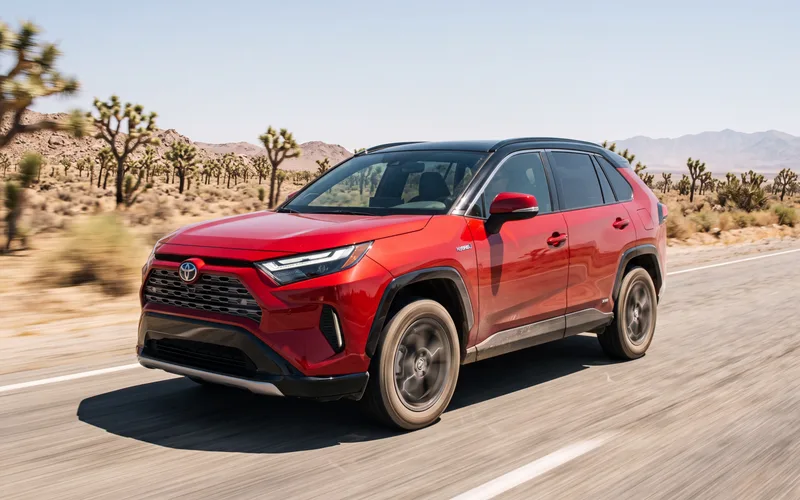 Toyota RAV4Compact SUVBetter at: Fuel economy and resale
If the CX-5's 26 MPG and 54% resale are what give you pause, the hybrid-only RAV4 answers both at once with 41-plus MPG combined and class-best value retention.
Compare 2.13C
2.13C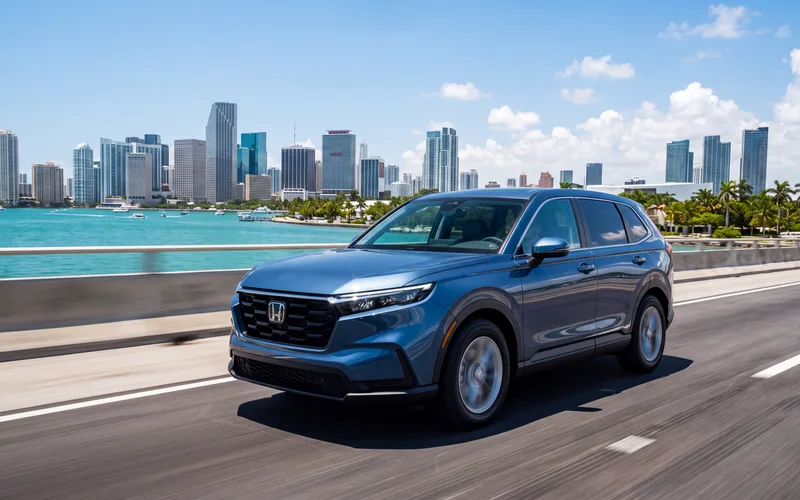 Honda CR-VCompact SUVBetter at: Hybrid efficiency
The CR-V matches the CX-5 on price and practicality while adding a 40-MPG-city hybrid option, more cargo room, and physical climate controls the redesigned Mazda gave up.
Compare 2.40C+
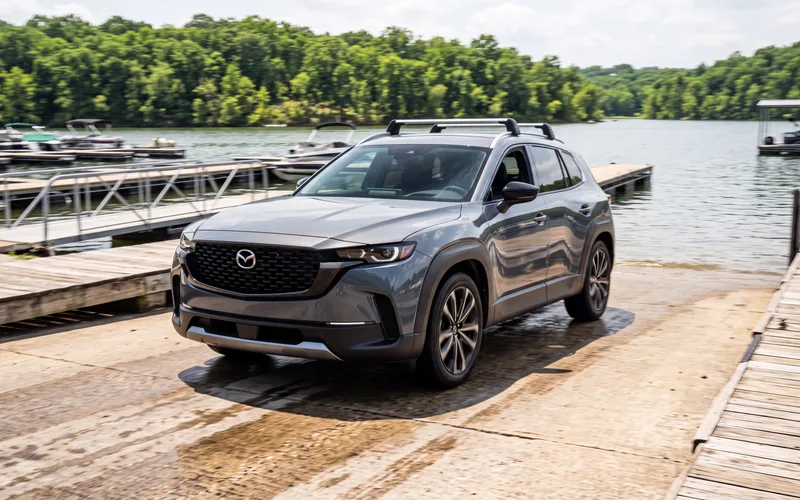 Mazda CX-50Compact SUVBetter at: Powertrain choice
Stay with Mazda's driving feel and interior quality but get the powertrain breadth and genuine dirt-road capability the 2026 CX-5 no longer offers.
CompareHow it's evolved
10 scored model years · 2017–2026
Subject scores by year
Hover or tap a score to see what moved it versus the year before. A corner mark flags a big swing.
| Year | Performance | Efficiency | Safety | Space | Cost | Reliability | Tech | Use-case | Driving | Value |
|---|---|---|---|---|---|---|---|---|---|---|
| 2026 | 31 | 55 | 77 | 55 | 63 | 75 | 77 | 63 | 73 | 70 |
| 2025 | 32 | 50 | 68 | 51 | 69 | 83 | 52 | 60 | 76 | 69 |
| 2024 | 34 | 64 | 75 | 51 | 66 | 82 | 56 | 60 | 79 | 73 |
| 2023 | 33 | 55 | 75 | 50 | 66 | 83 | 54 | 60 | 75 | 73 |
| 2022 | 33 | 55 | 74 | 50 | 68 | 77 | 54 | 60 | 75 | 73 |
| 2021 | 33 | 55 | 76 | 48 | 68 | 72 | 52 | 59 | 74 | 76 |
| 2020 | 32 | 55 | 77 | 48 | 67 | 68 | 41 | 58 | 75 | 76 |
| 2019 | 36 | 55 | 76 | 48 | 68 | 63 | 41 | 58 | 74 | 78 |
| 2018 | 29 | 56 | 74 | 47 | 70 | 62 | 34 | 57 | 74 | 77 |
| 2017 | 29 | 54 | 57 | 47 | 73 | 73 | 34 | 56 | 74 | 71 |
Compare two years
Best fit & conditions
Higher scores mean a better fit for that use case. Learn more about use-case fit →
Subject profile
Trims & configurations
5 trimsScores above reflect the volume trim. Per-trim specs and scores are rolling out — the full lineup:
Academic Probation · NHTSA safety recalls
No NHTSA safety recall is on record for the 2026 Mazda CX-5. Other model years of the CX-5 have 4 — listed below.
4 recalls on other model years of the CX-5 (2017–2019)
Nov 12, 2021Fuel system, gasoline: delivery: fuel pumpThe impeller inside the low-pressure fuel pump may crack and deform, potentially causing the fuel pump to fail.
Defect
Mazda North American Operations (Mazda) is recalling certain 2018 Mazda3, Mazda6, 2019 CX-3, 2018-2019 MX-5, CX-5, CX-9, and 2019-2020 Mazda2 vehicles. The impeller inside the low-pressure fuel pump may crack and deform, potentially causing the fuel pump to fail.
Risk
Fuel pump failure may cause an engine stall, increasing the risk of a crash.
Remedy
Dealers will replace the fuel pumps, free of charge. Owner notification letters were mailed July 18, 2022. Owners may contact Mazda customer service at 1-800-222-5500 Option 4. Mazda's number for this recall is 5321K.
NHTSA campaign 21V875000 ↗Manufacturer no. 5321K121,038 vehicles potentially affected (all models in the campaign)Owners notified Jul 18, 2022Filed by Mazda North American OperationsFiled as CX-5Jun 27, 2019Engine · Power train: automatic transmission: control module (tcm/pcm/tecm)A software error in the powertrain control module (PCM) may cause the engine to stall.
Defect
Mazda North American Operations (Mazda) is recalling certain 2018-2019 CX-5, Mazda6, and 2019 Mazda3 vehicles. A software error in the powertrain control module (PCM) may cause the engine to stall.
Risk
An unexpected stall increases the risk of a crash.
Remedy
Mazda will notify owners, and dealers will reprogram the PCM software, free of charge. The recall began August 20, 2019. Owners may contact Mazda customer service at 1-800-222-5500, option 4. Mazda's number for this recall is 3719F.
NHTSA campaign 19V497000 ↗Manufacturer no. 3719F262,220 vehicles potentially affected (all models in the campaign)Owners notified Aug 20, 2019Filed by Mazda North American OperationsFiled as CX-5Jun 25, 2018Air bags: side/windowIn the event of a side impact or rollover crash, the side curtain air bags may not properly unfold during deployment. As such, these vehicles fail to comply with the requirements of Federal Motor Vehicle Safety Standard (FMVSS) number 226, "Ejection Mitigation."
Defect
Mazda North American Operations (Mazda) is recalling certain 2018 Mazda CX-5 vehicles. In the event of a side impact or rollover crash, the side curtain air bags may not properly unfold during deployment. As such, these vehicles fail to comply with the requirements of Federal Motor Vehicle Safety Standard (FMVSS) number 226, "Ejection Mitigation."
Risk
If the air bags do not deploy properly in a crash, it can increase the risk of injury.
Remedy
Mazda will notify owners, and dealers will replace the curtain air bags, free of charge. The recall began July 31, 2018. Owners may contact Mazda customer service at 1-800-222-5500, Option 4. Mazda's number for this recall is 2718F.
NHTSA campaign 18V426000 ↗Manufacturer no. 2718F682 vehicles potentially affected (all models in the campaign)Owners notified Jul 31, 2018Filed by Mazda North American OperationsFiled as CX-5Nov 21, 2017Electrical system: wiring · Trailer hitchesThis harness may be routed such that there is insufficient clearance between the harness and the exhaust muffler, allowing the wiring harness to contact the muffler.
Defect
Mazda North American Operations (Mazda) is recalling certain 2017 CX-5 vehicles equipped with an accessory trailer hitch wiring harness. This harness may be routed such that there is insufficient clearance between the harness and the exhaust muffler, allowing the wiring harness to contact the muffler.
Risk
Contact with the muffler may damage the trailer wiring harness, potentially resulting in the trailer lighting being inoperative, thereby increasing the risk of a crash.
Remedy
Mazda will notify owners, and dealers will reroute the trailer hitch harness away from the muffler, replacing the harness if it is damaged, free of charge. The recall is expected to begin January 20, 2018. Owners may contact Mazda customer service at 1-800-222-5500. Mazda's number for this recall is 1617K.
NHTSA campaign 17V744000 ↗Manufacturer no. 1617K1,076 vehicles potentially affected (all models in the campaign)Owners notified Jan 22, 2018Filed by Mazda North American OperationsFiled as CX-5
Source: NHTSA Office of Defects Investigation recall database, model years 2017–2026. Recalls are listed by model year as the manufacturer filed them; whether a specific car is affected depends on its VIN — check a VIN at nhtsa.gov ↗. NHTSA model names matched to this page: CX-5.
Detailed scoring by subject
1Performance & PowertrainThe CX-5's lowest-graded category.0.01F
The all-new third-generation 2026 CX-5 launches in the US with a single naturally aspirated 2.5L Skyactiv-G four rated at 187 hp @ 6,000 rpm; the 227/256 hp 2.5 Turbo of the outgoing generation is discontinued, so this is the lineup maximum rather than a volume-trim figure. That sits near the bottom of the 150–550 hp SUV normalization band.
Peak torque of 185 lb-ft arrives high at 3,300 rpm, typical of a naturally aspirated four and well short of turbo rivals such as the CX-50 2.5T or the outgoing CX-5 Turbo (310–320 lb-ft). Low in the 130–500 lb-ft SUV band.
Instrumented tests of the mechanically similar 187-hp 2.5 NA CX-5 ran roughly 8.3–8.6 s to 60 mph; the third-generation car is longer and heavier on the same output, so mid-to-high 8s is the realistic figure. No instrumented test of the new generation was available to confirm.
The naturally aspirated 2.5 is a refinement strength in isolation — linear, lag-free throttle response and a clean, unobtrusive idle, with none of the turbo step or hybrid handoff coarseness that afflicts rivals. It is let down by outright thrust: with only 187 hp hauling a larger body, the engine has to be worked hard and gets vocal on grades and highway merges.
Mazda sticks with a conventional torque-converter Skyactiv-Drive automatic rather than a CVT, and it is a genuine segment differentiator: crisp, quick, decisive shifts with sensible ratio selection and a competent manual mode, and none of the drone that dogs the CR-V, Rogue, and Forester. The main knock is that six ratios is fewer than most rivals' eight, which costs a little highway relaxation and top-gear flexibility.
The CX-5 is rated at 2,000 lbs — enough for a small utility trailer, a pair of jet skis, or a light popup, but far short of the 3,500 lbs a RAV4, Sportage, or Tucson offers. Low in the 1,000–8,000 lbs SUV band, though still above the CR-V's 1,500 lbs.
i-Activ AWD is offered across the trim range and is one of the more sophisticated on-road systems in the class — it reads a wide sensor set including wiper and steering activity to pre-emptively shift torque rearward before slip occurs, and pairs with G-Vectoring Control Plus. What it lacks is any low range, locker, or multi-terrain mode suite, so it is a foul-weather traction system rather than a capability system.
The CX-5 is the road-biased half of Mazda's compact pair — the CX-50 is the one built on a wider track with raised ride height and off-road hardware. The CX-5 gets class-typical clearance (7.6 in on the outgoing generation), an Off-Road drive mode within Mi-Drive, and street tires, with no skid plates, no locker, no low range, and no dedicated rugged trim. Gravel roads and unplowed driveways, not trails.
The weakest point of the new CX-5's performance case: one engine, one transmission, no electrified option. Dropping the 2.5 Turbo removed the only performance step-up, and Mazda's Skyactiv-Z hybrid is a later addition rather than a 2026 offering — so a buyer cross-shopping RAV4 (gas/hybrid/PHEV) or Tucson (gas/hybrid/PHEV) has no electrified CX-5 to choose.
2Efficiency & RangeOne of the CX-5's weakest categories.1.69D
The all-new third-generation 2026 CX-5 carries over the 187-hp 2.5L Skyactiv-G and 6-speed automatic with standard i-Activ AWD, so combined economy should track the outgoing 2.5 NA AWD's 26 MPG; the larger, slightly heavier body is offset by improved aerodynamics. That is low-to-mid in the 18–45 MPG SUV band and well behind every hybrid-equipped compact rival.
City economy is the weak point of Mazda's naturally aspirated 2.5 paired to a torque-converter 6-speed with no hybrid assist, landing near the bottom of the 16–48 MPG SUV band. Hybrid compact SUVs (CR-V 40, RAV4 45, Tucson Hybrid 38) are roughly 60% better in the city.
Highway is the CX-5's relatively stronger figure — tall 6-speed gearing and the new generation's cleaner aerodynamics keep it near 30 MPG, mid-band for the 20–42 MPG SUV range and competitive with non-hybrid rivals (Tucson 2.5 AWD 30, Forester 33) even though hybrids still lead.
A roughly 14.8-gallon tank at 26 MPG combined yields about 385 miles of range — below the midpoint of the 230–600 mi SUV band and short of hybrid compact SUVs that clear 500 miles (CR-V Hybrid ~560, RAV4 ~594) on a smaller tank.
At EPA standard assumptions the CX-5 burns about 577 gallons a year, landing near $2,250 — costly for a compact SUV within the $700–$3,200 band and roughly $550/yr more than a CR-V Hybrid or $700/yr more than a RAV4. Consistent with the Hyundai Tucson 2.5 AWD, which draws the same figure off an identical 26 MPG combined rating.
With the 2.5 Turbo gone, the 2026 CX-5's sole engine is the naturally aspirated 2.5L Skyactiv-G, which runs on regular 87-octane unleaded with no premium recommendation and no special energy needs — the cheapest, simplest fuel situation available, matching the CR-V, Forester and Tucson at 90.
3SafetyThe CX-5's best-graded category.3.25B+
The CX-5 is all-new for 2026 on a longer-wheelbase platform and has no published NHTSA overall rating yet. The outgoing KF-generation CX-5 (2017-2025) held a 5-star overall rating every year it was tested, and Mazda's US lineup has been uniformly 5-star overall, so that result is carried forward with reduced confidence.
The redesigned 2026 CX-5 has not been through the IIHS program yet. The prior generation was a Top Safety Pick with Good ratings in small-overlap driver/passenger, the updated side test, roof strength and head restraints, but only Acceptable in the updated moderate-overlap test that grades rear-occupant protection — enough for TSP, short of TSP+. Mazda's consistent crashworthiness record supports a similar or slightly better result, but nothing is confirmed for the new structure.
i-Activsense is standard on every CX-5 trim including the base S Select, bundling Smart Brake Support (AEB with pedestrian detection), Mazda Radar Cruise Control with Stop & Go, lane departure warning and lane keep assist, blind spot monitoring, rear cross traffic alert, driver attention alert and high beam control. Making blind-spot and full-speed adaptive cruise standard on the cheapest trim is the top band for this item; the deduction is for the 360-degree camera and the more advanced highway assist remaining upper-trim items.
Smart Brake Support handles vehicle-to-vehicle and daytime pedestrian scenarios well, but the prior-generation CX-5 did not reach the top tier in the tougher combined day/night pedestrian front-crash-prevention evaluation, and the 2026 sensor set has not been independently tested. Solid rather than class-leading.
Blind spot monitoring and rear cross traffic alert are standard on every trim rather than optional or upper-trim-locked, which is unusual in the mainstream compact SUV class, and the redesign adds front cross traffic coverage. Coverage is alert-based with braking intervention limited to the rear-crossing function, so it stops short of the fully active top band.
Lane departure warning and lane keep assist are standard, and Cruising & Traffic Support adds lane centering on higher trims. Mazda's lane keep assist has historically been more of a corrective nudge than continuous centering, and true centering is not available on the volume lower trims — competent, not confidence-inspiring enough for the top band.
Mazda Radar Cruise Control with full-speed stop-and-go is standard on every trim and is consistently praised for natural spacing and smooth resume; Cruising & Traffic Support layers on lane centering for a genuine highway assist on upper trims. Falls short of the very top because the combined highway assist is not standard fleet-wide.
Mazda offers no hands-free highway driving system on any US model, and the 2026 CX-5 is no exception — there is no BlueCruise, Super Cruise or equivalent, and Cruising & Traffic Support requires hands on the wheel. The prior placeholder score of 68 was incorrect.
LED headlights with automatic high beam control are standard across the range and the outgoing CX-5 earned acceptable-or-better IIHS headlight ratings on every trim, which is what its Top Safety Pick award required. Adaptive front lighting that swivels with steering remains an upper-trim item, and the 2026 units are untested.
Forward sightlines are good thanks to a low cowl and slim A-pillars, but Mazda's styling gives the CX-5 a rising beltline and thick rear roof pillars that pinch the over-the-shoulder and rear three-quarter view. The 360-degree View Monitor that would compensate is not available on the volume lower trims, leaving the base car with only a reversing camera.
The 2026 redesign stretches the wheelbase and rear-door aperture, which makes loading a rear-facing seat easier than in the outgoing car, and there are two sets of lower anchors plus three top tethers. Anchors still sit in the seat bight and require digging, and a compact SUV's rear bench remains tight for three seats across.
4Space & ComfortOne of the CX-5's weakest categories.1.72C-
The third-generation CX-5 remains a strictly two-row, five-seat compact SUV across every US trim; Mazda's three-row offerings are the CX-70/CX-90. Replaces a placeholder value of 6.9 seats that was not a real configuration.
The all-new 2026 CX-5 grew roughly 15 mm in overall height with a more upright greenhouse, so front headroom should edge above the outgoing KF-generation figure. Estimated pending confirmation against Mazda's US spec sheet.
The 2026 redesign's ~115 mm wheelbase stretch is directed largely at the second row, so front legroom improves only modestly over the previous generation. Estimated pending confirmation.
Rear headroom was already a strong point for the CX-5 and the taller third-generation body should hold or slightly improve it. Estimated pending confirmation.
Second-row space is the headline gain of the 2026 redesign — the ~115 mm (4.5 in) longer wheelbase is spent primarily on rear knee room, moving the CX-5 from mid-pack toward the top of the compact-SUV class. Estimated pending confirmation.
The CX-5 has no third row in any trim or model year, including the 2026 redesign, so it scores in the bottom band by definition rather than being omitted.
Cargo capacity behind the second row rises substantially with the 2026 redesign — Mazda cited a large boot-volume increase over the outgoing car — bringing the CX-5 much closer to compact-SUV leaders like the CR-V. Estimated pending confirmation of the US SAE figure.
Maximum volume with the 60/40 rear bench folded improves with the longer, taller third-generation body, but a two-row compact SUV still sits near the bottom of a band calibrated across all SUV sizes. Estimated pending confirmation.
Competent everyday storage — larger center console and door bins than the outgoing car, wireless charging pad, and a flat-folding 60/40 rear bench — but no standout innovation such as an underfloor bin, sliding console, or onboard power export.
Front seats are a consistent CX-5 strength — Mazda's spine-neutral seat design draws repeated praise for long-haul support — and the 2026 car's extra rear legroom finally makes the back bench genuinely adult-friendly rather than merely adequate.
The CX-5 has always traded a little compliance for body control, and the redesign softens the primary ride without abandoning that character; sharp urban impacts still register more than in a CR-V or Tiguan.
NVH is a deliberate focus of the third-generation car, building on a predecessor already regarded as quieter than mainstream compact-SUV norms; the naturally aspirated 2.5L four is coarse only under hard acceleration.
Dual-zone automatic climate, rear vents, heated front seats and a heated wheel are widely available with ventilated fronts on upper trims — but migrating climate functions into the new 15.6-inch touchscreen costs some day-to-day usability versus physical controls.
5Cost of OwnershipMid-pack among this car's ten categories.2.26C
The all-new third-generation CX-5 grows in size and adds a much larger standard infotainment system, so it opens above the outgoing generation's ~$31k entry point, but Mazda continues to price the CX-5 as a mainstream volume play rather than a near-luxury one. At roughly $32,500 delivered it lands mid-pack — a little above the CR-V LX ($32,315) and below the RAV4 LE ($33,350), and notably it includes i-Activ AWD where those two base figures are front-drive.
The S Preferred has historically been the CX-5's volume seller — it adds heated seats, power liftgate and upgraded audio without reaching Premium money — and should land near $35,000 delivered on the new platform. That undercuts the CR-V EX-L ($36,850) and RAV4 XLE Premium ($38,950) while sitting above the Tucson SEL ($34,000) and Sportage EX ($33,700).
The CX-5's running-cost case rests on mechanical simplicity: a naturally aspirated 2.5 with no turbocharger, no hybrid system and a conventional torque-converter automatic instead of a CVT, which removes the three components that drive most out-of-warranty repair spend in this class. That should place it at or slightly below the RAV4 and Forester (~$5,200) and clearly under the turbocharged CR-V (~$5,800) and Sportage (~$6,100).
This is the category's weak point and its heaviest-weighted item. Mazda residuals are respectable and beat the Korean pair (~53%), but they sit far behind the class outliers — RAV4 (~69%) and CR-V (~68%) — and the 2026 car carries a specific headwind: it launches with no hybrid at all in a compact-SUV market where electrified variants increasingly set used-market demand, and it loses the Turbo that anchored the top of the range.
Mazda offers the industry-baseline 3-year/36,000-mile bumper-to-bumper term — the floor of the 3–5 year normalization band, so it scores zero. It matches Toyota, Honda and Subaru but is a full two years short of the Hyundai and Kia 5-year/60,000-mile coverage that sets the compact-SUV benchmark.
Mazda's 5-year/60,000-mile powertrain term is likewise the baseline and the bottom of the 5–10 year band. With no hybrid or EV components in the 2026 CX-5 there is no supplementary 8-year/100,000-mile electrified-component coverage of the kind that accompanies the CR-V, RAV4 and Forester hybrids, so this is the whole of the long-term mechanical protection.
Mazda bundles complimentary scheduled maintenance for 2 years/24,000 miles with 3 years/36,000 miles of roadside assistance and a Mazda Connected Services trial — a real, if short, included-service package covering the first few visits. That places it above rivals with no included maintenance at all (CR-V and Forester at 55, Sportage at 50) and essentially level with ToyotaCare on the RAV4 (75), while remaining well short of Hyundai's 3-year/36,000-mile program (90).
$35,000 volume-trim price minus its estimated resale value after 5 years (54% retained, or about $18,900) leaves about $16,100 in depreciation. Add the projected $5,000 in 5-year maintenance and repairs, and owning this vehicle for 5 years costs about $21,100 in total.
6Reliability & QualityOne of the CX-5's strongest categories.3.09B
Two forces pull against each other here. The CX-5 nameplate has one of the better predicted-reliability records in the compact class and Mazda's brand-level standing is strong, but 2026 is the first model year of an all-new third generation — there is no owner data for this platform, and Consumer Reports treats a fully redesigned model as insufficient-data, predicting from brand history rather than the car itself. The powertrain is a deliberate de-risking (carryover 2.5 NA and 6-speed automatic), so the exposure is concentrated in the new platform, body and electronics rather than the drivetrain. That lands it above average but well short of the settled-design leaders.
The two major studies disagree on Mazda, which caps this just under the top-5 band. Consumer Reports has repeatedly placed Mazda in the top tier of its brand predicted-reliability rankings, including a first-place finish and several top-three showings, while J.D. Power's Vehicle Dependability Study has consistently had the brand only around mid-pack. Strong on the CR side, unremarkable on the JDP side. Scored identically to the Mazda3 in this dataset, as it is a brand-level rather than model-level judgment.
An all-new generation has no recall or TSB record to credit — and an unearned clean sheet is not the same as a proven one, so this sits in the typical band rather than the 80+ band. The second-generation CX-5 set a genuinely light precedent, with its largest exposure being the cross-industry Denso low-pressure fuel-pump campaign rather than any design flaw of its own, and Mazda's overall campaign rate is low. Against that, first-year-of-production vehicles reliably generate above-average early campaigns and software TSB traffic, and the 2026 car introduces an entirely new infotainment stack — historically Mazda's densest source of bulletins.
This is the strongest card in the category and the reason the first-year-redesign risk stays contained. The 2.5L Skyactiv-G (PY-series) has been in continuous production since 2012 with a 200,000-mile-plus reputation, and it is paired with the conventional Skyactiv-Drive six-speed torque-converter automatic — so the 2026 CX-5 carries neither a CVT, a dual-clutch, a turbocharger, nor a hybrid system, removing every high-risk driveline component that the CR-V, RAV4, Rogue, Forester and Sportage each carry in some form. Dropping the 2.5 Turbo narrows the lineup but also removes its boost-related wear exposure. Held below 90 only by long-standing owner complaints about cylinder deactivation on the 2.5 NA.
Cabin material quality is Mazda's signature advantage and the CX-5 has held the class benchmark for it across generations, routinely described as closer to entry-luxury than to mainstream — broad soft-touch coverage, well-damped switchgear and restrained trim detailing at a price where rivals default to hard plastic. The third generation moves further upmarket still. Scored a point under the Mazda3 (88) because a compact SUV's cargo area, lower doors and rear cabin carry more unavoidable hard plastic than that car's tighter passenger box.
Mazda's physical assembly is a genuine strength — tight, consistent panel gaps and a solid, rattle-free structure are recurring notes on Hiroshima-built cars. Two things hold this below the Mazda3's 80. First-year-of-production for an all-new body is precisely when assembly variance peaks, before line tolerances settle. And Mazda's below-average J.D. Power Initial Quality Study placement, widely attributed to infotainment and controls complaints rather than build defects, is likely to worsen before it improves given the 2026 car's brand-new and much larger screen interface.
Network density is the clearest ownership weakness and it is brand-level, so it applies to the CX-5 exactly as to the Mazda3. Mazda operates roughly 560 US dealers against about 1,200-plus for Toyota and roughly 1,000 for Honda, leaving thin coverage across rural and smaller-metro markets — a buyer outside a major metro can face a materially longer drive for warranty work than a RAV4 or CR-V owner. Service satisfaction itself sits near the mainstream average and the Retail Evolution program has improved facility quality, but coverage is what sets the score.
Routine running costs are genuinely low — RepairPal's average annual repair-and-maintenance estimate for the CX-5 sits in the mid-$400s, under both the compact-SUV and all-vehicle averages — and as Mazda's US volume leader the CX-5 supports the deepest parts ecosystem in the brand's lineup. Two things keep it in the normal band rather than the 80+ band: Mazda's US volume is still a fraction of Toyota's or Honda's, so the aftermarket catalogue is thinner and some components remain effectively dealer-only, and the 2026 redesign resets that clock — third-generation body panels, lighting and trim have no aftermarket equivalents and no salvage supply at all in year one, making collision parts slower and dearer than the nameplate's long-run record suggests.
7Technology & InfotainmentOne of the CX-5's strongest categories.3.20B+
The all-new third-generation CX-5 replaces the outgoing 10.25-inch Commander-controlled display with a 15.6-inch touchscreen fitted as standard across the range — the largest screen in the mainstream compact-SUV class and above the top of the 7–15.5 in SUV normalization band, so the computed spec score clamps at 100.
The new Google built-in stack is a generational leap over Mazda Connect — a real touchscreen at any speed, modern graphics and app support, replacing a system whose touch input was locked out while driving. Two things keep it out of the 80s: Mazda deleted the rotary Commander dial and migrated climate and most secondary functions into the screen, a usability step backward for a brand that built its reputation on physical controls, and a first-year software stack in a class where Hyundai/Kia ship mature ones.
Wireless Apple CarPlay and wireless Android Auto are standard across the lineup, including the base trim — top-band coverage with no trim gate. Held just below the 90s only because projection now competes with the native Google apps rather than being the obvious default.
Google built-in supplies Google Assistant natural-language voice and Google Maps as the native navigation — genuinely best-in-class embedded maps with live traffic, and a decisive upgrade on the outgoing car's TomTom-based nav and command-word voice system. Short of the top of the band because the Google services depend on data connectivity that reverts to a paid subscription after the included trial.
A multi-speaker Bose premium system is available on upper trims and is a clear step up from the standard setup, but Bose in Mazda applications reads as good-not-exceptional against segment rivals, and the base system is merely adequate. Solidly mid-band rather than a reason to choose the car.
The third-generation redesign replaces the second-gen part-analog cluster (7-inch TFT flanked by physical dials) with a fully digital driver display of roughly 10 inches, standard on the volume trim. Rated just below the top band because Mazda's digital clusters run conservative on configurability rather than offering the layered layouts of Hyundai/Kia or VW.
The Google built-in architecture brings over-the-air updating to the CX-5 for the first time — infotainment, apps and map data refresh without a dealer visit, where the outgoing car needed USB or service-lane updates. It sits in the middle band rather than the top because there is no evidence Mazda pushes whole-vehicle OTA that adds functions beyond the infotainment domain, the way Tesla, Rivian or Ford do.
The MyMazda app covers the core set — remote start, lock/unlock, vehicle locate and status, scheduling — but it is subscription-gated after the included Connected Services trial, offers no phone-as-key on the CX-5, and has drawn persistent owner complaints about sluggish command response. Mid-band: functional, not a selling point.
The redesigned cabin moves to USB-C for front and rear device charging with wireless phone charging available on upper trims — resolving the outgoing car's dated USB-A layout. Kept in the upper-middle band because there is no household AC outlet or onboard power provision, and wireless charging is not standard on the volume trim.
Advanced Keyless Entry with push-button start is standard on the volume trim and app-based remote start is available through Connected Services, but the power liftgate is a trim-walk item rather than standard, hands-free operation is limited to upper grades, and Mazda offers no phone-as-key on this vehicle. Comfortably mid-band.
A rear camera is standard and the 360-degree View Monitor with front and rear parking sensors is available on upper trims, with image quality improving on the new high-resolution 15.6-inch display. Held to the middle band because surround view is not reachable on the volume trim and Mazda offers no automated parking assist in this class.
Mazda's windshield-projected Active Driving Display is one of the better mainstream HUDs — full color, projected onto the glass rather than a pop-up combiner, with navigation and driver-assist prompts — and Mazda fits it broadly across the CX-5 range rather than reserving it for the flagship. Just short of the top band because the volume base grade is the likeliest place for it to be omitted.
8Use-Case FitMid-pack among this car's ten categories.2.25C
The all-new 2026 third generation stretches the wheelbase and rear doors, delivering roughly 41 in of rear legroom and a low, flat ~37 cu ft cargo hold that swallows a stroller upright — genuinely easy family logistics. It falls short of segment-benchmark territory because LATCH access is merely competent rather than best-in-class and the second row is a conventional 60/40 bench with no sliding or 40/20/40 flexibility.
Mazda makes the full i-Activsense suite — AEB with pedestrian detection, blind-spot monitoring, rear cross-traffic alert, lane-keep assist and radar cruise with stop-and-go — standard on the ~$32.5k base 2.5 S Select, so families do not have to climb trims to get the safety content. It is held under 80 only because the redesigned body has not yet been crash-tested by IIHS or NHTSA, so the 5-star rating carried in the record belongs to the prior generation.
Quiet, well-damped and well-seated for four adults over multi-hour stints, with rear vents, rear USB-C power and — unusually for the class — enough cargo room behind an occupied second row for a family's weekend luggage. Rear amenities stop there: no rear-seat entertainment, and heated rear seats are a top-trim item.
Light, precise steering, an unusually smooth-shifting conventional 6-speed automatic and standard stop-and-go adaptive cruise make this a low-fatigue commuter, and the new 15.6-in touchscreen finally works by touch at speed instead of forcing the old rotary-dial workflow. The 187-hp naturally aspirated 2.5 in a heavier body means merges and on-ramps need real throttle, and outward visibility is only average.
26 MPG combined on regular unleaded works out to roughly $2,250 a year at 15,000 miles — acceptable in isolation, but the 2026 compact-SUV field is defined by hybrids in the high 30s, and Mazda offers no electrified CX-5 for this model year. Cheap consumables and moderate insurance keep it out of the bottom band.
The third generation grew in every direction and now sits at the large end of the compact-SUV class, so tight garages and parallel spots take more care than they did in the outgoing car. Cameras and sensors are competent but a 360-degree view is reserved for upper trims, and the rising beltline and thick rear pillars limit over-the-shoulder vision.
A 2,000-lb tow rating properly equipped edges past the CR-V but is still only enough for a small utility or landscape trailer, and the 187-hp naturally aspirated engine works hard under any real load. There is no bed, no meaningful payload headroom and no work-oriented drivetrain option — the flat ~37 cu ft cargo bay is the only genuinely useful work asset.
The naturally aspirated Skyactiv-G 2.5 and torque-converter 6-speed are among the longest-proven, least-stressed powertrains in the segment, and Mazda's reliability record is strong — this will take years of hard commuting. It is not a work vehicle by design, though: soft-touch, light-colored premium interior surfaces and no fleet or commercial presence mean it wears rather than shrugs off jobsite abuse.
Provisions amount to cargo-area tie-down hooks, a 12V socket, USB-C ports and dealer-accessory roof rails and a hitch — there is no 110V household outlet, no washdown surfaces and no upfit ecosystem to speak of. The carpeted cargo floor and premium trim actively discourage dirty loads.
Quiet at speed, comfortable in the front seats over long stints and good for roughly 385 miles between fills, with standard stop-and-go radar cruise and lane centering doing real work on interstate slogs. It stops short of the top band because 30 MPG highway is mid-pack, there is no hands-free assist, and lane centering is competent rather than polished.
i-Activ AWD is standard on every US trim — a real advantage over rivals that charge for it — and with roof rails, flat-folding rear seats and a 2,000-lb rating for a small trailer, gravel roads, trailheads and bike racks are all well within reach. Modest ground clearance, road-biased tires and the absence of a 110V camp outlet keep it firmly in the soft-roader bracket, well behind its own CX-50 sibling.
The redesign's biggest practical win: cargo behind the rear seats jumped to roughly 37 cu ft on a low, flat, wide floor with underfloor storage, expanding to about 65 cu ft folded — enough for bulky gear that would not fit the outgoing car. Held below the top band by a plain 60/40 split with no 40/20/40 pass-through and roof rails that are not standard on the base trim.
9Driving ExperienceGrades above the middle of the scale.2.97B-
Chassis dynamics are the CX-5's reason to exist and the clearest gap between it and the rest of the mainstream compact-SUV field: tightly controlled body motions, honest turn-in, and G-Vectoring Control Plus metering weight transfer mid-corner. The third-generation car stretches the wheelbase ~115 mm and softens primary ride slightly in pursuit of refinement, so it is a shade more mature and less darty than the outgoing KF, but it remains the class handling benchmark — clearly ahead of the CR-V (70) and a full tier above the Tucson/Sportage/Rogue cluster (60–63). Held below the 80+ band because it is a 187-hp, all-season-tired crossover on a taller body, not a genuine sport SUV.
Steering is Mazda's signature and the single most consistently praised aspect of the CX-5 — quick and linear just off-center, naturally weighted as lock builds, and communicative in a way no mainstream compact-SUV rival matches. It sits at the bottom edge of the top band rather than at the Mazda3's level because the taller body, higher seating position and heavier front end blunt some of the sedan's directness.
Firm, progressive pedal travel that is easy to modulate is a durable Mazda trait and better than the soft, long-travel pedals common in the class, and with no hybrid system there is no regen handoff to blend. Kept in the upper half of the adequate band rather than the 80+ band because no instrumented 70–0 mph test of the third-generation car was available and the volume trim rides on all-season rubber under a heavier body than the outgoing CX-5.
Mazda's refusal to fit a CVT is a real drivability advantage: the Skyactiv-Drive torque-converter six shifts crisply and decisively with sensible ratio choices, and the naturally aspirated 2.5 delivers honest, lag-free tip-in with no turbo step and no hybrid mode-change shunt. What holds it to the mid-70s is thrust rather than polish — 187 hp and 185 lb-ft peaking at 3,300 rpm in a longer, heavier body means the engine is worked hard on merges and grades, and six ratios is fewer than most rivals' eight.
The geared automatic sidesteps the sustained high-rpm drone that penalizes nearly every rival in this segment — the CVT and eCVT cars here score 50–64 on this item almost entirely for that reason — and the third generation continued Mazda's NVH push with added insulation and a stiffer body. It is inoffensive rather than pleasant: with only 187 hp hauling a larger car, the 2.5 gets coarse and vocal near redline more often than the same engine does in a Mazda3.
The outgoing KF-generation CX-5 turned in a published 36.1 ft curb-to-curb, but the third-generation car stretches its wheelbase roughly 115 mm (2,700 → ~2,815 mm), which at an unchanged steering lock works out to about 37.5 ft. Estimated at 37.4 ft — mid-pack for the segment and essentially level with the CR-V's 37.3 ft. Replaces a placeholder value of 39 ft that was not sourced from any Mazda figure.
The fundamentals are excellent and remain a Mazda strength — a low cowl and driver-oriented dash, well-shaped spine-neutral seats that draw repeated long-haul praise, generous tilt-and-telescope range, and a widely fitted windshield-projected head-up display. Two things keep it just below the segment leaders: the 2026 redesign deletes the rotary Commander controller and migrates climate and most secondary functions into the 15.6-inch touchscreen, a genuine day-to-day usability regression for a brand built on physical controls, and the CX-5's high beltline and thicker pillars give away outward visibility to the airier CR-V, Forester and Tucson.
In a segment where almost everything is an appliance, the CX-5 is the one enthusiasts actually recommend — the steering and chassis reward deliberate driving and give it a sense of occasion no Tucson or Rogue can approach. For 2026 it is materially less fun than it was, though: dropping the 2.5 Turbo removes the only quick CX-5 and leaves a single 187-hp naturally aspirated engine good for roughly 8.7 s to 60 mph, so the chassis is now permanently better than the engine feeding it. Top of the pleasant band rather than the genuinely-fun 80s.
10Value & Market PositionGrades above the middle of the scale.2.72B-
The third-generation CX-5 opens strong for a mainstream compact SUV: i-Activ AWD is standard on every US trim (both the CR-V LX and RAV4 LE are front-drive at their base prices), the full i-Activsense driver-assist suite including blind-spot monitoring and rear cross-traffic alert is standard where Honda still withholds BSM/RCTA on the LX, and the new generation makes a large center touchscreen with Google built-in standard rather than a mid-trim upgrade. It falls short of the 80+ band because comfort content — heated seats, power liftgate, upgraded audio — still waits for the S Preferred step, which is where Hyundai and Kia typically undercut Mazda at the same money.
Content-for-price is genuinely good — a near-premium cabin, standard AWD and a big-screen infotainment system for roughly $32.5K to open and ~$35K in the volume S Preferred, which undercuts the CR-V EX-L and RAV4 XLE Premium. The offsetting problem is what the money buys mechanically: the carryover 187-hp naturally aspirated 2.5 with a six-speed automatic and no hybrid option at launch means CX-5 buyers give up roughly 10+ MPG combined against the hybrid-only RAV4 and the hybrid-heavy CR-V for similar outlay, which is exactly the axis 2026 compact-SUV shoppers weigh hardest. Fair value, not a bargain.
Five well-spaced trims covering roughly $32.5K to $41K is a reasonable ladder with a clear volume rung and a genuine loaded top end, but the configuration menu behind it is thin: one engine, one transmission, and no drivetrain choice now that AWD is standard, against the CR-V's seven trims spanning two powertrains and the RAV4's broader hybrid/plug-in split. The absent hybrid — deferred to the Skyactiv-Z rollout — is the biggest gap for buyers shopping the segment on efficiency.
The CX-5 is Mazda's US volume backbone and a durable top-ten compact SUV, but it has never operated at leader scale — its annual US volume runs in the neighborhood of a third of the RAV4's and the CR-V's, and 2026 is a changeover year in which sell-down of the outgoing generation and the ramp of the new one both suppress reported volume. A steady mid-pack seller with a solid installed base, not a segment leader or a fast riser.
Mazda punches well above its market share on image — it is consistently the mainstream brand critics and enthusiasts single out for driving feel and interior execution, and its deliberate premium-adjacent positioning gives the CX-5 a favorable halo against Nissan and Mitsubishi. It stops short of the top band because Mazda's US footprint is small, its dealer network is thinner than Toyota's or Honda's, and its residual values, while healthy, trail those two benchmarks.
This is the weakest part of the CX-5's 2026 buying case: an all-new generation in its first model year is precisely when a manufacturer has no reason to discount and dealers have the least inventory depth, so buyers should expect transaction prices at or very near MSRP with little rebate or subvented-financing support. Mazda typically restores lease and APR support later in a generation's life, but 2026 shoppers are buying at the worst point in that cycle.
2026 is year one of an all-new third generation, replacing a second generation that ran nine model years (2017–2025) and had become one of the oldest core products in the segment. The new car brings a longer wheelbase, a materially larger cabin and cargo hold, and a new infotainment stack with Google built-in. Redesign risk for a 2026 buyer is essentially nil; the one caveat keeping it off a perfect score is that the Skyactiv-Z hybrid arrives after launch, so the powertrain — not the platform — will be the thing that dates this car first.
The CX-5 nameplate carries a strong critical record — the outgoing generation was repeatedly the class benchmark for steering, ride and cabin quality — and the third generation's added space and upgraded interior address its two most-cited weaknesses. Reviewers have been markedly less kind to the launch powertrain: retaining the 187-hp naturally aspirated 2.5 and six-speed automatic in a segment that has moved to hybrids reads as behind the curve, and folding climate functions into the new touchscreen drew criticism against a brand previously praised for physical controls. Well-reviewed rather than the pick of the class, and with no confirmed 2026 comparison-test wins or major awards on record for a car this new.